A Method Based on NLP for Twitter Spam detection
Ratul Chowdhury
1, Kumar Gourav Das
2, Banani Saha
3, and Samir Kumar Bandyopadhyay
4 1Department of Computer Science and Engineering, Future Institute of Engineering
and Management, Kolkata, India, [email protected]
2
Department of Computer Science and Engineering, Future Institute of Engineering
and Management, Kolkata, India, [email protected]
3Department of Computer Science and Engineering, University of Calcutta,
Kolkata, India, bsaha [email protected]
4
Department of Computer Science and Engineering, University of Calcutta,
Kolkata, India, [email protected]
Abstract
Social networking applications such as Twitter have increasingly gained significance in terms of socio-economic, political, and religious as well as entertainment sectors. This in turn, has witnessed a wide gamut of information explosion in the social networking realm that can tend to be both useful as well as misleading at the same point of time. Spam detection is one such solution that caters to this problem through identification of irrelevant users and their data. However, existing research has so far laid primary focus on user profile information through activity detection and relevant techniques that may underperform when these profiles exhibit characteristics of temporal dependency, poor reflection of generated content from the user profile, etc. This is the primary motivation for this paper that addresses the aforementioned problem of user profiles by focusing on both profile information and content-based spam detection. To this end, this work delivers three significant contributions. Firstly, exhaustive use of Natural language processing (NLP) techniques has been rendered towards creation of a new comprehensive dataset with a wide range of content-based features. Secondly, this dataset has been fed into a customized state-of-art hybrid machine learning model that has been exclusively built using a combination of both machine learning and deep learning techniques. Extensive simulation based analysis not only records over 98% accuracy but also establishes the practical applicability of this proposal by proving that modeling based on the mixed profile and content-generated data is more capable of spam detection in contrast to each of these standalone approaches. Finally, a novel methodology based on logistic regression is proposed and supported by analytical formulations. This paves the way for the custom-built dataset to be analyzed and corresponding probabilities to be obtained that differentiate legitimate users from spammers. The obtained mathematical outcome can henceforth be used for future prediction of user categories through appropriate parameter tuning for any given dataset. This makes our method a truly generic one capable of identifying and classifying different user categories.
Key-words: Twitter, Social Media, NLP, Tweet, User Categorizations and Mathematical Frame Work
Introduction
The impact of social media has brought drastic changes in the past few years in terms of socio-economic as well as organizational development. Facebook, twitter, LinkedIn are the most leading social media platform that enable users to interact with each other by both sharing, consuming information and building meaningful connection with people. As twitter data is freely available and has huge content so its derived features are very much effective for
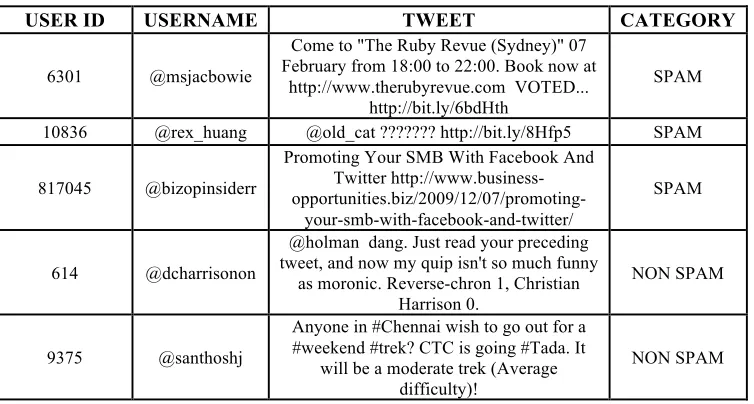
the researchers to work on various domains like spam detection, Personality identification, sarcasm detection, event detection, etc. This huge micro blogging platform has more than 313 million monthly active users tweeting around 350,000 tweets per minutes which is around 500 million tweets per day [1] Furthermore, Twitter is also infected by spammers for their private or organizational gain. Recent reports from Twitter depicts that around 9.9 million spammy twitter accounts were identified per week. Twitter spam [2] also known as unsolicited tweets contains malicious information and links. Various unfair means are used by spammers to spread their spams such as using abusive and bold languages as a reply to the users to seek attention, posting some hostile links, creating redundant profiles which can be created either by using automated tools or by manually, posting identical updates and trolling latest links to catch attention. A few spam and non spam accounts along with their respective tweets have been listed in the table1.Spam tweets often consist of Uniform resource locators (URLs) having links which are either adult contemporary or out of the context content. With the help of those URLs, spammers redirect the users to those mischievous sites which contain viruses. By using spoofing, they get personal information of the users. Spammers are adopting technologies like ‘bot’ [3-4] which automatically follows massive number of readers per day.
USER ID USERNAME TWEET CATEGORY
6301 @msjacbowie
Come to "The Ruby Revue (Sydney)" 07 February from 18:00 to 22:00. Book now at
http://www.therubyrevue.com VOTED... http://bit.ly/6bdHth
SPAM
10836 @rex_huang @old_cat ??????? http://bit.ly/8Hfp5 SPAM
817045 @bizopinsiderr
Promoting Your SMB With Facebook And Twitter http://www.business-
opportunities.biz/2009/12/07/promoting-your-smb-with-facebook-and-twitter/
SPAM
614 @dcharrisonon
@holman dang. Just read your preceding tweet, and now my quip isn't so much funny
as moronic. Reverse-chron 1, Christian Harrison 0.
NON SPAM
9375 @santhoshj
Anyone in #Chennai wish to go out for a #weekend #trek? CTC is going #Tada. It
will be a moderate trek (Average difficulty)!
NON SPAM
Table 1: Description of spam non spam tweets
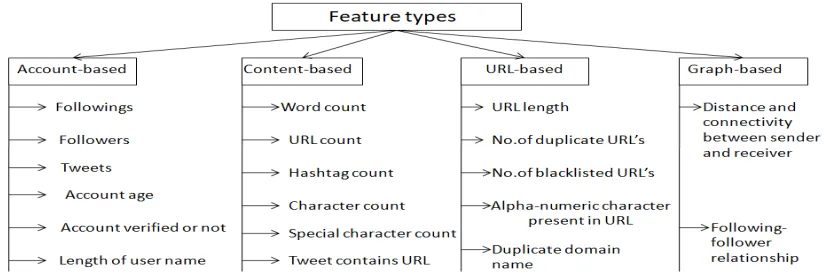
The researchers and anti-spam team of twitter are collaboratively trying to restrict the spammers on user level as well as on tweet level. Twitter has applied a branch of restrictions in recent past, it has suspended the accounts which behaves abnormally and trimmed the number of accounts that a user can follow in a day. As per the reports published in 2019 [5], a verified account can follow up to 1000 accounts per day and in case of unverified account, the count reduces to 400. Moreover, an active twitter user can follow up to 5000 accounts. For additional following, it must receive followers to a certain threshold. Researchers on the other hand are applying various content based, URL based, graph based and account based methods for spam detection [6-7]. The above methods have been further categorized into clustering, classification and hybrid problems. The various graph based, account based, content based and URL based features are listed in figure 1. Broadly, spam detection has been performed either at user level or at tweet level. Although tweet-level detection can identify spam tweets in real-time, it is increasingly difficult to capture user-level characteristics from a single tweet. On the contrary, user-level detection facilitates in providing more distinctive information of a particular user from the profile. Thus user-level detection makes it more suited to uniquely identify a legitimate user from a spammer and is therefore adopted in this paper.
been verified by various machine learning, deep learning and hybrid frameworks. So the main contributions of the paper are:
1.! Creation of a more upright dataset contains 1200 legitimate and 800 spam accounts.
2.! In tune with the previous contribution the next focus of this paper is the application of various NLP methods for feature extraction. Different novel techniques like Latent Dirichlet allocation (LDA), Latent Semantic allocation(LSA) have been used for creation of various derived features.
3.! Exhaustive investigation on the applicability of the derived feature is carried out through various machine learning, deep learning and hybrid methods. This establishes the feasibility and part superiority of the proposed methodology over and above existing methods in literature.
4.! A novel methodology based on logistic regression is further proposed and implemented on the given dataset. Subsequent analytical framework delivers corresponding probabilities for legitimate and spam users and can further be used for user categorization on any given dataset.
The rest of the paper is structured as follows, section 2 reflects the literature survey portion, section 3 describes dataset creation and preprocessing, section 4 shows the feature extraction, section 5 represents the proposed model, section 6 analyzes the results and performs various comparisons. Furthermore, section7 introduces and implements the proposed methodology for user categorization using a mathematical framework based on logistic regression. Finally, the paper is concluded in section 8.
Literature survey
In twitter environment, to broadcast an event, it is necessary to identify the relevant group of users related to that event. Twitter spam is a dispensable information or event for a particular group of user. In a report, Nexgate [8] mentioned that on an average within every 200 social media post, there is at least one spam tweet and according to [9] approximately 15% of the tweeter users are automatic bots. The demand of various social media platforms are increasing rapidly. According to the social media statistics [10] within 2020 approximately one third of the global population will be connected to social media. So spam detection and identification is an ongoing social threat.
Figure 1: Various account-based, content-based, URL-based and graph-based feature description
accuracy. Amleshwaram et al [18] presented a CATS system based on some Bait-oriented, behavioral entropy oriented, URL based and content entropy based features. Their work provides low latency and fast detection rate. In the past few years, authors have used various machine learning based approach [19-23] in spam detection. Bayesian, KNN, SVM, RF are popularly used with various derived features. Wu et al [24] presented a deep learning approach. According to the authors due to the problem of information fabrication and spam drift concept the real life spammer are not efficiently detected using traditional machine learning method.In this work the Word2vec output of the Ground-Truth twitter dataset is fed into MLP for classification. The proposed model shows above 90% accuracy. In another work, Madisetty et al [25] proposed a neural network based ensemble approach using deep CNN. Here CNN is combined with Twitter Glove, Google News, Edinburgh and random embedding. Among two different dataset HSPAM14 result is not up to the mark. In [26-27] the authors have also focused on various lightweight lexical features of URL like number of URL, length of URL, number of alphanumeric character present in each URL and others [28-29] have used various real time features of URL like HTTP Header, DNS, java script event, html content, etc. But lee et al [30] shows that the above mentioned scheme can’t catch suspicious URL that repeats long time interval. They proposed a sliding window based suspicious URL detection technique called WARNINGBIRD which can identify suspicious URL in long and short time interval. In tweet level Shedhai et al [31] proposed a semi supervised approach where tweets are categorized into four groups:1. Blacklisted domain detector 2. Near duplicate detector 3. Reliable hap tweet detector 4.Multicast based detector but the number of listed features considered in this work are extremely large. In a very recent studies Inuwa-Dutse et al[32] shows that most of the studies relay on large number of count based historical feature which not only creates an extra overhead on detection but also easily fabricated by the influence of bots.
Recent studies in literature have primarily focused on count based historical features for spam detection. Considering the problem of their dynamic variation, it can be concluded that there is a lot of room for improvement. The modification can be effectively performed by embedding new features, analyzing the contents of maximum number of tweets of a particular user and by applying various hybrid and ensemble approaches.
Dataset creation and preprocessing
Figure 2: Custom dataset preparation framework
Feature extraction
In order to perform the experiment,5 different types of lightweight features like account based, stylistic, hashtag oriented, embedded and topic word based features are used here. The description of the individual features and its purposes are shown in table 2.
Account based feature
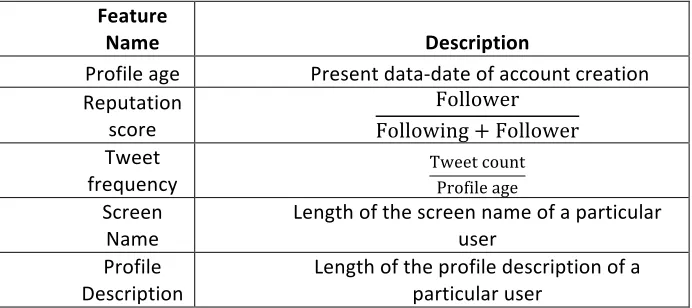
Account based features are the outer information about the profile. Five different types of account based features such as profile age, reputation score, tweet frequency, length of screen name and length of profile descriptions have been considered in this category.
Feature'
Name' Description'
Profile(age( (Present(data/date(of(account(creation( Reputation(
score((
Follower Following + Follower(
Tweet(
frequency(( Tweet-countProfile-age Screen(
Name( Length(of(the(screen(name(of(a(particular(user( Profile(
Description(( Length(of(the(profile(description(of(a(particular(user(
Table 2: Description of various account based features
Stylistic feature
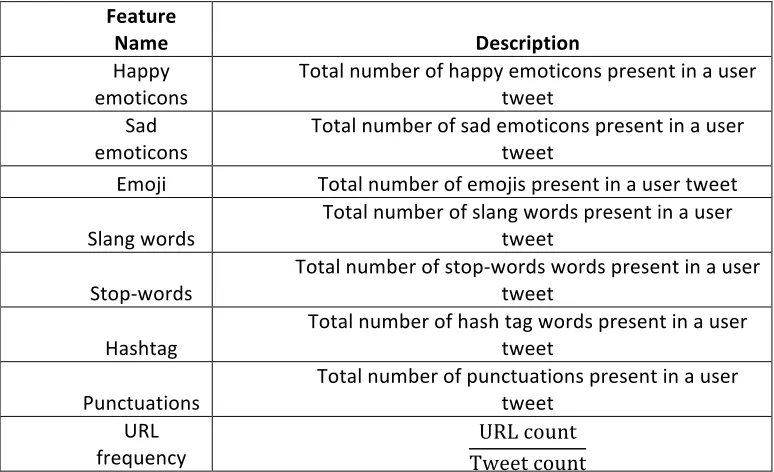
Stylistic features employ a significant role to identify the symmetric variations of natural languages. 8 different types of stylistic features that are used here are shown in table 3. For the number of happy emotions, sad emotions, emoji and slangs individual dictionary has been prepared under each category. Stop of words has been collected from NLTK corpus and the rest of the features are extracted programmatically.
Table 3: Description of various stylistic features
The spammers generate enormous number of tweets with repeated URLs for promotional purpose that contains very fewer number of emoticons, stop words, hash tags and punctuation as compared to the genuine user. In case pornographic user the slang word counts are very high.
Hashtag based feature
Hashtags are the type of metadata tag used in various social media platform which allows users to apply dynamic, user-generated tagging facilities to make it possible for others to easily find messages on a specific topic or phenomenon. The hashtag based features are the information containing in the hashtag. Latent semantic analysis is a popular natural language processing technique used here to extract the vector representation of the hashtags, The LSA has been applied on each and every hashtags of a particular user and a 25bits vector has been prepared. LSA works in 3 steps.
1)! Initially, a separate technique called term frequency-inverse document frequency (tf-idf) is used to find the frequency of the word in each document.
2)! In next step, singular value decomposition (SVD) is applied on tf-idf for dimensionality reduction. 3)! Finally, LSA is used as vector.
Word embedding based feature
Word embedding is the vector representation of a particular text where the words with the similar meaning have similar representation. In present work, Word embedding based feature are the vector representation of similar words present in a tweet. GloVe and word2vec model are two popular vector representation technique used in
Feature'
Name' Description'
Happy(
emoticons( Total(number(of(happy(emoticons(present(in(a(user(tweet( Sad(
emoticons( Total(number(of(sad(emoticons(present(in(a(user(tweet( Emoji( Total(number(of(emojis(present(in(a(user(tweet(
Slang(words( Total(number(of(slang(words(present(in(a(user(tweet(
Stop/words( Total(number(of(stop/words(words(present(in(a(user(tweet(
Hashtag( Total(number(of(hash(tag(words(present(in(a(user(tweet(
Punctuations( Total(number(of(punctuations(present(in(a(user(tweet( URL(
various NLP applications. By considering the various advantages of GloVe over traditional word2vec, the vector has been prepared using GloVe.
Topic word based feature
Topic words are the important keyword present in a particular document. In this work, to identify the topic word present in a tweet, Latent Dirichlet Allocation (LDA) topic modeling technique is applied.
Proposed model
The proposed model as illustrated in Figure 3 comprises of 4 primary sections – i) Tweet extraction; ii) preprocessing; iii) Feature extraction; iv) Train-Test split. Both SHP and custom dataset initially contains the raw tweets. In preprocessing phase, all the non English tweets have been removed. Whereas in feature extraction phase, a 338 bits feature vector has been prepared for training. The feature vector 1-8 containing the stylistic feature, vector 9-33 represents a 25 bits hashtag feature. The next 200 bits are the embedded feature containing the Glove output of the tweets. A 100 bits topic word based feature has been added next by applying LDA followed by LSA on the tweet respectively. Finally, 5 account based features are considered.
Figure 3: Complete framework for spam detection
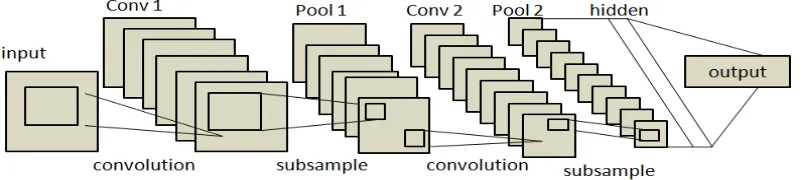
In next phase, these 338 bits feature vector has been fed into various machine learning classifier for training. For deep learning framework a 20*20 feature vector has been prepared. The intermediate structure of the CNN model is shown in figure 4. For CNN-SVM, the dense layer output of the CNN is transferred to SVM for classification.
Figure 4: Detailed CNN architecture
5.'EVALUATION'METRICS(
The(proposed(method(used(5(important(performance(indicators(to(evaluate(the(performance(of(the(model.(
((((((((((((((((((((((((((((((((((((((((((((((((((((((((((((((((AC=(((678698:78:967869 (
2.! Precision:(It(is(the(ratio(of(relevant(instances(by(the(retrieved(instances.(
(((((((((((((((((((((((((((((((((((((((((((((((Precision=((678:767 (
3.! Recall:( It( is( the( ratio( of( relevant( instances( that( have( been( retrieved( by( the( total( amount( of( relevant( instances.(
(((((((((((((((((((((((((((((((((((((((((((((( ((((Recall=(((678:967 (
4.! F1(Score:(It(is(the(weighted(average(of(precision(and(recall.(
(((((((((((((((((((((((((((((((((((((((((((((((F1(Score=((;∗ =>?@AA∗7B>?CDCEF7B>?CDCEF8=>?@AA (
TP((True(positive):(is(the(number(of(positive(instances(that(are(corrected(classified.(
TN((True(negative):is(the(number(of(negative(instances(that(are(correctly(classified.(
FP((False(positive):is(the(number(positive(instances(that(are(wrongly(classified.(
FN((False(negative):is(the(number(of(negative(instances(that(are(wrongly(classified.(
Hence(a(good(IDS(always(have(a(good(detection(rate(and(low(false(alarm(rate.(
Experimental'set'up'and'Result Analysis
For(preprocessing,(feature(extraction(and(classification(purpose,(the(method(used(the(most(promising(machine( learning(package(Keras(2.1.6(in(python(3.6.4(environment.(All(the(experiments(have(been(conducted(on(a(personal( notebook(with(Intel(core(i7/2760M(CPU(@(2.70GHz(configuration(and(8GB(memory.(All(the(experiments(have( been(performed(for(two(dataset(SHP(and(custom.(The(applicability(of(the(individual(and(combined(features(has( been(investigated(through(four(different(machine(learning,(two(deep(learning(and(one(hybrid(classifiers.(Finally,(a( critical(comparison(has(been(done(between(two(datasets(with(the(above(mentioned(parameters.(
The(directive(of(the(first(experiment(is(to(evaluate(the(effectiveness(of(the(proposed(features(for(SHP(dataset.( Table(4(shows(the(accuracy(achieved(through(various(machine(learning,(deep(learning(and(hybrid(frameworks.( The(table(clearly(shows(that(the(MLP(records(the(highest(accuracy((93%)(for(combined(feature(while(profile(based( features(also(record(higher(detection(rates(as(compared(to(others.(Similarly,(table(5(shows(the(accuracy(of(Custom( dataset.( Here( the( stylistic,( embedded( and( combined( feature( sets( have( contributed( a( significant( role( where( specifically(stylistic(feature(itself(records(above(98%(accuracy(for(RF(and(CNN/SVM(classifiers.(((
(
( ( ( (
Table(4:(Performance(evaluation(of(used(features(based(on(various(classifiers(for(SHP(dataset(
(
Classifier(( Stylistic(feature(( Hashtag(feature( Embedded(feature( Topic(word(feature( Account(feature( Combined(feature(
NB( 94.6( 40.35( 94.5( 86.9( 65.1( 95.05(
J48( 98( 89.45( 94.65( 86.9( 91.3( 97.55(
SMO( 94.45( 67.85( 95.45( 88.85( 60( 95.05(
RF( 98.15( 93.95( 97.05( 86.9( 92.9( 97.5(
MLP( 97.5( 57.8( 97( 86.8( 91.7( 96.75(
CNN( 97.8( 73( 96( 84( 87.8( 97.5(
CNN/SVM( 98( 62.5( 97( 62.5( 89.5( 97.7(
(
Table(5:(Performance(evaluation(of(used(features(based(on(various(classifiers(for(custom(dataset( (
In(the(next(section,(a(graphical(comparison(has(been(performed(with(respect(to(both(custom(and(SHP(datasets(in( terms(of(three(parameters:(precision,(recall(and(F1–Score.(This(graphical(comparison(has(been(made(solely(for( Stylistic,( embedded( and( combined( feature( sets( which( have( acted( as( primary( contributors( for( differentiation( between(legitimate(users(and(spammers.(Figure(5((a)(shows(precision(comparison.(Recall(comparison(is(shown(in( figure(5((b).(F/Measure(comparison(for(combined(feature(is(presented(in(figure(5((c).(((Figures(6((),(6((b)(and(6(c)( show(Precision(Comparison,(Recall(comparison(and(F/Measure(comparison(for(embedded(features.((((((((((((((
( (
Figure(5a:(Precision(comparison(for(combined(feature((((((((((((((((((((Figure(5b:(Recall(comparison(for(combined(feature(
( (
Figure(5(c:(F/Measure(comparison(for(combined(feature((((((((((((((((((((((
Classifier( Stylistic(feature( Hashtag(feature( Embedded(feature( Topic(word(feature( Account(feature( Combined(feature(
NB( 62.81( 59.18( 62.3( 74.98( 63.36( 89.1(
J48( 77.46( 89.45( 77.39( 74.18( 89.11( 90.3(
SMO( 73.4( 67.85( 82.14( 81.95( 71.78( 86.96(
RF( 78.85( 83.95( 84.5( 81.56( 89.34( 88.6(
MLP( 79( 48.8( 85.9( 81.8( 90.3( 93(
CNN( 79.8( 56.1( 84.2( 81.6( 90.5( 92.5(
( ( (
( (
Figure(6a:(Precision(Comparison(for(embedded(feature(((((((((((((((((((((
( ( (
( (
Figure(6b:(Recall(comparison(for(embedded(feature((((((((((((((((((Figure(6c:(F/Measure(comparison(for(embedded(feature((((((((((((((((( (
( (
(
(( ( ( (a)((((((((((((((((((((( ( ( ( (b)(
Figure(7a:(Precision(comparison(for(stylistic(feature((((((((((((((((((((Figure(7b:(Recall(comparison(for(Stylistic(feature( (
(
((((((((((((((((((((((((((((((((((((((((((((((((((((((((( ( (
Figure(7c:(F/Measure(comparison(for(Stylistic(feature(( (
creates(a(drastic(difference(between(Spam(and(Legitimate(user(in(Custom(Dataset(that(naturally(enhances(the( detection(capability(with(respect(to(the(embedded(features.((((
Although(98%(accuracy(was(observed(in([33](for(the(SPD(dataset,(it(has(several(shortcomings(in(comparison(to(our( work(as(discussed(in(the(following.(
i)! Limited(no.(of(tweets:(It(is(quite(noticeable(that(this(dataset(was(formatted(on(a(limited(number(of(tweets(of(a( particular(user((less(than(200)(which(is(not(significant(enough(to(evaluate(their(interests.(This(is(because(spammers( in(modern(times(are(observed(to(behave(as(legitimate(users(initially.(Only(after(being(rendered(as(a(legitimate( user( by( others,( they( begin( their( spamming( activities.( Under( such( circumstances,( limited( number( of( tweets( is( insufficient(to(completely(validate(the(authenticity(of(a(particular(user.(
( (
ii)! Overtly(dependent(on(account/based(features:(Modern/day(spamming(activities(are(highly(characterized(by(the( content(of(their(tweets(in(contrast(to(the(superficial(user/related(information(such(as(followers,(followings,(user( credentials,(etc.(This(is(because(account(based(features(can(be(easily(fabricated,(thereby(rendering(spam(detection( relying(on(account/based(features(highly(ambiguous.(Hence,(the(work(in([33](falls(short(of(providing(statistically( significant(accurate(results(in(today’s(scenario(due(to(its(over/reliance(on(account/based(features.(
The(proposed(work,(on(the(contrary,(addresses(both(these(shortcomings(effectively.(Accordingly,(in(our(custom( dataset,(the(maximum(number(of(tweets(for(a(particular(user(is(2000.(In(addition,(above(98%(detection(rate(is( achieved(successfully(based(on(only(8(stylistic(features(derived(specifically(for(this(purpose.(As(the(stylistic(features( are(based(on(contents(of(the(tweet(it(cannot(be(fabricated.(Therefore,(the(accuracy(obtained(by(our(proposed( model(is(highly(significant(under(the(current(scenario(of(spam(detection.(
Mathematical'formulation'for'user'categorization'
Finally,(this(section(delivers(the(proposed(methodology(for(user(categorization(in(real(time(using(logistic(regression( based(mathematical(model.(Accordingly,(in(this(section,(the(attributes(are(first(selected(based(on(their(significance( and(mathematical(formulation(is(thereafter(devised(based(on(the(working(principal(of(Logistic(regression.(Finally( validation(of(the(proposed(procedure(is(performed(through(graphical(analysis(over(a(randomly(selected(data.(
To(perform(the(user(classification(in(real(time(here(we(have(used(only(4(high(significant(valued(features(Profile( age,( reputation( score,( tweet( frequency( and( URL( frequency.( Logistic( regression( classifier( has( been( used( here( because(at(training(time(it(provides(some(B(weights(for(each(of(the(individual(features(which(are(further(been( used(for(predicting(classification(probabilities(in(real(time.(The(significant(features(and(its(corresponding(B(values( are(shown(in(table(6.(
Variables!in!the!Equation!
B! S.E.! Wald! df! Sig.! Exp(B)!
!AGE! 1.268! 108.682! .000! 1! .991! 3.553!
REPUTATIONSCORE! C122.443! 13514.348! .000! 1! .993! .000!
TWEETFREQUENCY! C.071! 7.449! .000! 1! .992! .931!
URLFREQUENCY! C58.702! 15612.929! .000! 1! .997! .000!
Constant! 4.041! 2021.424! .000! 1! .998! 56.909!
According(to(the(working(principal(of(Logistic(regression(the(corresponding(B(values(are(further(formulated(by(the( following(equation(for(providing(the(classification(probabilities(of(any(user.(
Logit=Constant(+(Profile(age(*(B1(+(Reputation(score(*(B2(+(Tweet(frequency(*(B3(+(URL(frequency(*(B4(
Odds=(GHEICJ(
Classification(Probabilities=M8KLLDKLLD (
(
(We( have( randomly( chosen( 100( accounts,( 50( legitimate( and( 50( spammers( for( validation( purpose.( The( corresponding(feature(values(in(terms(of(graph(are(shown(in(figure(8.(((
(
(a)!(((((((((((((((((((((((((((((((((((((((((((((((((((((((((((((((b)(
(
(( ( ( (c)((((((((((((((((((((((((((((((((((((((((((((((((((((((((((((((d)((((((((((((((((((((((
(( ( ( ( Figure(8(Feature(values(are(presented(
These(feature(values(are(formulated(through(equation(5,(6(and(7(respectively.(According(to(the(resultant( classification(probability(97(accounts(was(correctly(classified(and(only(3(was(misclassified.(
''''''''''''''Conclusions'
information(in(SPD(dataset(the(custom(dataset(has(been(prepared(by(considering(more(than(2000(tweets(of(a( particular(user.(The(proposed(stylistic(and(embedded(features(are(found(to(be(superior(based(on(limited(number( of(users.(Overall(98%(accuracy(is(observed(in(classifying(users(as(either(legitimate(ones(or(spammers(in(the(given( data(set.(The(proposed(model(also(provides(a(suitable(research(platform(for(further(studies(particularly(related(to( multi(label(spam(classification(as(well(as(its(impact(on(demographic(user(profiling.(
Conflict'of'Interest'
There(is(no(conflict(of(interest(of(any(author.(
References''
[1]H.(Tsukayama,("Twitter(turns(7:(Users(send(over(400(million(tweets(per(day,"(Washingon(Post,(March(2013.( [Online].(Available:(http://articles.washingtonpost.com(2013/03/(21/business/37889387(1(twitter/jack(/dorsey/ twitte(
(
[2](Alom,(Zulfikar,(Barbara(Carminati,(and(Elena(Ferrari.("Detecting(Spam(Accounts(on(Twitter."(In(2018(IEEE/ACM( International(Conference(on(Advances(in(Social(Networks(Analysis(and(Mining((ASONAM),(pp.(1191/1198.(IEEE,( 2018.(
(
[3](Gilani,(Zafar,(Liang(Wang,(Jon(Crowcroft,(Mario(Almeida,(and(Reza(Farahbakhsh.("Stweeler:(A(framework(for( twitter(bot(analysis."(In(Proceedings(of(the(25th(International(Conference(Companion(on(World(Wide(Web,(pp.( 37/38.(International(World(Wide(Web(Conferences(Steering(Committee,(2016.(
(
[4]( Haustein,( Stefanie,( Timothy( D.( Bowman,( Kim( Holmberg,( Andrew( Tsou,( Cassidy( R.( Sugimoto,( and( Vincent( Larivière.( "Tweets( as( impact( indicators:( Examining( the( implications( of( automated( “bot”( accounts( on( T( witter."(Journal(of(the(Association(for(Information(Science(and(Technology(67,(no.(1((2016):(232/238.(
(
[5]https://blog.twitter.com/en_us/topics/company/2018/how/twitter/is/fighting/spam/and/malicious/ automation.html(
(
[6](Wu,(Tingmin,(Sheng(Wen,(Yang(Xiang,(and(Wanlei(Zhou.("Twitter(spam(detection:(Survey(of(new(approaches( and(comparative(study."(Computers(&(Security(76((2018):(265/284.(
(
[7](Lalitha,(L.(A.,(Vishwanath(R.(Hulipalled,(and(K.(R.(Venugopal.("Spamming(the(mainstream:(A(survey(on(trending( Twitter(spam(detection(techniques."(In(2017(International(Conference(On(Smart(Technologies(For(Smart(Nation( (SmartTechCon),(pp.(444/448.(IEEE,(2017.(
(
((( [8](NexGate,(State(of(Social(Media(Spam(Research(report,(Online,(Accessed:18/02/2018((2013).( (
[9](O.(Varol,(E.(Ferrara,(C.(A.(Davis,(F.(Menczer,(A.(Flammini,(Online(Human/Bot(Interactions:(Detection,(
Estimation,(and(Characterization,(in:(International(AAAI(Conference(on(Web(and(Social(Media,(AAAI(Press,(2017,( pp.(280–289.(
(
[10](Social(Media(Statistics(and(Facts,(Online:(www.statista.com/topics/1164/social/networks,(Accessed:(18/02/ 2018.(
( (
[11]G.(Stringhini,(C.(Kruegel,(and(G.(Vigna,(“Detecting(Spammers(onSocial(Networks,”(Proc.(26th(Ann.(Computer( Security(ApplicationsConf.((ACSAC),(2010.(
(
[12](C.(Grier,(K.(Thomas,(V.(Paxson,(and(M.(Zhang,(“@spam:(TheUnderground(on(140(Characters(or(Less,”(Proc.( 17th(ACM(Conf.Computer(and(Comm.(Security((CCS),(2010.(
[13]K.(Lee,(J.(Caverlee,(and(S.(Webb,(“Uncovering(Social(Spammers:Social(Honeypots(þ(Machine(Learning,”(Proc.( 33rd(Int’l(ACMSIGIR(Conf.(Research(and(Development(in(Information(Retrieval,(2010.(
(
[14](Agarwal,(S.(and(Sureka,(A.,(2015,(February.(Using(knn(and(svm(based(one/class(classifier(for(detecting(online( radicalization(on(twitter.(In(International(Conference(on(Distributed(Computing(and(Internet(Technology((pp.( 431/442).(Springer,(Cham.(
(
[15](F.(Benevenuto,(G.(Magno,(T.(Rodrigues,(and(V.(Almeida,“Detecting(Spammers(on(Twitter,”(Proc.(Seventh( Collaboration,Electronic(Messaging,(Anti/Abuse(and(Spam(Conf.((CEAS),(2010.(
(
[16](Song,(Jonghyuk,(Sangho(Lee,(and(Jong(Kim.("Spam(filtering(in(twitter(using(sender/receiver(relationship."( In(International(workshop(on(recent(advances(in(intrusion(detection,(pp.(301/317.(Springer,(Berlin,(Heidelberg,( 2011.(
(
[17](Wang,(Alex(Hai.("Don't(follow(me:(Spam(detection(in(twitter."(In(2010(international(conference(on(security( and(cryptography((SECRYPT),(pp.(1/10.(IEEE,(2010.(
(
[18](Amleshwaram,(Amit(A.,(Narasimha(Reddy,(Sandeep(Yadav,(Guofei(Gu,(and(Chao(Yang.("Cats:(Characterizing( automation( of( twitter( spammers."( In( 2013( Fifth( International( Conference( on( Communication( Systems( and( Networks((COMSNETS),(pp.(1/10.(IEEE,(2013.(
(
[19]( Chen,( C.,( Zhang,( J.,( Xie,( Y.,( Xiang,( Y.,( Zhou,( W.,( Hassan,( M.M.,( AlElaiwi,( A.( and( Alrubaian,( M.,( 2015.( A( performance( evaluation( of( machine( learning/based( streaming( spam( tweets( detection.( IEEE( Transactions( on( Computational(social(systems,(2(3),(pp.65/76.(
(
[20]( Mccord,( M.( and( Chuah,( M.,( 2011,( September.( Spam( detection( on( twitter( using( traditional( classifiers.( In(international(conference(on(Autonomic(and(trusted(computing((pp.(175/186).(Springer,(Berlin,(Heidelberg.( (
[21](Wang,(B.,(Zubiaga,(A.,(Liakata,(M.(and(Procter,(R.,(2015.(Making(the(most(of(tweet/inherent(features(for(social( spam(detection(on(twitter.(arXiv(preprint(arXiv:1503.07405.(
(
[22](Singh, Monika, Divya Bansal, and Sanjeev Sofat. "Who is who on twitter–spammer, fake or compromised account? a tool to reveal true identity in real-time." Cybernetics and Systems 49, no. 1 (2018): 1-25.
(
[23]( Wang,( A.H.,( 2010,( July.( Machine( learning( for( the( detection( of( spam( in( twitter( networks.( In( International( Conference(on(E/Business(and(Telecommunications((pp.(319/333).(Springer,(Berlin,(Heidelberg.(
(
[24]( Wu,( T.,( Liu,( S.,( Zhang,( J.( and( Xiang,( Y.,( 2017,( January.( Twitter( spam( detection( based( on( deep( learning.( In(Proceedings(of(the(Australasian(computer(science(week(multi(conference((p.(3).(ACM.(
(
[25](Madisetty,(S.(and(Desarkar,(M.S.,(2018.(A(neural(network/based(ensemble(approach(for(spam(detection(in( Twitter.(IEEE(Transactions(on(Computational(Social(Systems,(5(4),(pp.973/984.(
(
[26](McGrath,(D.K.(and(Gupta,(M.,(2008.(Behind(Phishing:(An(Examination(of(Phisher(Modi(Operandi.(LEET,(8,(p.4.( (
[27](J./L.(Lee,(D./H.(Kim,(and(L.(Chang/Hoon,(“Heuristic(based(Approach(for(Phishing(Site(Detection(Using(URL( Features,”(CEET/2015,(2015.(
(
[28](Ma,(J.,(Saul,(L.K.,(Savage,(S.(and(Voelker,(G.M.,(2009,(June.(Beyond(blacklists:(learning(to(detect(malicious(web( sites( from( suspicious( URLs.( In( Proceedings( of( the( 15th( ACM( SIGKDD( international( conference( on( Knowledge( discovery(and(data(mining((pp.(1245/1254).(ACM.(
[29](Thomas,(K.,(Grier,(C.,(Ma,(J.,(Paxson,(V.(and(Song,(D.,(2011,(May.(Design(and(evaluation(of(a(real/time(url(spam( filtering(service.(In(2011(IEEE(symposium(on(security(and(privacy((pp.(447/462).(IEEE.(
(
[30]( Lee,( S.( and( Kim,( J.,( 2013.( Warningbird:( A( near( real/time( detection( system( for( suspicious( urls( in( twitter( stream.(IEEE(transactions(on(dependable(and(secure(computing,(10(3),(pp.183/195.(
(
[31]( Sedhai,( S.( and( Sun,( A.,( 2017.( Semi/supervised( spam( detection( in( Twitter( stream.( IEEE( Transactions( on( Computational(Social(Systems,(5(1),(pp.169/175.(
(
[32]( Inuwa/Dutse,( I.,( Liptrott,( M.( and( Korkontzelos,( I.,( 2018.( Detection( of( spam/posting( accounts( on( Twitter.(Neurocomputing,(315,(pp.496/511.((
(
[33](Lee,(K.,(Eoff,(B.D.(and(Caverlee,(J.,(2011,(July.(Seven(months(with(the(devils:(A(long/term(study(of(content( polluters(on(twitter.(In(Fifth(International(AAAI(Conference(on(Weblogs(and(Social(Media.(