
An exploratory study on the commercialisation of heat pump-fluidised bed drying technology
26
0
0
Full text
(2) Organizational Evaluation and Adoption of Technological Innovations: an exploratory study on the commercialisation of heat pump-fluidised bed drying technology 1. 2. 3. 4. 5.. Introduction Objectives Research methodology Results Conclusions.
(3) 1. • • • •. Introduction – Drying, Heat pump & Fluidised bed drying Drying & dryers The Concept – hybrid drying concept Innovation Adoption of technological innovation Commercialisation.
(4) 1.. Introduction – Drying, Heat pump & Fluidised bed drying. •. Drying & dryers – Drying is a thermal process in which heat and mass transfer occur simultaneously. Dryers are the equipment that facilitate the drying process Table1. Examples of selected dryers and typical applications Dryer Dryer type Type Tray or cabinet Tunnel Belt conveyer Rotary Pneumatic or flash. Product Product applications Applications Fruits, vegetables, meat, confectionery Fruits, vegetables Grain, fruits, vegetables, cereals, nuts Seeds, grains, starch, sugar crystals Starch, pulps, corps, granules, powders. Fluid bed Spray Drum Puffing Freeze. Vegetables, granules, grains, peas Milk, cream, coffee, tea, juices, eggs, extracts, syrups Milk, flakes, baby cereals, juices, purees Fruits, vegetables Flakes, juices, meat, shrimp, coffee, vegetables, extracts.
(5) 1.. Introduction – Drying, Heat pump & Fluidised bed drying. • Drying & dryers – Evolution of Food Drying Technology Figure 1. Evolution of Food Drying Technology SUN DRYING SMOKING HOT AIR DRYING HEAT PUMP DRYING SPRAY DRYING VACUUM/FREEZE DRYING.
(6) 1.. Introduction – Drying, Heat pump & Fluidised bed drying. •. Drying & dryers – Heat Pump Drying (HPD) or Dehumidified Air Drying Figure 2. Various Phases of the Development of HPD Technology SIMPLE HPD DEHUMIDIFIER HPD IMPROVED DEHUMIDIFIER HPD FLUIDISED BED HPD.
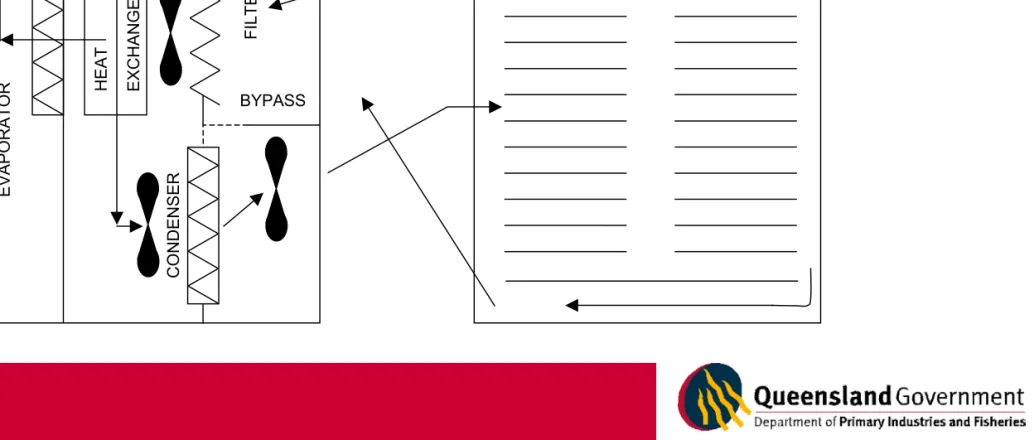
(7) 1.. Introduction – Drying, Heat pump & Fluidised bed drying. FILTER. EXCHANGER. BYPASS. CONDENSER. HEAT. Drying & dryers – Heat Pump Drying (HPD) or Dehumidified Air Drying Figure 3. Simple dehumidifier heat pump dryer. EVAPORATOR. •. 60 ¨ 0.25m2 tray area.
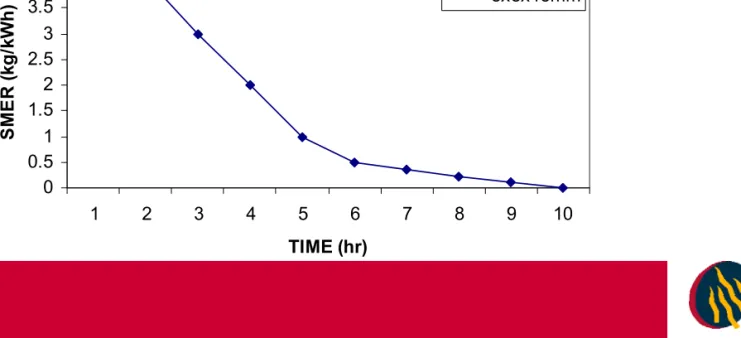
(8) 1.. Introduction – Drying, Heat pump & Fluidised bed drying. •. Drying & dryers – Heat Pump Drying (HPD) or Dehumidified Air Drying Efficiency – Specific Moisture Extraction Rate (SMER) Mass of water removed from the product per unit time. SMER =. Total energy input per unit time. SMER (kg/kWh). Figure 4. SMER versus drying time 4.5 4 3.5 3 2.5 2 1.5 1 0.5 0. 55 Deg C 8x8x15mm. 1. 2. 3. 4. 5. 6. TIME (hr). 7. 8. 9. 10.
(9)
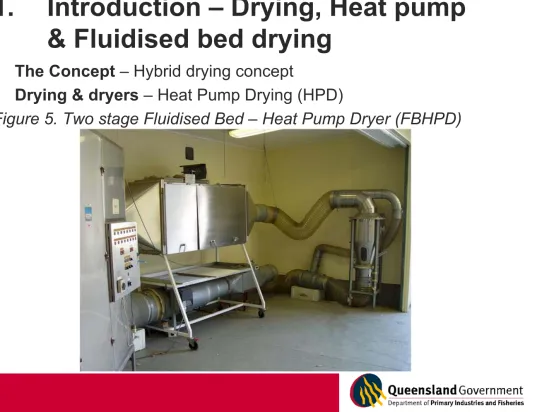
(10) 1.. Introduction – Drying, Heat pump & Fluidised bed drying. • The Concept – Hybrid drying concept • Drying & dryers – Heat Pump Drying (HPD) Figure 5. Two stage Fluidised Bed – Heat Pump Dryer (FBHPD).
(11) 1.. Introduction – Drying, Heat pump & Fluidised bed drying. • Adoption of technological innovation – Commercialisation Table 2. Comparison of performance characteristics of Single stage HPD versus Two-stage FBHPD 3 batches of 4 hours + a 4 batches of 4 hours + a larger batch of equivalent to larger batch of equivalent to 3 small batches for 6 hours 4 small batches for 6 hours Single stage normal batch process: • Time required • Average SMER Two stage drying process: • Time required • Average SMER Increase in Efficiency Throughput increase Decrease in drying time. 30 hours 1.51. 40 hours 1.51. 18 hours 2.47 64% 167% 40%. 22 hours 2.75 82% 182% 45%.
(12) 2.. Objectives. • Overall objective: Identify and analyse the critical issues associated with the diffusion of new drying technologies in the Queensland and Australian food industry • Specific objectives: To develop a commercialisation strategy for the Fluidised Bed-Heat Pump Drying (FBHPD) technology.
(13) 3.. Research methodology. • Literature search • Establish a framework for industrial setting – modelling • Field Study.
(14) 3.. Research methodology. • Literature search • Extensive literature search on the diffusion of innovations and critical assessment.
(15) 3.. Research methodology. • Establish a framework for industrial setting – modelling • Establish a framework that can be used as the basis for analysis the practical issues involved in the adoption and diffusion of technological innovations in industrial setting..
(16) 3.. Research methodology. • Field Study • A questionnaire was designed along the line of the findings of one of the recent studies. The questionnaire was pilot tested with one machinery manufacturer/food technology consultant and one food processing company and was further refined accommodating appropriate improvement. • 42 relevant individuals and organizations were short listed after initial contacts using one of the channels; phone, fax, mail and face-to-face meetings. • 21 individuals representing small to medium/large size businesses were interviewed face-to-face and 3 participants were interviewed over the phone. Questionnaires were sent to another 18 participants. • The model developed in the desktop research was used as the basis for structuring interviews..
(17) 4.. Results and discussion. • The Model • Summary of respondents information • Summary of field study findings.
(18) 4.. Results and discussion. • The Model Industry environment. SUPPLIER INFLUENCE. MANUFACTURERS. AGENCIES. FARMERS. CONSULTANTS. ADOPTER BEHAVIOUR. ATTRIBUTES OF INNIVATION INDUSTRY Industry environment.
(19) 4.. Results and discussion. • Summary of respondents’ information (32 Respondents) Type of Business. Products & Services. Markets. Respondent’s Position. Private Government Industry Association Grain & Maize Edible Tree Nuts Fruit & Vegetable Meat Other (Eg. Herbs) Consultancy Machinery manufacturer Local National International Senior Management Middle Management Operational. 29 01 02 09 06 03 02 04 03 05 04 17 11 20 11 01.
(20) 4.. Results and discussion. • Summary of field study findings Drying Technologies Used Hot Air Drying (Gas or Oil fired) including steam Simple Heat Pump Drying Dehumidifier Heat Pump Drying Microwave Drying Fluidised Bed Heat Pump Drying. 16 4 3 1 Nil. Summary of Important Field Study Findings Concern for Quality Inter-Organisational Communication Exposure to New Technologies Responsiveness to Industry/Environment Trends Formality of Evaluation Processes Perceived Satisfaction with Current Processes. LOW Nil 30% 70% 30% 40% 10%. Brand/Manufacturer Preference Final Purchase Decision taken by CEO Involvement of Engineering/Production in Decision Process Involvement with Consultants Aware of Fluidised Bed Heat Pump Technology. MEDIUM Nil 50% 20% 35% 30% 30% YES Nil 100% 65% 55% 30%. HIGH 100% 20% 10% 30% 30% 60% NO 100% Nil 35% 45% 70%.
(21) 5.. Conclusions. 1. Compared to other industries, adoption and diffusion of innovations in the Australian food drying industry was seen as relatively low. 2. Adoption and diffusion of innovations in this industry sector is largely determined by industry characteristics and market requirements. The evaluation process employed by businesses is basically a judgmental process. Lack of familiarity with the new technologies keeps people away from categorization of products and processes. At the same time, forming evaluative criteria is limited by lack of information on new products and processes. DPI as a premier R&D organization representing this industry sector has a key role to play in stimulating adopter behaviour..
(22) 5.. Conclusions (continued). 3. Finding of the field research showed that neither informationprocessing approach nor the hierarchy of effect approach of innovation evaluation could be successfully applied (in isolation) to analyse the whole range of issues affecting the diffusion of industrial innovations. Rather, an integrated approach would cover most of the issues. This study could be effectively used to develop a more comprehensive model of adoption and diffusion of technological innovations with a wider coverage to include other industry sectors as well..
(23) 5.. Conclusions (continued). 4. Throughout the field study, it was observed that most businesses are localized or isolated in the sense that they had little or no interaction with other sectors of the industry and the environment. The communication flow through the social system seemed to be extremely slow, and because of these reasons the dynamism within this part of industry was seen almost lost. Under these circumstances, the important of the DPI’s role becomes even more important. If Food Technology is to become the market leader in technical consulting and R&D services in this market segment, it is obvious that it should take this aspect seriously and penetrates into this market with a more proactive approach..
(24)
(25)
(26)
(27)
Figure
Related documents