Experiences of Online Learning: An Evaluation of First-year Sport
Sciences University Students’ Attitudes towards the Use of U-Link
Alberto Testa (Corresponding Author) School of Sport and Education, Brunel University
London, UB8 3PH, UK
Tel: 44-018-9526-7382 E-mail: [email protected]
Received: June 10, 2011 Accepted: June 28, 2011 Published: November 1, 2011 doi:10.5539/ies.v4n4p13 URL: http://dx.doi.org/10.5539/ies.v4n4p13
Abstract
The UK Government’s recent funding cuts in higher education, coupled with the importance of maintaining competitiveness at a global and national level — a competitiveness that has worsened lately due to a gloomy recession — have placed even more pressure on UK academic institutions to adopt innovative curricula and, most importantly, to increasingly use technology in their courses. Blended Learning — defined as “the thoughtful fusion of face-to-face oral communication and online learning experiences” (Garrison & Vaughan, 2008, p. 5), is replacing traditional teaching formats. Virtual Learning Systems (VLS) such as Web-CT and U-Link are part of the Blended Learning strategies, and represent a significant way to assess teaching quality at an academic institution, particularly at the departmental level. Hence, VLS should be constantly promoted, developed and, most importantly, evaluated. This case study aims to evaluate students’ attitudes towards the Virtual Learning System U-Link. Data were gathered using a survey administered to 116 first-year Sport Sciences students at Brunel University, a large UK academic institution. The students’ attitudes were assessed using a Likert Scale and open-ended questions. Overall, the respondents were satisfied with their U-Link experience and considered U-Link to be a key tool in their learning. In line with Bennett’s (2002) work, students judged their experiences with academic modules adopting U-Link more favorably than they did with modules that did not have online web-based support. Students’ comments, however, were not all positive; negative feedback pointed to an absence of interaction (lack of communication and feedback) between instructors and students, and a lack of interaction among students.
Keywords: Students’ learning experience, Virtual Learning Systems, Blended Learning, Evaluation study, Brunel University
1. Introduction
One of the most important tools for teaching and delivering knowledge in a higher-education setting is the Virtual Learning System (VLS), which is represented by variations such as Web-CT and U-Link. A VLS ‘is a world of learning populated by real people who think, read, type in their comments and questions in online discussions, laugh, feel pleased or disappointed, plan their study’ (Fry et al., 2007, p.148). VLSs are popular additions for improving students’ quality of learning (Tennent & Hyland, 2004). For example, they play an important role in shaping the first impressions of ‘freshers’ (first-year students) of the teaching methods in their universities’ departments and of what they will experience during their academic careers at their chosen institutions. In varying degrees, VLSs encompass and reflect the five conditions of Tinto’s Retention Theory, which underlines the importance of improving students’ learning experiences as a retention strategy. (Note 1) Ultimately, VLSs are significant elements of any academic institution’s pedagogic strategy because they efficiently deliver knowledge. Therefore, developing students’ skilled use of VLSs should not be neglected by any university. VLSs should be regularly promoted, developed and, most importantly, their effectiveness should be evaluated. Evaluation is especially crucial considering that the dynamics, attitudes, and experiences of online learners are still unclear when compared to face-to-face group learning (Finegold & Cooke, 2006).
strategies.
The main research question of this study was the extent to which participants were satisfied with their department’s use of U-Link. Particular attention was given to the U-Link level of interaction, both between students and instructors, and among students. The delivery of knowledge should be interactive, especially when it allows learners “to gauge where the broad standard should be in relation to others” (Curtin, 2002, p.3).
2. Literature Review
The use of online learning via VLS alongside traditional face-to face education is defined in the literature as ‘Blended Learning’ (Garrison & Vaughan, 2008). The popularity of Blended Learning methods can be traced to fundamental changes in higher education, namely the extraordinary advances in IT and the acknowledgment that face-to-face teaching methods alone do not “address the need for higher-order learning experiences and outcomes demanded by a changing knowledge and communication-based society” (Wong & Tatnall, 2009, p.313). Blended Learning, though, needs to be used skilfully to maximize its benefits for students in terms of achieving the learning outcomes stated in the modules studied. The integrated method adopted by the Department of Sport Sciences at Brunel University, which is the object of this study, includes the following elements: access to online resources; use of U-Link for announcements and lecture notes; student communication through an integrated email system; discussion boards; and online assessments, including the submission of reports, essays and quizzes.
VLSs and Blended Learning have been the focus of several studies. In particular, scholars have attempted to assess VLSs’ effectiveness in delivering knowledge and to establish how to measure this effectiveness (Charbonneau, 2004). Burge (1993, cited in Finegold & Cooke, 2006, p.202) underscored how knowledge sharing among peers, feedback, continuous access to resources, and students’ reflection on electronic messages were positive traits of VLSs. Phipps and Merisotis (1999) argued that the efficacy of online knowledge delivery can be measured by three benchmarks: a) the learning outcomes, b) students’ thoughts about VLSs, and c) students’ satisfaction. Other important factors are instructor teaching styles and knowledge of how to apply technology to education. (Note 3) Evaluations of the VLSs versus “traditional” methods of teaching highlight the former’s many possible benefits. As Charbonneau (2004) details, VLSs are cost-efficient and make knowledge more widely and easily accessible. Moreover, VLSs make recruiting students abroad possible; many universities have online-only courses that target potential students abroad. Previous studies have demonstrated that the skilful use of VLSs and their tools (email, discussion boards, and quizzes) may improve learning outcomes (Charbonneau, 2004). Furthermore, several studies have focused on the interactive capacities of the VLS. Interaction is crucial in delivering knowledge, especially from a constructivist approach, which is the approach that will be taken in this study. In this perspective, knowledge is “constructed” via individuals’ interactions with the environment; hence, the learners are actors who process information (Rovai, 2004).
The interactional dynamic in a VLS environment involves the promotion, via feedback and discussions, of students’ motivation and reflection on the course topic (Paechter et al., 2010). This dynamic is beneficial for learners, not only because it promotes knowledge construction, but also due to the crucial socio-emotional information it provides along with the exchange of information on educational content (Johnson, Hornik, & Salas, 2008). In addition, encouraging interactions among students in a VLS environment promotes a sense of shared support, community and group cohesion that are helpful for student engagement in learning and which facilitate a constructive student experience (Concannon, Flynn, & Campbell, 2005).
Several studies have focused on the interaction between students and their instructors. For instance, Masters and Oberprieler (2004) investigated the quantity and length of students’ posts in discussion boards to determine if peer-to-peer knowledge sharing could be promoted without grades. Ke and Hoadley (2009) also focused on the interactive dimension of VLS; they argue that the main benefits for students of applying technology to learning were access to peer knowledge, opportunities to provide feedback, easy access to technology, and reflection. In contrast, interaction dynamics that are not ideal can “impede groups of users or lead to persuasive but unproductive ideas” (p.488).
On the other hand, literature have also documented shortcomings related to technological hitches, such as lack of suitable feedback (Hara & King, 2000), and students’ preference for face-to-face interactions with their instructors instead of online contacts, which were deemed unnecessary (Edirisingha, 2004). Studies have also pointed out the students’ concerns about the value of online discussions for which they are not assessed and of time-consuming online tasks (Ellis, 2001; Gabriel, 2004).
3. Methodology
3.1 Participants
For this study, 116 first-year Brunel University undergraduate Sport Sciences students were selected. The voluntary nature of the survey was explained to the participants both verbally and in a brief note included in the survey questionnaire form; only those who volunteered to participate answered the survey. The explanations given to the participants were aimed at satisfying the university’s ethics policy; they also were meant to facilitate the respondents’ full participation in the study. If survey participants have a clear understanding of the researcher’s aim and the study’s purpose, they are more likely to respond in a meaningful way (Gilham, 2000).
3.2 Data Collection and Analysis
The survey consisted of a mix of closed and open-ended questions that focused on the use of U-link by first-year lecturers of sport sciences as a supplement to their lecture-based teaching modules. Before writing the survey, several questionnaires were critically examined for length, design and ease of response, and two questionnaires were chosen as examples: Hammoud et al. (2008) and Bennett’s (2002) works. Possible questions were written and refined until they were considered to be clear.
The survey was administered during week 21 of the second term of the 2009-10 academic year. This timeframe was chosen because the respondents were novices and needed time to become acquainted with university-level learning strategies and the use of U-Link. The survey included general background information and a U-Link Attitudes’ Questionnaire. (Note 4) Students were asked to indicate whether they agreed or disagreed with the statements. This part of the survey aimed to give a snapshot of the respondents’ experiences with U-Link and of their opinions on U-Link’s efficacy in enhancing their learning practices. This part of the survey was measured using a Likert scale. The open-ended questions aimed to collect the students’ feedback and present them with an opportunity to give their opinions about U-Link. All of the questions were analyzed and grouped in three meaningful predetermined categories, namely: a) what works, b) what needs work, and c) what needs to be changed. (Note 5)
4. Results and Discussion
The survey administered asked the respondents to state their age, gender, level of experience with and knowledge about VLS, as well as their usual locations for accessing the Internet. Table 1 shows that 93% of the sample belonged to the 18-20 year-old age group, whereas only 7% belonged to the 21-30 year-old age group.
The gender of the students was uniformly represented: the male students made up 55% and the female 45%, as shown in Table 2.
The majority of respondents (59%) were experienced in the use of the VLS, as can be seen in Table 3.
Proficiency in Internet and VLS use is an important factor in assessing students’ attitudes and U-Link effectiveness. Students with more than one experience were able to compare different instructors’ teaching styles within the department and, most importantly, compare them to past educational institutions’ methods. The most popular locations to access the Internet and VLS were the “University Facilities,” used by the 83% of the students, followed by “Home,” used by 78% of the respondents. The “Library Facilities” attracted a significant 57% of the students (see Table 4).
The data on Internet home access are in line with recent statistics. Access to the Internet in the UK has increased steadily from 9% of households in 1998 to 53% in June, 2004, to 70% of households (18.3 million) in 2009. This is a jump of almost 2 million households (11%) in the last year and 4 million households (28%) since 2006. (Note 6) Nevertheless, the high use of University provisions shown in these results are testimony instead to Brunel University’s successful strategy of investing £300 million into moving the campus towards delivering state-of-the-art facilities.
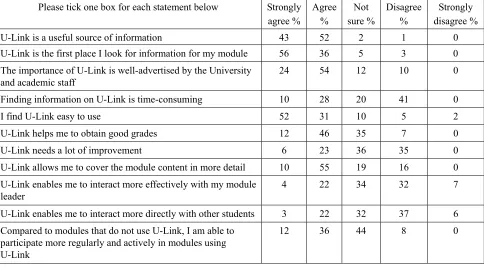
As mentioned earlier, in the main section of the survey the respondents were asked to answer eleven questions about their attitudes towards U-Link, which were complemented by four open-ended questions. The results are presented in Tables 5 and 6.
To evaluate the students’ perceptions of U-Link shown in Tables 5 and 6, three important benchmarks of “good practice” were used. (Cf. Chickering & Gamson, 1987). These criteria were particularly relevant to this study because they are suitable for assessing the interactive elements of U-Link. The three benchmarks are: a) Advantage of Online Delivery, b) Interaction Dynamics, and c) Use of Active Learning Techniques.
4.1 Advantage of Online Delivery
source of information. This result was further confirmed by 92% (56% SA and 36% A) of students who agreed that U-Link was the first place to search for module information and resources. In using U-Link, 83% stated that it was easy to use, whereas a notable majority (65%) believed that U-Link facilitated the process of deepening their knowledge about the topics studied. A disappointing 16% of respondents disagreed with this statement. Even if the majority (58%) agreed about U-Link helping them to obtain good grades, a notable 35% of the respondents strongly disagreed and 7% disagreed. Recurrent positive statements were identified in the open-ended answers that claimed the following about U-Link:
Enables students to link theory to practice Boosts grades
Enables a better understanding of the module through quizzes Helps with revision
Helps with weekly assessment to determine progress Allows easy access to lecture notes
Helps students know what they are doing
Provides information about the module, cancelled lectures and other changes
These data are somewhat supported by the literature (Motiwalla & Tello, 2000). Webster and Hackley (1997, cited in Charbonneau, 2004) clearly argue for the efficiency of VLSs in enhancing learning. However, it is important to consider that a complete appraisal of the use of VLSs cannot neglect an evaluation of the methods of knowledge delivery, which are intrinsically linked to the pedagogical strategy used by each individual instructor (Bangert, 2004; Robertson et al., 2005). It is also quite interesting to point out that two of the benefits identified by the students were the ease of obtaining good marks using online quizzes and the possibility of using U-Link instead of attending lectures. These purported “benefits” support Madden’s (2007) argument that VLSs can de-motivate students, especially from attending lectures and seminars, because resources about the topics studied are easily accessed electronically.
4.2 Interaction Dynamics and Active Learning Techniques
Previous studies have stressed students’ concerns about the lack of interaction and engagement with instructors in a VLS environment (Knipe & Lee, 2002; Robertson et al., 2005). The same concern was voiced in this study: 39% of students disagreed that U-Link favoured interaction between them and their instructors, whereas 34% were unconvinced (not sure). These results are disappointing; promoting interaction is a crucial part of good practice in teaching; good interaction provides the appropriate amount of guidance for students to meet their full potential. Specifically, the contact between academic staff and the students is important because it can promote students’ motivation and commitment. As Cameron (2001 mentioned in Clarke, 2006) argues, interaction dynamics help students to “move through their zone of proximal development either individually or as a whole class.”(p.17) The study also reported that students had difficulty contacting their instructors using the U-Link email facility, with the announcements tool (although some statements instead point to the good use of this facility), unclear timetables, and differences in quality when comparing the different modules’ layouts, which were sometimes poorly organized. Email and announcements are useful tools for providing feedback in a VLS setting. The overall patterns found in the open-ended questions, however, were not negative. This ambivalence can be explained by the two following factors: the students’ level of experience in using U-Link, and the instructors’ varying levels of VLS expertise, which affected the quality of their online teaching delivery (Hill, 2002; Robertson et al., 2005).
The quality of online instruction at the Brunel University Department of Sport Sciences is satisfactory but certainly has room for improvement. The interactional capabilities of U-Link should be facilitated not only by the ease-of-use of the VLS layout but also, and most importantly, by the engagement of academic staff with the online part of their teaching. Quality of online instruction is just as crucial as traditional face-to-face instruction for a positive learning experience (Biggs, 1999; Oliver, 2003). This study further shows that respondents had negative perceptions about the possibility of interacting with each other using U-Link under instructor supervision. According to 43% of students, U-Link did not promote student interaction, and another 32% were unconvinced. These data are noteworthy and point out a significant challenge that is inherent to the use of VLS in disseminating knowledge. Learning is better promoted when the instructor is able, in face-to-face teaching or via VLS, to create a sense of group cohesion, and where students help each other to achieve the common goal of gaining a better understanding of the topic studied. It is team effort that promotes efficiency in knowledge delivery.
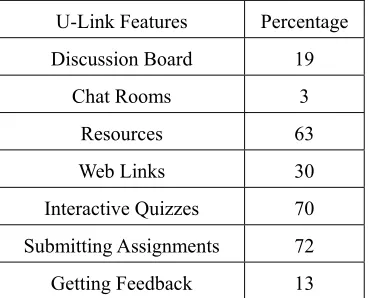
what I see, I remember; what I do, I understand” (Fuller, 1998, p.215). AL is more efficient than long-established passive knowledge methods. This study indicates that the most popular features of U-Link were the resources. Only 13% of respondents considered feedback to be a popular tool, (Note 7) whereas the discussion board and chat rooms also scored low. These results underline yet again students’ perception that there is a lack of interaction and the instructors’ lack of ability to engage students with active learning via VLS.
From the results of this study, it is evident that the discussion board (DB) facility was hardly used. The discussion board is a vital element of VLS and it needs to be used more effectively to enhance students’ learning. One possible fruitful use of the DB, regardless academic subjects’ differences, could be as a seminar support. In this scenario, students are provided with discussion questions related to the topic of the lecture and they are asked to answer these questions using the DB under online moderation and in preparation for seminars. (Note 8) This task will provide useful feedback on teaching strategies through identifying what students are interested in and helping to develop topics that are more challenging. This use of the DB may promote more group cohesion, which is important in the much-needed student-centred learning environment.
5. Conclusion
This case study aimed to evaluate the perceptions about U-Link of 116 first-year undergraduate Sport Sciences students at Brunel University (London, UK). The study shows that one of the main challenges in using a VLS is the promotion of more and better interaction between instructors and students, and among students. To make sure that students feel confident using U-Link or any similar VLS to its maximum potential, this paper suggests few modifications to improve students’ learning experiences. These can be generalized to any academic setting employing online web-based support strategies to teaching.
Academic staff should dedicate more time to introducing VLS (in the case of this study, U-Link) to their students in the first two weeks of the academic year.
Some work needs to be done on online communication strategies, and more feedback should be provided. Academic staff should encourage engaging behavior to promote students’ self-confidence and to allow them to participate effectively in online learning.
Chat rooms should be promoted by academic staff to improve online group interaction. Chat rooms can also be used as an additional tool during face-to-face tutorial times, especially during the exam period.
The use of the discussion board should be strongly encouraged.
Interaction dynamics are crucial for the student-instructor relationship; consequently, they are also important in a VLS context. The lack of interaction dynamics shown in this study’s results, which is in line with previous literature, re-emphasizes the difficulty to promote interaction based learning and the need for a VLS strategy centred on a constructivist learning approach (Rovai, 2004). The lack of interaction and the use of VLSs as a simple repository of resources, references and lecture notes indicate a pedagogic strategy based on a teacher-focused approach, which shifts the focus away from the students’ learning needs. This study suggests a need for more focus on active learning, on the promotion of a sense of online “community,” and more cooperation among students via use of the much-needed discussion board facility. The discussion board, when used correctly, promotes knowledge sharing, improves motivation, and facilitates the construction of a collaborative relationship between the instructor and students (Paechter et al., 2010). However, in doing so, the balance between the active role that discussion boards require from students and the distribution of the workload needs to be right in order not to overburden the students. (Note 9)
5.1 Considerations on Methodology and on Further Studies
This study acknowledges that readers may seek answers to questions that this paper may not have posed. This will always be the case in any study, which by nature cannot be free from limitations. The main shortcoming of this study is its relatively small sample size, which is comprised of only 116 undergraduate respondents out of 266 students. However, with a sample of this size and the gender distribution obtained (see Table 3), and calculating a margin of error of 5%, the total level of confidence is still 85%, which I believe gives a reasonable picture of the population’s attitude trends regarding U-Link.
References
Bangert, A. (2004). The seven principles of good practice: A framework for evaluating online teaching. Internet and Higher Education, 7(3), 217-232. http://dx.doi.org/10.1016/j.iheduc.2004.06.003
Bennett, G. (2002). Web-based instruction in Sport Management. Sport Management Review, 5, 45-68. http://dx.doi.org/10.1016/S1441-3523(02)70061-2
Bielaczyc, K. (2001). Design social infrastructure: The challenge of building computer supported learning communities. In A. E. P. Dillenbourg & K. Hakkarainen (Ed.), European perspectives on computer-supported collaborative learning: Proceedings of the 1st european conference on computer supported learning (pp. 106-114). Maastricht: Maastricht University.
Biggs, J. (1999). Teaching for quality learning at university. Edinburgh: Society for Research into Higher Education. Charbonneau, J. (July, 2004). ‘Weblectures: Enhancing the WebCt Experience for Distance Students’, Third Pan ` Commonwealth Forum on Open Learning, Dunedin, New Zealand.
Chickering, A., & Gamson, Z. (1987). Seven principles for good practice in undergraduate education. American Association for Higher Education Bulletin, 39(7), 3-7
Clarke, M. A. (2006). Reflective practice: A foundation for action research and effective teaching. In A. Warne (Ed.), Action research in English language teaching in the UAE (pp.19). Abu Dhabi: HCT Press.
Concannon, F., Flynn, A., & Campbell, M. (2005). What campus-based students think about the quality and benefits
of e-learning. British Journal of Educational Technology, 36, 501-512.
http://dx.doi.org/10.1111/j.1467-8535.2005.00482.x
Curtin, J. (2002). WebCT and online tutorials: New possibilities for student interaction. Australian Journal of Educational Technology, 18(1), 110-126
Edirisingha, P. (2004). Discussing to learn—how undergraduates integrate online discussion forums in their learning activities. ALT-C 2004: 11Th International Conference Research Proceedings, Hull. 11-123
Ellis, A. (2001). Student-centred collaborative learning via face-to-face and asynchronous online communication: What’s the difference? Meeting at the Crossroads. Proceedings of the Annual Conference of the Australasian Society for Computers in Learning in Tertiary Education, Melbourne, Australia.
Finegold, A., & Cooke, L. Exploring the attitudes, experiences and dynamics of interaction in online groups. Internet and Higher Education, 9, 201-215. http://dx.doi.org/10.1016/j.iheduc.2006.06.003
Fry, H., Ketteridge, S., & Marshall, S. (2007). A handbook for teaching and learning in higher education. enhancing academic practice. London: Routledge.
Fuller, T. (1998). Using computer assignments to promote active learning in the undergraduate social problems course. Teaching Sociology, 26, 215-221. http://dx.doi.org/10.2307/1318835
Gabriel, M. (2004). Learning together: Exploring group interactions online. Journal of Distance Education, 19(1), 54-72
Garrison, D., & Vaughan, N. (2008). Blended learning in higher education-framework, principles and guidelines. CA: Jossey-Bass-A Wiley Imprint.
Gilham, B. (2000). Case study research methods. London: Continuum.
Hammoud, L., Love, S., Baldwin, L., & Chen, S. (2008). Evaluating WebCT use in relation to Students’Attitude and performance. International Journal of Information and Communication Technology Education, 4(2), 26-43. http://dx.doi.org/10.4018/jicte.2008040103
Hara, N., & Kling, R. (2000). Students’ distress with a web-based distance education course: An ethnographic study of participants’ experiences. [Online] Available: http://slis.indiana.edu/CSI/WP/wp00-01B.html (February 2, 2010) Hill, J. (2002). Overcoming obstacles and creating connections: Community building in web-based learning environments. Journal of Computing in Higher Education, 14(1), 67-86. http://dx.doi.org/10.1007/BF02940951 Johnson, R., Homik, S., & Salas, E. (2008). An empirical examination of factors contributing to the creation of successful e-learning environments. International Journal of Human-Computer Studies, 66, 356-369. http://dx.doi.org/10.1016/j.ijhcs.2007.11.003
Knipe, D., & Lee, M. (2002). The quality of teaching and learning via videoconferencing. British Journal of Educational Technology, 33(3), 301-311. http://dx.doi.org/10.1111/1467-8535.00265
Madden-Hallett, Helen. (2007). Is WebCT a better choice for on-campus marketing students? The experience of undergraduate student users in Victoria, Australia In: Technology, Colleges and Community Worldwide Online Conference. University of Hawaii, 62-69
Masters, K., & Oberprieler, G. (2004). Encouraging equitable online participation through curriculum articulation. Computers and Education, 42(4), 319-332. http://dx.doi.org/10.1016/j.compedu.2003.09.001
Motiwalla, L., & Tello, S. (2001). Distance learning on the internet: An exploratory study. The Internet and Higher Education, 2(1), 253-264
Oliver, R. G. (2003). Exploring benchmarks and standards for assuring quality online teaching and learning in higher education. Proceedings of Open and Distance Learning Association of Australia Biennial Forum. [Online] Available:
http://ro.ecu.edu.au/cgi/viewcontent.cgi?article=4278&context=ecuworks&sei-redir=1#search=%22Oliver%2C%20 R.%20%282003%29.%20Exploring%20benchmarks%20standards%20assuring%20quality%20online.teaching%20l earning%20higher%20education.%22 (March 1, 2010)
Paechter, M., Maier, B., & Macher, D. (2010). Students’ expectations of and experiences in e-learning: Their relation to learning achievements and course satisfaction. Computers & Education, 54, 222-229. http://dx.doi.org/10.1016/j.compedu.2009.08.005
Phipps, R., & Merisotis, J. (1999). What’s the difference? A review of contemporary research on the effectiveness of distance learning in higher education. Washington: Institute of Higher Education Policy.
Robertson, J., Grant, M., & Jackson, L. (2005). Is online instruction perceived as effective as campus instruction by
graduate students in education? Internet and Higher Education, 8, 73-86.
http://dx.doi.org/10.1016/j.iheduc.2004.12.004
Rovai, A. P. (2004). A constructivist approach to online college learning. Internet and Higher Education, 7, 79-93. http://dx.doi.org/10.1016/j.iheduc.2003.10.002
Tennent, B., & Hyland, P. (2004). The WebCT discussion list and how it is perceived. Turkish Online Journal of Distance Education, 5(3), 1-10
Wong, L., & Tatnall, A. (2009). The need to balance the blend: Online versus face-to-face teaching in an introductory accounting subject. Issues in Informing Science and Information Technology, 6. [Online] Available: http://iisit.org/Vol6/IISITv6p309-322Wong611.pdf (June 1, 2010)
Notes
Note 1. Tinto (2003) mentions the five following crucial conditions: expectations, support, feedback, involvement and relevant learning. Cf. http://staffs.ac.uk/access-studies/docs/Amster-paperVT(1).pdf
Note 2. Founded in 1966, Brunel University has 2600 staff and circa 15000 students. Cf. http://timesonline.co.uk/tol/life_and_style/education/good_university_guide/article2166330.ece
Note 3. Cf. Charbonneau, (2004).
Note 4. Adapted from Hammoud, L. et al. (2008).
Note 5. This strategy was successfully used by Bennett (2002). Note 6. Cf. http://statistics.gov.uk/cci/nugget.asp?ID=8
Note 7. This is also reflected in the comments elicited by the open ended questions-see table 7 ‘what does not work’. Note 8. Strategy used by the School of English Studies at the University of Nottingham (UK) http://www.nottingham.ac.uk/pesl/themes/elearninguse/usingdis501/
Table 1. Students’ Age
Age Percentage 18-20 93 21-30 7
Table 2. Students’ Gender
Gender Percentage Male 55
Female 45
Table 3. VLS and Internet Experience Level
Level of Experience Percentage
None 41 Some 59
Table 4. Internet Access Locations
Home % Library % University % Other %
78 57 83 3
Table 5. U-Link Attitude Questionnaire Results
Please tick one box for each statement below Strongly agree %
Agree %
Not sure %
Disagree %
Strongly disagree %
U-Link is a useful source of information 43 52 2 1 0
U-Link is the first place I look for information for my module 56 36 5 3 0 The importance of U-Link is well-advertised by the University
and academic staff
24 54 12 10 0
Finding information on U-Link is time-consuming 10 28 20 41 0
I find U-Link easy to use 52 31 10 5 2
U-Link helps me to obtain good grades 12 46 35 7 0
U-Link needs a lot of improvement 6 23 36 35 0
U-Link allows me to cover the module content in more detail 10 55 19 16 0 U-Link enables me to interact more effectively with my module
leader
4 22 34 32 7
U-Link enables me to interact more directly with other students 3 22 32 37 6 Compared to modules that do not use U-Link, I am able to
participate more regularly and actively in modules using U-Link
Table 6. Open-Ended Questions Grouped into Significant Categories
What works What needs work What needs to be changed
Info About the module Lecturers do not read emails Students must have link to timetable via U-Link
View lectures notes before
lectures Often the layout is not well organised Uniform layouts to avoid confusion
Find timetable Too many downloads/confusing More lecturers should improve their skills in using
Quizzes At times announcements are not
clear
U-link needs to be made more student –friendly and easy to use
Help with revision Very slow All lectures should use PPT because
PDF cannot be edited on a laptop
Easy to use U-Link reduces time available
with tutors/module leaders
More Feedback
Know about cancelled lectures and timetable changes
Lectures’ changes should be made more obvious
Submitting assignments Lacking in feedback
Weekly assessment to determine progress
Technical problems with quizzes/submitting assignments U-Link Quizzes get easy marks
I do not have to attend lectures
Table 7. Popular U-Link Features
U-Link Features Percentage
Discussion Board 19
Chat Rooms 3
Resources 63
Web Links 30
Interactive Quizzes 70 Submitting Assignments 72