1
Future prospects for Neisseria gonorrhoeae treatment
Beatriz Suay-García and María Teresa Pérez-Gracia*.
Área de Microbiología, Departamento de Farmacia, Instituto de Ciencias Biomédicas, Facultad de Ciencias de la Salud, Universidad Cardenal Herrera-CEU, C/ Santiago Ramón y Cajal, 46115, Alfara del Patriarca, Valencia, España.
Corresponding author:
*María Teresa Pérez-Gracia
Área de Microbiología, Departamento de Farmacia, Instituto de Ciencias Biomédicas,
Facultad de Ciencias de la Salud, Universidad Cardenal Herrera-CEU, C/ Ramón y
Cajal, 46115, Alfara del Patriarca, Valencia, España.
Tel.: +34 96 136 90 00; fax: +34 96 139 52 72
E-mail address: [email protected]
2
Abstract
Gonorrhea is a sexually transmitted disease with a high morbidity burden. Incidence of
this disease is rising due to the increasing number of antibiotic-resistant strains.
Neisseria gonorrhoeae has shown an extraordinary ability to develop resistance to all
antimicrobials introduced for its treatment. In fact, it was recently classified as a
“Priority 2” microorganism in the WHO Global Priority List of Antibiotic-Resistant
Bacteria to Guide Research, Discovery and Development of New Antibiotics. Seeing as
there is no gonococcal vaccine, control of the disease relies entirely on prevention,
diagnosis and, especially, antibiotic treatment. Different health organizations
worldwide have established treatment guidelines against gonorrhea, mostly consisting
in dual therapy with a single oral or intramuscular dose. However, gonococci continue
to develop resistances to all antibiotics introduced for treatment. In fact, the first
strain of super-resistant N. gonorrhoeae was recently detected in the United Kingdom,
which was resistant to ceftriaxone and azithromycin. This increasing detection of
resistant gonococcal strains may lead to a situation where gonorrhea becomes
untreatable. Seeing as drug resistance appears to be unstoppable, new treatment
options are necessary in order to control the disease. Three approaches are currently
being followed for the development of new therapies against drug-resistant gonococci:
(1) novel combinations of already existing antibiotics, (2) development of new
antibiotics and (3) development of alternative therapies which might slow down the
appearance of resistances. N. gonorrhoeae is a public health threat due to the
increasing number of antibiotic-resistant strains. Current treatment guidelines are
already being challenged by this Superbug. This has lead the scientific community to
develop new antibiotics and alternative therapies in order to control this disease.
3 1. Introduction
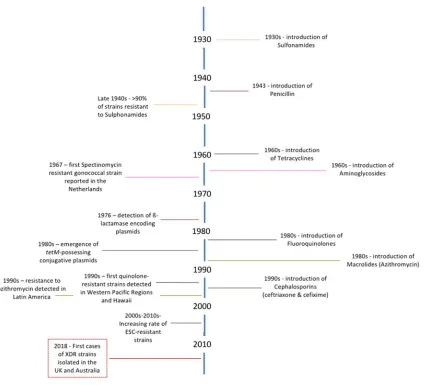
Gonorrhea is a sexually transmitted disease (STD) caused by the obligate human pathogen Neisseria gonorrhoeae. This disease has a high morbidity burden, with more than 106 million new cases being diagnosed every year worldwide [1]. In fact, this morbidity is increasing exponentially due to the fact that gonococci have an extraordinary ability to develop resistances to all antimicrobials introduced for its treatment (Figure 1) [ 2, 3].
The issue with drug-resistant N. gonorrhoeae has become such that the Centers for Disease Control (CDC) classified it as a “Superbug” in 2012, already alerting about a near future in which gonorrhea would become untreatable [4]. Furthermore, the World Health Organization (WHO) classified it as a “Priority 2” microorganism in the recently published WHO Global Priority List of Antibiotic-Resistant Bacteria to Guide
Research, Discovery, and Development of New antibiotics [5]. This document highlights
the importance of developing new antibiotics to treat this disease, seeing as existence of N. gonorrhoeae strains resistant to 3rd generation cephalosporins and
fluoroquinolones have already been reported. In fact, the first “super-resistant” strain was recently reported in the United Kingdom, showing resistance against the current first line treatment which consists in dual therapy with azithromycin and ceftriaxone [6].
4
5 2. Current treatment
Generally, treatment for gonococcal infection is given at first clinical visit, which implies that antimicrobial susceptibility is rarely performed prior to prescription. According to WHO guidelines [8], first-line antimicrobial therapy must be highly effective, widely available and affordable, lack toxicity, single dose and rapidly cure at least >95% of infected patients.
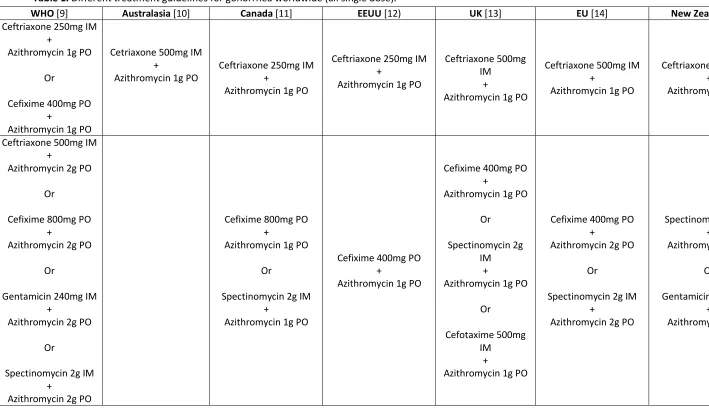
Different health organizations worldwide have established treatment guidelines against gonorrhea, mostly consisting in dual therapy with a single oral or intramuscular dose of a third-generation cephalosporin (250-500mg IM ceftriaxone or 400mg PO cefixime) in combination with a single oral dose of 1-2g of azithromycin [9-15] (Table 1).
6 Table 1. Different treatment guidelines for gonorrhea worldwide (all single dose).
WHO [9] Australasia [10] Canada [11] EEUU [12) UK [13] EU [14] New Zealand [15]
Ceftriaxone 250mg IM +
Azithromycin 1g PO
Or
Cefixime 400mg PO +
Azithromycin 1g PO
Cetriaxone 500mg IM +
Azithromycin 1g PO
Ceftriaxone 250mg IM +
Azithromycin 1g PO
Ceftriaxone 250mg IM +
Azithromycin 1g PO
Ceftriaxone 500mg IM
+
Azithromycin 1g PO
Ceftriaxone 500mg IM +
Azithromycin 1g PO
Ceftriaxone 250mg IM +
Azithromycin 1g PO
Ceftriaxone 500mg IM +
Azithromycin 2g PO
Or
Cefixime 800mg PO +
Azithromycin 2g PO
Or
Gentamicin 240mg IM +
Azithromycin 2g PO
Or
Spectinomycin 2g IM +
Azithromycin 2g PO
Cefixime 800mg PO +
Azithromycin 1g PO
Or
Spectinomycin 2g IM +
Azithromycin 1g PO
Cefixime 400mg PO +
Azithromycin 1g PO
Cefixime 400mg PO +
Azithromycin 1g PO
Or
Spectinomycin 2g IM
+
Azithromycin 1g PO
Or
Cefotaxime 500mg IM
+
Azithromycin 1g PO
Cefixime 400mg PO +
Azithromycin 2g PO
Or
Spectinomycin 2g IM +
Azithromycin 2g PO
Spectinomycin 2g IM +
Azithromycin 1g PO
Or
Gentamicin 240mg IM +
7 3. Future perspectives
8
Table 2. Antigonococcal agents currently under development. FUTURE
OPTIONS NAME
ACTION
MECHANISM STRUCTURE REFERENCE
Drug
repurposing
Sitafloxacin
DNA gyrase and
topoisomerase IV
inhibitor
17, 18
Delafloxacin
DNA gyrase and
topoisomerase IV
inhibitor
19
Novel dual
therapies - - 20, 21
New
antibacterial
agents
Solithromycin Protein synthesis
inhibitor 22-24
Zoliflodacin
Spiropyrimidine
trione
topoisomerase
inhibitor
9
Gepotidacin
DNA gyrase and
topoisomerase IV
inhibitor
22, 27, 28
Lefamulin Protein synthesis
inhibitor 29, 30
Aminoethyl
spectinomycins
Protein synthesis
inhibitor 31
Alternative
therapies
IL-12
Induction of
immune
response
- 32
Lactobacillus
crispatus
Biosurfactant
and acidic
environment
- 33
Monocaprin
Myristoleic
acid
Cell membrane
10
3.1. Repurposing of already existing antibiotics
Considering the fact that untreatable gonorrhea has indeed become a reality, the need for new treatment options has become a pressing issue. For this reason, the scientific community has turned to trying new combinations of already existing antibiotics as the fastest way to fight multi-resistant superbugs. Along these lines, Jönsson et al. studied the viability of introducing sitafloxacin, a newer-generation broad spectrum fluoroquinolone mostly used for respiratory infections, as part of a dual therapy against gonococci [17]. In the study, sitafloxacin was tested against a global gonococcal panel of 250 isolates, showing a rapid bactericidal effect with a Minimum Inhibitory Concentration (MIC) range of ≤0.001-1mg/L. These results prove that sitafloxacin is a good candidate to be included in the dual antimicrobial therapy for gonorrhea in cases with cephalosporin resistance or allergy.
Along these lines, another study focuses on the evaluation of sitafloxacin and 5 additional fluoroquinolones against ciprofloxacin-resistant N. gonorrhoeae isolates [18]. The in vitro potency of sitafloxacin was substantially higher compared with the other 5 fluoroquinolones, with a MIC range of 0.03-0.5mg/L against the ciprofloxacin-resistant strains. These results further confirm the utility of sitafloxacin in a dual antimicrobial therapy.
Another fluoroquinolone currently being studied for the treatment of gonorrhea is delafloxacin [19]. Soge et al. evaluated the activity of delafloxacin against 117 strains of N. gonorrheae. Results showed a MIC range of ≤0.001-0.25µg/mL, which is higher than that of ciprofloxacin, penicillin, tetracycline, azithromycin and spectinomycin. Further studies are required to correlate these promising in vitro results with clinical treatment outcomes.
11
Gentamicin is already included in several guidelines in combination with azithromycin as an alternative treatment option when main treatment options fail. A recent study studies the synergistic effect of this combination along with gentamicin combined with 5 other antimicrobials (cefixime, ceftriaxone, spectinomycin, azithromycin, moxifloxacin and ertapenem) [21]. The study concludes that gentamicin in combination with ertapenem or cefixime could be introduced as new antimicrobial dual therapy seeing as these combinations showed maximum efficacy and synergism against 75 gonococcal strains.
3.2. New Antibiotics
However, seeing as gonococci have proven to be able to develop resistances to all antibiotics introduced for its treatment, the long-term solution includes the development of new antibiotics. Ideally, these new antibiotics should belong to antibacterial families different to the ones already included in treatment guidelines in order to delay as much as possible the appearance of resistances.
Along these lines, WHO launched the Global Antibiotic Research and Development Partnership (GARDP) in order to work with experts to draw a plan to meet the urgent need for new drugs to treat gonorrhea [22]. Within this partnership, experts analyze current drugs in clinical development for the treatment of this disease. Currently, only 3 molecules have reached clinical trials: Solithromycin, Zoliflodacin and Gepotidacin.
Solithromycin is a broad-spectrum oral fluoroketolide which targets 3 prokaryotic ribosomal sites [23]. In vitro studies against 246 clinical isolates and international reference strains of N. gonorrhoeae showed promising results, with a MIC range of 0.001-32µg/mL, showing more activity than the antimicrobials currently recommended for its treatment. Phase II clinical trials concluded with 100% efficacy for infection in men and women for all studied sites (genital, oral and rectal) [24]. This drug is currently in Phase III trials.
12
considerably lower to that of most drugs currently being used for treatment but, most importantly, it did not present any cross-resistance to these antimicrobials.
Similarly, Farrell et al. studied the antigonococcal activity of Gepotidacin, a novel triazaacenaphthylene antibacterial which inhibits bacterial DNA gyrase and topoisomerase IV via a unique mechanism [27, 36]. The compound had a MIC50 and
MIC90 of 0.12 and 0.25mg/L respectively against 25 N. gonorrhoeae strains, including 5
ciprofloxacin non-susceptible strains. Moreover, synergism studies showed that no antagonism occurred when gepotidacin was combined with levofloxacin, azithromycin, tetracycline and ceftriaxone; while the combination of gepotidacin with moxifloxacin had a synergistic effect. This drug candidate underwent a Phase II evaluation, showing that oral doses of gepotidacin were ≥95% effective in treating uncomplicated urogenital gonorrhea [28].
Along with these 3 drugs in clinical trials, other compounds being developed to treat gonorrhea are still in early experimental phases. This is the case of Lefamulin, a novel semi-synthetic pleuromutilin, recently evaluated against 251 gonococcal clinical isolates, including multidrug-resistant and extensively-drug resistant samples [29]. The compound showed potent activity, MIC range of 0.004-2mg/L, against gonococcal isolates and no significant cross-resistance to other antimicrobials. Furthermore, this compound has also been proven to be active against the other most relevant bacterial pathogens causing STIs, Chlamydia trachomatis and Mycoplasma genitalium, proving to be a good candidate first-line antibiotic for the treatment of STIs [30]. However promising, further studies are required in order to consider the introduction of Lefamulin as a first-line treatment option.
For that matter, Butler et al. studied aminoethyl spectinomycins, a new class of semisynthetic analogs of the antibiotic spectinomycin, for the treatment of drug-resistant gonococci [31]. The studied compounds presented increased potency against
N. gonorrhoeae compared to spectinomycin. Furthermore, these compounds also
13
3.3. Alternative therapies
In addition to new antibiotics, alternative therapies to combat increasingly resistant N. gonorrhoeae are being developed. These alternatives are mainly focused on the prevention of recurring infections rather than on the treatment of the disease. In this regard, early in vivo studies have been performed regarding the intravaginal administration of interleukin-12 (IL-12) in mice [32]. The study concludes that intravaginally administered IL-12 promotes Th1-driven adaptive immune response, including the production of specific anti-gonococcal antibodies which would prevent recurring infection.
On a similar note, Foschi et al. studied the efficacy of vaginal lactobacilli in reducing N. gonorrhoeae viability [33]. The study assessed the anti-gonococcal activity of 14 vaginal Lactobacillus strains belonging to L. crispatus, L. gasseri and L. vaginalis. It was found that the acidic environment associated to lactobacilli metabolism is extremely effective in counteracting gonococcal growth, with complete abolishment of gonococci viability being observed at pH<4.0. Furthermore, results showed that lactobacilli cells are able to reduce viability and co-aggregate with gonococci. This is achieved by released-surface components with biosurfactant properties produced by lactobacilli. The study concludes that specific Lactobacillus strains, mainly belonging to
L. crispatus, are able to counteract gonococcal viability through multiple mechanisms,
representing a new potential probiotic strategy for the prevention of infection in women.
Prophylaxis is especially important during pregnancy, seeing as neonatal conjunctivitis is commonly caused by N. gonorrhoeae [34]. The most common approach is ophthalmic prophylaxis with antibiotic ointments. However, due to the increasing appearance of resistances, these are becoming less effective. Churchward et
al. studied 37 fatty acids or fatty acid derivatives for fast antigonococcal activity [35].
14 4. Conclusions
Neisseria gonorrhoeae is a public health threat worldwide due to the increasing
number of antibiotic-resistant strains. Current treatment guidelines include first-line treatments as well as alternative treatments which should only be prescribed in case of allergy or presence of resistance. However, most of these guidelines are already being challenged by this “Superbug”. This has lead the scientific community to develop new antibiotics and alternative therapies in order to control this disease. These new treatment options require not only high antigonococcal potency, but also no cross-resistance with current antibiotics in order to assure its applicability in the long-run. Alternative therapies, on the other hand, have focused on preventing infections rather than treating them and, therefore, controlling the disease before it has a chance of developing further resistances.
Author Contributions: B.S.G. and M.T.P.G. conceived and wrote the paper.
Conflicts of interest: The authors declare no conflict of interest.
ORCID iD
15 References
1. World Health Organization (WHO). 2012. Global action plan to control the spread and impact of antimicrobial resistance in Neisseria gonorrhoeae.
http://apps.who.int/iris/bitstream/10665/44863/1/9789241503501_eng.pdf
2. Bolan, G.A.; Sparling, P.F.; Wasserheit, J.N. The emerging threat of untreatable gonococcal infection. N. Eng. J. Med. 2012, 366, 485-487.
3. Hook, E.W. 3rd; Kirkcaldy, R.D. A Brief History of Evolving Diagnostics and Therapy for Gonorrhea: Lessons Learned. Clin. Infect. Dis. 2018. doi: 10.1093/cid/ciy271.
4. Centers for Disease Control and Prevention (CDC). Cephalosporin-resistant
Neisseria gonorrhoeae public health response plan. 2012, 1-43.
5. World Health Organization (WHO). 2017. Global Priority List of Antibiotic-Resistant Bacteria to Guide Research, Discovery, and Development of New Antibiotics. http://www.who.int/medicines/publications /WHO-PPL-Short_Summary_25Feb-ET_NM_WHO.pdf
6. Fifer, H.; Natarajan, U; Jones, L.; Alexander, S.; Hughes, G.; Golparian, D.; Unemo, M. Failure of Dual Antimicrobial Therapy in Treatment of Gonorrhea.
N. Eng. J. Med. 2016; 734, 2504-2506.
7. Suay-Garcia, B.; Pérez-Gracia, M.T. Drug-Resistant Neisseria gonorrhoeae: latest developments. Eur. J. Clin. Microbiol. Infect. Dis. 2017, 36, 1065-1071. Doi: 10.1007/s10096-017-2931-x.
8. World Health Organization (WHO). [22nd April 2018, date last accessed]
Strategies and laboratory methods for strengthening surveillance of sexually
transmitted infections.
http://www.who.int/reproductivehealth/publications/rtis/9789241504478/en/
9. World Health Organization (WHO). [22nd April 2018, date last accessed].
Guidelines for the treatment of Neisseria gonorrhoeae.
http://www.who.int/reproductivehealth/publications/rtis/gonorrhoea-treatment-guidelines/en/
10.Australasia Sexual Health Alliance. [22nd April 2018, date last accessed].
Australian STI Management Guidelines for Use in Primary Care.
http://www.sti.guidelines.org.au/sexually-transmissible-infections/gonorrhoea
11.Public Health Agency of Canada. [22nd April 2018, date last accessed]. Canadian
Guidelines on Sexually Transmitted Infections.
https://www.canada.ca/en/public-health/services/infectious-diseases/sexual-
health-sexually-transmitted-infections/canadian-guidelines/sexually- transmitted-infections/canadian-guidelines-sexually-transmitted-infections-34.html
16
13.Centers for Disease Control and Prevention (CDC). [22nd April 2018, date last
accessed]. Sexually Transmitted Diseases Treatment Guidelines.
https://www.cdc.gov/std/tg2015/gonorrhea.htm
14.Bignell, C., Fitzgerald. M.; Guideline Development Group; British Association for Sexual Health and HIV UK. UK national guideline for the management of
gonorrhea in adults. Int. J. STD. AIDS 2011, 22, 541-547.
15.The New Zealand Sexual Health Society. [22nd April 2018, date last accessed].
New Zealand Guideline for the Management of Gonorrhea 2014, and Response
to the Threat of Antimicrobial resistance.
http://www.nzshs.org/docman/guidelines/best-practice-guidelines/142-new- zealand-guideline-for-the-management-of-gonorrhoea-2014-and-response-to-the-threat-of-antimicrobial-resistance/file
16.Lee, H.; Lee, K.; Chong, Y. New treatment options for infections caused by increasingly antimicrobial-resistant Neisseria gonorrhoeae. Expert. Rev. Anti.
Infect. Ther. 2016, 14, 243-256. doi: 10.1586/14787210.2016.1134315.
17.Jönsson, A.; Sunniva, F.; Golparian, D.; Hamasuna, R.; Jacobsson, S.; Lindberg, M.; Jensen, J.S.; Ohnishi, M.; Unemo, M. In vitro activity and time-kill curve analysis of sitafloxacin against a global panel of antimicrobial-resistant and multidrug-resistant Neisseria gonorrhoeae isolates. APMIS 2018, 126, 29-37. 18.Hamasuna, R.; Ohnishi, M.; Matsumoto, M.; Okumura, R.; Unemo, M.;
Matsumoto, T. In vitro activity of sitafloxacin and additional newer generation Fluoroquinolones against ciprofloxacin-resistant Neisseria gonorrhoeae isolates. Microb. Drug. Resist. 2018, 24, 30-34.
19.Soge, O.O.; Salipante, S.J.; No, D.; Duffy, E.; Roberts, M.C. In Vitro Activity of Delafloxacin against Clinical Neisseria gonorrhoeae Isolates and Selection of Gonococcal Delafloxacin Resistance. Antimicrob. Agents Chemother. 2016, 60, 3106-3111. doi: 10.1128/AAC.02798-15.
20.Singh, V.; Bala, M.; Bhargava, A.; Kakran, M.; Bhatnagar, R. In vitro efficacy of 21 dual antimicrobial combinations comprising novel and currently recommended combinations for treatment of drug resistant gonorrhoea in future era. PLoS One 2018, 13, e0193678.
21.Singh, V.; Bala, M.; Bhargava, A.; Kakran, M.; Bhatnagar, R. In vitro synergy testing of gentamicin, an old drug suggested as future treatment option for gonorrhoea, in combination with six other antimicrobials against multidrug-resistant Neisseria gonorrhoeae strains. Sex. Transm. Dis. 2018, 45, 127-131. 22.Alirol, E.; Wi, T.E.; Bala, M.; Bazzo, M.L.; Chen, X.S.; Deal, C.; Dillon, J.R.;
17
23.Golparian, D.; Fernandes, P.; Ohnishi, M.; Jensen, J.S.; Unemo, M. In vitro activity of the new fluoroketolide solithromycin (CEM-101) against a large collection of clinical Neisseria gonorrhoeae isolates and international reference strains, including those with high-level antimicrobial resistance: potential treatment option for gonorrhea? Antimicrob. Agents Chemother. 2012, 56, 2739–2742.
24.Hook, E.W. 3rd; Golden, M.; Jamieson, B.D.; Dixon, P.B.; Harbison, H.S.; Lowens,
S.; Fernandes, P. A Phase 2 Trial of Oral Solithromycin 1200 mg or 1000 mg as Single-Dose Oral Therapy for Uncomplicated Gonorrhea. Clin. Infect. Dis. 2015 ,
61, 1043–1048.
25.Huband, M.D.; Bradford, P.A.; Otterson, L.G.; Basarab, G.S.; Kutschke, A.C.; Giacobbe, R.A.; Patey, S.A.; Alm, R.A.; Johnstone, M.R.; Potter, M.E.; Miller, P.F.; Mueller, J.P. In vitro antibacterial activity of AZD0914, a new spiropyrimidinetrione DNA gyrase/topoisomerase inhibitor with potent activity against Gram-positive, fastidious Gram-Negative, and atypical bacteria.
Antimicrob. Agents Chemother. 2015, 59, 467–474.
26.Unemo, M.; Ringlander, J.; Wiggins, C.; Fredlund, H.; Jacobsson, S.; Cole, M. High in vitrosusceptibility to the novel spiropyrimidinetrione ETX0914 (AZD0914) among 873 contemporary clinical Neisseria gonorrhoeae isolates from 21 European countries from 2012 to 2014. Antimicrob. Agents Chemother. 2015, 59, 5220–5225.
27.Farrell, D.J.; Sader, H.S.; Rhomberg, P.R.; Scangarella-Oman, N.E.; Flamm, R.K.
In vitro Activity of Gepotidacin (GSK2140944) against Neisseria gonorrhoeae. Antimicrob. Agents Chemother. 2017, 61, e02047-16. Doi:
10.1128/AAC.02047-16.
28.Taylor SN, Morris DH, Avery AK, Workowski KA, Batteiger BE, Tiffany CA, Perry CR, Raychaudhuri A, Scangarella-Oman NE, Hossain M, Dumont EF. Gepotidacin for the Treatment of Uncomplicated Urogenital Gonorrhea: A Phase 2, Randomized, Dose-Ranging, Single-Oral Dose Evaluation. Clin. Infect. Dis. 2018. doi: 10.1093/cid/ciy145.
29.Jacobsson, S.; Paukner, S.; Golparian, D.; Jensen, J.S.; Unemo, M. In vitro activity of the novel pleuromutilin lefamulin (BC-3781) and effect of efflux pump inactivation on multidrug-resistant and extensively-drug resistant
Neisseria gonorrhoeae. Antimicrob. Agents Chemother. 2017, 61, e01497.
30.Paukner, S.; Gruss, A.; Jensen, J.S. In Vitro Activity of Lefamulin against Sexually Transmitted Bacterial Pathogens. Antimicrob. Agents Chemother. 2018, 62, e02380-17. doi: 10.1128/AAC.02380-17.
31.Butler, M.M.; Waidyarachchi, S.L.; Connolly, K.L.; Jerse, A.E.; Chai, W.; Lee, R.E.;Kohlhoff, S.A.;Shinabarger, D.L.;Bowlin TL .Aminoethyl spectinomycins as therapeutics for drug-resistant gonorrhea and chlamydial co-infections.
Antimicrob. Agents Chemother. 2018, 65, e00325-18. Doi:
18
32.Liu, Y.; Perez, J.; Hammer, L.A.; Gallagher, H.C.; de Jesus, M.; Egilmez, N.K.; Russell, M.W. Intravaginal Administration of Interleukin 12 during Genital Gonococcal Infection in Mice Induces Immunity to Heterologous Strains of
Neisseria gonorrhoeae. mSphere 2018, 3, e00421.
33.Foschi, C.; Salvo, M.; Cevenini, R.; Parolin, C.; Vitali, B.; Marangoni, A. Vaginal Lactobacilli Reduce Neisseria gonorrhoeae Viability through Multiple Strategies: An in vitro Study. Front. Cell Infect. Microbiol. 2017, 7, 502.
34.Darling, E.K.; McDonald, H. A meta-analysis of the efficacy of ocular prophylactic agents used for the prevention of gonococcal and chlamydial ophtalmia neonatorum. J. Midwif. Womens Health 2010, 55, 319-327.
35.Churchward, C.P.; Alany, R.G.; Kirk, R.S.; Walker, A.J.; Snyder, L.A.S. Prevention of Ophthalmia Neonatorum Caused by Neisseria gonorrhoeae Using a Fatty Acid-Based Formulation. MBio. 2017, 8, e00534-17. doi: 10.1128/mBio.00534-17.