Article
1
Hybrid Machine Learning Model of Support Vector
2
Machine and Fruit Fly Optimization Algorithm for
3
Prediction of Remaining Service Life of Flexible
4
Pavement
5
Nader Karballaeezadeh 1, Adrienn Dineva 2, Amir Mosavi 3, Narjes Nabipour 4,*, Shahaboddin
6
Shamshirband 5,6,*, Danial Mohammadzadeh 7,8
7
1Department of Civil Engineering, Shahrood University of Technology, Shahrood, Iran:
8
9
2 Kalman Kando Faculty of Electrical Engineering, Obuda University, 1034 Budapest, Hungary
10
3 Queensland University of Technology (QUT), 130 Victoria Park Road, Queensland 4059, Australia
11
4 Faculty of Information Technology, Ton Duc Thang University, Ho Chi Minh City, Vietnam;
12
5 Department for Management of Science and Technology Development, Ton Duc Thang University, Ho Chi
13
Minh City, Vietnam
14
6 Faculty of Information Technology, Ton Duc Thang University, Ho Chi Minh City, Vietnam
15
7 Department of Civil Engineering, Ferdowsi University of Mashhad, Mashhad 9177948974, Iran
16
8 Department of Elite Relations with Industries, Khorasan Construction Engineering Organization, Mashhad
17
9185816744, Iran
18
* Correspondence: [email protected]
19
20
Abstract: Remaining service life (RSL) of pavement, as a sign of future pavement performance, has
21
always received growing attention from pavement engineers. The RSL describes the time from the
22
moment of pavement inspection until such a time when a major repair or reconstruction is required.
23
The conventional approach to determining RSL involves using non-destructive tests. These tests, in
24
addition to being costly, interfere with traffic flow and compromise users' safety. In this paper,
25
surface distresses of pavement have been used to estimate the pavement’s RSL in order to eliminate
26
the aforementioned problems and challenges. To implement the proposed theory, 105 flexible
27
pavement segments were taken from Shahrood-Damghan Highway (Highway 44) in Iran. For each
28
pavement segment, the type, severity, and extent of surface damage and pavement condition index
29
(PCI) were determined. The pavement RSL was then estimated using non-destructive tests include
30
Falling Weight Deflectometer (FWD) and Ground Penetrating Radar (GPR). After completing the
31
dataset, the modeling was conducted to predict RSL using three techniques include Support Vector
32
Regression (SVR), Support Vector Regression Optimized by Fruit Fly Optimization Algorithm
33
(SVR-FOA), and Gene Expression Programming (GEP). All three techniques estimated the RSL of
34
the pavement by selecting the PCI as input. The Correlation Coefficient (CC), Nash-Sutcliffe
35
efficiency (NSE), Scattered Index (SI), and Willmott’s Index of agreement (WI) criteria were used to
36
examine the performance of the three techniques adopted in this study. In the end, it was found that
37
GEP with values of 0.874, 0.598, 0.601, and 0.807 for CC, SI, NSE, and WI criteria, respectively, had
38
the highest accuracy in predicting the RSL of pavement.
39
Keywords: hybrid machine learning model; transportation infrastructure; flexible pavement;
40
remaining service life prediction; pavement condition index; support vector regression; fruit fly
41
optimization algorithm (FOA); gene expression programming (GEP); SVR-FOA
42
43
44
1. Introduction
45
Predicting future pavement conditions and estimating its service life is one of the fundamental tasks
46
of pavement engineers in pavement management systems (PMSs), as the future network conditions
47
act as a prerequisite for the planning, prioritization, and allocation of resource [1]. In general,
48
pavement management activities are split into two categories [2]: network-level management and
49
project-level management. Project-level management specifies roads that need to be repaired, repair
50
process, and repair timetable. Therefore, predicting future conditions of pavement is essential for
51
network-level management [2]. Forecasting pavement future conditions will require ongoing
52
pavement assessment and inspection that will improve the operational quality of maintenance
53
operations [3,4]. On the other hand, network-level management focuses on determining the budget
54
required to preserve the pavement network at the standard level. Hence, it is indispensable to
55
determine the remaining service life (RSL) of payment at this level of management [2]. Various factors
56
such as traffic, characteristics of pavement materials, subgrade properties, climatic conditions, and
57
maintenance quality have a destructive impact on the road pavement. As a result, pavement service
58
life is surrounded by uncertainties that complicate the prediction of RSL [5].
59
In recent years, several indices have been developed for pavement evaluation. One of these indicators
60
is the pavement condition index (PCI), which represents the general conditions of the pavement
61
surface and ranges from zero for a practically unusable pavement to 100 for a flawless pavement. PCI
62
is determined based on pavement inspection results in terms of type, severity, and extent of distresses
63
[6,7]. The PCI estimation requires an experienced inspector to determine PCI after a thorough
64
inspection of pavement surface distresses. Conversely, RSL of pavement, which is one of the pillars
65
of network-level pavement management, is determined by applying Falling Weight Deflectometer
66
(FWD) non-destructive test. In this test, a traffic lane is first blocked. Then an impulsive loading is
67
applied to the pavement to induce pavement surface deflections. By analyzing pavement surface
68
deflections, the RSL is calculated. A key point in calculating the RSL using the above method is
69
knowing the pavement layers thickness for the analysis of deflections. The thickness of the pavement
70
layers is determined by the Ground Penetrating Radar (GPR) non-destructive test. As a result, two
71
non-destructive tests are required to determine the RSL of pavement. Also, traffic interference during
72
FWD and GPR tests should not be forgotten[8].
73
In light of the above, the current method of determining RSL is not only costly but also compromises
74
the safety of inspectors due to traffic interference during testing. Given the limited budget resources
75
of transportation agencies, determining the RSL of pavement to manage a pavement network
76
represents one of the ongoing concerns of such companies[4]. One way to overcome these problems
77
is to employ artificial intelligence models. In this paper, three methods of Support Vector Regression
78
(SVR), SVR-FOA (Support Vector Regression Optimized by Fruit Fly Optimization Algorithm), and
79
Gene Expression Programming (GEP) have been applied to predict the RSL of road pavements. For
80
PCI is an index adopted in the project-level pavement management process. Hence, this index is
82
specified before entering network-level pavement management. As such, using PCI for network-level
83
management operations, such as estimation of RSL, will contribute to the overlapping of activities
84
and saving time. The methods presented in this paper, by excluding non-destructive tests from the
85
process of determining the RSL of pavement, drastically reduce costs associated with the pavement
86
network management. On the other hand, by eliminating non-destructive tests, traffic interference
87
during testing and the potential safety hazards to inspectors are also eliminated. The data required
88
for developing the methods proposed in this paper was collected from Shahrood-Damghan highway
89
in Semnan province, Iran. The pavement type of this highway is flexible. In this highway, a 100-m
90
long pavement segment was taken from the beginning of each kilometer, and after assessing the
91
surface distresses of each segment, its PCI was calculated. In the next step, FWD and GPR tests were
92
applied to the selected segments to determine the RSL. Finally, using three SVR, SVR-FOA and GEP
93
methods, the RSL modeling based on PCI was implemented.
94
This paper is organized as follows: Section 2 offers a review of studies on the prediction of RSL.
95
Section 3 introduces the method employed in this study. This section is made of four sub-sections
96
titled PCI, RSL, artificial intelligence techniques, and case study. In Section 4, the results of the
97
analyses are presented and discussed. Finally, the conclusions are drawn in Section 5.
98
99
2. Literature Review
100
PMS is an assessment management system (AMS) used by road network administrators to maintain
101
the entire network at the desired level. Predicting pavement performance is a key factor in PMSs [9].
102
The models of predicting pavement’s RSL fall in the category of the pavement performance
103
prediction models. In this section, studies carried out by other researchers on predicting RSL are
104
reviewed. Table 1 lists the results of studies that have strived to estimate RSL to date.
105
106
Table 1. Models for the prediction of RSL[10-17]
107
Category Model inputs Equation Author
1. Based on
pavement
responses
ℇt = Tensile strain at the
bottom of the asphalt layer,
E1 = Elastic modulus of
asphalt.
RSLfatigue= f1(εt)−f2(E1)−f3
Huang
(1993)
ℇc = Compressive strain at the
top of the subgrade. RSLrutting = f4(εc)
−f5 Huang
(1993)
ℇt = Tensile strain at the
asphalt layer bottom,
RSLfatigue= 0.1001(εt)
− 3.565(MR)−1.4747
Das &
Pandey
MR = Resilient modulus.
ℇr = Horizontal tensile strain
at the bottom of the asphalt
layer,
EAC = Modulus of asphalt.
ln(RSLfatigue) = a − b ln(εr)
− c ln(EAC)
Hossain &
Wu (2002)
ℇt = Tensile strain at the
asphalt layer bottom. RSLfatigue= K(εt)
−C Park & Kim
(2003)
2. Based on
pavement
quality
indices
IRI = International roughness
index. RSL =
ln(IRIterminal
a )
b − (Current age)
Al-suleiman &
Shiyab
(2003)
PCI = Pavement Condition
Index. RSL = 4.1872 ln(PCI) − 14.728
Setyawan
et al (2015)
3. Based on
the result of
the
non-destructive
test
δ = Pavement surface
curvature,
δ = D0− D20
RSLfatigue= α (
1
0.0023δ + 0.00002)
β Saleh
(2016)
AUPP = Area under
pavement profile,
AUPP
=5D0− 2D30− 2D60− D90
2
RSLfatigue
= α( 1
0.0000023AUPP0.912)
β
Saleh
(2016)
108
In Table 1, the models of determining RSL of pavement are divided into three categories based on the
109
model inputs:
110
• First category: Models that predict RSL based on the response (stress and strain) of pavement to
111
the applied loads.
112
• Second category: Models that predict RSL based on pavement quality indices.
113
• Third Category: Models that predict RSL based on the results of pavement non-destructive tests.
114
Among the above categories, models that predict remaining pavement service based on qualitative
115
indices appear to be more appropriate. It is because such models neither call for the analysis of
116
pavement behavior and response, as in the first category nor require non-destructive tests, like the
117
third category. Instead, they estimate the RSL of the pavement by assessing pavement and calculating
118
a qualitative index in the simplest possible way. In light of the above points, in this paper, PCI has
119
results of which are displayed in Table 1. The model presented in their study was based on data
121
collected from only 5 pavement segments in the Microsoft Excel software, which cast doubt on the
122
reliability of the model. In contrast, the methods proposed in this paper are based on the data
123
gathered from more than 100 pavement segments using artificial intelligence methods.
124
In general, PCI offers a valid index accepted by all transportation agencies around the world, and it
125
is widely used in their evaluations. Compared to the current method of estimating the RSL of
126
pavements (using two non-destructive FWD and GPR tests), the proposed method provides a far
127
simpler, safer and less costly way of estimating RSL.
128
129
3. Methodology
130
3.1. Pavement Condition Index (PCI)
131
PCI was developed by U.S. Army Crops of Engineers as a performance benchmark for PMSs[7].
132
Extensively used in roads, parking lots, and airports, PCI is recognized as a standard practice by
133
many organizations around the world, including the Federal Aviation Administration, the American
134
Public Works Association, and the U.S. Air Force[18]. PCI is a numerical index that expresses the rate
135
of pavement surface distresses. PCI exhibits structural integrity and Surface operational condition
136
but is not able to measure structural capacity[19].
137
To determine PCI in a pavement segment, the pavement surface of the segment is inspected, and
138
their surface distresses are recorded in the assessment form. The PCI of a pavement sample unit
139
depends on the type, extent, and severity of its surface damages. In the PCI calculation process, a
140
perfect and flawless pavement receives a maximum score of 100. For defective pavements, the score
141
is deducted from 100 incommensurate with the type, extent, and severity of the damage[7,18,19]. In
142
general, PCI can be computed using Eq. 1[4]:
143
144
PCI = 100 − ∑ni=1(Distress Score) (1)
where: PCI = Pavement Condition Index, distress Score = Score based on type, extent, and severity of
145
distresses, n = Number of distresses. The instructions for calculating distress scores are fully described
146
in ASTM D6433-07. The classification of a pavement segment based on PCI is according to Table 2.
147
148
Table 2. PCI rating scale[19]
149
Rating
Scale 0-10 10-25 25-40 40-55 55-70 70-85 85-100
Description Faile
d Serious
Very
Poor Poor Fair Satisfactory Good
150
3.2. Remaining Service Life (RSL)
The RSL of pavement under operation is a key factor in implementing PMSs. It is because learning
152
about the future conditions of the pavement network is essential for decision making, life cycle cost
153
analysis, planning and budget allocation[8,20]. In general, the definitions of RSL by different agencies
154
and departments of transportation can be split into two general categories[21]:
155
• The remaining time to reach a level of distress when the pavement needs to be rehabilitated or
156
reconstructed. For example, the Minnesota Department of Transportation (MnDOT) defines
157
the RSL as the time until the next major rehabilitation.
158
• The time until pavement conditions reach a specific condition index limit. For example, the
159
Michigan Department of Transportation (MDOT) defines the RSL based on the Michigan
160
Ride Quality Index, assuming an RSL of zero when the said index is 50.
161
The RSL of pavement segments in this paper has been determined using Heavy Falling Weight
162
Deflectometer (HWD). The HWD is an FWD, the application of which is not constricted to the road
163
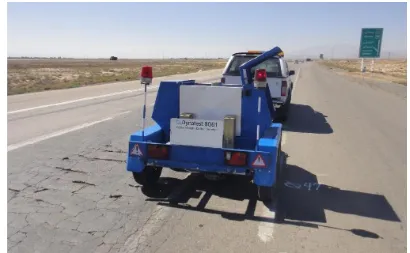
and could be used for airport pavement assessment. Figure 1 shows the HWD device employed in
164
this study.
165
166
Fig. 1. HWD used in this study for determining RSL
167
168
The HWD applies a tension similar to the standard axle load (8.2 tons) to the pavement surface over
169
10 to 35 milliseconds. A number of geophones are placed on the pavement surface at specified
170
distances from the loading center. The task of the geophones is to record the pavement deflections
171
induced by the load applied with the HWD device. Standard axle load simulation in HWD is
172
generated by a series of weight drops on a loading plate placed on the pavement surface[8]. Table 3
173
reveals the details of the HWD test undertaken in this study.
174
176
Table 3. HWD test details[22]
177
Parameter Value
Tension (Kpa) 600 – 900
Number of geophones 9
Geophone distance from center of laoding plate
(cm)
0, 20, 30, 45, 60, 90, 120, 150, and
180
Number of weights falling Four times
Loading plate radius (mm) 150
178
The deflections recorded by geophones are transferred to the central computer in HWD. In this
179
computer, the analysis of pavement surface deflections is performed using ELMOD6 software. One
180
output of this analysis is the estimation of pavement remaining service life under test.
181
A prerequisite of estimating RSL in accordance with the process described in this section is knowing
182
the thickness of pavement layers. For determining the pavement layer's thickness,
ground-183
penetrating radar (GPR) non-destructive testing was carried out for all pavement segments. GPR is
184
capable of calculating pavement thickness as a continuous profile by transmitting electromagnetic
185
waves through a transmit antenna and receiving recursive signals[23]. Table 4 shows the complete
186
details of the GPR experiment carried out in this study.
187
188
Table 4. GPR test details[24,25]
189
Parameter Value
Antenna type 1000 MHz
Record speed (km/hr) 10
Number of scanning (per meter) 10
Maximum pulse penetrating depth
(ns)
32
190
3.3. Artificial intelligent techniques
191
In this paper, the main objective is to present a new approach for predicting the RSL of flexible
192
pavements based on PCI using artificial intelligence techniques. To do so, a dataset of 105 pavement
193
segments was collected from Shahrood-Damghan highway in Iran. The data set consisted of the RSL
194
methods. GEP is an evolutionary algorithm that investigates the relationship between input and
196
output variables by developing computer programs[26]. Different from both the Genetic Algorithm
197
(GA) and Genetic Programming (GP), GEP is a combination of both introduced by Ferreira in 2001[27].
198
SVR is a supervised machine learning technique employed to solve regression problems. SVR is
199
especially popular due to its desirable management and performance in handling nonlinear
200
issues[28]. The success of an SVR in problem-solving depends on the values of its basic parameters.
201
The SVR basic parameters include C, ε, and kernel function parameters[8]. Improper values of the
202
basic parameters in the SVR can lead to under-fitting or over-fitting. Thus, optimum values must be
203
selected for these parameters during training[29]. FOA is an intelligent swarm algorithm introduced
204
by Pan in 2012, which utilizes the food searching strategy of a fruit fly to find the optimal values for
205
SVR basic parameters[30]. These methods are introduced in the following subsections.
206
207
3.3.1. Gene Expression Programming (GEP)
208
GEP is a developed GP method that solves a problem by creating expression trees (ETs). In fact, GEP
209
is an evolutionary algorithm for creating computer programs. The designed computer programs have
210
sophisticated tree structures that are trained similar to a living organism by changing size, shape, and
211
composition, and adapted to the conditions. Like living organisms, GEP programs are coded as
212
simple fixed-length linear chromosomes. Hence, GEP is a genotype-phenotype system that employs
213
a simple genome to store and transmit genetic information and adopts a complex phenotype to
214
explore and adapt to the environment. The genome consists of a chromosome or a fixed-length string
215
that combines one or more genes of the same size. In fact, each chromosome contains one or more
216
genes known as Sub-ETs. In GEP, all Sub-TEs are linked through the root with connection functions.
217
The connection functions in GEP include division, multiplication, subtraction, and addition[31].
218
Figure 2 shows an instance of the genotype-phenotype structure in GEP.
219
220
221
Fig. 2. A sample of the genotype-phenotype structure in GEP[32]
222
These genes, despite their fixed length, are coded for ETs of varying size and shape. It implies that
224
the size of the coding region varies from one gene to another to allow for progressive adaptation and
225
evolution. Each gene has a coding area called Open Reading Frame (ORF), which after being coded
226
as an expression tree, provides a solution to the problem[33]. Figure 3 demonstrates the coding region
227
(ORF), non-coding region, and the expression tree for a gene.
228
229
230
Fig. 3. The coding region (ORF), no-coding region, and expression tree in a gene [34]
231
Like other evolutionary approaches, GEP begins by randomly generating initial population
232
chromosomes. In the first population, each chromosome is assessed based on the fitness function and
233
receives a fitness value. Various fitness functions have been used in GEP, including Root Relative
234
Squared Error (RRSE), Relative Square Error (RSE), Root Mean Square Error (RMSE), and Mean
235
Square Error (MSE)[26]. The proper chromosomes are more likely to be picked in the next generation.
236
After being selected, chromosomes are amended by genetic operators (including transposition,
237
inversion, mutation, recombination, and gene crossover) and then reconstructed. This process is
238
sustained until a suitable solution or the maximum number of generations is reached[26,35].
239
240
3.3.2. Support Vector Regression (SVR)
241
The SVR is actually a support vector machine (SVM) used for regression problems. Supervisor
242
machine learning techniques, including SVR, utilize Structural Risk Minimization (SRM), while
243
conventional neural networks use Empirical Risk Minimization (ERM). ERM minimizes the error of
244
training samples, but SRM is able to minimize a higher level of error. As a result, SVM is capable of
245
overcoming the deficiencies of conventional neural networks[8,28]. The main idea in SVR is to map
246
nonlinear information into a higher dimensional space and then solve a linear regression problem in
247
the new space[28,36,37]. In the new space, a simple linear kernel function is adopted to solve the
248
problem. However, in complex problems, a simple linear kernel function will be inadequate. The
249
k(x, z) =< φ(x). φ(z) > (2)
Each kernel function must have two features[28]:
251
1. Symmetricity
252
k(x, z) =< φ(x). φ(z) >=< φ(z). φ(x) >= k(z, x) (3)
2. Compliance with the Cauchy-Schwartz criterion
253
k(x, z)2=< φ(x). φ(z) >2 ≤ ‖φ(x)‖2‖φ(z)‖2 (4)
These two conditions guarantee that the new space is definable by the kernel function. The most
254
famed kernel functions are Polynomial kernel, Radial Basis Functional kernel, Linear kernel, and
255
Sigmoid kernel [37]. Given the above explanation, it is clear that SVR requires an appropriate function
256
to explain the nonlinear relationship between input (xi) and output (yi)[37]:
257
f(xi) = w. φ(xi) + b (5)
where: φ(xi) = Transformation Function, w = Weight, b = Bias. w and b are obtained by minimizing
258
the following function, which is known as the regularized risk function [37]:
259
R(w) =1
2‖w‖
2+ C ∑ L
ε(yi, f(xi))
N
i=1 (6)
where:
260
1
2‖w‖
2 = Regularization term,
261
C = Penalty coefficient,
262
Lε(yi, f(xi)) = ε-insensitive loss function:
263
Lε(yi, f(xi)) = max{0, |yi, f(xi)| − ε} (7)
where: ε = Permitted error threshold.
264
To solve the optimization boundaries, two factors of ξ and ξ∗ are defined[37]:
265
minf(w,ξ,ξ∗) =1
2‖w‖
2+ C ∑N ( ξ ,ξ∗)
i=1 (8)
Subject to:
266
{ yi− [w. φ(xi)] − b ≤ ε +ξ , ξ≥ 0
[w. φ(xi)] + b − yi≤ ε +ξ∗ , ξ∗≥ 0
(9)
We now need to define a Lagrange function based on the objective function and boundary
267
conditions[37]:
268
269
maxH(∂i−, ∂i+) = −
1
2∑ ∑(∂i
−− ∂ i +)(∂
j −− ∂
j +)K(x
i , xj) N
j=1 N
i=1
+ ∑ yi(∂i−− ∂i+)
N
i=1
− ε ∑ yi(∂i−+ ∂i+)
N
i=1
(10)
∑ yi(∂i−− ∂i+) N
i=1
= 0 , ∂i−, ∂i+ ∈ [0 , C] (11)
Therefore, the regression function can be showed as follows[37]:
271
f(x) = ∑(∂i−− ∂i+)K(xi , xj)
N
i=1
+ b (12)
Where K(xi , xj) = Kernel function.
272
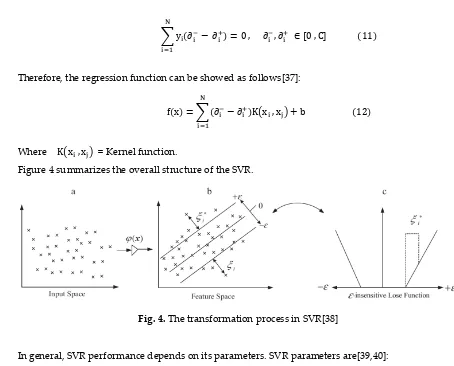
Figure 4 summarizes the overall structure of the SVR.
273
274
Fig. 4. The transformation process in SVR[38]
275
276
In general, SVR performance depends on its parameters. SVR parameters are[39,40]:
277
• ε: this parameter supervises the width of the ε-insensitive zone, used to fit the training data.
278
The value
can affects the number of support vectors used to build the regression function.279
For the bigger ε, estimates are more ‘flat’, and the fewer support vectors are chosen.
280
• C: this parameter specifies the trade-off between the complexity of the model and the grade
281
to which deviations larger than ε are bearable in optimization formulation.
282
• 𝛾: this parameter determines the relation between error minimization and smoothness of the
283
estimated function.
284
These parameters are chosen by the user based on prior knowledge of SVR, so this method is not
285
suitable for non-professional users. Various algorithms have been developed to optimize the amounts
286
of SVR parameters. In the following subsection, one of the optimization algorithms used in this paper
287
is introduced.
288
289
3.3.3. Fruit Fly Optimization Algorithm (FOA)
290
FOA is an optimization algorithm developed based on the food search behavior of the Drosophila
291
insect[30]. The fruit fly has superior smell and vision senses, which discriminates it from other insects.
292
Fruit flies track the smell of the food sources dispersed through the air and heads towards it. This
293
insect is even capable of smell tracking from a distance of 40 km. When approaching the food source,
294
shared among the fruit flies and finally, the route leading to the food source is identified[41]. Figure
296
5 illustrates the process of food search by a fruit fly.
297
298
Fig. 5. Food finding the iterative process of a fruit fly swarm[42].
299
300
In this paper, this optimization algorithm has been selected to find the optimal values of SVR
301
parameters, which is known as SVR-FOA. The general steps of SVR-FOA can be summarized as
302
follows[43,44]:
303
Step 1. SVR parameters (ε , C) initialization and kernel function determination
304
Step 2. Parameter initialization
305
Including the maximum number of iterations, location of initial population (X-axis, Y-axis),
306
population size, and random flight distance domain:
307
X_axis = rands(1,2) (13)
Y_axis = rands(1,2) (14)
Step 3. Population initialization
308
A random location (Xi, Yi) and food founding distance are assigned to each fruit fly:
309
Xi = X_axis + Random value (15)
Yi = Y_axis + +Random value (16)
where: i = Population size.
310
Step 4. Population evaluation
311
The distance from origin to the food source (D) and the smell concentration parameter (S) are
312
calculated:
313
Di= √Xi2+ Yi2 (17)
Si=
1
Di (18)
S value is substituted with the fitness function or smell concentration judgment function so that the
315
smell concentration for each fruit fly location can be attained:
316
Smelli = Function (Si) (19)
Step 6. Detect the maximal smell concentration
317
At this point, the fruit fly with the highest Si is identified and located within the population.
318
319
[bestSmellbestIndex] = max (Smell) (20)
Step 7. Keep smell concentration
320
The coordinates of the maximum smell concentration are set, and the fruit fly swarm flows in that
321
direction.
322
X_axis = X(bestIndex) (21)
Y_axis = Y(bestIndex) (22)
Step 8. Iterative optimization
323
Steps 3 to 6 are repeated until the smell concentration does not show any improvement compared to
324
the previous one or the maximum number of repetitions in Step 2 is reached.
325
Step 9. Output the optimum parameter of SVR
326
327
3.4. Case study
328
To implement the theory proposed in this paper, a stretch of 105 km from Shahrood-Damghan
329
highway in Iran was selected and inspected. Given that this highway is part of the route between
330
Tehran (the capital of Iran) and Mashhad (the second most important city of Iran), it constitutes one
331
of the major roads. The highway consists of two lanes in each direction and uses the flexible pavement.
332
A prerequisite of implementing the proposed theory is to select a number of sample segments from
333
his highway. To do so, segments 100 m in length and 7 m in width were selected from the beginning
334
of each kilometer. By inspecting the selected segments, the surface distress data (type, severity, and
335
extent) of each segment was recorded in the assessment forms. The PCI of each segment was
336
calculated as described in Section 3.1. With PCI known, the RSL of the pavement segments need to
337
be known. Hence, HWD and GPR tests were performed on all segments and the average RSL of each
338
segment was determined. Figure 6 shows the position of the Shahrood-Damghan Highway as well
339
341
Fig. 6. Highway No. 44 (Shahrood-Damghan) map used in this study.
342
343
4. Results and discussion
344
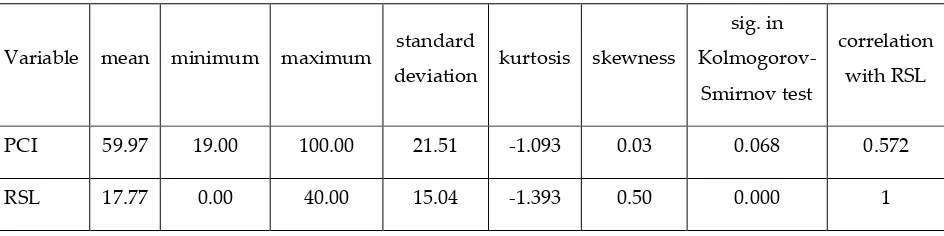
The results of the analysis are presented in this subsection. First, the statistical specifications of the
345
input and output modeling variables are listed in Table 5. The data was extracted from IBM SPSS 23
346
software.
347
Table 5. Statistical characteristics of the utilized data.
348
Variable mean minimum maximum standard
deviation kurtosis skewness
sig. in
Kolmogorov-Smirnov test
correlation
with RSL
PCI 59.97 19.00 100.00 21.51 -1.093 0.03 0.068 0.572
RSL 17.77 0.00 40.00 15.04 -1.393 0.50 0.000 1
349
As depicted in Table 5, the mean PCI of all pavement segments is 59.97, which according to Table 2,
350
is indicative of the fair state of all segments. Also, the mean RSL of pavement is 17.77 years. For
351
interpreting the mean RSL, it is worth noting that ELMOD6 software does not suggest the application
352
of an overlay layer for this RSL. Hence, the average RSL of the segments is fairly desirable. Before
353
calculating the correlation coefficient of the modeling input and output, the normality of the data
354
must be determined. This is determined by kurtosis and skewness coefficients, as well as the results
355
of the Kolmogorov-Smirnov test. According to Table 5, since PCI variables have normal distribution
356
but RSL distribution is abnormal, the Spearman correlation test must be used. The correlation
357
As noted in subsection 3.3.2, SVR consists of three basic parameters (C, ε and γ), with the quality of
359
SVR performance depending on the values selected for these three parameters. Table 6 shows the
360
values of these basic parameters for the SVR as well as the optimized values of these parameters by
361
the FOA algorithm.
362
363
Table 6. Parameters of the SVR and SVR-FOA models.
364
Model
SVR SVR-FOA
SVR parameter
C 1.0000 1.0022 ε 0.0100 0.2561 γ 0.0010 0.0760
365
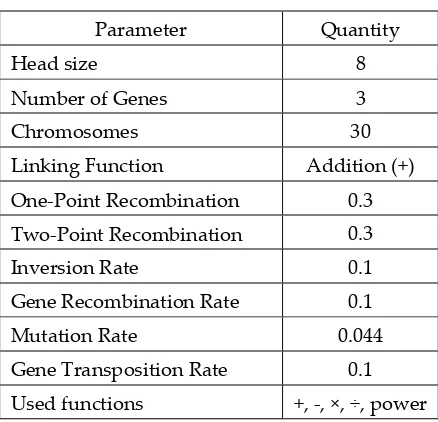
In Table 7, the characteristics of the GEP model used in this study, including model parameters and
366
genetic operators, are shown.
367
368
Table 7. Characteristics of the GEP model.
369
Parameter Quantity
Head size 8
Number of Genes 3
Chromosomes 30
Linking Function Addition (+)
One-Point Recombination
Rate
0.3
Two-Point Recombination
Rate
0.3
Inversion Rate 0.1
Gene Recombination Rate 0.1
Mutation Rate 0.044
Gene Transposition Rate 0.1
Used functions +, -, ×, ÷, power
Eq. 23 shows the proposed formula of the GEP method for estimating pavement remaining service
370
life in terms of PCI.
371
RSL = −6.59964 + 322.568
PCI − 8.96265− 2.61881√PCI + PCI − 1.18921√PCI
3 2
+0.35035(3.83258PCI − 9.83936)
9.83936 + PCI (23)
372
The results of scientific research are generally assessed with indicators that exhibit the accuracy and
373
error of the analysis. In this study, four criteria entitled Correlation Coefficient (CC), Scattered Index
374
(SI), Nash-Sutcliffe efficiency (NSE) and Willmott’s Index of agreement (WI) were used to determine
375
CC = ∑ RSLOiRSLpi
n
i=1 −
1
n∑ni=1RSLOi∑ni=1RSLpi
(∑ni=1RSLOi2−
1
n(∑ni=1RSLOi)2) (∑ni=1RSLpi2−
1
n(∑ni=1RSLpi)
2
)
(24)
SI = √1
n∑ni=1(RSLpi− RSLOi)2
RSLOi
̅̅̅̅̅̅̅̅ (25)
NSE = 1 −∑ (RSLOi− RSLpi)
2 n
i
∑ (RSLni Oi− RSL̅̅̅̅̅̅̅̅)Oi 2
(26)
WI = 1 − [ ∑ (RSLpi− RSLOi)
2 n
i=1
∑ (|RSLpi− RSL̅̅̅̅̅̅̅̅| + |RSLOi Oi− RSL̅̅̅̅̅̅̅̅|)Oi
2 n
i=1
] (27)
where: RSLOi = Observed RSL ith value, RSLPi = Predicted RSL ith value, and RSL̅̅̅̅̅̅̅̅Oi = Average of RSLOi.
377
CC is a number in the range of [-1, + 1], with values of +1, -1 indicating a complete correlation between
378
model inputs and outputs. Positive values represent direct correlation and negative values
379
demonstrate an inverse correlation. As the absolute value of CC approaches zero, the strength of
380
correlation decreases. SI represents an error, and smaller values indicate lower errors in modeling.
381
The highest NSE value is one with values close to one indicating greater modeling accuracy so that
382
NSE = 1 represents the best modeling quality. WI is an index between 0 and 1 with values close to
383
one suggesting the higher the modeling accuracy.
384
Table 8 reveals the four criteria introduced for all three methods employed in this study. To shed
385
further light on the results of Table 8, a three-dimensional bar histogram of the criteria is presented
386
in Figure 7. Based on the description in the preceding paragraph and the values in Table 8, it can be
387
concluded that FOA has improved SVR results. Comparing the SVR-FOA and GEP modeling results,
388
it can be contended that the GEP results are partially superior in the modeling proposed in this paper.
389
390
Table 8. Performance evaluation indices for GEP, SVR and SVR-FOA models.
391
parameter GEP SVR SVR-FOA
CC 0.874 0.865 0.879
SI 0.598 0.894 0.616
NSE 0.601 0.110 0.577
392
Fig. 7. Three-dimensional bar graphs of the statistical parameters.
393
In this study, a dataset containing information about 105 pavement segments was used.
394
Approximately 70% of the data (75 segments) were used for training and the remaining 30 segments
395
were utilized for testing. Figure 8 shows the RSL predicted by the three SVR, SVR-FOA and GEP
396
methods as well as the RSL measured in the HWD test for the segments selected as the test.
397
398
Fig. 8. Observed and estimated values of RSL with SVR, SVR-FOA and GEP models for test data.
399
Figure 9 displays the predicted RSL values versus the RSL values calculated by the HWD test for all
400
three machine learning techniques adopted in this paper. In this regard, the method with the best
401
prediction accuracy is the one that has a fit line equation of y = x, meaning that the line slope is equal
402
to one and its intercept is equal to zero. However, since in most cases it is not possible to reach this
403
state, it is generally stated that the highest prediction accuracy for a drawn fit line is obtained when
404
the slope is 1 and the intercept is 0. Figure 11 is plotted for the test dataset.
405
0 10 20 30 40 50
0 5 10 15 20 25 30
E
stim
ate
d
RSL
Number of test data
406
407
Fig. 9. The scatter plots of calculated RSL by HWD and estimated RSL by SVR, SVR-FOA and GEP
408
models for test data
409
Figure 10 shows the Taylor diagram of this article. Introduced by Taylor in 2001, Taylor diagram is a
410
mathematical diagram that graphically allows a comparison of several models of a system. In this
411
diagram, there are three categories of contours[47]:
412
• Blue contours
413
It shows the Pearson correlation coefficient.
414
• Orange contours
415
It indicates the RMS error that is proportional to the distance from a green spot on the horizontal axis
416
called observed.
417
• Black contours
418
It indicates the standard deviation proportional to the radial distance from the center.
419
y = 0.0842x + 11.885
0 10 20 30 40 50
0 10 20 30 40 50
E
st
im
a
ted
RSL
by
SVR
Calculated RSL by HWD
y = 0.3869x + 11.176
0 10 20 30 40 50
0 10 20 30 40 50
Estim
a
te
d
RSL
b
y
S
V
R
-FOA
Calculated RSL by HWD
y = 0.4125x + 9.3126
0 10 20 30 40 50
0 10 20 30 40 50
E
st
im
a
ted
RSL
by
G
E
P
420
Fig. 10. Taylor diagrams of estimated RSL for all models.
421
422
By examining Figures 7 to 10, it can be concluded that the SVR technique offers an average accuracy
423
for the purpose of this article. Using the FOA algorithm to select the basic parameters of this
424
technique significantly enhanced the accuracy of this method. On the other hand, the GEP method
425
provides a formula for RSL prediction. By re-examining Figures 7 to 10, it turned out that both
SVR-426
FOA and GEP methods yielded desirable accuracy for RSL prediction. However, the accuracy of the
427
GEP method was slightly higher than that of the SVR-FOA method.
428
429
5. Conclusion
430
Pavement management at both project and network levels are always associated with substantial
431
costs. Due to the budget constraints inflicted on organizations in charge of PMS, optimizing
432
pavement management costs is one of the priorities of any organization. RSL is a crucial factor for
433
pavement management at the network level. The current procedure for determining RSL involves
434
using FWD and GPR tests. These devices are not only costly but also interfere with the traffic flow
435
and compromise the safety of pavement inspectors. The aim subject of the study was to present a
436
new approach for predicting the RSL of flexible pavement, which eliminated the drawbacks of
437
current methods. After a review of previous studies on estimating the pavement RSL, we decided to
438
employed as input variable in modeling pavement RSL. PCI is an index that assigns a score of 0 to
440
100 based on the type, severity, and extent of pavement surface distress, with zero indicating the
441
worst situation and 100 representing the highest quality. The dataset utilized for modeling was
442
selected from Shahrood-Damghan highway in Iran. After selecting 105 pavement segments from the
443
highway, PCI and RSL of all segments were determined. Modeling was conducted using GEP and
444
SVR techniques after completing the dataset. The results of modeling with these techniques were
445
evaluated based on four criteria include CC, SI, NSE, and WI to determine the most appropriate
446
technique for estimating pavement RSL. After exploring all four criteria, it was found that the GEP
447
outcomes were far more accurate than the SVR. Then, to improve the accuracy of the SVR method,
448
the FOA optimization algorithm was employed to add a third technique (SVR-FOA) to the methods
449
applied in this paper. Again, the four criteria CC, SI, NSE, and WI revealed a significant improvement
450
in the accuracy of the SVR-FOA method compared to the SVR method but the GEP method still had
451
the highest prediction precision. In sum, the findings of this paper suggested that the GEP method
452
(with values of 0.874, 0.598, 0.601 and 0.807 for the four criteria CC, SI, NSE, and WI, respectively)
453
offered an alternative to current methods of predicting pavement RSL.
454
455
Author Contributions: conceptualization, N.K.; methodology, N.K.; software, A.D., A.M., N.N., and S.S.;
456
validation, A.D., A.M., N.N., and S.S; formal analysis, A.K.; investigation, N.K., A.D., A.M., N.N., S.S, and D.M;
457
resources, X.X.; data curation, N.K., A.D., A.M., N.N., S.S, and D.M; writing—original draft preparation, N.K.;
458
writing—review and editing, A.M.; visualization, N.K; supervision, S.S.; project administration, A.D.; funding
459
acquisition, A.D.
460
Acknowledgments: The EU regional fund is acknowledged.
461
Conflicts of Interest: The authors declare no conflict of interest.
462
463
References
464
1. Butt, A.A.; Shahin, M.Y.; Feighan, K.J.; Carpenter, S.H. Pavement performance prediction model
465
using the Markov process; 1987.
466
2. Soncim, S.P.; de Oliveira, I.C.S.; Santos, F.B. Development of fuzzy models for asphalt pavement
467
performance. Acta Scientiarum. Technology 2019, 41, e35626.
468
3. Arhin, S.A.; Williams, L.N.; Ribbiso, A.; Anderson, M.F. Predicting pavement condition index
469
using international roughness index in a dense urban area. Journal of Civil Engineering Research
470
2015, 5, 10-17.
471
4. Mfinanga, D.A. Sampling procedure for pavement condition evaluation of local collectors and
472
access roads. Tanzania Journal of Engineering and Technology 2007, 1, 99-109.
473
5. Wahyudi, W.; Sandra, P.A.; Mulyono, A.T. Analysis of Pavement Condition Index (PCI) and
474
Solution Alternative of Pavement Damage Handling Due to Freight Transportation
475
Overloading (Case Study: National Road Section West Sumatra Border–Jambi City). In
476
Proceedings of Proceedings of Eastern Asia Society for Transportation Studies.
477
6. Marcelino, P.; Lurdes Antunes, M.d.; Fortunato, E. Comprehensive performance indicators for
478
7. Bryce, J.; Boadi, R.; Groeger, J. Relating Pavement Condition Index and Present Serviceability
480
Rating for Asphalt-Surfaced Pavements. Transportation Research Record 2019, 0361198119833671.
481
8. Karballaeezadeh, N.; Mohammadzadeh S, D.; Shamshirband, S.; Hajikhodaverdikhan, P.;
482
Mosavi, A.; Chau, K.-w. Prediction of remaining service life of pavement using an optimized
483
support vector machine (case study of Semnan–Firuzkuh road). Engineering Applications of
484
Computational Fluid Mechanics 2019, 13, 188-198.
485
9. Luo, Z.; Chou, E.Y. Pavement condition prediction using clusterwise regression. Transportation
486
research record 2006, 1974, 70-77.
487
10. Huang, Y.H. Pavement analysis and design; Prentice-Hall: Upper Saddle River, New Jersey, 2004.
488
11. Das, A.; Pandey, B. Mechanistic-empirical design of bituminous roads: an Indian perspective.
489
Journal of transportation engineering 1999, 125, 463-471.
490
12. Hossain, M.; Wu, Z. Estimation of asphalt pavement life; 2002.
491
13. Park, H.M.; Kim, Y.R. Prediction of remaining life of asphalt pavement using fwd multiload
492
level deflections. In Proceedings of Transportation Research Board, 2003 Annual Meeting
493
Proceedings, Transportation Research Board, Washington, DC.
494
14. Smith, R.E. Structuring a microcomputer based pavement management system for local
495
agencies. Dissertation Abstracts International Part B: Science and Engineering[DISS. ABST. INT. PT.
496
B- SCI. & ENG.] 1987, 47.
497
15. Al-Suleiman, T.I.; Shiyab, A.M. Prediction of pavement remaining service life using roughness
498
data—case study in Dubai. International Journal of Pavement Engineering 2003, 4, 121-129.
499
16. Setyawan, A.; Nainggolan, J.; Budiarto, A. Predicting the remaining service life of road using
500
pavement condition index. Procedia Engineering 2015, 125, 417-423.
501
17. Saleh, M. A mechanistic empirical approach for the evaluation of the structural capacity and
502
remaining service life of flexible pavements at the network level. Canadian Journal of Civil
503
Engineering 2016, 43, 749-758.
504
18. Shahin, M.Y. Pavement management for airports, roads, and parking lots; Springer New York: 2005;
505
Vol. 501.
506
19. ASTM, D. 6433-07 Standard Practice for Roads and Parking Lots Pavement Condition Index
507
Surveys. ASTM International, West Conshohocken, Pennsylvania 2009.
508
20. Abdel-Khalek, A.; Elseifi, M.A.; Codjoe, J.; Fillastre, C. Estimating Service Life of In Situ Flexible
509
Pavements in Louisiana Using Pavement Management System Data. In Proceedings of
510
Construction Research Congress 2018American Society of Civil Engineers.
511
21. Kumar, R.; de Oliveira, M.; Lorrany, J.; Schultz, A.; Marasteanu, M. Remaining Service Life Asset
512
Measure, Phase 1. 2018.
513
22. ASTM. Standard test method for deflections with a falling-weight-type impulse load device.
514
2009.
515
23. ASTM. Standard guide for using the surface ground penetrating radar method for subsurface
516
investigation. 2011.
517
24. Cao, Y.; Dai, S.; Labuz, J.; Pantelis, J. Implementation of ground penetrating radar. 2007.
518
25. Designation, A.S. D4748-87 S tandard Test Method for Determining the Thickness of Bound
519
Pavement Layers Using Short-Pulse Radar. American Society for Testing and Materials, Philadelphia,
520
26. Ferreira, C. Gene expression programming in problem solving. In Soft computing and industry,
522
Springer: 2002; pp. 635-653.
523
27. Ferreira, C. Gene expression programming: a new adaptive algorithm for solving problems.
524
arXiv preprint cs/0102027 2001.
525
28. Suykens, J.A.; Vandewalle, J. Least squares support vector machine classifiers. Neural processing
526
letters 1999, 9, 293-300.
527
29. Cherkassky, V.; Ma, Y. Practical selection of SVM parameters and noise estimation for SVM
528
regression. Neural networks 2004, 17, 113-126.
529
30. Pan, W.-T. A new fruit fly optimization algorithm: taking the financial distress model as an
530
example. Knowledge-Based Systems 2012, 26, 69-74.
531
31. Ebtehaj, I.; Bonakdari, H.; Zaji, A.H.; Azimi, H.; Sharifi, A. Gene expression programming to
532
predict the discharge coefficient in rectangular side weirs. Applied Soft Computing 2015, 35,
618-533
628.
534
32. Yassin, M.A.; Alazba, A.; Mattar, M.A. Artificial neural networks versus gene expression
535
programming for estimating reference evapotranspiration in arid climate. Agricultural Water
536
Management 2016, 163, 110-124.
537
33. Lopes, H.S.; Weinert, W.R. EGIPSYS: an enhanced gene expression programming approach for
538
symbolic regression problems. International Journal of Applied Mathematics and Computer Science
539
2004, 14, 375-384.
540
34. Faradonbeh, R.S.; Salimi, A.; Monjezi, M.; Ebrahimabadi, A.; Moormann, C. Roadheader
541
performance prediction using genetic programming (GP) and gene expression programming
542
(GEP) techniques. Environmental earth sciences 2017, 76, 584.
543
35. Ferreira, C. Gene expression programming: mathematical modeling by an artificial intelligence;
544
Springer: 2006; Vol. 21.
545
36. Dibike, Y.B.; Velickov, S.; Solomatine, D. Support vector machines: Review and applications in
546
civil engineering. In Proceedings of Proceedings of the 2nd Joint Workshop on Application of
547
AI in Civil Engineering; pp. 215-218.
548
37. Cortes, C.; Vapnik, V. Support-vector networks. Machine learning 1995, 20, 273-297.
549
38. Cheng, K.; Lu, Z.; Wei, Y.; Shi, Y.; Zhou, Y. Mixed kernel function support vector regression for
550
global sensitivity analysis. Mechanical Systems and Signal Processing 2017, 96, 201-214.
551
39. Cherkassky, V.; Mulier, F.M. Learning from data: concepts, theory, and methods; John Wiley & Sons:
552
2007.
553
40. Vapnik, V. The nature of statistical learning theory; Springer science & business media: 2013.
554
41. Xiao, C.; Hao, K.; Ding, Y. An improved fruit fly optimization algorithm inspired from cell
555
communication mechanism. Mathematical Problems in Engineering 2015, 2015.
556
42. Chu, D.; He, Q.; Mao, X. Rolling bearing fault diagnosis by a novel fruit fly optimization
557
algorithm optimized support vector machine. Journal of Vibroengineering 2016, 18.
558
43. Yu, Y.; Li, Y.; Li, J.; Gu, X. Self-adaptive step fruit fly algorithm optimized support vector
559
regression model for dynamic response prediction of magnetorheological elastomer base
560
isolator. Neurocomputing 2016, 211, 41-52.
561
44. Cong, Y.; Wang, J.; Li, X. Traffic flow forecasting by a least squares support vector machine with
562
45. Mehr, A.D. An improved gene expression programming model for streamflow forecasting in
564
intermittent streams. Journal of hydrology 2018, 563, 669-678.
565
46. Willmott, C.J.; Robeson, S.M.; Matsuura, K. A refined index of model performance. International
566
Journal of Climatology 2012, 32, 2088-2094.
567
47. Taylor, K.E. Summarizing multiple aspects of model performance in a single diagram. Journal of
568
![Table 1. Models for the prediction of RSL[10-17]](https://thumb-us.123doks.com/thumbv2/123dok_us/1082295.1608965/3.595.79.519.560.780/table-models-prediction-rsl.webp)
![Table 2. PCI rating scale[19]](https://thumb-us.123doks.com/thumbv2/123dok_us/1082295.1608965/5.595.104.486.621.723/table-pci-rating-scale.webp)
![Table 4. GPR test details[24,25]](https://thumb-us.123doks.com/thumbv2/123dok_us/1082295.1608965/7.595.181.413.503.658/table-gpr-test-details.webp)
![Fig. 2. A sample of the genotype-phenotype structure in GEP[32]](https://thumb-us.123doks.com/thumbv2/123dok_us/1082295.1608965/8.595.188.405.543.735/fig-sample-genotype-phenotype-structure-gep.webp)
![Fig. 3. The coding region (ORF), no-coding region, and expression tree in a gene [34]](https://thumb-us.123doks.com/thumbv2/123dok_us/1082295.1608965/9.595.167.431.190.377/fig-coding-region-orf-coding-region-expression-tree.webp)
![Fig. 5. Food finding the iterative process of a fruit fly swarm[42].](https://thumb-us.123doks.com/thumbv2/123dok_us/1082295.1608965/12.595.189.412.131.297/fig-food-finding-iterative-process-fruit-fly-swarm.webp)