ORIGINALLY SUBMITTED: December 4, 2014 REVISED: August 25, 2015
ACCEPTED: September 21, 2016 Mentoring and Tutoring: Partnership in Learning
How an Evolution View of Workplace Mentoring Relationships Helps Avoid Negative Experiences: The Developmental
Relationship Mentoring Model in Action
Rhianon Washington and Elaine Cox
CORRESPONDING AUTHOR: Elaine Cox
Rhianon Washington
Dr. Rhianon Washington, University of Wales: Trinity Saint David, Carmarthen. SA31 3EP. Email: [email protected]
Abstract
In this paper, we explore how the use of a specific mentoring model focusing on the evolution of the relationship between mentor and mentee, may influence the incidence of failure. In our research we employed a case study methodology to examine a regional public services mentoring scheme in the UK where a developmental relationship mentoring model had been developed and used to guide practice. Findings indicated toxicity and negative outcomes may be positively influenced by mentor motivation and emotional intelligence, and can be avoided when there is awareness of how relationships develop and evolve. For example, the use of contracting in the early stages can limit the mismatched expectations that provoke disappointment, but equally mentor actions at other stages play key roles in reducing potential failure. Our study has implications for the enhancement of mentor training and scheme coordination as well as contributing to the understanding of negative mentoring relationships.
Introduction
Investment in mentoring in the public sector has grown worldwide (Ehrich & Hansford, 2008), with a proliferation of programs or schemes that address an array of specific issues, from workplace inequalities (Allen, Finkelstein & Poteet, 2009; European Commission, 2007), to adult substance misuse (Welsh Assembly, 2009) or mentoring to help young people pursue National Health Service (NHS) careers (Guardian Healthcare Professionals Network, 2014). Investment ranges from thousands of pounds in small programs to hundreds of thousands of pounds for larger ones and so, apart from the human cost where negative experiences may lead to reluctance to mentor ever again (Allen, 2007), the economic implications of failure are potentially significant. However, despite this investment, Hamlin and Sage (2011) argued that while researchers have studied the benefits of mentoring, there is too little focus on what constitutes effective mentoring in formal, company sponsored, settings or on the interpersonal processes involved.
Many staff still find the task of mentoring demanding (Green & Jackson, 2013), especially in certain contexts, such as overseas nurse support (O’Brien & Ackroyd, 2012). Indeed Allan (2010) found that in such mentoring, there were barriers and discriminatory practices actually caused by poor mentoring practices. These poor practices can sometimes lead to what has been termed ‘toxic’ mentoring (Barker, 2006), a situation where the relationship becomes harmful to
one or other of the parties.
Anecdotal evidence of toxic relationships identified by Megginson, Clutterbuck, Garvey, Stokes and Garrett-Harris (2006) suggested such relationships are unpredictable, insecure, and lack trust and commitment. Clutterbuck (2004) described toxic mentors as having manipulative goals and misaligned organisational values. Kay and Hinds (2007) catalogued causal factors as lack of time, being unreliable, poor preparation and under-developed empathic skills. Thus, it appears a variety of symptoms can indicate toxicity; ranging from examples of mentees consistently
through inappropriate use of power. Therefore toxicity could be described as the result of any behaviour (by mentor or mentee) that harms the common purpose of the mentoring process.
Barker (2006) focused on how ineffective mentoring may be avoided through analysis of the characteristics of failed relationships: she refers to different categories of toxic mentors who “derive energy from oppressive relationships” (p. 58), and proposes solutions either through
preparation to ensure compatibility (i.e. matching) or through analysis to find out why a
relationship is becoming problematic. However, whilst such analysis is useful, we contend that a focus on problem solving is like shutting the gate after the horse has bolted. In our paper, we look instead at how problems might be avoided by providing the right kind of training for mentors and mentees.
We employed a case study methodology to examine the use of a developmental relationship mentoring (DRM) model, characterised by different tasks that recognise the developmental potential of relationship evolution. The model was developed and implemented within one regional NHS mentoring scheme in the UK (hereafter called the Scheme). The aim of our study is to examine how the DRM model affects mentoring relationships and particularly how it might help prevent toxic or negative experiences.
The paper begins with an overview of relevant literature and then outlines the background to the Scheme and the DRM model. The findings reveal both practical and theoretical implications. Shedding light on the relationship in this way not only provides perspectives on mentor training, but also enhances understanding of how the needs of the relationship evolve over time and influence the health of the relationship. The results of our research should therefore provide a better understanding of the dynamics of mentoring relationships.
Literature
on how developmental relationship models of mentoring influence incidences of toxicity. We begin therefore, with a review the existing research into the reasons for toxicity and other attempts at prevention. We then summarise the origins of developmental relationship mentoring in order to highlight its potential for prevention.
Toxic, Failing and Problematic Mentoring
Compared to the abundance of studies on positive aspects of mentoring there has been less exploration of toxicity in mentoring (Carr & Heiden, 2011) even though incidences of negative mentoring experiences are reported as not uncommon (e.g. Eby & Allen, 2002): Eby (2007) even found that successful mentoring relationships may at some point encounter short term toxicity.
Reasons for toxicity have also been explored. In 2000, Eby, McManus, Simon, and Russell found problems were due to: (a) poor match within the dyad, (b) distancing behaviour, (c)
manipulative behaviour, (d) lack of mentor expertise, and (e) general dysfunctionality. Eby and Lockwood (2005) reported that 20% of their sample experienced misaligned expectations, with 12% reporting neglect and lack of commitment from the mentor. Kilburg and Hancock (2006) found recurring problems for dyads through apparent mismatch as well as poor communication. In other studies (e.g. Huskins, Silet, Weber-Main, Begg, Fowler, Hamilton & Fleming, 2011) authors have highlighted the issue of mismatched expectations and related it to a lack of contracting. Eby, Durley, Evans and Ragins (2008) confirmed that the causes of negative experiences include not only mismatches within the dyad, but also distancing behaviour, manipulative behaviour and lack of expertise. In that study, Eby et al recognised the frailties of poor mentoring scheme design and inadequate safeguards.
Toxicity in the relationship has been variously attributed. Feldman (1999) contended that while culpability is usually ascribed to the mentor’s role, mentees have in fact an equal influence
the part of the mentee, and relational factors, such as lack of fit between mentor and mentee, that make rapport building difficult. More recently, Straus, Johnson, Marquez and Feldman (2013) identified factors contributing to poor mentoring, such as “lack of commitment, personality differences, perceived (or real) competition, conflicts of interest, and the mentor’s lack of experience” (p.86). They reported that most participants had experienced a failed mentoring
relationship. These attributions have led to a variety of explorations into how to avoid such failure. Prevention
In terms of prevention, research has focused on three main areas: the use of empathy by the mentor, matching and the awareness of power dynamics.
Empathy. A number of researchers suggest that empathy has a role in the prevention of toxicity. Standing (1999) identified mentoring dispositions such ‘expressing care and concern’ (p.12) as the basis of a nurturing relationship that could guard against toxicity. In a case study of a destructive relationship, Kram (1988) offered an open systems perspective as a potential solution: Kram (1988) linked the transition from conflict to understanding to the development of an
empathic stance, identification of concerns and recognition of any psychosocial change. Since then, Liang, Tracy, Taylor and Williams’ (2002) found that among 296 students the quality of the relationship in terms of engagement, authenticity, empathy and empowerment had a greater impact on success than previously thought and in a later qualitative study of a mentoring scheme,
Hargreaves (2010) noted that by constructing knowledge with an empathic mentor, the mentee’s confidence grew and enabled better coping. Other researchers have also suggested that empathy is important in the empowerment of the mentee (Eby, Butts, Durley & Ragins, 2010; Ensher & Murphy, 2011)
Matching. Matching has been criticised for forcing a relationship that should occur
Hezlett (2003) argued that satisfaction with mentoring relationships was greater when both parties had choice. Blake-Beard et al (2007, p. 624) warned, however, that mentee choice is most likely to be based on similarities and comfort, thereby avoiding the challenge and growth that can arise from a mismatch. Despite this, the emphasis on matching dyads within schemes is considerable. A number of authors have conducted empirical research on mentor-mentee matching issues ranging from gender (Gray & Goregaokar, 2010) to complimentary skills (Ensher & Murphy, 2011) and role modelling (Cox, 2005). On the other hand, Cox’s (2005) research with 52 mentoring dyads in a community project suggested that matching may be unnecessary as the real needs of the mentee can change over time. Similarly, Fleck and Mullins (2012) in their study of a peer mentoring found initial dyad compatibility was not considered essential. The debate on a best way to match and particularly its importance in terms of successful outcomes therefore remains unresolved.
Power dynamics. Our review of the literature found that mismatches and uneven or abuse
of power within the mentoring dyad can lead to toxicity. Some authors (e.g. Eby et al, 2000; Brockbank & McGill, 2006) suggested that many of the issues created through misuse of power derive not only from the mentor but also the mentee or the organisation. Ensher and Murphy (2011) conceded that power does not necessarily sit with the mentor; the mentee also has some control. Earlier, Cox (2005) identified the power of the mentee in the relationship and introduced the term ‘empathic authority’ to describe the investiture of trust in the mentor by the mentee over time as sufficient rapport is achieved.
Scandura (1998) observed that power dynamics may be exacerbated by power differentials in gender. However, we found that later research offers contrary findings on whether cross or same gender dyads contribute to toxicity. Elliott, Leck, Orser and Mossop (2011), for example, found that participants were uneasy in cross-gender relationships, and gender-role stereotypes
mentoring relationships identified that cross-gender mentoring dyads secured greater psychosocial support than same-gender dyads.
While researchers have identified power as both a cause of failure and as having potential for preventing toxicity we have not found anyone who has examined whether models of mentoring that promote relationship development act as a defence against negative experiences. However, Hamlin and Sage’s (2011) investigation into effective and ineffective mentor and mentee
behaviours concluded there was a need for research into the relationship between developmental mentoring and negative behaviour. They recognised the difference between models, noting that many criteria were consistent with Megginson et al’s (2006) developmental mentoring model.
Developmental Mentoring
Kram (1985) found that mentoring relationships evolve through sequential phases and presented a four-phase developmental model based on findings from 18 mentoring relationships in one North American organisation. The phases included Initiation; where the dyad meet and
establish the relationship, Cultivation; through which the relationship develops, Separation; where the relationship comes to an end and Redefinition; where the association may continue in another guise, perhaps as a peer mentoring relationship. Kram used this model to describe the transitions inherent in mentoring relationships. Megginson et al (2006, p.19) later drew on Kram’s work, introducing five phases that move from initial contact where rapport is established, through the development of goals in what they called the direction-setting and progress-making phases, towards maturation of the relationship at the winding down and moving on phases. Clutterbuck (2005) further explained how these phases require modification of mentor behaviours and that the skills needed for building rapport are significantly different from the skills needed for gaining clarification and commitment to specific career or personal development goals. He suggested that a generic competence for mentoring might be “recognising and adapting appropriately to the phases
Keller (2005) also described how mentoring relationships have a pattern and structure that changes over time. He explained how “developmental phenomena define the life course of a relationship, with adjustments to changing circumstances and significant events altering its developmental pathway” (2005, p.84). These attempts to characterise mentoring in terms of the
evolution of the relationship all presuppose that relationship building is the key to mentoring success. The patterns identified are thought to contribute to relationship effectiveness and success. However, although there has been some identification and discussion of the phases of
developmental mentoring there has been no research that focuses specifically on its influence on toxicity. In the next section we explain how developmental mentoring has been interpreted and developed into a model for practice within one regional mentoring scheme in the NHS in the UK.
The Developmental Relationship Mentoring (DRM) Model
The DRM model differs from the traditional sponsorship model of mentoring more usually used in NHS settings in that it is developmental. The main differences are that in traditional mentoring (Ensher, Thomas & Murphy, 2001) mentors are usually in senior positions within the organisation and are experts in the mentee’s field. Consequently they are able to provide advice in
relation to career progression and often the mentee becomes a protégé. In the DRM Scheme however, mentors come from a wide range of backgrounds, and are not necessarily experts: instead they can be cross-profession or cross-organisation. They are trained in the DRM model to focus more on asking powerful questions to help mentees think for themselves. This approach to mentoring is mentee driven and includes significant elements of personal development.
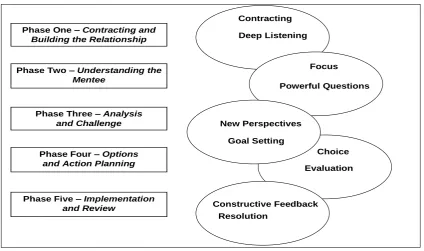
In the DRM model the focus on relationship development provides direction and guidance for the mentoring process. The model builds on Kram’s (1985) four phases and Megginson et al’s (2006) five phases and also has five phases: Contracting and Building the Relationship;
Understanding the Mentee’s Perspectives; Analysis and Challenge; Options and Action Planning;
Implementation, as shown in Figure 1.
Phase One – Contracting and
Building the Relationship
Phase Two – Understanding the
Mentee
Phase Three – Analysis
and Challenge
Phase Four – Options
and Action Planning
Phase Five – Implementation
and Review
Contracting
Deep Listening
Focus
Powerful Questions
New Perspectives
Goal Setting
Evaluation
Resolution
Constructive Feedback Choice
Phase One – Contracting and Building the Relationship
Several authors supported the contention that contracting in the initial stages may protect the dyad from toxicity (Johnson, 2002; Eby & Lockwood, 2005). Megginson et al’s (2006) initial rapport building stage further determined whether a relationship is viable through exploration of value alignment, respect and expectations, in order to enable the dyad to achieve agreement of purpose. The DRM translates this phase into a more detailed and practical guide emphasising contracting as key.
Phase one thus encompasses preliminary meetings and incorporates the contractual
elements of the relationship. By achieving a joint agreement through exploration of ground rules, boundaries and expectations, mentors can establish rapport and develop the trust necessary for the mentee to share and confide during the mentoring process. During this phase the dyad explores collaboratively their communication approaches. Tools to promote understanding, for example the Learning Styles Questionnaire (Honey & Mumford, 1982) or Belbin’s Team Roles (Belbin, 1981),
can also be used at this stage to enhance understanding, aid the discussion of potential tensions and so avoid possible conflict. Indeed, Kalbfleisch (2002) argued that such communication is central to the “initiation, maintenance, and repair of mentoring relationships” (p.63).
Mentors can identify the end of Phase one once rapport has been initiated and there is the basis for a strong, trust-based dyad with a bilateral mentoring agreement in place that can be revisited later to either review or reinvigorate the relationship. Phase one could be established as early as the initial meeting or may require several sessions before contracting is agreed.
Phase Two – Understanding the Mentee
and review experiences, skills, current role priorities, and career aims. The nature of the issues raised and the depth of reflection required often occupies more than one session. In this phase, the use of authentic listening skills and empathy (Cox, 2013), which offer validation, can create an understanding of feelings and thoughts of which the mentee was initially unaware. Neimeyer and Neimeyer (1986) argued that early validation also leads to more successful relationships and that failing relationships share less congruent constructs. This focus on stock-taking is designed to uncover strengths, weaknesses, circumstances and context to help achieve a better understanding. Phase Three – Analysis and Challenge
The third phase involves challenging mentees as well as recognising achievements. It is designed as a platform for mutual learning as mentors challenge discrepancies between, for example, self-perception and organisational needs, and broaden mentees’ insight and awareness. Building awareness enables a shift in power from mentor to mentee as mentees gain
self-confidence.
In DRM mentors are encouraged to use listening techniques and questioning, to create within the mentee a sense of being fully understood. Non-judgemental, deep listening and
powerful questioning are used to unlock rigid perceptions sufficiently to allow alternative options or solutions to be considered. In the Scheme’s documentation it states that mentor behaviour may change from being passive in the second phase to being more challenging in this third phase as trust increases. Thus the purpose of the third phase is to explore issues in greater depth, promoting frankness and bridging gaps between perceptions. A number of tools are available to facilitate this process including self-disclosure models such as Johari’s Window (Luft & Ingham, 1955). Phase Four - Options and Action Planning
stimulate this by challenging mentees to shift perspectives in the tradition of solution-focused self-directed learning (Cavanagh & Grant, 2014). Once options have been examined, a detailed action plan is discussed. This is an effective tool in learning transfer (Cowan, Goldman & Hook, 2010) and correlates with coaching approaches such as the GROW model (Alexander, 2006) which includes exploration of Goals, Reality, and Options and culminates in a final stage; the Will to act. Phase Five – Implementation and Review
The two stages of Phase Five: implementation of the action plan and review of results, culminate in mentor and mentee making a decision to either re-contract or end the process. In this phase the focus is therefore on where goals have been achieved, celebration of success and making plans to move on before risk of dependency sets in. The aim is to secure mentees’ autonomy and responsibility for their own development. The key skill associated with the phase is giving/ receiving constructive feedback following implementation of action by the mentee. The
relationship moves from the mentor’s influence through skills such as listening and challenge, to
mentee-centred behaviour, where the mentee arrives at his/her own potential solutions. Method
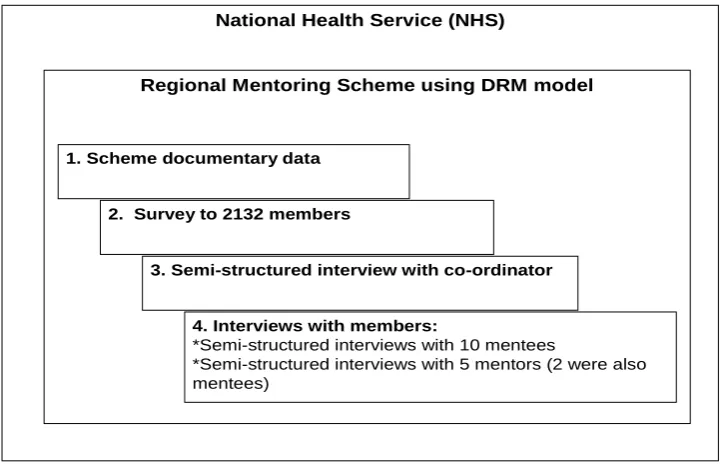
The Scheme was well suited to a case study research design as it allowed exploration of the influence of the DRM model on mentoring via practicing mentors and mentees who can be viewed as a bounded group (Marshall & Rossman, 2010). In Figure 2 we provide a map of the research design showing the context of the case study and the multiple units of data collection.
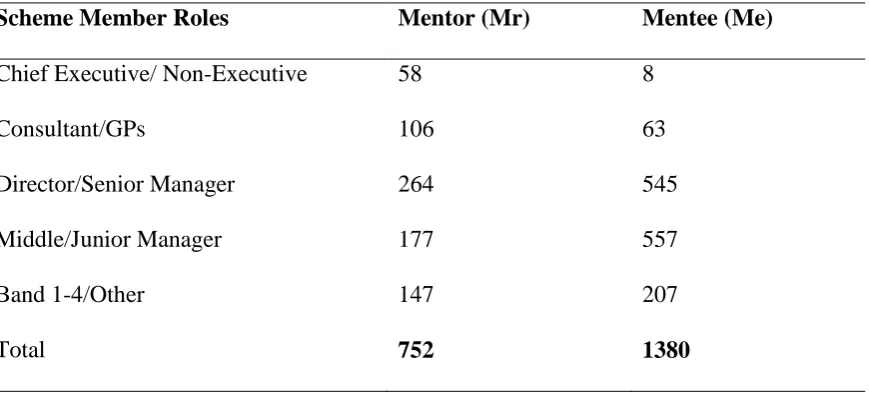
Membership of the Scheme at the time of data collection (in 2011) consisted of 752 mentors and 1380 mentees, 2132 members in total and included a wide variety of professionals and
National Health Service (NHS)
Regional Mentoring Scheme using DRM model
2. Survey to 2132 members
4. Interviews with members:
*Semi-structured interviews with 10 mentees
*Semi-structured interviews with 5 mentors (2 were also mentees)
3. Semi-structured interview with co-ordinator 1. Scheme documentary data
Figure 2: Research design: with embedded, multiple units of data collection
Following analysis of documentary data related to the Scheme to review the content of training and support given to members, a survey was designed. The decision to incorporate a quantitative survey was influenced by Eisenhardt’s (1989) recommendation that it can be synergetic and reveal relationships not obvious from qualitative data. The survey was guided in design by Creswell’s (2009) checklist of questions and in content by documentary evidence and Eby’s (2007) continuum of relational problems. Categories of symptoms: (a) trust, (b) personality
clash, (c) lack of communication, (d) lack of commitment, (e) mentor neglect, (f) mentee disinterest and (g) other, were drawn from existing research (Allen, 2007; Eby, 2007; Eby et al, 2000; Scandura, 1998) and adjustments made following a pilot survey. The intention was to: gather facts about Scheme participants; establish their experiences of toxic mentoring both within and outside the Scheme; rate the impact of the toxic experience using a simple rating scale (1-10); and evaluate the nature of toxic mentoring. The survey went to 2,132 Scheme members, as detailed in Table 1, and achieved a 6.61% return with 141 responses. Of these, 29% had experienced
Table 1
Breakdown of Members’ Roles in Scheme
Scheme Member Roles Mentor (Mr) Mentee (Me)
Chief Executive/ Non-Executive 58 8
Consultant/GPs 106 63
Director/Senior Manager 264 545
Middle/Junior Manager 177 557
Band 1-4/Other 147 207
Total 752 1380
Analysis of the survey involved cross tabulation to establish data relationships, for example, the number of non-member mentees who experienced mentor lack of skills as a causal factor of their toxicity.
In depth semi-structured interviews were also undertaken with 13 members who
volunteered via the survey (there were 5 mentors and 8 mentees, two males and 11 females, and a mix of clinical and non-clinical grades). The scheme co-ordinator was also interviewed to provide insight into the preventative nature of the DRM initiative. Our intention in the interviews was to illuminate the survey findings in terms of definition, symptoms and causal factors. The focus of the questions included understanding of the term ‘toxic’, the symptoms and causes of toxicity, plus
any perceived links between prevention and the model.
Price’s (2002) laddered question technique was used to increase awareness within interviews
mentor when recounting a toxic experience which was unresolved for her. In her narrative she displayed some confusion and uneasiness and in order to aid her understanding she was asked, “Did you contract?” This moved the mentor from her subjectivity within the experience to a
more critical exploration of the reasons behind her mentee’s behaviour, thereby confirming her response and aiding closure. This technique was adopted to customise interviews whilst still based on a standard question and ensuring robustness and ethical awareness (Price, 2002).
The use of Eisenhardt’s (1989) within case analysis presented a practical solution for dealing
with the amounts of data arising from documentary data and interviews. This technique involved making detailed notes and reflections to promote intimacy with the data and remembering that the interview data needed to contribute to the overall picture. Interview and survey data were
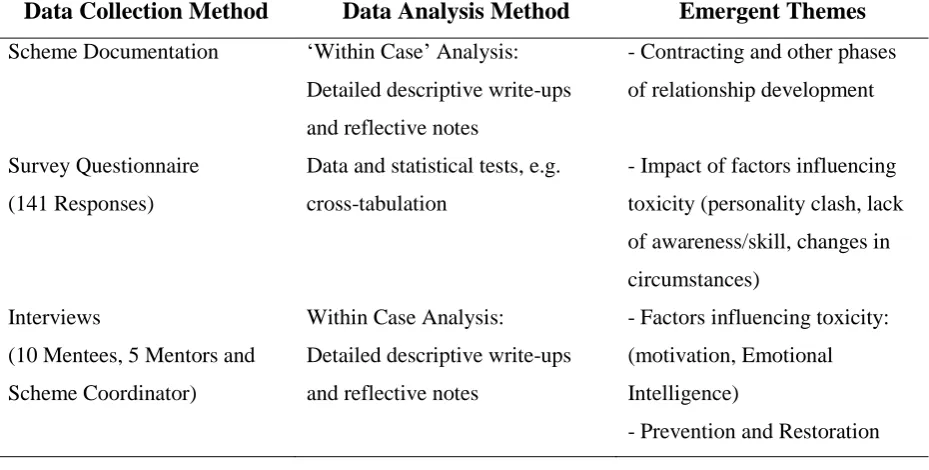
subsequently categorised during analysis to establish themes and patterns. Table 2
Overview of Data Analysis and Emergent Themes
Data Collection Method Data Analysis Method Emergent Themes Scheme Documentation ‘Within Case’ Analysis:
Detailed descriptive write-ups and reflective notes
- Contracting and other phases of relationship development
Survey Questionnaire (141 Responses)
Data and statistical tests, e.g. cross-tabulation
- Impact of factors influencing toxicity (personality clash, lack of awareness/skill, changes in circumstances)
Interviews
(10 Mentees, 5 Mentors and Scheme Coordinator)
Within Case Analysis: Detailed descriptive write-ups and reflective notes
- Factors influencing toxicity: (motivation, Emotional Intelligence)
- Prevention and Restoration
Findings
factors identified in the survey and interviews as influencing toxicity. We highlight two themes that are not mentioned in previous research, namely initial mentor motivation and the emotional intelligence of both mentor and mentee. The second section discusses prevention and restoration by considering the phases of the DRM model and their relationship to prevention. In the
presentation of findings that follows, we use the abbreviations Mr for Mentor and Me for Mentee. 1. Factors Influencing Toxicity
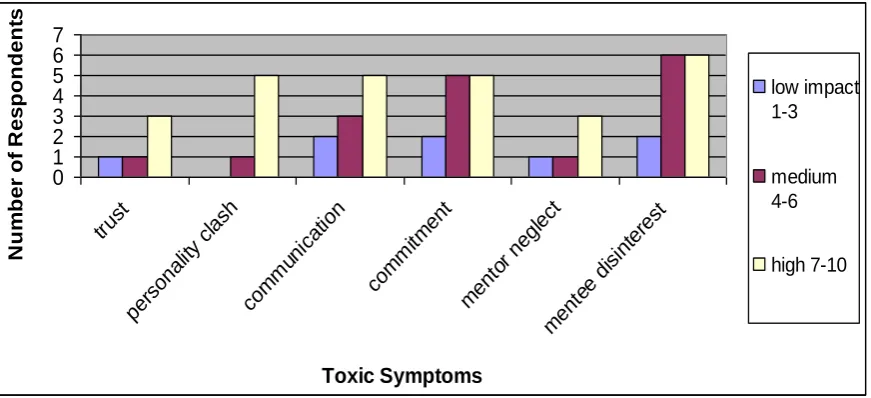
In order to establish the significance of the toxic experience for respondents, the survey asked them to rank impact of symptoms, such as lack of trust and sought opinions on likely causes of toxic experience. The level of impact of toxic symptoms is shown in Figure 3. The scale ranges from 1, indicating little or no impact, to 10, representing the complete breakdown of the
relationship. In the survey, 10% identified mentor neglect as a toxic symptom, with 11% selecting personality or chemistry clashes. Although infrequent, these symptoms were seen as more likely to produce a high toxic impact. Mentee disinterest proved the most common symptom with 27% of respondents experiencing it. This symptom also seemed to have the highest impact with 24% scoring it medium or high on the impact scale. Cultural differences were only identified as an issue by 7%, but did generate medium to high impact ratings. Surprisingly, trust problems were
experienced only by mentees outside of the DRM Scheme (10%), and personality clashes also occurred more frequently outside the Scheme, with 22% of respondents considering chemistry or personality clashes as causes with medium to high impact. These findings suggest that the DRM model could be effective in generating trust and avoiding personality issues.
The themes most identified by mentors during interview as influencing toxicity were mentee disengagement and lack of commitment:
She was very disengaged from the whole process. (Mr42)
0 1 2 3 4 5 6 7 trust person ality clash com mun icat ion com mitm ent men tor n
egle ct men tee disi nter est Toxic Symptoms N u m b e r o f R e s p o n d e n ts low impact 1-3 medium 4-6 high 7-10
Figure 3. Impact of toxicity experienced by respondents
Mentee disruption and disinterest were also identified, with medium to high levels of toxic impact being reported by respondents:
(she) made me feel really guarded…I felt I was almost being picked on. (Mr133) (he) was quite negative… difficult to engage…standoffish. (Mr60)
Other themes identified by mentees were personality clashes; lack of mentor awareness and skills; changes in circumstances and misunderstandings about the mentor role:-
Personality clash. Our analysis of Scheme documentation confirms claims that the DRM could guard against personality clash through effective phase one contracting and phase two development of understanding. Pre and post phase training and development were seen as encouraging the use of techniques to develop empathy and enhance communication which potentially could address such clashes. Arguably, personality clashes are more challenging to tackle although findings indicate that clear contracting may have helped - for example, in the case of Me49 who attributed toxicity to the fact that the “relationship was unclear”.
Lack of awareness or skill. Personality clashes were identified in conjunction with associated factors such as the mentor’s lack of skill and awareness. In the survey, 12% of mentees
recognised this as an issue. The impact varied but 60% of those who selected lack of mentor skills scored it as having a high toxic impact. Pre and post phase training, was aimed at enhancing skills and initial orientation, while training and remedial measures through ongoing development should have ensured prevention. Despite this, however, findings confirm there are still failings. During interview, Me117 attributed toxicity to both mentor and mentee “not really knowing what to do”, which suggests that the initial orientation and training failed to adequately prepare the dyad. This is echoed by Me63, who found that the mentor “projected their personality to find solutions”,
which is directly counter to the DRM model explained during training.
There are further examples of lack of mentor skills experienced by three of the
interviewees. However, in each case the guidelines in the DRM model were not followed. Me117 considered that her mentor lacked the skills necessary to be effective despite undergoing initial training, however her mentor had not engaged in the ongoing developmental program. Whilst ongoing development is not compulsory, participation is recommended. Me63 found her mentor neither followed the model nor employed the skills promoted within it, and a similar view was expressed by Me14 who also perceived her mentor as lacking empathy: “I didn’t feel particularly
emotionally supported. It felt like she was a novice…she seemed overwhelmed” (Me14). Changes in circumstances, roles and responsibilities. Conflicting roles or
responsibilities were most frequently named as causes of relationship failure. 28% of respondents felt that this contributed to a toxic relationship with 64% of those who selected it being mentees. Only one respondent identified this as of low toxic impact. In interview, one mentor, Mr132, and one mentee, Me16, also identified conflicting roles and responsibilities as the main cause of toxicity. Mr132 considered that a significant increase in his mentee’s job responsibility had adversely interrupted the mentoring process. Similarly Me26 reported a mentor who had increases in responsibility that had impacted the relationship. In the survey, conflicting roles or
source of toxicity is usually complex and dependent of a number of factors. While role conflict and increased responsibilities were most frequently identified by mentees during interviews, few single causal factors were considered to be the sole reason for toxicity. Mentees, for example, tended to blame a combination of conflicting roles and career change in tandem with a lack of mentor skills. Lack of communication, commitment or conflicting priorities also proved to be prominent factors.
Changes in circumstances should however be expected and according to the Scheme documentation, contracting should help negotiate a break or ensure an appropriate ending to the relationship should conflicting priorities prove an issue. Nevertheless, this was still identified as an issue. Life or career changes scored medium to high on the impact scale, affecting 17%
respondents. Such changes are often unexpected, unplanned and beyond the control of the
individual. Examples of conflicting priorities included changes in role along with personal issues and commitments. Phase five of the DRM was designed to include periodic re-contracting and review and a plan to end the relationship, however, there is little guidance on how to approach the ending or negotiate a break, even though its importance is recognised. Hamlin and Sage’s (2011) study for example, focused only on the beginning and middle phases of the relationship’s duration, thereby missing the importance of the ending of the relationship where problems may arise during review and evaluation, or in the style of the ending itself. Findings from our study demonstrate that absence of relationship closure is clearly a cause of toxicity and the lack of attention to it in the DRM training may be a failing.
Mentor Motivation
who become mentors, despite displaying essential mentoring personality characteristics such as empathy, are often ambitious, valuing the experience more in terms of career success. This was the case with Mr133, who suspected her mentee’s attendance to be motivated by career aspirations
rather than engagement with the mentoring process:
I still feel that it’s been suggested to her that it would be good for her to be in the Scheme and she’s come to show willing, if you like, and she does the minimum… I’m sure that’s
where her attitude comes from and the poison in the relationship comes from. (Mr133) When asked for the cause of motivational problems enforced presence was also often identified: “Being sent by the Manager”(Mr85); “People being made to attend” (Mr133).
Cox (2000) identified that motivation for becoming a mentor is influenced not only by traditional reasons such as altruism but also other motives, for example, the satisfaction of advising others (Liu, Macintyre & Ferguson, 2012), and former mentees wishing to give something back (Coates, 2012). The voluntary element of the Scheme may also be important to its quality according to the following interviewee:
I think there’s such commitment to it, I don’t feel that people do it just because it looks
good. […] Often with internal schemes it would be people who would do it because it would look good, [but] this is actual volunteering. (Me8)
Scandura’s (1998, p.464) work on supervisor/protégé roles in mentoring found that relationships
are susceptible to dysfunction in assigned relationships. It seems there is a case for voluntary attendance which avoids many of the motivational pitfalls and dysfunctional elements evident in Scandura’s study.
learning from and about each other. This focus on motivation to learn together is vital. Me117’s mentor seems to have failed in this regard. She could have employed the model’s techniques to help identify goals together without the risk of losing her mentee’s confidence:
I told her I didn’t think I was getting enough from it and she just asked what do you want to
get from it, but she never gave me the options. It was quite difficult because I didn’t know what I wanted to get from the relationship and I needed guidance” (Me117).
For mentors there is a fine balance between giving unwanted advice and helping the mentee to think things through. Me117 appears to have needed more support and guidance.
It could be however, that lack of self-confidence leads to fluctuations in motivation as suggested by Mr60, where this mentor’s doubts in her own skills prevented her from productively closing a relationship with a disinterested mentee:
I could have been a little more assertive about finding out what was wrong, was it just that she genuinely didn’t feel that anything could help her at that time or if it was just
something about me she didn’t get on with…I don’t know what went wrong so that makes
it toxic. (Mr60)
Both these examples of toxic experiences could have been mitigated through use of the DRM model: in the case of Me117, her mentor could have adopted the skills, tools and techniques provided in initial and ongoing training and development programs. While it could be argued that Me117 would have benefitted from a sponsorship scheme with a more directive approach, she was later matched in a successful developmental relationship which encouraged reflection within the dyad to enable closure in a mutually beneficial way.
Emotional Intelligence
manage the situation to the extent that the relationship flourished and continued successfully. This was achieved by the mentee adapting his response to the mentor and adjusting the way he
communicated:
I guess it’s about knowing - how to know my mentor better. I got the sense that the way she
approached her day job was the way she approached the mentoring, using that kind of very direct approach. She responded to me the way she would a staff member, so maybe I have to respond to that. (Me16)
Such findings suggest that emotional intelligence (Goleman, 1998, Nafukho & Muyia, 2014) is an important factor in the prevention and treatment of toxicity. The proactive approach by Me16 displays a developed emotional intelligence, a useful attribute in mentoring (Cherniss, 2007).
Another quote from Me16 suggests how the mature understanding of his mentor transformed a failing relationship into a highly successful one:
[my mentor said] I’ve never developed somebody from outside the organisation - so maybe she was institutionalised, maybe that was the way she is because that’s all she knows, that’s
the environment she knows. As much as I was proud, she was proud too, and that brought it onto a new level. (Me16)
Me16 was not alone in displaying mature management of an emotionally charged situation. Me14 suffered mentor neglect at a challenging time, leaving her in: “…a highly stressful situation at the time - and I was probably at the point where I actually, just before or not long before, went off sick with stress.” Despite this adversity Me14 accessed the tools associated with the DRM model: “the
outcome, whereas the mentors failed to support that. Such emotional resilience is recognised as a measure of emotional intelligence (Slaski & Cartwright, 2003).
However, mentors also demonstrated emotional intelligence (EI). The following example shows how regardless of his mentee’s non-responsiveness to his efforts to repair the damaged
relationship this mentor’s reaction demonstrates emotional insight and understanding:
When it went sour I examined my own approach and what I’d done, whether I had assumed too much…at the end of the day you have to recognise that things don’t always work out
and you need a way of drawing a conclusion. (Mr132)
The DRM model’s emphasis on communication skills and empathic understanding relate strongly to the factors associated with EI. The training encouraged mentors not only to listen non-judgementally but also to use empathy to aid understanding. Whilst acknowledging that research into the relationship between EI and mentoring is limited (Hawkey, 2006), the findings presented here suggest that emotionally intelligent mentoring may guard against toxicity and can also be effective in turning around potentially toxic relationships. This suggestion augments Cherniss (2007) who argues that the relationship between EI and mentoring is synergetic; that mentoring develops emotional competence and those who are emotionally intelligent influence the quality of the mentoring relationship, as examples from the mentees in this study demonstrate.
The causal factors of toxicity presented above, suggest that complex multiple elements combine to contribute to toxicity. We would suggest that these can be seen as falling into two classes; those that are beyond individual mentor/mentee control, such as changes in job role, and those that are preventable through the development of mentor or mentee attributes or skills that may be influential in the possible prevention, such as emotional intelligence.
2. Prevention and Restoration
model to increase its efficacy further. To fully explore any preventative or restorative potential of the DRM model, each of its five phases and their associated skills are reviewed using data
gathered from the survey and interviews, together with documentary evidence from the Scheme. Phase one – Contracting and building the relationship. Scheme documentation explains that the contracting element of phase one of the DRM model could help to clarify expectations that are realistic and desirable to the dyad and possibly minimise damage created by potential poor chemistry through the design of an acceptable working relationship. Contracting is therefore promoted as a key element in the DRM model and is designed to secure successful mentoring outcomes.
In terms of prevention, contracting is a key element of phase one. The dyad jointly establishes the nature of the collaboration, setting ground rules such as the purpose of the
relationship, confidentiality and how to resolve difficulties. Contracting also serves to clarify aims for the inexperienced mentee. The following are the Scheme coordinator’s views of the
significance of contracting:
The main focus for me around toxicity and preventing it and preventing any kind of negative experience for the mentee is: how clear the message is in the training on the mentor development day; how clear we are on the contracting phase, and it’s the
contracting phase and being honest about whether you are the right kind of mentor for an individual and having that level of social awareness. (Scheme Coordinator)
Experiences recounted by interviewees supported this view of the significance of contracting in prevention:
exploring all the factors at the beginning of the relationship... that’s why it’s beneficial.
(Me9)
A number of toxic experiences reported by participants could, arguably, have been avoided had clear contracting taken place. The difficulties faced by Me117 may not have occurred if, for example, the aims of the process had been established and aligned to her expectations. This supports existing literature where it is claimed that contracting can prevent negative mentoring (Huskins et al 2011; Maloney, 2012).
Phase two – Understanding of the mentee. This phase involves use of listening skills to promote understanding and appreciation and the development of rapport. By refraining from giving advice or direction mentors encourage mentees to lead the process. Devoting time and awareness to this phase can safeguard against conflict, as Me63 identifies:
[My mentor] told me the answers when really it was a projection of her opinion and if she had been more self-aware and aware of how we were different she may have realised the things she was saying were unhelpful. (Me63)
One mentor described the significance of spending time gaining an understanding of the mentee and outlines the process she used:
Another thing is knowing your mentee - I always do a series of tests. I tell them about it on the first meeting, so I do a Belbin’s role test, see what sort of role they have [and] do the
Honey and Mumford learning cycle [to] try and find out a little about them
This mentor demonstrates an appreciation of the importance attached to gaining insight into the mentee using tools such as learning styles questionnaires to achieve this. While learning styles theory has its critics (e.g. Coffield, Moseley, Hall & Eccleston, 2004) it does offer a basis for reflection on communicating with others and promotes self-awareness for both mentee and mentor.
Mr 42 also suggested that feeling understood is significant in the prevention of toxicity and displaying non-judgmental behaviour is key. She describes how she mentors:
My style is supportive, I always build up rapport. I find you don’t have them as your best mates as it’s a fine boundary because judgements can come in. It doesn’t matter what your
judgements are, it’s the person’s session. To prevent toxicity don’t let judgements in. (Mr42)
This emphasis on establishing rapport was also mentioned by other mentors as vital to the awareness necessary for supporting the mentoring during the next phase:
It may not be in the first meeting but certainly in the second one when you’ve established some rapport ... the extent of the relationship has to be explored early on. There is the assumption that it will work to the benefit of both parties - by the second one there has to be an understanding of where the boundaries are, there has to be some guidelines. (Mr132) Phase three – Analysis and challenge. The design intention of phase three was to promote greater perception and empower the mentee. The skills of the mentor are vital and include
techniques such as powerful questioning to challenge and inspire creative thought and reframe problems into solutions. The Scheme supported the use of a range of tools to facilitate this stage. Me8 reflected on the benefits of these:
Me14’s toxic experience with her mentor was rectified through applying what she called “handholds,” such as the lifeline exercise, which reviews career paths and decisions to enable
understanding and insight into the current situation. Accessing tools such as this allowed Me14 to achieve greater self-awareness:
The good point about the Scheme was that it gave me lots of handholds in terms of
thinking about my life and how my character and everything impacted on other people and vice versa. So I got to understand myself […] There was lots of self-help and I learnt basically through the tools. (Me14)
This finding suggests that mentees with the appropriate level of emotional intelligence and drive are able to utilise the DRM model to achieve self-mentoring.
Phase four – Options and action planning. Creative ideas, solutions and action plans are formulated during phase four with emphasis on stimulating the mentee to lead the process,
particularly in the identification and selection of options. Mentees struggled to remain open to different possibilities during this phase since the temptation is to provide solutions before all options have been considered. But the process was found to be effective:
I think it did open my eyes. I’m particularly thinking about my trainees or people thinking of coming into microbiology. It certainly made me think about how you need to keep your mouth shut to find the resonance for the other side. It’s very easy to do all the talking or create your own solutions. I think you gave me an understanding of how difficult it is to mentor and mentor well. (Me49)
Phase five – Implementation and review. While, some guidance does exist on ending relationships (e.g. Cox, 2010) and Megginson et al (2006) devoted two distinct phases (phase four, Winding Up and phase five, Moving On) to finishing the relationship, the DRM model does not currently distinguish a separate ending phase. However, according to the documentation the final phase does encompass the true intent of developmental mentoring; the empowerment of the
mentee to assume full responsibility for his/her own development. The facilitative style required to inspire the mentee necessitates shrewd judgment as well as empathy on the part of the mentor. Mutual feedback, while encouraged throughout is particularly essential at this stage and empowers the mentee. Me8 described it as follows:
I think there’s [a] partnership approach to it - the review opportunity for the mentee to
feedback how they feel and what they feel they can say. You’ve started to take over the session - that opportunity. (Me8)
The final phase may also herald fundamental changes in direction for the dyad or signal the end of the partnership. In this phase, the dyad is encouraged to review and celebrate the
relationship before moving on. Me14’s perspective confirms the significance of the initial contract for guiding the ending and how without this the ending can be perceived as unexpected or
distressing:
I do think it’s important to have a degree of formality from the outset so that you’ve got an agreed set of expectations… even though it is a formal relationship in the sense that
somebody is providing expertise for the other person, it almost feels like breaking a
friendship doesn’t it, over time, and that’s really awkward… whereas if you can go back to
the formal bit you can break that contract in a more formal way so it doesn’t feel so horrid. (Me14)
Conclusion
In our study of a specific mentoring scheme using the DRM model we have shown how a diversity of factors contributes to toxicity. We focused on how the DRM model may provide an antidote to the incidence of relationship failure by providing a structured process for guiding the evolution of the relationship over time. Findings provide a greater understanding of the dynamics of mentoring relationships, suggesting that the causes of toxicity are complex and influenced by factors that include mentor motivation and emotional intelligence. We suggest that the factors can be categorised in two ways: first, those that can be circumvented through intentional scheme co-ordination. For example, mentee motivation can be addressed through appropriate matching, mentors’ lack of skills can be improved through training and personality clashes can be resolved through rapport building techniques and empathy; second, those that are outside the control of the scheme, for example when circumstances change and a mentor is promoted outside the region, or leaves the organisation. We have suggested that such unavoidable causes can be alleviated through contracting and review, ensuring a satisfactory conclusion or break and that use of the DRM model addresses both categories through raising awareness of mentee needs at each phase and prepares for the evolution in the dynamic of the relationship and the situation of the mentor or mentee.
In contrast to Scandura’s (1998) typology of dysfunctional categories we categorise
track following the occurrence of toxicity. However, further research in this area would be needed to substantiate the claim that the DRM model, based on the idea that relationships evolve and require regular re-contracting and review, can provide the opportunity to redress imbalance.
One omission from the DRM model that was exposed during the study is the lack of emphasis on ending the relationship: unresolved endings were recognised as a potential cause of toxicity. Recognition by mentors of the cyclical nature of DRM could easily facilitate the ending of the relationship or guide a shift in focus for the dyad’s continuation and, ideally, discussion on
how to end the relationship should be included at the contracting stage (Cavanagh & Grant, 2014; Cox, 2010). With this important addition, the DRM model not only offers solutions for mentoring in the health service but has wider implications for other sectors such as business and education or anywhere mentoring schemes operate. Toxicity has chronic effects on both individuals and
organisations. Where negative experiences exist the possible damage for stakeholders can be significant, potentially having a detrimental impact on the success of a scheme, but more
importantly, repeated examples of failed relationships can have unforeseen effects on individuals’ future relationships and well being. Further research could focus on the relationship between psycho-social skills and prevention of toxicity as well as the use of emotional intelligence in repairing failing relationships.
In our research we used a specific case study of one scheme, thus any notable features are observed in this context. For example, in the Scheme both the mentors and mentees received training and this could impact the transferability of the model to other contexts. Scheme organisers would need to be aware that without this extra layer of mentee awareness, mentors may have to work harder to implement the model. Another feature of the Scheme is its regional nature and the explicit encouragement of members to form mentoring dyads outside their own part of the
References
Allan, H. (2010). Mentoring overseas nurses: Barriers to effective and non-discriminatory mentoring Practices. Nursing Ethics, 17(5) 603–613.
Allen, T.D. (2007). Mentoring relationships from the perspective of the mentor, In B. R. Ragins & K. E. Kram (Eds.), The handbook of mentoring at work: Theory, research and practice (pp. 123–147). Thousand Oaks, CA: Sage.
Allen, T.D. Finkelstein, L.M. & Poteet, M.L. (2009). Designing workplace mentoring programs: An evidence-based approach, West Sussex: Wiley-Blackwell.
Alexander, G.(2006). Behavioralcoaching: The GROWmodel. In J. Passmore (Ed.), Excellence in coaching: The industry guide (pp. 61–72). Philadelphia, PA: KoganPage.
Barker, E. R. (2006). Mentoring: a complex relationship. Journal of the American Academy of Nurse Practitioners, 18, 56-61.
Belbin, M. (1981). The management of teams: Why they succeed or fail. Burlington: Elsevier. Brockback, A, & McGill, I. (2006). Facilitating reflective learning through mentoring and
coaching. London: Kogan Page.
Carr, K., & Heiden, E. P. (2011). Revealing darkness through light: Communicatively managing the dark side of mentoring relationships in organisations. Australian Journal of
Communication, 38, 89-104.
Cavanagh, M. J., & Grant, A.M. (2014). The solution-focused approach to coaching, In E. Cox, T. Bachkirova & D. Clutterbuck (Eds.), The complete handbook of coaching, (2nd Ed., pp. 51-64). London: Sage.
Cherniss, C. (2007). The role of emotional intelligence in the mentoring process, In B. R. Ragins & K. E. Kram (Eds.), The handbook of mentoring at work: Theory, research and practice (pp. 427-446). Thousand Oaks, CA: Sage.
Clutterbuck, D. (2004). Everyone needs a mentor: Fostering talent in your organisation. (4th Ed.) London: CIPD.
Clutterbuck, D. (2005). Establishing and maintaining mentoring relationships: An overview of mentor and mentee competencies, SA Journal of Human Resource Management, 3(3), 2-9. Coates, W. C. (2012). Being a mentor: What’s in it for me? Academic Emergency Medicine, 19(1),
92-97.
Cowan, C. A., Goldman, E. F., & Hook, M. (2010). Flexible and inexpensive: Improving learning transfer and program evaluation through participant action plans Performance Improvement 49(5) 18-25.
Cox, E. (2000). The call to mentor, Career Development International, 5(4/5) 202 – 210. Cox, E. (2005). For better, for worse: the matching process in formal mentoring schemes,
Mentoring and Tutoring: Partnership in Learning, 13(3) 403-414.
Cox, E. (2010). Last things first: Ending well in the coaching relationship. In S. Palmer, & A. McDowall, (Eds.), The coaching relationship: Putting people first, (pp. 159-181). London:
Routledge.
Cox, E. (2013). Coaching understood, London: Sage.
Creswell, J. W. (2009). Research design: Qualitative, quantitative and mixed methods approaches, London: Sage.
Eby, L. T. (2007). Understanding problems in mentoring: A review and proposed investment model. In B. R. Ragins & K. E. Kram (Eds.), The handbook of mentoring at work: Theory, research and practice (pp. 323–344). Thousand Oaks, CA: Sage.
Eby, L. T., & Allen, T. D. (2002). Further investigation of protégés negative mentoring
experiences: Patterns and outcomes. Group and Organization Management, 27, 456-479. Eby, L. T., Butts, M., Durley, J. & Ragins, B. R. (2010). Are bad experiences stronger than good
ones in mentoring relationships? Evidence from the protégé and mentor perspective, Journal of Vocational Behavior, 77(1), 81-92.
Eby, L. T., Durley, J. R., Evans, S. C., & Ragins, B. R. (2006). The relationship between short-term mentoring benefits and long-short-term mentoring outcomes, Journal of Vocational Behavior, 69(3), 424-444.
Eby, L. T., Durley, J. R., Evans, S. C., & Ragins, B. R. (2008). Mentors' perceptions of negative mentoring experiences: Scale development and nomological validation. Journal of Applied Psychology, 93(2), 358−373.
Eby, L. T., & Lockwood, A. (2005). Protégés’ and mentors’ reactions to participating in formal
mentoring programs: A qualitative investigation. Journal of Vocational Behavior, 67(3),
441-458.
Eby, L. T., McManus, S. E., Simon, S. A., & Russell, J. E. A. (2000). The protégé’s perspective regarding negative mentoring experiences: The development of a taxonomy, Journal of Vocational Behavior, 57, 1-21.
Eisenhardt, K. M. (1989). Building Theories from Case Study Research, Academy of Management Review, 14(4) 532-550.
Elliott, C., Leck, J. D., Orser, B., & Mossop, C. (2011). An exploration of gender and trust in mentoring relationships. Journal of Diversity Management, 1(1), 1-12.
Ensher, E. A., Thomas, C., & Murphy, S. E. (2001). Comparison of traditional, step-ahead, and peer mentoring on protégés’ support, satisfaction, and perceptions of career success: A social exchange perspective. Journal of Business and Psychology, 15(3), 419–438.
Ensher, E. A., & Murphy, S.E. (2011). The Mentoring Relationship Challenges Scale: The impact of mentoring stage, type, and gender, Journal of Vocational Behavior, 79(1), 253-266. European Commission (2007). Structural change in research institutions: Enhancing excellence,
gender equality and efficiency in research and innovation Retrieved 15/5/14 from
http://ec.europa.eu/research/science-society/document_library/pdf_06/structural-changes-final-report_en.pdf
Feldman, D. C. (1999). Toxic mentors or toxic protégés? A critical re-examination of dysfunctional mentoring, Human Resource Management Review, 9(3), 247-278.
Fleck, C., & Mullins, M.E. (2012). Evaluating a psychology graduate student peer mentoring program, Mentoring and Tutoring: Partnership in Learning, 20(2), 271-290.
Girot E. A. & Rickaby C. (2008). Evaluating the role of mentor for advanced practitioners: an example from community matrons in England. Learning in Health and Social Care, 8(1), 1– 12.
Goleman, D. (1998). Working with emotional intelligence London: Bloomsbury.
Gray, D. E. & Goregaokar, H. (2010). Choosing an executive coach: The influence of gender on the coach-coachee matching process Management Learning, 41(5) 525-544.
Green, J., & Jackson, D. (2013). Mentoring: Some cautionary notes for the nursing profession, Contemporary Nurse. pp. 3528-3543.
Guardian Healthcare Professionals Network (2014). Retrieved 15/5/14 from
http://www.theguardian.com/healthcare-network/2014/mar/19/mentoring-scheme-young-people-nhs-careers
Hamlin, R. G., & Sage, L. (2011). Behavioural criteria of perceived mentoring effectiveness: An empirical study of effective and ineffective mentor and mentee behaviour within formal mentoring relationships, Journal of European Industrial Training, 35(8), 752-778
Hawkey, K. (2006) Emotional intelligence and mentoring in pre-service teacher education: a literature review Mentoring & Tutoring, 14(2), 137-147
Honey, P., & Mumford, A. (1982). The manual of learning styles, Maidenhead: Peter Honey Publications.
Huskins, W.C., Silet, K., Weber-Main, A. M., Begg, M. D., Fowler, V. G., Hamilton, J., & Fleming, M. (2011) Identifying and Aligning Expectations in a Mentoring Relationship Clinical and Translational Science, 4(6), 439-447
Johnson, W. B. (2002). The intentional mentor: Strategies and guidelines for the practice of mentoring. Professional Psychology: Research and Practice, 33(1), 88-96.
Kalbfleisch, P. J. (2002). Communicating in mentoring relationships: A theory for enactment. Communication Theory, 12, 63-69.
Kay, D., & Hinds, R., (2007). A practical guide to mentoring: How to help others achieve their goals. Oxford, England: How to Books.
Keller, T. E. (2005). The stages and development of mentoring relationships, In D. L. DuBois & M. Karcher (Eds.), Handbook of youth mentoring. (pp. 82–95). Thousand Oaks, CA: Sage.
Kilburg, G. M. & Hancock, T. (2006). Addressing sources of collateral damage in four mentoring programs, Teachers College Record, 108(7), 1321-1338.
Kram, K. E. (1985). Mentoring at work: Developmental relationships in organisational life. Glenview, IL: Scott Foresman
Kram, K. E. (1988). Developmental relationships in organisational life. New York: University Press of America.
Lankau, M. J. & Scandura, T. A. (2007). Mentoring as a forum for personal learning in
organizations. In B. R. Ragins & K. E. Kram (Eds.), The handbook of mentoring at work: Theory, research, and practice (pp. 95-122). Thousand Oaks, CA: Sage Publications.
Liang, B., Tracy, A. J., Taylor, C. A. & Williams, L. M. (2002). Mentoring college-age women: a relational approach. American Journal of Community Psychology, 30(2): 271-88.
Luft, J. & Ingham, H. (1955). The Johari window, a graphic model of interpersonal awareness, proceedings of the western training laboratory in group development California: UCLA
Liu, H., Macintyre, R., & Ferguson, R. (2012). Exploring qualitative analytics for e-mentoring relationships building in an online social learning environment. Proceedings of the 2nd International Conference on Learning Analytics and Knowledge, ACM 179-183.
Marshall, C., & Rossman, G. B. (2010). Designing qualitative research. Thousand Oaks, CA:
Sage. Megginson, D. & Clutterbuck, D. (1995). Mentoring in Action, London: Kogan Page. Megginson, D., Clutterbuck, D., Garvey, B., Stokes, P., & Garrett-Harris, R. (2006). Mentoring in
action: A practical guide. London: Kogan Page.
Nafukho, F. M., & Muyia, M. A. (2014). Emotional Intelligence and Its Critical Role in
Developing Human Resources. Handbook of Human Resource Development, 623-639.
Neimeyer, G. & Neimeyer, R. A. (1986). Personal constructs in relationship deterioration: A longitudinal study. Social Behaviour and Personality, 14 (2), 253-257.
O'Brien, T. & Ackroyd, S. (2012). Understanding the recruitment and retention of overseas nurses: Realist case study research in National Health Service Hospitals in the UK, Nursing Inquiry, 19(1), 39-50.
Price, B. (2002). Laddered questions and qualitative data research interviews, Journal of Advanced Nursing, 37(3), 273-281.
Sambunjak, D., Straus, S. E. & Marusic, A. (2010). A systematic review of qualitative research on the meaning and characteristics of mentoring in academic medicine, Journal of General Internal Medicine, 25(1), 72–78.
Scandura, T.A. (1998). Dysfunctional mentoring relationships and outcomes, Journal of Management, 24(3), 449-467.
Sosik, J. J. and Godshalk, V. M. (2005). Examining gender similarity and mentor’s supervisory status in mentoring relationships, Mentoring and Tutoring: Partnership in Learning, 13(1), 39–52.
Slaski, M. and Cartwright, S. (2003). Emotional intelligence training and its implications for stress, health and performance, Stress and Health, 19(4), 233-239.
Standing, M. (1999). Developing a supportive/challenging and reflective/competency education (SCARCE) mentoring model and discussing its relevance to nurse education, Mentoring and Tutoring: Partnership in Learning, 6(3), 3-17.
Straus, S. E., Johnson, M. O., Marquez, C. & Feldman, M. D. (2013). Characteristics of successful and failed mentoring relationships: A qualitative study across two academic health centers, Academic Medicine, 88(1), 82-89.
Wanberg, C. R., Welsh, E. T. & Hezlett. S. A. (2003). Mentoring Research: A Review and dynamic process model. In Martocchio, J. & Ferris, J. (Eds.), Research in Personnel and Human Resource Management 22, (pp. 39-124). Oxford: Elsevier Science.
Welsh Assembly (Community Safety Division) (2009). Evaluation of European Social Fund Peer Mentoring (Wales). Retrieved 15/5/14 from
http://wales.gov.uk/statistics-and-research/evaluation-european-social-fund-peer-mentoring/?lang=en
Whitehead, B., Owen, P., Holmes, D. & Beddingham, E. (2013). Supporting newly qualified