330 | P a g e
STATE OF THE ART TECHNIQUES FOR OPTIMUM
ALLOCATION AND SIZING OF DISPERSED
GENERATION UNITS IN POWER SYSTEM
NETWORK
Shreya Mahajan
1, Shelly Vadhera
2 1M.Tech Student,
2Associate Professor,EED, NIT Kurukshetra, Haryana, (India)
ABSTRACT
Distributed Generation (DG) also known as dispersed generation is small scale generation units directly
coupled with the distributed system. There has been great interest in the installation of dispersed generation
sources close to the consumer load centre. The DG technologies comprise of both conventional and
non-conventional sources of energy to generate power in order to satisfy the demand of ever rising energy demand.
Optimum position and size of DG units can aid the performance of active power system network. Integration of
DG units of optimum capacity at ideal locations improves the voltage profile of the system and minimizes the
active losses and reactive losses of the system. In this paper, state of the art techniques for optimum placement
and sizing of DG have been suggested. This paper provides an overview of the various methods implemented for
determining optimal location and capacity of DG units to maximize the benefits of DG units in the system
network.
Keywords
:
Distributed Generation, Loss Minimization, Optimum Location, Optimization
Techniques, Voltage Profile Improvement
I. INTRODUCTION
The deregulation of the electricity sector has created many opportunities to develop new technologies. Dispersed generation is one of those technologies to meet the ever increasing demand of electricity. The term “Dispersed Generation” refers to small electric generation units close to the point of consumption. Integration of DG sources in the existing power system network can result in various advantages. Dispersed generation resources can improve the voltage profile of the network, lessen system losses and enhance the reliability and efficiency of the system. These advantages could be maximized by proper positioning of DG units at optimum location with ideal capacity and suitable type of DG unit. The benefits of integrating DG are segregated into technical, economical and environmental benefits. Technical advantages comprise of voltage improvement, minimization of real losses and reactive power losses, enhancement of system efficiency, increase in system reliability, improving power factor of the system and therefore improving power quality of the system.
environmental benefits constitute the reduction in the emission of pollutants, less noise pollution and extra saving of fuel [1-5]. An overview of the different methods for integrating DG in the system has been suggested in this paper. Several researchers have been working this area to avail the maximum benefits from the integration of DG units in the power system. With the deregulation of the power system network, it is important for the electrical utilities to maximize the positive effects of DG [6]. Numerous methods have been proposed to determine the optimum location and size of DG in order to improve the voltage level and for loss minimization. Improper location and non-optimum capacity of the DG unit can have negative impact on the active power system network. It may cause the voltage to rise above a pre-determined voltage level, increase of fault current in the system, poor efficiency and elevation of system losses. Therefore, it is necessary to find out the optimum location and size of DG units along with its type to enhance the working and planning of active network. This paper suggests various techniques to determine the ideal location and optimum size of DG units for voltage level improvement and loss minimization.
II. DIFFERENT DG TECHNOLOGIES
Different DG technologies are available in the market today. DG size ranges from a few kilowatts to less that 10 Megawatts. Distributed generation resources (DER) can be classified into renewable DG resources and conventional DG resources. Several DG technologies along with their size and applications are shown in Table 1.
TABLE 1: DG Technologies and its applications
No. DG Type Size Applications
1 Micro-Turbines A few kW to several
hundred MW
Peak load shaving.
2 Fuel cells A few tens of kW to a
few MW
Base load applications, used as
a module to serve large loads.
3 Photovoltaic cells A few W to several
hundred kW
Stand alone and base load applications.
4 Wind turbines A few hundred W to a
few hundred MW
Remote homes, farms, industry application.
5 Combustion diesel engines A few hundred MW Peak load shaving
and backup operation
III. PROBLEM FORMULATION
332 | P a g e
3.1
Objective Function
The problem objective of optimum placement and sizing of DG can be single or multi objective. The single objective functions could be real loss minimization, reactive loss minimization, voltage level enhancement, maximization of DG capacity, reduction of cost of generation and minimization of voltage deviations. Multi objective functions are attained by combining single objective functions using weighting factors.
3.2 Constraints
The most popular constraints to solve the problem of sizing and location of DG units are voltage limits, real power limits, reactive power limits, power flow limits, short circuit level ratio limits, maximum number of DG units and size of DG units.
3.3 Number of DG units
The problem of sizing and placement of distributed generators is categorized into single DG unit and multiple DG units.
3.4 Types of DG units
The problem of optimum deployment of DG units may consist of different types of DG units described as follows:
DG delivering real power only.
DG delivering reactive power only.
DG delivering both real power and reactive power.
DG delivering real power and absorbing reactive power.
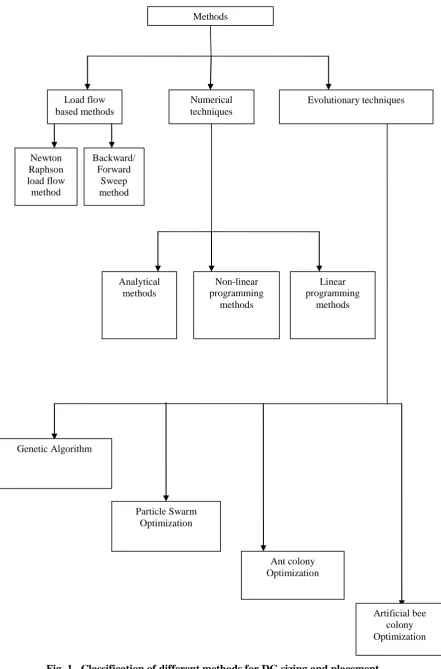
IV. METHODS FOR OPTIMUM LOCATION AND SIZING OF DG UNITS
Fig. 1. Classification of different methods for DG sizing and placement
MethodsLoad flow based methods
Newton Raphson load flow
method
Backward/ Forward
Sweep method
Numerical techniques
Analytical methods
Non-linear programming
methods
Linear programming
methods
Evolutionary techniques
Genetic Algorithm
Particle Swarm Optimization
Ant colony Optimization
334 | P a g e
4.1 Load Flow Based Methods
4.1.1 Newton Raphson load flow based method
A simple conventional Newton Raphson method is used to solve the problem of optimal location of a single DG unit which is delivering only real power in the system [7]. A load flow based method for optimal location of dispersed generation unit delivering only real power for voltage profile impro vement has been presented in [8]. A load flow based approach for optimum allocation of DG units for voltage profile improvement and loss minimization has been suggested in [9]. A Newton Raphson load flow method for optimal sizing and placement of DG units using weighting factors has been proposed in [10]. The cost and loss factors are minimized in this paper.
4.1.2 Forward/Backward load flow method
A forward/backward load flow technique for optimal placement of DG units has been presented in [11]. An approach for optimal allocation and sizing of DG units using forward/backward sweep method has been presented in [12].
4.2 Numerical Techniques
4.2.1 Analytical techniques
The 2/3 rule has been proposed to determine the optimum location and size of radial feeder with u niformly distributed load in [13]. An analytical technique based on exact loss formula has been suggested in [14]. Three analytical approaches using different power loss expressions to determine optimal size and power factors have been proposed in [15]. A loss sensitivity calculation based approach to determine optimal location of DG units has been presented in [16].
4.2.2 Non-linear programming methods
A mixed integer non-linear programming method for optimal placement of DG units has been presented in [17]. A non-linear programming method has been employed for optimal allocation of d ifferent types of DG units considering electricity market fluctuations in [18].
4.2.3 Linear programming methods
A linear programming method has been used to solve the problem of optimal placement and sizing of DG units to attain maximum DG energy harvesting has been proposed in [19].
4.3 Evolutionary Algorithms
4.3.1 Genetic Algorithm
It is an artificial intelligence technique which has been applied in various optimization problems such optimal DG placement. The Genetic Algorithm (GA) is an optimization technique based on natural selection and genetics [20]. In case of DG placement, fitness function can be loss minimization, voltage profile improvement and cost reduction. A combined GA and tabu search is suggested in [21].
4.3.2 Particle Swarm Optimization
clonal algorithm based method for optimum allocation of DG units has been explained in [25]. A hybrid GA and PSO is suggested in [26].
4.3.3 Ant Colony Optimization
It is an optimization technique obtained from the behavior of real ants. The procedure of the Ant Colony algorithm controls the scheduling of three activities. The first step comprises of initialization of the pheromone trail. In second step, each ant constructs a complete solution to the problem according to a probabilistic state transition rule. The third step updates quantity of pheromone. This process is iterated until a stopping criterion is obtained. An ant colony algorithm has been proposed to solve the optimum placement and optimum sizing of DG units in radial distribution system network in [27].
4.3.4 Artificial Bee Colony Algorithm
It is a new meta-heuristic technique introduced by Karaboga in 2005. An extended version of the Artificial Bee Colony Algorithm has been proposed. An Artificial Bee Colony algorithm to find the optimum placement of DG units has been suggested in [28].
V. CONCLUSION
This paper has suggested an overview of state of the art techniques implemented to solve the problem of sizing and position of DG units in the network system. The solution methodology implemented to solve the problem of optimal allocation and size of DG units are categorized as load flow based techniques, numerical methods, analytical methods, evolutionary algorithms such as GA, PSO etc. This problem may include various objective functions, numerous constraints to solve the location issues of DG units. The most common objective function is the reduction of real losses, reactive power losses and voltage profile improvement. It can be concluded that the numerical and analytical methods are time consuming and not very efficient to solve the problem of placement and size of DG sources in the system. Evolutionary algorithms such as PSO, GA, Ant Colony Optimization etc are very feasible and easy to implement.
REFERENCES
[1] T. Ackermann, G. Andersson, and L. Soder, “Distributed generation: a definition,” Electric Power Systems Research, vol. 57, pp. 195-204, 2001.
[2] P. Chidareja, “Benefits of distributed generation: A line loss reduction analysis,” Transmission and Distribution Conference and Exhibition: Asia and Pacific, 2005.
[3] P. Chidareja and R. Ramakumar, “An approach to quantify technical benefits of distributed generation,” IEEE Trans. Energy, vol. 19, no. 4, pp. 764-773, 2004.
[4] H. A. Gil and G. Joos, “Models for quantifying the economic benefits of distributed generators,” IEEE Trans. Power Systems, vol. 23, pp. 327-335, 2008.
336 | P a g e [6] L. A. Freeman and R .E. Brown, “Analyzing the reliability impact of distributed generation”, Proc. of the
IEEE Summer Meeting, pp. 1013-1018, 2001.
[7] Hadi Sadaat, Power System Analysis Tata McGraw-Hill Education, 2002.
[8] A. Kazemi and M. Sagedhi, “A load flow based method for optimal location of dispersed generation units,” Power Systems Conference and Exposition, 2009.
[9] Nibedita Ghosh, S. Sharma, and S. Bhattacharjee, “A load flow based approach for optimal allocation of distributed generation units in the distributed network for voltage improvement and loss minimization,” Internation Journal of Computer Applications, vol. 50, no. 15, 0975-8887, 2012.
[10] S. Ghosh, S. P. Ghoshal, and Saradindu Ghosh, “Optimal sizing and placement of distributed generation in a network system,” Electrical Power and Energy Systems, vol. 32, pp. 849-856, 2010.
[11] G. W. Chang, S. Y. Chu, and H. L. Wang, “A simplified forward and backward sweep approach for distribution system load flow analysis,” International Conference on Power System Technology, 2006. [12] Limei Zhang, Wei Tang, and Guan Honghao, “The back/forward sweep based power flow method for
distribution networks with DGs,” International Conference on Power Electronics and Intelligent Transportation System, 2009.
[13] N. S. Rau and Y. H. Wan, “Optimum location of resources in distributed planning,” IEEE Trans. Power Systems, vol. 9, no. 4, pp. 2014–2020, 1994.
[14] N. Acharya, P. Mahat, and N. Mithulananthan, “An analytical approach for DG allocation in primary distribution network,” Electric Power Systems Research, vol. 28, pp. 669-678, 2006.
[15] D. Q. Hung, N. Mithulananthan, and R. C. Bansal, “Analytical expressions for DG allocation in primary distribution networks,” IEEE Trans. Energy Conversion, vol. 25, no. 3, pp. 814–820, 2010.
[16] W. El-Khattam and M. M. A. Salama, “Distribution generation technologies, definitions and benefits,” Electric Power System Research, vol. 71, pp. 119-128, 2004.
[17] L. F. Ochoa and G. P. Harrison, “Minimizing energy losses: Optimal accommodation and smart operation of renewable distributed generation,” IEEE Trans. Power Systems, vol. 26, no. 1, pp. 198–205, 2011. [18] Y. M. Atwa and E. F. El-Saadany, “Probabilistic approach for optimal allocation of wind based distributed
generation in distribution systems,” IET Renewable Power Generation, vol. 5, no.1, pp. 79–88, 2011. [19] A. Keane and M. O. Malley, “Optimal allocation of embedded generation on distribution networks,”
IEEE Trans. Power Systems, vol. 20, no. 3, pp. 1640–1646, 2005.
[20] A. A. Abou El-Ela, S. M. Allam, and M. M. Shatla, “Maximal optimal benefits of distributed generation using genetic algorithms,” Electric Power Systems Research, vol. 80, pp. 869-877, 2010.
[21] M. Gandomkar, M. Vakilian, and M. Ehsan, “A genetic based tabu search algorithm for optimal DG allocation in distribution networks,” Electric Power Components and Systems, vol. 33, no. 12, pp. 1351– 1362, 2005.
[22] R. Eberhart and J. Kennedy, “Particle swarm optimization,” IEEE International Conference on Neural Networks, vol. 4, pp. 1942-1948, 1995.
[24] G. Celli, E. Ghiani, S. Mocci, and F. Pilo, “A multi-objective evolutionary algorithm for the sizing and siting of distributed generation,” IEEE Trans. Power Systems, vol. 20, pp. 750-757, 2005.
[25] M. Sedighizadeh, M. Fallahnejad, M. R. Alemi, M. Omidvaran, and D. Arzaghi-haris, “Optimal placement of distributed generation using combination of PSO and clonal algorithm,” IEEE International Conference on Power and Energy, 2010.
[26] W. Prommee and W. Ongsakul, “Optimal multiple distributed generation placement in microgrid system by improved reinitialized social structures particle swarm optimization,” Euro. Trans. Electric Power, vol. 21, no. 1, pp. 489–504, 2011.
[27] L. Wang and C. Singh, “Reliability constrained optimum placement of reclosers and distributed generators in distribution networks using an ant colony system algorithm,” IEEE Trans. Power Systems, vol. 38, no. 6, pp. 757–764, 2008.
[28] F. S. Abu-mouti and M. E. El-Hawary, “Optimal distributed generation allocation and sizing in distribution systems via artificial bee colony algorithm,” IEEE Trans. Power Delivery, vol. 26, no. 4, pp. 2090–2101, 2011.