Partial Pressure of Carbon Dioxide in Extremely Low Birth Weight Infants
Supported by Nasal Prongs Continuous Positive Airway Pressure
An T. Nguyen, MD*; Hany Aly, MD‡; Joshua Milner, MD*; Kantilal M. Patel, PhD§; and Ayman El-Mohandes, MD, MPH‡
ABSTRACT. Objective. Traditionally, delivery room management of extremely low birth weight (ELBW) in-fants consisted of immediate intubation and mechanical ventilation. There have been recent reports of success using nasal prongs continuous positive airway pressure (NCPAP) in this population. Data on the partial pressure of carbon dioxide (PCO2) in spontaneously breathing ELBW infants is very limited. The objective of this study was to determine the trend of the average PCO2 in the spontaneously breathing ELBW infants, while on NC-PAP, during the first week of life and to determine whether a brief period of mechanical ventilation affects the PCO2levels after extubation.
Methods. This is a retrospective cohort study of in-fants who had birth weights<1000 g and were admitted to the neonatal intensive care unit at our institution. These ELBW infants were divided into groups on the basis of whether they were never intubated (group 1) or were intubated for<48 hours (group 2). Average daily PCO2levels while on NCPAP were compared between the 2 groups. Minimum and maximum PCO2levels were also compared with a third group of infants (group 3), who were intubated for >48 hours and treated mainly with mechanical ventilation during the first week of life.
Results. Sixty-two ELBW infants were included in this study: 24 infants in group 1, 19 infants in group 2, and 19 infants in group 3. There was no significant dif-ference between the average PCO2levels of group 1 and group 2 during the first week of life. The daily PCO2level during the first week of life for infants who were breath-ing spontaneously on NCPAP had a mean value of 39.73 ⴞ1.78 mm Hg. There was no difference between the daily average minimum PCO2 levels among the 3 groups. Group 3, however, had significantly higher max-imum PCO2levels compared with the first 2 groups dur-ing days 2 through 7 of life.
Conclusions. Daily average PCO2levels in the sponta-neously breathing ELBW infants during the first week of life remains at approximately 40 mm Hg. These levels seem to be unaffected by an initial brief period of me-chanical ventilation. Infants who are treated with longer periods of mechanical ventilation have higher daily max-imum PCO2 levels during the first week of life. Addi-tional studies are required to detect neurodevelopmental outcomes of these 3 groups.Pediatrics2003;112:e208 –e211.
URL: http://www.pediatrics.org/cgi/content/full/112/3/e208; nasal CPAP, extremely low birth weight infants, carbon dioxide, chronic lung disease.
ABBREVIATIONS. ELBW, extremely low birth weight; NCPAP, nasal prongs continuous airway pressure; CLD, chronic lung dis-ease; Pco2, partial pressure of carbon dioxide; NICU, neonatal
intensive care unit; IVH, intraventricular hemorrhage; CO2,
car-bon dioxide, RDS, respiratory distress syndrome.
T
reatment of extremely low birth weight(ELBW) infants continues to change in the postsurfactant era. Recently, there have been several reports of success using an immediate strat-egy toward nasal prongs continuous airway pressure (NCPAP) support in place of intubation and mechan-ical ventilation in the delivery room.1– 4 The use of
NCPAP has brought much excitement because there have been many reports linking the barotrauma and high fraction of inspired oxygen levels associated with mechanical ventilation to the risk for chronic lung disease (CLD).4 –7
There have been many reports and significant con-troversy about the role of partial pressure of carbon dioxide (Pco2) in the respiratory management of the ELBW infant.8However, without a clear definition of
“normocapnia” in this population, these studies are difficult to interpret. It would be of interest to know where these ELBW infants would keep their Pco2if they were given the chance to breathe spontane-ously. It would also be helpful to determine whether ELBW infants experience hypercapnia without the support offered by mechanical ventilation.
Previously, examining the Pco2in spontaneously
breathing ELBW infants has been difficult because the majority of ELBW infants were mechanically ven-tilated beyond the peripartum period. The aim of this study was to determine the average Pco2level of the
spontaneously breathing ELBW infant during the first week of life and to determine whether brief and more extended periods of mechanical ventilation af-fect these levels.
METHODS Subjects
All infants who were born at our institution and weighing
⬍1000 g at birth and were admitted to the neonatal intensive care unit (NICU) between 1997 and 2001 were identified retrospec-tively. Infants were excluded when they were transferred to an-other hospital or died during the first week of life. They were divided into groups on the basis of the length of intubation and
From the *Department of Pediatrics, Children’s National Medical Center, Washington, DC; ‡Newborn Services, George Washington University Med-ical Center, Washington, DC; and §Department of Statistics, Children’s National Medical Center, Washington, DC.
Received for publication Oct 3, 2002; accepted Apr 11, 2003.
Address correspondence to Hany Aly, MD, George Washington University Hospital, 900 23rd St, NW, Ste G2092, Rm G132, Washington, DC 20037. E-mail: [email protected]
mechanical ventilation in the first week of life: never intubated (group 1), intubated for⬍48 hours (group 2), or intubated for⬎48 hours (group 3).
Respiratory Management
Our unit practice consists of infants who are initially dried, stimulated, and assessed in the delivery room. ELBW infants with spontaneous respiratory efforts are offered distending pressure using facial CPAP with a Carden valve to maintain a continuous pressure of 5 cm of water. ELBW infants are then immediately transported to the NICU. A water-seal CPAP unit9is always ready
in the NICU. Infants are immediately placed on NCPAP using the nasal prongs of Hudson Respiratory Care (Temecula, CA). With signs of respiratory compromise, such as severe retraction, fre-quent apnea, or increased oxygen requirement (fraction of in-spired oxygen⬎60%), the infant will be intubated for mechanical ventilation. In the delivery room, ELBW infants who do not breathe spontaneously are immediately intubated and supported with conventional mechanical ventilators. Intratracheal surfactant therapy is offered on an individual rescue basis depending on the clinical and radiographic findings.
Measurement
All Pco2values during the first week of life were compiled
from the medical records for each infant in group 1 and group 2. Our practice is to maintain an umbilical artery catheter in place during the first 3 days of life. After this period, capillary blood gases are then collected as indicated. A peripheral arterial line is placed only when additional intensive monitoring is needed. Av-erage daily Pco2levels of group 1 were sequentially compared
with those of group 2, who had been weaned to NCPAP at that time. Daily minimum and maximum Pco2 values for days 1
through 7 of life were collected for group 3. These values were compared among the 3 groups.
Data Analysis
Data were analyzed using The SAS System Version 6.12.10The
2test was used to compare differences in sex distribution of the
3 groups. The Kruskal-Wallis test (2approximation) was used to
determine statistically significant differences between the mean birth weight, mean gestational age, and Pco2levels of the test
groups. The Fisher exact test was used to compare the percentages of ELBW infants with multiple gestation, maternal infection, and Apgar score⬍4 in the 3 groups.
RESULTS
Seventy-six neonates who weighed⬍1000 g were sequentially born at our institution and admitted to the NICU during the study period. Five infants died, and 2 were transferred to the Children’s Hospital for surgical reasons during the first week of life. Of the
surviving 69 infants, 62 medical records were avail-able for review.
Twenty-four infants were never intubated and were treated with NCPAP alone (group 1). Nineteen infants were initially intubated and ventilated but weaned to NCPAP in ⬍48 hours of life (group 2). Another 19 infants were treated mainly with me-chanical ventilation during the first week of life (group 3). The demographic and perinatal data of this study population are included in Table 1.
There was no significant difference between the daily average Pco2 levels of group 1 and group 2 during the first week of life (Table 2). For both groups, average Pco2levels were highest on the first day of life (group 1: 41.56⫾ 5.88 mm Hg; group 2: 43.25⫾10.76 mm Hg) and lowest on the second day
of life (group 1: 37.55 ⫾ 6.53 mm Hg; group 2:
37.79⫾ 6.61 mm Hg). Overall mean Pco2level dur-ing the first week of life for infants who were
breath-ing spontaneously on NCPAP was 39.73⫾1.78 mm
Hg. The trend of daily Pco2averages for both groups
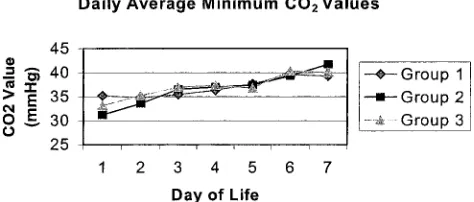
is shown in Fig 1. Average daily pH values for the infants in group 1 ranged from 7.30 to 7.35 (Table 3). There was no difference between the daily average minimum Pco2 levels among the 3 groups (Fig 2).
The infants who were treated mainly with mechani-cal ventilation, however, had significantly higher maximum Pco2 levels compared with the other 2
Fig 1. Average daily Pco2during the first week of life are shown
as a function of days of life (DOL) in infants who were treated with NCPAP (group 1) and mechanically ventilated and weaned to NCPAP within the first 48 hours of life (group 2). The Pco2
averages near 40 mm Hg and are similar for both groups.
TABLE 1. Demographic Data Group 1 (n⫽24)
Group 2 (n⫽19)
Group 3 (n⫽19)
PValue
Birth weight 782⫾151 766⫾131 742⫾140 .56 Gestational age 26.8⫾1.7 26.2⫾1.2 25.7⫾1.6 .34
Gender (% male) 20.8 26.3 31.6 .72*
Multiple gestation 37.5% 15.8% 25% .33* Maternal infection 30.4% 47.4% 31.6% .50* Apgar⬍4 at 1 min 8.7% 36.8% 47.4% .008* * Fisher exact test.
TABLE 2. Daily Average CO2Values (⫾Standard Deviation)
Day 1 Day 2 Day 3 Day 4 Day 5 Day 6 Day 7
Group 1 41.56⫾5.88 37.55⫾6.53 37.92⫾7.65 38.04⫾6.28 38.64⫾5.69 40.75⫾5.61 40.29⫾5.52 Group 2 43.25⫾10.76 37.79⫾6.61 39.52⫾6.47 38.94⫾5.91 39.37⫾6.70 40.13⫾6.36 42.47⫾6.36
Pvalue 0.80 0.97 0.49 0.74 0.77 0.89 0.39
http://www.pediatrics.org/cgi/content/full/112/3/ at Viet Nam:AAP Sponsored on August 30, 2020 e208 e209
www.aappublications.org/news
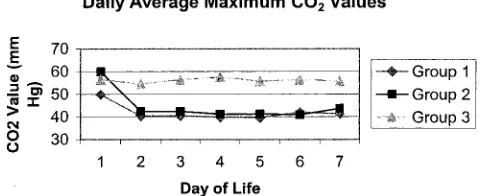
groups during days 2 through 7 of life (P⬍.05). This difference was not found on the first day of life (P⫽
.27). Group 3 had daily average maximum Pco2 lev-els ranging between 54.51 and 57.52 mm Hg (Fig 3). None of the infants in group 1 or 2 had grade 3 or higher intraventricular hemorrhage (IVH) or stage 3 or higher retinopathy of prematurity. In group 3, 3 infants developed IVH grade 3 or 4 (P⫽ .05) and 2 infants developed retinopathy of prematurity stage 3 (P ⫽ .18). There was a trend for a decreased inci-dence of BPD in group 1 (16.7%) compared with group 2 (36.8%) and group 3 (42.1%) that did not reach significance (P⫽.14). A total of 5 infants died; 3 from group 1 (necrotizing enterocolitis, sepsis and airway obstruction) and 2 from group 3 (pulmonary hemorrhage and hyaline membrane disease).
DISCUSSION
ELBW infants who were supported with early NC-PAP could maintain Pco2 levels that averaged
ap-proximately 40 mm Hg. ELBW infants who were treated solely with NCPAP did not show any signif-icant difference in their Pco2levels when compared with those who were initially ventilated and then weaned to NCPAP at a later time.
Pco2 of blood is determined by carbon dioxide
production and alveolar ventilation, and the latter is affected by minute ventilation, dead space volume, and blood flow. The normal reference range for Pco2
levels in children has been generally accepted to be between 33 and 45 mm Hg.11 Healthy term infants
between 2 weeks and 9 months of life have been reported to have Pco2levels of 40.5 ⫾3 kPa (5.4⫾
0.4 kPa).12This information has been adapted to the
treatment of the ELBW infant; however, no data are available to determine whether these respiratory me-chanics are applicable to this population.
In a previous report by Lindner et al,3initial Pco 2
in ELBW infants who were supported with NCPAP was higher when compared with those who were intubated and mechanically ventilated in the deliv-ery room (54⫾13 vs 42⫾17 mm Hg, respectively). These levels did decrease within the first day of life to 48 mm Hg (range: 32–57 mm Hg) and were main-tained during the first week at 47 mm Hg (range: 39 – 49 mm Hg). Their management practice was dif-ferent from ours. ELBW infants in their study were initially given distending pressure of 20 cm of water via a mechanical ventilator through a nasal pharyn-geal tube before CPAP initiation. In addition, we use a water-seal CPAP device in place of ventilator-de-livered CPAP. Finally, we have a strict policy with airway care requiring appropriate positioning and airway suctioning every 2 to 3 hours.
Extreme levels of Pco2 in the ELBW infant can
have adverse effects on neonates. Hypocapnia has been reported to increase the risk for CLD7,8,13,14and
has been associated with poor neurologic outcomes, including periventricular leukomalacia,8,15–17
cere-bral palsy, and neurodevelopmental delay.8,15Severe
hypercapnia, however, has likewise been linked to adverse outcomes such as IVH.8,18,19
We found that ELBW infants who were main-tained on NCPAP did not develop carbon dioxide (CO2) retention, with results similar to those seen
with intermittent mechanical ventilation (group 3). Many of these infants, when allowed to breathe in-dependently, settled at a Pco2level in the low 30s
during the first few days of life. This low Pco2level
does not seem to be a compensatory response to significant metabolic acidosis. This may be of rele-vance because CPAP has been associated with a de-creased incidence of IVH.2,3 IVH in the premature
infant is attributed to the lack of cerebral autoregu-lation.18 We speculate that low Pco
2 levels in this
subgroup may serve as a protective measure to com-pensate for this lack of autoregulation. Of note, none of the infants in groups 1 and 2 had any grade 3 or 4 IVH or periventricular leukomalacia.
Our finding that prolonged mechanical ventilation during the first week after birth is associated with higher daily maximum Pco2levels can be attributed
to increased severity of respiratory distress
syn-Fig 2. Average daily minimum Pco2for groups 1 and 2 and in
infants who were mechanically ventilated for⬎48 hours (group 3), as a function of DOL. There is no significant difference among the 3 groups.
Fig 3. Average daily maximum Pco2levels for all 3 groups are
shown as a function of age in days (DOL). The maximum Pco2in
group 3 is significantly higher than in groups 1 and 2 on days 2 through 7 of life.
TABLE 3. Daily Average pH Values (⫾Standard Deviation)
Day 1 Day 2 Day 3 Day 4 Day 5 Day 6 Day 7
drome (RDS) and could be an early harbinger of ongoing lung disease. This more severe RDS in the mechanical ventilation group may be reflected in the lower Apgar scores of this group. Another important perinatal factor is maternal glucocorticoid use, for which data were not available for this study. How-ever, in other aspects that may suggest a more severe degree of illness in the ventilation group (gestational age, birth weight, percentage of boys), we did not find significant differences from the other 2 groups. In fact, all 3 groups had similar numbers of ELBW infants with birth weight between 500 and 750 g (10 of 24 for group 1, 9 of 19 for group 2, and 10 of 19 for group 3). Even so, it came as no surprise that patients who require prolonged mechanical ventilation have some form of intrinsic lung disease with hypercap-nia. It is not the aim of this study to compare Pco2
levels of these infants with those on NCPAP. Rather, these data show that ELBW infants with moderate RDS can be supported adequately with NCPAP and not show evidence of respiratory insufficiency or Pco2retention.
The clinical practice to allow Pco2to rise to
ame-liorate the incidence of CLD in the premature infant has been revisited recently.20,21There is no consensus
on acceptable Pco2levels. Instead, one may look at
Pco2levels in neonates who are breathing
spontane-ously without distress. The parameters seen in these spontaneously breathing infants can help us to arrive at optimal settings for infants who require mechan-ical ventilation.
The results of this study show that a short period of mechanical ventilation does not affect the Pco2
level in the ELBW infant after extubation. However, this comparison was limited only to the first week of life, and no additional information can be deter-mined regarding other effects of this intervention. Surprising, ELBW infants who are intubated for brief period (⬍24 hours) experience a significantly higher incidence of CLD compared with ELBW infants on NCPAP.22 Although infants who are treated for the
most part with mechanical ventilation during the first week of life seem to have a higher daily maxi-mum Pco2, any clinical impairment associated with
such hypercapnia remain unknown.
CONCLUSIONS
During the first week of life, the spontaneously breathing ELBW infant has an average daily Pco2
near 40 mm Hg. Those levels of Pco2 seem to be
unaffected by any brief time on mechanical ventila-tion. Infants who are mechanically ventilated for more extensive periods of time (⬎48 hours) have an elevated maximum Pco2during the first week of
life. Additional studies are required to detect possi-ble adverse neurodevelopmental and pulmonary changes associated with increased levels of Pco2.
REFERENCES
1. Gitterman MK, Fusch C, Gitterman AR, Regazzoni BM, Moessinger AC. Early nasal continuous positive airway pressure treatment reduces the need for intubation in very low weight infants.Eur J Pediatr. 1997;156: 384 –388
2. Jonsson B, Katz-Salamon M, Faxelius G, Broberger U, Lagercrantz H. Neonatal care of very-low-birthweight infants in special-care units and neonatal intensive care units in Stockholm. Early nasal continuous positive airway pressure versus mechanical ventilation: gains and losses.Acta Paediatr. 1997;86(419 suppl):4 –10
3. Lindner W, Vobetabeck S, Hummler H, Pohlandt F. Delivery room management of extremely low birth weight infants: spontaneous breathing or intubation?Pediatrics. 1999;103:961–967
4. Van Marter L, Allread EN, Pagano M, et al. Do clinical markers of barotrauma and oxygen toxicity explain interhospital variation in rates of chronic lung disease?Pediatrics.2000;105:1194 –1201
5. Palta M, Gabbert D, Weinstein MR, Peter ME. Multivariate assessment of traditional risk factors for chronic lung disease in very low birth weight neonates.J Pediatr. 1991;119:285–292
6. Corcoran JD, Patterson CC, Thomas PS, Halliday HL. Reduction in the risk of bronchopulmonary dysplasia from 1980 –1990: results of a mul-tivariate logistic regression analysis.Eur J Pediatr. 1993;152:677– 681 7. Gannon CM, Wiswell TE, Spitzer AR. Volutrauma, PaCO2levels and
neurodevelopmental sequelae following assisted ventilation.Clin Peri-natol. 1998;25:159 –175
8. Ambalavanan M, Carlo WA. Hypocapnia and hypercapnia in respira-tory management of newborn infants.Clin Perinatol. 2001;28:517–531 9. Aly H. Nasal prongs continuous positive airway pressure: a simple, yet
powerful tool.Pediatrics.2001;108:759 –761
10. SAS Institute Inc.SAS/STAT Software: Changes and Enhancements Through Release 6.12.Cary, NC: SAS Institute Inc; 1997:831– 843
11. Perez Fontan JJ, Haddad GG. Respiratory pathophysiology. In: Behr-man RE, KliegBehr-man RM, Jenson HB, eds.Nelson Textbook of Pediatrics.
Philadelphia, PA: WB Saunders Company; 2000:1248
12. Horemuzova E, Katz-Salamon M, Milerad J. Breathing patterns, oxygen and carbon dioxide levels in sleeping healthy infants during the first nine months after birth.Acta Paediatr.2000;89:1284 –1289
13. Garland JS, Buck RK, Allred EN, Leviton A. Hypocarbia before surfac-tant therapy appears to increase bronchopulmonary dysplasia risk in infants with respiratory distress syndrome.Arch Pediatr Adolesc Med. 1995;149:617– 622
14. Kraybill EN, Runyun DK, Bose CL, et al. Risk factors for chronic lung disease in infants with birth weights of 751 to 1000 g.J Pediatr. 1989; 115:115–120
15. Graziani LJ, Spitzer AR, Mitchell DG, et al. Mechanical ventilation in preterm infants: neurosonographic and developmental studies. Pediat-rics. 1992;90:515–522
16. Fujimoto S, Togari H, Yamaguchi N, et al. Hypocarbia and cystic periventricular leukomalacia in premature infants.Arch Dis Child. 1994; 71:F107–F110
17. Wiswell TE, Graziani LJ, Kornhauser MS, et al. Effects of hypocarbia on the development of cystic periventricular leukomalacia in premature infants treated with high-frequency jet ventilation.Pediatrics. 1996;98: 918 –924
18. Van de Bor M, Van Bel F, Lineman R, et al. Perinatal factors and periventricular intraventricular hemorrhage in preterm infants.Am J Dis Child. 1986;140:1125–1130
19. Wiswell TE, Gannon CM, Graziani LJ, et al. Hypercapnia during the first 3 days of life increases the risk for the development of severe intracranial hemorrhage in the very low birthweight, conventionally-ventilated premature infant [abstract].Pediatr Res.1998;43:203A 20. Carlo WA, Stark AR, Bauer C, et al. Effects of minimal ventilation in a
multicenter randomized controlled trial of ventilator support and early corticosteroid therapy in extremely low birth weight infants.Pediatrics. 1999;104(suppl):738 –739
21. Mariani G, Cifuentes J, Carlo WA. Randomized trial of permissive hypercapnia in preterm infants.Pediatrics. 1999;104:1082–1088 22. Milner JD, Aly H, Patel K, El-Mohandes AE. Nasal prongs continuous
positive airway pressure (CPAP) is associated with a decreased inci-dence of bronchopulmonary dysplasia (BPD) in extremely low birth-weight infants (ELBWI) [abstract].Pediatr Res.2002;51:369A
http://www.pediatrics.org/cgi/content/full/112/3/ at Viet Nam:AAP Sponsored on August 30, 2020 e208 e211
www.aappublications.org/news
DOI: 10.1542/peds.112.3.e208
2003;112;e208
Pediatrics
An T. Nguyen, Hany Aly, Joshua Milner, Kantilal M. Patel and Ayman El-Mohandes
Supported by Nasal Prongs Continuous Positive Airway Pressure
Partial Pressure of Carbon Dioxide in Extremely Low Birth Weight Infants
Services
Updated Information &
http://pediatrics.aappublications.org/content/112/3/e208
including high resolution figures, can be found at:
References
http://pediatrics.aappublications.org/content/112/3/e208#BIBL
This article cites 20 articles, 6 of which you can access for free at:
Subspecialty Collections
http://www.aappublications.org/cgi/collection/fetus:newborn_infant_sub
Fetus/Newborn Infant
collection(s):
This article, along with others on similar topics, appears in the following
Permissions & Licensing
http://www.aappublications.org/site/misc/Permissions.xhtml
its entirety can be found online at:
Information about reproducing this article in parts (figures, tables) or in
Reprints
http://www.aappublications.org/site/misc/reprints.xhtml
DOI: 10.1542/peds.112.3.e208
2003;112;e208
Pediatrics
An T. Nguyen, Hany Aly, Joshua Milner, Kantilal M. Patel and Ayman El-Mohandes
Supported by Nasal Prongs Continuous Positive Airway Pressure
Partial Pressure of Carbon Dioxide in Extremely Low Birth Weight Infants
http://pediatrics.aappublications.org/content/112/3/e208
on the World Wide Web at:
The online version of this article, along with updated information and services, is located
American Academy of Pediatrics. All rights reserved. Print ISSN: 1073-0397.
American Academy of Pediatrics, 345 Park Avenue, Itasca, Illinois, 60143. Copyright © 2003 by the been published continuously since 1948. Pediatrics is owned, published, and trademarked by the Pediatrics is the official journal of the American Academy of Pediatrics. A monthly publication, it has
at Viet Nam:AAP Sponsored on August 30, 2020
www.aappublications.org/news