Research Note
Insect natural enemy complex in some agroforestry systems of
Mizoram, India
D. Paul¹ and Lalnunsangi²*
¹ Centre for Environmental Studies, North Eastern Hill University, Shillong 793022, India ² Department of Zoology, Mizoram University, Aizawl 796009, India
Received 3 March 2011 | Accepted 9 March 2011
ABSTRACT
Small scale agroforestry systems in north-east India are unique in terms of the complex
biodiversity of both the agricultural produce and the adjoining biotic components, and
thus, are excellent models for sustainable production system. The structure and biotic
composition of the systems offer inbuilt sustainability and potential for reduced
de-pendence on chemical fertilizers and pesticides. Maintenance and potential role of
natu-ral enemy complex in various compartments of such systems are discussed in the light
of land use practices and holding size.
Key words Key words Key words
Key words:
Agroforestry; insect pest; insect natural enemy complex; sustainability
.Corresponding author: Lalnunsangi Phone. +91-9436153083
E-mail: [email protected]
INTRODUCTION
In Mizoram, India, farmers normally prac-tice tree-based cropping systems on the basis of knowledge inherited from earlier genera-tions. Although in the past, such practices were directed at retaining the trees for use as timber, at present, realizing the value of eco-nomically important species, teak is intro-duced as the preferred tree component. Jha1
and Jha and Lalnunmawia2 presented
re-search findings of agroforestry system named
as tree-greenhedge-crop farming system and Bamboo based agroforestry system, respec-tively. Lalramnghinglova and Jha3 have
re-ported various multipurpose tree species and predominant agroforestry system prevalent in Mizoram. The most common and successful agroforestry practice is intercropping of Oryza sativa L. (Poaceae) and Zea mays L. (Poaceae) along with Tectona grandis L (Verbenaceae).
The agroforestry or farm forestry practices has exposed plantations to risk of insect pests epidemics because of failure of natural regula-tory factors. It has been experienced and re-corded since the introduction of plantation forestry that insect pests are one of the serious www.sciencevision.info
biological determinants in productivity, espe-cially in man-made plantations. On account of high reproductive potential and short life cycle, most insect pests of plantation forestry are capable of multiplying to an amazing numbers, within short period affecting success of plantation. Agroforestry has introduced another dimension to tree plantation entomol-ogy.
Species diversity frequently causes signifi-cant reduction of insect pest.4 Manipulation
of plant elements in an ecosystem also en-courages built-up of the natural enemies of the pest, simultaneously creating ecological conditions that will suppress population build -up of the pest. This is mainly done through encouraging beneficial plant species (perennial/annual) that support 10-12 poly-phagous parasitic species and discouraging the plant species (perennial/annual) that act as alternate hosts of pests.
It is also well known that mixed culture of plant species faces much lesser problem from insect pests than in monoculture comprising of even aged genetically similar population of crop. Agroforestry which is another type of polyculture can be designed to control or re-duce damage by insect pests.5,6 It is desirable
to gain insight in to the evolving plant-insect interactions particularly pest problems of agroforestry system.
MATERIALS AND METHODS
Study area
The study was conducted in Aizawl dis-trict of Mizoram (Fig. 1). In each case, a plot was selected. The tree component was teak and the crop component in both the sites was maize (Zea mays), Phaseolus vulgaris L. (Fabaceae) and/ or Vigna sinensis L. (Fabaceae). Besides, the site at Aizawl also had Clerodendrum colebrookianum Walp. (Lamiaceae) and Solanum indicum L. (Solanaceae)as other components.
Weed species such as Imperata cylindrica L. ( P o a c e a e ), D r y m a r i a c h o r d a t a L . (Caryophyllaceae), Cyperus rotundus L. (Cyperaceae), Eupatorium sp, Ageratum cony-zoides L. (Asteraceae), etc. were common in the sites.
Each experimental plot was subdivided into three components, viz. tree component, crop component, and fringe area. The fringe area consisted of the natural vegetation
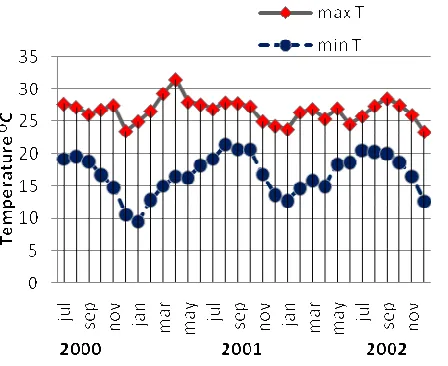
imme-Figure 1. Graph showing monthly minimum and maximum temperatures in Aizawl.
diately outside the cropping plots. Three tree components were chosen. These were teak, tung, and Leucaena.
Sampling and data collection
Monthly records for maximum and mini-mum temperature, and rainfall were collected from Aizawl Metorological office.
A random sampling program,7 replicated
five times, was undertaken for 28 months (August 2000 to December 2002) in each component of each site to account for the fol-lowing:
Total arthropod fauna: The arthropod fauna of the different components of each site was monitored through a replicated monthly sampling program. Sweep net sampling was used for this purpose.
Seasonal dynamic study: The monthly sampling detailed above was analysed for the seasonal dynamics of various orders of
arthropods encountered during the study
Pest of crop and tree components: The pests collected through the random sam-pling program detailed above, and also through handpicking were identified from FRI Dehra Dun, ZSI, Shillong and ICAR, Shillong
Natural enemy complex: The natural ene-mies were also segregated as a group from the monthly sampling data
RESULTS
The minimum temperatures in Aizawl hovered around 10°C recorded during the winter in January, and the maximum tem-peratures occurred during March in all the years (Fig. 1). The rainfall was distributed during the period May-October, with occa-sional mild showers during the dry and cold period (Fig. 2).
Figure 3 depicts the seasonal fluctuation of
Figure 3. Total fauna in the different components of the Teak agroforestry site , Aizawl.
0 2 4 6 8 10 12 14 16 18
aug sep oct novdec jan feb mar apr may jun jul aug sep oct nov dec jan febmar apr may jun jul aug sep oct nov dec
Months (2000-2002)
n
u
m
b
e
rs
/m
2
2
the total arthropod fauna in the different com-ponents of the teak agroforestry site. The overall population densities were low during the cold and dry months, and started to in-crease with the onset of the rainy season, co-inciding with the growing season of the flora, and had the highest records during the mon-soons, possibly with the addition of the new individuals recruited from the overwintering population of dormant eggs and pupae.
Analysis of the percentage contribution of the fauna in the different components (Fig. 4) revealed that the natural enemy complex was constituted of the orders Hymenoptera,
Der-maptera, Chilopoda, Hemiptera, Mantoidae, and Araneida. Besides, some predatory cole-opteran species were also present. Among the three components, the fringe area had repre-sentatives of the maximum number of groups (Fig. 4).
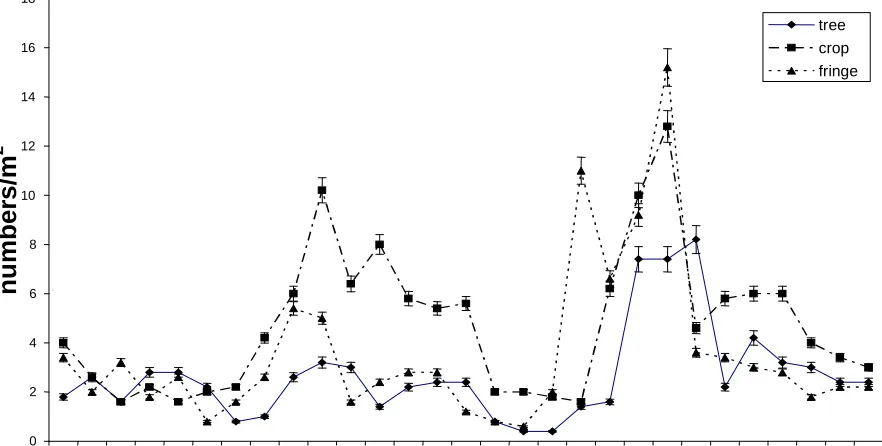
The overall trend of low population re-cords of the tung agroforestry site during the dry and cold periods, followed by peaks dur-ing the warm and wet seasons was similar to the teak site. However, the population table of the fringe area component was markedly higher that the other components (Fig. 5).
The percentage composition of the natural
Teak
coleoptera 14%
hymenoptera 30%
homoptera 14% diptera
12% Larvae
12% dermaptera
8% araneida
10%
Fringe area
coleoptera 15% hymenoptera
18% homoptera
7% mantids
11% orthoptera
23% dermaptera
8% Larvae
8% araneida
10% hymenoptera
22% diptera
12% larvae
15% dermaptera
7% araneida
8% chilopoda
5% orthoptera
16%
coleoptera 15%
Crop
Figure 4. Contribution of the fauna in the different components of the teak site.
Figure 5. Seasonal fluctuation of arthropods in the different components of the Aleurites sites, Aizawl.
0 1 2 3 4 5 6
1 2 3 4 5 6 7 8 9 10 11 12 13 14 15 16 17 18 19 20 21 22 23 24 25 26 27 28 29
Months (2000-2002)
N
u
m
b
e
rs
/m
2
2
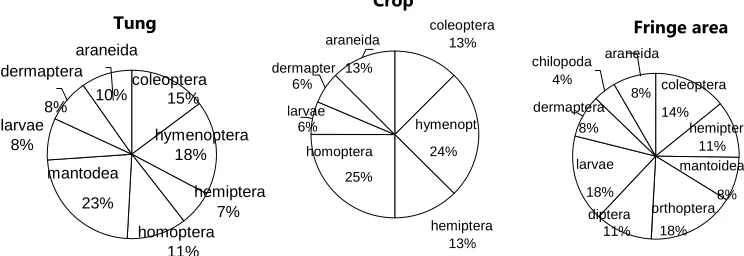
enemy complex of the tung agroforestry site (Fig. 6) revealed the presence of highest diver-sity in the fringe area component, followed by the tree component. The Hymenoptera, par-ticularly the ants were predominant in the crop component.
At the Leucaena agroforestry site, the over-all trend of low population records during the dry and cold periods, followed by peaks dur-ing the warm and wet seasons was similar to the other sites. The population table of the crop component was markedly higher during the first cropping cycle, and this was due to the high numbers of Isoptera and Hymenop-tera. Barring this, the fringe area component had markedly higher population tables than that of the other components (Fig. 7).
The percentage contribution too followed a similar trend as that of the other sites, with the representative groups being higher in the fringe area.
DISCUSSION
The results of the present study indicate the potential of the natural enemy complex as pest management options without the use of harmful chemical insecticides. The tree com-ponent in this context may be visualized as a secure habitat for many of the predatory com-ponents, and the presence of food in the crop component in the form of pests in the near vicinity may act as an attractant for habitation
of the tree component. The fringe area too is a suitable habitat, and this is substantiated by the large numbers of the predators recovered from the area. Further, many of the actively flying predators and parasitoids like mantids and wasps can use the natural vegetation as camouflage while predating in the cropping area. A further benefit arising out of the tree component is an undisturbed ground litter and vegetal cover around the tree component, which often form suitable habitat for preda-tory chilopods and beetles.
Combining trees with crops and the pres-ence of natural buffer of vegetation surround-ing the crop plot thus seem to provide ambi-ent conditions for the suppression of pest populations and at the same time enhancing the faunal comlex,8 consisting of natural
ene-mies.9-12 Further, the tree component provides
habitation to fauna beyond the cropping sea-son, and moderates the climatic conditions.
REFERENCES
1. Jha LK (2000). Trees greenhedge crop farming system, an alternative to jhum cultivation. In: International Workshop on Agroforestry and Forest Products (Nath et al., eds). Linkman publication, Kolkata, pp. 81-86.
2. Jha LK & Lalnunmawia F (2003). Agroforestry with bam-boo and ginger to rehabilitate degraded areas in North East India. J Bamboo Rattan, 2, 103-109.
3. Lalramnghinglova JH & Jha LK (1996). Prominent agrofor-estry systems and important multipurpose trees in
farm-Figure 6. Contribution of the fauna in the different components of the tung site.
Fringe area coleoptera 14% hemiptera 11% mantoidea 8% orthoptera 18% diptera 11% larvae 18% dermaptera 8% chilopoda 4% araneida 8% Crop coleoptera 13% hymenopt 24% hemiptera 13% homoptera 25% larvae 6% dermapter 6% araneida 13% Tung coleoptera 15% hymenoptera 18% hemiptera 7% homoptera 11% mantodea 23% larvae 8% dermaptera 8% araneida 10%
ing system of Mizoram. Indian For,122, 604-609. 4. Altieri MA & Liebman MZ (1986). Insect, weed and plant
disease management in multiple cropping system, In:
Multiple Cropping System (CA Francis, ed). Macmillan, New York, pp. 183-218.
5. Sen Sarma PK (1993). Insect pest management in agro-forestry. In: Agroforestry: Indian Perspective (LK Jha & PK Sen Sarma, eds). Ashish Publications, New Delhi, pp. 223-229.
6. Sen Sarma PK (2000). Integrated management of insects pests of agroforestry system-some considerations. In:
Agroforestry and Forest Products (LK Jha, D Paul, U Sahoo, H Lalramnghinglova & LN Singh, eds). pp. 195-200. 7. Southwood TRE (1978). Ecological Methods with Particular
Reference to the Study of Insect populations. Methuen, London, pp. 391.
8. Cromortie WJ (1981). The environmental control of insect using crop diversity. In: CRC Handbook of Pest Manage-ment in Agriculture (D Pimental, ed). Boca, Rotan, Florida, pp. 223-250.
9. Allen RT (1979). The occurrence and importance of ground beetles in agricultural and surrounding habitats. In: Carabid Beetles; Their Evolution, Natural History and Classification (TL Erwin, GE Bell & DR Whitehead, eds), pp. 485-506.
10. Den Boer PJ (1990). The survival value of dispersal in terrestrial arthropods. Biol Conserv, 54, 175-92.
11. Duelli P, Struder M, Marchand I & Jacob S (1990). Popula-tion movements of arthropods between natural and culti-vated areas. Biol Conserv,54, 193-207.