African Journal of Rural Development, Vol 3 (1): January-March 2018: pp. 665-676. ISSN 2415-2838
This article is licensed under a Creative Commons license, Attribution 4.0 International (CC BY 4.0)
Received: 17 May 2017 Accepted: 14 October 2017 Cite as:Kavoi, J.M. and Mutinda, M.N. 2018.Influence of Multi-Stakeholder
Linkages and Practices on the Adoption of Technologies and Innovations in
Influence of multi-stakeholder linkages and practices on the adoption of
technologies and innovations in lower Eastern Kenya
J. M. KAVOI1 and M.N. MUTINDA2
1 KARLO-Katumani Research Centre, Socio-Economics and Policy Development Research Programme, P.O. Box 340-90100, Machakos, Kenya
2Department of Natural Resources, Faculty of Environment and Resource Development, Egerton University, P.O. Box 536, Egerton, Njoro, Kenya
Corresponding author: [email protected]; [email protected]
ABSTRACT
The study is an assessment of how the factors related to multi-stakeholder linkages and practices (MSLIAD) influence the adoption of Gadam sorghum technologies and practices by farmers in six sub-counties in lower eastern Kenya where past public-private-partnership
development initiatives have been implemented. The factors studied included: (i) farmers’
attitude towards MSLIAD, (ii) prevailing policies, (iii) coordination of stakeholders in production and provision of services, (iv) competition among the stakeholders, (v) information sharing among the stakeholders, and (vi) collective action in access to markets. Stratified random sampling was used to select 165 household heads who were interviewed using a structured questionnaire. Data were analysed using both descriptive and inferential statistics. Significant (p <.05) negative influences were found to exist between the MSLIAD factors and the adoption of technologies and practices by the farmers. Strong linkages between research, policy and practice were found necessary to enhance technology adoption. Further, existing linkages should be clearly defined for proper coordination of information sharing and feedback across all communication levels.
Key words: Eastern Kenya, feedback, information sharing, research-policy-practice, strong linkages, technology and innovation adoption
RÉSUMÉ
La présente étude vise à évaluer comment les facteurs déterminant les liens et pratiques
multipartites influencent l’adoption des technologies et pratiques liées au sorgho variété
Gadam, par les agriculteurs de six divisions du bas-est du Kenya où des initiatives de
développement de partenariat public-privé ont été mises en œuvre. Les facteurs étudiés comprenaient: (i) l’attitude des agriculteurs envers ces pratiques, (ii) les politiques en
vigueur, (iii) la coordination des acteurs dans la production et la prestation des services,
(iv) la concurrence entre les acteurs, et (vi) l’action collective dans l’accès aux marchés.
Un échantillonnage aléatoire stratifié a été utilisé pour sélectionner 165 chefs de ménage
interrogés à l’aide d’un questionnaire structuré. Les données ont été analysées à l’aide
<0,05) ont été observées entre les facteurs déterminant les liens et pratiques et l’adoption
de technologies et de pratiques par les agriculteurs. Des liens forts entre la recherche, la
politique et la pratique ont été jugés nécessaires pour améliorer l’adoption de la technologie.
De plus, les liens existants devraient être clairement définis pour une bonne coordination du
partage d’informations et des feedback à tous les niveaux de communication.
Mots-clés: Kenya oriental, feedback, partage d’informations, recherche-politique- pratique, liens forts, adoption de la technologie et de l’innovation
INTRODUCTION
A major bottleneck to development of the African continent is declining agricultural productivity (Nyagumbo and Rurinda, 2011). As such, in recent years, agriculture has received attention from governments, investors and other partners after decades of neglect. Such attention should support and create strong linkages that link smallholders to productive value chains (ASARECA, 2013; Byerlee and Bernstein, 2013). The New Economic Partnership for African Development (NEPAD) has recognized partnerships among African countries themselves and between them and the international community as key elements of a shared and common vision to eradicate poverty (United Nations [UN], 2011). As noted by Bett et al. (2014) and Castle et al. (2016), adoption of technologies and innovations that enhance or maintain land productivity sustainably becomes crucial in achieving the much desired food security to feed the increasing population.
Policies are statements of organizational objectives and expectations that reflect the social values and needs of the masses (Sycamnias, 2010; Byerlee and Bernstein, 2013). Linkages are the interactions between organizations and may be formed for joint research or for transferring technologies and innovations (Giuliani and Arza, 2009). They allow exchange and or transfer of information, resources or power and can be used to enhance
consensus building and people’s understanding
on relevant integrated decision-making.
Linkages help minimize duplication of efforts and any delay in the process of project planning and implementation continuum (Mwangi, 2011). In developing countries, linkages between different actors are more related to the provision of specific services as opposed to research or entrepreneurship (Arza and López, 2011). Stronger linkages can be achieved through creation of an enabling environment that promotes product specialization among producers (farming community) and processors (value addition) (Buchanan et al., 2013; Hailu and Campbell, 2014). As noted by Buttoud et al. (2011) and Food and Agriculture Organization (FAO) (2011), a strategy therefore is needed to promote social and policy learning among different stakeholders in order to address contradiction between policies and markets in technology and innovation development.
Smallholder farmers in the semi-arid lower Eastern Kenya region, like smallholder farmers in other African countries continue to face limited access to agricultural services due to weak collaborative linkages between public extension staff and other service providers (Ministry of
and household income in the region. The Gadam sorghum commercialization public-private partnership (PPP) development initiative in semi-arid lower Eastern Kenya is an example of past joint development initiatives.
The overall objective of the Gadam sorghum PPP initiative was to promote the production and commercialisation of Gadam sorghum grain among the smallholder farmers in the semi-arid areas of lower Eastern Kenya, covering Kitui, Machakos and Makueni Counties. A cereal grain consumption analysis carried out in 2008 had shown that East African Breweries Limited (EABL) at the time used 100 million kg of barley annually. Barley production had gone down because more barley farmers had turned to wheat production following increase in international wheat markets (Karanja et al., 2011). To meet its annual grain consumption, the EABL had to import barley, thus consuming part of the
country’s foreign exchange earnings. To address
this, barley consumption by the brewing industry needed to be reduced by 60% through the use of the fermentable Gadam sorghum grain. It was also envisaged that through commercialization of Gadam, farmers in the target region would acquire a new and more reliable source of household income and food security.
Several factors catalysed the development of the PPP joint initiative. They included the huge demand for Gadam sorghum grain by the EABL. Prior to this initiative, the EABL was sourcing its sorghum for brewing from a neighbouring country. Secondly there was the assured and sustainable market for Gadam sorghum grain. Unlike the previous low farm-gate and local markets prices of KShs.3-5 per kg, the new stable farm-gate price was KShs.17 per kg (Karanja et al., 2011). Thirdly, a proper delivery system was assured - one of the partners was to organize for the Gadam sorghum grain aggregation from a production cell (a group of 15-20 or 25 neighbouring farmers) into a central
collection point for eventual delivery of the same to the buyer.
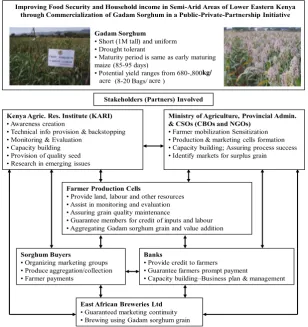
Partners involved in the Gadam sorghum commercialization PPP development initiative were the public sector (Research, extension and local administration, politicians); Civil Society Organization (Non Governmental Organizations, Community-Based Organizations, Faith-Based Organizations); private sector (commercial banks, EABL, transporters), the producers (Farmer self-help groups, farmer-based organizations), and local vernacular Frequency Modulation (FM) radio stations. These stakeholders were linked in the PPP development initiative as shown in Figure 1.
With a guaranteed market and better farm-gate price, it was hoped that the Gadam sorghum PPP joint initiative would increase production and marketing of the sorghum grain from the region. To meet the demand from the EABL, the Gadam PPP initiative aimed at delivering 12,000MT of Gadam sorghum grain during the first year of production. It was also hopped that production would raise 24,000MT during the second year and eventually production tonnage was anticipated to stabilize at 70,000MT. However, just like other past PPP initiatives, production and tonnage from the region picked up during the first two years of its inception. About 300MT of Gadam sorghum grain were delivered from the semi-arid lower Eastern Kenya region to the EAML during the first year of production (Kavoi
et al., 2010). Although production seemed to
The general objective of the study was to determine factors related to effectiveness of existing linkages between research, policy and practice among development partners in the semi-arid areas of Kitui, Machakos and Makueni Counties. The specific objectives were to:
determine the level of farmer’s adoption of
technology and practices related to the growing of sorghum in the target area, and assess the influence of multi-stakeholder linkages between
research, policy and practice on farmer’s
adoption of technologies and innovations related to sorghum growing in the target area.
MATERIALS AND METHODS
An emergent (also known as a working design) research design was used in this study (Spring et
al., 2007). Working (Emergent) research design
enables the researcher to be flexible and to make necessary adjustments as the study progresses (Wiersma and Jurs, 2009; Whitten, 2011). This naturalistic and holistic participative research design takes the interests of both the researcher and the respondents into account. It provides for active participation of both the researcher and the respondents (Martin, 2008). With assistance from local extension staff and administrators, lists of households in the selected villages where the Gadam sorghum commercialization initiative was implemented were compiled. These formed the sampling frame from which the desired sample size for the study was drawn (equation 1). To draw the desired sample size, sampling standard procedures were adopted
Figure 1. Gadam sorghum commercialization model adopted by the partners: Arrows indicate linkages between stakeholders
s
East African Breweries Ltd
•Guaranteed marketing continuity •Brewing using Gadam sorghum grain
Kenya Agric. Res. Institute (KARI)
•Awareness creation
•Technical info provision & backstopping •Monitoring & Evaluation
•Capacity building •Provision of quality seed •Research in emerging issues
Ministry of Agriculture, Provincial Admin. & CSOs (CBOs and NGOs)
•Farmer mobilization Sensitization •Production & marketing cells formation •Capacity building; Assuring process success •Identify markets for surplus grain
Sorghum Buyers
•Organizing marketing groups •Produce aggregation/collection •Farmer payments
Banks
•Provide credit to farmers •Guarantee farmers prompt payment
•Capacity building–Business plan & management
Farmer Production Cells
•Provide land, labour and other resources •Assist in monitoring and evaluation •Assuring grain quality maintenance
•Guarantee members for credit of inputs and labour •Aggregating Gadam sorghum grain and value addition
KENYA ARID AND SEMI-ARID LANDS PROGRAMME (KASAL)
Kenya Agricultural Research Institute European Union Ministry of Agriculture
Gadam Sorghum
•Short (1M tall) and uniform •Drought tolerant
•Maturity period is same as early maturing maize (85-95 days)
•Potential yield ranges from 680-,800Kg/ Acre (8-20 Bags/ Acre)
Improving Food Security and Household income in Semi-Arid Areas of Lower Eastern Kenya through Commercialization of Gadam Sorghum in a Public-Private-Partnership Initiative
Stakeholders (Partners) Involved kg/ acre
(SMART, 2012).
n = Z2pq (1)
d2 Where
n = the desired sample size
Z = the standard deviation set using a desired confidence levels (e.g. at 95% confidence interval Z is 1.96),
P = the proportion of the target estimated to have a particular characteristic for example the target population has 60 % of the households living under the poverty line,
q = 1-P, and,
d = the degree of accuracy desired, which in this case was 95%,
The respondents from each study site were proportionately selected in all the study sites in the six Sub-Counties (Equation 2). Thus, 34 respondents (Kyuso), 29 respondents (Migwani), 26 respondents (Mwala), 21 respondents (Machakos), 31 respondents (Kathonzweni) and 24 respondents (Makueni) were selected and interviewed.
i = N1 (n) (2)
N2
Where
i = Proportion of the sample taken in particular village
N1 = the total number of households in a
particular village N2 = the total population
n = the total sample size calculated on the basis of the target population
Using a Gadam sorghum PPP commercialization and development initiative, a semi-structured questionnaire was used to collect data from a sample of 165 households involved in the initiative. All the respondents were selected from six purposively selected Sub-Counties in the three Counties where past joint development initiatives e.g. cotton production and marketing; sunflower production and marketing, among others, were carried out.
Conceptual framework and operationalization of the study variables. The conceptual framework adopted in this study (Figure 2) outlines six independent factors in MSLIAD hypothesized
to influence the level of Farmer’s adoption of
technology and innovation. Political factors and climatic variability were recognized as possible moderating factors.
The study variables were operationally defined and the underlying concepts measured using multiple-indicators (Bryman and Bell, 2011). The indicators were developed as statements relating to specific action as viewed by the individual respondent. Respondents were asked to judge the extent to which they personally
Independent Variables
Factors influencing MSLIAD current status:
a) Perceptions and Attitude
(mind-set)
b) Prevailing policies and
strategies
c) Coordination of product and
service provision
d) Competition among
stakeholders
e) Information sharing
f) Collective action (Group
access to market)
Moderating Variables a) Political
factors
b) Climate variability
Dependent Variables
Level of technology and innovation adoption by farmers:
a) Area under Gadam
sorghum in relation to other crops
b) Application of appropriate
agronomic practices
c) Group membership and
participation in group activities
Figure 2. Conceptual framework for analysing existing MSLIAD in semi-arid areas of Kitui, Machakos and Makueni Counties
believed the action was true on a five-point rating scale. The responses were rated very High, High, Moderate, Low and Very Low. Scores were then assigned for each response as 1, 2, 3, 4, and 5, respectively. The higher the score for a response, the higher was the belief that the action was true as implied by the statement. The scores for each indicator were then combined together to form a grand score or an index. The reliability of the indicators making up the index were determined using the
Cronbach’s alpha reliability coefficient. This
coefficient is fundamentally concerned with issues of internal consistency of measures of a concept (Cronbach and Shavelson, 2004). The alpha reliability coefficient was used to assess the internal consistency of the multi-item index or the combined scores of the index because it determines whether or not the indicators making the index are consistent or answers the question. An alpha of 0.70 and above was considered sufficient.
The dependent variable, the extent of farmers’
adoption of Gadam sorghum technology and innovation, was defined as individual farmers who were currently growing the crop having done so from 2009 when the initiative was introduced. The variable was developed as an index with a maximum score of 5. It combined 3 indicators, namely: (i) area under Gadam sorghum in relation to other crops, with a maximum score of 1, (ii) number of technologies and practices applied by the farmer, such as use of high yielding variety, fertilizer application and land preparation, with a maximum score of 3, and (iii) whether the farmer was currently growing Gadam sorghum, with a maximum score of 1.
The six independent variables, which included: (i) attitude of the farmers towards MSLIAD, (ii) prevailing policies and strategies, (iii) coordination of the stakeholders in production and provision of services, (iv) competition
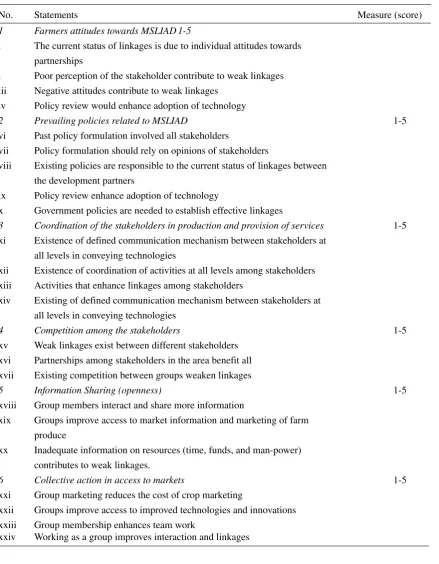
among the stakeholders, (v) information sharing, and (vi) collective action in access to markets. The variables were operationalized as indicated in Table 1.
Data analysis. Descriptive and inferential statistics using the Statistical Package for Social Sciences (SPSS) versions 21.0 were used to analyse the data. Descriptive statistics used included means, standard deviation (S.D), range, frequency, number, and percentages. In order to determine the influence of the independent factors on the adoption of technologies and innovations promoted and disseminated through MSLIAD, a regression analysis was carried out using the regression model as shown:
Y = a+(βX1+βX2+βX3+ …βX6) +e
Where
Y = Dependent variable (farmers adoption of technology and innovation)
X1 = Farmers attitude towards MSLIAD X2 = Prevailing policies related to MSLIAD
X3 = Coordination of the stakeholders in
production and provision of services X4 = Competition among the stakeholders X5 = Information sharing (openness) X6 = Collective action in access to markets e = the error term
RESULTS AND DISCUSSION
Social demographic characteristics of the farmers. The social demographic characteristics of the farmers sampled are presented in Table 2. The low proportion of the respondents who have attained post-secondary education level (3 %) is likely to negatively influence increased technology and innovation adoption among the smallholder farmers in the study region
Table 1. Independent Variables and Indicators describing them
No. Statements Measure (score)
1 Farmers attitudes towards MSLIAD 1-5
i The current status of linkages is due to individual attitudes towards partnerships
i Poor perception of the stakeholder contribute to weak linkages iii Negative attitudes contribute to weak linkages
iv Policy review would enhance adoption of technology
2 Prevailing policies related to MSLIAD 1-5
vi Past policy formulation involved all stakeholders
vii Policy formulation should rely on opinions of stakeholders
viii Existing policies are responsible to the current status of linkages between the development partners
ix Policy review enhance adoption of technology
x Government policies are needed to establish effective linkages
3 Coordination of the stakeholders in production and provision of services 1-5 xi Existence of defined communication mechanism between stakeholders at
all levels in conveying technologies
xii Existence of coordination of activities at all levels among stakeholders xiii Activities that enhance linkages among stakeholders
xiv Existing of defined communication mechanism between stakeholders at all levels in conveying technologies
4 Competition among the stakeholders 1-5
xv Weak linkages exist between different stakeholders xvi Partnerships among stakeholders in the area benefit all xvii Existing competition between groups weaken linkages
5 Information Sharing (openness) 1-5
xviii Group members interact and share more information
xix Groups improve access to market information and marketing of farm produce
xx Inadequate information on resources (time, funds, and man-power) contributes to weak linkages.
6 Collective action in access to markets 1-5
xxi Group marketing reduces the cost of crop marketing
xxii Groups improve access to improved technologies and innovations xxiii Group membership enhances team work
Table 2. Social demographic characteristics of the farmers
Farmers characteristic Statistics
Age Mean 53, range 25 to 93 years
Gender Men 42.4 %; Women 57.6 %
Highest Education level attained
No formal education 10.9 %
Primary education 56.4 %
Secondary education 29.7 %
Post-secondary education 3.0 %
Household members number Mean 6 (range 1 to 19)
Number of years in farming Mean 26, range 2 to 58 years
n=165
Descriptive statistics of the study variables. The index, indicators, their descriptive statistics and
Cronbach’s alpha levels are summarised and presented in Table 3.
Table 3. Descriptive statistics of the study variables
Variable description Mean SD alpha
Dependent variable:
Level of technology and innovation adoption 1.36 1.68 0.709
Area under Gadam sorghum in relation to other crops .26 .01
Number of technologies and practices applied by farmer .73 .08
Whether currently growing Gadam sorghum .36 .07
Independent variables:
Farmer attitude towards MSLIAD 13.06 1.09 0.718
Prevailing policies related to MSLIAD 22.41 1.51 0.710
Coordination of the stakeholders in production and 18.27 1.21 0.881
provision of services
Competition among stakeholders 13.01 0.58 0.724
Information sharing (openness) 27.79 1.83 0.768
Collective action in access to markets 32.49 2.14 0.826
n=165
Level of adoption of MSLIAD technologies and innovations. The extent of farmer’s
adoption of technologies and innovation was the dependent variable. The score of the index ranged from 0 to 5 on a scale of 0 and 5 with
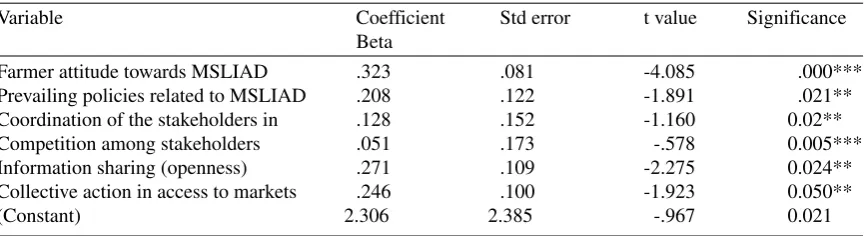
Factors influencing adoption of technologies and practices promoted through MSLIAD. An ordinary Least Squares Regression Model was conducted to predict the influence of the independent factors on the adoption of technologies and practices promoted through MSLIAD (Table 4). The study revealed
that farmer’s adoption of Gadam sorghum
production technology and innovation promoted through MSLIAD was significantly (p <.05) and negatively influenced by the farmers attitude towards MSLIAD, prevailing policies, coordination of stakeholders in production and provision of services, competition among the stakeholders, information sharing (openness) as observed by Leniv et al. (2016) among the stakeholders, and collective action in access to markets.
DISCUSSION
Multi-stakeholder partnerships and linkages are essential for knowledge transfer in order to achieve intended adoption of technologies and innovations among the farming communities. Such linkages are required in agricultural innovative systems as interactions and linkages bring about increased adoption of innovations and technologies as noted by Ragasa et al. (2016). In addition, concrete structure for learning and knowledge sharing enables knowledge to evolve in an upward spiral manner (de Haas,
2016). In every knowledge activity, a variety of stakeholders is involved who should optimize joint knowledge creation and formulation of a follow-up plan of action that can be acted on. The strong positive influence implies that the six variables are relevant in the enhancement of
farmer’s adoption of technology and innovation
in Gadam sorghum growing. Thus, the positive influence on information sharing calls for strong linkages between stakeholders responsible for technology development (research), conducive environment for technology and innovation promotion and dissemination (policy) and technology implementation (practice).
CONCLUSIONS
Based on the study findings, the researchers concluded that information sharing is important in enhancing promotion and adoption of MSLIAD technologies. Openness and trust in information sharing were crucial in establishing and maintaining strong linkages between different development partners. Strong linkages between research, policy and practice were necessary to enhance technology development, promotion and adoption for increased food productivity and security. Information required for policy formulation can be sought from all levels, especially from the grassroots for increased practice in technology diffusion and adoption. Substantial impact on policy
Table 4. Ordinal linear regression model estimates of independent factors influencing adoption of technologies and practices promoted through MSLIAD
Variable Coefficient Std error t value Significance Beta
Farmer attitude towards MSLIAD .323 .081 -4.085 .000*** Prevailing policies related to MSLIAD .208 .122 -1.891 .021** Coordination of the stakeholders in .128 .152 -1.160 0.02** Competition among stakeholders .051 .173 -.578 0.005*** Information sharing (openness) .271 .109 -2.275 0.024** Collective action in access to markets .246 .100 -1.923 0.050** (Constant) 2.306 2.385 -.967 0.021
performance in achieving sustainable innovative agricultural development requires effective mechanism for sensitizing all stakeholders on key policy issues.
RECOMMENDATIONS
The researchers recommend that, the existing linkages should be clearly defined for proper coordination of information sharing, information flow and feedback. Stakeholders should embrace the use PPP development initiatives, which involve different disciplines and expertise to reduce costs associated with activity planning, implementation and participatory monitoring and evaluation (P.M.&E) of implemented activities. Policy formulators should effectively engage other stakeholders at different administrative levels in gathering the relevant information for development and promotion of the developed policies. To achieve substantial impact on policy performance in sustainable innovative agricultural development, relevant government departments and partnering development agents should put in place effective mechanism for sensitizing all stakeholders on key policy issues.
ACKNOWLEDGEMENTS
The authors are grateful to the National Commission for Science, Technology and Innovation of Kenya for funding the study. Their appreciation also goes to the Ministry of Agriculture staff, local leaders and the farming community for the cooperation accorded to them during the study. Appreciation also goes to the Kenya Agricultural and Livestock Research Organization (KALRO) and Egerton University
for allowing the researchers to use institutions’
facilities.
STATEMENT OF NO-CONFLICT OF INTEREST
The authors declare that there is no conflict of interest in this paper.
REFERENCES
Arza, A. and López, V. 2011. Firms’ linkages
with public research organizations in Argentina: Drivers, perceptions and behaviours. Technovation 31: 384-400.
Association for Strengthening Agricultural Research in Eastern and Central Africa (ASARECA). 2013. Opportunities for Africa in unlocking the vast potential of agribusiness. Policy Analysis and advocacy programme (P.A.A.P). Electronic Newsletter 16 (8): 1-3. Bett, C., Githaigah, T., Njana, J. and Munyao,
J. 2014. Improved quality protein maize dissemination and production in medium and low altitude ecologies of Kenya. In: Kimenye, L. and McEwan, M. (Eds). 2014. Scaling up, dissemination and adoption of agricultural
technologies using innovation platforms—
lessons from Eastern and Central Africa. ASARECA, Entebbe.
Bryman, A. and Bell, E. 2011. Business Research Methods. 3rd edition. Oxford: Oxford University Press
Buchanan, K., Brouwer, H., Klerkx, L., Schaap, M., Brouwer, J. and Le Borgne, E. 2013. Facilitating multi-stakeholder processes: Balancing internal dynamics and institutional politics. Knowledge Management
for Development 9 (3): 3-10.
Buttoud, G., Kouplevatskaya-Buttoud, I., Slee, B. and Weiss, G. 2011. Barriers to institutional
learning and innovations in the forest sector in Europe: Markets, policies and stakeholders.
Forest Policy and Economics 13: 124-131.
Byerlee, D. and Bernstein, J. 2013. Feed the Future Learning Agenda Literature Review: Improving research and development. Rockville, MD: Westat.
Castle, M., Lubben, B. and Luck, J. 2016. Factors influencing the adoption of precision agriculture technologies by Nebraska producers. Presentations, Working Papers, and Gray Literature: Agricultural Economics 49pp.
Cronbach, L. and Shavelson, R. 2004. My current Thoughts on Coefficient Alpha and
Psychological Measurements 64 (3): 391-418.
de Haas, B. 2016. Perspectives on Strengthening Linkages between Research, Policy and Practice. Working Paper. Amsterdam: Share-Net International. Retrieved from: http:// www.billiedehaas.com/media/downloads/ share-net_working_paper_linking_research_ policy_practice_final.pdf
Food and Agriculture Organization (FAO). 2011. Factors influencing the strength of the link in agricultural extension in developing economies. FAO, Rome.
Giuliani, E. and Arza, V. 2009 . What drives
the formation of “valuable”
industry linkages? Insights from the wine industry. Research Policy 38: 906-921.
Hailu, M. and Campbell, B. 2014. Evidence of Impact: Climate-smart agriculture in Africa. Technical Centre for Agricultural and Rural Cooperation (CTA). pp.13-14.
Kavoi, J., Karanja, D. and Wafula, J. 2010. Turning challenges into opportunities:
Commercialization of Gadam sorghum in maize dominated farming systems of lower semi-arid areas of Eastern Kenya. Paper presented during the 12th KARI biennial
scientific conference, 9th – 11th August,
2011, KARI headquarters, Kaptagat road, Nairobi, Kenya.
Karanja, D., Kavoi, J. and Mutuku, R. 2011. The role of the market in addressing climate change in the semi-arid lands of Kenya: The case of Gadam sorghum. Paper presented during the End of Project Conference, 9th to 11th August, 2011, KARI Headquarters, Nairobi, Kenya.
Levin, N., Leonelli, S., Weckowska, D., Castle, D. and Dupré, J. 2016. How do scientists define openness? Exploring the relationship between open science policies and research practice. Bulletin of Science, Technology and
Society 36 (2): 128-141
Martin, A. 2008. Self-reflection on emergent research design:. Graduate Journal of Social
Science 5 (1): 49-70.
Ministry of Agriculture. 2012. National agricultural sector extension policy (N.A.S.E.P). Government Printer, Nairobi, Kenya.
Mwangi, J. 2011. Challenges and opportunities for effective linkages between research,
policy and practice. Paper presented during the African Technology Policy Studies Network (ATPS) conference in November 2011, Mombasa, Kenya.
Nyagumbo, I. and Rurinda, J. 2011. An appraisal of policies and institutional frameworks impacting on smallholder agricultural water management in Zimbabwe.
Physics and Chemistry of the Earth.
Parts A/B/C, 47: 21-32. doi:10.1016/j. pce.2011.07.001
Ragasa, C., Ulimwengu, J., Randriamamonjy, J. and Badibanga, T. 2016. Factors affecting performance of agricultural extension: Evidence from Democratic Republic of Congo. The Journal of Agricultural Education
and Extension 22 (2): 113-143.
Rušarová, K., Mazancová, J. and Havrland,
B. 2015. Factors limiting adoption of technologies by farmers in Catabola Municipality, Angola. Scientia Agriculturae
Bohemica 47 (2): 97–104
Spring, M., Stevenson, M. and Selviaridis, K. 2007. Emergent research design strategies in collaborative research: A tale of two studies. POMS 18th Annual Conference, Dallas, Texas, U.S.A. May 4 to May 7, 2007
Sycamnias, E. 2010. Policy and planning. Online: from http://www.oppapers.com/ essays/Policy-And-Planning/355201
Tata, J. and McNamara, P. 2016. Social factors that influence use of ICT in agricultural
extension in Southern Africa. Agriculture 6 (2): 15; doi:10.3390/agriculture6020015. www.mdpi.com/journal/agriculture
United Nations 2011. Sustainable development for Africa. UN.
Whitten, J. 2011. Types of qualitative research designs. Retrieved on 20-10-2011 at Types of Qualitative Research Design | eHow. com http://www.ehow.com/list_7607707_ t y p e s - q u a l i t a t ive - r e s e a r c h - d e s i g n . html#ixzz1bGV6ZrgJ.