(PLATES 29-44)
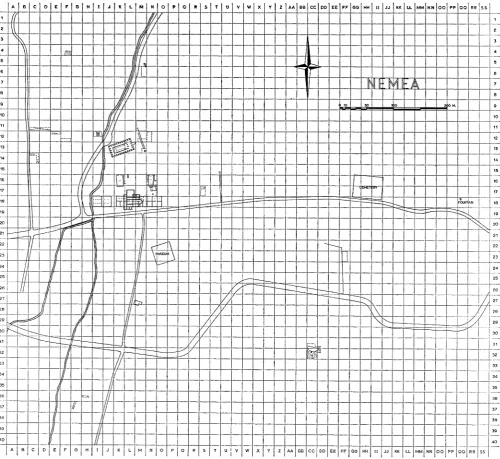
7XCAVATIONS were continued in 1975 1 at Nemea in the same general areas ll4 Xwhich were explored in 1974: 2 the prehistoric ridge of Tsoungiza, the Sanc-
tuary of Zeus, and the Stadium (Fig. 1). In addition, brief investigations were carried out in an area far to the south of the sanctuary.
TsoUNGIZA
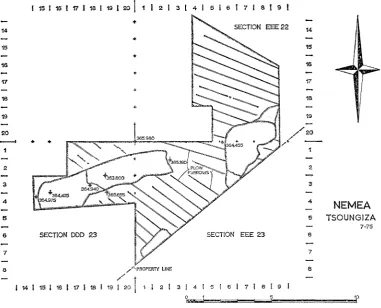
Work was continued in the fill disturbed by plowing and in the underlying pits which had been partially explored in 1974. That work had been confined to grid squares DDD 22 and EEE 23. The work was extended this year into squares DDD 23 and EEE 22 (Fig. 2). In the latter areas the disturbed fill was found to contain a heavy concentration of Late Helladic material (PI. 29, a). Basically within the area EEE/4, 6-22/13, 14, this material included a plain kylix (P 137, H. 0.106 m), a plain stemless cup (P 136, H. 0.065 m.), and a painted bowl (P 150, P.H. 0.10 m.; PI. 29, b). Despite the disturbance of this material, the date seemed to be consis- tently and exclusively of the Late Helladic III B period.3
1 The staff consisted of Marilyn Jones, Susan Pulliam, and Lynn Woken of the University of California at Berkeley, James Wright of Bryn Mawr, and Judson Harward of Harvard as field archaeologists; Carol Harward as laboratory technician; Stephen Elbert of Berkeley as photographer and architect; and Stella G. Miller as Assistant Director. Felix Warburg of San Francisco served as associate architect during the month of June. The gratitude of the undersigned for the long hours of hard and careful work of those mentioned above cannot be adequately expressed.
The support of the University of California at Berkeley for the Nemea project has remained constant and we were particularly happy that our visitors who observed this year's work included Chancellor A. H. Bowker. We were also pleased to have a visit from Mr. and Mrs. Rudolph Peterson and it is with gratitude and satisfaction that we can report that the Peterson Museum is now (August 1975) complete in its structural frame and roof, with a basement storeroom which is now housing the antiquities discovered during the past two seasons.
Once again we have benefited from the co-operation of the Greek Archaeological Service and the American School of Classical Studies and we would express our gratitude to those members of both institutions who have made our work progress more smoothly.
It is a pleasure to acknowledge that the excavations this year were supported by a gifts-and- matching grant from the National Endowment for the Humanities. We would also thank the many private individuals whose contributions have made the matching grant possible. The fact that these contributors are too numerous to acknowledge here by name in no way lessens our indebtedness to them.
2 Cf. " Excavations at Nemea 1973-1974," Hesperia, 44, 1975, pp. 144-172. It is hoped that
this single citation will suffice for the many references made below to the work of last year.
3 Pottery lot TS 16.
American School of Classical Studies at Athens is collaborating with JSTOR to digitize, preserve, and extend access to Hesperia
IA B C 0 E P G H I J K L 4 N O P 0 B S T 0 V W X Y Z AA BB CC DD EE PF GG HH 1 .J KK LL MM NN 00 PP 00 RR SS
2 v L2
3 3
4 - 4
7
NE MEA 7
8 ~~~~~~~~~~~~~~~~~~~~~~~~~~~~~~~~~~~~~~~~~~~~~~~~8,
9 91 0,0 50 18 20M. 9
10 10
11 11
i
___//?~?.
:'
i u
/- - -*
'"
-12\ __ n i " "112 I
13 13r.?'
i_ '3
14 _ _1 4J
15 15
16 _ _ ,
1J
13
1135!!//^~~~ 11~~~~~ . , CE T R ---
17 17~~~~~~~~~~~~~~~~~~~~~~~~~~~~~~~~~~~~~~~~~~~~~~~~~~~~~~~~~~~~~~~~~~~~~~~?
18- I . 8~ 1
19
i
O
NTN
L
gi
20 20
21 22
23 8869 2 33
242 24
?? j (,~~~~~~~~~~~~~~~~~~~~~~~~~~~~~~~~~~~~~~~~~~~~~~~~~~~25
26 26
127
2871 1' 28
29 129
_____ I__
30 3
31
31
32
'3~~~~~~~~~~~~~~~~~~~~~~~~~~~~~~~~~~~~~~~~~~~~~3
-3 1 33
34 34
DS35 r--
36 36
571 37 4 ~~~~~~~~~~~~~~~~~~~~~~~~~~~~~~~~~~~~~~~~~~~~37
38 38
39 39
40
A B C E F G H I J K L M N 0 P 0 R S T U V W X Y 2 AA 88 CC 00 EE FF GG HH 11 JJ KK LL MM.NN 00 PP 00 RR SS
The northern continuation of an undisturbed pit which had been partially ex- cavated in 1974 in Section EEE 23 was found below the plowed fill of Section EEE 22. This work remains incomplete since the pit continues eastward into a neighboring field and to an even greater depth than the more than two meters reached in 1975.
1 15 16 1 17 1 18 1 19 1 20 1 l I 2 1 3 I 4 1 5 1
I Zl,
6 7 1 8 9
SECTION EEE 22 14
15
SECTION DDD 23
,^PROPERTY LINE
14 I 15 1 16 1 17 1 18 1 19 1 20 1 1 2 1 3 1 4
o
SECTION EEE 23
1 5 1 6 1 7 1 8 1 9 1
FIG. 2. Tsoungiza, Sections DDD 22 and 23, EEE 22 and 23.
As now defined this pit is roughly ovoid in plan and contained an enormous quantity of ceramic materials of the Early Neolithic period. Some thirty objects of obsidian, chert, and stone, including blades and various types of tools, were found in this pit together with a blue bead.4 The earth fill of this pit was black with traces of burning and a respectable amount of bones including those of sheep, goats, and pigs.5
4 Pottery lots TS 17-25. A lack of time and work space precluded all efforts at mending this
material although much can, with patience and perseverance, be done in the future. Deposit EEE 22, 23:1, which includes objects inventoried in 1974: ST 38, 39, 117-123, 164-166, 169, 219, 227, 228, 230, 239-241, 252, 253, 265, 270, 271, 273, 274, 276, 278, 296, 301-304, 306.
5 Our thanks for this observation go to Sebastian Payne of the Porto Cheli excavations of
Indiana University and the University of Pennsylvania.
An area was also opened in Section DDD 23 in order to pursue another pit which had been partially explored last year in Section EEE 23. As now exposed, this pit is a rectangular trench roughly 1.50 m. in width and running in a northeast- southwest direction (PI. 29, c). Continuing out of the excavated area to the south- west, the present length of the pit is about eight meters. The floor of the pit has been cut along two natural veins of the soft bedrock, resulting in two areas of floor sloping down toward the southwest divided by a partition of undug bedrock. There appeared to be no stratigraphic difference between these two lower areas each with the same black earth fill. The pottery of this pit was also of the Early Neolithic period and about thirty artifacts of obsidian, chert, and stone were catalogued.6
The work on Tsoungiza in 1975 has served to emphasize rather than to solve the problems which were posed by the work of 1974. The increase in the quantity of Early Neolithic material from the " refuse pits " must indicate a substantial Early Neolithic settlement nearby. The Late Helladic material, although not so plentiful as the Neolithic and although badly battered by the plow, is of very good quality and also implies the existence of an important Mycenaean settlement in the imme- diate vicinity. It is unfortunate that the areas investigated in 1974 and 1975 have been so badly damaged, and it is very sad to report that such destruction on Tsoungiza has continued. In March 1975, the crest of the hill (grid squares DDD, GGG-16, 18) was severely damaged by deep-plowing.7 This disturbance brought to the surface many sherds of Early, Middle, and Late Helladic times together with roof tiles, stone tools including a large grinder and mortar (ST 184, H. 0.10 m.; ST 185, L. 0.42 m., P1. 29, d), and an ivory sword pommel (BI 3, Diam. 0.061 m.; P1. 30, a). In July 1975, Tsoungiza was declared an archaeological zone and it is to be hoped that this protection will help preserve the remainder of the hill until full investigations are carried out.
THE SANCTUARY OF ZEUS
Section I 12
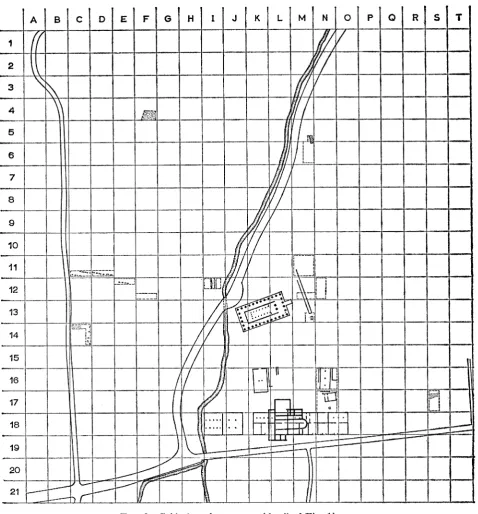
A trench about 9 X 12 m. was opened less than thirty meters northwest of the Temple of Zeus (Fig. 3) in an attempt to connect the eastern part of the sanctuary with the area west of a modern asphalt road. Limitations of time precluded a thorough investigation of Section I 12 and the most that can be said for the moment
6
Pottery lots TS 11-15. Inventoried objects: ST 211, 214-218, 220-226, 229, 232-238, 242-251, 254, 264; for objects inventoried in 1974 from this pit see Hesperia, 44, 1975, p. 152, note 23. This deposit, formerly EEE 23: 1, is now Deposit DDD, EEE 23: 1.
is that this area contained a heavy modern silt accumulation which covered a river bed of the twelfth or thirteenth century after Christ. Any possible relationship be- tween this medieval river bed (only ten meters west of the modern river) and the ancient course of the Nemea River must await future exploration.
Section M 11
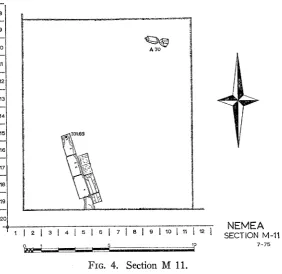
During the excavations of the 1920's the greater part of the long narrow Altar of Zeus east of the temple had been uncovered, and work in 1974 around the center of the altar revealed evidence for its chronology. Among the many problems involving the architectural form and the history of this structure, the question of the full length of the altar seemed paramount for our activities in 1975. Blegen had reported that: " only the extreme north end of the structure still lies buried beneath the soil, where it extends a short distance into a vineyard, with the owner of which it proved im- possible to reach a settlement." However, Blegen also presented a total length for the altar of 40.58 m.8 Our excavations in Section M 11 were undertaken with the purpose of uncovering the north end of the altar and of verifying the measurement given by Blegen.
The clearing of the section produced two foundation blocks for a circular base (A 70a, b, P.W. 1.12 m.; P1. 30, b) which were not in situ but which may have been close to their original position and may be associated with a battered circular triglyph altar which was discovered on the modern surface about twenty meters to the northeast (A 71, est. max. Diam. 0.81 m.; P1. 30, c).
Throughout the whole of Section M 11, agricultural activities of the last 1400 years have disturbed the lower levels. A large part of the disturbance took place during deep-plowing in 1965, the scars of which are now visible on the upper surfaces of the preserved blocks of the altar (P1. 30, d). Earlier farming activities were also documented (PI. 30, e) and seem to fall into two basic periods: the Byzantine of the twelfth an(l thirteenth centuries and the Late Roman of the sixth century.9 It is to the latter period that the bulk of the damage to the Altar of Zeus is to be assigned, as well as disturbances in earlier levels which resulted in a mixture of pottery and other material fromn the Mycenaean through the Classical periods. The thorough character of this mixture might best be pointed out by noting some of the artifacts recovered from the same stratigraphic context: a small fragment of an inscription
(I 14, P.H. 0.065 m.; PI. 31, a), a silver coin of the fifth century minted by the Arkadian League (C 214; PI. 31, b), two Archaic Corinthian aryballoi (P 97, H. 0.067m.; P 120; PI. 31, c), and fragments of a figured vessel of the Geometric period (P 123, P.H. 0.049 m.; PI. 31, d). The latter is encouraging for it is only a
8 Blegen, op. cit., p. 422.
A C D E F H I J K L M N 0 P Q R
4 2
3
14
15
6 - - .. - . . _ - A I.. .X . -
17
21
12~?'F~ I. 1
?i\-.
--....~~~~~~~~~~~~~~~. ..*:**L iP\
13 F-ni kLt2 /w$
16 ~ ~ ~ ~ ~ ~ ~ ~ ~ ~ -. ~ ~ . ll - - - -
17
50
^
....7...|
21 .-/!/ ,,
i~~~~~~~~~~~~~~~~~~~~~~~~~~~~~~~~~~~~~~~~~~~~~~~~~~~~~~~ -
Z 1
'
w K w t~~~~~~~~~~~~~~~~~~~~~~~~~~~~ t s v
FIG. 3. Grid plan of sanctuary (detail of Fig. 1).
T
I
I b I
10 I
I I
.
I
-1
1-
part of other contemporary ceramic fragments found in this disturbed context and represents the first significant quantity of Geometric material at Nemea.
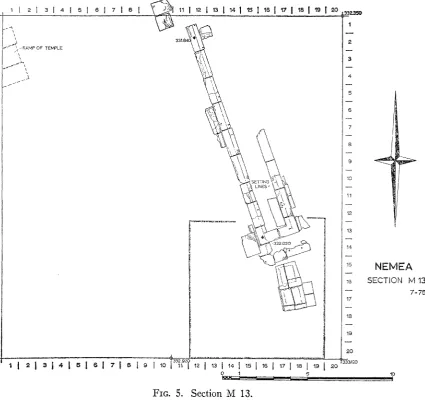
Throughout its length (Figs. 4, 5) 10 the altar was three or four courses of masonry wide, with curbing stones now preserved at various points along both east and west faces. In Section M 11, however, only a single course of masonry (0.65 m. wide) is preserved and it aligns with the easternmost course of blocks still extant in the more southerly parts of the altar. It is quite clear (P1. 30, e) that the western
8
9
10 11
12
13
14
15
16
17
18
19
20
1 2 | 3 I 4 I 5 I 6 | 7 | 8 1 9 1 10 I 11 1 12 1
" 1 5 10
NEMEA SECTION M-11
7-75
FIG. 4. Section M 11.
masonry courses at this north end were pulled out during Late Roman farming activities; any trace of robbing trenches of the missing western blocks was obliterated at the same time.
Even more unfortunate than this destruction of a part of the width of the altar is the loss of the whole of the northern end. Evidence for the original continuation of the altar further north is provided by the rough anathyrosis of the north end of the northernmost preserved block, which stands in marked contrast to the smooth east face of the same block (P1. 30, d). The ubiquitous and now familiar farming trenches of the Late Roman and Byzantine periods have removed any trace of the robbing trench for the north end of the altar so that it can be said only that the preserved
10
length is 40.41 m., and that the original total length of the Altar of Zeus was somewhat longer.
Despite the loss of the larger blocks of the west side and of the north end of the altar in Section M 11, several smaller blocks of curbing are preserved along the
1 1 2 1 3 1 4 1 5 1 6 1 7 1 8 I 11 12 I 13 I 14 15 16 1 17 I is I 8 19 20
-I \.-RAMP OF TEMPLE \
i
1 I 2 1 3 1 4 I 5 1 6 1 7 1 8 1 9 1 10 11 12 1 13 1 14 1 15 16 1 17 | 18 19 j 20
0 1 5
1 2 1 3 4 5 6 7 8 9 10 11 12 13 14 15 16 17 18 19 20 333.120 NEMEA SECTION M 13
7-75
FIG. 5. Section M 13.
eastern face of the structure. Although some of these blocks, which average about 0.55 m. in width, are not well preserved, it is clear that all are later additions to the original altar construction and that at least two of them are re-used water-channel blocks (P1. 30, d). In their present situation the eastern or exterior lips of these water channels have been broken away so that the visible effect, once the lower parts of the blocks were covered with earth, will have been a 0.16 m. wide curbing along
the eastern face of the altar.l1 The evidence for the period when this curbing was installed is meager; the earliest possible date would be the early fourth century although the Hellenistic period cannot as yet be excluded.
Section M 13
In order to have a better look at the south end of the Altar of Zeus, the south- eastern corner of Section M 13 (area M/12, 19-13/13, 20; Fig. 5) was opened in 1975. Our first task was to remove the retaining wall which had been constructed in 1926 parallel to and a few centimeters south of the south end of the altar. With the removal of this wall and the modern farming fill behind it, a rectangular founda- tion of hard poros measuring 1.36 X 2.72 m. appeared (PI. 31, e). The state of preservation is surprisingly good,12 especially since it was discovered that medieval farming activities to the west of this foundation extended some 0.75 m. deeper than its top. Although forming an apparently unified rectangle, the new foundation is actually two separate constructions set side-by-side. The upper surfaces of the three blocks of the northern construction preserve a continuous rectangular depression for the receipt of a statue base, and it seems hardly fortuitous that small but very thick pieces of a bronze statue were discovered in the disturbed fill west of this base.13
The southern of the contiguous constructions consists of four blocks which together measure 1.30 X 1.36m. The upper surface, although badly weathered, reveals traces of a statue base which will have measured about 0.97 X 1.00 m. The relation of the construction of the two parts of this foundation suggests that the southern part was the earlier, but the absolute construction date of the two parts is supported by very little evidence, due to medieval farming.
While the northern part of this foundation rests directly upon earth fill, the southern rests upon four blocks (PI. 32, a). Differences in material, construction technique, and orientation leave no doubt that these lower blocks are a part of an earlier monument which was superseded. These blocks were, however, allowed to remain in place and to serve as foundations for the later construction above. Each of the lower blocks measures about 0.69 X 0.94 m., and together they make up a rectangular construction measuring 1.40 X 1.87 m. Although the area investigated to the east of these blocks was very small, the anathyrosis on the east face of the blocks as well as the nature of the stratigraphy make it highly likely that this con- struction was once much larger and had been partially robbed out when the upper foundation was set in place. If such a sequence is assumed, for it cannot be proven,
11 A similar technique of working down the upper surfaces of a larger block in order to produce a thinner curbing is visible along the west side of the altar in Section M 13; cf. Fig. 5.
12
Compare the top elevation of the new foundation (+ 332.49) with that of the altar as pre- served at its south end (+ 332.02).
then the date of the robbing will also provide a date for the construction of the upper foundation. The ceramic content of thle robbing trench seems to place this activity firmly late in the third quarter of the fourth century B.C.14 This is, of course, the
time when much activity has been documented at Nemea, not the least of which is the construction of the later temple, and it is of interest that the robbing trench and associated layers produced several fragments of red painted plaster and two joining pieces of a geison.'5
The construction date of the lower foundation cannot be fixed with precision, but a layer of fine white clay ran hard up against it. If, as seems quite likely, this is the same white clay which was discovered in 1974 elsewhere east of the temple, then its date in the mid-fifth century B.C. provides a general terminus ante quemn
for the lower foundation.16
Although time did not permit closer examination, it should be mentioned that removal of the 1926 retaining wall did reveal several interesting features of the Altar of Zeus. These include a large hard gray limestone block at the southwest corner of the altar which rests upon a part of the curbing of the altar and which may well belong to the series of such blocks along its western face. Evidence dis- covered in 1974 had suggested that these blocks may have been set in place during the second century after Christ. Also worthy of note is the series of soft yellow poros blocks which extends, albeit in rough fashion, the line of the altar some 1.20 m. further to the south. The top surfaces of these stones are badly weathered, but at least three small rectangular cuttings on the upper surfaces survive. These might suggest a light fencing or barrier at the south end of the altar which was necessitated by the proximity of the foundations discussed above.
Section N 16
More than a meter and a half of modern and medieval disturbed fill were found to cover the remains and undisturbed ancient levels in Section N 16. The removal of the upper fill was so time consuming that it was possible only to lay bare parts of three different ancient buildings. Once again Byzantine irrigation ditches and Late Roman farming plots had thoroughly mixed up earlier levels into which they had been cut. The result was not only a certain amount of damage to the ancient buildings, but the distressing mixture of material from many different periods which has been observed elsewhere in the sanctuary. It is to be hoped that some material similar to that found in the disturbed levels this year will be discovered in better contexts
14Pottery lots 11-14.
15 A 81. It is not clear whether this material is to be associated with the fragments from the
earlier Temple of Zeus which were found in Section M 12 last year.
16 A general contemporaneity between the lower foundation and the altar may also be indicated
at a greater depth in the future since the material is of considerable interest. A sig- nificant industrial activity in this area is indicated by a series of iron tools (IL 11, L. 0.09 m.; IL 12, IL 14, IL 15; PI. 32, b), of terracotta molds for statues (TC 32c, f, i; TC 38a, P.H. 0.051 m.; TC 32 d, g, b; P1. 32, c), lead tools and ingots (IL 13, P.L. 0.115 m.; IL 30, IL 31; PI. 32, d), and several pieces of pumice.17 The purpose of a handsome bronze fishhook (BR 33; P.L. 0.053 m.; Pl. 33, a) in this context is not, however, so easily determined. The general concentration of this material in the eastern and southeastern areas of Section N 16 would suggest that we have to look for a sculptor's workshop there although the evidence so far available is not conclusive.
The numismatic evidence from the upper levels of the disturbed fill confirms Byzantine activity (PI. 33, d).18 The numismatic evidence from the lower levels, although clearly showing that the area had been disturbed in the Late Roman period, also provides some general indication of the possible chronological limits of the indus- trial activity noted above. Although these coins included one Corinthian issue from Imperial times, the preponderance was from the Classical and early Hellenistic periods
(Pl. 33, c).19
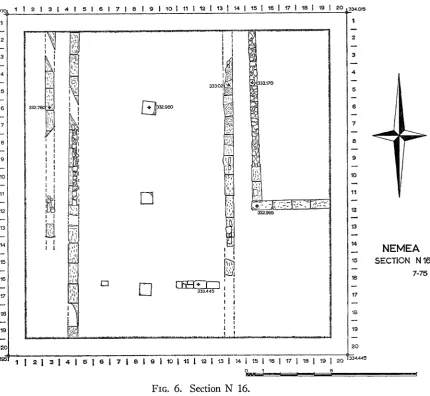
Six different walls from three different buildings appeared in Section N 16 (Fig. 6; PI. 34, a, b). Although badly damaged by Late Roman farming plots in some areas, all these walls (save one, see below) share a common orientation and a common construction system which consists of large, squared soft yellow poros blocks serving as a foundation-toichobate with rubble walls above. The central area of the section is dominated by two walls, parallel to one another and about 8.60 m. apart. These two walls run out of the section to both north and south, although the southern wall which connects the two was discovered already in 1974 in Section N 17 and was further explored this year (see below). The poros blocks of the foundation- toichobate of both walls are about 0.55-0.60 m. in width and about 1.20 m. in length. The overall north-south dimension of the building is not yet known, but it will have been in excess of 21 meters. Three hard gray limestone blocks, each measuring about 0.70 m. square and set at intervals of ca. 5.20 m. on center, were discovered along the north-south longitudinal axis of the building. These obviously formed a row of interior roof supports and with them may perhaps be associated a small fragment of a Doric capital (A 88, P.H. 0.11 m.; PI. 33, b)20 which was found along the eastern wall of the structure. From this same area came a series of Lakonian roof tiles which included two stamped fragments (AT 27, 28; PI. 34, c, right) and a fragment from
17 Stored iin
pottery lot 1.
18 C 225, 231, 232: Manuel I; C 229, Frankish.
19 C 310: Corinth Imperial (Galba); C252 (silver), 253, 312, 325, 328: Corinth Classical- Hellenistic; C 313, 315; Sikyon Classical-Hellenistic; C 326 (silver): Argos Classical.
20
an opaion tile (AT 29, P.L. 0.235 m.; PI. 34, c, left). Although these architectural elements cannot be associated with the new building with complete security, the likelihood that they do belong seems very great.
1 1 2 1 3 1 4 I 5 1 6 I 7 1 8 1 9 I 10 I 11 I 12 1 13 1 14 1 15 1 16 I 17 | 18 1 19 - 20 5334.015
1 2 3 4 5 6 7 8
* 9
10
11
, 12 13 14 15 16 17 18 19 20 NEMEA
SECTION N16
7-75
1 I 2 1 3 1 4 1 5 1 6 1 7 I 8 1 9 1 10 11 I 12 1 13 1 14 1 15 1
0_ 1
16 I 17 1 18 j 19 J 20 334.445
FIG. 6. Section N 16.
In line with the northern side of the southernmost interior base and running eastwards to the eastern wall of the building is a wall made of hard gray limestone blocks of various sizes, several of which are re-used in this position. On this same east-west line, but to the west of the base, is another block which once must have been a part of a similar wall now almost completely destroyed. The date of this attempt to divide the single large room of the building into smaller areas is not known, but it is clearly later than the original date of the building's construction, as shown by differences in masonry technique, material, and relative elevations.
Lack of time prevented probes into deeper layers so that there is, for the present, no stratigraphic evidence for the original construction date of the building. The masonry style is very similar to that of the " dining establishment " discovered last year in Section N 17, which might suggest a very late Archaic or early Classical date, while the similar alignment of the structure's orientation with that of the " xenon " might be construed as evidence for a date in the very early Hellenistic period. Some corroborative evidence for the earlier date was discovered along the eastern face of the rubble socle of the east wall of the building at N/14-16/14, where the cleaning of a small area of undisturbed fill hard up against the wall yielded an Archaic silver coin of Corinth (C 329; PI. 35, a). Other evidence for the construction date which was revealed in Section N 17 will be presented below.
Parallel to and only some 0.90 m. west of the west wall of the large central building lies another wall of very similar construction. This wall has foundation- toichobate blocks averaging 0.50 X 1.20 m. and is clearly the eastern wall of a second building within Section N 16. Interrupted by the oblique line of a medieval irrigation ditch near the northern scarp, traces of the wall extend out of the section to the north. The southern end of the wall has not yet been exposed although a length of more than 10.50 m. has been revealed.
In the northeastern part of Section N 16 two more walls which form the south- western corner of yet a third building came to light this year. Separated from the ,east wall of the large central building by only about a meter, the walls of this structure share the basic orientation and masonry technique of the other two buildings within 'Section N 16. The soft yellow poros foundation-toichobate blocks, which average ,about 0.55 X 1.10m. in size, are slightly smaller than those of the large central 'building. The west wall of the building has been exposed for a length of about 10.50 m. before disappearing into the north scarp of the section. The south wall of the building extends some 4.65 m. from the corner before disappearing into the east :scarp. Although, as previously noted, the heaviest concentration of tools and terra- cotta molds was found in the Late Roman disturbance in this area, the precise function of this building, as well as its full architectural extent and date, must await future explorations to the north and east.
Section NV 17
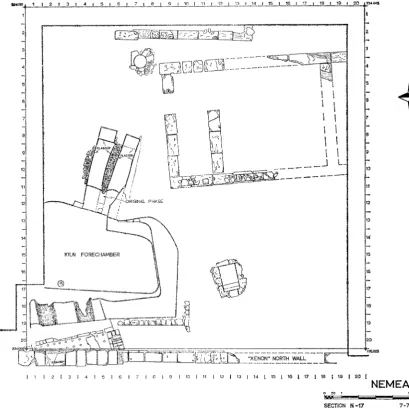
It would now appear that the earliest features of the kiln complex are the great south kiln, discovered in 1964, together with the kiln forechamber. The construction of both elements would fall within the third quarter of the fourth century B.C. The
?AI 2 I U L L"XENON" I NORTH WALL
I 1 2 3 1 4 1 5 6 1 7 , I 9 1 10 I 11 i1 12 1 13 1 14 1 15 1 16 | 17 1 18 19 | 20 [
SECTION N-17
FIG. 7. Section N 17.
+
NEMEA
d W 7-74 7-75
date of the closing of the south kiln, which had been previously placed around 330
B.C.,21 has been confirmed by excavation this year in the eastern of the two passage-
ways to the stoking chambers (PI. 35, b).22 The forechamber, however, continued
21
B. H. Hill, The Temple of Zeus at Nemtea, Princeton, 1966, p. 46.
22
Pottery lots 36-38. This evidence will, then, support the firm dating of the manufacture of the roof tiles for the later Temple of Zeus, and thus a general date for the construction of the
in use after the construction of the north kiln. The reason for this closure of the south kiln can only be a matter for speculation, but it is certain that the " xenon " could not have been constructed while the south kiln was still in use. It may, there- fore, be suggested that the south kiln was closed in order to prepare for the con- struction of the " xenon " and that the latter structure is consequently to be assigned a date, at the earliest, in the last quarter of the fourth century B.C.
The evidence discovered in 1975 suggests that the north kiln was built later than the south kiln, and it is possible, although unproven, that the former was con- structed as a replacement for the latter. In any event, the north kiln has now been found to have had a relatively long history which included one major and several minor changes in its architectural form. In its original phase in the late third or early fourth quarter of the fourth century B.C. the north kiln consisted of two parallel stoking chambers, each about 4.75 m. long and varying in width from 0.86 to 1.06 m. (PI. 35, c)."23 Each chamber had its own entrance divided by a mud-brick wall some 0.40 m. wide and each was coated with a heavy coarse stucco which makes a vertical return at the north end. A low stone socle facing the forechamber marked the western edge of the entrance to the west chamber and another socle marked the the eastern edge of the entrance to the east chamber (PI. 35, d).
The next two phases in the history of the north kiln consist of successive raisings of the floor levels of the stoking chambers which now slope upward toward the closed north end rather than being level as in the original phase. The next later phase was the occasion for a substantial change in the plan of the north kiln. At this point the floor was once again raised, although still sloping upward to the north, but the size of the chamber was greatly reduced by the installation of a new plaster return at the north end with a resultant total length of about three meters. An even more substantial change occurred at the south end of the kiln: the original dividing wall was partially destroyed at its south end and the southern part of the east wall of the east chamber was thickened at the same time. A single entrance for both chambers about 1.50 m. wide was thus created, covered by a stucco vault which survives only in its lowest portions. This single entranceway branched into the two original chambers about 1.20 m. north of its opening from the forechamber. The total effect of these changes was to make the north kiln into a much smaller structure than it had been in its original phase. As discovered in 1974, this final phase of the
temple, in the third quarter of the fourth century B.C. The revision of this date suggested last year was made without the appreciation that the south kiln and the forechamber went out of use at different times.
23 Only the eastern of the two chambers has been fully excavated, so that the present appearance
north kiln and the forechamber was terminated when both were filled in the first quarter of the third century B.C.
The kiln complex of Section N 17 was, then, in operation for about half a century, the large south kiln being superseded by the smaller north kiln which went through many alterations during its history. The use of the kiln complex as a whole for the nearly exclusive manufacture of roof tiles was confirmed by the many examples discovered again in 1975, but this time in the packing of the various floors of the north kiln.24 These facts would suggest the existence of an extensive building pro- gram at Nemea of which the Temple of Zeus and the " xenon " will have formed a part. Much more of the sanctuary will have to be uncovered before this theory can be regarded as more than a suggestion.
As reported last year, a well is located just north of the north kiln. Although it had been supposed last year that the well was contemporary with the " dining establishment" just east of it, excavations in 1975 both in and around the well revealed that it is rather later in date. The head of the well indicates two major periods of use (PI. 34, d). An original head was made of two nicely worked rectilinear blocks with a semicircular cutting in each for the opening of the well mouth. These blocks were covered by a secondary head which is constructed of a series of roughly worked, smaller limestone blocks which are set to radiate out from the opening. The packing around and between these blocks included rubble, mud brick, oven-fired tile fragments, and burnt stucco of the type which lines the chambers of the north kiln. The ceramic date for the construction of this secondary head falls within the first half, perhaps in the second quarter, of the third century B.C.25 It may be suggested, therefore, that the installation of the secondary head followed upon the dismantling of the kiln complex. In the packing for this wellhead, in addition to the material mentioned above, were a few fragmentary re-used blocks. These included the corner of a Doric capital (A 86, P.H. 0.166 m; P1. 33, b) which is from the same series as fragment A 88 found in Section N 16 (see above, p. 184). If this series is to be associated with the large building in Section N 16, then the building ought to have gone out of use in the early Hellenistic period and might be considered a victim of the building program that was suggested by the existence and history of the kiln complex. The size of the fragments is, however, so small as to make them readily portable. Thus, they may have come to this area from elsewhere and it is only their provenience which suggests an association with the large central building of Section N 16.
The packing around the original wellhead provided no datable material; only the material from within the well is available to establish its original date.
Below the original wellhead hard packed rubble makes up the walls which widen from a diameter of 0.74 m. at the original head to a diameter of ca. 1.40 m. at the
24
Pottery lots 30-35, 41. Other tiles from the south kiln are stored in pottery lots 36-38.
bottom of the well. The total depth of the well from the top of the secondary head to the bottom is exactly ten meters (+ 333.19- + 323.19). The contents of the well will require more study and much material can still be mended, but a preliminary summary can be presented here. The upper seven meters (+ 333.19- + 326.18) were deliberately filled with a dumped sandy earth which represents the closing of the well. This fill contained little pottery but many stones, some of which were worked and are of considerable interest. First among these stones may be listed the frag- mentary inscription (I 13, P.H. 0.181 m.; PI. 35, e) which appears to record an agreement involving finances between two Doric states and may, on the basis of the dimensions of the stone and of the letters, be associated with another fragment found long ago in the crypt of the Temple of Zeus.26 Unfortunately the latter fragment has disappeared during the past forty years so that the association of the two cannot be regarded as proven, and the stones do not, individually or together, make for a completely intelligible text.
Several impressive architectural blocks were also in this closing fill of the well. T'hese include a poros wall block equipped with " ice tong " lifting holes (A 83, L. 0.79 m.; PI. 35, f) and two Doric column drums (A 82, P.H. 0.985 m.; PI. 36, a. A 84, P.H. 0.887 m.; PI. 36, b). The latter have twenty flutes and traces of a fine white stucco on their surfaces. One of the columns (A 82) has a circular empolion cutting (0.025 m. diameter) on its preserved end and two of its flutes have been chiseled away deliberately. The second column, broken at both ends, has also been partially reworked with six flutes chiseled away and replaced by a rough faceted surface. The original provenience of these pieces cannot, as yet, be determined.
Although the ceramic evidence from this closing fill is extremely meager, it is adequate to show that the well was filled in the very late Hellenistic if not the Early Roman period. Certainly a date after the middle of the second century B.C. is indi-
cated and a date in the early first century B.C. is not excluded.27
The bottom three meters of the well contained large quantities of pottery from the periods of use. The various layers seem to belong to three general periods with long gaps between which probably reflect the periods of inactivity at Nemea in the Hellenistic period when the games had been transferred to Argos.28 The latest of
26 D. Bradeen, " Inscriptions from Nemea," Hesperia, 35, 1966, pp. 320-321, no. 2.
27
Pottery lots 55, 56. All the catalogued material from the well is grouped together as Deposit N 17:2.
28 The history of these transfers is not completely clear, but the first move to Argos probably
occurred in the mid-third century; cf. W. Vollgraff, Mnemosyne, 44, 1916, pp. 65-69, 221-232.
Certainly the first move to Argos had been effected before ca. 235 B.C., at which time Aratos
these periods belongs around the middle of the second century B.C.29 and is represented by a long-petal bowl (P 142, est. H. 0.073 m.; PI. 36, c), a fusiform unguentarium (P 118), and a coarse water jug (P 119). From these same levels came an interesting fragment of a Corinthian cover tile (AT 31, W. 0.31 m.; PI. 36, d) which once belonged to a hipped roof.
The second general period of use indicated in the well belongs to the latter part of the third century B.C.80 In addition to coarse water jugs (P 141, H. 0.344 m.; P
148; PI. 36, f), somewhat finer wares emerged, such as a cup, a plate and a deep bowl (P 146, H. 0.086 m.; P 140; and P 138, respectively; PI. 37, a). Two stamped handles, probably from the same amphora (P 126, P.L. 0.101 m.; P 127; P1. 37, b), came from these levels as did a :fragmentary lamp (L 11, H. without handle 0.028 m.; P1. 37, c).31 The ceramic picture for these levels is completed by fragments
of five different Megarian bowls including a fine but worn bowl with representations of the gods (P 128, H. 0.075 m.; P 129, P 143, P 147; PI. 37, e. P 139, H. 0.080 m; P1. 37,f). These levels also yielded many iron implements such as two pins (IL 25, IL 26), two sickles (IL 18, IL 35), a knife (IL 24, P.L. 0.232 m), a buckle (IL 27), and, not surprisingly in the context of a well, an ironbucket hook (IL 23), all shown in Plate 37, d. Also of considerable interest is a fragment of an unfluted column (A 85, P.H. 0.705 m.; PI. 36, e) which matches in dimensions and material the column found in 1974 in situ in front of and between the entrance to the stoking chambers of the south kiln (Fig. 7; Pl. 35, b).
The date of this general level provides a problem for, as mentioned above (footnote 28), the historical sources seem to imply that the Games were celebrated at Argos from the mid-third century until 145 B.C. The only recorded exception to this was in the extraordinary events of 235 B.C. when Aratos attempted to reinstitute the
Games at Nemea under the control of Kleonai and violated the safe-conduct of con- testants traveling to the rival games at Argos.32 It is difficult to believe that such a
references to the Nemean Games in the late third and early second centuries seem all to localize the Games at Argos; cf. Plut., Philopoemen, 11, 1-;, Flamininus, 12, 2; Polybios, II, 70, 4-5; V, 101, 5-6; XXII, 10, 1; Livy, XXVII, 30, 9; XXXIV, 41, 1. An inscription found at Nemea (Bradeen, op. cit., pp. 326-329, no. 7) implies that the Nemean Games had once again been
moved back to their original setting by Mummius in 145 B.C. and this theory has been significantly
strengthened by the discovery of archaeological evidence of great activity at Nemea in the mid-
second century B.C. We do not know how long this situation endured and Strabo's reference
(VIII, 6, 19) to the Games at Nemea under Argive control may or may not indicate the locale of the Games in his time. Certainly by the Imperial period the Games were customarily held at Argos; cf. Pausanias, II, 24, 2 vis-a-vis II, 15, 2.
29
Pottery lots 56-59.
30 Pottery lots 60, 61.
31 Cf. R. H. Howland, Athenian Agora, IV, Greek Lamps, Princeton, 1958, type 28B.
32 Plutarch, Aratos, 28, 3-4: Kal TOyV aywva TrIv NExeowv yayev Ev KAXEvacs, t 7TrarpLOv ovrca Kal
brief period of celebration of the Games at Nemea could account for the mass of material from this level of the well.
The earliest general phase of the well includes the last quarter of the fourth century and the first quarter of the third century B.C.33 Time prevented mending
the coarser wares, but several of the finer pieces were joined. These included a miniature bowl with basket handle (P 154, H. 0.043 m.), a one-handler (P 155), a cup kantharos (P 158), a one-handled kantharos (P 149), two one-handled mugs
(P 156, P 157), and a saltcellar (P 159), all shown in Plate 38, a. From these same levels came the handle, a fragment of the wall, and the ring base of a bronze vessel
(BR 39, Diam. of base 0.117 m.; PI. 38, b). The ceramic date for this earliest phase of the well is nicely confirmed by three coins of the late fourth century B.C. from the
same layers (C 337-339; PI. 38, c).
A construction date for the well in the third or fourth quarter of the fourth century B.C. would suggest that it had been intended originally as a source of water for the kiln complex. The usefulness of the well outlived that of the kiln complex, however, and further detailed study of the pottery from this well will certainly improve our comprehension of the Hellenistic period and of Hellenistic ceramics at Nemea.
Investigations were also carried on this year in the " dining establishment " discovered in 1974 in the northeastern part of Section N 17. Foundation trenches for the walls of the building were explored in several areas. These trenches continue around the ends of the blocks which flank the gap in the west wall of the building, and the gap in the wall of the antechamber (Pls. 34, d, 38, d). This confirms the existence in these areas of doorways as had been supposed last year. The chrono- logical evidence uncovered during this work augments, but does not supplant, the conclusion of last year that this structure was constructed in the early fifth century
B.C.34
Probes in the east end of the building revealed that the destruction of the walls, which had been observed in this area last year, took the form of a large and amorphous pit filled with heavy silt. The cause of this pit could not be determined, but it did yield a mass of material.35 The pottery included much Classical and early Hellenistic material, but the date of the fill clearly goes through the Hellenistic period (P 109, P.H. 0.045 m.; PI. 39, a. P 112, P 114) into the first century after Christ, as is shown by various mugs and jugs (e. g. P 116, P.H. 0.080m.; P 113, P 125; P1.
city of Kleonai, and is sometimes so translated. It seems rather more likely that the games were actually celebrated at Nemea but under the time-sanctioned control of Kleonai.
33 Pottery lots 62-64.
3Pottery lots 46-51.
35 Deposit N 17:3, pottery lot 42. The several coins from this deposit (C 317, 318, 320, 321,
39, b). The excavation of this pit revealed that the block at N/18-17/4 which last year had been supposed to form the return of the east exterior wall of the building is, in fact, the return of an interior cross wall (Fig. 7). Another block which con- tinues the line of the north wall further eastward shows that the building included at least one more room. Future excavations will be necessary in order to determine the full architectural form of the structure.
Along the north edge of Section N 17 runs the south wall of the large central building of Section N 16 which was discussed above (Pl. 38, d). Although partially damaged by the same Early Roman pit which destroyed parts of the " dining estab- lishment," the southeast corner of the building is clear as is the similarity of con- struction technique and orientation of this wall with those in Section N 16. The excavation of the packing of the original wellhead (see above, p. 189) revealed that the packing seemed to extend beneath the foundation-toichobate blocks of the wall in that area. Whether this is to be taken as an indication that the building as a whole should postdate the well (i. e. late fourth century B.C.) is not clear.
STADIUM
North End
Excavations took place in Section FF 23 (Fig. 1) along what must have been the east side of the lower, north end of the stadium race course (PI. 39, c). A trench 9 X 17m. was opened in order to uncover whatever traces might remain of the retaining wall which must have existed to support this end of the race course.36 Unfortunately, time did not allow a complete excavation of the area and thus the original purpose of the trench was not fulfilled. However, it was possible to recover heavy concentrations of dumped fill of the Middle Byzantine period. This fill included
36 It has been claimed that no retaining wall existed for the north end of the Nemea stadium;
several coins (C 233-241; PI. 40, a) and fragmentary pottery (P 104, est. rim Diam. 0.27 m.; P 106; P1. 40, b)."7 Together with this fill were several ancient blocks in- cluding a wall block equipped with " ice tong " lifting holes and a faceted column drum
(P1. 39, d). It has not been possible to establish the original provenience of these blocks although it is tempting to associate them with the north end of the stadium; they would seem to augur well for the lower levels in this area. It will also be of interest in the future to determine the location of the Middle Byzantine settlement which was responsible for the production of such a large quantity of ceramic and numismatic material.
South End
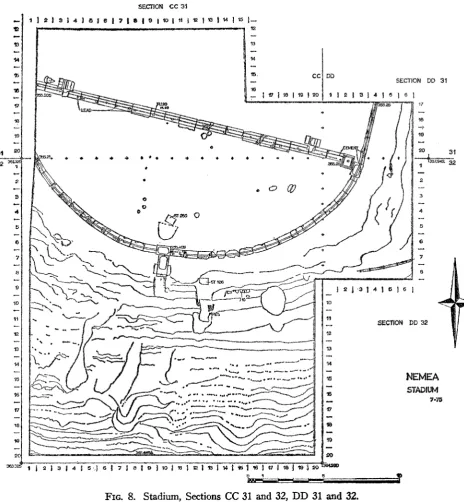
The 1975 season has seen great progress in the southern or closed end of the Nemea stadium.38 Nearly all of the starting line and a large part of the hydraulic system of this end have come to light and both include many interesting features
(Fig. 8; Pls. 40, c, 41, a, b).
The levels excavated by hand down to the floor in the stadium this year (+ 357.60- + 355.15) contained very little datable pottery, although the ceramic limits clearly extend into the mid-fourth century after Christ.39 The numismatic evi- dence is clearer (C 288, C 293, C 292, C 361; P1. 41, c),40 and indicates that the stadium floor was maintained or at least cleaned until the fifth century after Christ,
37 Pottery lot 10. C 233, Manuel I; C 235, Maurice; C 236, Basil; C 240, Leo VI; C 234,
238, Frankish; C 237, 239, 241, Byzantine.
38
The amount of progress in the stadium this year has been made possible by the generosity of the Caterpillar Tractor Co. in Peoria (Illinois) and Athens. An arrangement with Caterpillar has resulted in the removal of more than 11,000 m.3 of earth by a Wheelloader no. 930. Several years of digging by hand would have been required to move a similar amount of earth. It is with especial pleasure that we acknowledge our indebtedness to the Caterpillar Company and specifically to Messrs. W. Franklin, E. Chapman, G. Avrasoglou, S. Theodorou, and R. Williams.
An additional note concerning the advisibility of the use of such heavy machinery at a Classical site might be welcome at this point. Our experience in 1974 had shown that the upper five meters of fill in the stadium was silt, absolutely devoid of all architectural features, which had washed down from the hill above during the past millenium and a half. Furthermore, this fill was almost completely sterile, producing, on an average, about ten worn nondescript sherds per week. There was, then, no archaeological reason why all but the last meter or two of fill over the race course should not be removed by heavy machinery. The additional consideration that more than thirty years would be required to empty the whole of the stadium by hand provided a sound economic reason for the employment of heavy equipment. We have therefore made use of the Caterpillar Wheelloader in the stadium with confidence and gratitude. We believe that both sentiments have been justified by the results.
39 Pottery lots 11-13 which include a lamp (L 10) very similar to no. 271 in J. Perlzweig,
Athenian Agora, VII, Lamps of the Roman Period, Princeton, 1961.
40 The latest coins are C 292 and C 361, both of Theodosius II
(A.D. 408-450). Other, much
SECTION CC 31
I 1 2 1 3 1 4 3 5 I e 1 7 1 6 I I 10 I 11 I V1 33 1 14 15 |-
---? ---?-W----?-- 12
e 13
i
SECTION DD 31
'17
18
19
20 4 4 4 4 4 9
I
2
4
6
7
8
1 2 1 3 3_4 1 6 ] 6 1
SECTION DD 32
NEMEA
STADIUM
7-75
FIG. 8. Stadium, Sections CC 31 and 32, DD 31 and 32.
4 4 4
, 5.
6,
0
0
0
0
9
10
12 -
14
31
j
10
12
13
a century or more later than had been supposed last year. This same fill produced two more nmarble statue bases similar to one found last year.41 One of these (ST 260, W. 0.45 m; PI. 41, d), although badly broken, still preserves the lead dowels which once held the statue in place. The lead itself retains the marks of the chisel that removed the statue long ago.
A certain amount of work was carried out in the area which had been excavated: last year. This included the excavation of an unlined pit carved into the bedrock in the lower area, of the seats at CC/17, 18-32/9, 10. The pit has an average diameter of 1.70 tn. and a depth of 2.57 m. (+ 356.09-+ 353.52). The purpose of this pit is obscure, for had it been intended as a well the crumbling bedrock walls would have. prohibited a long use and (at least in 1975) water'only seeps into the pit very slowly. Little was found in the pit aside from a nearly complete amphora of the Byzantine period (P 108, P.H. 0.33 m.; PI. 42, a).42
Jufst west of this pit is an area of stones (CC/15-32/10) which had been left in place last year because of the possibility that these had once formed a part of the informal se'ating arrangements of the stadium. Further cleaning of these stones revealed that one was a broken and re-used inscription (I 15, P.H. 0.35; P1. 42, c). A possible interpretation of the stone is that it had originally belonged to a monument of the Classical period at Nemea, honoring a victor in the wrestling event, b'ut the text is too fragnientary to be certain of such a restoration.
The cleaning of a large portion of the floor of the stadium has revealed many of the accouiterments of the Nemea race course (Pl. 41, a, b). About 21 meters of the starting line have been exposed with only a few centimeters of the western end still awaiting excavation beneath more than six meters of silted fill. The indi- - vidual blocks that form the starting line vary in dimensions but average about 1.10 m. in length, 0.56 m. in width, and 0.24 m. in height. The upper surfaces of these blocks bear two parallel grooves each about 0.06 m. wide, 0.03 m. -deep and 0.11 m. apart. The south face of each groove is nearly vertical, while the north face is cut at an oblique angle to the upper surface. The northern groove is cut as a continuous line along the whole length of the starting blocks; the southern groove is interrupted at regular intervals for a distance which varies from 0.22 to 0.26 m. Each of these gaps in the southern groove is the location 'of a square cutting about 0.08 m. on a side and 0.14 m. deep.43 The average distance between these cuttings is 1.63 m. There
41 These bases exhibit each a different method of securing the statue. The base found in 1974
(ST 126) preserves a cutting in the shape of a foot. One of the bases found this year (ST 310),
although very fragmeAtary, appears to have Ia large rectangular cutting on its top surface. The cuttings on the third base (ST 260) consist of simple dowel holes at the ball and at the heel of each foot.
42 Pottery lot 18.
are twelve such cuttings which divide the original starting line into thirteen lanes.i At the east end of the starting line is a base formed of two limestone blocks (PI. 42, b). The lower block measures 0.74 m. in east-west width, 0.89 m. in length, and 0.225 m. in height. Its upper surface -has been provided with a centrally recessed area surrounded by a rim 0.08 m. wide. The upper block is set into this recessed area and is 0.58 m. wide, 0.73m. long, and rises 0.21rm. above the surface of the rim of the lower block. The upper surface of this upper block is also provided with a central recessed panel, cut 0.03 m. into the top of the .stone and with a 0.06 m. wide rim around the outside. Near the center of this panel is a shallow circular cutting 0.06 m. deep and 0.095 m. in diameter. This two-block base is set directly on top of the easternmost block of the starting line and not quite at right angles to it. While the front or north groove of the starting line continues beneath the base, the south groove stops about 0.38 m. short of the base and 1.01 m. east of the easternmost square cutting in the starting line. Just west of the base the front groove retains traces of a reddish hydraulic cement, like that used elsewhere in the stadium (see below), which was used to fill this groove, presumably at the time when the base was installed. The purpose of this base, which probably has a mate at the still unexcavated west end of the starting line, is not completely clear. There are parallels among bases with recessed upper surfaces,45 some of which were clearly for the support of statues while others may have supported a more prosaic device such as large posts relevant to the race itself.
The cuttings in the starting line reveal another later phase in the history of the Nemea stadium, involving major changes in the starting line, and perhaps in the foot races. One change was the construction of two curious projections, one close to either end of the starting line (PI. 42, b, d). Although extending out into the race-course area, both projections are cut into the starting line between the first and second square cuttings at either end.46 Although there are minor differences between these two projections, the similarities are so great that they must be regarded as contemporary additions to the original starting line. The western of these two con- sists of a large block which was re-used, -and retains traces of "ice tong" lifting holes partially cut away for the later use of the block in this place. Measuring about 0.96 m. in length and 0.70 m. in preserved width, the block has been set back into a cutting 0.10 m. deep in two of the original blocks of the starting line. These two
44 Although the whole of the starting line is not yet exposed it seems clear that this was the total number of lanes in the original phase.
45 Perhaps the most pertinent for our purposes are those at the ends of the starting lines of
the later stadium at Isthmia; cf. 0. Broneer, Isthmia, II, Topography and Architecture, Princeton, 1973, pp. 56-57, plan VI. For other examples of the type see C. K. Williams, II, " Corinth, 1969: Forum Area," Hesperia, 39, 1970, pp. 6-8.
46 This implies that the width of the track in the second phase was reduced by about five and
blocks ihave been cut through and their ends replaced by a roughly worked block set further back along the lines of a 0.55 m. wide cutting in the added projection. The rough block is cut back in a shallow semicircular cutting 0.16 m. wide, with a maximum depth of 0.02 m. All of these cuttings are on the same axis. The largest, which extends from the projecting block into the line of the original blocks of the starting line, has a total north-south dimension of some 0.75 m. This cutting is about 0.13 m. deep and, as mentioned above, some 0.55 nm. wide. The sides of the cutting flare out toward the bottom, however, so that the width at its greatest depth is 0.58 m., giving the cutting a trapezoidal cross-section. The bottom surface of this cutting is provided with a series of very shallow cuttings all running parallel to the sides of the deep cutting and thus at right angles to the starting line. The upper surface of the western side of the projecting block has another cutting, per- pendicular to and intercepting the deep cutting, which is 0.16 mn. wide and 0.11 m, deep.
This projection has a mate near the east end of the starting line, which is actually constructed of two blocks. However, the arrangement of the cuttings in the pro- jecting addition and in the original blocks of the starting line is practically identical with those described above but forms a mirror image: the cutting on the west side of the west projection is echoed on the east side of the east projection. Although the purpose of these projecting additions is surely to be associated with a mechanismi for the starting of the races, the precise nature of that mechanism is not readily apparent. One is probably justified in thinking of some intricate device and may recall the rather elaborate machine in the hippodrome at Olympia.47 It should be mentioned that other added projections like those in the Nemea stadium have also been discovered in the stadia at Epidauros, Isthmia, and Halieis, and in the race course in the Corinthian Forum.'
At the same time when these projections were added to the Nemea stadium, the size of the running lanes was modified. Whereas the original square cuttings which marked the lanes (see above) had been set in line with the back (south) groove and were respected by it, these later cuttings are placed without regard to the groove, frequently interrupting its line and with their centers rather behind or south of it. These cuttings are about 0.10 m. square on the average, and pass all the way through the stone of the starting blocks. Lead is still preserved in three of these cuttings, the westernmost of which gives a dimension of 0,07 X 0.07 m. for the post
47 Pausanias, VI, 20, 10-14.
48 Respectively, P. Kavvadias, T'o 'Itepv rTo' 'AwkrnqrLov, Athens, 1900, pp. 111-112, plate facing
p. 105, and IlpcTRta', 1902, pls. A': y, y', 8; B': 6, 6'; Broneer, op. cit. (note 45 above), pp. 59, 140-
142, pls. 27, d, 96; F. Cooper, personal communication; C. H. Morgan, " Excavations at Corinth,
1936-1937,' A.J.A., 41, 1937, p. 550, pls. XVI, XVII, 1 foreground (cf. Broneer, op. cit., pls. 38,