693
A Novel Passive Islanding Detection Algorithm
for a Bidirectional Dual Utility Interactive Inverter
Paulose Thomas1 and Sebin Davis K2 1
PG Scholar,Department of Electrical and Electronics Engineering,Sahrdaya College of Engineering and Technology, Kodakara, India. Email:[email protected]
2
Assistant Professor, Department of Electrical and Electronics Engineering, Sahrdaya College of Engineering and Technology, Kodakara, India.
Email:[email protected]
Abstract :A bidirectional dual inverter for utility interactive systems along with a new passive islanding detection system is presented here as the project topic. The method is preferred to any single phase inverter in a grid operating capacity. A hybrid inverter which operates in multiple operating modes is synchronized with an AC Grid system initially. The power feeding to the grid is in unity power factor and harmonics are eliminated using the control loop. Then Grid is manually turned off in the steady state condition and the proposed islanding detection method is demonstrated. Different algorithms support the system and various High Level Languages are used to complete the coding part of the project. The validity is checked through comparisons and different model predictions with MATLAB simulations. An entire sample design for 300VA hybrid inverter is given to demonstrate the application of the process for the micro grid systems. Hardware model for new islanding detection system is completed and results are verified.
Keywords: Bidirectional dual inverter,Hybrid inverter, Islanding detection, Unity power factor
I. Introduction
The system includes a dual inverter which can perform Alternate Current (AC)-Direct Current (DC) as well as DC-AC conversion and also synchronize with the electrical utility grid. The convertor can send or receive power to the grid depending on its various modes. Its multi quadrant operation gives the best level of charging and discharging functions. The reconfigurable converter operates as inverter when it needs to send the power from PV or battery and again operates as a rectifier when it needs to charge the batteries from the grid [1]. Customers prefer this system because of the availability of space for installation, increasing utility charges and unreliable supply from the grid. Here the bidirectional inverter converts DC to AC. But it needs a Maximum Power Point Tracking (MPPT) system for tracking the maximum power point obtained from the installed panels [2]. The solar inverter used for grid-connected solution also includes anti islanding functionality to prevent accidents to utility workers whenever the grid is switched off for maintenance [3].
II. Need for project
694 III. Islanding Detection
Detecting an islanding condition is the subject of considerable research. In general, these can be classified into passive methods, which look for transient events on the grid, and active methods, which probe the grid by sending signals of some sort from the inverter or the grid distribution point. There are also methods that the utility can use to detect the conditions that would cause the inverter-based methods to fail, and deliberately upset those conditions in order to make the inverters switch off. Grid interconnection of photovoltaic (PV) power generation systems has the advantage of immediate and efficient utilization of generated power [6]. However, the technical requirements from the utility-system side need to be satisfied to ensure the safety of the PV system installer and the reliability of the utility grid. Clarifying the technical requirements for grid interconnection and solving the problems are therefore very important issues for widespread application of PV systems. The isolation point is generally on the low-voltage distribution line when an islanding condition exists, but islanding may also occur on the higher voltage distribution or transmission lines when large numbers of PV and other distributed generation sources are present. In photovoltaic distributed resource islanding, one or more non-utility generation sources (more specifically, sources over which the utility has no direct control) and a portion of the utility system operate while isolated from the remainder of the utility system [7].
The primary weakness of the Over Voltage Protection /Under Voltage Protection and Over Frequency Protection /Under Frequency Protection, in terms of islanding prevention, is their relatively large non detection zones. In addition, the reaction times for these protective methodologies may be variable or unpredictable. Phase Jump Detection (PJD) suffers from a serious implementation difficulty in that it is difficult to choose thresholds that provide reliable islanding detection but do not result in frequent nuisance trips. The starting of certain loads, particularly motors, often causes transient phase jumps of significant size, and these will cause nuisance trips of the PV inverter if the thresholds are set too low. PJD thresholds could be altered for a given installation site, but such site-specific parameters increase the difficulty in installing utility-interactive PV systems. Harmonic detection suffers from the same serious implementation difficulty as PJD; it is not always possible to select a trip threshold that provides reliable islanding protection but does not lead to nuisance tripping of the PV inverter. It is clear that a threshold must be selected that is: (a) higher than the THD that can be expected in the grid voltage; but (b) lower than the THD that will be produced during islanding by either of the two mechanisms described above. A new innovative voltage dip analysis method is developed which responds faster than under voltage protection method. Harmonics distortion method is also combined with this proposed method in the simulation. The inverter should generate harmonics only less than 5% as per standards. So a THD sensor is used in the power lines feeding the grid to detect the rise in harmonics. The combined effort helps to perform the anti-islanding functionality faster and accurately [8].
IV. Working of the device
695
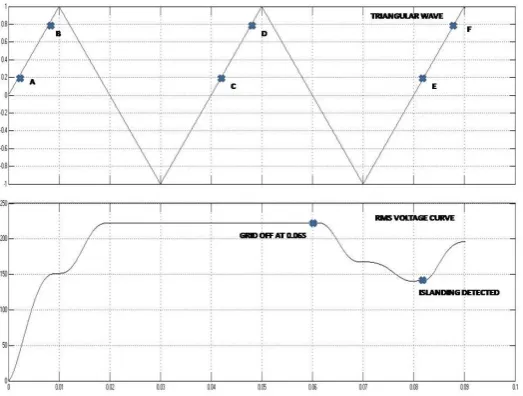
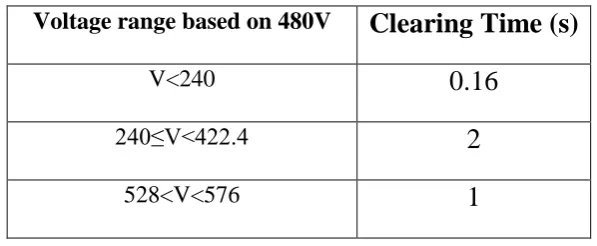
processed using the equation B*B - A*A. If the value is lesser than 3500 and greater than -4000 the grid is normal. Again C*C – B*B is taken and value is checked and so on. If at any case the value is not in the range then a serious abnormality is faced by the grid and the inverter has to be disconnected or it has to stop feeding power to the grid. The minimum time taken for an RMS value to be calculated is 20ms (1 cycle) as per MATLAB simulation block and here also the time gap between C and B is slightly more than 20ms. That is the time gap between points C and B is 34ms which is slightly greater than one and half cycle of the AC wave. The sudden shift in slope of the RMS Voltage can be seen in the figure. Here grid is turned off at 60ms in the x axis time scale and islanding is detected at 82ms. That is the total time to respond was taken 22ms which is an improved time value compared to existing systems. That is because the value E*E-D*D is not in the range and islanding is thus detected. Current control shifts to voltage control and RMS thus again increases. The repeated experiments gave a range of detection times from 8ms to 30ms. Again as per IEEE 1547 norms these values are well under the standard limits [9]. The standards are shown in Table 1 and Table 2. Thus the triangular wave frequency is set to 25Hz so that abrupt grid turn off reflects in voltage reduction and the mathematical formula generates a value above the threshold range. The grid voltage is allowed to make changes of +5 % to -5%. Considering the standard changes the system will not go for anti – islanding mode if the voltage is varied abruptly within the permissible limits. That is voltage reductions or flickering will not affect the proposed system and the grid tie mode will continue to work. Since the hybrid inverter is of constant power, any abrupt grid turn off cases will demand more current and in turn reduces the synchronized voltage. This reduction in voltage is taken as the key observation for proposing the new islanding detection method. As an additional confirmation a total harmonic distortion sensor also coupled to the system to measure the harmonics content in the current feeding the grid. The inverter is designed to have harmonics in the current feeding the grid lesser than 5% at any loads. So any sudden changes will lead to higher harmonics rate and thus system can proceed to anti-islanding with the measure of this value also. Most of the house loads will be nonlinear and the hybrid inverter is designed carefully in such a way that the harmonics will be very less and care is taken to keep the power factor near to unity while powering up the grid.
696
Table 1. Response to abnormal voltage
Voltage range based on 480V
Clearing Time (s)
V<240
0.16
240≤V<422.4
2
528<V<576
1
Table 2. Response to Abnormal Frequency
Distributed Resource Frequency range Hz
Clearing Time (s)
≤30 kW >60.5 0.16
≤30 kW <59.3 0.16
>30 kW >60.5 0.16
>30 kW <{59.8–57.0} (adjustable
setpoint)
Adjustable 0.16–300
>30 kW <57.0 0.16
V. Results
697
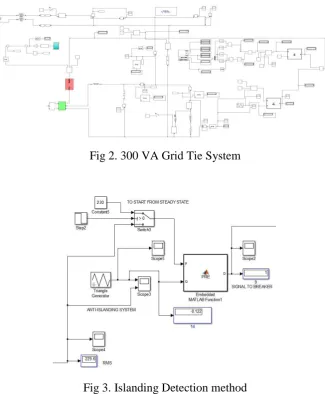
Fig 2. 300 VA Grid Tie System
Fig 3. Islanding Detection method
698
Fig 5. Anti- Islanding – Inverter Fig 6. Anti- Islanding – Load
Fig 7. Circuit
699
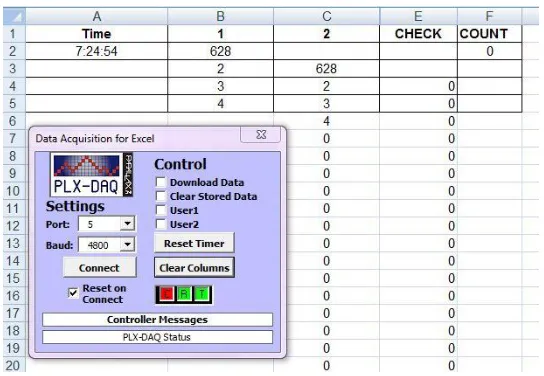
Fig 9. Computer Screen of the User
VI. Conclusion
A complete simulation for 300VA bidirectional dual inverter for utility interactive systems is designed. The system operates in multiple operating modes like hybrid mode, hybrid with export mode and off-grid mode. A new anti- islanding functionality named voltage dip analysis is presented to this project. The proposed method detects islanding in a faster rate compared to the conventional systems. Along with that to increase accuracy, islanding detection using THD analysis is also incorporated in the MATLAB simulation. Thus the combined efforts of both detection methods helped the anti-islanding task to achieve its objective comfortably. A hardware of the proposed anti-islanding system using the principle of voltage dip analysis is designed and modelled. Different high level languages and software requirements were used to complete this project. The entire system is a PC based project seeing its possibilities in future for advanced level communicated grid networks.
Acknowledgements
We would like to express our immense gratitude and profound thanks to all Sahrdaya college of engineering and technology Electrical and Electronics Engineering department teaching and non-teaching staff and especially to the Programme Co-ordinator Dr. Gopakumar P who had given this valuable opportunity and his constant encouragement throughout project.
700
[1] Nikhil Sasidharan and Jai Govind Singh, "A Novel Single Stage Single Phase Reconfigurable Inverter Topology for a Solar Powered Hybrid AC/DC Home” IEEE Trans. Ind. Electron.,vol.64, no. 4, pp.1-4, April 2017
[2] Jacob A. Mueller, Md. Rasheduzzaman, and Jonathan W. Kimball, “A Model Modification Process for Grid-Connected Inverters Used in Islanded Microgrids”, IEEE Trans. ENERGY CONVERSION, vol. 31, no. 1, pp.240-242, Mar 2016
[3] Paul H. Kydd, Joel R. Anstrom, Paul D. Heitmann, Kevin J. Komara and Michael E. Crouse, "Vehicle-Solar-Grid Integration:Concept and Construction," IEEE Power and Energy Technology Systems Journal ,vol. 3, no. 3,pp.1-3, Sept. 2016
[4] Xiangdong Zong, Peter W. Lehn,"Reactive Power Control of Single Phase Grid Tied Voltage Sourced Inverters for Residential PV Application", IECON 2012 - 38th Annual Conference on IEEE Industrial Electronics Society, vol. 6, no. 5,pp.696-698, Dec. 2012
[5] Yi-Hung Liao, “A Novel Reduced Switching Loss Bidirectional AC/DC Converter PWM Strategy With Feed forward Control for Grid Tied Microgrid Systems”, IEEE Trans. Power Electron., vol. 29, no. 3, pp.1500-1503, Mar 2014
[6] Asim Datta, Debasree Saha, Amitava Ray and Priyanath Das,"Evaluation of anti-islanding techniques for renewable energy powered distributed generators using analytic network process", IET Renewable Power Generation, vol. 10, no. 9,pp.5-7, Oct 2016
[7] Sung-Ho Lee, Woo-Jun Cha, Jung-Min Kwon and Bong-Hwan Kwon, "Control Strategy of Flyback Microinverter with Hybrid Mode for PV AC Modules, IEEE Trans. Ind. Electron.,vol.63, no. 2, pp.995-1002, Feb.2016
[8] Ward Bower and Michael Ropp, "Evaluation of Islanding Detection Method for Utility-Interactive Inverters in Photovoltaic Systems",Sandia National Report operated for the United States Department of Energy by Sandia Corporation.pp.29-35, Nov 2002.
[9] IEEE-SA Standards Board, "IEEE Standard for Interconnecting Distributed Resources with Electric Power Systems",IEEE Std 1547™-2003, pp.8-9, Jul 2003.
A
BOUTA
UTHORS701
electronic devices, microgrid stability and position tracking devices for solar panels.