Wine Economics and Policy 7 (2018) 109–119
Using social media for consumer interaction: An international comparison of
winery adoption and activity
Gergely Szolnoki
a,n, Rebecca Dolan
b, Sharon Forbes
c, Liz Thach
d, Steve Goodman
ba
Geisenheim University, Von-Lade-Str. 1, 65366 , Germany
b
The University of Adelaide Business School, 10 Pulteney St, Adelaide, SA 5005, Australia
c
Lincoln University, Room C218, PO Box 85084, Lincoln 7647, Christchurch, New Zealand
d
Sonoma State University Wine Business Institute, 1801 E. Cotati Blvd, Rohnert Park, CA, USA
Received 3 November 2017; received in revised form 25 July 2018; accepted 31 July 2018 Available online 7 August 2018
Abstract
With the rapid adoption of social media by consumers, it is increasingly important for retailers to investigate and consider their use and adoption of social media, and to know which activities are most effective. This can differ by product line and geographical location. Further, for complex products such as wine, with specific consideration of higher price segments, consumers frequently search for more information before purchase. This study investigates the social media adoption and activities of 1173 wineries located in Germany, the USA, New Zealand and Australia. The results show that Facebook is the main platform that wineries use to engage with consumers, but that the actual reasons social media is used vary. Winery size and the number of hours spent working on social media also varies across respondents and countries. The
findings suggest that wineries need to develop a clear purpose for using social media and then adapt to the needs of the consumers in their respective markets.
&2018 UniCeSV, University of Florence. Production and hosting by Elsevier B.V. This is an open access article under the CC BY-NC-ND license (http://creativecommons.org/licenses/by-nc-nd/4.0/).
Keywords:Social media; Wine; Consumer interaction; International comparison
1. Introduction
Social media has grown dramatically over the past decade with estimates of more than 32% of the global population
using social media platforms in 2016 (Emarketer, 2016). The
highest usage is in China, followed by the USA, Europe, and Asia-Pacific countries (Chaffey, 2016). The rapid spread of social media apps on mobile phones is enabling the growth to expand to Latin America, the Middle East and Africa. Market-ing professionals and academics alike have conducted research to investigate how to harness the power of social media,
Organisations have experimented with launching social media campaigns, with varying degrees of success (and failure). The advent of targeted advertising on social media platforms such
Facebook and Twitter, has spawned more interest, yet many industries continue to suffer from a lack of knowledge regarding the marketing purpose of social media, and many flounder in fear of adoption (Kacker and Perrigot, 2016).
In the consumer product sector, this is especially proble-matic because consumers communicate about brands online in social media channels regardless of whether those brands respond or not. A lack of response in public social media
channels can harm brands (Karwal, 2015). Hence it is
important for businesses to understand how to interact with customers via social media. The global wine industry is one
such industry that finds its brand a subject of global online
conversations. Part of this has to do with the vast number of small unknown wine brands across the globe, with estimates of
www.elsevier.com/locate/wep
https://doi.org/10.1016/j.wep.2018.07.001
2212-9774/&2018 UniCeSV, University of Florence. Production and hosting by Elsevier B.V. This is an open access article under the CC BY-NC-ND license (http://creativecommons.org/licenses/by-nc-nd/4.0/).
nCorresponding author.
E-mail addresses:[email protected](G. Szolnoki),
[email protected](R. Dolan),
[email protected](S. Forbes),[email protected](L. Thach),
[email protected](S. Goodman).
more than 90,000 different labels in the US market alone
(Degen and Thach, 2015). This, coupled with the fact that
wine is an intimidating and complex product to many
consumers (Bruwer and Alant, 2009; Lockshin, Hall, 2010),
spawns both positive recommendations and negative critiques, a situation exacerbated with the rise of social media. The negative comments might contribute to disliking of a particular product or brand, while positive opinions about wines might affect the brand image.
There are several studies on social media in the wine
industry (Strickland, 2013; Szolnoki et al., 2014; Thach,
2009; Wilson and Quinton, 2012; Dean and Forbes, 2016),
however very few examine the topic from a multi-country perspective. Therefore, the purpose of this research is to investigate social media adoption and engagement amongst wineries in different countries, and more importantly to understand the activities they use to interact with consumers on social media platforms. This information can then assist in understanding if there are national differences, as well as differences in how Old World (traditional European producers) verses New World wineries engage with wine consumers. The results are useful for informing practitioners in the wine industry, in addition to other consumer product businesses, regarding some of the issues needing consideration when launching social media strategies for marketing purposes. In addition, the conclusions provide some direction for future research, an area of considerable need for academics and practitioners alike.
2. Literature review
The rapid rise of social media channels has attracted interest from both academe and industry, keen to understand its nuances and how to strategically adopt, implement and manage for desired results. The emergence of social media platforms and increasing customer adoption of these platforms has
significantly altered the way customers communicate and
interact with each other and with businesses. Technological
developments have introduced significant changes to the way
in which organisations interact with existing, and prospective customers (Siamagka et al., 2015). While it took 38 years for the radio to attract 50 million listeners, and 13 years for television to gain 50 million viewers, it took just 18 months for
Facebook to reach 50 million participants (Nair, 2011). In
2016, there were more than 1.65 billion monthly active users on Facebook, 1 billion monthly active users of WhatsApp, 500 million monthly active users of Instagram, and 310 million monthly active users of Twitter (Statista, 2016). Worldwide, it is estimated that by 2018 there will be around 2.4 billion users
of social media around the world (Szolnoki et al., 2016;
Emarketer, 2015). The interactive properties of social media
have transformed consumers from passive observers of content to active participants who create vast quantities of user-generated content through their conversations, interactions and behaviours online.
The term social media is a construct derived from two underlying areas of research: communication science and
sociology (Peters et al., 2013). From the communication
science perspective, social media are a means for storing and delivering information and data. Comparatively, from the perspective of sociology, social media are viewed as social structures made up of a set of social actors linked by a complex
set of dynamic ties (Peters et al., 2013). Combining both
perspectives, social media can be described as“communication systems that allow their social actors to communicate through multiple dyadic ties” (Peters et al., 2013, p.282). Hence, in contrast to traditional and other online media, social media are more egalitarian in nature. Unlike traditional media platforms, social media resemble dynamic, interconnected, egalitarian, and interactive organisms beyond the control of any organisa-tion (Peters et al., 2013). Social networking sites are com-monly defined as:Web-based services that allow individuals to construct a public or semi-public profile within a bounded system, articulate a list of other users with whom they share a connection, and view and traverse their list of connections and those made by others within the system (Boyd and Ellison, 2008, p. 210).
Social media has seen increased flexibility and visibility in marketing content and a change in the way individuals and organisations interact. There has been a shift in power to customers, as they move from passive receivers of marketing
content to active participants in the brand message (Mangold
and Faulds, 2009). In line with this shift, most social
media-centric research has focussed on interactive customer experi-ences, which are said to act as a significant influencing factor of many consumer behaviour aspects, including information acquisition, purchase behaviour and post-purchase
communi-cation (Mangold and Faulds, 2009). Scholars have emphasised
consumer roles such as product and brand-related advocacy
(Chu and Kim, 2011; Riegner, 2007), customer-led content
generation (Vivek et al., 2012) and customer-created product innovations (Hoyer et al., 2010;Sawhney et al., 2005). Social media usage has been found to contribute positively to brand
performance and consumer loyalty (Rapp et al., 2013).
Research has explored the concept from varying perspectives, including the usage motivations of participants (Joinson, 2008;
Raacke and Bonds-Raacke, 2008), social interactions, usage
patterns (Golder et al., 2007;Hsu and Lin, 2008;Lampe et al.,
2006) and characteristics of users (Gjoka et al., 2008;
Hargittai, 2007). Scholars have also focused their attention
on online and virtual brand communities (Aksoy et al., 2013),
online brand culture (Schembri and Latimer, 2016) and
anti-brand community behaviours (Dessart et al., 2016). As a result,
there is a significant amount of social and network value
provided to both users and organisations through social media as users comment, review and share information online. While such streams of research place a strong perspective on consumer experiences through social media forums, the use of social media from an organisational and strategic perspec-tive has received less attention.
media adoption, with an inundation of industry blogs, websites and guides on the best practice for marketing within the social network sphere emerging in recent years (Steeves, 2013). As a result of the increasing focus on consumer engagement and use of social media platform, little is known about the state of social media engagement and use from an organisational perspective.
2.1. Research context
Wine marketing practitioners have been quick to recognise the value and potential of social media engagement, rapidly
integrating such platforms into the marketing mix (Stelzner,
2014;Sinclair, 2014;Bergen, 2014). Social media sites are an
increasingly popular touch point for wine consumers, with the viral and social capabilities of online networks creating a new forum for customer interaction with wine brands (Barber et al.,
2008;Bulearca and Bulearca, 2010;Keller, 2009). Wine is an
experiential product (Bruwer and Alant, 2009), and as wine
brands compete to attract and retain consumers many are embracing social media to reach their consumers and
commu-nicate their brand experience, quality and personality
(Vinography, 2012). Social media is particularly effective
among wine consumers, as word of mouth is such an important driver of wine sales (Leigon, 2011). The socialisation aspect of social media allows consumers to exchange information and
encourage others to try different wines (Wilson and Quinton,
2012), so it is a key channel for influencing and affecting wine purchase.
One of the earlier studies of digital and social media
adoption in the wine industry, conducted by Thach (2009),
found that seven years ago, of 208 US wineries, 61% had online shopping for consumers, 11% were using vlogs (video) and 2% using blogs, with the main purpose of increasing brand awareness. However, more recent studies show a rapid
increase in the popularity of social media platforms. Alonso
et al. (2013)conducted a study of Italian, Spanish as well as
New World wineries that were involved in wine tourism, and discovered that 35% reported using social media. Of those, the number one reason was to communicate with customers about events at the winery. The second main reason was to promote and market wines. Wine consumers are frequent users of social media platforms, such as Facebook. Research suggests that 90 percent of wine drinkers use Facebook for at least 6.2 hours
per week (Breslin, 2013). Recent research has indicated the
importance of this area for marketing academics and practi-tioners, with social media network participation leading to
enhanced business performance (Quinton and Wilson, 2016),
and improved product quality through access and knowledge of the needs and expectations of customers (Fiore et al., 2016). Wine marketers have been trying to understand how social
media works and how their businesses can use them (Dean and
Forbes, 2016), and some wine brands have indicated success
through their social media marketing strategies, with docu-mented examples demonstrating that wineries have achieved a positive return on investment through the implementation of successful social media campaign.
2.2. Benefits and challenges of social media adoption in the wine industry
Several scholarly studies have explored how successful social media practices may benefit the wine industry. Scholars have suggested that social media assists with wine sales as word of mouth is particularly effective among wine consumers
(Leigon, 2011), with the socialisation aspect of social media
acting as an appropriate fit with wine, allowing consumers to
exchange information and encourage others to try different wines (Wilson and Quinton, 2012).Laverie et al. (2011)argue that having a social media presence is a new and low-cost way for wineries to build loyal, ongoing relationships with
con-sumers and a brand community.Bouquet (2012)reported that
over half of US wineries are utilising Facebook as a medium to
generate customer sales. In another study (Thach and Lease,
2014) of 375 US wineries, when managers were asked “how
much impact do you believe your social media efforts have on
wine sales?”, 87% of the respondents reported a perceived
increase in wine sales. In addition, the study highlighted the fact that the more social media platforms utilised the higher the ROI, regardless of the size of the winery.
Social media has provided a platform for wine consumers to discuss and disseminate wine related information with other users, in addition, to directly with the brand. A recent study by
Higgins et al. (2016)showed that 30% of millennials in the US
use Facebook as a source of information on wine. These millennials were more likely to drink wine at social occasions, purchase more wine each month and spend more on wine each month. Social media plays a crucial role in selling wine since word-of-mouth is more effective than any other manner of selling of wine (Leigon, 2011).Kolb and Thach (2016)support this notion, explaining that wine is an information-rich topic,
and some consumers do not feel confident in choosing for
themselves; people welcome recommendations from friends, trustworthy colleagues and the various social media applica-tions provide the platform for these exchanges (Laverie et al.,
2011;Leigon, 2011;Wilson and Quinton, 2012).Thach (2010)
also suggested that consumer-generated wine reviews are increasing and wineries need to pay more attention to what
is written about their brands on wine blogs.Dean and Forbes
(2016) provide an in-depth examination of the conversations
and posts made in an online wine discussion forum, demon-strating that many wine consumers use these forums to share often kind and informative wine reviews. Wine brands can use these positive online reviews and discussions to further influence potential customers.
Despite the potential for valuable outcomes through social media strategies, many practitioners have identified a lack of awareness and knowledge regarding effective social media
purpose, creating a significant challenge as practitioners
navigate through this forum with little guidance and empirical
understanding (Stelzner, 2014). Research in the Australian
wine industry revealed that a majority of wine brands have a low level of understanding and do not know how to use social
media platforms (Strickland, 2013). Other respondents
to use social media, and 90 percent expressed concern that there was no evidence that having a social media presence
provided financial returns in the wine industry (Strickland,
2013). These are results are contradictory with studies such as
Thach and Lease (2014), regarding the return on investment.
Velikova et al. (2011) demonstrated that most wineries were
aware of the popularity of social media, but few knew how it
could be helpful to them, similar to earlier findings in the
Australian wine industry (Dolan and Goodman, 2011;Dolan et
al., 2012). Similarly, Thach (2009)describes that many
wine-ries have a Web 1.0 approach, having built a website to passively provide information but have not adopted interactive social media tools. In France, a study of luxury Bordeaux wine brands revealed that they did not have a clearly defined social media strategy (Reyneke et al., 2011). Other authors have also noted that the wine industry has been slower than other
industries to adopt online applications (Bruwer and Wood,
2005; Gebauer and Ginsburg, 2003; Quinton and
Harridge-March, 2003). Research has also suggested that while some
wine brands make active efforts through social media, many
are failing to actively engage their ‘fans’, with average
engagement rates in Australian wine brands Facebook pages being below 10% (Dolan et al., 2016).
Other research shows (Bengtsson et al., 2007) that the size of thefirm does impact technology adoption, with largerfirms more likely to adopt Internet-based processes before smaller
firms.Buckley (1989)surmised that this is most likely because
smaller firms have fewer employees and financial support.
However,Aral et al. (2013)found that e-commerce and social
media are forcing all sizes of businesses to adopt new technology because their consumers are using it. In the wine industry, Thach and Lease (2014), didn’t find any conclusive proof that winery size impacted the adoption of social media, but found that smaller wineries may respond to customers on social media quicker than larger wineries.
No previous literature has been found to have examined the use of social media platforms or future plans for social media strategies in the international wine industry. Globally, some wine brands have embraced the new social media technologies, others have claimed that various issues prevent them from doing so.
Strickland (2013)notes that very few previous studies have been
undertaken to specifically identify social media use in the wine industry.Thach (2009) also reported that there is little evidence regarding the use of social media in the wine industry. This research adopts an international perspective, contributing a greater understanding of social media adoption across a number of countries. Specifically, we investigate social media adoption and purpose. This includes consideration of communication channels, comparison of social media adoption across regions, identification of trends, reasons and motives for social media adoption. While marketing scholars and practitioners have been captivated with the emergence and use of new media, notably social media channels, to date there are no studies which provide an international investigation of social media adoption and purpose in this regard.
3. Research questions
The literature review shows an increasing interest in market-ing practice and academic research of interactive and social media. However, there is a little comparison of social media activities and purpose across different countries and contexts. Therefore, we begin our investigation of multi-national social media adoption by exploring Research Question 1 (RQ1):
Which communication channels are used by wineries across various countries?In order to investigate the status of social media among the communications channels in the global wine business.
While scholars have proposed increasing popularity of
social media adoption in single (Thach, 2009; Reyneke et
al., 2011; Szolnoki et al., 2014; Dolan et al., 2016) and dual
(Forbes et al., 2015) country studies, this research extends our
understanding of social media adoption by taking a multi-national perspective. Hence, we provide a comparison of social media adoption strategies across four countries, as indicated in
Research Question 2 (RQ2):How comparable is the level of
social media adoption and importance amongst wineries in the selected countries?
The recent literature surrounding wine marketing demon-strates that while New World countries seem to focus on
marketing and sales (Remaud and Couderc, 2006; Resnick,
2008), Old World countries focus primarily on production
(Festa et al., 2016). As such, we would expect that New World
countries such as Australia, New Zealand, and the US would excel in their social media adoption as a result of their market orientation, in comparison to Old World countries such as Germany, which is said to maintain a product orientation. This research investigates and compares the motivations for social media adoption and use in Old World and New World wine countries, as indicated in Research Question 3 (RQ3):Is there an Old World and New World trend when analysing the usage of different social media platforms?, and further in Research
Question 4 (RQ4): Do the wineries from Germany, the US,
New Zealand and Australia differ from each other in terms of why they use social media?
To the best of our knowledge, no prior research has investigated the extent to which the size of the winery, beyond
the geographical border, influences the adoption of social
media technologies, especially in a multi-country setting. Hence, this study investigates the size of the winery within
Research Question 5 (RQ5): Does the size of the winery
–beyond the geographical border–influence the adoption of social media?
Through the investigation of the five overarching research
4. Methodology
In order to investigate the research questions, an online
survey – based on the methodology used by Szolnoki et al.
(2013)–was adopted. As a basis we used the questionnaire of
the above-mentioned survey. The extended questionnaire was back-translated (German-English) and tested withfive wineries in Germany and anotherfive in the US before thefield research started. The questionnaire was designed to 1) measure the attitudes and preferences of wineries towards social media; 2) analyse the usage and problems with different social media platforms; 3) understand why wineries use social media and what they expect of them; and 4) evaluate the importance of social media among the other communication channels.
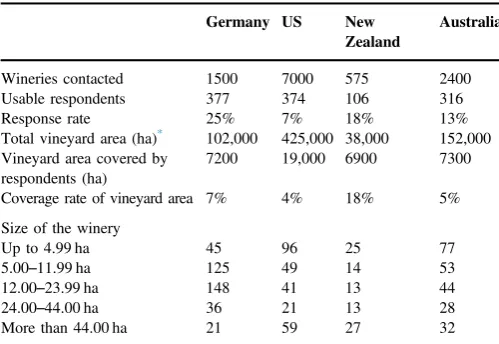
The survey was conducted in Germany, the US, Australia and New Zealand in 2014. The data were collected in an online survey in Germany, the US and Australia. It was run separately and hosted on different online survey platforms. In Germany, a database of 1500 wineries with email addresses was used to recruit participants for the survey. A total of 377 respondents completed the questionnaire in Germany. In the US, an email with the link to the survey was sent out to 7000 US wineries with a total of 375 usable responses. In Australia, the Wine Industry Directory of 2400 wineries was used for informing producers about the survey. A total of 379 respondents were received. Due to the experience of a very low response rate in a previous online study in 2013, a decision was made to post out the questionnaire in New Zealand to 575 wineries instead of sending them an email. In New Zealand, a total of 106 wineries took part in the survey.
Table 1 summarizes the number of respondents and the
response rate in the selected countries. In addition, the cover-age rate regarding the total vineyard area was also calculated, and the size of the wineries who participated in the survey was displayed.
Given the fact that the topic of the survey – social media
–requires internet access from the wineries, we decided to use an online survey tool. Despite the disadvantages in terms of
validity of this method (Szolnoki, 2013), the fact that there is a growing tendency of using internet in the wine business and
that the online survey is the most efficient method to reach
more than 1100 wineries infive different countries, the online survey seemed to be the best instrument for this study. Regarding the reliability of the study, the national statistics were compared with the number of wineries participated in the survey. According the official statistics (Germany–Deutsches
Weininstitut, 2017; US - Tax and Trade Bureau and Wine
Institute, 2016; New Zealand – New Zealand Wine, 2016;
Australia – The Australian and New Zealand Wine Industry
Directory, 2016) we can state that in Germany 5%, in the US
3%, in New Zealand 5% and in Australia 13% of all the wineries participated in the study. The national structure of winery size is not available for all countries so that we cannot compare the sample of this study with the official statistics.
The sample analysed in this study cannot be considered as representative for wine producers in all four countries. Thus it gives an overview of the social media activities form the producer point of view and shows tendencies in term of using social media among the winemakers.
The data were analysed with SPSS 22.0 by using frequency, mean, cross tables and ANOVA. Similar to Mueller et al. (2011), we used theχ2test as an ordinal penetration measure to test the differences of the countries in terms of a number of platforms and social media workload. For metric responses, factorial analysis of variance was used, and post hoc effects (the Tukey-b test) were estimated, affording an analysis of the
significant differences between the countries. In case of
multiple responses, there was no possibility to calculate significant differences.
5. Results and discussion
5.1. Social media adoption and importance
Research Question 1 sought to identify which communica-tion channels are used by wineries to communicate with their customers. The results inTable 2indicate clearly that there are differences between the methods of communication across the selected four countries. Personal contact with the customers plays a major role in communication. The level of personal communication is overall one of the most important commu-nication tools. In the US, New Zealand and Australian about
Table 1
Response rate and coverage.
Germany US New
Zealand
Australia
Wineries contacted 1500 7000 575 2400
Usable respondents 377 374 106 316
Response rate 25% 7% 18% 13%
Total vineyard area (ha)* 102,000 425,000 38,000 152,000 Vineyard area covered by
respondents (ha)
7200 19,000 6900 7300
Coverage rate of vineyard area 7% 4% 18% 5%
Size of the winery
Up to 4.99 ha 45 96 25 77
5.00–11.99 ha 125 49 14 53
12.00–23.99 ha 148 41 13 44
24.00–44.00 ha 36 21 13 28
More than 44.00 ha 21 59 27 32
*
OIV (2016).
Table 2
Usage of communication channels in the wine business (multiple response).
Germany US New Zealand Australia (n¼377) (n¼374) (n¼106) (n¼316)
Personally* 97.9% 87.7% 89.6% 82.0%
Post* 84.4% 37.4% 30.2% 30.1%
Phone/Fax* 82.5% 80.5% 65.1% 49.4%
E-Mail 85.9% 97.9% 90.6% 83.2%
Newsletter* 33.7% 61.0% 54.7% 41.5%
Social media* 46.2% 86.9% 64.2% 62.0%
80% of the wineries use personal communication, while in Germany it achieved 98%. Presumably, a lot of this personal communication would occur with customers who make visits to wineries in person; the option for personal communication would thus not exist for those wineries which do not have a cellar door operating to welcome visitors. German wineries mainly focus on traditional communication channels such as personal contact, by post or phone/fax. More than 80% of the interviewed wineries in Germany stated they use these com-munication channels; this result suggests there are differences between Old and New World wineries based on the higher use that German wineries make of traditional communication channels such as post and phone/fax.
With regards to Research Question 2, the results inTable 2 provide evidence of the clear differences across nations in terms of the adoption of social media as a communication channel. In the US 87%, in Australia 64% and New Zealand 62% of wineries are using social media as a communication channel while this share in Germany is only 46%. However, the rates of adoption across all four nations in this study are higher than those reported in an earlier study of both Old World and New World nations which reported that 35% of
wineries are using social media (Alonso et al., 2013). This
finding has consistencies with recent literature byRemaud and
Couderc (2006) and Resnick (2008) which shows that New
World wineries seem to focus more on marketing and sales, while Old Word wineries have a production and terroir focus. While the New World versus Old World divide is evident in terms of the use of social media as a communication channel; it is somewhat surprising that the number who have adopted social media is not higher across the wineries in many of the nations. In Australia and New Zealand, for instance, almost 40% of wineries are not using social media to communicate,
and in Germany, a little over 50% do not do so. Stelzner
(2014),Sinclair (2014) and Bergen (2014) suggest that wine
marketers have rapidly integrated social media platforms into their marketing mix; our study did not measure the speed of adoption so we cannot support or refute these earlierfindings, but we can argue that numerous wineries have not adopted
social media tools, rapidly or indeed at all. Siamagka et al.
(2015)make the point that technology has introduced changes
to the way in which organisations can interact with both existing and potential customers, but our study suggests that a considerable number of wineries are not, in fact, choosing to use social media technology to reach their current or perspec-tive customers. Given that an estimated 2.4 billion current or
potential wine consumers will be using social media by 2018, it would seem that the wine industry still has some work to do in order to be able to communicate with these people via this communication channel.
Aside from measuring the usage of social media, this study also sought to identify its importance to wine businesses
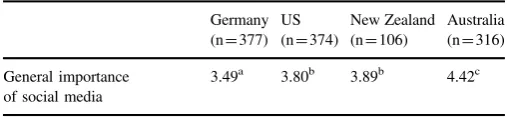
(seeTable 3). These results show a slightly different structure
to those ofTable 2. Although the adoption of social media was the highest among US wineries, they do not evaluate the importance as high as Australian wineries. New Zealand and the US were in this case between the two extremes, while
German winemakers recorded the lowest importance.
AlthoughStrickland (2013)found that almost all social media
users in the Australian wine industry expressed usage of these tools, but they had concerns in its ability to generate revenue, there is not disparity between the results, since Strickland measured ability to generate revenue and this study was focusing on the importance of social media as a communica-tion tool. Even though the importance of social media is higher in Australia than in the other nations, and lower in Germany, the overall results suggest that social media remains a relatively important tool for wineries in all of the nations since the average is sitting above the mean of the 6-point scale. With regards to Research Question 2, these results show
significant differences between nations. Wineries in the Old
World nation of Germany place a significantly lower level of
importance on social media than do those in the New World. With regards to the importance of social media, this result, perhaps not surprisingly, mirrors what was reported earlier with regards to the adoption of social media as a communica-tion channel. Further research would be needed to determine whether the lower rate of social media adoption by German wineries results in a lower level of importance being attached to it, or whether the perception that it is somewhat unimportant
to German wine marketers is leading to the lower
adoption rate.
5.2. Social media platforms and practices
Research Question 3 analyses which social media platforms are used by wineries and seeks to understand if there is a
Table 3
Importance of social media (6-point-scale; 1¼not important at all, 6¼very important).
Germany US New Zealand Australia (n¼377) (n¼374) (n¼106) (n¼316)
General importance of social media
3.49a 3.80b 3.89b 4.42c
F value¼25.419; significant differences between a, b and c.
Table 4
Usage of social media platforms (multiple response).
Germany US New Zealand Australia (n¼174) (n¼352) (n¼77) (n¼219)
Facebook 93.1% 98.0% 93.5% 88.1%
Twitter* 13.8% 67.3% 76.6% 55.7%
Read blogs 44.8% 42.3% 44.2% 33.3%
Video sharing* 15.5% 39.5% 45.5% 30.1% Instagram/Pinterest* 1.1% 35.2% 28.6% 21.9%
Run a blog* 7.5% 24.4% 22.1% 21.0%
Googleþ 12.6% 17.6% 24.7% 22.8%
Comment other blogs 13.8% 16.8% 11.7% 11.4%
Others 6.3% 5.4% 6.5% 5.5%
difference between countries or in the Old World versus New World. Across all wineries in all nations, Facebook is by far the most used social media platform (seeTable 4). In an earlier
study,Bouquet (2012) reported that over half of US wineries
are using Facebook; our results would suggest that Facebook usage across wineries in multiple nations is a growing trend, and is now much higher. As reported previously, there are more than 1.65 billion users actively using Facebook each
month (Statista, 2016); this represents a massive number of
current and potential wine consumers and is likely the reason wineries are primarily utilising this particular social media platform. Facebook is especially useful for millennials, with a previous study indicating that 30 percent of these wine consumers turn to Facebook as a source of wine information
(Higgins et al., 2016).Breslin (2013)also reported that 90% of
wine drinkers are actively using Facebook for more than 6 h per week; having a presence on Facebook would thus appear to
make sound business sense for wineries, and our findings
provide evidence that wineries are indeed engaging via this platform.
Other social media platforms are used to a lesser extent, and there is some evidence of a difference between Old World and New World wine businesses regarding their use of social media platforms. For example, German wineries are similar to those in the New World in terms of their usage of Facebook, reading blogs, and commenting on blogs, however they have
significantly lower use of social media platforms such as
Twitter, Video sharing, Instagram/Pinterest and running a blog. This is further highlighted inTable 5, which illustrates that German wineries are far more likely than those in the New World to utilise just a single social media platform. Many wineries in New Zealand, Australia and the US are commu-nicating through multiple social media platforms. This finding may relate to the results byThach and Lease (2014), regarding the greater the number of social media platforms utilised by wineries, the higher the return on investment is. Utilising multiple platforms allows wineries to engage with a greater number of actual and potential consumers, at the same time, it is more time consuming than dealing only with one platform.
Our findings suggest that the number of adopted social
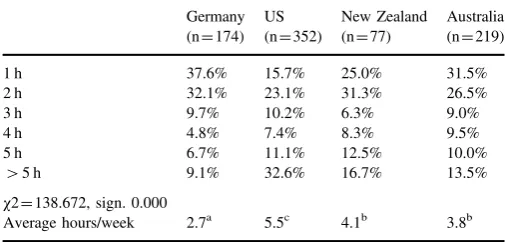
media platforms and the workload of wineries to operate these platforms correlate strongly. Table 6indicates the total
work-load and the average in hours per week and shows significant
differences across nations; no previous research has been found to have identified the number of hours that businesses, in a single sector and across multiple nations, are spending in order to engage and communicate through social media plat-forms. Wineries, especially those in the New World, are spending several hours per week on tasks relating to social media. For example, almost a third of US wineries are
spending more than five hours per week, while a similar
percentage of wineries in New Zealand and Australia are spending four or more hours per week. Two-thirds of German wineries spend only one to two hours a week on social media, which is the lowest among the countries in this research. The hours of work relating to social media are likely to be higher for wineries which choose to utilise multiple social media platforms, something that we have shown to be more likely among New World wineries. This undoubtedly results in greater financial and time costs for wineries and is likely to be a problem for small wineries in particular, where often a business owner is also the viticulturist, the winemaker and the marketer.
Table 5
Number of social media platforms used by wineries.
Germany US New Zealand Australia
(n¼174) (n¼352) (n¼77) (n¼219)
1 70.7% 21.9% 15.6% 29.2%
2 16.1% 21.6% 28.6% 29.2%
3 8.0% 21.3% 15.6% 19.6%
4 2.9% 22.4% 29.9% 11.9%
5 2.3% 8.2% 3.9% 9.1%
6 0.0% 4.3% 6.5% 0.9%
7 0.0% 0.3% 0.0% 0.0%
χ2 ¼179.490, sign. 0.000.
Table 6
Social media workload hours/week.
Germany US New Zealand Australia (n¼174) (n¼352) (n¼77) (n¼219)
1 h 37.6% 15.7% 25.0% 31.5%
2 h 32.1% 23.1% 31.3% 26.5%
3 h 9.7% 10.2% 6.3% 9.0%
4 h 4.8% 7.4% 8.3% 9.5%
5 h 6.7% 11.1% 12.5% 10.0%
45 h 9.1% 32.6% 16.7% 13.5%
χ2¼138.672, sign. 0.000
Average hours/week 2.7a 5.5c 4.1b 3.8b
F value¼25.419; significant differences between a, b and c.
Table 7
Reason why wineries use social media (multiple response).
Germany US New Zealand
Australia
(n¼174) (n¼352) (n¼77) (n¼219)
Provide event information* 90.8% 81.0% 61.0% 64.4% Public relation 75.9% 72.7% 71.4% 63.9% Communicate to the
consumers*
44.8% 85.5% 74.0% 77.2%
Gain new consumers* 41.4% 82.7% 79.2% 78.5% Advertise wineries 62.6% 77.3% 63.6% 66.2% Provide customer service* 34.5% 54.0% 58.4% 58.0% Provide wine tasting
information*
40.8% 59.9% 44.2% 49.8%
Communicate to others* 16.7% 35.8% 41.6% 29.7%
Not defined 12.6% 5.1% 9.1% 6.4%
*
5.3. Social media adoption motives
Research Question 4 sought to understand why wineries are using social media and whether these motives might differ
across nations. Table 7 illustrates the main reasons wineries
decided to use social media platforms. The most frequently mentioned reasons include to provide event information, public relations, to communicate to consumers, to gain new consumers, and to advertise the winery. There are several differences across the four nations. For example, German wineries are more likely to use social media to provide event information and for public relations, than are the wineries from the other countries. However, wineries from the US, New Zealand and Australia make greater use of social media for tasks such as communicating to consumers, gaining new consumers, advertising, providing customer service and wine tasting information as well as communicating with others. The results proved the results of an earlier study across seven nations (Alonso et al., 2013) which reported that communicat-ing about events and promotcommunicat-ing or marketcommunicat-ing wines were the primary reasons why wineries used social media.
Of particular interest, is the result pertaining to providing wine tasting information on social media platforms. The percentages of wineries using social media, for this reason, are between 40% and 60%. For some wineries, this is an area where they could improve their use of social media and potentially increase sales of their wines, especially amongst millennials or those consumers who lack knowledge or
confidence when making a wine purchase.
Also of interest is the number of wineries that have not
defined the reason for using social media. Almost 13% of
German wineries, 5% of US wineries, 9% of New Zealand wineries and 6% of Australian wineries belong to this group. This result provides further support for earlier studies which have indicated that wineries around the world do not know how to strategically use social media platforms (e.g.Dolan et
al., 2012; Reyneke et al., 2011; Stelzner, 2014; Strickland,
2013;Velikova et al., 2011).
5.4. Social media adoption and Winery size
Research Question 5 analyses whether the size of the winery operation (measured as vineyard hectares) has any relationship to the adoption of social media. We neglected the national differences for the following analysis and split the participating wineries by their size (seeTable 8). In total,five groups were compared with each other in terms of social media usage. The lowest social media activity occurs in the group of 5–12 ha, while very small wineries (up to 5 ha), as well as middle size
wineries (12–24 and 24–44 ha), use Web 2.0 significantly
more. Larger wineries above 44 ha have integrated social media almost without exception into their business philosophy beyond country borders. This result may relate to earlier studies about technology adoption which reported that larger
firms are likely to adopt more quickly than smaller ones
(Bengtsson et al., 2007) because they have more employees
and financial support (Buckley, 1989). It could be expected
that the largest wineries would have a greater number of
employees and would thus find it easier to adopt one, or
possibly multiple, social media platforms. The larger wine brands might also expect to be talked about by wine consumers on social media more often than a smaller, less well-known brand, and would, therefore, have more desire to be online to monitor what was being said. At the same time, we also found evidence that the smallest sized wineries were adopting social media tools more than medium-sized wine businesses; this
result provides some support forAral et al. (2013)who found
that businesses of all sizes were adopting new technology because their customers are using it. A smaller wine business could have a greater desire to sell wine directly to consumers rather than through retailer intermediaries (i.e. via a cellar door, the internet, or social media) in order to maximise their profit margins and this might be the reasons for the usage of social media among the smallest wineries in our study.
6. Conclusion
Although attention has been given to social media research in academic literature, much of this has examined utilisation and outcomes from the perspective of consumers. There is evidence that social media usage contributes positively to brand perfor-mance and consumer loyalty (e.g.Rapp et al., 2013). Despite this, less attention has been paid to understanding social media utilisation from an organisational perspective. Indeed, no previous study has been found to have examined the use of social media platforms amongst individual businesses of varying size, operat-ing in a soperat-ingle industry sector, and across multiple nations; this study begins to address this gap.
This research set out to investigate the social media adoption rate and activities of wineries located in four countries and has reported some similarities and some differences based on both nation, Old World/New World and winery size. Though all wineries in the sample report continue to interact with consumers through traditional channels, such as face to face and via phone or post, wineries in the New World countries of the US, Australia and New Zealand report a far higher usage of social media channels than those in Germany, and social media is typically more important to them.
Table 8
Usage of social media by vineyard size.
Up to 4.99 ha 5.00-11.99 ha 12.00-23.99 ha 24.00-44.00 ha More than 44.00 ha
(n¼243) (n¼241) (n¼246) (n¼98) (n¼139)
Despite the high adoption of social media amongst US wineries (almost 87%), the levels of adoption are lower for wineries in New Zealand (64%), Australia (62%) and Germany (46%). Earlier literature has suggested that wineries which
have a social media presence will achieve benefits such as
increased sales through word of mouth, loyalty, and ongoing relationships with customers in a low-cost way (e.g.Laverie et
al., 2011; Leigon, 2011). Our findings suggest that many
wineries have not adopted social media and have thus not put themselves in a position to reap these expected benefits.
Interestingly, our study also found that wineries in all four countries did not have much interest in increasing social media adoption levels in the future. This could be because many wineries report they are already spending several hours per
week engaging on social media, without knowing thefinancial
nor brand return, or it could relate to the notion that some wineries do not know how to effectively use social media as part of their marketing strategies and are thus unlikely to increase their use of these platforms, thus missing what might be a significant marketing opportunity.
6.1. Limitations
The current study provides a snapshot of wineries in four different wine growing countries. The selection of the wineries was based on an electronic mailing list; however, it was not
possible to get a sample that represents – in terms of
geography and size of the company – exactly the structure
of the wineries in the certain county. Therefore we cannot state that these results are representative. In addition, only compa-nies with internet access and email addresses were contacted,
which may be a limiting factor. Although Moore (2011)
reported a significant 90% internet presence among US
wine-ries six years ago, in Germany, for example, this share is most certainly lower. In addition, also the survey instrument has some disadvantages as already addressed in the chapter
“Methodology”. Despite these limitations, the results are
revealing and provide some key implications for practitioners and new issues for future research.
6.2. Implications and future research
The adoption rate of social media amongst consumers has been spectacular, with some channels growing quicker than others and settling into typical market share patterns of other industries. Business adoption of social media has also grown
exponentially as firms rode the wave of interest in ‘new’
channels that hype promised as a road to fortunes. What is evident in this research is that companies in different markets are using the various channels of social media to different extents. While that might be surprising it has effects on the future action of researchers and practitioners.
A major consideration for practitioners, and of importance for future research, is how social media is used differently in geographical markets. This research shows that different markets have a business preference for different forms of social media; what we don’t know is to what extent this lines
up with consumers in terms of (i) the social media they use, (ii) the social media they are more likely to expect brand activity and (iii) the social media they are most likely to engage with brands, in this instance, wine brands. This is important not just in the home market of thefirm's operation, but also important to develop knowledge and insight regarding international markets; what works at home might not be relevant away from home.
A second consideration is that this research highlights that a majority offirms do not intend to increase their use of social media nor venture into platforms they do not currently use. This has several implications, including the fact that previous research (Dolan et al., 2012) highlighted that many firms do not have a plan, nor an objective aligned to their use of social media for marketing. Although strategic planning was not investigated in this survey, we still suppose that companies have little planning and no measurement when they have established social media platforms as communication tools. It does not suggest they are abandoning social media, merely that after putting resources into an unknown media, with no planning or objectives, the novelty and the‘must-do’of having activity in the high growth area has led to a questioning of
‘why more’. Like all areas of marketing,firms need to begin by identifying the marketing problem, developing objectives and then designing a plan to address the situation, along with
measures of progress. If not, the firm runs the risk of
committing resources without a purpose or direction and with no indication of success.
The third area for further research is to investigate wine
branding and marketing activity specifically to see what
activities work and work best in social media and then specifically, in which type of media. The various social media channels are ‘new’, although ‘new’ might mean ten years old, they are non-traditional, as such they do not have the rigour of decades of research to understand how and why to use them. This is a key issue for researchers, practitioners and the new media themselves if they are to occupy a space amongst business users that seek to communicate with customers.
References
Aksoy, L., Van Riel, A., Kandampully, J., Wirtz, J., Den Ambtman, A., Bloemer, J., Horváth, C., Ramaseshan, B., Van De Klundert, J., Gurhan Canli, Z., 2013. Managing brands and customer engagement in online brand communities. J. Serv. Manag. 24, 223–244.
Alonso, A., Bressan, A., O'shea, M., Krajsic, V., 2013. Website and social media usage: implications for the further development of wine tourism, hospitality, and the wine sector. Tour. Plan. Dev. 10, 229–248.
Aral, S., Dellarocas, C., Godes, D., 2013. Introduction to the special issue— social media and business transformation: a framework for research. Inform. Syst. Res. 24 (1), 3–13.
Barber, N., Dodd, T., Ghiselli, R., 2008. Capturing the younger wine consumer. J. Wine Res. 19, 123–141.
Bengtsson, M., Boter, H., Vanyushyn, V., 2007. Integrating the internet and marketing operations: a study of antecedents infirms of different size. Int. Small Bus. J. 25 (1), 27–48.
Bouquet, P., 2012. Social media marketing in the American and French wine industry in 2011. ABLE Social. Media Mark. (Online)(Available at: http// ablesocial. com/market-research, date accessed March, 31,2014 (Accessed 10 August 2017).
Boyd, D.M., Ellison, N.B., 2008. Social network sites: definition, history, and scholarship. J. Comput.-Mediat. Commun. 13, 210–230.
Breslin, K., 2013. Presentation on Constellation Digital Marketing in 2012, San Francisco, CA.
Bruwer, J., Alant, K., 2009. The hedonic nature of wine tourism consumption: an experiential view. Int. J. Wine Bus. Res. 21, 235–257.
Bruwer, J., Wood, G., 2005. The Australian online wine-buying consumer: motivational and behavioural perspectives. J. Wine Res. 16, 193–211.
Buckley, P.J., 1989. Foreign direct investment by small and medium sized enterprises: the theoretical background. Small Bus. Econ. 1 (2), 89–100.
Bulearca, M., Bulearca, S., 2010. Twitter: a viable marketing tool for SMEs?. Glob. Bus. Manag. Res. 2, 296–309.
Chaffey, D., 2016. Global social media research summary 2016. Smart Insights: Soc. Media Mark.
Chu, S.-C., Kim, Y., 2011. Determinants of consumer engagement in electronic word-of-mouth (eWOM) in social networking sites. Int. J. Advert. 30, 47–75.
Dean, D.L., Forbes, S.L., 2016. Are Customers Having E-Conversations about Your Wine? The Importance of Online Discussion Forums as Electronic Word of Mouth for Wine Marketers (Successful Social Media and Ecommerce Strategies in the Wine Industry). Springer.
Degen, W. & Thach, L., 2015. "7 Tips to Work Successfully with Wine Distributors" [Online]. Available at:〈http://www.winebusiness.com/news/? Go¼getArticle&dataid¼155929〉(accessed 11 August 2016).
Dessart, L., Morgan-Thomas, A., Veloutsou, C., 2016. What Drives Anti-brand Community Behaviours: an Examination of Online Hate of Technology Brands (Let's Get Engaged! Crossing the Threshold of Marketing's Engagement Era). Springer.
Deutsches Weininstitut, 2017. Deutscher Wein Statistik 2016/2017. [Online] Available at: 〈http://www.deutscheweine.de/fileadmin/user_upload/Website/ Service/Downloads/Statistik_2016-2017-neu.pdf〉(accessed 10 August 2017). Dolan, R. & Goodman, S., 2011. "Building Customer Based Brand Equity: An Exploration of South Australian Wine Brands on Facebook". In: Proceed-ings of Australian & New Zealand Marketing Academy Conference. Perth, Australia.
Dolan, R., Goodman, S. & Habel, C., 2012. "Engaging Friends and Influencing People: Consumer Perceptions of Brand Communciation Strategies on Facebook". In: Proceedings of Australian & New Zealand Marketing Academy Conference. Adelaide, Australia.
Dolan, R., Conduit, J., Fahy, J. & Goodman, S., 2016."Facebook for Wine Brands: An Analysis of Strategies for Facebook Posts and User Engage-ment Actions". In: Proceedings of Academy of Wine Business Research Conference. Adelaide, Australia.
Emarketer, 2015. "Number of Social Network Users Worldwide from 2010 to 2018" [Online]. Available at: 〈http://www.statista.com/statistics/261676/ digital-buyer-penetrationworldwide/〉(Accessed 14 April 2016).
Emarketer, 2016. "Nearly One-Third of the World Will Use Social Networks Regularly This Year" [Online]. Available at:〈http://www.emarketer.com/ Article/Nearly-One-Third-of-World-Will-Use-Social-Networks-Regularly-This-Year/1014157sthash.n0d81ebp.dpuf〉(Accessed 30 June 2016).
Festa, G., Cuomo, M.T., Metallo, G., Festa, A., 2016. The (r)evolution of wine marketing mix: from the 4Ps to the 4Es. J. Bus. Res. 69, 1550–1555.
Fiore, M., Vrontis, D., Silvestri, R., Contò, F., 2016. Social media and societal marketing: a path for a better wine?. J. Promot. Manag. 22, 268–279.
Forbes, S.L., Goodman, S., Dolan, R., 2015. Use of social media in the Australian and New Zealand wine industries. Aust. N.Z. Grapegrow. Winemak. 95.
Gebauer, J., Ginsburg, M., 2003. The US wine industry and the internet: an analysis of success factors for online business models. Electron. Mark. 13, 59–66.
Gjoka, M., Sirivianos, M., Markopoulou, A. & Yang, X., 2008. "Poking facebook: characterization of osn applications". In: Proceedings of the ACM First Workshop on Online Social Networks. Seattle, USA.
Golder, S.A., Wilkinson, D.M., Huberman, B.A., 2007. Rhythms of Social Interaction: Messaging within a Massive Online Network (Communities and Technologies 2007). Springer.
Hargittai, E., 2007. Whose space? Differences among users and non‐users of social network sites. J. Comput. Commun. 13, 276–297.
Higgins, L., Wolf, M., Wolf, M., 2016. Wine on Facebook: a look at millenials' wine information search. In: Szolnoki, G., Thach, L., Kolb, D. (Eds.), Succesful Social Media and Ecommerce Strategies in the Wine Industry. Palgrace Macmillan, New York.
Hoyer, W.D., Chandy, R., Dorotic, M., Krafft, M., Singh, S.S., 2010. Consumer cocreation in new product development. J. Serv. Res. 13, 283–296.
Hsu, C.-L., Lin, J.C.-C., 2008. Acceptance of blog usage: the roles of technology acceptance, social influence and knowledge sharing motivation. Inform. Manag. 45, 65–74.
Joinson, A.N., 2008. "Looking at, looking up or keeping up with people?: motives and use of facebook". In: Proceedings of the sixth annual SIGCHI conference on Human factors in computing systems. Florence, Italy.
Kacker, M., Perrigot, R., 2016. Retailer use of a professional social media network: insights from franchising. J. Retail. Consum. Serv. 30, 222–233.
Karwal, S., 2015. Digital Marketing Handbook: A Guide to Search Engine Optimization, Pay per Click Marketing, Email Marketing, Content Market-ing, Social Media Marketing. CreateSpace Independent Publishing Platform.
Keller, K.L., 2009. Building strong brands in a modern marketing commu-nications environment. J. Mark. Commun. 15, 139–155.
Kolb, D., Thach, L., 2016. Analyzing German winery adoption of Web 2.0 and social media. J. Wine Res., 1–16.
Lampe, C., Ellison, N. & Steinfield, C., 2006. "A Face (book) in the crowd: Social searching vs. social browsing". In: Proceedings of the 20th anniversary conference on computer supported cooperative work. Banff, Canada.
Laverie, D.A., Humphrey, W., Velikova, N., Dodd, T.H. & Wilcox, J.B., 2011. "Building wine brand communities with the use of social media: a conceptual model". In: Proceedings of the 6th Academy of Wine Business Research. Bordeaux, France.
Leigon, B., 2011. Grape/Wine Marketing with new media and return of the boomer. Pr. Winery Vineyard J.
Lockshin, L. & Hall, J., 2010. "Consumer purchasing behaviour for wine: what we know and where we are going". In: Proceedings of Academy of Wine Business Research conference. Auckland, New Zealand.
Mangold, W.G., Faulds, D.J., 2009. Social media: the new hybrid element of the promotion mix. Bus. Horiz. 52, 357–365.
Moore, S., 2011. Public Relation in the California Wine Industry: Improving Social Media Use Focusing on Facebook and Twitter (Senior Project. Faculty of the Journalism Department). California Polytechnic State University.
Nair, M., 2011. Understanding and measuring the value of social media. J. Corp. Account. Financ. 22, 45–51.
New Zealand Wine, 2016. Vineyard Reports. [Online] Available at:〈https:// www.nzwine.com/en/news-media/statistics-reports/vineyard-reports/〉
(accessed 10 August 2017).
Peters, K., Chen, Y., Kaplan, A.M., Ognibeni, B., Pauwels, K., 2013. Social media metrics—a framework and guidelines for managing social media. J. Interact. Mark. 27, 281–298.
Quinton, S., Harridge-March, S., 2003. On-line wine-strategic or tactical?. Int. J. Wine Mark. 15, 34–43.
Quinton, S., Wilson, D., 2016. Tensions and ties in social media networks: towards a model of understanding business relationship development and business performance enhancement through the use of LinkedIn. Ind. Mark. Manag. 54, 15–24.
Raacke, J., Bonds-Raacke, J., 2008. MySpace and Facebook: applying the uses and gratifications theory to exploring friend-networking sites. CyberPsy-chology Behav. 11, 169–174.
Remaud, H., Couderc, J.P., 2006. Wine business practices: a new versus old wine world perspective. Agribusiness 22, 405–416.
Resnick, E., 2008. Wine Brands: Success Strategies for New Markets, New Consumers and New Trends. Springer.
Reyneke, M., Pitt, L., Berthon, P.R., 2011. Luxury wine brand visibility in social media: an exploratory study. Int. J. Wine Bus. Res. 23, 21–35.
Riegner, C., 2007. Word of mouth on the web: the impact of Web 2.0 on consumer purchase decisions. J. Advert. Res. 47, 436–447.
Sawhney, M., Verona, G., Prandelli, E., 2005. Collaborating to create: the Internet as a platform for customer engagement in product innovation. J. Interact. Mark. 19, 4–17.
Schembri, S., Latimer, L., 2016. Online brand communities: constructing and co-constructing brand culture. J. Mark. Manag., 1–24.
Siamagka, N.-T., Christodoulides, G., Michaelidou, N., Valvi, A., 2015. Determinants of social media adoption by B2B organizations. Ind. Mark. Manag. 51, 89–99.
Sinclair, L., 2014. Spending on digital marketing to outstrip traditional channels: study. Aust. Bus. Rev. (24 March, 2014).
Statista, 2016. "Statistics and Market Data on Social Media & User-Generated Contetn" [Online] Available at: 〈https://www.statista.com/ markets/424/topic/540/social-media-user-generated-content/〉 (accessed 13 June 2016).
Steeves, N., 2013. "Best practices: posting and analyzing effective facebook content" [Online] Available at:〈 http://www.nimble.com/blog/posting-and-analyzing-on-facebook/2014〉(accessed 13 June 2017).
Stelzner, M., 2014. 2014 Social Media Marketing Industry Report. Social Media Examiner.
Strickland, P., 2013. "The importance of social media technology of Yarra Valley wineries in Australia". In: Proceedings of the 7th American Association of Wine Economics conference. Stellenbosch, South Africa.
Szolnoki, G., Taits, D., Nagel, M., Fortunato, A., 2014. Using social media in the wine business: an exploratory study from Germany. Int. J. Wine Bus. Res. 26, 80–96.
Szolnoki, G., Thach, L., Kolb, D., 2016. Current status of global wine ecommerce and social media. In: Szolnoki, G., Thach, L., Kolb, D. (Eds.), Successful Social Media and Ecommerce Strategies in the Wine Industry. Palgrave Macmillam, New York.
Thach, L., 2009. Wine 2.0—the next phase of wine marketing? Exploring us winery adoption of wine 2.0 components. J. Wine Res. 20, 143–157. Thach, L., 2010. Wine blogs: expressing diverse wine opinions in a new realm of
online wine relationship marketing. In: Proceedings of the 5th International Academy of Wine Business Research Conference. Auckland, New Zealand. Thach, L. & Lease, T., 2014. "Exploring the Impact of Social Media Practices
on Wine Sales in U.S. Wineries". Proceedings of Academy of Wine Business Research Conference. Geisenheim, Germany.
The Australian and New Zealand Wine Industry Directory, 2016. Wine Industry Statistics – Wine Producers. Winetitles Media, Broadview, Australia.
U.S. Tax and Trade Bureau, 2016. Number of Wineries. [Online] Available at:
〈https://www.wineinstitute.org/resources/statistics/article124〉(accessed 10 August 2017).
Velikova, N., Wilcox, J.B. & Dodd, T.H., 2011. "Designing Effective Winery Websites: Marketing-Oriented versus Wine-Oriented Websites". In: Pro-ceedings of the 6th AWBR International Conference. Bordeaux, France. Vinography, 2012. Social Media and the Wine Industry: A New Era. [Online]
Available at:〈http://www.vinography.com/archives/2012/02/social_media_ and_the_wine_indu.html〉(accessed 14 September 2015).
Vivek, S., Beatty, S., Morgan, R., 2012. Customer engagement: exploring customer relationships beyond purchase. J. Mark. Theory Pract. 20, 122–146.