0
Factors associated with the
development of effective experience in
excellent managerial ability
P.L. Nuthall
Faculty of Commerce Research Report no. 1
July 2013
ISSN: 2253-4571
1
Faculty of Commerce
Faculty of Commerce PO Box 85084 Lincoln University LINCOLN 7647 Christchurch P: (64) (3) 325 2811 F: (64) (3) 325 3847
Copyright Statement:
This information may be copied or reproduced electronically and distributed to others without restriction, provided the Faculty of Commerce, Lincoln University is acknowledged as the source of information. Under no circumstances may a charge be made for this information without the express permission of the Faculty of Commerce, Lincoln University, New Zealand.
1
Factors associated with the development of effective experience in excellent
managerial ability
Abstract
Modelling farmers’ managerial ability shows that farmers’ lessons from various forms of experience are by far the most significant factor in achieving high management skill. This begs the question of obtaining an understanding of the components making up successful experiential outcomes. To help unravel this question the results from analysing 740 farmer survey questionnaires is presented. It turns out high ‘experience’ is related to many factors.
Keywords: experience, managerial ability, variables.
About the Authors:
2 1 Introduction
Modelling farm survey data has shown farmers’ ‘experience’ is by far the most important factor in achieving successful outcomes on modern Western country farms, and probably similarly for all other farms. The other core factors in managerial ability are intelligence and management style or personality (Muggen, 1969). Research based on some 740 farmer survey data suggests the contribution of each to managerial ability is 74% for ‘experience’, and 8.3% and 17.7% for intelligence and style respectively. Intelligence is only half as important as management style, which in turn is only a fraction as important as ‘experience’.
But having heaps of experience does not necessarily lead to managerial ability. The important thing is actually learning from experience and mistakes to build decision constructs that work. In the modelling of the farmer data (full report in Nuthall, a&b, 2009) a structural equation model was used to not only determine the important factors in ability, but also to work out the factors associated with valuable and useful experience.
In the model the experience variable was what is known as a latent variable…. not directly observable, but able to be inferred from the structure of the model and observed variables (such as age, profit and so on). When working on improving managerial ability it is critical to consider these factors which give rise to ‘high’ experience.
To this end, the 740 farmers were split into a number of groups based on their level of ‘good experience’ which had been calculated using the model and converted to percentage scores. To provide a comparison, farmers with ‘experience’ rated as 80% or greater were compared with those with a less than 50% ‘experience’ rating. Provided below are a number of tables giving the values of a range of related variables for each ‘experience’ group. Only those variables where the means had a significance difference of less than 10% probability are shown… i.e. they only have a 10% or less chance of being from the same distribution.
Generally the attributes were measured on a 5 point Likert scale, though there are some exceptions. These are noted as appropriate. The mean of each variable for each ‘experience’ grouping is presented as is the significance probability level, and also whether a higher level of the variable is desirable to improve ‘experience’, and thus managerial ability. Generally a lower value is desirable for each variable as the scale went from 1 for the variable being ‘true’ to 5 where the farmer considered the factor is not true for him or her. To reduce space, the variable names are not the full statement offered to the farmer. The full set of questions asked is presented as an appendix in Nuthall, P.L. (b & c, 2009).
3 2 The results
Besides Table 1, the variable groupings presented in the subsequent tables include components of the processes a farmer might use, personality factors, farmer attitudes, relationships with others, learning aspects, objectives and, finally, technical productivity. The latter is more of an expression of high experience and high ability rather than a possible causing factor.
Considering all these variables gives ideas on desirable training and the factors to concentrate on when working on improving farmers’ managerial ability through improving ‘experience’.
Table 1 PARENTAL INFLUENCES Comparison of statistics of farms with experience % >80%(41 farms) relative to farms with experience<50% (72 farms). Total sample 735 farms. Scoring scale 1=true …… 5=not true (shown by *)
Variable Mean value Significance Desirable
High Exp Low Exp
Attendance at country primary school (1=yes) 1.1 1.3 0.083 yes Encouraged to use imagination when young * 2.0 2.5 0.044 yes Encouraged to get on with people when young* 1.6 2.4 0.025 yes Listened to tech matters discussion when young * 2.8 3.3 0.061 yes Wanted info. on decision reasons when young* 2.4 3.2 0.001 yes Learnt a lot of financial knowledge from parents* 3.1 2.6 0.058 no
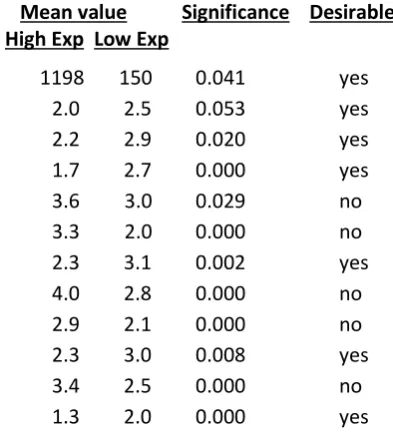
Table 2 PROCESSES Comparison of statistics of farms with experience % >80%(41 farms) relative to farms with experience<50% (72 farms). Total sample 735 farms. Scoring scale 1=true …… 5=not true (shown by *)
Variable Mean value Significance Desirable
High Exp Low Exp
4
Table 3 PERSONALITY FACTORS (BELIEFS/FACTORS) Comparison of statistics of farms with experience % >80%(41 farms) relative to farms with experience<50% (72 farms). Total sample 735 farms. Scoring scale 1=true …… 5=not true (shown by *)
Variable Mean value Significance Desirable High Exp Low Exp
Easy to ring strangers for technical information* 2.4 3.6 0.000 yes Become anxious with too many jobs to hand* 3.0 2.3 0.015 no Tolerate employee/contractor mistakes* 2.4 3.1 0.007 yes Worry at night over decisions* 3.7 3.0 0.019 no New methods exhilarating and challenging* 1.7 2.8 0.000 yes Worry about using the correct methods* 4.0 4.5 0.036 maybe Happy to make do with what is to hand* 2.5 1.7 0.000 no Having to change is a real pain* 3.7 2.5 0.000 no Get cross and short with others* 2.9 2.4 0.074 no
It is very clear that farmers prepared to travel to attend field days tend to have high ‘experience’ as do farmers who talk to others about their decision problems. Similarly farmers who write down ideas and budget comparisons tend to have greater success.
Anxiety and worry are not good traits to have. Becoming less anxious can, however, be achieved through concentrating on techniques such as relaxation, and sharing the load. Again, from Table 3, talking to others in assessing situations tends to be associated with successful ‘experience’. Learning to ‘keep your cool’ is also beneficial. Also note the ‘high experience’ farmers are not that concerned at reducing risk.
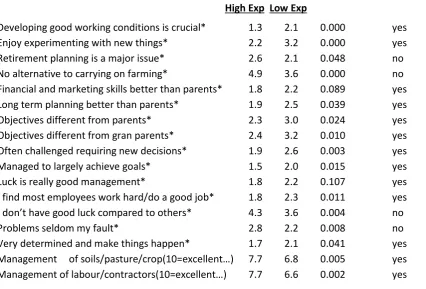
When it comes to attitudes, Table 4 contains data suggesting, amongst other things, having determination and a belief that good luck is made by the farmer are both valuable. Similarly, farmers that enjoy working with new approaches, and find themselves ‘challenged’ at times, tend to have more valuable ‘experience’.
5
Table 4 ATTITUDES Comparison of statistics of farms with experience % >80%(41 farms) relative to farms with experience<50% (72 farms). Total sample 735 farms. Scoring scale 1=true …… 5=not true (shown by *)
Variable Mean value Significance Desirable
High Exp Low Exp
Developing good working conditions is crucial* 1.3 2.1 0.000 yes Enjoy experimenting with new things* 2.2 3.2 0.000 yes Retirement planning is a major issue* 2.6 2.1 0.048 no No alternative to carrying on farming* 4.9 3.6 0.000 no Financial and marketing skills better than parents* 1.8 2.2 0.089 yes Long term planning better than parents* 1.9 2.5 0.039 yes Objectives different from parents* 2.3 3.0 0.024 yes Objectives different from gran parents* 2.4 3.2 0.010 yes Often challenged requiring new decisions* 1.9 2.6 0.003 yes Managed to largely achieve goals* 1.5 2.0 0.015 yes Luck is really good management* 1.8 2.2 0.107 yes I find most employees work hard/do a good job* 1.8 2.3 0.011 yes I don’t have good luck compared to others* 4.3 3.6 0.004 no
Problems seldom my fault* 2.8 2.2 0.008 no
Very determined and make things happen* 1.7 2.1 0.041 yes Management of soils/pasture/crop(10=excellent…) 7.7 6.8 0.005 yes Management of labour/contractors(10=excellent…) 7.7 6.6 0.002 yes
Table 5 RELATIONSHIPS WITH OTHERS Comparison of statistics of farms with experience % >80%(41 farms) relative to farms with experience<50% (72 farms). Total sample 735 farms. Scoring scale 1=true …… 5=not true (shown by *)
Variable Mean value Significance Desirable
High Exp Low Exp
Enjoy farmer groups* 3.1 3.5 0.091 yes
6
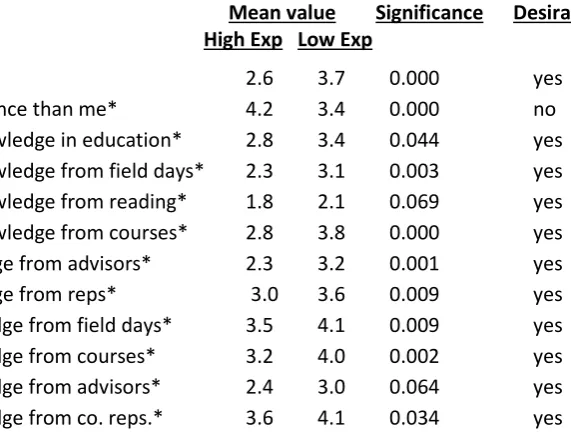
Table 6 LEARNING Comparison of statistics of farms with experience % >80%(41 farms) relative to farms with experience<50% (72 farms). Total sample 735 farms. Scoring scale 1=true …… 5=not true (shown by *)
Variable Mean value Significance Desirable
High Exp Low Exp
Attending field days is vital* 2.6 3.7 0.000 yes Parents had greater intelligence than me* 4.2 3.4 0.000 no Learnt a lot of technical knowledge in education* 2.8 3.4 0.044 yes Learnt a lot of technical knowledge from field days* 2.3 3.1 0.003 yes Learnt a lot of technical knowledge from reading* 1.8 2.1 0.069 yes Learnt a lot of technical knowledge from courses* 2.8 3.8 0.000 yes Learnt a lot of tech knowledge from advisors* 2.3 3.2 0.001 yes Learnt a lot of tech knowledge from reps* 3.0 3.6 0.009 yes Learnt a lot of fin’c’l knowledge from field days* 3.5 4.1 0.009 yes Learnt a lot of fin’c’l knowledge from courses* 3.2 4.0 0.002 yes Learnt a lot of fin’c’l knowledge from advisors* 2.4 3.0 0.064 yes Learnt a lot of fin’c’l knowledge from co. reps.* 3.6 4.1 0.034 yes
Table 7 OBJECTIVES Comparison of statistics of farms with experience % >80%(41 farms) relative to farms with experience<50% (72 farms). Total sample 735 farms. Scoring scale 1=true …… 5=not true (shown by *)
Variable Mean value Significance Desirable
High Exp Low Exp
Important to pass property to family* 3.5 2.8 0.042 no Important to keep debt low* 4.3 1.4 0.000 no Important to plan for leisure and holidays* 1.7 3.1 0.000 yes Minimising pollution is important* 1.3 2.1 0.000 yes Business expansion absolutely necessary* 2.9 3.8 0.001 yes Aiming for maximum sustainable income important* 2.4 1.9 0.030 no
Assets to children for education/business important* 3.1 2.4 0.005 no
7
Table 8 TECHNICAL FACTORS Comparison of statistics of farms with experience % >80%(41 farms) relative to farms with experience<50% (72 farms). Total sample 735 farms. Scoring scale 1=true …… 5=not true (shown by *)
Variable Mean value Significance Desirable
High Exp Low Exp
Years on current farm 19.8 27.9 0.010
Years managing current farm 18.1 21.6 0.094 Years working on farm before manager 5.8 8.2 0.067
Age category with 6 options(1=<25….. 6= >65) 4.1 4.7 0.001 younger Lambing percentage (sheep farmers only) 145 128 0.003 yes
Milk solids per hectare (dairy farmers only) 1005 814 0.052 yes Milk solids per cow (dairy farmers only) 377 320 0.037 yes
3 Conclusion
Overall, it is important for farmers to understand the factors associated with successful experience, and similarly their advisors and consultants. Farmers need to have the attributes of ‘experts’ (Cooke, 1992; Shanteau, 1990). Most farmers will recognise the importance of learning from experience, but many do not achieve this to a desirable level. Helping change this situation can have lasting impacts in farmers achieving their goals, and similarly for the nation they are part of. In helping farmers it is also useful to understand their core values and approaches which can be assessed using standard tests (Nuthall, 2006). Working with others in close and supportive groups is probably the best way to move towards achieving the attributes associated with beneficial ‘experience’. It is highly likely an ability to be self-critical is also important. This was not measured in the survey suggesting further work on this aspect is desirable.
References
Cooke N., (1992) Modelling human expertise in expert systems. Chp 3 in Hoffman R.(Ed). The psychology of expertise – cognitive research AI. Springer, NY.
Muggen G., (1969) Human factors in farm management. A review of the literature. World Agricultural Economics and Rural Sociology Abstracts 11(2):1-11
Nuthall P.L., (2006) Development of Tests for Assessing Managerial Ability on New Zealand Farms. Farm and Horticultural Management Group, Lincoln University, Research Report 01/2006
Nuthall, P.L. (a, 2009) Modelling the origins of managerial ability in agricultural production. Australian Journal of Agricultural and Resource Economics 53:413-436
Nuthall, P L. (b, 2009) Managerial factors in primary production: data from a sample of New Zealand farmers with an emphasis on experience as a factor in success. Lincoln University AERU Research Report No 315:1-46. May 2009, ISSN 1170-7682, ISBN 978-1-877519-05-5.
Nuthall, P.L. (c, 2009) Farm Business Management … The Human Factor, CABI, Wallingford, UK