CFD ANALYSIS FOR HEAT TRANSFER
BETWEEN COPPER ENCAPSULATED
PHASE CHANGE MATERIAL AND
HEAT TRANSFER FLUID
M.Premkumar1, S.Ramachandran2
1
Research scholar, Sathyabama University
2
Professor and Head, Mechanical Engineering, Sathyabama University Email:[email protected]
Email: [email protected]
Abstract:
Heat transfer plays an important role in the enhancement of thermal energy storage in phase change material (PCM). The effective utilization of solar thermal energy can be obtained by proper storage of that energy. There are various techniques for the enhancement solar thermal storage in phase change material such as introduction of wire brushes, honey comb structure, fins and packed bed storage. In this study the analysis of heat transfer between PCM and heat transfer fluids (HTF) with Spherical and cylindrical finned encapsulations made of copper are done using computational fluid dynamic (CFD) analysis software GAMBIT and Fluent 6.2. The analysis is done in two modes as charging and discharging. During the charging mode the input is given in terms of temperature to the heat transfer fluid and the amount of heat transfer inside the PCM encapsulation is taken as output. During the discharging process the output temperature in the PCM is given as input and the amount of heat transferred to the heat transfer fluid is noted. The results from CFD analysis conclude that the heat transfer is more in finned encapsulations than that of without finned encapsulations and the copper sphere with fins is considered to be the best out of all other encapsulations.
Key words: Therminol-66; D-Mannitol; Copper encapsulations; CFD.
1. INTRODUCTION
The increase in the cost and demand of fossil fuels paved a way to the entire world to turn towards the renewable energy resources. Out of all renewable energy resources solar energy is an abundant energy available everywhere in the world. The solar energy thus available is to be tapped in an effective way and has to be stored for further use. The challenging task in solar energy is its storage for later use. There are various techniques used for the storage of solar thermal energy such as sensible and latent heat storage. Thermal energy storage plays an important role in the effective functioning of diverse systems, such as solar energy collectors, heating and cooling systems, power and industrial waste heat recovery [3]. Energy can be stored and retrieved as sensible heat, latent heat and also in thermo - chemical reactions or a combination of any of these. Latent heat thermal storage (LHS) is one of the efficient ways of storing thermal energy. Unlike the sensible heat storage (SHS) method, the latent heat storage method provides much higher storage density, with a smaller temperature difference between storing and releasing heat.
In latent heat storage the phase change material is used as a medium to storage a large amount of solar energy by changing its phase [1]. The amount of energy stored in PCM depends on the effective heat transfer between HTF and PCM. There are various techniques for the enhancement solar thermal storage in phase change material such as introduction of wire brushes, honey comb structure, fins and packed bed storage [2 & 9]. In our study we have justified the enhancement of heat transfer in finned copper encapsulations containing PCM using CFD software GAMBIT and Fluent 6.2. The analysis is done in two modes as charging and discharging. During the charging mode the input is given in terms of temperature to the heat transfer fluid and the amount of heat transfer inside the PCM encapsulation is taken as output. During the discharging process the output temperature in the PCM is given as input and the amount of heat transferred to the heat transfer fluid is noted. The results from CFD analysis conclude that the heat transfer is more in finned encapsulations than that of without finned encapsulations and the copper sphere with fins is considered to be the best out of all other encapsulations.
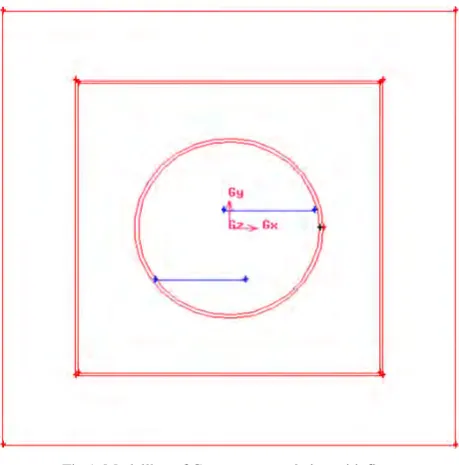
2. Modelling of PCM Tank
Fig 1. Modelling of Copper encapsulation with fins.
3. Computational Fluid Dynamic Analysis
The computational fluids dynamic analysis is done using FLUENT 6.2 and GAMBIT software. The designing and meshing are done using GAMBIT tool and heat transfer analysis is done using FLUENT 6.2 software. The energy analysis is done using K- ε model [6]. The design structure considered for CFD analysis consist of a heat transfer fluid tank with Therminol-66 and PCM encapsulation with D-mannitol placed inside. The HTF tank is surrounded with glass wool insulation. The meshing structure used was tetrahedron. The CFD analysis is done for all type of encapsulation in charging and discharging cycle.
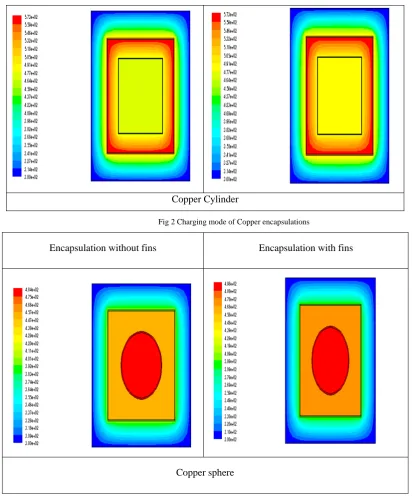
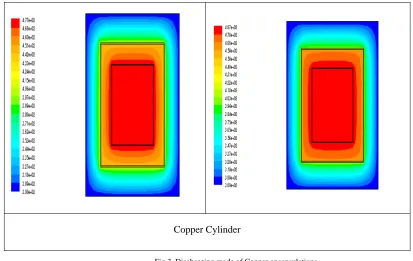
During the charging mode the temperature of heat transfer fluid is given as input as 300°C ant the temperature obtained in PCM D-mannitol is found after 10,000 iterations. And during the discharging mode the temperature of PCM obtained during the charging mode is given as the input temperature of D-mannitol and the now the temperature obtained by the therminol-66 is found after same number of iterations. The outcome of copper encapsulations during charging and discharging modes are shown in Figure 2 and 3.
Encapsulation without fins Encapsulation with fins
Copper Cylinder
Fig 2 Charging mode of Copper encapsulations
Encapsulation without fins Encapsulation with fins
Copper Cylinder
Fig 3. Discharging mode of Copper encapsulations
4. Result and Discussions
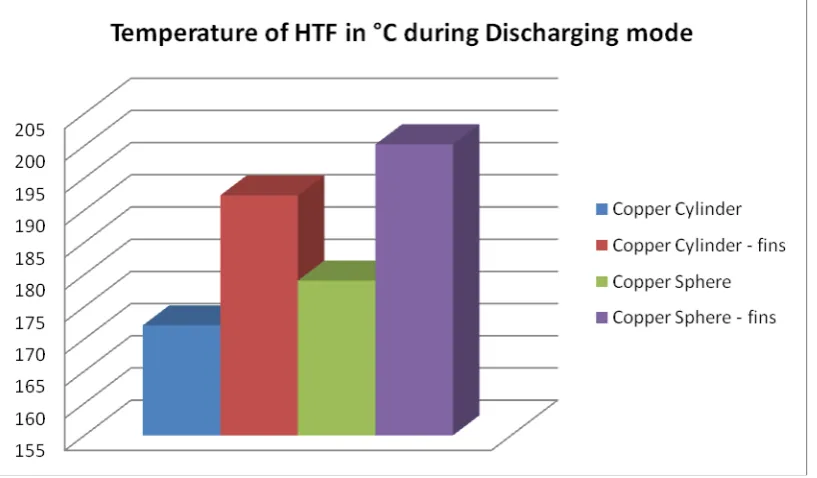
The results obtained from the CFD analysis is listed in the table 1. The heat transfer between the Therminol-66 and D-Mannitol and vice versa is analyses using CFD software. The results of the analysis are shown in Table 1. The charging and discharge mode graphs are developed from tabulation and are shown in Figure 4 and 5.
Table 1. CFD- Charging and Discharging
Encapsulations
Temperature in ° C
Charging Discharging Without fins With fins Without fins With fins
Fig 4. Temperature of PCM in °C during Charging Mode
The Figure 4 shows the temperature obtained by phase change material D-mannitol during the charging mode. The input temperature for heat transfer fluid, therminol-66 is given as 300°C in each type of copper encapsulations and the corresponding temperature gained D- mannitol PCM is noted during the charging mode for various encapsulations. The figure 4 infers that the heat transfer is enhanced in copper spherical encapsulation with fins than that of copper spherical encapsulation without fins. Also we can note that the heat transfer in copper cylindrical encapsulation with fins is slightly better than that copper spherical encapsulation. So it is concluded that during the charging mode the insertion of fin structure enhances the heat transfer rate between the heat transfer fluid and phase change material irrespective of its material and shape.
Fig 5. Temperature of HTF in °C during Discharging mode
encapsulation without fins. Also we can note that the heat transfer in copper cylindrical encapsulation with fins is slightly better than that copper spherical encapsulation. Finally, the insertion of fin structure enhances the heat transfer rate between the heat transfer fluid and phase change material irrespective of its material and shape.
References
[1] Atul Sharma, Tyagi V.V., Chen C.R. and Buddhi D. (2008), ‘Review on thermal energy storage with phase change materials and applications’, Renewable and Sustainable Energy Reviews.
[2] Chow Zhong J.K. and Beam J.E. (1996), “Thermal conductivity enhancements for phase change storage media”, Heat mass transfer, Vol.23, No.1, pp.91-100.
[3] Feng Yang, Xiugan Yuan and Guiping Lin (2003), ‘Waste heat recovery using heat pipe heat exchanger for heating automobile using exhaust gas’, Applied Thermal Engineering, Vol. 23, pp. 367-372.
[4] Ismail K.A.R. and Stuginsky R. (1999), “A parametric study on possible fixed bed models for pcm and sensible heat storage”, Applied Thermal Engineering, Vol. 19, pp. 757-788.
[5] Jianfeng wang, Yingxiu Ouyang and Guangming Chen (2001), ‘Experimental study on charging processes of a cylindrical heat storage capsule employing multiple-phase change materials’, International Journal of Energy Research, Vol. 25, pp. 439-447.
[6] Liwu Fan and J.M. Khodadadi (2011), ‘Thermal conductivity enhancement of phase change materials for thermal energy storage: A review’, Renewable and Sustainable Energy Reviews, Vol. 15, No. 1, pp.24-46.
[7] Nallusamy N., Sampath S. and Velraj R. (2007), ‘Experimental investigation on a combined sensible and latent heat storage system integrated with constant/varying (solar) heat sources’, Renewable Energy, Vol. 32, pp. 1206-1227.
[8] Roman Domanski and Giuma Fellah (1996), ‘Exergy analysis for the evaluation of a thermal storage system employing PCMs with different melting temperatures’, Applied Thermal Engineering, Vol. 16, No. 11, pp. 907-919.