DESIGN AND IMPLEMENTATION OF
GAUSSIAN SMOOTHING FILTER FOR
IMAGE PROCESSING APPLICATIONS
Harish.A
PG student, Department of ECE, MVGR College of Engineering (A), Vizianagaram, Andhra Pradesh, India Email:[email protected]
Satyanarayana.M
Associate Professor, Department of ECE, MVGR college of Engineering (A), Vizianagaram, Andhra Pradesh, India Email:[email protected]
Abstract:
Gaussian smoothing filter plays a very vital role in the field of image processing due to enhancing capability and removal of different noise which are occurred at the image processing. In this paper, a clear study about selection of optimal value of sigma and kernel sizes are observed in Gaussian smoothing filter. Moreover with the optimal value a rigorous study have been done by varying the window size for different class of images. Hence we make a remarkable contribution for the selection of an optimal value and the filter is applied to different images which are effected by different noise like Gaussian noise, salt and pepper noise etc. The optimum valued filter is designed and coded in verilog and observed the design parameter values like area, delay, power. The filters are coded in Xilinx vivado and ISE tool and simulated by using Modelsim tool. The performance of filter is computed with various quality measures like PSNR, SSIM, and GMSD etc. The MATLAB simulation shows that the optimal value of the filter and quality parameter values which are more reliable in the field of image processing applications.
Keywords: GSF,ES-GSF, SSIM,GMSD,MAE,MSE,UIQI
1. Introduction
Image processing deals with the images which undergoes some mathematical operations for which the input is image. The output either image or parameters which gives information about image. The smoothing technique is used to decrease noise in the image but the output is less pixels for a given image. Smoothing methods are generally based on low pass filters. Smoothing is based on single value representing the image, such as the average value of the image or the middle value.
The contribution of this paper is to design the optimal value of kernel and selection of window size. The optimum Gaussian kernel values and window selection are designed by using GSF algorithm. The optimum values are observed by plotting different values to the SSIM value then the better output is identified and the optimum value is taken for the different images. The maximum value of SSIM is ‘1’ but practically not possible.
The energy efficient designs are widely used in recent years for portable devices which are used in image/video processing applications. The advancements in the VLSI technologies allow us to fabricate more number of transistors in one single chip. As the design complexity increases which gives poor efficiency. The energy efficient design is major concern in high portable devices for increasing reliability. Most of the portable devices are used in the multimedia applications like image/video processing applications. The approximated designs are used in the energy efficient designs in multimedia applications. The approximated designs have speed, power, area, accuracy. The approximated design improves the SPAA and delay metrics over conventional designs which are having low cost in the design and improves accuracy.
In mobile and multimedia devices are suffer from energy utilization is due to increase in the functionality and complexity. Image processing suffer from noise at compression/transmission degrade the image quality. In order to reduce the noise smoothing filters are used with the characteristics of averaging, median, mean and Gaussian etc. Generally we use 2D Gaussian smoothing filter provides better tradeoff between spatial and frequency domains.
used in image/video processing applications to get better design results with acceptable quality. The DCT architectures are used in past years for approximated adders, multipliers and squarer.
2. Gaussian smoothing
Gaussian smoothing filter is used in image smoothing technique. The Gaussian filter performs image blurring, image segmentation and edge detection. When we deal with images we use two dimensional Gaussian function. A 2D Gaussian smoothing function with mean and standard deviation is shown below.
g(x, y) = exp( ( )/ ) (1)
x,y are two variables and σ represents standard deviation. The Gaussian function behaviour is based on standard deviation value. In discrete time analysis the Gaussian function requires infinitely large convolution practically not possible. The higher values of σ are neglected (±3σ).
One type of non-uniform low pass filter is Gaussian smoothing filter. The Gaussian kernel coefficients maintain inverse relation with distance. As the width of peak increases the amount of blur increases. In order to implement effective Gaussian function we use Gaussian kernel. The larger the value of σ used or better smoothing. The 5x5 Gaussian kernel is obtained by using equation (1) and the variables ranges from -2 to 2. The Gaussian kernel matrix is shown below for σ =1.
2.1 Energy scaling algorithm and architecture
The energy scalable Gaussian filter steps are shown below. Initially the 5x5 input image matrix is extracted and centred to the pixel. The Gaussian kernel matrix is convolved with the input image matrix then the smoothed image is obtained. In order to maintain the brightness of the image we multiply with the gain of the matrix. Here we perform liner convolution with input matrix by padding with zeros to the Gaussian kernel.
Algorithm for ES-GSF
Input: image of size {row x column} Output: smoothed image
For every pixel si
Extract 5x5 image sub matrix Compute kernel approximation kapp ES = Σ kapp
Ss = 1/s *Σ image sub matrix * kapp Ss = Smoothed image
end for
return smoothed image
The approximate GSF requires the simple shift and add logic but in case of energy scaling GSF a multiplexer is used for efficient mode of operation. By using these architectures the power ,area, accuracy and speed will be more. Based on the multiplexer value the energy scaling mode is selected. The energy scaling is mainly depends on the nearest pixel approximation and boundary concept methods.
3 Quality and design metrics
The design parameters which are used in our design are discussed below
3.1 Mean Square Error (MSE)
For input image I and noisy output image N the mean square error expression is shown below.
MSE = 1/XY [( ( , ) − ( , )]
3.2 Mean Absolute Error (MAE)
The mean absolute error is shown below.
= ∑ | − |/
3.3 Peak Signal to Noise Ratio (PSNR)
The PSNR is widely used in image and video processing applications to measure the amount of noise present in the image. The PSNR in db is shown below.
PSNRdb = 10.log10 (sigI2/ MSE)
Where sigI represents maximum signal value of image (255).
3.4 Structural Similarity Index (SSIM)
For a given i/p signal the amount of error is measured by using SSIM. This parameter is widely used in recent years for perceivable errors. The SSIM is given by
SSIM = (2μxμy + C1)(2σxy+C2) / (μ2x + μ2y+C1)( σ2x+ σ2y+C2) 3.5 Universal Quality Index (UIQI)
The universal quality index is defined as Qi = 4σxy xiyi / (σ2x+ σ2y)[( x2i)+ y2i)]
4 Simulation results on MATLAB
The Gaussian filter quality metrics are implemented in MATLAB for different images and the design metrics are shown below table.
Design
metrics Flower.jpg Lena.tif Livingroom.tif Mandril.tif DIFFERENT IMAGES Pirate.tif Woman_darkhair.tif PSNR 32.7707 32.8465 31.6306 31.1508 31.5084 33.0275
GMSD 0.0585 0.0847 0.880 0.0793 0.0754 0.0845 SSIM 0.8792 0.8361 0.7647 0.7840 0.7960 0.8801 SSIM1 0.3824 0.4756 0.5905 0.6854 0.5495 0.3810 MAE 3.96 3.78 4.87 5.14 4.92 4.06 MSE 34.63 34.03 45.02 50.28 46.31 32.64 UIQI 0.9610 0.9968 0.9918 0.9983 0.9948 0.9927
Table1. Error metrics
4.1 Performance evaluation of Gaussian kernel with variable window size
Fig1. Optimum selection of kernel and window size
From the figure 2 we can observe that the plot values for different values of sigma to the different values of window size. From the figure we observed that at σ = 0.8 gives the SSIM of 0.82 for all window sizes. Hence we conclude that the selection of window is negligible at the lane value of sigma. Whatever the size of window is selected that does not reflect the quality of image. We observed that the tremendous fall of quality level by taking window size of 3, the quality and sigma are inversely related. By taking the window sizes of 5 and 7 the quality of image is high at the kernel values of 1.2 and 1.4.
4.2 FPGA Implementation for GSF & Results
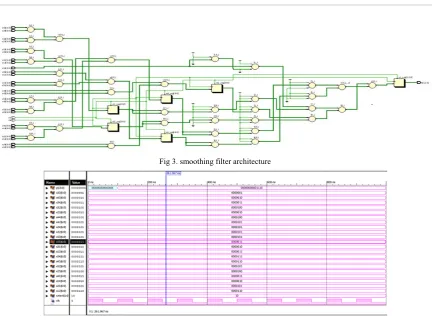
The Energy Scaling GSF architectures [1] are implemented by using Xilinx vivado and ISE tool. The approximate GSF [1] and energy scaling Gaussian filter architecture [1] are coded in verilog. In order to implement the GSF architecture in verilog the 5x5 Gaussian smoothing pixel values are taken from the Matlab. The schematic and output wave forms for the smoothing and energy efficient architectures are shown and the design summary is shown below.
Fig 3. smoothing filter architecture
Fig 4. Energy Efficient architecture output waveform
4.3 Efficacy in the application
In this paper different edge detection algorithms are used, most widely used edge detection algorithms are sobel and canny edge detectors. By using canny edge detection gives the better results compared to the sobel edge technique. The results for different edge detection are shown below.
Fig 5. Various edge detection algorithms used in proposed model
5. Conclusion
References
[1] Bharat Garg , G.K. Sharma, A quality-aware Energy-scalable Gaussian Smoothing Filter for image processing applications. In Microprocessors and Microsystems Volume 45, Part A, August 2016, Pages 1–9.
[2] A. Jaiswal , B. Garg , V. Kaushal , G. Sharma , SPAA-aware 2d Gaussian smoothing filter design using efficient approximation techniques, in: Proceedings of 2015 28th International Conference on VL SI Design (VL SID), 2015, pp. 333–338 . IEEE.
[3] B. Garg , N.K. Bharadwaj , G. Sharma , Energy scalable approximate DCT architec- ture trading quality via boundary error-resiliency, in: Proceedings of 2014 27th IEEE International System-on-Chip Conference (SOCC), 2014, pp. 306–311 . IEEE.
[4] J. Han , M. Orshansky , Approximate computing: An emerging paradigm for energy-efficient design, in: Proceedings of 2013 18th IEEE European Test Sympo- sium (ETS), 2013, pp. 1–6 .
[5] A. Kahng, S. Kang, Accuracy-configurable adder for approximate arithmetic de- signs, in: Proceedings of 2012 49th ACM/EDAC/IEEE Design Automation Conference (DAC), 2012, pp. 820–825.
[6] S. Khorbotly, F. Hassan, A modified approximation of 2d Gaussian smoothing filters for fixed-point platforms, in: IEEE 43rd Southeastern Symposium on Sys- tem Theory (SSST), March 2011, pp. 151–159.
[7] J. Liang, J.Han, F.Lombardi, New metrics for the reliability of approximate and probabilistic adders, Comput. IEEE Trans. 62(December 2011) 1760–1771.
[8] V. Gupta , D. Mohapatra , S. Park , A. Raghunathan , K. Roy , IMPACT: Imprecise adders for low-power approximate computing, in: Proceedings of 2011 Inter- national Symposium on Low Power Electronics and Design (ISLPED), aug. 2011, pp. 409–414.
[9] T. Popkin, A.Cavallaro, D. Hands , Accurate and efficient method for smoothly space-variant Gaussian blurring, IEEE Trans. Image Process. 19 (May 2010) 1362–1370.
[10] P.Y. Hsiao , C.H. Chen , S.S. Chou , L.T. Li , S.J. Chen , A parameterizable digital- approximated 2d Gaussian smoothing filter for edge detection in noisy image, in: Proceedings IEEE International Symposium on Circuits and Systems ISCAS, May 2006, 4, pp. 3189–3192.