New presentation - see History box
E
UROPEAN
ETS 300 368
T
ELECOMMUNICATION
May 1995S
TANDARD
Source: ETSI TC-SPS Reference: T/S 22-21,1
ICS: 33.080
Key words: ISDN, supplementary service
Integrated Services Digital Network (ISDN);
Explicit Call Transfer (ECT) supplementary service
Functional capabilities and information flows
ETSI
European Telecommunications Standards Institute ETSI Secretariat
Postal address: F-06921 Sophia Antipolis CEDEX - FRANCE
Office address: 650 Route des Lucioles - Sophia Antipolis - Valbonne - FRANCE X.400: c=fr, a=atlas, p=etsi, s=secretariat - Internet: [email protected]
Tel.: +33 92 94 42 00 - Fax: +33 93 65 47 16
Copyright Notification: No part may be reproduced except as authorized by written permission. The copyright and the foregoing restriction extend to reproduction in all media.
Whilst every care has been taken in the preparation and publication of this document, errors in content, typographical or otherwise, may occur. If you have comments concerning its accuracy, please write to "ETSI Editing and Committee Support Dept." at the address shown on the title page.
Page 3 ETS 300 368: May 1995
Contents
Foreword ... 5
1 Scope ... 7
2 Normative references ... 7
3 Definitions... 8
4 Abbreviations ... 8
5 Description ... 9
6 Derivation of the functional model ... 9
6.1 Functional model description ... 9
6.2 Description of the FEs ... 9
6.3 Relationship with a basic service ... 10
7 Information flows... 10
7.1 Information flow diagrams... 10
7.2 Definition of the individual information flows ... 13
7.2.1 Relationship rq ... 13
7.2.1.1 Contents of TRANSFER INVOKE... 13
7.2.2 Relationship rr... 13
7.2.2.1 Contents of TRANSFER INVOKE... 13
7.2.3 Relationship rs1 ... 14
7.2.3.1 Contents of TRANSFER COMPLETE... 14
7.2.3.2 Contents of TRANSFER ACTIVE ... 14
7.2.3.3 Contents of LOOP TEST... 14
7.2.3.4 Contents of LOOP TEST REJECT ... 14
7.2.4 Relationship rs2 ... 14
7.2.4.1 Contents of TRANSFER COMPLETE... 14
7.2.4.2 Contents of TRANSFER ACTIVE ... 15
7.2.4.3 Contents of TERMINAL DETAILS ... 15
7.2.4.4 Contents of LOOP TEST... 15
7.2.4.5 Contents of LOOP TEST REJECT ... 15
7.2.5 Relationship rt ... 16
7.2.5.1 Contents of TRANSFER INFORM ... 16
7.2.5.2 Contents of TERMINAL DETAILS ... 16
7.2.6 Relationship ru ... 16
7.2.6.1 Contents of TERMINAL DETAILS ... 16
8 SDL diagrams for FEs ... 16
8.1 FE1... 17
8.2 FE2... 19
8.3 FE3... 20
8.4 FE4... 24
8.5 FE5... 27
8.6 FE6... 30
9 Functional Entity Actions (FEAs)... 31
9.1 FEAs of FE1... 31
9.2 FEAs of FE2... 31
9.3 FEAs of FE3... 31
9.5 FEAs of FE5 ... 33
9.6 FEAs of FE6 ... 33
10 Allocation of FEs to physical locations ... 34
Page 5 ETS 300 368: May 1995
Foreword
This European Telecommunication Standard (ETS) has been produced by the Signalling Protocols and Switching (SPS) Technical Committee of the European Telecommunications Standards Institute (ETSI). In accordance with CCITT Recommendation I.130, the following three level structure is used to describe the supplementary telecommunication services as provided by European public telecommunications operators under the pan-European Integrated Services Digital Network (ISDN):
- Stage 1: is an overall service description, from the user's standpoint;
- Stage 2: identifies the functional capabilities and information flows needed to support the service described in stage 1; and
- Stage 3: defines the signalling system protocols and switching functions needed to implement the service described in stage 1.
This ETS details the stage 2 aspects (functional capabilities and information flows) needed to support the Explicit Call Transfer (ECT) supplementary service. The stage 1 and stage 3 aspects are detailed in ETS 300 367 and ETS 300 369-1, respectively.
Transposition dates
Date of latest announcement of this ETS (doa): 31 August 1995 Date of latest publication of new National Standard
or endorsement of this ETS (dop/e): 29 February 1996
Page 7 ETS 300 368: May 1995
1
Scope
This European Telecommunication Standard (ETS) defines the stage two description of the Explicit Call Transfer (ECT) supplementary service for the pan-European Integrated Services Digital Network (ISDN) as provided by European public telecommunications operators. Stage two identifies the functional capabilities and the information flows needed to support the service description as described in stage one. The stage two description also identifies user operations not directly associated with a call (see CCITT Recommendation 1.130 [2]).
This ETS is specified according to the methodology specified in CCITT Recommendation Q.65 [3].
This ETS does not formally describe the relationship between this supplementary service and the basic call, but where possible this information is included for guidance.
In addition this ETS does not specify the requirements where the service is provided to the user via a private ISDN. This ETS does not specify the requirements for the allocation of defined Functional Entities (FEs) within a private ISDN; it does, however, define which functional entities may be allocated to a private ISDN.
This ETS does not specify the additional requirements where the service is provided to the user via a telecommunications network that is not an ISDN.
The ECT supplementary service enables a user who has two calls, each of which can be an incoming or an outgoing call, to connect the other users in the two calls.
The ECT supplementary service is applicable to all circuit-switched telecommunication services.
This ETS is applicable to the stage three standards for the ISDN ECT supplementary service. The term "stage three" is also defined in CCITT Recommendation 1.130 [2]. Where the text indicates the status of a requirement, i.e. as strict command or prohibition, as authorization leaving freedom, as a capability or possibility, this shall be reflected in the text of the relevant stage two and stage three standards.
Furthermore, conformance to this ETS is met by conforming to the stage three standards with the field of application appropriate to the equipment being implemented. Therefore, no method of testing is provided for this ETS.
2
Normative references
This ETS incorporates by dated or undated reference, provisions from other publications. These normative references are cited at the appropriate places in the text and the publications are listed hereafter. For dated references, subsequent amendments to or revisions of any of these publications apply to this ETS only when incorporated in it by amendment or revision. For undated references the latest edition of the publication referred to applies.
[1] ITU-T Recommendation I.112 (1993): "Vocabulary of terms for ISDNs".
[2] CCITT Recommendation I.130 (1988): "Method for the characterization of telecommunication services supported by an ISDN and network capabilities of an ISDN".
[3] CCITT Recommendation Q.65 (1988): "Stage 2 of the method for the
characterization of services supported by an ISDN".
[4] CCITT Recommendation Q.71 (1988): "ISDN 64 kbit/s circuit mode switched bearer service".
[5] CCITT Recommendation Z.100 (1988): "Specification and Description
3
Definitions
For the purposes of this ETS, the following definitions apply:
Integrated Services Digital Network (ISDN): See ITU-T Recommendation I.112 [1], definition 308. primary call: One of user A's (answered) calls.
secondary call: The other user A call (answered or alerting).
service; telecommunication service: See ITU-T Recommendation I.112 [1], definition 201.
transfer by join: The effecting of transfer by joining together the primary and secondary calls at user A's local exchange.
transfer by rerouteing: The effecting of transfer by establishing a new connection to replace the primary and secondary calls.
user A: The served user, i.e. the user requesting the ECT supplementary service. user B: The other user in user A's primary call.
user C: The other user in user A's secondary call.
4
Abbreviations
For the purposes of this ETS, the following abbreviations apply:
CC Call Control
CCA Call Control Agent
ECT Explicit Call Transfer
FE Functional Entity
FEA Functional Entity Action
ISDN Integrated Services Digital Network
LE Local Exchange
PTNX Private Telecommunication Network eXchange
SDL Specification and Description Language
Page 9 ETS 300 368: May 1995
5
Description
This stage two supports only one variant of the ECT supplementary service, that of transfer by join. The functional model supports interworking with transfer by rerouteing, which may occur within a private network but involving users of a public network.
Table 1 shows the states for the invocation of the ECT supplementary service. Table 1: States for invocation of ECT
Primary call Secondary call
Active, held Active, idle
Active, held Alerting, idle (note)
Active, idle Alerting, held (note)
NOTE: Only applicable for an outgoing call.
The procedures are currently restricted to basic telecommunication services involving a single 64 kbit/s connection. This ETS is not applicable to a video telephony call involving two 64 kbit/s connections.
6
Derivation of the functional model
6.1 Functional model description
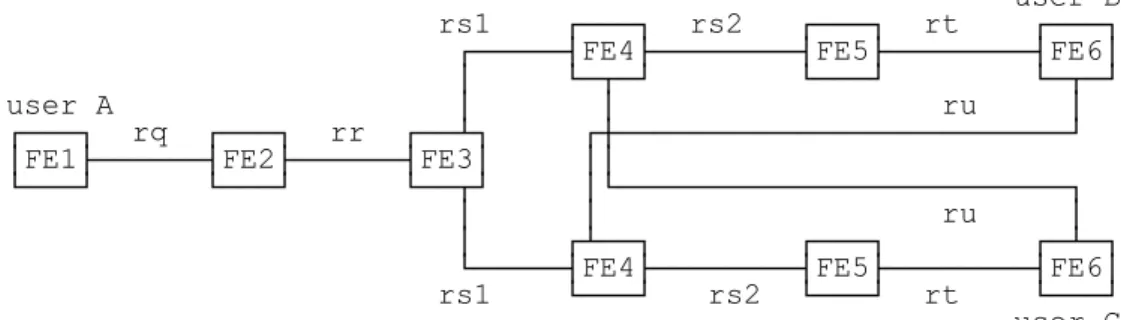
The functional model for the ECT supplementary service is shown in figure 1.
user B rs1 ÚÄÄÄ¿ rs2 ÚÄÄÄ¿ rt ÚÄÄÄ¿ ÚÄÄÄÄÄ´FE4ÃÄÄÄÄÄÄÄÄ´FE5ÃÄÄÄÄÄÄÄÄ´FE6³ ³ ÀÄÂÄÙ ÀÄÄÄÙ ÀÄÂÄÙ user A ³ ³ ru ³ ÚÄÄÄ¿ rq ÚÄÄÄ¿ rr ÚÄÄÁ¿ ÚÅÄÄÄÄÄÄÄÄÄÄÄÄÄÄÄÄÄÄÄÄÄÄÄÄÄÙ ³FE1ÃÄÄÄÄÄÄ´FE2ÃÄÄÄÄÄÄ´FE3³ ³³ ÀÄÄÄÙ ÀÄÄÄÙ ÀÄÄÂÙ ³ÀÄÄÄÄÄÄÄÄÄÄÄÄÄÄÄÄÄÄÄÄÄÄÄÄÄ¿ ³ ³ ru ³ ³ ÚÁÄÄ¿ ÚÄÄÄ¿ ÚÄÁÄ¿ ÀÄÄÄÄÄ´FE4ÃÄÄÄÄÄÄÄÄ´FE5ÃÄÄÄÄÄÄÄÄ´FE6³ rs1 ÀÄÄÄÙ rs2 ÀÄÄÄÙ rt ÀÄÄÄÙ user C
Figure 1: Functional model for the ECT supplementary service 6.2 Description of the FEs
The FEs required by the ECT supplementary service in addition to those of basic call are as follows:
FE1: Transfer invoke entity;
FE2: Transfer validate entity;
FE3: Transfer execute entity;
FE4: Transfer screen entity;
FE5: Transfer complete receive entity;
6.3 Relationship with a basic service
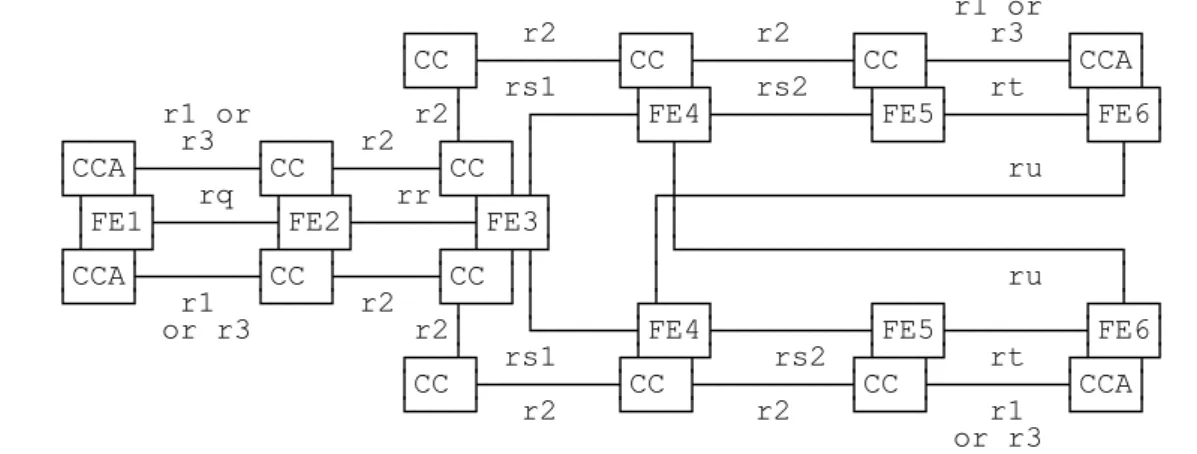
The relationship with a basic service is as shown in figure 2.
NOTE: The basic call model is defined in CCITT Recommendation Q.71 [4], § 2.1, with the exception that r1 represents an outgoing call relationship from a Call Control Agent (CCA) and r3 represents an incoming call relationship to a CCA.
r1 or ÚÄÄÄ¿ r2 ÚÄÄÄ¿ r2 ÚÄÄÄ¿ r3 ÚÄÄÄ¿ ³CC ÃÄÄÄÄÄÄÄ´CC ÃÄÄÄÄÄÄÄÄ´CC ÃÄÄÄÄÄÄÄ´CCA³ ÀÄÄÂÙ rs1 ÀÂÄÄÁ¿ rs2 ÀÂÄÄÁ¿ rt ÀÂÄÄÁ¿ r1 or r2³ ÚÄÄÄÄÄ´FE4ÃÄÄÄÄÄÄÄÄ´FE5ÃÄÄÄÄÄÄÄ´FE6³ ÚÄÄÄ¿ r3 ÚÄÄÄ¿ r2 ÚÁÄÄ¿³ ÀÄÂÄÙ ÀÄÄÄÙ ÀÄÂÄÙ ³CCAÃÄÄÄÄÄÄ´CC ÃÄÄÄÄÄ´CC ³³ ³ ru ³ ÀÂÄÄÁ¿ rq ÀÂÄÄÁ¿ rrÀÄÂÄÁÁ¿ ÚÅÄÄÄÄÄÄÄÄÄÄÄÄÄÄÄÄÄÄÄÄÄÄÄÄÙ ³FE1ÃÄÄÄÄÄÄ´FE2ÃÄÄÄÄÄÄ´FE3³ ³³ ÚÁÄÄÂÙ ÚÁÄÄÂÙ ÚÄÁÄÂÂÙ ³ÀÄÄÄÄÄÄÄÄÄÄÄÄÄÄÄÄÄÄÄÄÄÄÄÄ¿ ³CCAÃÄÄÄÄÄÄ´CC ÃÄÄÄÄÄ´CC ³³ ³ ru ³ ÀÄÄÄÙ r1 ÀÄÄÄÙ r2 ÀÂÄÄÙ³ ÚÁÄÄ¿ ÚÄÄÄ¿ ÚÄÁÄ¿ or r3 r2³ ÀÄÄÄÄÄ´FE4ÃÄÄÄÄÄÄÄÄ´FE5ÃÄÄÄÄÄÄÄ´FE6³ ÚÄÄÁ¿ rs1 ÚÁÄÄÂÙ rs2 ÚÁÄÄÂÙ rt ÚÁÄÄÂÙ ³CC ÃÄÄÄÄÄÄÄ´CC ÃÄÄÄÄÄÄÄÄ´CC ÃÄÄÄÄÄÄÄ´CCA³ ÀÄÄÄÙ r2 ÀÄÄÄÙ r2 ÀÄÄÄÙ r1 ÀÄÄÄÙ or r3
Figure 2: Relationship to basic call
7
Information flows
7.1 Information flow diagrams
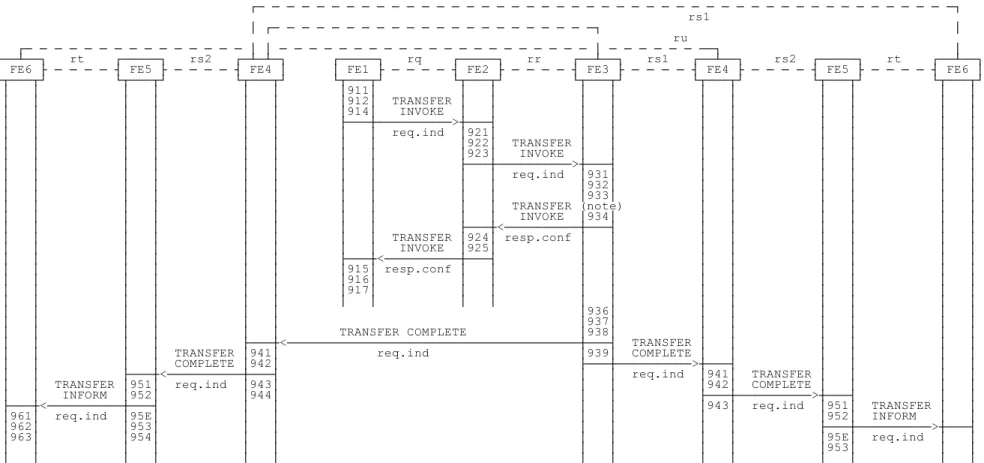
The information flow diagrams assume the existence of a primary call and a secondary call and that both calls are maintained until the completion of the transfer. Clearing of the primary and secondary calls with respect to the served user is not shown as this uses basic call information flows only. Similarly any information flows concerned with holding and retrieving the primary and secondary calls are outside the scope of this ETS.
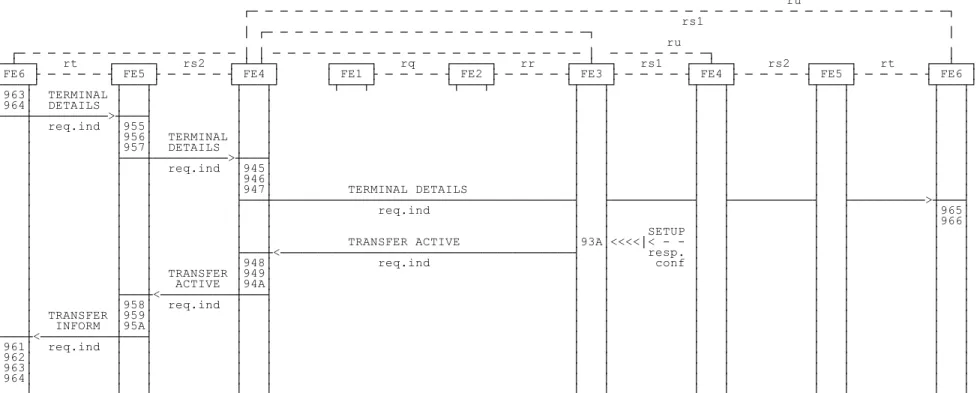
The TERMINAL DETAILS information flow may occur between both FE6s. Where there is no information to be sent at all, the information flow is not present in either direction. The information flow is only shown in one direction in figure 3 for reasons of clarity.
The TRANSFER ACTIVE information flow will only occur in the case of an alerting transfer where the alerting user subsequently answers. In such a case, a TERMINAL DETAILS information flow from user B's FE6 may also occur as a result of receiving the second TRANSFER INFORM indication.
Page 11 ETS 300 368: May 1995
ru
ÚÄ Ä Ä Ä Ä Ä Ä Ä Ä Ä Ä Ä Ä Ä Ä Ä Ä Ä Ä Ä Ä Ä Ä Ä Ä Ä Ä Ä Ä Ä Ä Ä Ä Ä Ä Ä Ä Ä Ä Ä Ä Ä Ä Ä Ä Ä Ä¿ rs1
³ ÚÄ Ä Ä Ä Ä Ä Ä Ä Ä Ä Ä Ä Ä Ä Ä Ä Ä Ä Ä Ä Ä Ä¿ ³ ru
ÚÄ Ä Ä Ä Ä Ä Ä Ä Ä Ä Ä Ä Ä Ä Ä ³ ³ Ä Ä Ä Ä Ä Ä Ä Ä Ä Ä Ä Ä Ä Ä Ä Ä Ä Ä Ä Ä Ä ³ Ä Ä Ä Ä Ä Ä ÄÄ¿ ³ ÚÄÄÁÄÄ¿ rt ÚÄÄÄÄÄ¿ rs2 ÚÄÁÄÁÄ¿ ÚÄÄÄÄÄ¿ rq ÚÄÄÄÄÄ¿ rr ÚÄÄÁÄÄ¿ rs1 ÚÄÄÁÄÄ¿ rs2 ÚÄÄÄÄÄ¿ rt ÚÄÄÁÄÄ¿ ³ FE6 Ã Ä Ä Ä Ä ´ FE5 Ã Ä Ä Ä Ä ´ FE4 ³ ³ FE1 Ã Ä Ä Ä Ä ´ FE2 Ã Ä Ä Ä Ä ´ FE3 Ã Ä Ä Ä Ä ´ FE4 Ã Ä Ä Ä Ä ´ FE5 Ã Ä Ä Ä Ä ´ FE6 ³ ÀÂÄÄÄÂÙ ÀÂÄÄÄÂÙ ÀÂÄÄÄÂÙ ÀÂÄÄÄÂÙ ÀÂÄÄÄÂÙ ÀÂÄÄÄÂÙ ÀÂÄÄÄÂÙ ÀÂÄÄÄÂÙ ÀÂÄÄÄÂÙ ³ ³ ³ ³ ³ ³ ³911³ ³ ³ ³ ³ ³ ³ ³ ³ ³ ³ ³ ³ ³ ³ ³ ³ ³912³ TRANSFER ³ ³ ³ ³ ³ ³ ³ ³ ³ ³ ³ ³ ³ ³ ³ ³ ³914³ INVOKE ³ ³ ³ ³ ³ ³ ³ ³ ³ ³ ³ ³ ³ ³ ³ ³ ÃÄÄÄÅÄÄÄÄÄÄÄÄÄÄ>ÅÄÄÄ´ ³ ³ ³ ³ ³ ³ ³ ³ ³ ³ ³ ³ ³ ³ ³ ³ req.ind ³921³ ³ ³ ³ ³ ³ ³ ³ ³ ³ ³ ³ ³ ³ ³ ³ ³ ³922³ TRANSFER ³ ³ ³ ³ ³ ³ ³ ³ ³ ³ ³ ³ ³ ³ ³ ³ ³923³ INVOKE ³ ³ ³ ³ ³ ³ ³ ³ ³ ³ ³ ³ ³ ³ ³ ³ ÃÄÄÄÅÄÄÄÄÄÄÄÄÄÄ>ÅÄÄÄ´ ³ ³ ³ ³ ³ ³ ³ ³ ³ ³ ³ ³ ³ ³ ³ ³ req.ind ³931³ ³ ³ ³ ³ ³ ³ ³ ³ ³ ³ ³ ³ ³ ³ ³ ³ ³932³ ³ ³ ³ ³ ³ ³ ³ ³ ³ ³ ³ ³ ³ ³ ³ ³ ³933³ ³ ³ ³ ³ ³ ³ ³ ³ ³ ³ ³ ³ ³ ³ ³ ³ TRANSFER (note) ³ ³ ³ ³ ³ ³ ³ ³ ³ ³ ³ ³ ³ ³ ³ ³ INVOKE ³934³ ³ ³ ³ ³ ³ ³ ³ ³ ³ ³ ³ ³ ³ ³ ÃÄÄÄÅ<ÄÄÄÄÄÄÄÄÄÄÅÄÄÄ´ ³ ³ ³ ³ ³ ³ ³ ³ ³ ³ ³ ³ ³ ³ TRANSFER ³924³ resp.conf ³ ³ ³ ³ ³ ³ ³ ³ ³ ³ ³ ³ ³ ³ ³ ³ INVOKE ³925³ ³ ³ ³ ³ ³ ³ ³ ³ ³ ³ ³ ³ ³ ³ ÃÄÄÄÅ<ÄÄÄÄÄÄÄÄÄÄÅÄÄÄ´ ³ ³ ³ ³ ³ ³ ³ ³ ³ ³ ³ ³ ³ ³ ³915³ resp.conf ³ ³ ³ ³ ³ ³ ³ ³ ³ ³ ³ ³ ³ ³ ³ ³ ³916³ ³ ³ ³ ³ ³ ³ ³ ³ ³ ³ ³ ³ ³ ³ ³ ³ ³917³ ³ ³ ³ ³ ³ ³ ³ ³ ³ ³ ³ ³ ³ ³ ³ ³ ³ ³ ³ ³ ³ ³ ³ ³ ³ ³ ³ ³ ³ ³ ³ ³ ³ ³ ³936³ ³ ³ ³ ³ ³ ³ ³ ³ ³ ³ ³ ³ ³937³ ³ ³ ³ ³ ³ ³ ³ ³ ³ ³ ³ ³ TRANSFER COMPLETE ³938³ ³ ³ ³ ³ ³ ³ ³ ³ ³ ³ ÃÄÄÄÅ<ÄÄÄÄÄÄÄÄÄÄÄÄÄÄÄÄÄÄÄÄÄÄÄÄÄÄÄÄÄÄÄÄÄÄÄÄÄÄÄÅÄÄÄ´ TRANSFER ³ ³ ³ ³ ³ ³ ³ ³ ³ ³ TRANSFER ³941³ req.ind ³939³ COMPLETE ³ ³ ³ ³ ³ ³ ³ ³ ³ ³ COMPLETE ³942³ ÃÄÄÄÅÄÄÄÄÄÄÄÄÄÄ>ÅÄÄÄ´ ³ ³ ³ ³ ³ ³ ÃÄÄÄÅ<ÄÄÄÄÄÄÄÄÄÄÅÄÄÄ´ ³ ³ req.ind ³941³ TRANSFER ³ ³ ³ ³ ³ ³ TRANSFER ³951³ req.ind ³943³ ³ ³ ³942³ COMPLETE ³ ³ ³ ³ ³ ³ INFORM ³952³ ³944³ ³ ³ ÃÄÄÄÅÄÄÄÄÄÄÄÄÄÄ>ÅÄÄÄ´ ³ ³ ÃÄÄÄÅ<ÄÄÄÄÄÄÄÄÄÄÅÄÄÄ´ ³ ³ ³ ³ ³943³ req.ind ³951³ TRANSFER ³ ³ ³961³ req.ind ³95E³ ³ ³ ³ ³ ³ ³ ³952³ INFORM ³ ³ ³962³ ³953³ ³ ³ ³ ³ ³ ³ ÃÄÄÄÅÄÄÄÄÄÄÄÄÄÄ>ÅÄÄÄ´ ³963³ ³954³ ³ ³ ³ ³ ³ ³ ³95E³ req.ind ³ ³ ³ ³ ³ ³ ³ ³ ³ ³ ³ ³ ³953³ ³ ³ ³ ³ ³ ³ ³ ³ ³ ³ ³ ³ ³ ³ ³ ³
NOTE: If the optional procedures for preventing loops are provided, the information flow shown in figure 4 occurs at this point, before proceeding with the rest of the information flow shown in this figure.
ru
ÚÄ Ä Ä Ä Ä Ä Ä Ä Ä Ä Ä Ä Ä Ä Ä Ä Ä Ä Ä Ä Ä Ä Ä Ä Ä Ä Ä Ä Ä Ä Ä Ä Ä Ä Ä Ä Ä Ä Ä Ä Ä Ä Ä Ä Ä Ä Ä¿ rs1
³ ÚÄ Ä Ä Ä Ä Ä Ä Ä Ä Ä Ä Ä Ä Ä Ä Ä Ä Ä Ä Ä Ä Ä¿ ³ ru
ÚÄ Ä Ä Ä Ä Ä Ä Ä Ä Ä Ä Ä Ä Ä Ä ³ ³ Ä Ä Ä Ä Ä Ä Ä Ä Ä Ä Ä Ä Ä Ä Ä Ä Ä Ä Ä Ä Ä ³ Ä Ä Ä Ä Ä Ä Ä¿ ³ ÚÄÄÁÄÄ¿ rt ÚÄÄÄÄÄ¿ rs2 ÚÄÁÄÁÄ¿ ÚÄÄÄÄÄ¿ rq ÚÄÄÄÄÄ¿ rr ÚÄÄÁÄÄ¿ rs1 ÚÄÄÁÄÄ¿ rs2 ÚÄÄÄÄÄ¿ rt ÚÄÄÁÄÄ¿ ³ FE6 Ã Ä Ä Ä Ä ´ FE5 Ã Ä Ä Ä Ä ´ FE4 ³ ³ FE1 Ã Ä Ä Ä Ä ´ FE2 Ã Ä Ä Ä Ä ´ FE3 Ã Ä Ä Ä Ä ´ FE4 Ã Ä Ä Ä Ä ´ FE5 Ã Ä Ä Ä Ä ´ FE6 ³ ÀÂÄÄÄÂÙ ÀÂÄÄÄÂÙ ÀÂÄÄÄÂÙ ÀÂÄÄÄÂÙ ÀÂÄÄÄÂÙ ÀÂÄÄÄÂÙ ÀÂÄÄÄÂÙ ÀÂÄÄÄÂÙ ÀÂÄÄÄÂÙ ³963³ TERMINAL ³ ³ ³ ³ ³ ³ ³ ³ ³ ³ ³ ³ ³964³ DETAILS ³ ³ ³ ³ ³ ³ ³ ³ ³ ³ ³ ³ ÃÄÄÄÅÄÄÄÄÄÄÄÄÄÄ>ÅÄÄÄ´ ³ ³ ³ ³ ³ ³ ³ ³ ³ ³ ³ ³ req.ind ³955³ ³ ³ ³ ³ ³ ³ ³ ³ ³ ³ ³ ³ ³956³ TERMINAL ³ ³ ³ ³ ³ ³ ³ ³ ³ ³ ³ ³ ³957³ DETAILS ³ ³ ³ ³ ³ ³ ³ ³ ³ ³ ³ ³ ÃÄÄÄÅÄÄÄÄÄÄÄÄÄÄ>ÅÄÄÄ´ ³ ³ ³ ³ ³ ³ ³ ³ ³ ³ ³ ³ req.ind ³945³ ³ ³ ³ ³ ³ ³ ³ ³ ³ ³ ³ ³ ³946³ ³ ³ ³ ³ ³ ³ ³ ³ ³ ³ ³ ³ ³947³ TERMINAL DETAILS ³ ³ ³ ³ ³ ³ ³ ³ ³ ³ ³ ³ ÃÄÄÄÅÄÄÄÄÄÄÄÄÄÄÄÄÄÄÄÄÄÄÄÄÄÄÄÄÄÄÄÄÄÄÄÄÄÄÄÄÄÄÄÄ´ ÃÄÄÄÄÄÄÄÄÄÄÄ´ ÃÄÄÄÄÄÄÄÄÄÄÄ´ ÃÄÄÄÄÄÄÄÄÄÄ>ÅÄÄÄ´ ³ ³ ³ ³ ³ ³ req.ind ³ ³ ³ ³ ³ ³ ³965³ ³ ³ ³ ³ ³ ³ ³ ³ ³ ³ ³ ³ ³966³ ³ ³ ³ ³ ³ ³ ³ ³ SETUP ³ ³ ³ ³ ³ ³ ³ ³ ³ ³ ³ ³ TRANSFER ACTIVE ³93A³<<<<³< - - ³ ³ ³ ³ ³ ³ ³ ³ ³ ³ ÃÄÄÄÅ<ÄÄÄÄÄÄÄÄÄÄÄÄÄÄÄÄÄÄÄÄÄÄÄÄÄÄÄÄÄÄÄÄÄÄÄÄÄÄÄ´ ³ resp. ³ ³ ³ ³ ³ ³ ³ ³ ³ ³ ³948³ req.ind ³ ³ conf ³ ³ ³ ³ ³ ³ ³ ³ ³ ³ TRANSFER ³949³ ³ ³ ³ ³ ³ ³ ³ ³ ³ ³ ³ ³ ACTIVE ³94A³ ³ ³ ³ ³ ³ ³ ³ ³ ³ ³ ÃÄÄÄÅ<ÄÄÄÄÄÄÄÄÄÄÅÄÄÄ´ ³ ³ ³ ³ ³ ³ ³ ³ ³ ³ ³958³ req.ind ³ ³ ³ ³ ³ ³ ³ ³ ³ ³ ³ ³ TRANSFER ³959³ ³ ³ ³ ³ ³ ³ ³ ³ ³ ³ ³ ³ INFORM ³95A³ ³ ³ ³ ³ ³ ³ ³ ³ ³ ³ ÃÄÄÄÅ<ÄÄÄÄÄÄÄÄÄÄÅÄÄÄ´ ³ ³ ³ ³ ³ ³ ³ ³ ³ ³ ³961³ req.ind ³ ³ ³ ³ ³ ³ ³ ³ ³ ³ ³ ³ ³962³ ³ ³ ³ ³ ³ ³ ³ ³ ³ ³ ³ ³ ³963³ ³ ³ ³ ³ ³ ³ ³ ³ ³ ³ ³ ³ ³964³ ³ ³ ³ ³ ³ ³ ³ ³ ³ ³ ³ ³ ³ ³ ³ ³ ³ ³ ³ ³ ³ ³ ³ ³ ³ ³
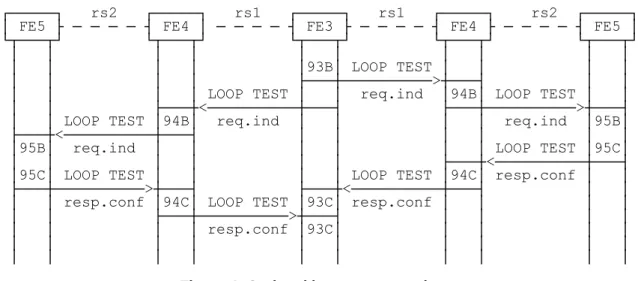
Page 13 ETS 300 368: May 1995 Figure 4 shows the optional procedure for preventing loops.
ÚÄÄÄÄÄ¿ rs2 ÚÄÄÄÄÄ¿ rs1 ÚÄÄÄÄÄ¿ rs1 ÚÄÄÄÄÄ¿ rs2 ÚÄÄÄÄÄ¿ ³ FE5 Ã Ä Ä Ä Ä ´ FE4 ³ Ä Ä Ä Ä ´ FE3 Ã Ä Ä Ä Ä ´ FE4 Ã Ä Ä Ä Ä ´ FE5 ³ ÀÂÄÄÄÂÙ ÀÂÄÄÄÂÙ ÀÂÄÄÄÂÙ ÀÂÄÄÄÂÙ ÀÂÄÄÄÂÙ ³ ³ ³ ³ ³ ³ ³ ³ ³ ³ ³ ³ ³ ³ ³93B³ LOOP TEST ³ ³ ³ ³ ³ ³ ³ ³ ÃÄÄÄÅÄÄÄÄÄÄÄÄÄÄ>ÅÄÄÄ´ ³ ³ ³ ³ ³ ³ LOOP TEST ³ ³ req.ind ³94B³ LOOP TEST ³ ³ ³ ³ ÃÄÄÄÅ<ÄÄÄÄÄÄÄÄÄÄÅÄÄÄ´ ÃÄÄÄÅÄÄÄÄÄÄÄÄÄÄ>ÅÄÄÄ´ ³ ³ LOOP TEST ³94B³ req.ind ³ ³ ³ ³ req.ind ³95B³ ÃÄÄÄÅ<ÄÄÄÄÄÄÄÄÄÄÅÄÄÄ´ ³ ³ ³ ³ ³ ³ ³95B³ req.ind ³ ³ ³ ³ ³ ³ LOOP TEST ³95C³ ³ ³ ³ ³ ³ ³ ÃÄÄÄÅ<ÄÄÄÄÄÄÄÄÄÄÅÄÄÄ´ ³95C³ LOOP TEST ³ ³ ³ ³ LOOP TEST ³94C³ resp.conf ³ ³ ÃÄÄÄÅÄÄÄÄÄÄÄÄÄÄ>ÅÄÄÄ´ ÃÄÄÄÅ<ÄÄÄÄÄÄÄÄÄÄÅÄÄÄ´ ³ ³ ³ ³ resp.conf ³94C³ LOOP TEST ³93C³ resp.conf ³ ³ ³ ³ ³ ³ ÃÄÄÄÅÄÄÄÄÄÄÄÄÄÄ>ÅÄÄÄ´ ³ ³ ³ ³ ³ ³ ³ ³ resp.conf ³93C³ ³ ³ ³ ³ ³ ³ ³ ³ ³ ³ ³ ³ ³ ³ ³ ³ ³ ³ ³ ³ ³ ³ ³ ³
Figure 4: Optional loop test procedure 7.2 Definition of the individual information flows
7.2.1 Relationship rq
7.2.1.1 Contents of TRANSFER INVOKE
This confirmed information flow initiates a transfer. It contains the identities of the calls involving user B and user C.
The contents of the TRANSFER INVOKE req.ind and TRANSFER INVOKE resp.conf information flows are shown in table 2.
Table 2: TRANSFER INVOKE
Name req.ind resp.conf
Call identities M
-Transfer result - M
7.2.2 Relationship rr
7.2.2.1 Contents of TRANSFER INVOKE
This confirmed information flow requests execution of a transfer. It contains the identities of the calls involving user B and user C.
The contents of the TRANSFER INVOKE req.ind and TRANSFER INVOKE resp.conf information flows are shown in table 3.
Table 3: TRANSFER INVOKE
Name req.ind resp.conf
Call identities M
7.2.3 Relationship rs1
7.2.3.1 Contents of TRANSFER COMPLETE
This unconfirmed information flow indicates that a transfer has been effected.
The contents of the TRANSFER COMPLETE req.ind information flow are shown in table 4. Table 4: TRANSFER COMPLETE
Name req.ind
Transferred number O (note 1)
Alerting indication O (note 2)
NOTE 1: Mandatory if known.
NOTE 2: Mandatory if the other user is being alerted.
7.2.3.2 Contents of TRANSFER ACTIVE
This unconfirmed information flow indicates that answer has taken place subsequent to an alerting transfer. The contents are the same as those of a basic call SETUP resp.conf.
7.2.3.3 Contents of LOOP TEST
This confirmed information flow indicates that a loop test has been invoked.
There are no contents of the LOOP TEST req.ind or LOOP TEST resp.conf information flows. 7.2.3.4 Contents of LOOP TEST REJECT
This unconfirmed information flow indicates that a loop test has failed.
The contents of the LOOP TEST REJECT req.ind information flow is shown in table 5. Table 5: Contents of LOOP TEST REJECT
Name req.ind
Reason M
7.2.4 Relationship rs2
7.2.4.1 Contents of TRANSFER COMPLETE
This unconfirmed information flow indicates that a transfer has been effected.
Page 15 ETS 300 368: May 1995 Table 6: TRANSFER COMPLETE
Name req.ind
Transferred number O (note 1)
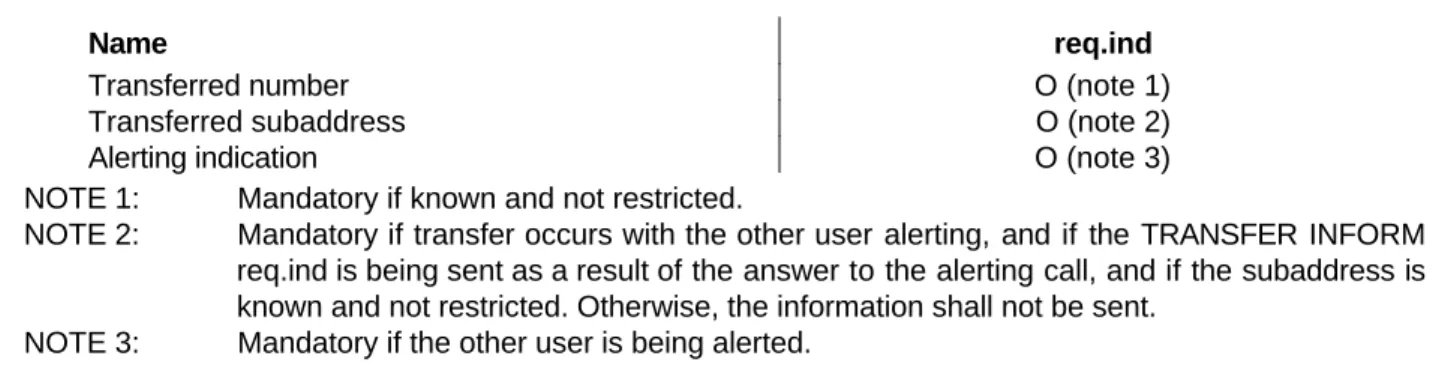
Transferred subaddress O (note 2)
Alerting indication O (note 3)
NOTE 1: Mandatory if known and not restricted.
NOTE 2: Mandatory if transfer occurs with the other user alerting, and if the TRANSFER INFORM req.ind is being sent as a result of the answer to the alerting call, and if the subaddress is known and not restricted. Otherwise, the information shall not be sent.
NOTE 3: Mandatory if the other user is being alerted.
7.2.4.2 Contents of TRANSFER ACTIVE
This unconfirmed information flow indicates that answer has taken place subsequent to an alerting transfer. The contents are the same as those of a basic call SETUP resp.conf.
7.2.4.3 Contents of TERMINAL DETAILS
This unconfirmed information flow informs users of any subaddress associated with the other user involved in the transfer.
The contents of the TERMINAL DETAILS req.ind information flow are shown in table 7. Table 7: TERMINAL DETAILS
Name req.ind
Transferred subaddress M
7.2.4.4 Contents of LOOP TEST
This confirmed information flow indicates that a loop test has been invoked.
There are no contents of the LOOP TEST req.ind or LOOP TEST resp.conf information flows. 7.2.4.5 Contents of LOOP TEST REJECT
This unconfirmed information flow indicates that a loop test has failed.
The contents of the LOOP TEST REJECT req.ind information flow are shown in table 8. Table 8: Contents of LOOP TEST REJECT
Name req.ind
7.2.5 Relationship rt
7.2.5.1 Contents of TRANSFER INFORM
This unconfirmed information flow informs users of the successful completion of a call transfer, and the identity of the other user.
The contents of the TRANSFER INFORM req.ind information flow are shown in table 9. Table 9: TRANSFER INFORM
Name req.ind
Transferred number O (note 1)
Alerting indication O (note 2)
NOTE 1: Mandatory if known and not restricted. NOTE 2: Mandatory if the other user is being alerted.
7.2.5.2 Contents of TERMINAL DETAILS
This unconfirmed information flow informs users of any subaddress associated with the other user involved in the transfer.
The contents of the TERMINAL DETAILS req.ind information flow are shown in table 10. Table 10: TERMINAL DETAILS
Name req.ind
Transferred subaddress M
7.2.6 Relationship ru
7.2.6.1 Contents of TERMINAL DETAILS
This unconfirmed information flow informs users of any subaddress associated with the other user involved in the transfer.
The contents of the TERMINAL DETAILS req.ind information flow are shown in table 11. Table 11: TERMINAL DETAILS
Name req.ind
Transferred subaddress M
8
SDL diagrams for FEs
The Specification and Description Language (SDL) diagrams are provided according to CCITT Recommendation Z.100 [5].
Page 17 ETS 300 368: May 1995
8.1 FE1
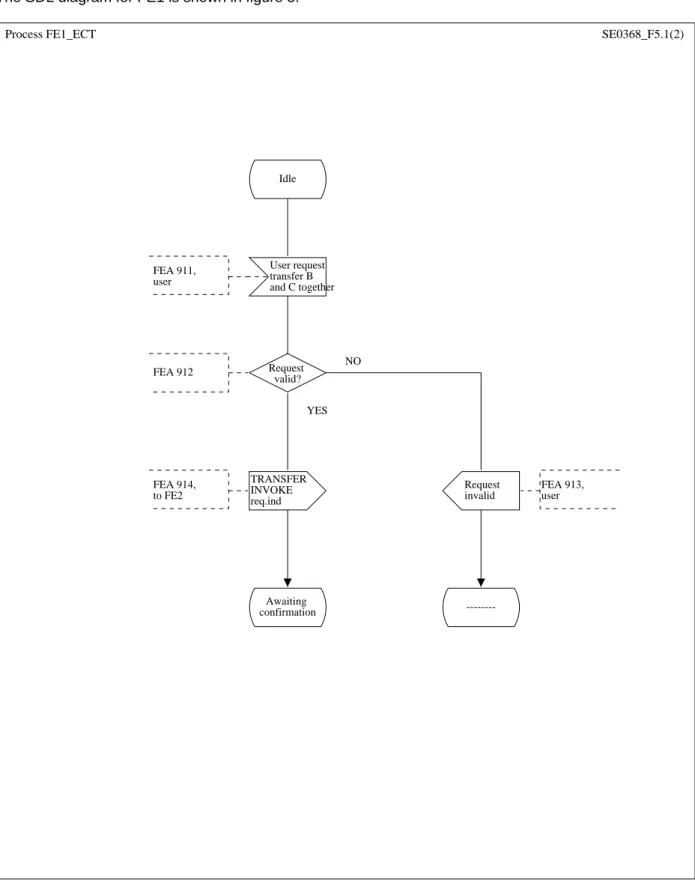
The SDL diagram for FE1 is shown in figure 5.
Process FE1_ECT SE0368_F5.1(2)
Idle
User request transfer B and C together FEA 911,
user
Request valid? FEA 912
Request invalid
FEA 913, user
---TRANSFER
INVOKE req.ind FEA 914,
to FE2
Awaiting confirmation
NO YES
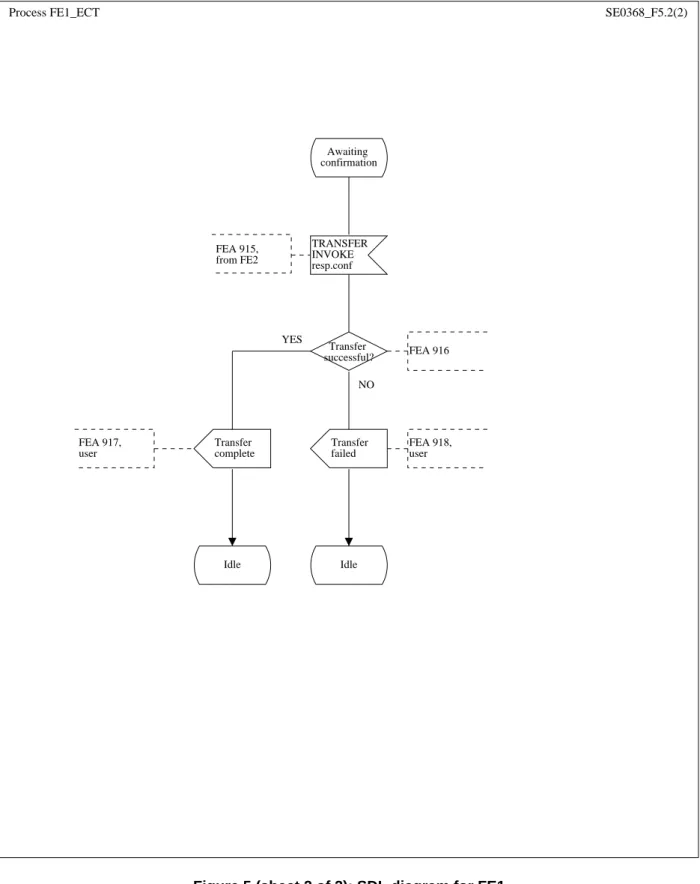
Process FE1_ECT SE0368_F5.2(2)
Awaiting confirmation
TRANSFER INVOKE resp.conf FEA 915,
from FE2
Transfer
successful? FEA 916
Transfer complete FEA 917,
user
Idle
Transfer failed
FEA 918, user
Idle YES
NO
Page 19 ETS 300 368: May 1995
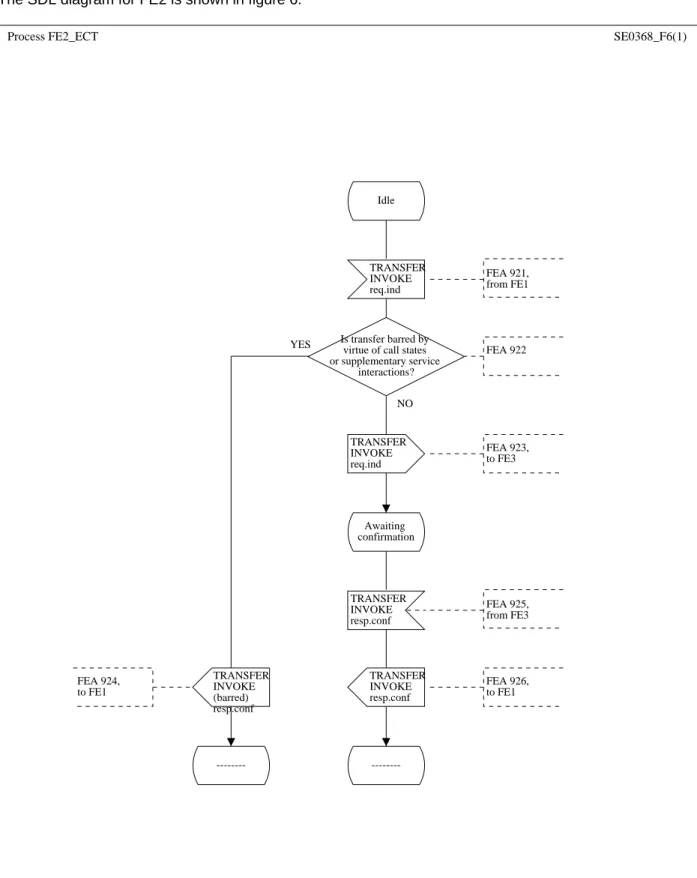
8.2 FE2
The SDL diagram for FE2 is shown in figure 6.
Process FE2_ECT SE0368_F6(1)
Idle
TRANSFER INVOKE req.ind
FEA 921, from FE1 Is transfer barred by
virtue of call states or supplementary service
interactions?
TRANSFER INVOKE (barred) resp.conf
---FEA 924,
to FE1
FEA 922
TRANSFER INVOKE req.ind
FEA 923, to FE3
Awaiting confirmation TRANSFER INVOKE resp.conf
FEA 925, from FE3 TRANSFER
INVOKE resp.conf
FEA 926, to FE1
---YES
NO
8.3 FE3
The SDL diagram for FE3 is shown in figure 7.
Process FE3_ECT SE0368_F7.1(2)
NOTE:For example, may be for operational reasons, or because CUG restrictions have been infringed.
Idle TRANSFER INVOKE req.ind FEA 931, from FE2 Identify primary and secondary calls FEA 932 Transfer request unacceptable? (NOTE) FEA 933 Loop prevention procedure? Loop Test ---TRANSFER INVOKE (accept) resp.conf FEA 934, to FE2
Connect call paths between user B and
user C together FEA 936
Clear call paths to user A FEA 937
TRANSFER COMPLETE req.ind FEA 938,
to B’s FE4
TRANSFER COMPLETE req.ind Is user C being alerted?
Wait transfer
active ---FEA 939,
to C’s FE4 TRANSFER INVOKE (reject) resp.conf FEA 935, to FE2 ---NO YES failure success YES NO NO YES
Page 21 ETS 300 368: May 1995
Process FE3_ECT SE0368_F7.2(2)
Wait transfer active
Transfer active indication
FEA 93A, from co-located CC
TRANSFER ACTIVE req.ind
Idle
FEA 93A, to B’s FE4
Macro Loop_Test SE0368_F7.3(2)
Loop Test
LOOP TEST req.ind
FEA 93B, to B’s FE4
LOOP TEST req.ind
FEA 93B, to C’s FE4
SET (NOW+ Loop,TLoop)
Test in progress
Page 23 ETS 300 368: May 1995
Macro Loop_Test SE0368_F7.4(2)
Test in progress LOOP TEST req.ind TRANSFER INVOKE (reject) resp.conf RESET (TLoop) failure FEA 93C FEA 935, to FE2 FEA 93C, from B’s or C’s FE4
LOOP TEST resp.conf RESET (TLoop) success FEA 93C FEA 93C, from B’s or C’s FE4
TLoop Reason? FEA 93C TRANSFER INVOKE (reject) resp.conf failure FEA 935, to FE2 Implementation option? success FEA 93C LOOP TEST REJECT req.ind LOOP TEST REJECT
req.ind received for other call?
RESET (TLoop) FEA 93C ---FEA 93C, from B’s or C’s FE4
"simultaneous transfer" "insufficient information" "proceed with transfer" "reject transfer" YES NO
8.4 FE4
The SDL diagram for FE4 is shown in figure 8.
Process FE4_ECT SE0368_F8.1(3)
Idle
TERMINAL DETAILS req.ind
Transmission of terminal details permitted?
---TERMINAL DETAILS req.ind
FEA 947, to remote FE6
---FEA 945, from local FE5 TRANSFER
COMPLETE req.ind FEA 941,
from FE3
TRANSFER COMPLETE req.ind FEA 942,
to local FE5
Cancel any active user-to-user signalling supplementary service FEA 943
Store call details FEA 944
Other party being alerted?
---Wait transfer
active
NO
YES
NO YES
Page 25 ETS 300 368: May 1995
Process FE4_ECT SE0368_F8.2(3)
Wait transfer active TRANSFER
ACTIVE req.ind FEA 948,
from FE3
Store call details FEA 949
TRANSFER ACTIVE req.ind FEA 94A,
to local FE5
Idle
TERMINAL DETAILS req.ind FEA 945,
from local FE5
Transmission of terminal details permitted? FEA 946
---TERMINAL
DETAILS req.ind
---FEA 947,
to remote FE6
NO YES
Process FE4_ECT SE0368_F8.3(3)
Idle
LOOP TEST reject req.ind
Loop prevention procedure?
---LOOP TEST reject req.ind FEA 94D,
to FE3 FEA 94D, from FE5 LOOP TEST
resp.conf Loop prevention procedure?
---LOOP TEST resp.conf FEA 94C,
to FE3 FEA 94C, from FE5 LOOP TEST
req.ind Loop prevention procedure?
---LOOP TEST req.ind FEA 94B,
to FE5 FEA 94B, from FE3
NO YES
NO YES
NO YES
Page 27 ETS 300 368: May 1995
8.5 FE5
The SDL diagram for FE5 is shown in figure 9.
Process FE5_ECT SE0368_F9.1(3)
Idle TERMINAL DETAILS req.ind Transmission of terminal details permitted? ---FEA 956 TERMINAL DETAILS req.ind FEA 957,
to local FE4
---FEA 955,
from local FE6 TRANSFER COMPLETE req.ind FEA 951, from FE4 TRANSFER INFORM req.ind Cancel any active user-to-user signalling supplementary service
Outstanding notifications FEA 953,
to local FE6
Store call details FEA 954 Other user being alerted? Wait transfer active ---FEA 95E FEA 952, to local FE6
NO YES
YES
NO
Process FE5_ECT SE0368_F9.2(3)
Wait transfer active TRANSFER
ACTIVE req.ind FEA 958,
from FE4
Store call details FEA 959
TRANSFER INFORM req.ind FEA 95A,
to local FE6
Idle
TERMINAL DETAILS req.ind FEA 955,
from local FE6
Transmission of terminal details permitted?
---FEA 956
TERMINAL DETAILS req.ind
---FEA 957,
to local FE4
NO YES
Page 29 ETS 300 368: May 1995
Process FE5_ECT SE0368_F9.3(3)
Idle
LOOP TEST req.ind
FEA 95B, from FE4 Loop
prevention procedure?
---Collocated
FE3 in state "Test in progress"?
LOOP TEST REJECT req.ind
FEA 95D, to FE4
---LOOP TEST
resp.conf FEA 95C,
to FE4
---NO YES
YES NO
8.6 FE6
The SDL diagram for FE6 is shown in figure 10.
Process FE6_ECT SE0368_F10(1)
Idle
TERMINAL DETAILS req.ind
FEA 965, from remote FE4 User indication
further details of other user
---FEA 966, user TRANSFER
INFORM req.ind FEA 961,
from FE5
User indication "transferred" call state and identity FEA 962,
user
Any terminal specific details
to send?
---FEA 963
TERMINAL DETAILS req.ind FEA 964,
to FE5
---NO YES
Page 31 ETS 300 368: May 1995
9
Functional Entity Actions (FEAs)
9.1 FEAs of FE1
911: FE1 receives the request for transfer.
912: FE1 optionally performs local checks with respect to the compatibility of the two calls against information held with the CCAs.
913: If the request is found locally to be invalid, the requesting user is informed that the transfer has failed.
914: If the request is found locally to be valid, FE2 is requested to execute the transfer.
915: FE1 receives the result of the transfer from FE2.
916: FE1 examines the result of the transfer.
917: If the transfer is successful, the requesting user is informed of the successful completion. Optionally the calls involved may be released (if they have not already been cleared by FE2).
918: If the transfer is unsuccessful, the requesting user is informed. 9.2 FEAs of FE2
921: FE2 receives the request for invocation of transfer from FE1.
922: FE2 determines whether the transfer is valid in terms of the two calls to be transferred. Such checks are network specific; when FE2 resides in the public network it shall check that one call is answered and held and that the other call is not held and is answered or alerting (see table 1), that the requesting user is not a conference controller, that the three-party supplementary service has not been invoked by the requesting user, and that closed user group restrictions would not be violated if the transfer were allowed to proceed. Checks performed when FE2 is in another network are outside the scope of this ETS.
923: If the transfer is permitted, a request for transfer is sent to FE3.
924: If the transfer is barred, a response indicating rejection is returned to FE1. 925: The result of the transfer is received from FE3.
926: The result of the transfer is relayed to FE1. 9.3 FEAs of FE3
931: FE3 receives the request for invocation of transfer from FE2. 932: FE3 identifies the primary and secondary calls.
933: FE3 shall verify whether the requested transfer is allowed or e.g. should be registered for operational reasons, or would violate closed user group restrictions if allowed to proceed.
935: If the transfer is barred, a response indicating rejection is returned to FE2. 936: The call paths from user A's exchange toward user B and user C are joined
together.
937: The call paths from user A's exchange toward user A are cleared.
938: Completion of the transfer is indicated to user B's exchange. This includes the identity of user C where known and an indication of whether user C is being alerted.
939: Completion of the transfer is indicated to user C's exchange. This includes the identity of user B where known.
93A: Following an alerting transfer, answer by user C is indicated to user B's FE4 on receipt of the basic call setup confirmation by the Call Control (CC) collocated with FE3.
93B: As a network option, a LOOP TEST req.ind is sent to both FE4s to determine if a loop exists.
93C: As a network option, the results of the loop test are processed. 9.4 FEAs of FE4
941: FE4 receives the indication of transfer completion from FE3. 942: The indication of transfer completion is passed to the local FE5. 943: Any active user-to-user signalling supplementary service is cancelled.
944: Details received in the transfer complete indication relevant to the network are stored.
945: FE4 receives terminal specific details intended for the remote user from the local FE5.
946: FE4 determines whether or not such information transfer is allowed. The
mechanism for deciding upon this (for example a timer or counter) is implementation dependent.
947: If the information can be transferred, it is sent to the remote FE6.
948: FE4 receives the indication that answer has taken place subsequent to an alerting transfer.
949: Details received in the transfer active indication relevant to the network are stored.
94A: The indication that answer has taken place is passed to the local FE5 applying any restriction requirements to identity information, if appropriate.
94B: As a network option, a LOOP TEST req.ind received from FE3 is relayed to FE5.
94C: As a network option, a LOOP TEST resp.conf received from FE5 is relayed to FE3.
94D: As a network option, a LOOP TEST REJECT req.ind received from FE5 is
Page 33 ETS 300 368: May 1995 9.5 FEAs of FE5
951: FE5 receives the indication of transfer completion from FE4. 952: The indication of transfer completion is passed to the local FE6.
953: Any outstanding notifications (for example that the local user is holding) are sent to the remote user.
954: Details received in the transfer complete indication relevant to the network are stored.
955: FE5 receives terminal specific details intended for the remote user from the local FE6.
956: FE4 determines whether or not such information transfer is allowed. The
mechanism for deciding upon this (for example a timer or counter) is implementation dependent.
957: If the information can be transferred, it is relayed to the local FE4.
958: FE5 receives the indication that answer has taken place subsequent to an alerting transfer.
959: Details received in the transfer active indication relevant to the network are stored.
95A: The indication that answer has taken place is passed to the local FE6 applying any restriction requirements to identity information, if appropriate.
95B: As a network option, a LOOP TEST req.ind received from FE4 is processed. 95C: As a network option, if there is no collocated FE3 in state "TEST IN
PROGRESS" for the same call, a LOOP TEST resp.conf is sent to FE4.
95D: As a network option, if there is no collocated FE3 in state "TEST IN PROGRESS" for the same call, a LOOP TEST REJECT req.ind is sent to FE4. 95E: Any active user-to-user signalling supplementary service is cancelled.
9.6 FEAs of FE6
961: FE6 receives the indication that a transfer or answer following an alerting transfer has taken place.
962: The local user is informed of the transfer or the answer and the other details associated with it, such as other party number (if received).
963: FE6 determines whether there is any subaddress to be sent to the other user. 964: If there is a subaddress to be sent, this is indicated to the local FE5.
965: FE6 receives the subaddress associated with the remote terminal. 966: The local user is informed of the other terminal's subaddress.
10
Allocation of FEs to physical locations
The possible physical locations of FEs are shown in table 12.
Table 12: Allocation of functional entities
FE1 FE2 FE3 FE4 FE5 FE6
Scenario 1 (note) A's TE A's LE A's LE B's LE B's LE B's TE
C's LE C's LE C's TE
Scenario 2 (note) A's TE A's LE A's LE B's LE B's PTNX B's TE
C's LE C's LE C's TE
Scenario 3 (note) A's TE A's LE A's LE B's LE B's LE B's TE
C's LE C's PTNX C's TE
Scenario 4 (note) A's TE A's LE A's LE B's LE B's PTNX B's TE
C's LE C's PTNX C's TE
Scenario 5 A's TE A's PTNX PTNX B's LE B's LE B's TE
C's LE C's LE C's TE
Scenario 6 A's TE A's PTNX PTNX B's LE B's PTNX B's TE
C's LE C's LE C's TE
Scenario 7 A's TE A's PTNX PTNX B's LE B's LE B's TE
C's LE C's PTNX C's TE
Scenario 8 A's TE A's PTNX PTNX B's LE B's PTNX B's TE
C's LE C's PTNX C's TE NOTE: FE4 can also be allocated in the gateway of user A's network.
Scenario 1 represents transfer by join either entirely within one public network, or between different public networks.
Scenarios 2, 3 and 4 represent transfer by join where user B, user C, and both user B and user C are in a private network, respectively.
Scenarios 5, 6, 7 and 8 represent transfer (by join or rerouteing) where the transfer is invoked from and controlled within a private network for the cases where both user B and user C, only user C, only user B, and neither user B nor user C are in the public network, respectively. In these scenarios, the Private Telecommunication Network eXchange (PTNX) where the functionality of FE3 is realized may or may not be user A's PTNX and in the case of transfer by rerouteing the functionality may be split across a number of PTNXs.
Scenarios where FE2 and FE3 are not collocated, allowing a private network to invoke the service of the public network, are outside the scope of this ETS.
Page 35 ETS 300 368: May 1995
History
Document history
March 1994 Public Enquiry PE 58: 1994-03-07 to 1994-07-01
March 1995 Vote V 75: 1995-03-06 to 1995-04-28
May 1995 First Edition
February 1996 Converted into Adobe Acrobat Portable Document Format (PDF)
ISBN 2-7437-0137-4 Dépôt légal : Mai 1995