CR
iMTRAC ANNUAL REPOR
T 2013–2014
PART
3:
CORPORA
TE
GOVERNANCE
C O R P O R A T E
G O V E R N A N C E
CR
iMTRAC ANNUAL REPOR
T 2013–2014
PART
3:
CORPORA
TE
GOVERNANCE
PART 3:
CORPORATE GOVERNANCE
Our robust governance and assurance framework ensures transparent, ethical and accountable decision-making and helps to manage risks and partner relations. Effective corporate management helps us achieve our goals.TRANSPARENT,
ETHICAL AND
ACCOUNTABLE
DECISION-MAKING
CR
iMTRAC ANNUAL REPOR
T 2013-2014
PART
3:
CORPORA
TE
CR
iMTRAC ANNUAL REPOR
T 2013–2014
PART
3:
CORPORA
TE
GOVERNANCE
Corporate Governance
Our robust corporate governance and assurance framework provides rigour and discipline to the way we deliver our work. It ensures transparent, ethical and accountable decision-making, and helps us manage risk and our partner relations.
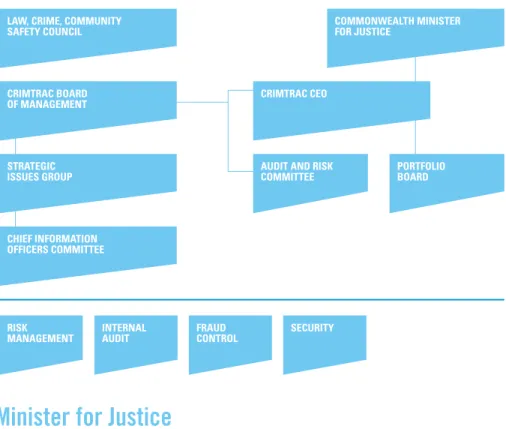
Governance bodies form a key part our assurance processes. They include the CrimTrac Board of Management, our Strategic Issues Group, Chief Information Officers Committee, the Audit and Risk Committee, and Portfolio Board. These committees enable us to work collaboratively with our police partners to ensure we achieve desired outcomes for police.
Governance framework
Figure 3.1: CrimTrac Governance Framework
iMTRAC ANNUAL REPOR
T 2013–2014
PART
3:
CORPORA
TE
GOVERNANCE
Law, Crime and Community Safety Council
The Council of Australian Governments (COAG) meeting on 13 December 2013 decided to amalgamate the former Standing Council on Law and Justice (SCLJ) and the Standing Council on Police and Emergency Management (SCPEM) to form the Law, Crime and Community Safety Council (LCCSC).
The LCCSC considers matters related to law reform, law enforcement and crime reduction, as well as emergency management, including policy, operations and service provision. The LCCSC is responsible for approving our strategic direction and initiatives that require legislation or special funding consideration.
CrimTrac Board of Management
The CrimTrac Inter-Governmental Agreement (IGA) establishes the CrimTrac Board of
Management, which comprises all Australia’s police commissioners, the ACT Chief Police Officer, and a Deputy Secretary of the Commonwealth Attorney-General’s Department.
The Board is responsible for the efficient and effective delivery of the CrimTrac initiative. On 3 July 2013, Commissioner Ian Stewart of the Queensland Police Service succeeded Commissioner Andrew Scipione of the New South Wales Police Force as Chair of the Board. The Board held five meetings during the reporting period: 3 July 2013, 5 September 2013, 28 November 2013, 13 March 2014, and 10 June 2014.
The Board approved the build and implementation of:
• Australian Ballistics Information Network Project (3 July 2013)
• National Automated Fingerprint Identification System Capacity Upgrade Project (3 July 2013).
• National Firearms Interface Project (13 March 2014, subject to LCCSC approved)
• National DNA Investigative Capability Project (13 March 2014)
• Biometric Identification Services initial scoping. This includes the replacement of the National Automated Fingerprint Identification System (10 June 2014)
• a national information capability for long-term missing persons, unidentified human remains and disaster victim identification (10 June 2014).
CR
iMTRAC ANNUAL REPOR
T 2013–2014
PART
3:
CORPORA
TE
GOVERNANCE
Commissioner Ian Stewart APM Queensland Police Service Chair, CrimTrac Board of Management
Commissioner Karl O’Callaghan APM Western Australia Police
Commissioner Gary Burns BM APM South Australia Police Deputy Chair, CrimTrac Board of Management
Commissioner John McRoberts APM Northern Territory Police
Commissioner Andrew Scipione APM New South Wales Police Force
Commissioner Darren Hine APM Tasmania Police
Chief Commissioner Ken Lay APM Victoria Police
Commissioner Tony Negus APM Australian Federal Police
iMTRAC ANNUAL REPOR
T 2013–2014
PART
3:
CORPORA
TE
GOVERNANCE
Strategic Issues Group
Our Strategic Issues Group (SIG) provides strategic, considered and aggregated advice to the Board of Management in relation to national information-sharing solutions.
This advisory function:
• identifies all key operational, technical and financial implications
• identifies and, where possible, eliminates obstacles to successful implementation of our solutions
• ensures appropriate representation for police agencies on CrimTrac program and project boards to align work activities
• contributes to our annual business planning, prioritisation and performance measurement. The SIG comprises representatives at a senior executive level from all Australian police agencies, the Commonwealth Attorney-General’s Department and our Executive. The SIG met four times during the reporting period: 20 August 2013, 12 November 2013, 18 February 2014, and 13 May 2014.
Chief Information Officers' Committee
The Chief Information Officers' Committee (CIOC) was established by the CrimTrac Board of Management through the Strategic Issues Group. It provides ICT leadership, direction and assurance to the Board of Management, through the Strategic Issues Group, for our ICT services and initiatives.
During the reporting period, the CIOC:
• developed Terms of Reference, which were approved by the Board of Management in September 2013
• identified the National Information Exchange Model (NIEM) as a successful international framework by which various government agencies can share data—the NIEM was
subsequently adopted by the Board of Management to support information sharing for the police and wider justice community
• established system availability measures and disaster recovery targets for each of our systems, which were subsequently approved by the Board of Management
• started developing principles to support increased software sharing between police agencies
• provided advice to support the development of the CrimTrac ICT Blueprint for National Police Information Sharing 2014–2018
CR
iMTRAC ANNUAL REPOR
T 2013–2014
PART
3:
CORPORA
TE
GOVERNANCE
Members of the CIOC include the Chief Information Officer (CIO) or Chief Technology Officer from each police agency, as well as the CIO of New Zealand Police and the National Manager of the Australian Crime Commission. The CIOC met four times during the reporting period.
Audit and Risk Committee
The CrimTrac Audit and Risk Committee provides independent assurance and advice on our risk, control and compliance frameworks and financial statement responsibilities. The Committee reports to our CEO and the CrimTrac Board of Management.
The Committee is chaired by an independent member, and consists of three other independent members and one CrimTrac member. The CEO appoints all Committee members, including the Chair. Committee membership includes:
• Mr Will Laurie—Chair (independent member)
• Dr David Lacey—Deputy Chair (independent member)
• Mr Trevor Kennedy—representing the Commonwealth Attorney-General’s Department
• Ms Katherine Van Gurp, Northern Territory Police, Fire and Emergency Services—representing our partner agencies
• Ms Carolyn Nixon, CrimTrac Chief of Staff—representing CrimTrac.
The Australian National Audit Office (ANAO) is also invited to attend each committee meeting. The current ANAO representative is Mr Sean Benfield.
The Committee met quarterly during 2013–14, with an additional meeting in September 2013 to review and recommend the approval of the 2012–13 Financial Statements. The Committee’s key outcomes during the reporting period included reviews of:
• our enterprise risk and control frameworks
• our 2012–13 Financial Statements and Certificate of Compliance
• the performance of our internal audit function, and endorsement of our Internal Audit Strategy 2013–16 and Audit Work Plan
• tabled audit reports and the implementation of recommendations
• updates on business continuity planning and disaster recovery arrangements
iMTRAC ANNUAL REPOR
T 2013–2014
PART
3:
CORPORA
TE
GOVERNANCE
Portfolio Board
The Portfolio Board (PFB) governs and provides strategic oversight of CrimTrac’s portfolio of programs and projects. Its role is to:
• make investment decisions
• ensure that the portfolio of work is in line with strategic and organisational goals
• continually monitor that the work being undertaken remains valid to operational policy. The PFB operates as an internal board with a focus on investment decisions. It is the primary approver for all internal projects. The PFB provides, through the Chief Executive Officer (CEO), recommendations to the SIG and the BoM on external projects.
The PFB is comprised of members of our senior executive, and from relevant directors representing various interests including ICT, legal, finance, business, and strategy. The Portfolio Board had 12 regular meetings plus six out of session meetings throughout the year.
Risk management
We apply an enterprise-wide risk management framework that helps us make informed decisions, while also meeting corporate accountabilities.
The process of identifying, analysing, treating, monitoring and reviewing risks is embedded into all of our functions and contributes directly to achieving our corporate goals.
During the reporting period, we:
• reviewed risk management requirements under the Public Governance, Performance and Accountability Act 2013 (PGPA Act) and developed a capability improvement priority plan to ensure compliance with the PGPA Act
• continued to develop the framework for managing enterprise risk, as well as for specific risk functions, including project management, security, fraud and safety
• tested and confirmed identified enterprise risks and treatments
• delivered training on enterprise risk management to all staff through our annual Corporate Awareness e-learning program
• developed and implemented an Internal Control Framework, which includes mapping CrimTrac’s key controls, control ownership and monitoring activities
• developed and implemented a Security Risk Plan
• conducted a fraud risk assessment, identifying and implementing recommendations for strengthening controls where required.
CR
iMTRAC ANNUAL REPOR
T 2013–2014
PART
3:
CORPORA
TE
GOVERNANCE
Internal Audit
Our internal audit function provides assurance to the CEO and the CrimTrac Board of Management that our financial and operational controls work efficiently and effectively. Our risk-based assurance program has a strong focus on performance audit activity, while providing assurance on key control areas.
This program of work helps us deliver on our strategic objectives and creates an environment of continuous improvement. Activities completed during 2013–14 provided assurance on:
• fraud and information management arrangements
• service delivery within the National Police Checking Service
• the relocation of our secondary data centre
• IT security accreditation
• elements of our disaster recovery arrangements
• information and records management.
We accepted all recommendations made as part of this work, with our Audit and Risk Committee continuing to monitor implementation.
Fraud control
We are committed to implementing and maintaining fraud controls and meeting all reporting and compliance obligations.
• During the reporting period, we finalised our biennial fraud risk assessment and released our Fraud Control Plan 2013–2015, including substantially reviewing and revising our Fraud Control Policy.
We continue to raise awareness of fraud risk and fraud control responsibilities through:
• induction training for new starters
• a dedicated fraud awareness module within the annual Corporate Awareness e-learning program for all staff
• the release of the Fraud Control Plan 2013–15 and the revised Fraud Control Policy.
iMTRAC ANNUAL REPOR
T 2013–2014
PART
3:
CORPORA
TE
GOVERNANCE
Security
Our security function helps us achieve our strategic objectives by providing security services that meet the needs of key stakeholders.
Throughout the reporting period, we assessed and reported compliance against the Protective Security Policy Framework, meeting all 33 mandatory requirements. These include:
• formalising several security policies and procedures
• introducing physical site accreditation
• improving clearance procedures
• assessing against the National eAuthentication Framework (NeAF).
We also finalised accreditation of CrimTrac’s baseline environment against the Australian Government Information Security Manual (ISM). We will now shift our focus to system-level assessments. This activity involves supporting new projects, including the Australian Ballistic Information Network (ABIN) and the Australian Cybercrime Online Reporting Network (ACORN), to ensure they achieve required ISM compliance.
We also made significant progress towards compliance against the Australian Signals Directorate ‘ASD Top 4’.
We strengthened our security assurance capability by completing an extensive Active Vulnerability Assessment (AVA) incorporating public, partner and internal attack vectors. This led to us establishing a penetration testing partner to ensure ongoing and regular testing of high-risk assets.