IBM Center for Applied Insights
Exploring the frontiers of cloud computing
for increased innovation and competitiveness through differentiation at the application level.
impact.
An increasing number of pioneers are seeing the
advantages of PaaS and are blazing the trail with
early adoption. What they’ve done — and where
they plan to go — can provide valuable insight
into what PaaS can do for the business. This
leading group is setting an example worth
emulating for those who seek to improve their
speed to market while reducing risk.
About the study
To understand current attitudes and activity in the Platform-as-a-Service space, IBM surveyed more than 1,500 IT decision makers from 18 countries. We supplemented these responses with qualitative interviews to gain a perspective on the level of adoption and strategic relevance of this form of cloud computing.
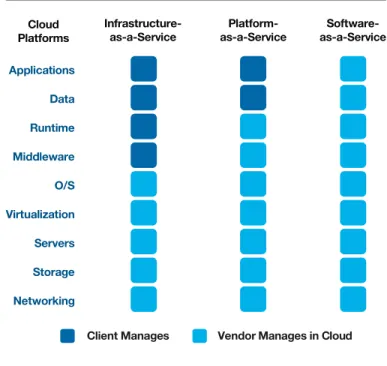
Networking Storage Servers Virtualization O/S Middleware Runtime Data Applications
Cloud Platforms
Infrastructure-as-a-Service as-a-ServicePlatform- as-a-Service
Software-Client Manages Vendor Manages in Cloud
Figure 1: PaaS offers a high degree of standardization at the platform level while still allowing organizations to differentiate via their applications.
IBM Center for Applied Insights 3
Who’s pursuing PaaS — and why
To better understand the actions and attitudes of those at the forefront of PaaS adoption, we ranked survey respondents according to the extent of PaaS adoption within their enterprise and their reported understanding of its strategic relevance to their organization. They were organized in four groups (Figure 2):
• Pioneers have adopted PaaS and see it as a way to drive innovation and improve the entire application lifecycle across the enterprise.
• Experimenters are using PaaS and are taking a pragmatic approach to future expansion.
• Preparers have bought into the idea of PaaS and are preparing to act, but have not done so yet.
• Observers still have to be convinced of the value of PaaS and have elected not to adopt at the moment.
Pioneering enterprises fully understand the PaaS opportunity, embrace the concept and are assertively moving forward with their strategy to integrate it into their operations. They stand out from a larger group of businesses that have adopted a more tentative stance. While some companies are hesitant to trust their mission-critical applications, processes and data to the cloud, Pioneers have gained confidence and are now comfortable using PaaS.
PaaS adoption
Understand the strategic relevance of PaaS
Experimenters
33%
Observers
39%
Pioneers
16%
Preparers
12%
Figure 2: A group of trailblazing companies see and understand the true potential of PaaS.
“…business users see the biggest value [from
PaaS] because they are seeing applications
developed more quickly; they are getting in
front of customers quickly, getting feedback
and driving the pace of innovation… I can’t
express enough how difficult this is to do in a
non-cloud environment.”
—GM, Software Developer, US
Because of their early adopter mentality, Pioneers are
predisposed to leveraging a cloud-based platform in pursuit of business benefit. This propensity appears in their higher usage of both traditional outsourcing and public cloud services. Nearly half of Pioneers said they have used application outsourcing, a rate 70 percent higher than the rest of the respondents combined. Pioneers also use public cloud services for standard and advanced applications at a greater rate: the current and planned usage rate for Pioneers is three times higher for analytics and almost six times greater for public cloud development environments. These numbers show that Pioneers clearly see the benefits of external collaboration with IT vendors.
“PaaS can make the company more nimble and
cost-effective, with consistent performance and
faster roll-outs.”
—VP IT, Utility, US
Reaping the benefits of PaaS
In light of the fact that PaaS is still a relatively new concept, the Pioneers’ actions raise an interesting question: what made them choose to embark on the PaaS journey? Their responses, summarized in Figure 3, are illuminating.
Pioneers stand ready to reap a broad spectrum of benefits, ranging from the most fundamental to the highly strategic. The more strategic the benefit, the greater the distance between the Pioneers and the rest of the respondents. The small differences in the perception of basic benefits are not surprising. These are what cloud computing provides in general and are not specific to PaaS. Any cloud adopter might expect to see gains like continuous application availability and a robust infrastructure that can help bring new applications online more efficiently.
In contrast, the capabilities unique to PaaS, those that specifically strengthen development capabilities, are of particular interest to the Pioneers. For example, they see the
Experimenters + Preparers + Observers Benefits of PaaS
Fundamental Advanced
Rest of Respondents Pioneers Delta
Availability 41% 46% +5%
Simplified & automated 35% 46% +11%
Resiliency 35% 49% +14%
Efficiency 37% 51% +14%
Integrated & optimized 20% 35% +15%
Portability 27% 43% +16%
Standardized & repeatable 24% 41% +17%
Leverage human expertise 29% 45% +16%
Integrate existing & future 26% 47% +21%
Data management integration & analysis 27% 52% +25%
opportunity for preconfiguration and standardization as a great benefit of PaaS and look to repeatable and standardized best practices as a way to achieve it.
Pioneers identify what takes place at the strategic end of the spectrum as the most transformational and meaningful to the business outside of the development context. PaaS enables a shift from development, deployment, production and maintenance as discrete activities to a more holistic endeavor. It’s a change in focus from technical capability to what PaaS allows the organization to do.
IBM Center for Applied Insights 5
Turning challenges into positive change
Overarching concerns such as security and ROI take on unique importance in a cloud environment. Some organizations view them as hurdles. Not so for the Pioneers. While they share the concerns, they address the issues head-on to get at the
opportunities offered by PaaS adoption. They are able to move beyond the challenges and turn their attention to matters of quality, performance and innovation.
Focusing on security
All respondents, including Pioneers, are concerned about security. Across a number of the PaaS services — application platform services, database-as-a-service and integration services — security ranked as one of the top three concerns. To address this issue, the risks and responsibilities surrounding PaaS need to be fully understood and communicated to the rest of the enterprise. PaaS users need to be prepared to handle vendor-facing matters like the delineation of responsibilities and governance and data sovereignty issues. Where will the data be stored? What about tracking its creation and alteration throughout the lifecycle? Who is responsible for secure deletion? What about outages and service interruptions? How is encryption and identity management handled? Addressing these questions before getting involved with a PaaS
implementation can help mitigate security concerns.
“The key concern comes back to security, because
now when you’re actually talking about a
whole database being someplace else, if that
gets into the wrong hands...”
—Head of IT, Insurance, Germany
Making PaaS pay off
Overall, the Pioneers are more focused on strategic gains than on immediate ROI, and they view PaaS as a way to make transformational changes. However, all the respondent segments — including Pioneers — indicated a lower total cost of ownership as the most significant potential benefit of PaaS while, at the same time, articulating concerns about achieving expected cost savings. Although the relative importance varied, these were both top potential benefits and concerns when looking across different types of PaaS implementations, such as application development lifecycle services and application platform services. Observers tend to be worried about cost more than other respondents, signaling that they’re not yet recognizing the strategic value of PaaS.
Professional services consulting firm CLD Partners is an example of a company that is making PaaS pay off, both through immediate ROI and strategic gains. When building applications for its clients, the firm historically struggled with the
provisioning and management of systems. But PaaS offered a path to a whole new way of developing software. With PaaS, the company can now establish new development and test
environments, and authorize users in seconds — all from a single, unified console. More importantly, CLD can use the applications and procedures it develops as a template, speeding time-to-value for future projects.
For CLD, the future is collaborative, web-enabled, PaaS-based development that breaks free of traditional limits, bringing the customer into the process. The organization envisions an environment where developers work side-by-side with customers, using simple browser-based tools to model and demonstrate product features and ultimately turn them into fully functioning software. CLD is already finding that PaaS is helping them rein in costs by using a streamlined development platform that simplifies management and oversight.
Achieving quality and performance
Because they are the most advanced users, Pioneers see things differently. They’ve generally overcome hesitations related to security and return on their PaaS investment and are now most apprehensive about the performance and service quality of their PaaS implementations. Pioneers ranked quality assurance and performance as their number one concern across
application development lifecycle services, integration services and application platform services. However, this isn’t slowing them down; their use of PaaS is accelerating — one quarter of Pioneers said that they will be using public cloud development environments in the next twelve months.
As shown in Figure 3, Pioneers ranked a group of four best practice-related benefits as more valuable than the rest of the respondents (15-17 percent more). These were: standard, repeatable deployments, workload and application portability, leveraging human expertise, and integrated stacks of optimized middleware. This group of benefits is closely associated with the concept of patterns — leveraging both human expertise and data to create a template for complex tasks common to many development efforts, such as application architecture, security management or database configuration. Because they’re
automated and based on tested practices, patterns can help reduce the risk of error and streamline development processes. PaaS implementations that leverage this kind of embedded expertise provide organizations with an advantage in terms of improving overall performance and service quality.
What should you do?
A look at how the Pioneers are acting suggests specific steps to consider when developing a PaaS strategy:
• Prioritize and pilot — It sounds basic, but start with a pilot project, either deployed internally or through a cloud provider. Choose a new or existing application best suited for cloud development and production — one that is complex enough to allow for both substantive learning and benefits. Pioneers generally started with existing applications like web and CRM and simple integration services, then advanced from there.
• Transform application delivery to drive business improvement — Analyze and assess your current application environment with scalability objectives and business innovation in mind. Use that knowledge to build a strategic roadmap for progressively migrating applications to PaaS and eventually transforming the entire application lifecycle — development, testing and operations — creating opportunities for business improvement and greater market agility in key application areas.
• Harvest expertise — Capture and leverage knowledge to unlock the power of PaaS to improve the way applications are created, developed and managed. Work continuously to identify best practices and expertise that can be used to advantage. Harvest these as repeatable patterns to be leveraged across the cloud platform.
“...folks are realizing that PaaS is important.
[Often] PaaS is restricted to the developer
community. The trick is to expose [it] more
liberally inside the operation.”
IBM Center for Applied Insights 7
The Pioneers teach us some valuable lessons about the adoption of PaaS. One of the most telling is that PaaS adoption is a process — a journey that is about much more than technology and short-term ROI. It can touch and benefit the entire business. Even the Pioneers have not reached the ultimate destination. They are learning as they go and finding new ways to use the power of the cloud.
About the authors
Greg Sherman, Global Offering Manager for IBM SmartCloud Application Services, has a wide variety of experience leading strategy and product development within and outside of IBM. Greg has held leadership positions in software development, systems architecture, and product management. He can be reached at [email protected]. Don Boulia, Vice President of Strategy for Application & Integration Middleware, leads strategy activities for IBM private cloud initiatives. He can be reached at
David Jarvis, Senior Consultant at the IBM Center for Applied Insights, specializes in fact-based research on emerging business and strategic technology topics. In addition to his research responsibilities, David teaches on business foresight and creative problem solving. He can be reached at [email protected]. Kevin Thompson, Manager at the IBM Center for Applied Insights, has nearly a decade of global strategy, research, brand management, communications, and corporate citizenship experience. In 2007, Kevin created the award-winning IBM Corporate Service Corps program. He can be reached at
Contributors
We would like to acknowledge the special contributions from our core team without whose gracious contribution of time and expertise this work would not have been completed.
Craig Sowell Barry Baker
David Wong Bruce Otte
Don Gordon John Reiners
Stephen Rogers Caroline Day
Melissa Hennessey Julie Cohen Sloma
Brandie Brooks Steve Ollice
About the IBM Center for Applied Insights
ibm.com/smarter/cai/value
The IBM Center for Applied Insights value introduces new ways of thinking, working and leading. Through evidence-based research, the Center arms leaders with pragmatic guidance and the case for change.
registered or common law trademarks in other countries. Other product, company or service names may be trademarks or service marks of others. A current list of IBM trademarks is available on the web at “Copyright and trademark information” at www.ibm.com/legal/copytrade.shtml. This document is current as of the initial date of publication and may be changed by IBM at any time. Not all offerings are available in every country in which IBM operates.
THE INFORMATION IN THIS DOCUMENT IS PROVIDED “AS IS” WITHOUT ANY WARRANTY, EXPRESS OR IMPLIED, INCLUDING WITHOUT ANY WARRANTIES OF MERCHANT-ABILITY, FITNESS FOR A PARTICULAR PURPOSE AND ANY WARRANTY OR CONDITION OF NON-INFRINGEMENT. IBM products are warranted according to the terms and conditions of the agreements under which they are provided.
Please Recycle