Administration
The
Complete
Guide
to
DBA Practices
and Procedures
Second
EditionCraig
S. MullinsAAddison-Wesley
UpperSaddle River,NJ • Boston • Indianapolis •San Francisco
New York•Toronto • Montreal • London• Munich• Paris •Madrid
Contents
Preface xxxi
HowtoUse This Book xxxiii
Acknowledgments xxxv About the Author xxxvii
Chapter 1 What Is a DBA? 1
WhyLearn Database Administration? 3
AUnique VantagePoint 4 DBA Salaries 4
Database Technology 6
TheManagement Discipline ofDatabase Administration 9
A Day in the Life ofaDBA 12
Evaluating a DBAJob Offer 14
Database, Data, andSystemAdministration 15
DataAdministration 15
Database Administration 19
SystemAdministration 20
DBA Tasks 20
Database Design 21
Performance Monitoring andTuning 22
Ensuring Availability 24
Database Securityand Authorization 24
Governance andRegulatory Compliance 26
BackupandRecovery 26
EnsuringDataIntegrity 27 DBMS Release Migration 29
Jack-of-All-Trades 29
The Types of DBAs 31
System DBA 31
Database Architect 32
DatabaseAnalyst 33
Data Modeler 33
Application DBA 34
Task-OrientedDBA 36
Performance Analyst 36
Data Warehouse Administrator 36
Staffing Considerations 37
HowMany DBAs? 37
DBA ReportingStructures 40
Multiplatform DBA Issues 42
ProductionversusTest 44
The Impact ofNewerTechnologyon DBA 46
Contents xi
TheInternet: From DBA to eDBA 50
The Personal DBA and the Cloud 53
NoSQL, Big Data, and the DBA 55
New Technology Impacts on DBA 56
DBA Certification 56
The Rest of the Book 58
Review 58
Bonus Question 59
Chapter 2 Creating the Database Environment 61
Definingthe Organization's DBMS Strategy 61
Choosing a DBMS 63 DBMS Architectures 68
DBMS Clustering 71
DBMSProliferation 73
Hardware Issues 73
CloudDatabaseSystems 74
Installingthe DBMS 75
DBMS Installation Basics 75
HardwareRequirements 76
Storage Requirements 76
MemoryRequirements 78
ConfiguringtheDBMS 80
Connectingthe DBMSto Supporting Infrastructure Software 81
Installation Verification 81
DBMSEnvironments 82
UpgradingDBMS Versions and Releases 82 Featuresand Complexity 87
Complexity ofthe DBMS Environment 87
Reputation ofthe DBMS Vendor 89
Organization Style 89
DBA StaffSkill Set 90
Platform Support 90
Supporting Software 91 FallbackPlanning 92
Migration Verification 92
The DBMS Upgrade Strategy 92 Database Standards and Procedures 92
DatabaseNaming Conventions 93
Other Database Standards andProcedures 96
DBMS Education 103
Summary 104 Review 104
BonusQuestion 105
Suggested Reading 105
Chapter 3 Data Modeling and Normalization 107
DataModeling Concepts 108
Entity-Relationship Diagramming 110
The Componentsofa Data Model 113 Entities 113
Attributes 115
Keys 120
Relationships 122
Discovering Entities, Attributes, and Relationships 124
Conceptual, Logical, and Physical Data Models 125 WhatIsNormalization? 128
The Normal Forms 128 FirstNormalForm 129 Second Normal Form 129
Contents xiii
A Normalized Data Model 133
Further NormalForms 134
Normalization in Practice 135
Additional Data Modeling Issues 135 Summary 136
Review 137
Bonus Question 138
Suggested Reading 138
Chapter 4 Database Design 141
From LogicalModel to Physical Database 141
TransformEntities to Tables 142
TransformAttributesto Columns 142
BuildReferential ConstraintsforAllRelationships 146 BuildPhysicalData Structures 147
DatabasePerformanceDesign 150
DesigningIndexes 150
Hashing 158
Clustering 159
InterleavingData 160
Denormalization 160
When toDenormalize 161
Prejoined Tables 164
ReportTables 164
MirrorTables 165
Split Tables 165
Combined Tables 168
Redundant Data 168
Repeating Groups 169
Derivable Data 170 Hierarchies 171
Special Physical ImplementationNeeds 173
Denormalization Summary 173 Views 175
Data Definition Language 177
TemporalData Support 177 A Temporal Example 178
Business Time andSystem Time 179
Summary 180 Review 181
Bonus Question 181
Suggested Reading 182
Chapter 5 Application Design 185
DatabaseApplication DevelopmentandSQL 186
SQL 186
Set-at-a-TimeProcessing and Relational Closure 189
Embedding SQL ina Program 191
SQLMiddleware andAPIs 192
Application Infrastructure 193
Object Orientation andSQL 199
Types of SQL 200
SQL Codingfor Performance 202
QueryingXML Data 203
DefiningTransactions 205 Transaction Guidelines 207
UnitofWork 207
TransactionProcessing Systems 207
Application Servers 209
Locking 210
Types ofLocks 212 Lock Time-outs 213
Contents XV
Deadlocks 214 LockDuration 215
Lock Escalation 219
Programming Techniques to Minimize LockingProblems 220
Locking Summary 220
BatchProcessing 221
Summary 222
Review 222
BonusQuestion 223
Suggested Reading 223
Chapter 6 Design Reviews 227 WhatIs aDesignReview? 227
RulesofEngagement 228
Design ReviewParticipants 229
Knowledge and SkillsRequired 232
Types ofDesignReviews 232
ConceptualDesignReview 233
Logical Design Review 235
Physical DesignReview 236
Organizational Design Review 237
SQL andApplication CodeDesignReview 238
Pre-Implementation DesignReview 239
Post-Implementation DesignReview 239 DesignReviewOutput 239
Additional Considerations 240
Dealingwith RemoteStaff 240
Mentorship andKnowledge Transfer 240 Summary 241
Review 241
Chapter 7 Database Change Management 243
ChangeManagementRequirements 244
TheChange Management Perspective ofthe DBA 246
Types ofChanges 247
DBMS Software 248
Hardware Configuration 248
LogicalandPhysicalDesign 248
Applications 249
PhysicalDatabase Structures 250
ImpactofChange onDatabase Structures 250
TheLimitations ofALTER 252
Database Change Scenarios 254
ComparingDatabase Structures 257
RequestingDatabase Changes 258 Standardized Change Requests 259 Communication 260
CoordinatingDatabase andApplication Changes 260
Compliance 261
DBA Scripts and ChangeManagement 262
Summary 262
Review 263
Suggested Reading 263
Chapter 8 DataAvailability 265
Defining Availability 267
IncreasedAvailability Requirements 268 Cost of Downtime 271
How MuchAvailabilityIsEnough? 273
Availability Problems 274
Loss ofthe Data Center 274
Contents xvii
LossoftheServer Hardware 276
Disk-Related Outages 278
Operating SystemFailure 279 DBMSSoftwareFailure 279
Application Problems 279
Security and Authorization Problems 280
Corruption ofData 280 Loss ofDatabase Objects 281
Loss ofData 282
DataReplication andPropagation Failures 283 SeverePerformanceProblems 283
RecoveryIssues 284 DBA Mistakes 284
Outages:Planned and Unplanned 286
Ensuring Availability 287
Perform Routine Maintenance WhileSystemsRemain
Operational 288
AutomateDBA Functions 290
ExploitHigh-AvailabilityFeatures 291
Exploit Clustering Technology 292 Database Architecture andNoSQL 296
Summary 296
Review 297
Suggested Reading 298
Chapter 9 Performance Management 299
Defining Performance 299
A BasicDatabasePerformanceRoadMap 302
Monitoringversus Management 304
Preproduction PerformanceEstimation 307 Historical Trending 308
Service-LevelManagement 308
Typesof Performance Tuning 311
System Tuning 311
Database Tuning 312
Application Tuning 312
Performance TuningTools 313
DBMS Performance Basics 315
Summary 316
Review 316
BonusQuestion 317
Suggested Reading 317
Chapter 10 System Performance 319 TheLargerEnvironment 320
Interaction with the Operating System 320 AlliedAgents 321
Hardware Configuration 322
Components ofthe DBMS 324
DBMS Installation and Configuration Issues 327
Types of Configuration 327
Memory Usage 328
Data Cache Details 332
"Open"Database Objects 336 Database Logs 336
Locking and Contention 341
TheSystem Catalog 342
Other Configuration Options 343 GeneralAdvice 344
Contents xix
Summary 346
Review 346
BonusQuestion 347 Suggested Reading 347
Chapter 11 Database Performance 349
TechniquesforOptimizingDatabases 349 Partitioning 350
Raw Partition versusFile System 351
Indexing 352
Denormalization 355
Clustering 356
InterleavingData 360 FreeSpace 360
Compression 361
File Placement and Allocation 362
PageSize (Block Size) 364 DatabaseReorganization 365
DeterminingWhen toReorganize 369 Automation 371
Summary 371
Review 371
Suggested Reading 372
Chapter 12 Application Performance 373
Designing Applications for RelationalAccess 373 Relational Optimization 374
CPU andI/O Costs 376
Database Statistics 376
Query Analysis 378 Joins 379
Additional OptimizationConsiderations 391
View Access 391
QueryRewrite 392
Rule-Based Optimization 393
ReviewingAccess Paths 394
ForcingAccess Paths 398
SQLCodingandTuningforEfficiency 399
A Dozen SQLRules ofThumb 400
AdditionalSQL Tuning Tips 406
IdentifyingPoorly Performing SQL 406
Summary 407
Review 407
Suggested Reading 408
Chapter 13 Data Integrity 409
Types ofIntegrity 409
Database Structure Integrity 410
Types ofStructuralProblems 410
Managing StructuralProblems 411 SemanticData Integrity 414
Entity Integrity 416
Unique Constraints 417
Data Types 417
DefaultValues 419
Check Constraints 419
Triggers 426
Referential Integrity 433 Temporal Database Systems 444
Summary 446 Review 447
Chapter 14 Database Security 449
DataBreaches 449
DatabaseSecurityBasics 451
Database Users 455
Grantingand Revoking Authority 456
Types ofPrivileges 457
GrantingtoPUBLIC 460
Revoking Privileges 461
Label-BasedAccess Control 463
Security Reporting 465
Authorization Roles andGroups 466
Roles 466
Groups 467
Other Database SecurityMechanisms 468
Using Viewsfor Security 468
Using Stored Proceduresfor Security 470
Encryption 470
DataatRestEncryption 472 Data in TransitEncryption 472
Encryption Techniques 472
SQL Injection 473
SQL InjectionPrevention 475
Auditing 477
ExternalSecurity 478
Job SchedulingandSecurity 479 Non-DBMS DBA Security 480
DBMSFixpacks andMaintenance 480
Summary 481
Review 481
Chapter 15 Regulatory Compliance and Database
Administration 483
A CollaborativeApproach to Compliance 486
WhyShould DBAs Care aboutCompliance? 487
Metadata Management, DataQuality, and Data Governance 488
Metadata 488 Data Quality 489
Data Governance 489
Database Auditing and Data Access Tracking 490
DatabaseAuditing Techniques 493
PrivilegedUserAuditing 495
Data Masking and Obfuscation 496
Data Masking Techniques 497
Database ArchivingforLong-TermData Retention 498
TheLife Cycle ofData 499
DatabaseArchiving 500
Components ofa DatabaseArchiving Solution 505 The Impactofe-Discovery on DBA 506
CloserTracking of Traditional DBA Tasks 507 Database ChangeManagement 508
Database Backup andRecovery 508
Summary 511
Review 511
SuggestedReading 512
Chapter 16 Database Backup and Recovery 515
The Importance ofBackup and Recovery 515
Preparing for Problems 516
Backup 517
FullversusIncrementalBackups 521 Database Objects andBackups 523
DBMS Control 524
ConcurrentAccess Issues 525
Backup Consistency 527
Log ArchivingandBackup 529
Determining YourBackup Schedule 531
DBMSInstanceBackup 533
Designing the DBMS Environmentfor Recovery 533 Alternate Approaches to DatabaseBackup 534
Document YourBackup Strategy 536
Database Object Definition Backups 536
Recovery 537
DeterminingRecovery Options 538
GeneralSteps for Database Object Recovery 540
Types ofRecovery 541 IndexRecovery 550
Testing YourRecoveryPlan 551
Recovering aDroppedDatabase Object 552
RecoveringBroken Blocks andPages 553
Populating Test Databases 553
Alternatives to Backup andRecovery 554
StandbyDatabases 554
Replication 555
DiskMirroring 556
Summary 557 Review 557
Suggested Reading 558
Chapter 17 Disaster Planning 559 The Need forPlanning 559
General DisasterRecovery Guidelines 563
TheRemote Site 564
The Written Plan 564
Personnel 569
Backing Upthe Database for DisasterRecovery 569
Tape Backups 570
Storage Management Backups 572
OtherApproaches 573
Some Guidelines 573 Disaster Prevention 575
Disaster and Contingency Planning Web Sites 576
Summary 576
Review 576
Suggested Reading 577
Chapter 18 Data and Storage Management 579
Storage Management Basics 579 Files andData Sets 583
File PlacementonDisk 584
Raw Partitions versusFileSystems 586
TemporaryDatabase Files 587
Space Management 587 DataPage Layouts 588
IndexPage Layouts 592 TransactionLogs 594 FragmentationandStorage 595
Storage Options 596
RAID 597
JBOD 604
Contents XXV
Network-AttachedStorage 605
TieredStorage 606
Planningforthe Future 608
Capacity Planning 608
Summary 609
Review 609
Suggested Reading 610
Chapter 19 Data Movement and Distribution 613
Loading andUnloading Data 614
The LOAD Utility 614 The UNLOAD Utility 618
MaintainingApplication TestBeds 621 EXPORT andIMPORT 622
BulkData Movement 623 ETL Software 623
Replication andPropagation 623
Messaging Software 624
Other Methods 625
Distributed Databases 626
Setting Upa Distributed Environment 627 Data DistributionStandards 629
AccessingDistributedData 630
Two-Phase COMMIT 631
DistributedPerformanceProblems 632
Summary 633
Review 634
Bonus Question 634
Chapter 20 Data Warehouse Administration 637
What Is a DataWarehouse? 637
Analytical versus Transaction Processing 638
Administering the DataWarehouse 640 Too Much Focus on Technology? 641
Data WarehouseDesign 641
DataMovement 644
Data Cleansing 645
Data WarehouseScalability 649
Data WarehousePerformance 650
Data Freshness 654
Data Content 654
Data Usage 655
Financial Chargeback 655
BackupandRecovery 656
Don't Operate in aVacuum! 657
Summary 658
Review 658
Suggested Reading 659
Chapter 21 Database Connectivity 661
Multitier, DistributedComputing 661
A Historical Look 661
Business Issues 663
What Is Client/ServerComputing? 663
Types ofClient/ServerApplications 667
Network Traffic 670
Database Gateways 671
Database Drivers 672
Contents xxvii
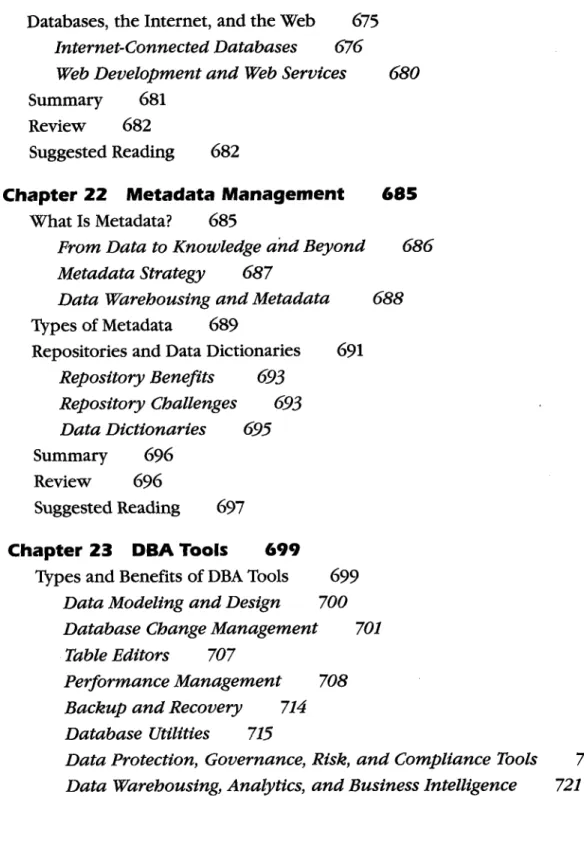
Databases, theInternet, and the Web 675
Internet-ConnectedDatabases 676
WebDevelopmentand Web Services 680
Summary 681
Review 682
Suggested Reading 682
Chapter 22 Metadata Management 685
What Is Metadata? 685
From Data toKnowledge andBeyond 686
MetadataStrategy 687
Data Warehousing and Metadata 688
Types of Metadata 689
RepositoriesandData Dictionaries 691 Repository Benefits 693
Repository Challenges 693
Data Dictionaries 695 Summary 696
Review 696
SuggestedReading 697
Chapter 23 DBA Tools 699
Typesand Benefits of DBA Tools 699
DataModelingandDesign 700 Database Change Management 701
Table Editors 707
Performance Management 708
Backup andRecovery 714
Database Utilities 715
Data Protection, Governance, Risk, andCompliance Tools 716
Programming andDevelopmentTools 724
Miscellaneous Tools 726
ExamineNativeDBATools 728
Evaluating DBATool Vendors 729
Homegrown DBA Tools 732
Summary 733
Review 733
Chapter 24 DBA Rules of Thumb 735
Write DownEverything 735
Keep Everything 736
Automate! 737
Share YourKnowledge 739
Analyze, Simplify, andFocus 741
Don't Panic! 742
MeasureTwice, Cut Once 743
Understand the Business, NotJust the Technology 743
Don't Become aHermit 745
Use All of the Resources atYourDisposal 745
Keep Up-to-Date 746
Invest inYourself 747
Summary 748
Final Exam 748
Appendix A Database Fundamentals 753 What IsaDatabase? 753
WhyUseaDBMS? 754
Advantages of UsingaDBMS 755
Contents xxix
Appendix B The DBMS Vendors 761 TheBigThree 762
The Second Tier 763
Other Significant Players 763
Open-SourceDBMS Offerings 764
Nonrelational DBMS Vendors 765 NoSQL DBMSVendors 765
Object-OrientedDBMS Vendors 766
PC-Based DBMS Vendors 766
Appendix C DBATool Vendors 769 The MajorVendors 769
OtherDBA Tool Vendors 770
DataModelingTool Vendors 771
RepositoryVendors 772
Data Movement and BusinessIntelligenceVendors 773
Appendix D DBA Web Resources 775
Usenet Newsgroups 775
Mailing Lists 776
WebSites, Blogs, and Portals 778 Vendor Web Sites 778
Magazine Web Sites 778 Consultant Web Sites 779
Blogs 780
Database Portals 781 Other Web Sites 782
Appendix E Sample DBA Job Posting 785
Job Posting 785
Bibliography 793
Database Management and Database Systems 793
DataAdministration, DataModeling, andDatabaseDesign 799 Database Security, Protection, andCompliance 802
DataWarehousing 804
SQL 805
Object Orientation and Database Management 807
Operating Systems 807
RelatedTopics 808 DB2 812
IMS 813
MySQL 813 Oracle 814
SQL Server 815
Sybase 816
Other Database Systems 817
Glossary 819