XR-2206
...the analog plus companyTM
Monolithic
Function Generator
Rev. 1.03
June 1997-3
FEATURES
Low-Sine Wave Distortion, 0.5%, Typical
Excellent Temperature Stability, 20ppm/°C, Typ.
Wide Sweep Range, 2000:1, Typical
Low-Supply Sensitivity, 0.01%V, Typ.
Linear Amplitude Modulation
TTL Compatible FSK Controls
Wide Supply Range, 10V to 26V
Adjustable Duty Cycle, 1% TO 99%
APPLICATIONS
Waveform Generation
Sweep Generation
AM/FM Generation
V/F Conversion
FSK Generation
Phase-Locked Loops (VCO)
GENERAL DESCRIPTION
The XR-2206 is a monolithic function generator integrated circuit capable of producing high quality sine, square, triangle, ramp, and pulse waveforms of high-stability and accuracy. The output waveforms can be both amplitude and frequency modulated by an external voltage. Frequency of operation can be selected externally over a range of 0.01Hz to more than 1MHz.
The circuit is ideally suited for communications, instrumentation, and function generator applications requiring sinusoidal tone, AM, FM, or FSK generation. It has a typical drift specification of 20ppm/°C. The oscillator frequency can be linearly swept over a 2000:1 frequency range with an external control voltage, while maintaining low distortion.
ORDERING INFORMATION
Part No. Package
Operating Temperature Range
XR-2206M 16 Lead 300 Mil CDIP -55°C to +125°C
XR-2206P 16 Lead 300 Mil PDIP –40°C to +85°C
XR-2206CP 16 Lead 300 Mil PDIP 0°C to +70°C
XR-2206
11 SYNCO VCO
4 VCC
12 GND
10 BIAS
Timing Capacitor
5 TC1
6 TC2
Timing Resistors
7 TR1
8 TR2
9 FSKI
1 AMSI
Current
Switches MultiplierAnd Sine
Shaper 2 STO
3 MO 13
WAVEA1 14 WAVEA2
15 SYMA1
16 SYMA2
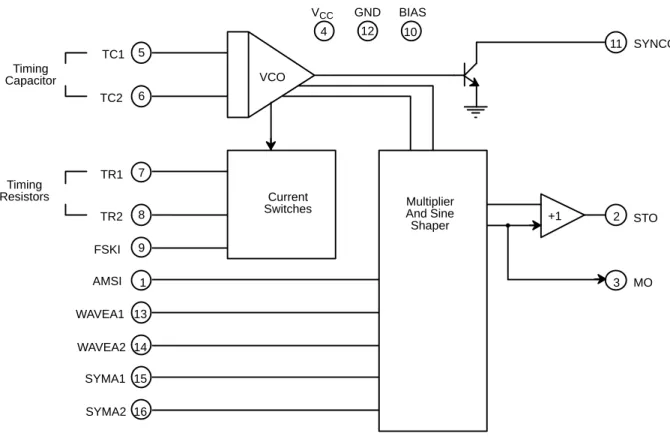
Figure 1. XR-2206 Block Diagram
XR-2206
16 Lead PDIP, CDIP (0.300”)
SYMA2 SYMA1 WAVEA2 WAVEA1 GND SYNCO BIAS FSKI AMSI
STO MO VCC
TC1 TC2 TR1 TR2
1 2 3 4 5 6 7 8
16 15 14 13 12 11 10 9
AMSI STO MO VCC
TC1 TC2 TR1 TR2
SYMA2 SYMA1 WAVEA2 WAVEA1 GND SYNCO BIAS FSKI
16 Lead SOIC (Jedec, 0.300”) 16
1
9 8
2 3 4 5 6 7
15 14 13 12 11 10
PIN DESCRIPTION
Pin # Symbol Type Description
1 AMSI I Amplitude Modulating Signal Input.
2 STO O Sine or Triangle Wave Output.
3 MO O Multiplier Output.
4 VCC Positive Power Supply.
5 TC1 I Timing Capacitor Input.
6 TC2 I Timing Capacitor Input.
7 TR1 O Timing Resistor 1 Output.
8 TR2 O Timing Resistor 2 Output.
9 FSKI I Frequency Shift Keying Input.
10 BIAS O Internal Voltage Reference.
11 SYNCO O Sync Output. This output is a open collector and needs a pull up resistor to VCC. 12 GND Ground pin.
13 WAVEA1 I Wave Form Adjust Input 1.
14 WAVEA2 I Wave Form Adjust Input 2.
15 SYMA1 I Wave Symetry Adjust 1.
XR-2206
DC ELECTRICAL CHARACTERISTICS
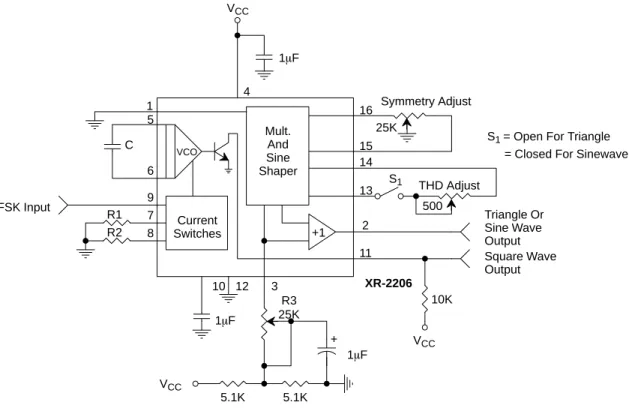
Test Conditions: Test Circuit of Figure 2 Vcc= 12V, TA = 25°C, C = 0.01F, R1 = 100k, R2 = 10k, R3 = 25k
Unless Otherwise Specified. S1 open for triangle, closed for sine wave.
XR-2206M/P XR-2206CP/D
Parameters Min. Typ. Max. Min. Typ. Max. Units Conditions General Characteristics
Single Supply Voltage 10 26 10 26 V
Split-Supply Voltage +5 +13 +5 +13 V
Supply Current 12 17 14 20 mA R1 10k
Oscillator Section
Max. Operating Frequency 0.5 1 0.5 1 MHz C = 1000pF, R1 = 1k
Lowest Practical Frequency 0.01 0.01 Hz C = 50F, R1 = 2M
Frequency Accuracy +1 +4 +2 % of fo fo = 1/R1C
Temperature Stability Frequency
+10 +50 +20 ppm/°C 0°C TA 70°C
R1 = R2 = 20k
Sine Wave Amplitude Stability2 4800 4800 ppm/°C
Supply Sensitivity 0.01 0.1 0.01 %/V VLOW = 10V, VHIGH = 20V,
R1 = R2 = 20k
Sweep Range 1000:1 2000:1 2000:1 fH = fL fH @ R1 = 1k
fL @ R1 = 2M
Sweep Linearity
10:1 Sweep 2 2 % fL = 1kHz, fH = 10kHz
1000:1 Sweep 8 8 % fL = 100Hz, fH = 100kHz
FM Distortion 0.1 0.1 % +10% Deviation
Recommended Timing Components
Timing Capacitor: C 0.001 100 0.001 100 F Figure 5
Timing Resistors: R1 & R2 1 2000 1 2000 k
Triangle Sine Wave Output1 Figure 3
Triangle Amplitude 160 160 mV/k Figure 2, S1 Open
Sine Wave Amplitude 40 60 80 60 mV/k Figure 2, S1 Closed
Max. Output Swing 6 6 Vp-p
Output Impedance 600 600
Triangle Linearity 1 1 %
Amplitude Stability 0.5 0.5 dB For 1000:1 Sweep
Sine Wave Distortion
Without Adjustment 2.5 2.5 % R1 = 30k
With Adjustment 0.4 1.0 0.5 1.5 % See Figure 7 and Figure 8
Notes
1Output amplitude is directly proportional to the resistance, R
3, on Pin 3. See Figure 3. 2For maximum amplitude stability, R
3 should be a positive temperature coefficient resistor.
XR-2206
DC ELECTRICAL CHARACTERISTICS (CONT’D)
XR-2206M/P XR-2206CP/D
Parameters Min. Typ. Max. Min. Typ. Max. Units Conditions Amplitude Modulation
Input Impedance 50 100 50 100 k
Modulation Range 100 100 %
Carrier Suppression 55 55 dB
Linearity 2 2 % For 95% modulation
Square-Wave Output
Amplitude 12 12 Vp-p Measured at Pin 11.
Rise Time 250 250 ns CL = 10pF
Fall Time 50 50 ns CL = 10pF
Saturation Voltage 0.2 0.4 0.2 0.6 V IL = 2mA
Leakage Current 0.1 20 0.1 100 A VCC = 26V
FSK Keying Level (Pin 9) 0.8 1.4 2.4 0.8 1.4 2.4 V See section on circuit controls
Reference Bypass Voltage 2.9 3.1 3.3 2.5 3 3.5 V Measured at Pin 10.
Notes
1Output amplitude is directly proportional to the resistance, R
3, on Pin 3. See Figure 3. 2For maximum amplitude stability, R
3 should be a positive temperature coefficient resistor.
Bold face parameters are covered by production test and guaranteed over operating temperature range.
Specifications are subject to change without notice
ABSOLUTE MAXIMUM RATINGS
Power Supply. . . 26V Power Dissipation . . . 750mW Derate Above 25°C. . . 5mW/°C
Total Timing Current . . . 6mA Storage Temperature . . . -65°C to +150°C
SYSTEM DESCRIPTION
The XR-2206 is comprised of four functional blocks; a voltage-controlled oscillator (VCO), an analog multiplier and sine-shaper; a unity gain buffer amplifier; and a set of current switches.
The VCO produces an output frequency proportional to an input current, which is set by a resistor from the timing
terminals to ground. With two timing pins, two discrete output frequencies can be independently produced for FSK generation applications by using the FSK input control pin. This input controls the current switches which select one of the timing resistor currents, and routes it to the VCO.
XR-2206
5
Figure 2. Basic Test Circuit
Symmetry Adjust 25K 1 6 7 8 9 11 3 2 13 14 15 16 4
10 12 XR-2206 1mF
VCC
C
R1 R2 FSK Input
S1 THD Adjust
500 Triangle Or Sine Wave Output Square Wave Output VCC 10K 1mF
R3 25K
5.1K 5.1K VCC
1mF Current Switches Mult. And Sine Shaper +1 VCO +
S1 = Open For Triangle
= Closed For Sinewave
Figure 3. Output Amplitude as a Function of the Resistor,
R3, at Pin 3
ÎÎÎÎÎÎÎÎÎÎ ÎÎÎÎÎÎÎÎÎÎ ÎÎÎÎÎÎÎÎÎÎ ÎÎÎÎÎÎÎÎÎÎ ÎÎÎÎÎÎÎÎÎÎ ÎÎÎÎÎÎÎÎÎÎ ÎÎÎÎÎÎÎÎÎÎ ÎÎÎÎÎÎÎÎÎÎ ÎÎÎÎÎÎÎÎÎÎ ÎÎÎÎÎÎÎÎÎÎ Triangle Sinewave 26 22 18 14 10
8 12 16 20 24 28 70°C Max. Package Dissipation 1KW 2KW 10KW 30KW
Figure 4. Supply Current vs Supply Voltage, Timing, R
0 20 40 60 80 100 1 2 3 4 5 6
Peak Output V
oltage (V
olts)
R3 in (KW)
I CC
(mA)
XR-2206
ÁÁÁÁÁ
ÁÁÁÁÁ MINIMUM TIMING R
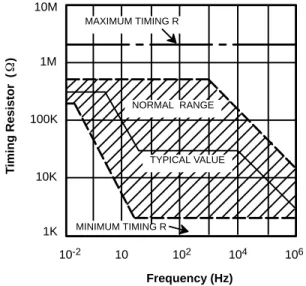
ÎÎÎÎÎÎÎÎÎÎÎÎ ÎÎÎÎÎÎÎÎÎÎÎÎ ÎÎÎÎÎÎÎÎÎÎÎÎ ÎÎÎÎÎÎÎÎÎÎÎÎ ÎÎÎÎÎÎÎÎÎÎÎÎ ÎÎÎÎÎÎÎÎÎÎÎÎ ÎÎÎÎÎÎÎÎÎÎÎÎ ÎÎÎÎÎÎÎÎÎÎÎÎ ÎÎÎÎÎÎÎÎÎÎÎÎ ÎÎÎÎÎÎÎÎÎÎÎÎ ÎÎÎÎÎÎÎÎÎÎÎÎ ÎÎÎÎÎÎÎÎÎÎÎÎ Figure 5. R versus Oscillation Frequency.
ÎÎÎÎÎÎÎÎÎÎÎ ÎÎÎÎÎÎÎÎÎÎÎ ÎÎÎÎÎÎÎÎÎÎÎ ÎÎÎÎÎÎÎÎÎÎÎ ÎÎÎÎÎÎÎÎÎÎÎ ÎÎÎÎÎÎÎÎÎÎÎ ÎÎÎÎÎÎÎÎÎÎÎ ÎÎÎÎÎÎÎÎÎÎÎ ÎÎÎÎÎÎÎÎÎÎÎ ÎÎÎÎÎÎÎÎÎÎÎ 4V 4V 10M 1M 100K 10K 1K
10-2 10 102 ÁÁÁÁÁÁ
ÁÁÁÁÁÁ MAXIMUM TIMING R
VCC / 2
DC Voltage At Pin 1 Frequency (Hz) T iming Resistor W 0 0.5 1.0 Normal Output Amplitude
Figure 6. Normalized Output Amplitude versus DC Bias at AM Input (Pin 1)
Figure 7. Trimmed Distortion versus Timing Resistor.
Distortion (%)
Timing R K(W)
0 1 2 3 4 5
1.0 10 100 103 ÁÁÁÁÁÁÁ
ÁÁÁÁÁÁÁ
ÁÁÁÁÁÁÁ
C = 0.01mF
Trimmed For Minimum Distortion At 30 KW
Figure 8. Sine Wave Distortion versus Operating Frequency with
Timing Capacitors Varied.
10 100 1K 10K 100K 1M 0 1 2 3 4 5 Distortion (%) Frequency (Hz) ÁÁÁ R=3KW ÁÁÁÁ ÁÁÁÁ
RL=10KW ÁÁÁÁÁ
ÁÁÁÁÁ NORMAL RANGE
ÁÁÁÁÁ
ÁÁÁÁÁ TYPICAL VALUE
=0.5VRMS Pin 2 VOUT
()
XR-2206
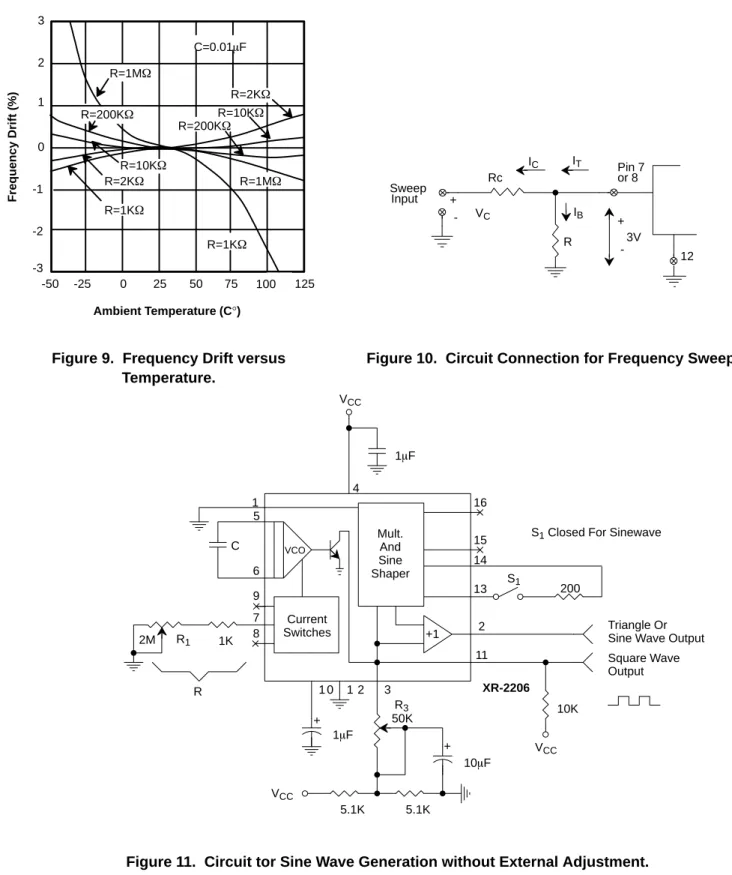
Figure 9. Frequency Drift versus Temperature.
3
2
1
0
-1
-2
-3
-50 -25 0 25 50 75 125 C=0.01F
R=1M
R=2K R=10K R=200K
R=1M
R=1K R=10K
R=2K R=1K
Ambient Temperature (C°)
Figure 10. Circuit Connection for Frequency Sweep.
Sweep Input +
- VC
R IB
IC
Rc
IT Pin 7
or 8
12
ÁÁ
100
Figure 11. Circuit tor Sine Wave Generation without External Adjustment.
(See Figure 3 for Choice of R3)
R=200K
Frequency Drift (%)
+
1 5
6
7 8 9
11 3
2 13 14 15 16 4
1 0 1 2 XR-2206
1F
C
R1
2M 1K
S1
Triangle Or Sine Wave Output Square Wave Output 200
10K R3
50K
5.1K 5.1K VCC
10F 1F
R
VCC
VCC
Current Switches
Mult. And Sine Shaper
+1
+ +
VCO
S1 Closed For Sinewave
XR-2206
0
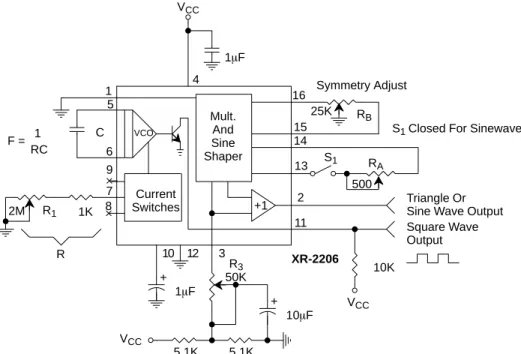
Figure 12. Circuit for Sine Wave Generation with Minimum Harmonic Distortion.
(R3 Determines Output Swing - See Figure 3)
Figure 13. Sinusoidal FSK Generator
Symmetry Adjust 25K RB 1 5 6 7 8 9 11 3 2 13 14 15 16 4
1 12 XR-2206
1F
C 1K R1 2M F = S1 Triangle Or Sine Wave Output Square Wave Output RA 500 10K 5.1K 5.1K
10F R3
50K 1F
R Mult. And Sine Shaper Current Switches VCC VCC VCO + + +1 VCC 1 5 6 7 8 9 11 3 2 13 14 15 16 4
10 12 XR-2206
1F VCC C FSK Input R1 R2 <1V >2V F1
F2
F1=1/R1C
200
5.1K 5.1K
10F 1F
R3 50K F2=1/R2C VCC Mult. And Sine Shaper VCO + + +1 Current Switches
S1 Closed For Sinewave 1
RC
XR-2206
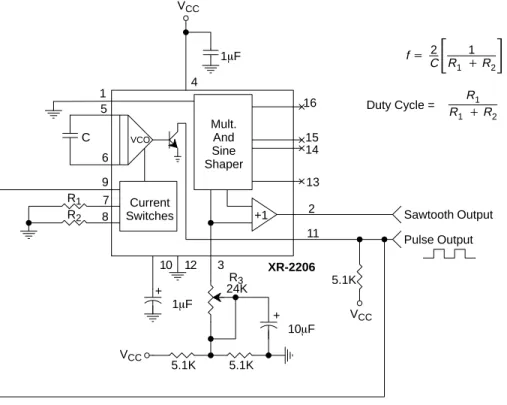
Figure 14. Circuit for Pulse and Ramp Generation.
1 5
6
7 8 9
11 3
2 13 14 15 16 4
10 12 XR-2206
1F VCC
C
R1
R2
5.1K
5.1K 5.1K
10F 1F
R3
24K
VCC
VCC
Mult. And Sine Shaper
VCO
+1
+
+ Current
Switches
f 2 C
1 R1R2
R1 R1R2 Duty Cycle =
Sawtooth Output Pulse Output
Frequency-Shift Keying
The XR-2206 can be operated with two separate timing resistors, R1 and R2, connected to the timing Pin 7 and 8,
respectively, as shown in Figure 13. Depending on the polarity of the logic signal at Pin 9, either one or the other of these timing resistors is activated. If Pin 9 is open-circuited or connected to a bias voltage 2V, only R1 is activated. Similarly, if the voltage level at Pin 9 is
1V, only R2 is activated. Thus, the output frequency can
be keyed between two levels. f1 and f2, as: f1 = 1/R1C and f2 = 1/R2C
For split-supply operation, the keying voltage at Pin 9 is referenced to V-.
Output DC Level Control
The dc level at the output (Pin 2) is approximately the same as the dc bias at Pin 3. In Figure 11, Figure 12 and Figure 13, Pin 3 is biased midway between V+ and ground, to give an output dc level of V+/2.
APPLICATIONS INFORMATION Sine Wave Generation
Without External Adjustment
Figure 11 shows the circuit connection for generating a sinusoidal output from the XR-2206. The potentiometer, R1 at Pin 7, provides the desired frequency tuning. The maximum output swing is greater than V+/2, and the
typical distortion (THD) is < 2.5%. If lower sine wave distortion is desired, additional adjustments can be provided as described in the following section.
The circuit of Figure 11 can be converted to split-supply operation, simply by replacing all ground connections with V-. For split-supply operation, R
3 can be directly
XR-2206
With External Adjustment:
The harmonic content of sinusoidal output can be reduced to -0.5% by additional adjustments as shown in Figure 12. The potentiometer, RA, adjusts the sine-shaping resistor, and RB provides the fine
adjustment for the waveform symmetry. The adjustment procedure is as follows:
1. Set RB at midpoint and adjust RA for minimum
distortion.
2. With RA set as above, adjust RB to further reduce distortion.
Triangle Wave Generation
The circuits of Figure 11 and Figure 12 can be converted to triangle wave generation, by simply open-circuiting Pin 13 and 14 (i.e., S1 open). Amplitude of the triangle is
approximately twice the sine wave output.
FSK Generation
Figure 13 shows the circuit connection for sinusoidal FSK signal operation. Mark and space frequencies can be independently adjusted by the choice of timing resistors, R1 and R2; the output is phase-continuous during
transitions. The keying signal is applied to Pin 9. The circuit can be converted to split-supply operation by simply replacing ground with V-.
Pulse and Ramp Generation
Figure 14 shows the circuit for pulse and ramp waveform generation. In this mode of operation, the FSK keying terminal (Pin 9) is shorted to the square-wave output (Pin 11), and the circuit automatically frequency-shift keys itself between two separate frequencies during the positive-going and negative-going output waveforms. The pulse width and duty cycle can be adjusted from 1% to 99% by the choice of R1 and R2. The values of R1 and
R2 should be in the range of 1k to 2M.
PRINCIPLES OF OPERATION Description of Controls Frequency of Operation:
The frequency of oscillation, fo, is determined by the
external timing capacitor, C, across Pin 5 and 6, and by the timing resistor, R, connected to either Pin 7 or 8. The frequency is given as:
f0+ 1
RC Hz
and can be adjusted by varying either R or C. The recommended values of R, for a given frequency range, as shown in Figure 5. Temperature stability is optimum for 4k < R < 200k. Recommended values of C are from 1000pF to 100F.
Frequency Sweep and Modulation:
Frequency of oscillation is proportional to the total timing current, IT, drawn from Pin 7 or 8:
f+ 320IT(mA)
C(F) Hz
Timing terminals (Pin 7 or 8) are low-impedance points, and are internally biased at +3V, with respect to Pin 12. Frequency varies linearly with IT, over a wide range of current values, from 1A to 3mA. The frequency can be controlled by applying a control voltage, VC, to the
activated timing pin as shown in Figure 10. The frequency of oscillation is related to VC as:
f+ 1 RC
ǒ
1 )R RC
ǒ
1 –VC 3
Ǔ
Ǔ
Hzwhere VC is in volts. The voltage-to-frequency conversion gain, K, is given as:
K+ ēfńēVC+– 0.32 RCC HzńV
CAUTION: For safety operation of the circuit, IT should be limited to 3mA.
XR-2206
Output Amplitude:
Maximum output amplitude is inversely proportional to the external resistor, R3, connected to Pin 3 (see
Figure 3). For sine wave output, amplitude is approximately 60mV peak per k of R3; for triangle, the peak amplitude is approximately 160mV peak per k of R3. Thus, for example, R3 = 50k would produce
approximately 13V sinusoidal output amplitude.
Amplitude Modulation:
Output amplitude can be modulated by applying a dc bias and a modulating signal to Pin 1. The internal impedance
at Pin 1 is approximately 100k. Output amplitude varies linearly with the applied voltage at Pin 1, for values of dc bias at this pin, within 14 volts of VCC/2 as shown in
Figure 6. As this bias level approaches VCC/2, the phase of the output signal is reversed, and the amplitude goes through zero. This property is suitable for phase-shift keying and suppressed-carrier AM generation. Total dynamic range of amplitude modulation is approximately 55dB.
CAUTION: AM control must be used in conjunction with a
well-regulated supply, since the output amplitude now becomes a function of VCC.
Figure 15. Equivalent Schematic Diagram
2 1 6
16 14
5 13 11
VR VCC 15V2
5 6
7 VCC
VR V1 V2 Reg. Int’nI.
12 4 VCC
10 VR V1
VR 8
9
XR-2206
A 0.100 0.200 2.54 5.08 A1 0.015 0.060 0.38 1.52 B 0.014 0.026 0.36 0.66 B1 0.045 0.065 1.14 1.65
c 0.008 0.018 0.20 0.46 D 0.740 0.840 18.80 21.34 E1 0.250 0.310 6.35 7.87 E 0.300 BSC 7.62 BSC e 0.100 BSC 2.54 BSC L 0.125 0.200 3.18 5.08 α 0° 15° 0° 15°
D
B e
B1
16 LEAD CERAMIC DUAL-IN-LINE
(300 MIL CDIP)
Rev. 1.00
SYMBOL MIN MAX MIN MAX
INCHES MILLIMETERS
1 8
9
α
c E1
A
L A1
Seating Plane
Base Plane
16
E
XR-2206
16 LEAD PLASTIC DUAL-IN-LINE
(300 MIL PDIP)
Rev. 1.00
16 1
9 8
D
e B1
A1
E1
E
A L
B Seating
Plane
SYMBOL MIN MAX MIN MAX
INCHES
A 0.145 0.210 3.68 5.33 A1 0.015 0.070 0.38 1.78
A2 0.115 0.195 2.92 4.95
B 0.014 0.024 0.36 0.56 B1 0.030 0.070 0.76 1.78
C 0.008 0.014 0.20 0.38 D 0.745 0.840 18.92 21.34 E 0.300 0.325 7.62 8.26 E1 0.240 0.280 6.10 7.11
e 0.100 BSC 2.54 BSC eA 0.300 BSC 7.62 BSC eB 0.310 0.430 7.87 10.92
L 0.115 0.160 2.92 4.06
α 0° 15° 0° 15°
MILLIMETERS
α
A2
C
Note: The control dimension is the inch column
eB
XR-2206
SYMBOL MIN MAX MIN MAX
A 0.093 0.104 2.35 2.65 A1 0.004 0.012 0.10 0.30
B 0.013 0.020 0.33 0.51 C 0.009 0.013 0.23 0.32 D 0.398 0.413 10.10 10.50 E 0.291 0.299 7.40 7.60 e 0.050 BSC 1.27 BSC H 0.394 0.419 10.00 10.65 L 0.016 0.050 0.40 1.27
α 0° 8° 0° 8°
INCHES MILLIMETERS
16 LEAD SMALL OUTLINE
(300 MIL JEDEC SOIC)
Rev. 1.00
e
16 9
8
D
E H
B
A
L C
A1 Seating
Plane α
Note: The control dimension is the millimeter column
XR-2206
NOTICE
EXAR Corporation reserves the right to make changes to the products contained in this publication in order to im-prove design, performance or reliability. EXAR Corporation assumes no responsibility for the use of any circuits de-scribed herein, conveys no license under any patent or other right, and makes no representation that the circuits are free of patent infringement. Charts and schedules contained here in are only for illustration purposes and may vary depending upon a user’s specific application. While the information in this publication has been carefully checked; no responsibility, however, is assumed for inaccuracies.
EXAR Corporation does not recommend the use of any of its products in life support applications where the failure or malfunction of the product can reasonably be expected to cause failure of the life support system or to significantly affect its safety or effectiveness. Products are not authorized for use in such applications unless EXAR Corporation receives, in writing, assurances to its satisfaction that: (a) the risk of injury or damage has been minimized; (b) the user assumes all such risks; (c) potential liability of EXAR Corporation is adequately protected under the circum-stances.
Copyright 1972 EXAR Corporation Datasheet June 1997