1st Edition
Electronic
Medical Records
For sample use only -
data from 2006.
Electronic Medical Record Environment Overview
A
pproximately 75 percent of U.S. hospitals have a foundation clinical datarepository operational or in the process of being installed, so that it can be used to extend and expand their clinical automation capabilities.
The vast majority of laboratory, radiology and pharmacy departments in U.S. hospitals are automated. But the key applications for preventing or eliminating medical errors —CPOE/pharmacy dispensing/nursing medication administration as integrated application components—are currently installed and fully utilized in less than 10 percent of U.S. hospitals.
One reason for this low percentage of installed applications for reducing or eliminating medical errors is the relative immaturity of the computerized practitioner order entry applications and its lack of proven integration with pharmacy dispensing and nursing medication administration and documentation applications.
However, over the next 24 months, these applications will become more robust in functionality, stability and scalability. Thus, the risk factors experienced by the pioneers and early adopters of these clinical information systems today will be much reduced for U.S. hospitals that begin to implement these solutions in 2006.
What makes up an electronic medical record (EMR) environment—also known as
the computer-based patient record? For this report, it will be defined as a foundation
provides access and reports to assist clinicians in the delivery of care along with other applications. These are tightly coupled with the CDR to create components of—and eventually the complete—legal medical record. Other components of the EMR that advance the functionality of the clinical systems for supporting patient care delivery are:
workflow engines
rules engines (e.g., clinical decision support)
controlled medical vocabularies—to normalize the various naming conventions used for similar terms in systems providing data (e.g., laboratory, pharmacy, transcription and radiology systems)
clinical documentation applications (e.g., care plans, flow sheets,
electronic medication administration records, physician templated documentation)
order entry
computerized practitioner order entry applications.
Because of the need for seamless integration with the other EMR applications,
pharmacy information systems are also included in our definition of an EMR
environment. We have also chosen to discuss a major component of the EMR, nursing applications, as a separate environment for this report.
The key success criteria for U.S. hospitals transforming their clinical environments with IT solutions will be to incrementally improve their environments. The degree of incremental improvement that can be achieved by any institution will be a factor in the
funding and staffing resources available to implement the desired clinical information
system strategies.
While some hospitals will implement clinical information systems that impact their entire enterprise operation, most will incrementally implement clinical solutions to address key care delivery service improvement needs.
The EMR Market
The applications tracked for this market are the clinical data repository, clinical decision support applications, computerized practitioner order entry, enterprise EMR, medical terminology, order entry, and physician documentation.
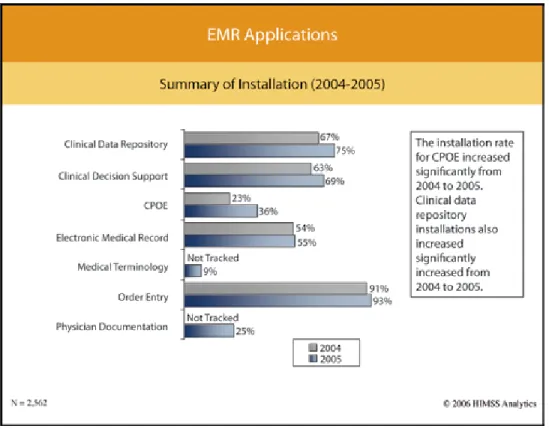
The clinical data repository, clinical decision support, order entry and enterprise EMR applications had all exceeded 50 percent contracting or implementation in the U.S. hospital market (see Figure EMR1).
Order entry applications, which traditionally were charge capture applications, are being transformed by computerized practitioner order entry (CPOE) applications that are
designed to reduce or eliminate medical errors with the use of clinical decision support.
Computerized practitioner order entry is experiencing good growth, and these applications will become more successful as hospitals improve the necessary supporting application infrastructure (e.g. clinical documentation and improved integration between CPOE, pharmacy and eMAR applications).
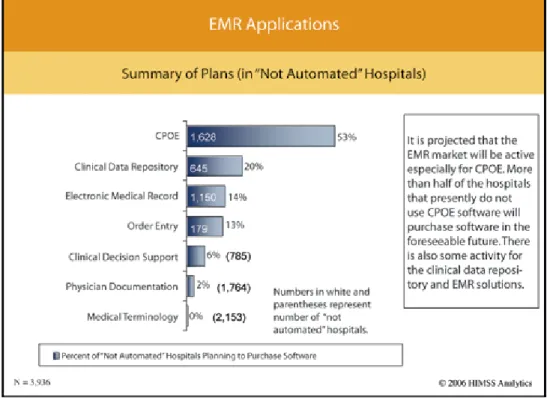
An evaluation of hospitals lacking a specific application that they plan to purchase
shows that CDR, CPOE and EMR applications will continue to have good buying activity over the next 24 months (see EMR2).
Figure EMR1
CPOE is experiencing good
growth, and these applications will
become more successful as hospital boost infrastructures.
The EMR application replacement selling market manifests the highest activity in the order entry application segment (see Figure EMR3).
Figure EMR2
This is not surprising; order entry systems traditionally were charge capture systems, but they have begun to transform into true clinical components with the advent of CPOE applications that are used by all practitioners (e.g., nurses, allied health personnel, etc.).
Market Spend Forecast
Please note: Five-year CAGR spend forecasts will be provided for all applications, with the exception of RPACS, CPACS and Barcodes.
Clinical Date Repository
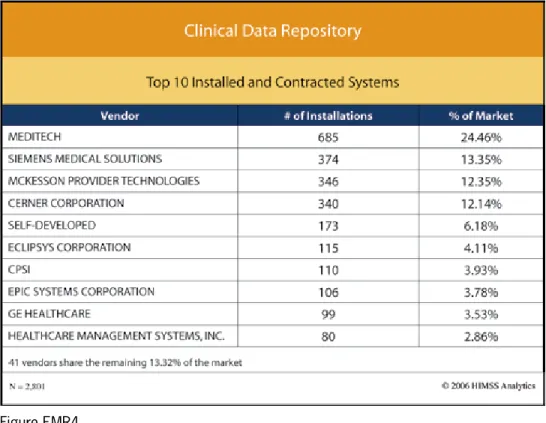
The top four vendors control approximately 61 percent of the market, while the top 10 vendors represent approximately 87 percent of the market (see Figure EMR4). Self-developed
applications are the fifth most installed application, and
represent a good replacement selling market for the enterprise vendors.
While MEDITECH, McKesson Provider Technologies, Siemens Medical Solutions and Cerner currently represent the top tier of vendors in this market, Eclipsys, Epic Systems and GE Healthcare are beginning to win more market share. Market consolidation will continue to play a role in this segment as evidenced by the recent acquisition of IDX by GE Healthcare.
Figure EMR4 Market consolidation will continue to play a role in the clinical data repository
Clinical Decision Support
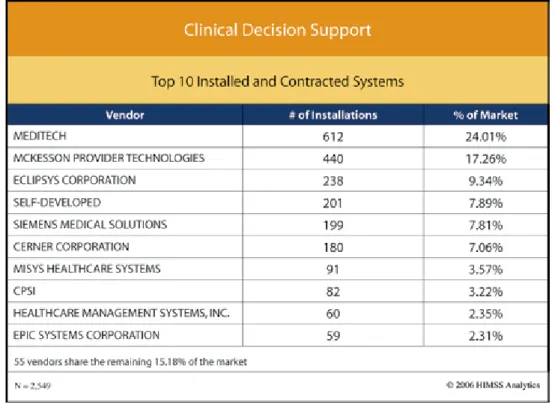
The top four vendors (not including self-developed) in this market control approximately 58 percent of the market, while the top 10 vendors represent approximately 85 percent of the market (see Figure EMR5).
Clinical decision support applications run the gamut from simple drug
conflict-checking algorithms to complex protocol monitoring.
Most of the order entry, CPOE, physician documentation, and clinical data repository
environments have some measure of clinical decision support built into their workflow.
Computerized Practitioner Order Entry (CPOE)
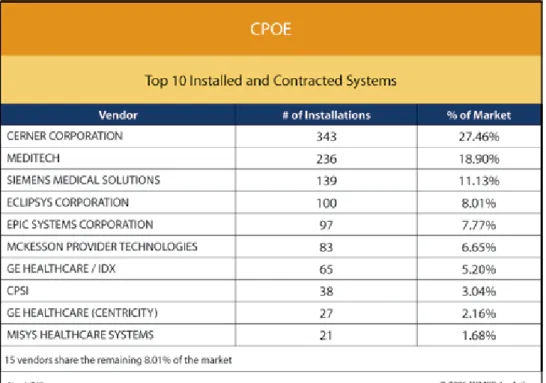
The top four vendors in this market segment control 65 percent of the market, while the top 10 vendors represent 92 percent of the market (see Figure EMR6).
Cerner and MEDITECH have clear leadership positions, but Siemens, Eclipsys and Epic Systems are showing good market growth with their products.
CPOE is an emerging market that will continue to show
solid growth for the next five years, especially as the CPOE
applications begin to stabilize and mature.
Recent negative publicity about CPOE systems does not appear to have slowed the market, but it has caused hospitals to re-evaluate their CPOE strategies. Most hospitals are implementing CPOE incrementally across services lines, in contrast to attempting enterprise-wide implementation (the “big bang” approach).
Electronic Medical Record
This is the environment where clinical data is used as a true medical record, and where that data could be considered the legal medical record.
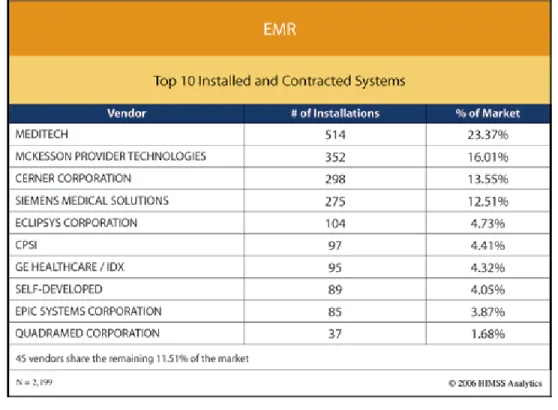
In this environment, patient care information is charted with clinical documentation and/or physician documentation applications. The top four CPOE vendors control 63 percent of the segment, and the overall top 10 represents 88 percent (see Figure
EMR7). While MEDITECH has a significant lead as the top vendor in the category,
Figure EMR6
Most hospitals are implementing
CPOE incrementally, in contrast to the “big
McKesson Provider Technologies, Cerner and Siemens Medical Solutions have attained solid market positions. Eclipsys, CPSI, GE Healthcare and Epic Systems represent a second tier of vendors that are very competitive, and that will challenge the market
leaders for the specific market sub-segments targeted within this environment.
Medical Terminology
Due to the current low implementation numbers for medical terminology applications, we are not providing a vendor top 10 listing. This is a very immature market relative to commercial applications, and we believe that, over time, SNOMED will become a de facto standard in this area.
Order Entry
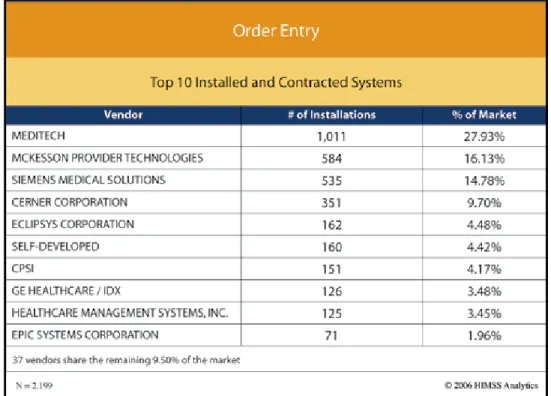
The four top order entry vendors control 69 percent of the market, and the overall top 10 represents 90 percent (see Figure EMR8). The original purpose of order entry applications in the mid-1980s was to provide charge capture mechanisms for services and supplies used in the care delivery process. These have evolved into more
sophisticated clinical applications that supply clinical decision support functions to
reduce the number of duplicate, conflicting and unnecessary tests.
Over time, the new CPOE applications will replace order entry applications, which
were significant applications for the hospital information system (HIS) market of the
1980s and 1990s.
A vendor’s existing order entry client base represents a good market opportunity for that company’s CPOE application. But, if the order entry function was a component of an HIS, then it could well be replaced by the vendor that supplies a hospital’s EMR applications.
Physician Documentation
This environment represents documentation created from templates that mimic the charting documents that physicians create today. It does not represent the documentation generated by physicians using dictation/transcription services. The data generated from templated electronic documents is discreet and capable of driving
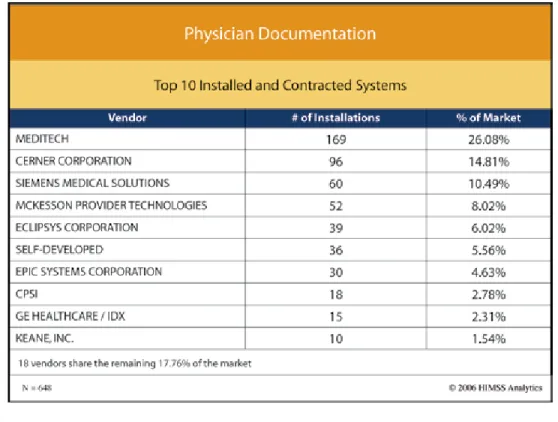
workflow and clinical decision support applications. The top four order entry vendors
control 59 percent of the market, while the entire top ten represents 90 percent of the total (see Figure EMR9).
This is an emerging market, and while MEDITECH currently leads, Cerner, Siemens Medical Solutions, McKesson
Provider Technologies, Eclipsys and Epic will all continue to
provide competitive solutions that, over the next five years,
will generate many changes in this segment’s top 10 market share rankings.
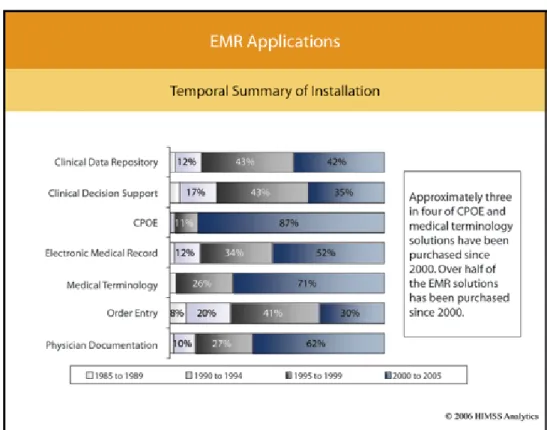
An evaluation of the temporal contract signing activity for EMR applications shows that while the CDR application installations have been made evenly from 1995 to 1999, clinical decision support and order entry saw more installations in the 1995-1999 time frame.
All of the other EMR applications have shown more installation activity in the 2000-2005 period (see Figure EMR10).
control 59 percent of the market, while the entire top ten represents 90 percent of the total (see Figure EMR9).
This is an emerging market, and while MEDITECH currently leads, Cerner, Siemens Medical Solutions, McKesson
Provider Technologies, Eclipsys and Epic will all continue to
provide competitive solutions that, over the next five years,
will generate many changes in this segment’s top 10 market share rankings.
An evaluation of the temporal contract signing activity for EMR applications shows that while the CDR application installations have been made evenly from 1995 to 1999, clinical decision support and order entry saw more installations in the 1995-1999 time frame.
All of the other EMR applications have shown more installation activity in the 2000-2005 period (see Figure EMR10).
Figure EMR9
This is an emerging market—one that,
over the next five years is likely to see
many changes in the top 10 market
The following is an EMR market summary:
There is substantial market penetration for order entry, installed at 93 percent. Installation rates for clinical data repository and clinical decision support were also strong at 75 percent and 69 percent, respectively. More than half (55 percent) mentioned that they have installed electronic medical records solutions.
MEDITECH is mentioned as one of the top two market leaders across all electronic medical records applications except for physician documentation.
The majority of CPOE, medical terminology and physician
documentation applications were signed from 2000 to 2004. In the same time frame, more than half of the enterprise electronic medical records were purchased.
McKesson Provider Technologies lead the market among vendors that are under consideration for future installation of clinical data repository
and CPOE systems, while MEDITECH is most frequently identified
as a potential vendor in the order entry, clinical decision support and physician documentation markets.
Future activity in this market will focus on first-time purchases for
CPOE, medical terminology and physician documentation. The replacing current software indication is highest for the order entry market.
Our analysis of this market is represented by the following points:
Clinical data repository (CDR) and CPOE showed the best growth over the last 12 months. The CDR is the foundation for the EMR, which supports this growth. CPOE continues to be a hot application to pursue for reducing medical errors, even with several provocative journal
articles that question CPOE’s benefits.
While the percentage of hospitals replacing order entry applications is not high, the true number associated with replacements is well over 100. Most of these replacements will be for older legacy architecture applications.
MEDITECH, McKesson Provider Technologies, Cerner and Siemens Medical Solutions have solid positions as leaders of the EMR market segment. Future purchase decisions indicate that Cerner and McKesson Provider Technologies will continue to improve and strengthen their
positions, while GE Healthcare begins to move up toward a top five
listing.
While Cerner, MEDITECH, and Siemens Medical Solutions currently have solid leadership positions in the CPOE market, future purchase decisions indicate that McKesson Provider Technologies will gain
significant market share over the next 24 months to challenge the
leaders.
A top 10 listing of self-developed applications for the CDR, clinical decision support, EMR, order entry and physician documentation portends a future replacement selling market for many hospitals with these applications.
The absence of a top 10 listing for self-developed for the CPOE market manifests an acknowledgement by the market that CPOE is best
acquired commerically.
MEDITECH and Cerner will continue to be leaders in the physician documentation application market when purchase decisions over the next 24 months are factored in.