EN 13445-2:2002 (E)
Issue 35 (2009-01)
2
Contents
Foreword...3
1 Scope ...4
2 Normative
references ...4
3 Terms,
definitions, symbols and units ...7
3.1 Terms
and
definitions ...7
3.2 Symbols
and units...8
4
Requirements for materials to be used for pressure-bearing parts...10
4.1 General...10
4.2 Special
provisions ...12
4.3 Technical
delivery conditions ...13a
4.4 Marking ...14
5
Requirements for materials to be used for non-pressure parts ...14
Annex A (normative) Grouping system for steels for pressure equipment ...15
Annex B (normative) Requirements for prevention of brittle fracture at low temperatures ...31
Annex C (informative) Procedure for determination of the weld creep strength reduction factor
(WCSRF) ...48p
Annex D (informative) Technical delivery conditions for clad products for pressure purposes...49
Annex E (informative) European steels for pressure purposes ...53
Annex ZA (informative) Clauses of this European Standard addressing essential safety requirements
or other provisions of EU directives...54
EN 13445-2:2002 (E)
Issue 35 (2009-01)
3
Foreword
This document (EN 2:2002, EN 2:2002/A2:2006, EN 2:2002/A1:2007, EN
13445-2:2002/A3:2008 and EN 13445-2:2002/A5:2008) has been prepared by Technical Committee CEN/TC 54 "Unfired
pressure vessels", the secretariat of which is held by BSI.
EN 13445-2:2002 shall be given the status of a national standard, either by publication of an identical text or by
endorsement, at the latest by November 2002, and conflicting national standards shall be withdrawn at the latest by
November 2002. EN 13445-2:2002/A2:2006 shall be given the status of a national standard, either by publication of
an identical text or by endorsement, at the latest by June 2007, and conflicting national standards shall be
withdrawn at the latest by June 2007. EN 13445-2:2002/A1:2007 shall be given the status of a national standard,
either by publication of an identical text or by endorsement, at the latest by June 2007, and conflicting national
standards shall be withdrawn at the latest by June 2007. EN 13445-2:2002/A3:2008 shall be given the status of a
national standard, either by publication of an identical text or by endorsement, at the latest by June 2009, and
conflicting national standards shall be withdrawn at the latest by June 2009. EN 13445-2:2002/A5:2008 shall be
given the status of a national standard, either by publication of an identical text or by endorsement, at the latest by
June 2009, and conflicting national standards shall be withdrawn at the latest by June 2009.
Attention is drawn to the possibility that some of the elements of this document may be the subject of patent rights.
CEN [and/or CENELEC] shall not be held responsible for identifying any or all such patent rights.
This document has been prepared under a mandate given to CEN by the European Commission and the European
Free Trade Association, and supports essential requirements of EU Directive(s).
For relationship with EU Directive(s), see informative annex ZA, which is an integral part of this document.
In this standard the Annexes A and B are normative and the Annexes C to E are informative.
This European Standard consists of the following Parts:
Part 1: General.
Part 2: Materials.
Part 3: Design.
Part 4: Fabrication.
Part 5: Inspection and testing.
Part 6: Requirements for the design and fabrication of pressure vessels and pressure parts constructed from
spheroidal graphite cast iron.
CR 13445-7, Unfired pressure vessels - Part 7:
Guidance on the use of conformity assessment procedures.
According to the CEN/CENELEC Internal Regulations, the national standards organizations of the following
countries are bound to implement this European Standard: Austria, Belgium, Bulgaria, Cyprus, Czech Republic,
Denmark, Estonia, Finland, France, Germany, Greece, Hungary, Iceland, Ireland, Italy, Latvia, Lithuania,
Luxembourg, Malta, Netherlands, Norway, Poland, Portugal, Romania, Slovakia, Slovenia, Spain, Sweden,
Switzerland and the United Kingdom.
EN 13445-2:2002 (E)
Issue 35 (2009-01)
4
1 Scope
This Part of this European Standard specifies the requirements for materials (including clad materials) for unfired
pressure vessels and supports which are covered by EN 13445-1:2002 and manufactured from metallic materials;
it is currently limited to steels with sufficient ductility but it is, for components operating in the creep range, also
limited to sufficiently creep ductile materials .
NOTE Other materials will be added later by amendments.
It specifies the requirements for the selection, inspection, testing and marking of metallic materials for the
fabrication of unfired pressure vessels.
2 Normative
references
This European Standard incorporates by dated or undated reference, provisions from other publications. These
normative references are cited at the appropriate places in the text and the publications are listed hereafter. For
dated references, subsequent amendments to or revisions of any of these publications apply to this European
Standard only when incorporated in it by amendment or revision. For undated references the latest edition of the
publication referred to applies (including amendments).
EN 288-3:1992, Specification and approval of welding procedures for metallic material — Part 3: Welding
procedure tests for the arc welding of steels.
prEN 764-1:2001, Pressure equipment — Terminology — Part 1: Pressure, temperature, volume, nominal size.
EN 764-2:2002, Pressure equipment — Part 2: Quantities, symbols and units.
EN 764-3:2002, Pressure equipment — Part 3: Definition of parties involved.
EN 1092-1:2007, Flanges and their joints — Circular flanges for pipes, valves, fittings and accessories, PN
designated — Part 1: Steel flanges
EN 10028-2:2003, Flat products made of steels for pressure purposes — Part 2: Non-alloy and alloy steels with
specified elevated temperature properties.
EN 10028-3:2003, Flat products made of steels for pressure purposes — Part 3: Weldable fine grain steels,
normalized.
EN 10028-4:2003, Flat products made of steels for pressure purposes — Part 4: Nickel alloy steels with specified
low temperature properties.
EN 10028-5:2003, Flat products made of steels for pressure purposes — Part 5: Weldable fine grain steels,
thermomechanically rolled.
EN 10028-6:2003, Flat products made of steels for pressure purposes — Part 6: Weldable fine grain steels,
quenched and tempered.
EN 10028-7:2007, Flat products made of steels for pressure purposes — Part 7: Stainless steels.
EN 10045-1:1990, Metallic materials — Charpy impact test — Part 1: Test method.
EN 13445-2:2002 (E)
Issue 35 (2009-01)
5
EN 10164:1993, Steel products with improved deformation properties perpendicular to the surface of the product —
Technical delivery conditions.
EN 10204:2004, Metallic products — Types of inspection documents.
EN 10216-3:2002,
Seamless steel tubes for pressure purposes — Technical delivery conditions — Part 3: Alloy
fine grain steel tubes
EN 10216-4:2002,
Seamless steel tubes for pressure purposes — Technical delivery conditions — Part 4:
Non-alloy and alloy steel tubes with specified low temperature properties.
EN 10217-3:2002, Welded steel tubes for pressure purposes — Technical delivery conditions — Part 3: Alloy fine
grain steel tubes.
EN 10217-4:2002,
Welded steel tubes for pressure purposes — Technical delivery conditions — Part 4: Electric
welded non-alloy steel tubes with specified low temperature properties.
EN 10217-6:2002,
Welded steel tubes for pressure purposes — Technical delivery conditions — Part 6:
Submerged arc welded non-alloy steel tubes with specified low temperature properties.
EN 10222-3:1998, Steel forgings for pressure purposes — Part 3: Nickel steels with specified low temperature
properties
EN 10222-4:1998, Steel forgings for pressures purposes — Part 4: Weldable fine grain steels with high proof
strength
prEN 10253-2:1999, Butt welding pipe fittings — Part 2: Wrought carbon and ferritic alloy steel with specific
inspection requirements.
EN 10269:1999, Steels and nickel alloys for fasteners with specified elevated and/or low temperature properties
EN 10273:2007, Hot rolled weldable steel bars for pressure purposes with specified elevated temperature
properties.
EN 10291:2000, Metallic materials — Uniaxial creep testing in tension – Method of test.
EN 12074:2000, Welding consumables — Quality requirements for manufacture, supply and distribution of
consumables for welding and allied processes.
EN 13445-1:2002, Unfired pressure vessels — Part 1: General.
EN 13445-3:2002, Unfired pressure vessels — Part 3: Design.
EN 13445-4:2002, Unfired pressure vessels — Part 4: Fabrication.
EN 13445-5:2002, Unfired pressure vessels — Part 5: Inspection and testing.
EN 13479:2004, Welding consumables — General product standard for filler metals and fluxes for fusion welding of
metallic materials.
EN 20898-2:1993, Mechanical properties of fasteners — Part 2: Nuts with specified proof load values — Coarse
thread (ISO 898-2:1992)
EN ISO 898-1:1999,
Mechanical properties of fasteners made of carbon steel and alloy steel — Part 1: Bolts,
screws and studs (ISO 898-1:1999)
EN 13445-2:2002 (E)
Issue 35 (2009-01)
6
EN ISO 1:1999, Steel — Conversion of elongation values — Part 1: Carbon and low alloy steels (ISO
2566-1:1984).
EN ISO 2566-2:1999, Steel — Conversion of elongation values — Part 2: Austenitic steels (ISO 2566-2:1984).
EN ISO 3506-1:1997, Mechanical properties of corrosion-resistant stainless-steel fasteners — Part 1: Bolts, screws
and studs (ISO 3506- 1:1997)
EN ISO 3506-2:1997,
Mechanical properties of corrosion-resistant stainless-steel fasteners — Part 2: Nuts
(ISO 3506-2:1997)
EN 13445-2:2002 (E)
Issue 35 (2009-01)
7
3 Terms, definitions, symbols and units
3.1 Terms and definitions
For the purposes of this European Standard the terms and definitions given in EN 13445-1:2002, prEN
764-1:2001, EN 764-3:2002 and the following terms and definitions shall apply.
3.1.1
minimum metal temperature
T
Mthe lowest temperature determined for any of the following conditions (also see 3.1.2, 3.1.3):
⎯
normal
operations;
⎯
start up and shut down procedures;
⎯
possible process upsets, such as flashings of fluid, which have an atmospheric boiling point below 0 °C;
⎯
during pressure or leak testing.
3.1.2
temperature adjustment term
T
Srelevant to the calculation of the design reference temperature
T
R and is dependent on the calculated tensilemembrane stress at the appropriate minimum metal temperature
NOTE 1 Values forTS are given in Table B.2-12.
NOTE 2 For tensile membrane stress reference is made to EN 13445-3, Annex C:2002-05.
3.1.3
design reference temperature
T
Rthe temperature used for determining the impact energy requirements and is determined by adding the
temperature adjustment
T
S to the minimum metal temperatureT
M:T
R =T
M+
T
S3.1.4
impact test temperature
T
KVthe temperature at which the required resistance to impact energy has to be achieved (see clause B.2).
3.1.5
impact rupture energy
KV
the energy absorbed by a sample of material when subjected to a Charpy-V-notch test in accordance with
EN 10045-1
3.1.6
reference thickness
e
Bthickness of a component to be used to relate the design reference temperature
T
R of the component with itsrequired impact test temperature
T
KV , (see Tables B.2-2 to B.2-7 and Figures B.2-1 to B.2-10). For unwelded partsthe reference thickness
e
Bis equal to the nominal wall thickness (including corrosion allowance). For welded parts
the reference thickness is defined in Table B.4-1.
3.1.7
weld creep strength reduction factor (WCSRF)
EN 13445-2:2002 (E)
Issue 1 (2002-05)
8
3.2 Symbols and units
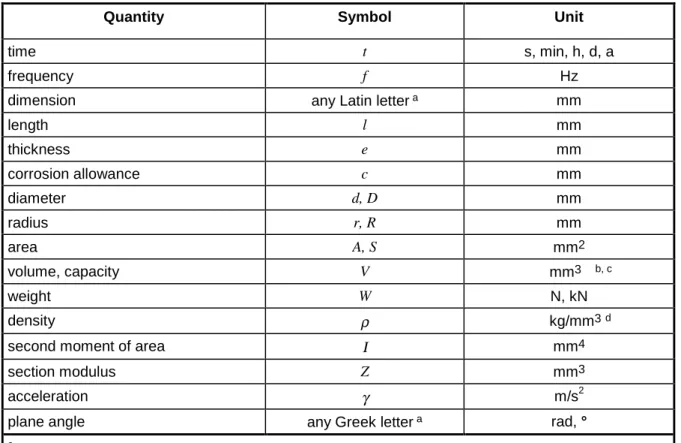
For the purpose of this part, the symbols and units of EN 764-2:2002 apply together with those given in Table 3.2-1 and Table 3.2-2.
Table 3.2-1 — Quantities for space and time
Quantity Symbol Unit
time t s, min, h, d, a
frequency f Hz
dimension any Latin letter a mm
length l mm
thickness e mm
corrosion allowance c mm
diameter d, D mm
radius r, R mm
area A, S mm2
volume, capacity V mm3 b, c
weight W N, kN
density
ρ
kg/mm3 dsecond moment of area
Ι
mm4section modulus Z mm3
acceleration
γ
m/s2plane angle any Greek letter a rad, °
a Symbols may use any lower-case letter, except for those defined elsewhere in this table. b Volume may also be given in m3
or L.
c Litre "L" is a non-SI unit which may be used with SI units and their multiples. d Density may also be given in kg/m3
EN 13445-2:2002 (E)
Issue 35 (2009-01)
11
NOTE Examples for compensation:⎯ application of higher safety factors in design;
⎯ performance of burst tests to demonstrate ductile material behaviour.
4.1.5
When measured on a gauge length other than that stated in 4.1.4, the minimum elongation after fracture
shall be determined by converting the elongation given in 4.1.4 in accordance with
⎯
EN ISO 2566-1:1999 for carbon and low alloy steels;
⎯
EN ISO 2566-2:1999 for austenitic steels.
4.1.6
Steels shall have a specified minimum impact energy measured on a Charpy-V-notch impact test specimen
(EN 10045-1) as follows:
⎯
≥
27 J for ferritic and 1,5 % to 5 % Ni alloy steels;
⎯
≥
40 J for steels of material group 8, 9.3 and 10
at a test temperature in accordance with Annex B, but not higher than 20 °C. The other requirements of Annex B
shall also apply.
4.1.7
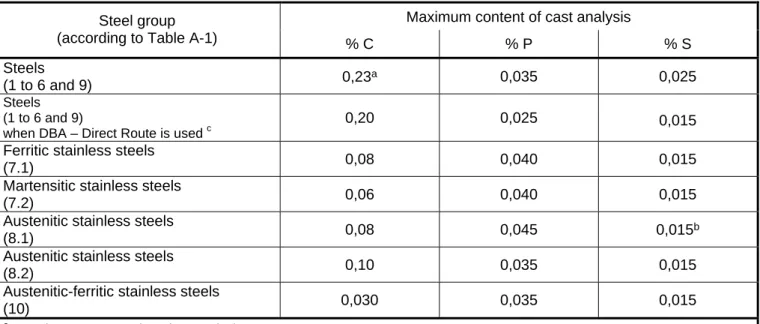
The chemical composition of steels intended for welding or forming shall not exceed the values in Table
4.1-1. Line 2 of the table refers to vessels or parts designed using Design by Analysis – Direct Route according to
Annex B of EN 13445-3:2002. Exceptions shall be technically justified.
Table 4.1-1 — Maximum carbon-, phosphorus- and sulphur contents for steels intended
for welding or forming
Maximum content of cast analysis
Steel group
(according to Table A-1)
% C
% P
% S
Steels
(1 to 6 and 9)
0,23
a0,035 0,025
Steels (1 to 6 and 9)
when DBA – Direct Route is used c
0,20 0,025
0,015
Ferritic stainless steels
(7.1)
0,08 0,040 0,015
Martensitic stainless steels
(7.2)
0,06 0,040 0,015
Austenitic stainless steels
(8.1)
0,08 0,045
0,015
bAustenitic stainless steels
(8.2)
0,10 0,035 0,015
Austenitic-ferritic stainless steels
(10)
0,030 0,035 0,015
a Maximum content of product analysis 0,25 %.
b For products to be machined a controlled sulphur content of 0,015 % to 0,030 % is permitted by agreement provided the
resistance to corrosion is satisfied for the intended purpose.
c
In addition the ratio on thickness reduction (ratio of initial thickness of slab/ingot to the thickness of the final plate) shall be equal or greater than:
⎯ 4 for NL2 steels and steels of material group 9;
EN 13445-2:2002 (E)
Issue 1 (2002-05)
12
4.2 Special provisions
4.2.1 Special properties 4.2.1.1 General
Where the behaviour of a material can be affected by manufacturing processes or operating conditions, to an extent that would adversely affect the safety or service life of the pressure vessel, this shall be taken into consideration when specifying material.
Adverse effects may arise from:
manufacturing processes: e.g. degree of cold forming and heat treatment;
operating conditions: e.g. hydrogen embrittlement, corrosion, scaling and ageing behaviour of the material after cold forming.
4.2.1.2 Lamellar tearing
Where lamellar tearing due to the joint design and loading needs to be addressed, steels shall be used which have improved deformation properties perpendicular to the surface and verified in accordance with EN 10164:1993. NOTE For guidance see EN 1011-2.
4.2.2 Design temperature above 20 °C
4.2.2.1 A material shall only be used for pressure parts within the range of temperatures for which the material properties required by EN 13445-3 are defined in the technical specification for the material. If the technical delivery condition does not contain the specific material values required for the allowable temperature TS the values required in EN 13445-3 for the design shall be determined by linear interpolation between the two adjacent values. Values shall not be rounded up.
For other than austenitic and austenitic-ferritic stainless steels, the specified value of ReH (Rp0,2) at room
tempe-rature (RT) may be used for tempetempe-ratures less than or equal to 50 °C. Interpolation between 50 °C and 100 °C shall be performed with the values of RT and 100 °C and using 20 °C as the starting point for interpolation. Above 100 °C linear interpolation shall be performed between the tabulated values given in the table.
4.2.2.2 As the impact properties may be affected by long or frequent holding of the material at elevated temperatures, it is presupposed that the temperatures and periods of exposure to elevated temperatures be recorded for review during in-service inspection. The influence of such exposure upon the lifetime expectancy shall be estimated and recorded.
For operations such as drying and cleaning of pressure vessels, steels with specified low temperature properties but without elevated temperature 0,2 % proof strength values may however be used at elevated temperatures for drying and cleaning processes provided that the values of 0,2 % proof strength used in design calculations for elevated temperatures shall be obtained by multiplying the specified minimum yield strength values at 20 °C by the factor given in Table 4.2-1.
EN 13445-2:2002 (E)
Issue 35 (2009-01)
Table 4.2-1 — Yield strength reduction factors for low temperature steels
Temperature
T
Steel
100 °C 200
°C 250
°C 300
°C
Quenched and tempered
0,75
0,68
0,64
0,60
Normalised or thermomechanically
treated
0,70 0,58 0,53 0,48
Interpolation shall be carried out as in 4.2.2.1.
4.2.3 Prevention of brittle fracture
The requirements in Annex B shall apply.
4.2.4 Design properties in the creep range
4.2.4.1
Creep properties of base material
For interpolation and extrapolation of creep properties given in the materials standard, see EN 13445-3:2002,
Clause 19.
When creep properties are not available from a materials standard, they shall be determined using EN 10291:2000.
4.2.4.2
Creep properties of weldments
Creep properties of weld joints subjected to stresses normal to the weld may differ significantly from those of the
base material.
For the design of vessels in the creep range, this is taken into account in EN 13445-3 by making use of a weld
creep strength reduction factor
zcobtained from tests on weldments. If no data are available, a default value of
zcis used.
An acceptable method to determine
zcby cross-weld tests is given in Annex C (see also [17]).
4.2.5 Specific requirements for steels for fasteners
Fasteners include bolts, studs and nuts.
Free cutting steel shall not be used. Bolting made of carbon steel or Ni alloy ferritic steel with > 3,5 % nickel shall
not be used above 300 °C.
The specified minimum tensile strength of bar material of ferritic and martensitic steel for bolts shall not exceed
1 000 N/mm
2. The minimum elongation of bar material after fracture shall be at least A
5= 14 %.
Impact requirements for ferritic and martensitic steels are specified in B.2.2.2.
Bolt material with a design temperature below − 160 °C shall be impact tested at − 196 °C.
Hydrogen embrittlement, fatigue or relaxation properties shall be taken into account where appropriate.
NOTE 1 Detailed requirements on the surface condition and internal soundness of the bar can be necessary for some applications.
NOTE 2 Materials for fasteners compliant with the requirements of this standard should be certified on the basis of EN 10204:1991.
EN 13445-2:2002 (E)
Issue 35 (2009-01)
13a
4.3 Technical delivery conditions
4.3.1 European
Standards
The European Standards for plates, strips, bars, tubes, forgings and castings for pressure purposes shall be used.
NOTE 1 Table E.2-1 provides an overview on materials for pressure purposes specified in harmonised standards.NOTE 2 Table E.1-1 contains an informative summary of European Materials Standards referred to and of European Standards covering components of pressure-bearing parts.
EN 13445-2:2002 (E)
Issue 35 (2009-01)
15
Annex A
(normative)
Grouping system for steels for pressure equipment
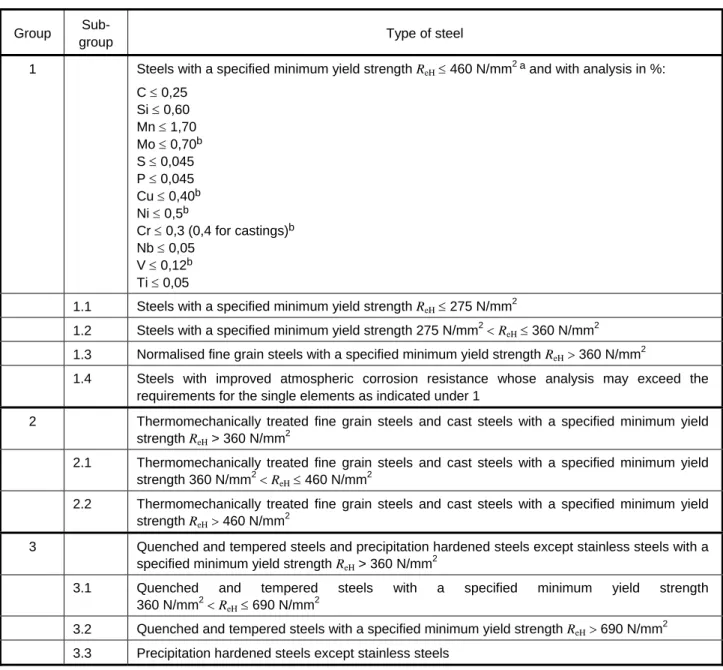
Steels shall be grouped as shown in Table A-1. The figures given in group 1 are referring to the ladle analysis of the
materials. The figures given in group 4 to 10 are based on the element content used in the designation of the
alloys.
Table A-1 — Grouping system for steels (extract from
CR ISO 15608:2000)
Group Sub-group Type of steel
1 Steels with a specified minimum yield strength ReH≤ 460 N/mm
2 a
and with analysis in %: C ≤ 0,25
Si ≤ 0,60 Mn ≤ 1,70 Mo ≤ 0,70b S ≤ 0,045 P ≤ 0,045 Cu ≤ 0,40b Ni ≤ 0,5b
Cr ≤ 0,3 (0,4 for castings)b
Nb ≤ 0,05 V ≤ 0,12b Ti ≤ 0,05
1.1 Steels with a specified minimum yield strength ReH≤ 275 N/mm
2
1.2 Steels with a specified minimum yield strength 275 N/mm2<ReH≤ 360 N/mm
2
1.3 Normalised fine grain steels with a specified minimum yield strength ReH> 360 N/mm
2
1.4 Steels with improved atmospheric corrosion resistance whose analysis may exceed the requirements for the single elements as indicated under 1
2 Thermomechanically treated fine grain steels and cast steels with a specified minimum yield strength ReH > 360 N/mm
2
2.1 Thermomechanically treated fine grain steels and cast steels with a specified minimum yield strength 360 N/mm2<ReH≤ 460 N/mm
2
2.2 Thermomechanically treated fine grain steels and cast steels with a specified minimum yield strength ReH> 460 N/mm
2
3 Quenched and tempered steels and precipitation hardened steels except stainless steels with a specified minimum yield strength ReH > 360 N/mm
2
3.1 Quenched and tempered steels with a specified minimum yield strength 360 N/mm2<ReH≤ 690 N/mm
2
3.2 Quenched and tempered steels with a specified minimum yield strength ReH> 690 N/mm
2
EN 13445-2:2002 (E)
Issue 35 (2009-01)
16
Table A-1 (concluded)
Group Sub-group Type of steel
4 Low vanadium alloyed Cr-Mo-(Ni) steels with Mo ≤ 0,7 % and V ≤ 0,1 % 4.1 Steels with Cr ≤ 0,3 % and Ni ≤ 0,7 %
4.2 Steels with Cr ≤ 0,7 % and Ni ≤ 1,5 %
5 Cr-Mo steels free of vanadium with C ≤ 0,35 %c
5.1 Steels with 0,75 % ≤ Cr ≤ 1,5 % and Mo ≤ 0,7 % 5.2 Steels with 1,5 % < Cr ≤ 3,5 % and 0,7 < Mo ≤ 1,2 % 5.3 Steels with 3,5 % < Cr ≤ 7,0 % and 0,4 < Mo ≤ 0,7 % 5.4 Steels with 7,0 % < Cr ≤ 10 % and 0,7 < Mo ≤ 1,2 % 6 High vanadium alloyed Cr-Mo-(Ni) steels
6.1 Steels with 0,3 % ≤ Cr ≤ 0,75 %, Mo ≤ 0,7 % and V ≤ 0,35 % 6.2 Steels with 0,75 % < Cr ≤ 3,5 %, 0,7 % < Mo ≤ 1,2 % and V ≤ 0,35 % 6.3 Steels with 3,5 % < Cr ≤ 7,0 %, Mo ≤ 0,7 % and 0,45 % ≤ V ≤ 0,55 % 6.4 Steels with 7,0 % < Cr ≤ 12,5 %, 0,7 % < Mo ≤ 1,2 % and V ≤ 0,35 %
7 Ferritic, martensitic or precipitation hardened stainless steels with C ≤ 0,35 % and 10,5 % ≤ Cr ≤ 30 %
7.1 Ferritic stainless steels 7.2 Martensitic stainless steels
7.3 Precipitation hardened stainless steels
8 Austenitic steels
8.1 Austenitic stainless steels with Cr ≤ 19 % 8.2 Austenitic stainless steels with Cr > 19 %
8.3 Manganese austenitic stainless steels with 4 % < Mn ≤ 12 % 9 Nickel alloyed steels with Ni ≤ 10 %
9.1 Nickel alloyed steels with Ni ≤ 3 % 9.2 Nickel alloyed steels with 3 % < Ni ≤ 8 % 9.3 Nickel alloyed steels with 8 % < Ni ≤ 10 % 10 Austenitic ferritic stainless steels (duplex)
10.1 Austenitic ferritic stainless steels with Cr ≤ 24 % 10.2 Austenitic ferritic stainless steels with Cr > 24 %
a In accordance with the specification of the steel product standards,
R
eH may be replaced by
R
p0,2 orR
t0.5. b A higher value is accepted provided that Cr + Mo + Ni + Cu + V ≤ 0,75 %.EN 13445-2:2002 (E)
Issue 35 (2009-01)
17
BLANK PAGE
EN 13445-2:2002 (E)
Issue 35 (2009-01)
18
EN 13445-2:2002 (E)
Issue 35 (2009-01)
19
BLANK PAGE
EN 13445-2:2002 (E)
Issue 35 (2009-01)
20
EN 13445-2:2002 (E)
Issue 35 (2009-01)
21
BLANK PAGE
EN 13445-2:2002 (E)
Issue 35 (2009-01)
22
EN 13445-2:2002 (E)
Issue 35 (2009-01)
23
BLANK PAGE
EN 13445-2:2002 (E)
Issue 35 (2009-01)
24
EN 13445-2:2002 (E)
Issue 35 (2009-01)
25
BLANK PAGE
EN 13445-2:2002 (E)
Issue 35 (2009-01)
26
EN 13445-2:2002 (E)
Issue 35 (2009-01)
27
BLANK PAGE
EN 13445-2:2002 (E)
Issue 35 (2009-01)
28
EN 13445-2:2002 (E)
Issue 35 (2009-01)
29
BLANK PAGE
EN 13445-2:2002 (E)
Issue 35 (2009-01)
30
EN 13445-2:2002 (E)
Issue 35 (2009-01)
31
Annex B
(normative)
Requirements for prevention of brittle fracture at low temperatures
B.1 General
This annex distinguishes between pressure equipment that has design temperature for normal operation higher or
lower than 50 °C.
For pressure equipment with normal operation temperatures higher than 50 °C B.5 applies. If B.5 is not applicable,
the following rules for lower normal operation temperatures shall be used.
For pressure equipment with design temperature equal to or less than 50 °C this annex specifies three alternative
methods for establishing criteria for the prevention of low temperature brittle fracture
1)of steels in the form of plate,
strip, tubes, fittings, forgings, castings, flanges, fasteners and weldments used in pressure parts. The criteria are
based on impact energy requirements at specified temperatures for the base material, heat affected zone (including
the fusion line) and weld metals.
The three methods are:
Method 1
Code of Practice:
a) Technical requirements based on the choice of T
R= T
27Jas specified in harmonised European
Material Standards and on the assumption that it is possible to achieve these minimum
properties after fabrication. Calculated from the principles of fracture mechanics used for method
2 for C and CMn steels with yield strength < 460 MPa and
b) based on operating experience for Ni-alloyed steels with Ni
≥
3 % up to 9 %, for austenitic steels
and for bolts and nuts.
Method 2
Method developed from the principles of fracture mechanics and from operating experiences:
A more flexible approach than method 1 for derivation of technical requirements applicable to C,
CMn and low alloy ferritic steels with a specified minimum yield strength
≤
500 MPa and for
austenitic-ferritic steels with a specified minimum yield strength
≤
550 MPa. This method can be
applied for these steels to a wider range of thicknesses and temperatures than method 1 because T
Rmust not be equal to T
27J(see Figures B.2–1 to B.2–11).
In addition for ferritic steels with max 355
MPa in PWHT condition operation experience was considered for higher thicknesses.
Method 3
The application of a fracture mechanics analysis. This general method is applicable to cases not
covered by methods 1 or 2. This method may also be used to justify deviations from the
requirements of method 1 or 2. Only general guidance is given on the use of this method which shall
only be used in agreement with the parties concerned.
Each of the three methods may be used independently. It is only necessary to satisfy the requirement of any one
method.
EN 13445-2:2002 (E)
Issue 35 (2009-01)
32
All applicable combinations of the temperatures
T
M(minimum metal temperature) and
T
S(temperature adjustment
term) shall be considered and the lowest possible
T
R-value (design reference temperature) shall be used for the
determination of the required material impact test temperature.
NOTE For definitions of temperature terms see 3.1.1 to 3.1.4.
B.2 Material selection and impact energy requirements
B.2.1 Introduction
The methods specified in B.2.2 (method 1) or B.2.3 (method 2) shall be used to determine the impact energy
required to avoid brittle fracture. Alternatively, B.2.4 (method 3) may be used to determine the required toughness.
The method used shall be fully documented, in order to ensure that compliance can be verified.
Reference thickness for constructional details is defined in Table B.4-1.
B.2.2 Method 1
B.2.2.1 General
Method 1 allows the selection of materials taken from harmonised European material standards with regard to
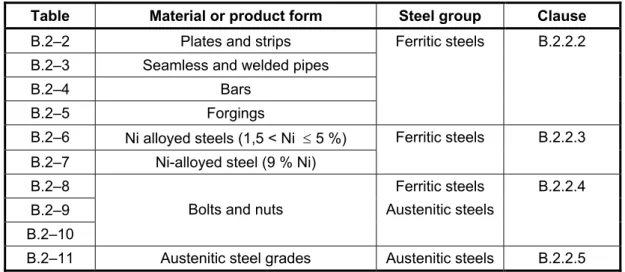
prevention of brittle fracture. Table B.2–1 gives an overview to the following tables by steel type and product form.
The weld metal, the heat affected zone and other parts affected by manufacturing processes shall satisfy the same
impact energy requirements as the guaranteed minimum properties for the base material at
T
Rgiven in the tables.
The Table lists design reference temperatures for maximum thickness at given strength levels represented by
steels from harmonised European material standards with guaranteed minimum strength and impact properties.
Where it is not possible to achieve these minimum properties after fabrication, a tougher starting material shall be
selected.
Table B.2–1 ― Guide to material selection
Table
Material or product form
Steel group
Clause
B.2–2
Plates and strips
B.2–3
Seamless and welded pipes
B.2–4 Bars
B.2–5 Forgings
Ferritic steels
B.2.2.2
B.2–6
Ni alloyed steels (1,5 < Ni
≤
5 %)
B.2–7
Ni-alloyed steel (9 % Ni)
Ferritic steels
B.2.2.3
B.2–8
B.2–9
B.2–10
Bolts and nuts
Ferritic steels
Austenitic steels
B.2.2.4
EN 13445-2:2002 (E)
Issue 35 (2009-01)
33
NOTE Requirements for austenitic-ferritic steels are only given in B.2.3 (method 2).
Where test pieces of at least 5 mm wide can not be obtained the material need not be subject to impact testing.
Values of the design reference temperature
T
Rshall be calculated from the metal temperature
T
Musing the values
of the temperature adjustment
T
Sgiven in Table B.2–12.
B.2.2.2 Ferritic steels
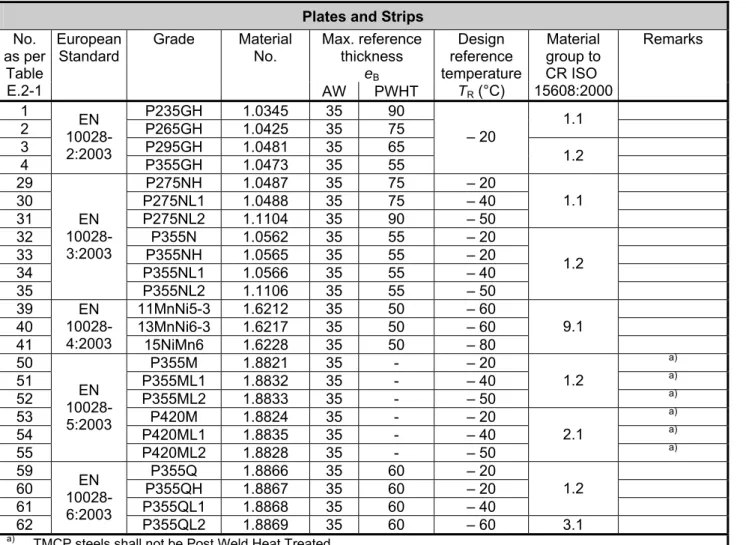
Tables B.2–2 to B.2–5 list ferritic steels taken from harmonised European material standards with specified impact
properties below –10 °C.
The tabulated value of
T
Ris based on the impact test temperature
T
KVfor
KV
= 27 J.
Table B.2–2 — General requirements for prevention of brittle
fracture with reference thickness for plates and strips
Plates and Strips
Max. reference
thickness
e
BNo.
as per
Table
E.2-1
European
Standard
Grade Material
No.
AW PWHT
Design
reference
temperature
T
R(°C)
Material
group to
CR ISO
15608:2000
Remarks
1 P235GH
1.0345
35
90
2 P265GH
1.0425
35
75
1.1
3 P295GH
1.0481
35
65
4
EN
10028-2:2003
P355GH 1.0473 35 55
– 20
1.2
29 P275NH
1.0487
35
75
–
20
30
P275NL1 1.0488 35 75
–
40
31
P275NL2 1.1104 35 90
–
50
1.1
32 P355N
1.0562
35
55
–
20
33 P355NH
1.0565
35
55
–
20
34
P355NL1 1.0566 35 55
–
40
35
EN
10028-3:2003
P355NL2 1.1106 35 55
–
50
1.2
39 11MnNi5-3
1.6212
35
50
–
60
40 13MnNi6-3
1.6217
35
50
–
60
41
EN
10028-4:2003
15NiMn6 1.6228 35 50
–
80
9.1
50 P355M
1.8821
35
-
–
20
a)51 P355ML1
1.8832
35
-
–
40
a)52 P355ML2
1.8833
35
-
–
50
1.2
a)
53 P420M
1.8824
35
-
–
20
a)54 P420ML1
1.8835
35
-
–
40
a)55
EN
10028-5:2003
P420ML2 1.8828 35 -
–
50
2.1
a)
59 P355Q
1.8866
35
60
–
20
60 P355QH
1.8867
35
60
–
20
61 P355QL1
1.8868
35
60
–
40
1.2
62
EN
10028-6:2003
P355QL2 1.8869 35 60
–
60
3.1
EN 13445-2:2002 (E)
Issue 35 (2009-01)
34
Table B.2–3 — General requirements for prevention of brittle fracture
with reference thickness for seamless and welded tubes
Seamless and welded tubes
Max. reference
thickness
e
BNo.
as per
Table
E.2-1
European
Standard
Grade Material
No.
AW PWHT
Design
reference
temperature
T
R(°C)
Material
group to
CR ISO
15608:2000
Remarks
231 P275NL1
1.0488
35
75
– 40
232 P275NL2
1.1104
35 75 – 50
1.1
233 P355N
1.0562
35
55
– 20
234 P355NH
1.0565
35 55 –
20
235 P355NL1
1.0566
35 55 –
40
236
EN
10216-3:2002
P355NL2
1.1106 35 55 –
50
1.2
248 P215NL
1.0451
10
10
–
40
a)249 P255QL
1.0452
35
40
–
50
250 P265NL
1.0453
25 25 –
40
1.1
251
26CrMo4-2
1.7219
15 40 –
60
5.1
252
11MnNi5-3
1.6212
35 40 –
60
9.1
253
EN
10216-4:2002
13MnNi6-3
1.6217
35 40 –
60
9.1
306 P275NL1
1.0488
35 40 –
40
307
P275NL2 1.1104 35 40 –
50
1.1
308
P355N 1.0562 35 40 –
20
309
P355NH 1.0565 35 40 –
20
310 P355NL1
1.0566
35
40
–
40
311
EN
10217-3:2002
P355NL2 1.1106 35 40
–
50
1.2
316 P215NL
1.0451
10
10
–
40
1.1
a)317
EN
10217-4:2002
P265NL 1.0453 16 16 –
40
1.1
a)
321 P215NL
1.0451
10
10
–
40
1.1
a)322
EN
10217-6:2002
P265NL 1.0453 25 25 –
40
1.1
a) a) Thickness limitation results from wall thickness limitation in the European material standard and in the European component
standards respectively.
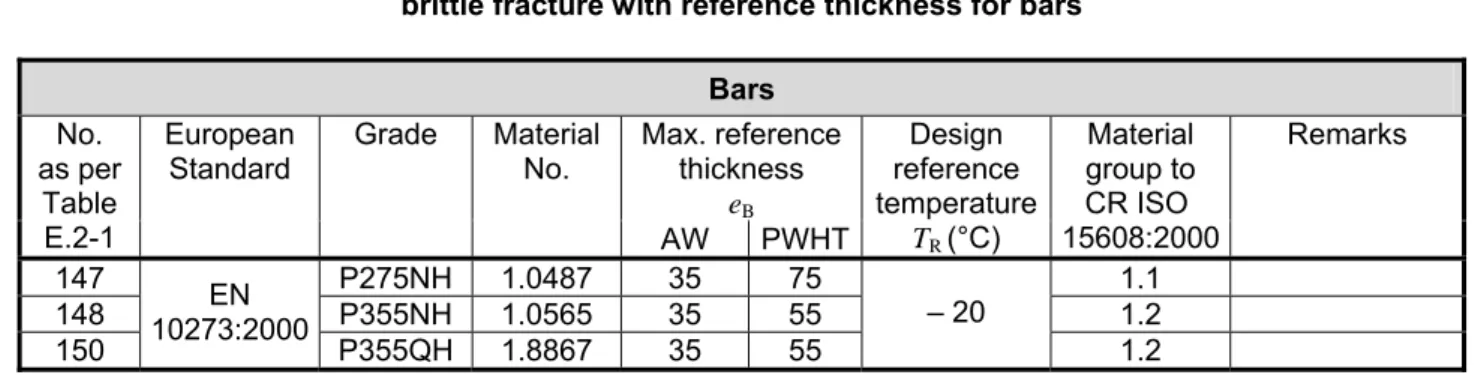
Table B.2–4 — General requirements for prevention of
brittle fracture with reference thickness for bars
Bars
Max. reference
thickness
e
BNo.
as per
Table
E.2-1
European
Standard
Grade Material
No.
AW PWHT
Design
reference
temperature
T
R(°C)
Material
group to
CR ISO
15608:2000
Remarks
147 P275NH
1.0487
35
75
1.1
148 P355NH
1.0565
35
55
1.2
150
EN
10273:2000
P355QH 1.8867 35
55
– 20
EN 13445-2:2002 (E)
Issue 35 (2009-01)
35
Table B.2–5 — General requirements for prevention of
brittle fracture with reference thickness for forgings
Forgings
Max. ref..
thickness
e
BNo.
as per
Table
E.2-1
European
Standard
Grade Material
No.
AW PWHT
Design
reference
temperature
T
R(°C)
Material
group to
CR ISO
15608:2000
Remarks
367 13MnNi6-3
1.6217
35
70
–
60
9.1
369
EN
10222-3:1998
15NiMn6 1.6228 35 50
–
80
9.1
378 P285QH
1.0478
35
85
–
20
1.2
380 P355QH1
1.0571
35
60
–
20
1.2
382
EN
10222-4:1998
P420QH 1.8936 35 50
–
20
3.1
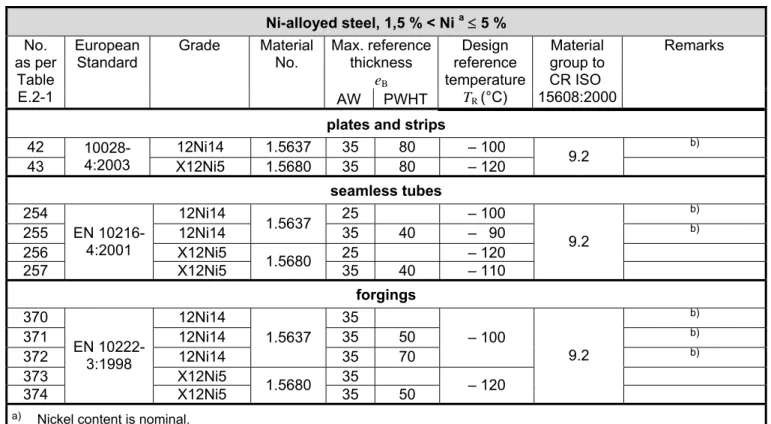
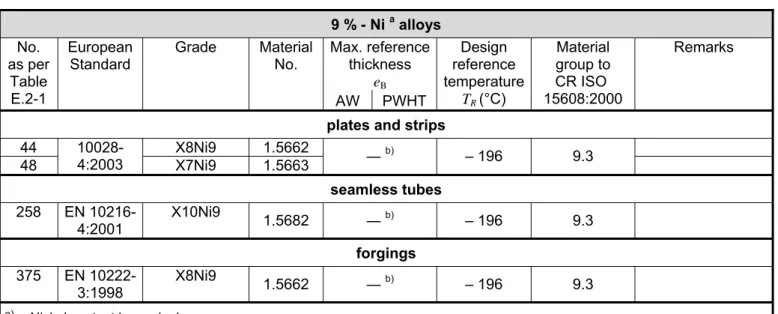
B.2.2.3 Ni –alloyed steels (Ni > 1,5 %)
Table B.2-6 lists Ni alloyed steels up to and including 5 % Nickel taken from harmonised European material
standards.
Table B.2-7 lists Ni alloyed steels with 9 % Nickel taken from harmonised European material standards.
The tabulated value of
T
Ris based on the impact test temperature
T
KVfor
KV
= 27 J.
EN 13445-2:2002 (E)
Issue 35 (2009-01)
36
Table B.2–6 — General requirements for prevention of brittle fracture with
reference thickness for Ni-alloyed steels with 1,5 % < Ni
≤
5 %
Ni-alloyed steel, 1,5 % < Ni
a≤
5 %
Max. reference
thickness
e
BNo.
as per
Table
E.2-1
European
Standard
Grade Material
No.
AW PWHT
Design
reference
temperature
T
R(°C)
Material
group to
CR ISO
15608:2000
Remarks
plates and strips
42
12Ni14
1.5637
35
80
– 100
b)43
10028-4:2003
X12Ni5 1.5680
35 80 –
120
9.2
seamless tubes
254 12Ni14
25
–
100
b)255 12Ni14
1.5637
35
40
– 90
b)256 X12Ni5
25
–
120
257
EN
10216-4:2001
X12Ni5
1.5680
35 40 –
110
9.2
forgings
370 12Ni14
35
b)371 12Ni14
35
50
b)372 12Ni14
1.5637
35 70
– 100
b)
373 X12Ni5
35
374
EN
10222-3:1998
X12Ni5
1.5680
35 50
– 120
9.2
a) Nickel content is nominal.
b) If used at – 105 °C (e. g. ethylene application), then 27 J shall be guaranteed at this temperature. NOTE Thickness limitation result from wall thickness limitation in European material standards.
EN 13445-2:2002 (E)
Issue 35 (2009-01)
37
Table B.2–7 — General requirements for prevention of brittle fracture
with reference thickness for Ni-alloyed steels with 9 % Ni
9 % - Ni
aalloys
Max. reference
thickness
e
BNo.
as per
Table
E.2-1
European
Standard
Grade Material
No.
AW PWHT
Design
reference
temperature
T
R(°C)
Material
group to
CR ISO
15608:2000
Remarks
plates and strips
44 X8Ni9
1.5662
48
10028-4:2003
X7Ni9 1.5663
―
b)
–
196 9.3
seamless tubes
258 EN
10216-4:2001
X10Ni9
1.5682
―
b)–
196 9.3
forgings
375 EN
10222-3:1998
X8Ni9
1.5662
―
b)–
196 9.3
a) Nickel content is nominal.
b) Materials can be used to maximum thickness permitted in harmonised European material standards.
B.2.2.4 Bolts and nuts
For other bolts and nuts than given in Table B.2-8 a specified impact energy of minimum 40 J is required at
T
KV= RT for
T
M=
≥
−
10 °C.
If
T
Mis lower than
−
10 °C, specified impact energy of minimum 40 J is required at
T
KV≤
T
M.
Except bolting material made from austenitic stainless steels specified in Table B.2-9 and B.2-10, bolting material
with a design temperature below –160 °C shall be impact tested at –196 °C.
Table B.2–8 — General requirements for prevention of brittle fracture
with reference thickness for nuts and bolts for
T
M≥
-10 °C
European Standard
Type of
material
a)Thickness
limitation
Impact test
KV for
T
M≥
-10 °C
Test temperature /
value
EN 10269:1999
All steels
According to
EN 10269:1999
According to
EN 10269:1999,
Table 4
According to
EN 10269:1999,
Table 4
5.6
M = < 39
M
≥
16
+ 20 °C / 40 J
EN ISO 898-1:1999
8.8
M = < 39
M
≥
16
+ 20 °C / 52 J
5
M = < 39
None
―
EN 20898-2:1993
8
M = < 39
None
―
EN 13445-2:2002 (E)
Issue 35 (2009-01)
38
Table B.2–9 — General requirements for prevention of brittle fracture with reference
thickness for nuts and bolts, bolting material according to EN 10269:1999
Type of material
Thickness
limitation
Impact test
T
MRemark
1.4307, 1.4301,
1.4303, 1.4404,
1.4401, 1.4948,
1.4919, 1.4941,
1.4980 a)
According to
EN 10269:1999,
Table 7
According to
EN 10269:1999,
Table 4
– 196 °C
Verification required
for diameter or
thickness > 20mm
1.4429, 1.4910,
According to
EN 10269:1999,
Table 7
According to
EN 10269:1999,
Table 4
– 273 °C
Verification required
for diameter or
thickness > 20mm
1.5523, 1.1133
1.6563
According to
EN 10269:1999,
Table 7
According to
EN 10269:1999,
Table 7
– 20 °C
―
d
≤
60 mm
– 60 °C
1.7218
60 <
d
≤
100 mm
According to
EN 10269:1999,
Table 7
– 50 °C
―
1.6582, 1.6580,
1.7225
According to
EN 10269:1999,
Table 7
According to
EN 10269:1999,
Table 7
– 40 °C
―
d
≤
45 mm
– 120 °C
1.5680
45 <
d
≤
75 mm
According to
EN 10269:1999,
Table 7
– 110 °C
―
1.5662
According to
EN 10269:1999,
Table 7
According to
EN 10269:1999,
Table 7 at – 196°C
– 196 °C
―
a) When used at -273 °C, verification testing at -196 °C according to Table 7 of EN 10269:1999 is required.
Table B.2–10 — General requirements for prevention of brittle fracture
with reference thickness for nuts and bolts
Standard
Type of material
a)Thickness limitation
T
M
Impact test
50
M
≤
39
EN ISO 3506-1:1997
A2, A3
70
M
≤
24
– 196 °C
None
50
M
≤
39
EN ISO 3506-1:1997
A4, A5
70
M
≤
24
– 60 °C
b)None
50
M
≤
39
EN ISO 3506-2:1997
A2, A3,
A4, A5
70
M
≤
24
– 196 °C
None
a)Starting material shall comply with EN 10269:1999. b) – 196 °C for studs
EN 13445-2:2002 (E)
Issue 35 (2009-01)
39
B.2.2.5 Lowest minimum metal temperatures for austenitic stainless steels
Solution annealed austenitic stainless steels according to Table B.2-11 can be applied down to temperature
T
Mwithout impact testing, except when impact testing is required by the material standard. E.g. EN 10028-7 requires
impact testing at room temperature above 20 mm thickness for use at cryogenic temperatures (below -75 °C
according to EN 10028-7:2007).
Table B.2–11 — Austenitic stainless steels and their lowest minimum metal
temperature
T
MMaterial
Material
number
T
M(in °C)
X1NiCrMoCu 31-27-4
1.4563
X1CrNiMoN 25-22-2
1.4466
X1CrNi 25-21
1.4335
X2CrNiMoN 17-13-3
1.4429
X2CrNiMoN 17-11-2
1.4406
X2CrNiMoN 18-12-4
1.4434
X2CrNiMo 18-15-4
1.4438
X2CrNiN 18-10
1.4311
X2CrNiMo 18-14-3
1.4435
X2CrNi 19-11
1.4306
−
273
X6CrNiTi 18-10
1.4541
X1CrNiMoCuN 25-25-5
1.4537
X1NiCrMoCuN 25-20-7
1.4529
X1CrNiMoCuN 20-18-7
1.4547
X1NiCrMoCu 25-20-5
1.4539
X2CrNiMoN 17-13-5
1.4439
X6CrNiMoTi 17-12-2
1.4571
X3CrNiMo 17-13-3
1.4436
X6CrNiMoNb 17-12-2
1.4580
X2CrNiMo 17-12-3
1.4432
X5CrNiMo 17-12-2
1.4401
X2CrNiMo 17-12-2
1.4404
X6CrNiNb 18-10
1.4550
X5CrNi 18-10
1.4301
X2CrNi 18-9
1.4307
GX5CrNi9-10
1.4308
GX5CrNiMo19-11-2
1.4408
GX2NiCrMo28-20-2
1.4458
GX2CrNi19-11
1.4309
GX2CrNiMo19-11-2
1.4409
EN 13445-2:2002 (E)
Issue 35 (2009-01)
40
Where the design temperature is below -105 °C weld metal and heat affected zones for austenitic stainless steels
shall meet additional requirements of part 4, clause 8 of this standard.
B.2.2.6 Temperature
adjustment
T
Sis a temperature adjustment which can be used under the conditions given in Table B.2–12.
Table B.2–12 — Temperature adjustment
T
sRatio of pressure induced principal membrane stress
and
maximum allowable design stress
Membrane stress
b
Condition
>
75 %
>
50 %
≤
75 %
≤
50 %
≤
50 MPa
Non welded,
post-weld heat
treated
condition
a0 °C
+
10 °C
+
25 °C
+
50 °C
As-welded condition
and reference
thickness
≤
35 mm
0 °C
0 °C
0 °C
+
40 °C
a Also applicable for equipment where all nozzles and non-temporary welded attachments are first
welded to vessel components and these sub-assemblies are post-weld heat treated before being assembled into the equipment by butt-welding, but the main seams are not subsequently post-weld heat treated.
b The membrane stress should take account of internal and external pressure and dead weight. For
walls and pipes of heat exchangers the restraint of free end displacement of the heat exchanger pipes should also be taken into account.