UDC: (811.111’276.6:81’366):(159.953:(341.18+331.1.)) DOI: 10.22190/JTESAP1603689E
ACROSS DISCIPLINARY STUDY OF MARKED THEME IN METHOD SECTIONS
Seyed Foad Ebrahimi
English Department, Shadegan Branch, Islamic Azad University, Shadegan, Iran 0098-9168853083 [email protected]
Abstract. The aim of this study is to analyze and compare types and discourse functions of marked theme used in research article method sections in the disciplines of Applied Linguistics, Psychology and Chemistry. The data for this study is 30 research article method sections (10 from each disciplines) published in 2011 to 2014 issues in ISI indexed journals. The corpus is analyzed based on the framework suggested by Ebrahimi (2014). Findings suggested that frequency of occurrence of marked theme types are guided and imposed by the nature of discipline of writers. Findings, in relation to discourse functions of marked theme, highlighted that discourse functions are required by disciplinary nature and rhetorical functions of research article method section. The findings of this study could have implications in teaching writing research article method sections to writers from concerned disciplines or disciplines close in nature.
Key words: marked theme, research article method section, discourse functions, disciplinary differences
1. INTRODUCTION
Writing research article is a challenging product at graduate and postgraduate level. Students at these two levels see that publishing in highly prestigious journals is the key to entering the disciplinary discourse community. Based on Swales (1990), discourse community members have different methods to communicate knowledge which are called genre. Among them is research article that has received a noticeable attention within last three decades.
To write a research article (RA), writers need to have two different kinds of knowledge. One is to know how research articles are organized into rhetorical sections and into move and steps. Second is to know that rhetorical sections of research article and more precisely moves and steps of research article have some discourse functions, which are performed and realized by selections of linguistic features. RA rhetorical sections have received different attentions from researchers in the last three decades. Among the RA rhetorical sections, introduction section has received the greatest attention (e.g., Fakri, 2004; Gledhill, 2000; Ozturk, 2007; Loi & Evans 2010; Martin and Perez, 2014; Samraj, 2002). Results and discussion section as well received noticeable attention (e.g., Brett, 1994; Holmes, 1997; Hopkins & Dudley-Evans, 1988; Williams, 1999; Yang & Allison, 2003; Peacock, 2002; Bitchener and Basturkmen, 2006; Basturkmen, 2012). RA method section compared
to other sections of RA has received little attention (e.g., Bruce, 1983, 2008; Swales, 1990; Lim, 2006; Gollin-kies, 2014). This little attention provoked this study to spot the light on this rhetorical section by the functional study of Halliday (1985) notion of theme.
Theme is an element in a particular structural configuration taken as a whole; it organises the clause as a message; and the message could configure as the theme and rheme (Halliday 1985). In exploring theme, Davis (1988) presents a two-part analysis, namely obligatory topic realized by the grammatical subject (GS) and marked themes (MT) (Example 1) realized by any element preceding the GS.
Example 1: In some cases the DMTA experiment was repeated on the
same specimen a second time to determine whether any changes had occurred in the material. (Che 8)
Theme has received attention from researchers in the last two decades (Lores, 2004; North, 2005; Jalilifar, 2009, 2010; Ebrahimi and Chan, 2015). Lores (2004) studied the realization of theme types in the moves of Applied Linguistics RA abstracts. She found significant differences in the realization of theme in the moves of RA abstracts. Jalilifar (2010) focused on the use of theme types in the ELT RA published in Iranian national journals compared to international highly prestigious journals. He found that writers’ backgrounds of English could affect the selection of theme types. Ebrahimi and Chan (2015) scrutinized functionally the unmarked theme realized in the grammatical subject position in RA abstracts from two disciplines of Economics and Applied Linguistics. They found that there are disciplinary differences in relation to the functions enacted by the use of the unmarked theme types.
The literatures reviewed indicate that little attention has been given to the study of MT in the RA sections across disciplines. Thus, this study intends to fill this gap in the literature by shedding the light on the types and discourse functions of MT in the RA method section across three disciplines, namely Applied Linguistics (AL), Psychology (Psy) and Chemistry (Che).
1.1. Research questions:
This study intends to answer the following questions:
1. What are the types of MT used in the RAM sections of three disciplines of AL,
Psy and Che?
2. What are the discourse functions performed by the use of MT types in the RAM
sections of three disciplines of AL, Psy and Che?
2. METHODOLOGY
2.1 Corpus
Table 1 Description of RA abstract corpus
AL Psy Che
No. of RAM Section 10 10 10
No. of journals from which RAM were taken 3 3 3
Length of RAM (range) 488-2174 885-2457 280-1778
Total number of words of RAM 10315 15672 11261
Total number of tokens 119 122 82
2.2. Framework of analysis
To analyze the data, Ebrahimi (2014) framework of analysis was used. He suggested this framework based on studies he carried out on the introduction section of RA from different disciplines. The framework is presented as below:
Table 2 Types and discourse functions of MT
Discourse Function
Definition (Function) Location in
Discourse (Data)
To show and describe the world-related or discourse-related context of the research or its findings and claims.
Validation To provide supportive evidences to validate the research hypothesis, findings, and conclusions. These supportive evidences could be sourced from the same study by reference to the tables, figures or from other studies in the
disciplinary discourse community.
Condition To report the real-world events and facts coming from process and
procedures of the experimental section, with cause and effect relationship. It also focuses on hypotheses which are not fully tested yet. These hypotheses result from observed phenomenon or unexplained or partial data that need to be clarified in the future.
Cause To help writers present the cause or the rationale for the research actions and hypothesis.
Purpose To present the purpose for which a research action was used.
Contrast To sharply juxtapos with the positive additive aims of addition CF, since these CFs are mainly used for negative expansion.
Addition To exemplify and elaborate by using opposition and expanding on the preceding statements through positive emphasis.
Means To introduce common processes and techniques of scientific investigation. Viewpoint To show overt viewpoint temporarily help writers to gain a high discourse
profile, similar to the participant role of We as subject.
Time To show time-related context of the research, research actions, findings and claims.
2.3. Procedure
able to compare and justify findings of the study. Second, three journals from each discipline were selected. The selections were based on the index of the journals. The journals are indexed in Thompson Routers Sci list. Third, ten RAs were selected from each discipline. The RAs are empirical RAs implying IMRD structure. Forth, RAM sections were extracted and analyzed based on Ebrahimi (1014) framework. Fifth, the findings were tabulated and discussed across the three disciplines.
To increase the validity of analyses, the data was reviewed several times by several reviewers to tone down any false detection of the types and discourse functions. This was important in the detection of the types and discourse functions of MT in the Psy and Che RAMs, as the researcher lacks thorough knowledge about the topics covered in these RAMs. In the cases that the researcher could not comprehend the content to detect the discourse function, the researcher discussed the content with an MA or PhD students researching in the same discipline.
3. RESULTS AND DISCUSSION
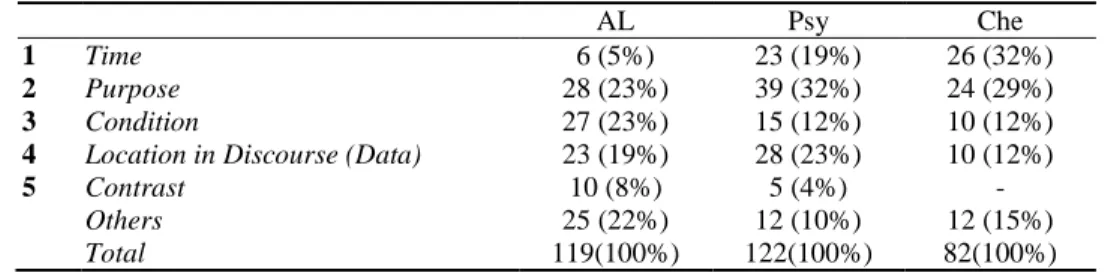
The marked theme types found in the data were time, purpose, condition, location in discourse (data) and contrast. The results obtained concerning the frequency and discourse functions of marked theme types are presented in Table 3 and 4 and discussed below.
Table 3 Frequency and Percentage of the MTs in RAM
AL Psy Che
1 Time 6 (5%) 23 (19%) 26 (32%)
2 Purpose 28 (23%) 39 (32%) 24 (29%)
3 Condition 27 (23%) 15 (12%) 10 (12%)
4 Location in Discourse (Data) 23 (19%) 28 (23%) 10 (12%)
5 Contrast 10 (8%) 5 (4%) -
Others 25 (22%) 12 (10%) 12 (15%)
Total 119(100%) 122(100%) 82(100%)
*Others include MTs, their manifestation did not reach 5% in at least one discipline.
Table 4 Type and Discourse Functions of the MTs in RAM
MT Discourse Function AL Psy Che
1 Time Chronological presentation of steps of data collection
or experiment
Chronological presentation of data analysis and measurement steps
*
Time period of research * *
2 Purpose Justify and rationalize sampling, procedures and data
analysis
3 Condition Report a research action in a cause and effect form
Justify a research action *
Present conditional situation of research *
4 Location in Discourse (Data)
Present discourse-related or real world-related context
5 Contrast Rationalize a step or action in method *
3.1. Time
Table 3 shows an obvious disciplinary difference between the three sets of RAMs in relation to the time MT. The Che and AL writers, in turn, showed the highest and lowest tendency towards including this MT (32% and 5% respectively). The highest employment of this MT by Che writers could tell us that ideas were chronologically organized in the Che RAMs (Bruce, 2008). Such chronological organization helped to provide the reader with a very straightforward description of the procedures, which, respectively, contributed to the better interpretation of RAMs.
As to the discourse functions served by the time MT, the results in Table 4 point to three discourse functions. This MT was used to present the steps in data collection or an experiment chronologically in the three sets of RAMs (Example 2-4). In AL and Psy RAMs, this discourse function was mostly used to show how writers narrowed down the available data based on the criterion of inclusion. This helped these writers to justify, rationalize, and increase the reliability of selected participants or corpora and, at the same time, increase the validity of study findings. In Che RAMs, this discourse function was used to show the steps in an experiment. Providing more details about how experiments were conducted could increase the interpretation of findings, which, in turn, could increase the reliability and validity of the study.
Example 2: In the first round, 250 criteria-meeting RAs published in the two 5-year periods (1985–1989; 2000–2004) were selected from the five journals, with five RAs each year/per journal. (AL 4)
Example 3: After informed consent was given, individual appointments with the children were made. (Psy 1)
Example 4: After being cooled to room temperature, the solution was filtered to remove a small amount of insoluble components. (Che 2)
The chronological presentation of the steps of the data analysis and measurement were a discourse function found to be enacted by the time MT in the AL and Che RAMs (Example 5-6). This discourse function helped these writers to stress the importance of the order of steps in data analysis and measurement. This discourse function suggests that a change in the order of steps while conducting an experiment or data analysis might result in different findings. Generally, this discourse function helped writers to present the reader with a clear and straightforward picture of how data were analyzed, how an experiment was conducted and how findings were reached.
Example 5: After establishing the corpora, we proceeded to identify the moves in each
RA in accordance with the five-step procedure suggested by Nwogu (1997). (AL 4)
Example 6: After removing the AOT, pieces of the consistent swelled gels were used to
determine the swelling gravimetrically. (Che 9)
Example 7: In October–November 1998, a scientific team from the Netherlands Institute of Applied Geosciences (NITG-TNO) onboard the R/V Zirfaea sampled the Netherlands Continental Flat (North Sea) at 12 sites [12 vibro-cores (6m barrel length) and 6 box-cores (1m barrel length)] (Table 1; Fig. 1) within the framework of a project for identification of tracers for sediment sources and transport in the North Sea [14]. (Che 4)
3.2. Purposes
A clear disciplinary difference was reported by the data analysis concerning the use of the purpose MT in the three sets of RAMs (see Table 3). The occurrence of this MT ranged between 23% in AL RAMs and 32% in Psy RAMs. In view of this finding, it could be suggested that the Psy writers inclined more towards providing the reader with an explanation of research actions and procedures. Such an explanation resulted in an RAM section, which was full of reason-result structures.
As for discourse functions, this MT was used to serve one discourse function across the three sets of RAMs (see Table 4). It was used to justify and rationalize sampling, procedures and data analysis (Example 8-10). These justifications and rationalizations through the application of the purpose MT could be discussed because writers needed to justify their data selection, procedure of data collection and analysis. They also through these justifications and rationalizations sought to validate their studies. Based on Lim (2006), the occurrence of these justifications and rationalizations was not surprising, since justifying sampling and data analysis procedures are two steps of the method section. Example 8: In order to explore intertextual links, the thesis introductions were analyzed for the number of citations used and whether these citations were integral, where the name of the cited author appears in the citing sentence, or non-integral, where the author appears in parenthesis or a footnote (Swales,1990). (AL 2)
Example 9: In order to form quantitative scales, leading diagnostic items were summed
after being coded as present or absent for all main affective and anxiety disorders or syndromes (i.e. initial codes 3 ¼ threshold were recorded as 1, while initial codes 1 ¼ absent and 2 ¼ sub threshold were recorded as 0). (Psy 7)
Example 10: In order to detect the cytotoxicity to Panc-28 cells, these cells were treated with limonin, LNA, ILNA, SG and LG at different (6.25, 12.5, 25, 50,100 and 200 μM) concentrations and incubated for 24, 48 and 72 h. (Che 6)
3.3. Condition
A marked disciplinary difference in the use of the condition MT was reported by the data analysis (see Table 3). The highest use was found in the AL RAMs (23%) and the lowest use in the Psy and Che RAMs (12%). This result might mean that AL writers were more inclined to clarify the conditions in which the study was conducted for the benefit of the reader. Such clarification could help the reader to reach a better interpretation of the findings.
Example 11: If the frequency of a move fell below 50%, it was considered “optional”. (AL 4)
Example 12: Where significant effects emerged, pair wise post-hoc comparisons with Bonferroni correction were performed. (Psy 3)
Example 13: When all the contour grid points are defined, the area, perimeteRDiameter of the particle are calculated and the energy-dispersive X-ray spectrum is recorded by performing cross scans over the particle. (Che 4)
To justify a research action was another discourse function fulfilled by use of the condition MT. This discourse function was found in AL and Psy RAMs (Example 14-15). This discourse function might reveal a writer’s tendency to present a plausible rationale and reasons for research actions. This practice increased the validity of the method section, which also contributed to the significance of the findings. Use of the condition MT to serve this discourse function could be justified according to Lim’s (2006) model of the move and step analysis of the method section. He pointed out that one step in the method section is “justifying the method of measuring variables”.
Example 14: Since most collocations are relatively rare, in comparison to individual words, a large corpus is required in order to find such items. (AL 3)
Example 15: As the correlation matrix did not display clear indication to group items, composite diagnostic indicators (i.e. total number of symptoms) of affective disorders and anxiety disorders were formed. (Psy 7)
Another discourse function enacted by this MT was to present the conditional situation of research (Example 16-17). This was the practice of the Psy and Che writers. This discourse function was used at the beginning of RAMs to help writers to direct the reader’s attention towards the conditional situation of research. This might tell us that there was a direct relation between the conditional situation in which research was conducted and its findings and outcomes. Thus, any change in the former may cause change to the latter.
Example 16: Under the auspices of the New England Women’s Health Project, BED
cases, psychiatric controls, and non-psychiatric controls were recruited using two recruitment avenues. (Psy 7)
Example 17: In some cases the DMTA experiment was repeated on the same specimen a
second time to determine whether any changes had occurred in the material. (Che 8)
3.4. Location in Discourse (Data)
In the case of the location in discourse (data) MT, the result obtained showed a marked disciplinary difference between the four sets of RAMs (see Table 3). The application of this MT fluctuated between 12% in the Che RAMs and 23% in Psy RAMs. This result could tell us that Psy writers preferred more to equip the reader with discourse-related or real world-related location of the presented ideas (Gosden, 1992). It also depicted the tendency of the Psy writers to present such information in the thematic position to help the reader to achieve a better understanding and interpretation of the ideas. More application of this MT in the Psy RAMs could be justified on the grounds that this MT, which frequently presented through “deictic forms”, could contribute directly to the textual cohesion and interaction of the RAMs (Gosden, 1992 p. 212).
discourse-related or real world-discourse-related context in which one step of the data collection and experiment were carried out (see Table 4). This discourse function, which was found in all three sets of the RAMs (Example 18-20), could be discussed based on the necessity to present the context of the data or the experiment. Lim (2006), in his move and step analysis of method sections, argued for the necessity of such information. Another justification for this discourse function came from the helpful role, which it plays in narrowing down data or an experiment to a specific context.
Example 18: In this context, account was given to the absence of teachable Model Answers for use in Italian academic law examinations. (AL 7)
Example 19: In the first phase, 8397 (94.5%) completed all questionnaire sections. (Psy 6)
Example 20: In lab environment, the sediment cores were split along into 2 halves. (Che 4)
3.5. Contrast
A clear disciplinary difference was revealed by the data analysis in relation to the manifestation of the contrast MT in the four sets of RAMs. While this MT was totally put aside in the Che RAMs, the highest manifestation was found in the AL RAMs (see Table 3). The manifestation of this MT in the AL RAMs could be discussed based on the importance of the contrast MT in text development since it helps writers to create the necessary polarizing tension to justify the research procedures.
According to Table 4, this MT was used to serve two discourse functions in the RAMs analyzed across three disciplines. With the exception of Che RAMs, this MT was used to rationalize a step or action in a method (Example 21-22). Such use could mean that when steps and actions in a method are rationalized, the findings based on such method are more valid and reliable. These validity and reliability contributed directly to the significance of findings that respectively increased the chance of publication.
Example 21: Though the interviews were organized around a set of prepared questions
(given in Appendix A), they proceeded in different directions depending on issues that were raised by the interviewees. (AL 2)
Example 22: Contrary to the standard teaching of mindfulness in DBT, in this study patients were instructed to practice the skills acquired during each session at home, a common requirement of all other skills training modules. (Psy 10)
Two disciplines of AL and Psy, this MT was used to describe the features of a sample (Example 23-24). This might indicate the necessity to describe the sample in soft science disciplines. This finding could support the findings of Lim (2006). In his model of the moves and steps of RAMs in business management, another soft science discipline, he included a description of the sample as one step in writing RAMs.
Example 23: Although the corpora are small, they would seem to offer a reliable assessment of the legal problem genre in the two languages since the rhetorical/linguistic patterns of discourse recurring in such texts appear in both languages. (AL 1)
4. CONCLUSION AND IMPLICATIONS
This study intended to analyze and compare types and discourse functions of MTs realized in RAMs across three disciplines namely AL, Psy and Che. The results indicated that selections of types of MT were imposed by nature of disciplines under study and nature of RAM section. The selection of the time, condition, contrast and validation MT were imposed by nature of disciplines. Writers in the disciplines of Che and Psy were imposed to select and include more of the time MT to present the sequences of experiments conducted in the studies. Writers from discipline of AL were imposed to include more of the condition, contrast, and validation MTs. These selections could be due to a) the disciplinary nature of AL in which writers have to present the condition under which the study was done, to validate their studies as they belong to the soft science and to contrast their study with earlier studies to create the necessary space for doing the study. The location in data was used in different rate in three disciplines, which indicates that this MT is more sensitive to the disciplinary nature compared to other MT types. Only the purpose of study MT was imposed by nature of RAM section. This is due to the nature of RAM section in which writers need to state the purpose of selections of data, participants, instruments and methods of analysis.
Concerning the discourse functions enacted by the use of MTs, it is evident that beside the location in discourse and purpose MTs, which performed only one discourse function that was shared by three discourse functions, other MTs performed discourse functions, which are imposed by nature of disciplines and nature of RAM section. It could be concluded that selection and discourse functions of MT types are practiced based on nature of disciplines and rhetorical functions of RAM section.
This study might have the following two implications for writers and readers. Concerning writers, findings presented in this study highlight the importance of MT in writing RAM section, thus instructors or course designers should help writers to have a conscious selection of appropriate MT types to show the intended meaning. As to the readers, the findings presented here could increase the reader’s attention to these types of theme and help better interpretation of information presented in the RAM section
REFERENCES
Basturkmen, H. (2012). A genre-based investigation of discussion sections of research articles in dentistry and disciplinary variation. Journal of English for Academic Purposes, 11(2), 134-144.
Becher, T, (1989). Academic Tribes and Territories: Intellectual Enquiry and the Cultures of Disciplines. The Society for Research into Higher Education and Open University Press, Milton Keynes, UK.
Becher, T. (1994). The significance of disciplinary differences. Studies in Higher Education , 19(2), 151-161.
Bitchener, J., & Basturkmen, H. (2006). Perceptions of the difficulties of postgraduate L2 thesis students writing the discussion section. Journal of English for Academic Purposes, 5(1), 4-18.
Brett, P. (1994). A genre analysis of the results section of sociology articles. English for Specific Purposes, 13, 47-59.
Bruce, I. (2008). Cognitive genre structures in Methods sections of research articles: A corpus study. Journal of English for Academic Purposes, 7(1), 38-54.
Davies, F. (1988). Marked theme as a heuristic for analyzing text-type, text and genre. In J. Pigue & D. J. Viera (Eds.) Applied linguistics: Theory and practice in ESP (pp. 45 – 79). Valencia: Valencia University Press.
Ebrahimi, S. F. (2014). Thematicity in English academic research articles across disciplines in hard and soft sciences, Unpublished PhD thesis, UPM, Malaysia.
Ebrahimi, S. F., & Chan, S. H. (2015). Research Article Abstracts in Applied Linguistics and Economics: Functional Analysis of the Grammatical Subject.Australian Journal of Linguistics, 35(4), 381-397.
Fakhri, A. (2004). Rhetorical properties of Arabic research article introductions. Journal of Pragmatics, 36(6), 1119-1138.
Gollin-Kies, S. (2014). Methods reported in ESP research articles: A comparative survey of two leading journals. English for Specific Purposes,36, 27-34.
Gosden, H. (1992). Discourse functions of marked theme in scientific research articles. Journal of English for Specific Purposes, 11, 207-224.
Gledhill, C. (2000). The communicative purpose of collocation in research article introductions. English for Specific Purposes, 19(2), 115-135.
Halliday, M. A. k. (1985). An introduction to functional grammar. London: Britain Edward Arnold.
Holmes, R. (1997). Genre analysis, and the social sciences: an investigation of the structure of research article discussion sections in three disciplines. English for Specific Purposes, 16(4), 321–337.
Hopkins, A., & Dudley-Evans, T. (1988). A genre-based investigation of the discussion sections in articles and dissertations. English for Specific Purposes, 7, 113–121.
Jalilifar, A.R. (2010). The status of theme in Applied Linguistics Articles. The Asian ESP Journal, 6 (2), 7-39.
Jalilifar, A. R. (2009). Research article in Applied Linguistics: A gender-based writing guide. Ahwaz: Shahid Chamran University Press.
Lim, J. M. H. (2006). Method sections of management research articles: A pedagogically motivated qualitative study. English for Specific Purposes, 25(3), 282-309.
Loi, C. K., & Evans, M. S. (2010). Cultural differences in the organization of research article introductions from the field of educational psychology: English and Chinese. Journal of Pragmatics, 42(10), 2814-2825.
Lores, R. (2004). On RA abstracts: From rhetorical structure to Thematic organization. Journal of English for Specific Purposes, 23, 280-302.
Martín, P., & Pérez, I. K. L. (2014). Convincing peers of the value of one’s research: A genre analysis of rhetorical promotion in academic texts. English for Specific Purposes, 34, 1-13.
North, S (2005). Disciplinary variation in the use of Theme in undergraduate essays. Journal of Applied Linguistics, 26 (3), 431-452.
Ozturk, I. (2007). The textual organisation of research article introductions in applied linguistics: Variability within a single discipline. English for Specific Purposes, 26(1), 25-38.
Peacock, M. (2002). Communicative moves in the discussion section of research articles. System, 30(4), 479-497.
Samraj, B. (2002). Introductions in research articles: Variations across disciplines. English for specific purposes, 21(1), 1-17.
Swales, J. M. (1990). Genre analysis: English in academic and research setting. Cambridge: Cambridge University Press.