TECHNICAL UNIVERSITY OF CLUJ-NAPOCA
ACTA TECHNICA NAPOCENSIS
Series: Applied Mathematics, Mechanics, and Engineering Vol. 60, Issue IV, November, 2017
STABILITY OF HUMAN BODY SUBJECTED TO VIBRATIONS ON A
VIBRATING PLATE
Mariana ARGHIR
Abstract: The paper presents a study of the stability of the human body, subjected to vibrations on a vibrating platform. The body of a human operator, subject to study is placed inclined on the vibrating plate, which runs in vertical vibrations, with constant frequency. The body is divided into six distinct segments, for which we know the mechanical characteristics, as determined by previous our studies and for which it has been studied the dynamics of individual and of entire system. Through this paper seeks to analyse the stability of each segment of the body and bring their contribution to the analysis of vibration imposed on human organism in vibrational environment.
Key words: stability of human body, general vibrations on the vibrating platform, constant frequency.
1. INTRODUCTION
It is considered a human subject placed on a vibrating platform, which produces vertical vibrations. The body is placed at 45 ° inclined towards horizontal plate. A suggestive image can be date as in figure 1 [1].
Fig. 1. Human body posture sitting on the vibrating platform [1]
The segments masses are: m1 – mass of the dorsal region leg (foot); m2 – mass of the crurale region of the previous leg (the calf of the leg); m3 – mass of the femoral region leg (femur); m4 – mass of the leg buttocks region; m5 – mass of the abdomen; m6 – mass of the thorax.
In the Figure 1 are presented the gravity forces for the body segments (Gi, i=1 to 6), the action force (F(t)), that acts over the body situated on the vibrating platform, and the linkage forces (N1 and N2) the normal reactions on the segments who are posted assumed horizontal on the platform.
An important fact is that the action force is situated at the distance „l” about the application gravity force for the „4” segment, because here there is vertical direction of the mass centre position of the mechanical system. But the action force is divided into two different components, because they are direct applied on the subjected components of the human body. F1(t) acts on the segment “1”, and F2(t) component of the active force acts on the “4” segment.
This work is the continuation of the work [1] in which were established the differential equations of dynamics of material system assimilated human body posted on a horizontal vibrating platform.
System integration of differential equations, in order to establish the laws of motion of the material is done with Runge-Kutta method of order as well as 4 and a half, with variable pitch, Matlab programming environment.
) t ( F
4
N
5
G
3
G G2
1
G
z
x
l
4
G
6
G
1
2. DIFFERENTIAL EQUATIONS OF THE
HUMAN BODY ON THE
VIBRATING PLATFORM
Using the system (12) of differential equations [1], that govern the biomechanical system assimilated with the human body subjected to vibrations on the horizontal vibrating plate, they need to be transformed into a new system of differential equations having the second time derivative of the unknowen quantity, expresed over the all unknowen as in following relations. All the mechanical characterics will be presented in the next paragraph of this paper.
2.1. Dorsal Region Leg
The dorsal region leg (foot) has only one unknown, because the segment “1”, it is considered that vertically vibrates only. The differential equation is given in the relation (1).
[
1 1V 2V 1 2V 2]
1V 2V 1 2V 21
1 F(t) (c c )z c z (k k )z k z
m 1
z&& = − + & + & − + +
(1)
2.2. Crurale Region of the Previous Leg
The crurale region of the previous leg named and “calf of the leg” has two differential equations due to its inclined position reported to the vibrating platform. They are “z2” for the vertical motion, and “x2” for the horizontal motion.
(
)
(
)
(
)
(
)
+ + + + + + + + + + + − + = 3 H 3 V 3 3 H 3 V 3 2 H 3 V 3 V 2 2 H 3 V 3 V 2 1 V 2 1 V 2 2 2 z k k 2 2 z c c 2 2 z k k 2 2 k z c c 2 2 c z k z c m 1 z & & & & & (2)(
)
(
)
(
)
(
)
− − − − − − + − = 2 H 3 V 3 2 H 3 V 3 3 H 3 V 3 3 H 3 V 3 2 2 x k k 2 2 x c c 2 2 x k k 2 2 x c c 2 2 m 1 x & & & & (3)2.3. Femoral Region Leg
The femoral region leg (femur) has two differential equations due to its inclined position. The unknowen are “z3” for the vertical motion, and “x3” for the horizontal one.
+ + + + + + + + − + + + − − + + + = 4 H 4 V 4 4 H 4 V 4 3 H 4 V 4 H 3 V 3 3 H 4 V 4 H 3 V 3 2 H 3 V 3 2 H 3 V 3 3 3 z ) k k ( 2 2 z ) c c ( 2 2 z ) k k k k ( 2 2 z ) c c c c ( 2 2 z ) k k ( 2 2 z ) c c ( 2 2 m 1 z & & & & & (4) − + − + − + − − − + − − − − + − = 4 H 4 V 4 4 H 4 V 4 3 H 4 V 4 H 3 V 3 3 H 4 V 4 H 3 V 3 2 H 3 V 3 2 H 3 V 3 3 3 x ) k k ( 2 2 x ) c c ( 2 2 x ) k k k k ( 2 2 x ) c c c c ( 2 2 x ) k k ( 2 2 x ) c c ( 2 2 m 1 x & & & & & (5)
2.4. Leg Buttocks Region
The leg buttocks region is posted in the horizontal possition, but, due to the likages with the neighboring segments, which are pitched at 45 °, the motion is considered to be in both directions. The system of differential equations for this segmen followes.
2.5. Abdominal Region
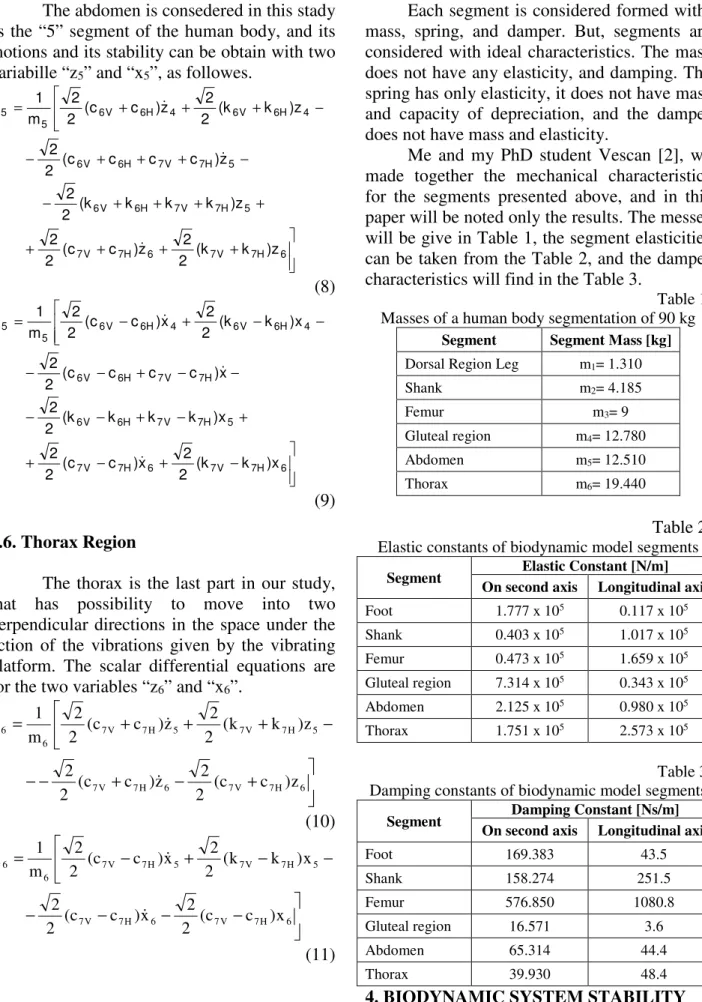
The abdomen is consedered in this stady as the “5” segment of the human body, and its motions and its stability can be obtain with two variabille “z5” and “x5”, as followes.
+ + + + + + + + − − + + + − − + + + = 6 H 7 V 7 6 H 7 V 7 5 H 7 V 7 H 6 V 6 5 H 7 V 7 H 6 V 6 4 H 6 V 6 4 H 6 V 6 5 5 z ) k k ( 2 2 z ) c c ( 2 2 z ) k k k k ( 2 2 z ) c c c c ( 2 2 z ) k k ( 2 2 z ) c c ( 2 2 m 1 z & & & & & (8) − + − + + − + − − − − + − − − − + − = 6 H 7 V 7 6 H 7 V 7 5 H 7 V 7 H 6 V 6 H 7 V 7 H 6 V 6 4 H 6 V 6 4 H 6 V 6 5 5 x ) k k ( 2 2 x ) c c ( 2 2 x ) k k k k ( 2 2 x ) c c c c ( 2 2 x ) k k ( 2 2 x ) c c ( 2 2 m 1 x & & & & & (9)
2.6. Thorax Region
The thorax is the last part in our study, that has possibility to move into two perpendicular directions in the space under the action of the vibrations given by the vibrating platform. The scalar differential equations are for the two variables “z6” and “x6”.
+ − + − − − + + + = 6 H 7 V 7 6 H 7 V 7 5 H 7 V 7 5 H 7 V 7 6 6 z ) c c ( 2 2 z ) c c ( 2 2 z ) k k ( 2 2 z ) c c ( 2 2 m 1 z & & & & (10) − − − − − − + − = 6 H 7 V 7 6 H 7 V 7 5 H 7 V 7 5 H 7 V 7 6 6 x ) c c ( 2 2 x ) c c ( 2 2 x ) k k ( 2 2 x ) c c ( 2 2 m 1 x & & & & (11)
3. MECHANICAL CHARACTERISTICS
Each segment is considered formed with: mass, spring, and damper. But, segments are considered with ideal characteristics. The mass does not have any elasticity, and damping. The spring has only elasticity, it does not have mass and capacity of depreciation, and the damper does not have mass and elasticity.
Me and my PhD student Vescan [2], we made together the mechanical characteristics for the segments presented above, and in this paper will be noted only the results. The messes will be give in Table 1, the segment elasticities can be taken from the Table 2, and the damper characteristics will find in the Table 3.
Table 1. Masses of a human body segmentation of 90 kg
Segment Segment Mass [kg]
Dorsal Region Leg m1= 1.310
Shank m2= 4.185
Femur m3= 9
Gluteal region m4= 12.780
Abdomen m5= 12.510
Thorax m6= 19.440
Table 2. Elastic constants of biodynamic model segments
Segment Elastic Constant [N/m] On second axis Longitudinal axis
Foot 1.777 x 10⁵ 0.117 x 10⁵
Shank 0.403 x 10⁵ 1.017 x 10⁵
Femur 0.473 x 10⁵ 1.659 x 10⁵
Gluteal region 7.314 x 10⁵ 0.343 x 10⁵
Abdomen 2.125 x 10⁵ 0.980 x 10⁵
Thorax 1.751 x 10⁵ 2.573 x 10⁵
Table 3. Damping constants of biodynamic model segments
Segment Damping Constant [Ns/m] On second axis Longitudinal axis
Foot 169.383 43.5
Shank 158.274 251.5
Femur 576.850 1080.8
Gluteal region 16.571 3.6
Abdomen 65.314 44.4
Thorax 39.930 48.4
Biodynamic system assimilated human body subjected to vibrations on a vibrating platform, is represented in the system of ordinal differential equations, nonhomogeneous, with constant coefficients, consisting of relationships (1) to (11).
The study was done on the two different directions of motion propagation. The vertical direction is given by the “z”, and the horizontal direction along the platform and parallel to it is the "x" coordinate.
4.1. VERTICAL STABILITY
4.1.1. Dorsal Region Leg
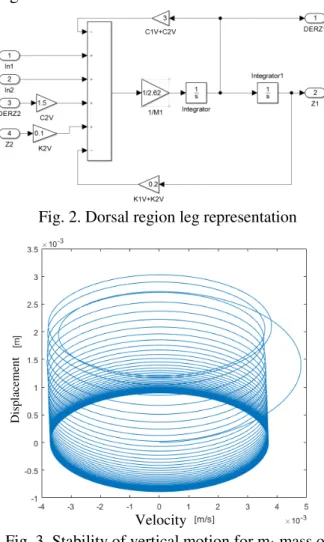
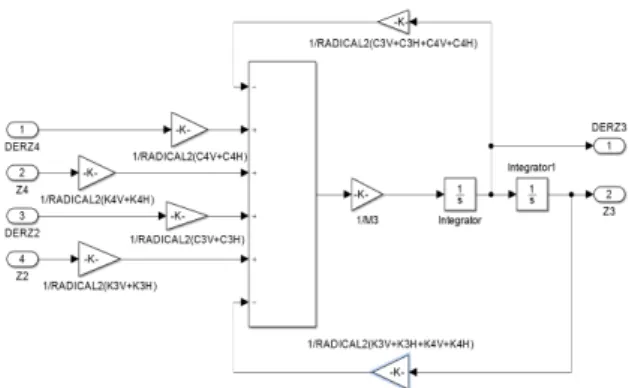
The (1) differential equation of the dorsal region leg (foot) was made with Runge-Kutta method. The Matlab representation in situated in the Figure 2, and its stability is given in the Figure 3.
Fig. 2. Dorsal region leg representation
Fig. 3. Stability of vertical motion for m1 mass of
the dorsal region leg
4.1.2. Crurale Region of the Previous Leg
The (2) differential equation of the crurale region leg (shank) was made with Runge-Kutta method. The Matlab representation in situated in the Figure 4, and its stability is given in the Figure 5.
Fig. 4. Representation in Matlab programming environment of m2 mass of shank
Fig. 5. Stability of vertical motion for m2 mass
of shank (crurale region of leg)
4.1.3. Femoral Region Leg
The femoral region leg (femur) will be presented in the Figure 6 with Runge-Kutta method integration for its differential equation of vertical displacement, and its stability in Matlab programming environment for the m3 mass realises the Figure 7. They characterise the vertical motion of the femur in the dorsal leg, as in the relation (4).
Velocity
Velocity
D
is
p
la
ce
m
en
t
D
is
p
la
ce
m
en
Fig. 6. Representation in Matlab programming environment of m3 mass of femur
Fig. 7. Stability of vertical motion for m3 mass
of femur
4.1.4. Leg Buttocks Region
The buttocks leg has the Matlab representation in the figure 8, and its stability is given in the figure 9.
Fig. 8. Representation in Matlab programming environment of m4 mass of buttocks
Fig. 9. Vertical motion stability of buttocks m4 mass
4.1.5. Abdomen
The (8) differential equation of the abdomen was made the Matlab representation in situated in the Figure 10, and its stability is given in the Figure 11.
Fig. 10. The m5 mass in Matlab representation
Fig. 11. The m5 stability in the vertical vibrations
D
is
p
la
ce
m
en
t
Velocity
Velocity
Velocity
D
is
p
la
ce
m
en
t
D
is
p
la
ce
m
en
4.1.6. Thorax
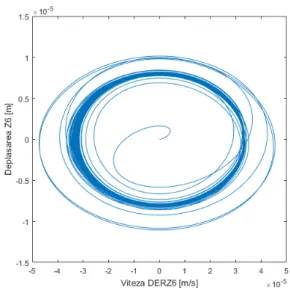
The thorax is last segment in this study, and it has the dynamics equation (10) for the vertical displacement. Its integration is given in the Figure 12, and the stability in the Figure 13.
Fig. 12. The Matlab representation for the m6 thorax
Vertical motion
Fig. 13. The m6 thorax mass stability
4.2. HOTIZONTAL STABILITY
In the horizontal direction was made one reprezentation in Matlab programming environement, for each coordinate of the biomechanical system assimilated with the human body.
But, for better management of work space, is assembling the five representations in one (Fig. 14) for the entire system.
4.2.1. Crurale Region of the Previous Leg
The (3) differential equation of the crurale region leg (shank) was made with Runge-Kutta method. The Matlab representation in situated in the Figure 14 for the horizontal direction, and its stability is in the Figure 15.
Fig. 15. The horizontal stability of the m2 mass
of the shank
4.2.2. Femoral Region Leg In the Figure
The femoral region leg (femur) will be presented in the Figure 14 with Runge-Kutta method integration for its differential equation of horizontal displacement, and its stability in Matlab programming environment for the m3 mass realises the Figure 16. It characterises the horizontal motion of the femur in the dorsal leg, as in the relation (5).
4.2.3. Leg Buttocks Region
The femoral region leg (femur) will be presented in the Figure 14 with Runge-Kutta method integration for its differential equation of horizontal displacement, and its stability in Matlab programming environment for the m3 mass realises the Figure 17. It characterises the
horizontal motion of the buttocks in the dorsal leg, as in the relation (7).
Fig. 16. The horizontal stability of the m3 mass
of the femur
Fig. 17. The horizontal stability of the buttocks m4 mass
4.2.4. Abdomen
The (9) differential equation of the abdomen was made the Matlab representation in situated in the Figure 14, and its horizontal stability is given in the Figure 18.
4.2.5. Thorax
Fig. 18. The m5 abdomen stability
Fig. 19. The m6 thorax stability
5. CONCLUSIONS
In this work it is proposed a new biomechanical model of human body subjected to connections on a vibrating platform.
The human body is divided into six different segments of it, and it sat in an inclined position towards the platform with 45 degrees.
Two segments are situated on the platform (foot and buttocks), and over them acts the active force having the distribution about them taking into account the masses of the segments.
Biomechanical system assimilated to the human body subjected to vibrations on a vibrating platform is a stable system. The platform makes the vertical vibrations with constant frequency of 30 Hz, and with an oscillation magnitude equal with 0.003m.
The study was conducted on two directions of propagation of vibrations.
Direction is vertical, so that the normal fluctuations of the platform are vertical. Depiction of the masses can be found in figures 3, 5, 7, 9, 11, 13. The vertical movement is stable for the human body. Direction of horizontal excitation arising
from the tilt of the body segments. Movement is stable, as the result of the figures 15, 16, 17, 18, and 19.
6. BIBLIOGRAPHY
[1] Arghir Mariana, Dynamics of Human Body Subjected to Vibrations nn a Vibrating Plate,
ACTA TECHNICA NAPOCENSIS; Series: Applied Mathematics, Mechanics, and Engineering, Vol. 60, Issue III, Pag. 331-336, Ed. UT Pres, ISSN 1221-5872, Cluj-Napoca, September, 2017.
[2] Sergiu Dan Vescan, Mariana Arghir, Contribution to the Study of Mechanical Properties of Human Body, ACTA TECHNICA NAPOCENSIS; Series: Applied Mathematics, Mechanics, and Engineering, Vol. 58, Issue IV, Pag. 613-618, Ed. UT Pres, ISSN 1221-5872, Cluj-Napoca, November, 2015.
Stabilitatea corpului uman supus la vibratii pe o placa vibratoare
Rezumat: Lucrarea prezinta un studiu al stabilitǎiiţ corpului uman, supus la vibratii pe o platforma vibratoare. Corpul operatorului uman, supus studiului este asezat inclinat pe placa vibratoare, care executa vibratii verticale, cu frecventa constanta. Corpul este divizat in sase segmente distincte, pentru care se cunosc caracteristicile mecanice, stabilite prin studii anterioare si pentru care s-a studiat dinamica individual si a ntregului sistem. Prin aceasta lucrarese cauta sa se analizeze stabilitatea fiecarui segment al corpului si isi aduce contributia la anliza vibratiilor impuse organismului uman in mediu vibrational.
![Fig. 1. Human body posture sitting on the vibrating platform [1]](https://thumb-us.123doks.com/thumbv2/123dok_us/7998647.2120743/1.892.115.443.719.928/fig-human-body-posture-sitting-vibrating-platform.webp)