UDC 629.463.083-049.6
V. Y. SHAPOSHNYK
1*1*Dep. «Cars and Cars Facilities», Dnipropetrovsk National University of Railway Transport named after Academician
V. Lazaryan, Lazaryan St., 2, Dnipro, Ukraine, 49010, tel. +38 (056) 373 15 19, e-mail [email protected], ORCID 0000-0003-4701-6491
THEORETICAL STUDIES ON THE PROCESS OF CHANGE OF THE
TECHNICAL CONDITION OF FREIGHT CARS IN OPERATION
Purpose. The scientific work is intended to investigate the technical condition of freight cars during their opera-tion. The said purpose involves solving the following tasks: 1) to describe the technical condition of a freight car during the maintenance and repair period; 2) to determine the dependences of the probability of a freight car being in working condition during the life cycle; 3) to specify the expression for the technical availability ratio of the car fleet. Methodology. To achieve the purpose, the author examined the methodological approaches to the definition of various stages of the freight car life cycle. The system of change and transition of the technical condition of the freight car is described using differential equations. Findings. In the case of an unstable process of changing the technical condition of a freight car, the probabilistic characteristic of the appropriate life cycle stage depends on the amount of time. The intensity of the input and output flows are correlated with each other, taking into account the probability of a freight car being at the appropriate stage of its life cycle. Originality. Transitions from one car life cycle to another occur in discrete steps, that is, such transitions are characterized by a random process. The probabil-ity of a freight car being at the appropriate life cycle is determined by its prior technical condition. The total value of the set of all possible conditions consists of the Markov chain for random processes with random states and a con-tinuous flow of time. The study resulted in obtaining, for the first time, of the dependence of the probability of a freight car being in working condition during the life cycle. Practical value. On the basis of the obtained defini-tion for the probability of the freight car being in working condidefini-tion the expression for the technical availability ratio of the car fleet was clarified.
Keywords: freight car; reliability; life cycle of the car; technical condition diagram; technical availability ratio; car fleet
Introduction
The main task of rail transport is to ensure
un-interrupted transportation process, the mandatory
condition of which is the safe railway operation [9,
17]. Successful implementation of the tasks facing
the railway needs to improve the technical level of
rolling stock, the introduction of modern
high-efficient constructive solutions, materials and
tech-nologies [12, 16, 18, 19]. In order to maintain
a high technical level of the car fleet, it is
neces-sary to introduce the modern technologies for
re-newal and increase of wear resistance of parts,
im-provement of the maintenance system of cars in
operation [4, 8, 10, 13, 15]. With the introduction
of new information technologies that enable the
automatic identification of cars and their individual
parts, even the normal operation of the car can be
viewed as a stand for reliability testing [6, 11]. The
analysis of publications on this problem indicates
the need for theoretical studies of the process of
changing the technical condition of freight cars in
operation [1, 7, 14].
Purpose
The main purpose of the work is to investigate
the process of changing the technical condition of
freight cars in operation. To achieve it, it is
neces-sary: 1) to describe the technical condition of the
freight car during maintenance and repair; 2) to
determine the dependences of the probability of a
freight car being in working condition during the
life cycle; 3) to specify the expression for the
tech-nical availability ratio of the car fleet.
Methodology
The freight car during its lifetime may be at
dif-ferent stages of the life cycle:
– in under-control operation;
– in good working condition;
– on maintenance (M, Mc-1, Mc-2);
– on roundhouse servicing (RS);
– on overall repairs (OR, OR with life
exten-sion);
– on storage;
– in a good non-working condition (idle).
Transitions from one life cycle to another occur
in discrete steps, that is, such transitions are
char-acterized by a random process [2]. The probability
of a freight car being at the appropriate life cycle is
determined by its prior technical condition. The
total value of the set of all possible conditions
con-sists of the Markov chain for random processes
with random states and a continuous flow of time.
In this case, there is a sequence of dependent
nical states [3]. The transition itself from one
tech-nical states
S
nto other
S
koccurs through the
ac-tions of the corresponding streams of events. Such
events are failure or restoration.
Let us denote the failure flow intensity rate as
, and the restoration flow intensity rate of the
technical condition of the freight car as
.
Characteristics of the corresponding technical
condition of the freight car at a certain stage of the
life cycle are given in Table 1.
T a b l e 1
Characteristics of the technical condition of the freight car during the life cycle
Stage of the relevant life cycle
Designation of tech-nical condition,
S
Failure intensity value, λ Restoration intensity rate of the technical condition, μ
Starting (initial) state Sо – –
Under-control operation Scon – con
Good working condition Sw – –
On maintenance SM M M
On maintenance Mc-1 SMc1 Mc1 Mc1
On maintenance Mc-2 SMc2 Mc2 Mc2
On roundhouse servicing SRS RS RS
On OR SOR SOR OR
On OR with life extension SORL ORL ORL
On storage Sst st st
Idle state Si i i
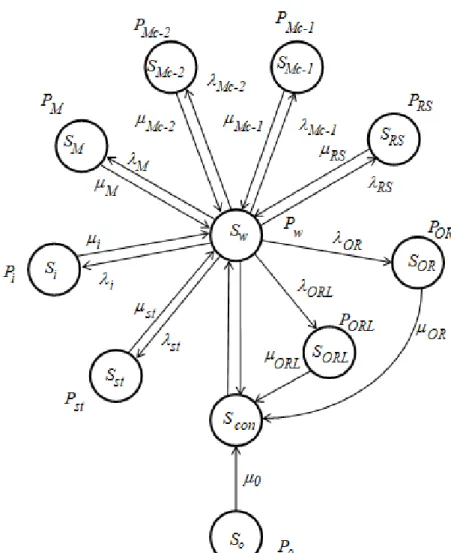
For the given technical conditions of the life
cycle of a freight car it is possible to propose
a marked diagram with corresponding transitions
(Fig. 1).
The indication of the technical condition of the
freight car is given in the circles, and the
transi-tions themselves from one condition to another are
indicated by arrows specifying the intensity of the
failure or restoration flows. Each technical
condi-tion of the freight car is characterized by the
corre-sponding probability:
–
Р
о– probability rate of freight car being in
its original condition (a test specimen undergoing
acceptance tests and having a trial run);
–
Р
w– probability rate of freight car being in
working condition;
–
Р
M– probability rate of carrying out
maintenance of the freight car;
–
Р
Mc2– probability rate of carrying Mc-2 of
the freight car;
–
Р
con– probability rate of being under the
control of operation;
–
Р
RS– probability rate of conducting RS of
the freight car;
–
Р
OR– probability rate of carrying out OR of
the freight car;
–
Р
ORL– probability rate of carrying out ORL
of the freight car;
–
Р
st– probability rate of the working
condi-tion of the freight car during storage;
–
Р
i– probability rate of the working
condi-tion of the freight car at idle.
The probability flow of the technical condition
of the freight car will be equal to the product:
,
і і і і
Р
Р
.
Fig. 1. Freight car technical condition diagram
Findings
In the case of an unstable process of changing
the technical condition of a freight car, the
proba-bilistic characteristic of the appropriate life cycle
stage depends on the amount of time, while the
intensity of the input and output flows are
correlat-ed with each other, taking into account the
proba-bility of a freight car being at the appropriate stage
of its life cycle.
о
о o
dP t
P t
dt
;
(1)
dP
t
t
t
con
w con con con
P
P
dt
;
(2)
dP
t
t
t
M
w M M M
P
P
dt
;
(3)
1
1 1 1
dP
t
t
t
Mc
w Mc Mc Mc
P
P
dt
; (4)
2
2 2 2
dP
t
t
t
Mc
w Mc Mc Mc
P
P
dt
; (5)
dP
t
t
t
RS
w RS RS RS
P
P
dt
;
(6)
dP
t
t
t
OR
w OR con con
P
P
dt
t
con con
Р
;
(7)
dP
t
t
t
ORL
w ORL con con
P
P
dt
t
con con
Р
;
(8)
dP
t
t
t
st
w st st st
P
P
dt
;
(9)
dP t
t
t
i
w i i i
P
P
dt
;
(10)
For the probability of freight car being in
work-ing condition, we use the followwork-ing differential
equation:
dP t
t t t
w
w o con con OR OR OR
P P P
dt
t
t
ORL ORL ORL RS RS RS
P
P
t
1
t
1 1
M M M Mc Mc Mc
P
P
2
t
2 2t
Mc Mc Mc st st st
P
P
t
i i i
P
(11)
If we solve the system of equations (1-11), we
can find the probability of the freight car being in
working condition (12):
2
2
2
w wР
о о о
t
Р
con con
t
con con
or con
con or
or
or
Р
t
con con
t
or or
t
or
or
con
orl
orl
con
orl
orl
t
orl orl
orl
orl
1
1
1
1
1
1
1
1
Р
M M M
t
M
M
Р
Mc
Mc
t
Mc
Mc
Mc
t
w
t
w
M
M
M
Mc
Mc
Mc
2
2
2
2
2
2
2
2
Р
Mc
Mc
t
Mc
Mc
Mc
Р
RS RS RS
t
RS
RS
t
w
t
w
Mc
Mc
Mc
RS
RS
RS
Р
st st st
t
st
st
Р
i i i
t
i
i
t
w
t
w
st
st
st
i
i
i
. (12)
Using the expression to find the probability of
the freight car being in the working condition (12),
2
2
1
2
Р
t
Р
t
n
m
оi оi оi
coni coni
coni coni
ori coni
R
A
m
tot
i
t
wi
coni coni
t
ori ori
t
ori
ori
coni ori
ori
ori
coni
orli
orli
coni
orli
orli
t
orli orli
orli
orli
1
1
1
1
1
1
1
1
Р
Mi Mi Mi
t
Mi
Mi
Р
Mc i Mc i Mc i
t
Mc i
Mc i
t
wi
t
wi
Mi
Mi
Mi
Mc i
Mc i
Mc i
2
2
2
2
2
2
2
2
Р
Mc
i Mc
i Mc
t
i
Mc
i
Mc
i
Р
RSi RSi RSi
t
RSi
RSi
t
wi
t
wi
Mc
i
Mc
i
Mc
i
RSi
RSi
RSi
Р
sti sti sti
t
sti
sti
Р
ii ii ii
t
ii
ii
t
t
sti wi
sti
sti
ii wi
ii
ii
. (13)
where
m– the number of freight cars in good
technical condition;
i
– the corresponding freight
car;
m
tot– total number of the car fleet units.
Originality and practical value
Having formed the Markov chain for random
processes of probability of the freight car being at
a corresponding life cycle with random conditions
and continuous flow of time, we for the first time
obtained dependence of probability of the freight
car being in the working condition during the life
cycle. On the basis of the obtained definition for
the probability of the freight car being in working
condition the expression for the technical
availability ratio of the car fleet was clarified.
Conclusions
The work considered change of technical
con-dition of freight cars in operation occurs during the
whole lifetime, and the technical condition can be
in different stages of the life cycle. Transitions
from one car life cycle to another occur in discrete
steps, that is, such transitions are characterized by
a random process.
LIST OF REFERENCE LINKS
1. Босов, А. А. Теоритические основы рационального содержания подвижного состава железных дорог : монография / А. А. Босов, П. А. Лоза. – Днепропетровск : Дриант, 2015. – 252 с.
2. Бочаров, П. П. Теория вероятностей. Математическая статистика / П. П. Бочаров, А. В. Печинкин. – Москва : Физматлит, 2005. – 296 с.
3. Булинский, А. В. Теория случайных процессов / А. В. Булинский, А. Н. Ширяев. – Москва : Физматлит, 2005. – 408 с.
4. Дюргеров, Н. Г. Восстановление и повышение износостойкости деталей вагонов : учеб. пособие для вузов ж.-д. трансп. / Н. Г. Дюргеров, И. С. Морозкин, В. Н. Кротов. – Ростов н/Д, 2011. – 255 с.
5. Корн, Г. Справочник по математике для научных работников и инженеров. Определения, теоремы, формулы : [пер. с англ.] / Г. Корн, Т. Корн. – Москва : Наука, 1974. – 832 с.
6. Мурадян, Л. А. Автоматична ідентифікація окремих частин транспортного засобу при впроваджені нових концепцій системи технічного обслуговування та ремонту / Л. А. Мурадян, В. Ю. Шапошник // Інформ.-керуючі системи на залізн. трансп. – 2017. – № 4. – С. 44–50.
8. Мурадян, Л. А. Повышение надежности грузовых вагонов с применением новых технологий изготов-ления и восстановизготов-ления рабочих поверхностей / Л. А. Мурадян, В. Ю. Шапошник, Д. А. Подосенов // Електромагнітна сумісність та безпека на залізничному транспорті. – 2016. – № 11. – С. 49–54.
9. Мямлин, В. В. Теоретические основы создания гибких поточных производств для ремонта подвижного состава : монография / В. В. Мямлин. – Днепропетровск : Стандарт-Сервис, 2014. – 380 с.
10. Мямлин, С. В. Определение стратегии технического обслуживания и ремонта вагонной техники / С. В. Мямлин, Л. А. Мурадян, В. Ю. Шапошник // Транспортная инфраструктура Сибирского региона : материалы VII-ой междунар. науч.-техн. конф. (29 марта – 1 апр. 2016 г.). – Иркутск, 2016. – Т. 2. – С. 369–373.
11. Мямлін, С. В. Проблема визначення терміну «надійність». Методологія побудови та вивчення надійно-сті вантажних вагонів / С. В. Мямлін, Л. А. Мурадян, Д. М. Барановський // Наука та прогрес транспор-ту. – 2015. – № 6 (60). – С. 110–117. doi: 10.15802/stp2015/57034
12. Остаточный срок службы детали и алгоритм управления фактическим состоянием грузового вагона с учётом требуемого уровня риска возникновения опасного отказа / П. А. Устич, А. А. Иванов, Ф. А. Мажидов, А. А. Салтыкова // News of science : Proceedings of materials the international scientific conference
(
Czech Republic, Karlovy Vary ; Russia, Moscow, 30–31 August 2015). – Karlovy Vary ; Kirov, 2015. – С. 83–94.13. Рейдемейстер, А. Г. Способы увеличения прочности боковых рам трехэлементных тележек / А. Г. Рей-демейстер, А. А. Шикунов // Наука та прогрес транспорту. – 2015. – № 5 (59). – С. 141–149. doi: 10.15802/stp2015/55351
14. Устич, П. А. Надежность рельсового нетягового подвижного состава / П. А. Устич, В. А. Карпычев, М. Н. Овечников. – Москва : УМЦ МПС, 2004. – 416 с.
15. Fomin, O. V. Improvement of upper bunding of side wall of gondola cars of 12-9745 model / O. V. Fomin // Metallurgical and Mining Industry. – 2015. – Vol. 7, No. 1. – P. 45–48.
16. Myamlin, S. V. The modeling of economic efficiency of products carriage-building plant in conditions of dy-namic pricing / S. V. Myamlin, D. Baranovskiy // Проблеми економіки транспорту : зб. наук. пр. Днiпро-петр. нац. ун-ту залізн. трансп. iм. акад. В. Лазаряна. – Дніпропетровськ, 2014. – Вип. 7. – С. 61–66. doi: 10.15802/pte.v0i7.32096
17. Pradhan, S. Application of Semi-Hertzian Approach to Predict the Dynamic Behavior of Railway Vehicles Through a Wear Evolution Model / Smitirupa Pradhan, Arun Kumar Samantaray, Ranjan Bhattacharyya / Journal of Friction and Wear. – 2017. – Vol. 38. – Iss. 6. – P. 437–443. doi: 10.3103/s1068366617060125
18. Shykunov, O. A. Three-element bogie side frame strength / О. А. Shykunov // Наука та прогрес транспорту. – 2017. – № 1 (67). – С. 183–193.doi: 10.15802/stp2017/92535
19. Zhao, F. Influence of small stress cycles on the fatigue damage of C70E car body / F. Zhao, J. Xie // Journal of Mechanical Engineering. – 2014. – Vol. 50. – Iss. 10. – P. 121–126. doi: 10.3901/jme.2014.10.121
В. Ю. ШАПОШНИК
1*1*Каф. «Вагони та вагонне господарство», Дніпропетровський національний університет залізничного транспорту імені
академіка В. Лазаряна, вул. Лазаряна, 2, Дніпро, Україна, 49010, тел. +38 (056) 373 15 19, ел. пошта [email protected], ORCID 0000-0003-4701-649
ТЕОРЕТИЧНІ ДОСЛІДЖЕННЯ ПРОЦЕСУ ЗМІНИ ТЕХНІЧНОГО
СТАНУ ВАНТАЖНИХ ВАГОНІВ ПІД ЧАС ЕКСПЛУАТАЦІЇ
циклу залежить від величини часу. Інтенсивність вхідного й вихідного потоків корелюються між собою з урахуванням імовірності перебування вантажного вагона на відповідній стадії його життєвого циклу.
Наукова новизна. Переходи з одного життєвого циклу вагона в інший відбуваються стрибкоподібно, тобто таким переходам властивий випадковий процес. Імовірність перебування вантажного вагона у відповідному життєвому циклі визначається його попереднім технічним станом. Загальна величина сукупності всіх мож-ливих станів складається з ланцюга Маркова для випадкових процесів із випадковими станами й безперерв-ним потоком часу. У результаті дослідження вперше отримана залежність імовірності перебування вантаж-ного вагона в робочому стані протягом циклу існування. Практична значимість. На основі отриманого визначення для ймовірності перебування вантажного вагона в робочому стані було уточнено вираз для коефіцієнта технічної готовності вагонного парку.
Ключові слова: вантажний вагон; надійність; життєвий цикл вагона; схема технічного стану; коефіцієнт технічної готовності; вагонний парк
В. Ю. ШАПОШНИК
1*1*Каф. «Вагоны и вагонное хозяйство», Днепропетровский национальный университет железнодорожного транспорта
имени академика В. Лазаряна, ул. Лазаряна, 2, Днипро, Украина, 49010, тел. +38 (056) 373 15 19, эл. почта [email protected], ORCID 0000-0003-4701-6491
ТЕОРЕТИЧЕСКИЕ ИССЛЕДОВАНИЯ ПРОЦЕССА ИЗМЕНЕНИЯ
ТЕХНИЧЕСКОГО СОСТОЯНИЯ ГРУЗОВЫХ ВАГОНОВ ПРИ
ЭКСПЛУАТАЦИИ
Цель. В научной работе необходимо исследовать техническое состояние грузовых вагонов при их экс-плуатации. Указанная цель предполагает решение следующих задач: 1) описать техническое состояние гру-зового вагона в период технического обслуживания и ремонта; 2) выяснить зависимости вероятности нахождения грузового вагона в рабочем состоянии в течение цикла существования; 3) уточнить выражение для коэффициента технической готовности вагонного парка. Методика. Для достижения поставленной цели автором были рассмотрены методологические подходы к определению различных стадий жизненного цикла грузового вагона. Система изменения и перехода технического состояния грузового вагона описана с помо-щью дифференциальных уравнений. Результаты. В случае неустановившегося процесса изменения техни-ческого состояния грузового вагона вероятностная характеристика соответствующей стадии жизненного цикла зависит от величины времени. Интенсивность входного и выходного потоков коррелируются между собой с учетом вероятности пребывания грузового вагона на соответствующей стадии его жизненного цик-ла. Научная новизна. Переходы с одного жизненного цикла вагона в другой происходят скачкообразно, то есть таким переходам присущий случайный процесс. Вероятность нахождения грузового вагона в соответ-ствующем жизненном цикле определяется его предыдущим техническим состоянием. Общая величина со-вокупности всех возможных состояний состоит из цепи Маркова для случайных процессов со случайными состояниями и непрерывным потоком времени. В результате исследования впервые получена зависимость вероятности пребывания грузового вагона в рабочем состоянии в течение цикла существования.
Практическая значимость. На основе полученного определения вероятности нахождения грузового вагона в рабочем состоянии было уточнено выражение для коэффициента технической готовности вагонного парка.
Ключевые слова: грузовой вагон; надежность; жизненный цикл вагона; схема технического состояния; коэффициент технической готовности; вагонный парк
REFERENCES
1. Bosov, A. A., & Loza, P. A. (2015). Teoriticheskie osnovy ratsionalnogo soderzhaniya podvizhnogo sostava zheleznykh dorog: Monografiya. Dnepropetrovsk: Driant. (in Russian)
2. Bocharov, P. P., & Pechinkin, A. V. (2005). Teoriya veroyatnostey. Matematicheskaya statistika. Moscow: Fizmatlit. (in Russian)
4. Dyurgerov, N. G., Morozkin, I. S., & Krotov, V. N. (2011). Vosstanovlenie i povyshenie iznosostoykosti detaley vagonov: Uchebnoe posobie dlya vuzov zheleznodorozhnogo transporta. Rostov-on-Don. (in Russian) 5. Korn, G., & Korn, T. (1974). Spravochnik po matematike dlya nauchnykh rabotnikov i inzhenerov:
Opredeleniya, teoremy, formuly. Perevod s angliyskogo. Moscow: Nauka. (in Russian)
6. Muradyan, L. A., & Shaposhnik, V. Yu. (2017). Automatic identification of separate parts of vehicle with iplementation of new concepts of maintenance and repair implementation. Informacijno-kerujuchi systemy na zaliznychnomu transporti, 4, 44-50. (in Ukranian)
7. Muradyan, L. A., Shaposhnik, V. Yu., & Mishchenko, A. A. (2016). Methodological fundamentals of determi-nation of unpowered rolling stock maintenance characteristics. Science and Transport Progress, 1(61), 169-179. doi: 10.15802/stp2016/61044 (in Russian)
8. Muradyan, L. A., Shaposhnik, V. Yu., & Podosenov, D. A. (2016). Improving the reliability of freight wagons with the use of new manufacturing technologies and regeneration of working surfaces. Electromagnetic com-patibility and safety on railway transport, 11, 49-54. (in Russian)
9. Myamlin, V. V. (2014). Teoreticheskie osnovy sozdaniya gibkikh potochnykh proizvodstv dlya remonta podvizhno-go sostava: Monografiya. Dnepropetrovsk: Standart-Servis. (in Russian)
10. Myamlin, S. V., Muradyan, L. A., & Shaposhnik, V. Yu. (2016). Opredelenie strategii tekhnicheskogo obsluzhivaniya i remonta vagonnoy tekhniki. Transportnaya infrastruktura Sibirskogo regiona: Materialy VII-oy Mezhdunar nauchno-tekhnicheskVII-oy konferentsii (Irkutsk, 29 march–1 april ),2, 369-373. (in Russian) 11. Myamlіn, S. V., Muradyan, L. A., & Baranovskiy, D. M. (2015). Problem of the definition the «reliability»
term. Methodology of construction and study the reliability of freight cars. Science and Transport Progress, 6(60), 110-117. doi: 10.15802/stp2015/57034 (in Ukranian)
12. Ustich, P. A., Ivanov, A. A., Mazhidov, F. A., & Saltykova, A. A. (2015). Ostatochnyy srok sluzhby detali i algoritm upravleniya fakticheskim sostoyaniem gruzovogo vagona s uchetom trebuemogo urovnya riska vozniknoveniya opasnogo otkaza. News of science: Proceedings of materials the international scientific con-ference (Czech Republic, Karlovy Vary ; Russia, Moscow, 30–31 August ), 83–94. (in Russian)
13. Reydemeyster, A. G., & Shikunov, A. A. (2015). Strength increase methods of the side frame of the bogie in three–piece trucks. Science and Transport Progress, 5(59), 141-149. doi: 10.15802/stp2015/55351 (in Rus-sian)
14. Ustich, P. A., & Karpychev, V. A., & Ovechnikov, M. N. (2004). Nadezhnost relsovogo netyagovogo podvizhnogo sostava. Moscow: UMTs MPS. (in Russian)
15. Fomin, O. V. (2015). Improvement of upper bunding of side wall of gondola cars of 12-9745 model. Metallur-gical and Mining Industry, 7(1), 45-48. (in English)
16. Myamlin, S. V., & Baranovskiy, D. (2014). The modeling of economic efficiency of products carriage-building plant in conditions of dynamic pricing. The Problems of the Transport Economics, 7, 61-66. doi: 10.15802/pte.v0i7.32096 (in English)
17. Pradhan, S. (2017). Application of Semi-Hertzian Approach to Predict the Dynamic Behavior of Railway Ve-hicles Through a Wear Evolution Model. Smitirupa Pradhan, Arun Kumar Samantaray, Ranjan Bhattacharyya.
Journal of Friction and Wear, 38(6), 437-443. doi: 10.3103/s1068366617060125 (in English)
18. Shykunov, O. A. (2017). Three-element bogie side frame strength. Science and Transport Progress, 1(67),
183-193. doi: 10.15802/stp2017/92535 (in English)
19. Zhao, F., & Xie, J. (2014). Influence of small stress cycles on the fatigue damage of C70E car body. Journal of Mechanical Engineering, 50(10), 121-126. doi: 10.3901/jme.2014.10.121 (in English)