Premna grandipaniculata
(Lamiaceae, Premnoideae),
a remarkable new species from north Myanmar
Yun-Hong Tan1,2, De-Rong Li3, Shi-Shun Zhou1,2, Yong-Jun Chen3,
Gemma L.C. Bramley4, Bo Li3
1 Southeast Asia Biodiversity Research Institute, Chinese Academy of Sciences, Yezin, Nay Pyi Taw 05282, Myanmar 2 Centre for Integrative Conservation, Xishuangbanna Tropical Botanical Garden, Chinese Academy of Sciences, Mengla, Yunnan 666303, China 3 College of Agronomy, Jiangxi Agricultural University, Nanchang, Jiangxi 330045, China 4 Herbarium, Royal Botanic Gardens Kew, Richmond, Surrey TW9 3AE, UK
Corresponding author:Bo Li ([email protected])
Academic editor:K. Ming | Received 3 November 2017 | Accepted 12 November 2017 | Published 29 January 2018
Citation: Tan Y-H, Li D-R, Zhou S-S, Chen Y-J, Bramley GLC, Li B (2017) Premna grandipaniculata (Lamiaceae, Premnoideae), a remarkable new species from north Myanmar. In: Jin X-H, Shui Y-M, Tan Y-H, Kang M (Eds) Plant diversity in Southeast Asia. PhytoKeys 94: 117–123. https://doi.org/10.3897/phytokeys.94.22033
Abstract
A remarkable new Premna species from Myanmar, P. grandipaniculata Y.H.Tan & Bo Li (Lamiaceae), is here described and illustrated. It differs from all known congeneric taxa by having huge complicated pani-cles which have tertiary branches formed by spike-like thyrses. In Premna, such a spike-like thyrse is found in P. bracteata and P. interrupta, but those species can be easily distinguished from P. grandipaniculata by their habit, indumentum, leaf size and inflorescence structure.
Keywords
Morphology, paniculiform inflorescence, Premna, spike-like thyrses
Introduction
Myanmar is an important component of the Indo-Burma biodiversity hot-spot (Conservation International, available at: http://www.biodiversityhotspots.org/xp/ Hotspots/indo_burma/) and its northern region emerges in the Himalaya Centre, one of the globally richest plant diversity centres (Rafiqpoor et al. 2005, Brooks et al. 2006). However, for nearly half a century, there has been a great shortage of critical floristic surveys in northern Myanmar. A recent surge of field explorations in this region coordinated by
http://phytokeys.pensoft.net
Copyright Yun-Hong Tan et al. This is an open access article distributed under the terms of the Creative Commons Attribution License (CC BY 4.0), which permits unrestricted use, distribution, and reproduction in any medium, provided the original author and source are credited.
Yunhong Tan et al. / PhytoKeys 94: 117–123 (2017) 118
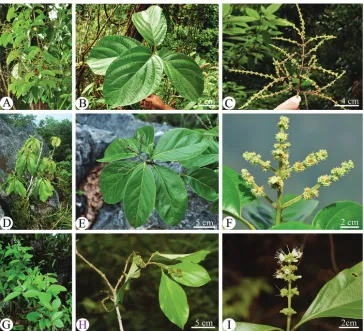
the Southeast Asia Biodiversity Research Institute, Chinese Academy of Sciences, has resulted in the discovery and description of new species (e.g. Aung et al. 2017, Liu et al. 2017, Tan et al. 2017, Yang et al. 2017a, b, c). During fieldwork in 2016 and 2017, the first author encountered and collected an unusual Premna L. plant, a huge woody climber bearing large, complicated paniculiform inflorescences and large, suborbicular, glabrous leaves. The terminal branches of the inflorescence are spike-like thyrses formed by sessile cymes laxly arranged on the axis. After checking and comparing the plant with all known congeneric taxa, it was found that such an inflorescence is similar to that of P. bracteata
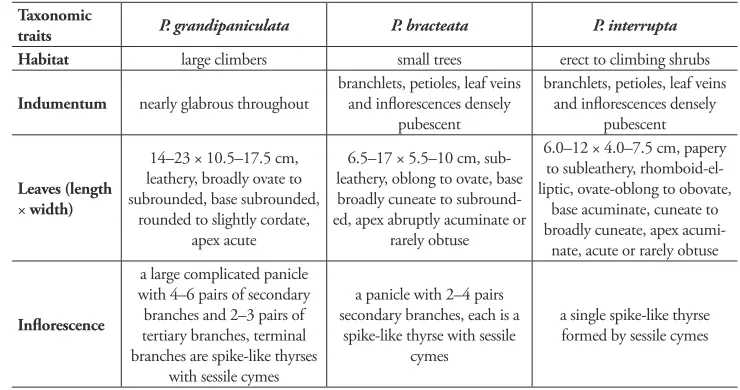
Wall. ex C.B. Clarke and P. interrupta Wall. ex Schauer, but the plant differs significantly from those two species in many aspects (Figure 1, Table 1). Thus, it was confirmed that it represents a remarkable undescribed new species and it is presented here.
Methods
Both herbarium specimens and living branches of the putative new species and of
P. bracteata and P. interrupta were observed under a stereo dissecting microscope (Ste-reoZoom Leica S8 APO, Leica Microsystems 2017) and measured using a ruler and a micrometer. High resolution images of the type specimens of P. bracteata (held at M and K, acronyms according to Thiers 2017) and of P. interrupta (held at BM, E, K, and P) were consulted on JSTOR Global Plants (http://about.jstor.org/, accessed 15 August 2017). Type specimens held at K, (barcode no. K001114139 for P. bracteata, K000884639, K000884640 and K001114151 for P. interrupta) were examined in the Herbarium. The conservation status of the new species was evaluated based on the guidelines of the International Union for Conservation of Nature (IUCN 2012).
Taxonomy
Premna grandipaniculata Y.H.Tan & Bo Li, sp. nov.
urn:lsid:ipni.org:names:77175495-1
Figures 1A–C, 2
Diagnosis. This species is distinguishable by its huge complicated paniculiform in-florescences. Premna grandipaniculata shares the same primary inflorescence structure with P. bracteata and P. interrupta, but is distinct from the latter two in its spike-like thyrses forming a panicle with tertiary branches (vs. with secondary branches in
P. bracteata, while without branches in P. interrupta) and in having nearly glabrous branchlets, petioles, leaves and inflorescences (vs. densely pubescent throughout in the latter two species) (Table 1).
Figure 1. Morphological comparisons amongst Premna grandipaniculata (A–C), P. bracteata (D–F) and
P. interrupta (G–I). A, D, G habit B, E, H branchlets with leaves C, F, I inflorescences.
Description. Woody climbers. Branches grey, terete, robust, nutant, without an interpetiolar ridge. Branchlets purplish brown, with densely small white elliptic len-ticel stomentose, without bracts at the base. Leaves simple, opposite-decussate, gla-brous, broadly ovate to suborbicular, leathery, 14–23 × 10.5–17.5 cm, apex acute, base subrounded, rounded to slightly cordate, margin entire; veins 4–7 pairs, abaxi-ally raised and adaxiabaxi-ally slightly compressed, secondary veins curved and jointed near margin; petiole 2.4–3.5 cm long, purplish dark green, slightly inflated, purplish furrowed on upper part. Inflorescences terminal, a large complicated panicle with tertiary branches, 18–30 cm long, 12–20 cm wide, peduncle nearly glabrous, ter-minal branches spike-like thyrses, 10–20 cm long, formed by sessile cymes laxly ar-ranged on axis; bracts ovate, 3.0–10 mm long, easily deciduous; bracteoles subulate, tiny. Calyx campanulate, 2.0–2.5 mm long, outside minutely brownish pubescent, 2-lipped; lips entire, or upper lip emarginate and ciliate, apex subrounded. Corolla
Yunhong Tan et al. / PhytoKeys 94: 117–123 (2017) 120
Table 1.Morphological comparisons amongst Premna grandipaniculata, P. bracteata and P. interrupta.
Taxonomic
traits P. grandipaniculata P. bracteata P. interrupta
Habitat large climbers small trees erect to climbing shrubs
Indumentum nearly glabrous throughout branchlets, petioles, leaf veins and inflorescences densely pubescent
branchlets, petioles, leaf veins and inflorescences densely
pubescent
Leaves (length
× width)
14–23 × 10.5–17.5 cm, leathery, broadly ovate to subrounded, base subrounded,
rounded to slightly cordate, apex acute
6.5–17 × 5.5–10 cm, sub-leathery, oblong to ovate, base broadly cuneate to subround-ed, apex abruptly acuminate or
rarely obtuse
6.0–12 × 4.0–7.5 cm, papery to subleathery, rhomboid-el-liptic, ovate-oblong to obovate,
base acuminate, cuneate to broadly cuneate, apex acumi-nate, acute or rarely obtuse
Inflorescence
a large complicated panicle with 4–6 pairs of secondary branches and 2–3 pairs of tertiary branches, terminal branches are spike-like thyrses
with sessile cymes
a panicle with 2–4 pairs secondary branches, each is a
spike-like thyrse with sessile cymes
a single spike-like thyrse formed by sessile cymes
around throat, 4-lobed; lobes broadly obovate, apex subrounded. Stamens 4, equal, exserted; anther purple. Ovary oblong, 1.0–1.5 mm long, glabrous, glandular; style white, slender, 3.5–4.5 mm long. Fruits drupaceous, narrowly obovate, 4.0–5.0 × 2.5–3.5 mm, yellowish brown.
Phenology. Flowering was observed from early March to April and fruiting from late May to late June.
Distribution. The species is currently known only from the type locality of Putao, Kachin State, northern Myanmar, grows in tropical montane forests, at an elevation 700–1200 m a.s.l.
Etymology. The specific epithet “grandipaniculata” indicates that the species bear large complicated paniculiform inflorescences.
Preliminary conservation status. This species is only known from a single local-ity in Myanmar and as the habitat, in which it is found, is threatened by deforestation (author’s personal observation), it is categorised as critically endangered under criteria B and D following IUCN Red List Categories (IUCN 2012).
Yunhong Tan et al. / PhytoKeys 94: 117–123 (2017) 122
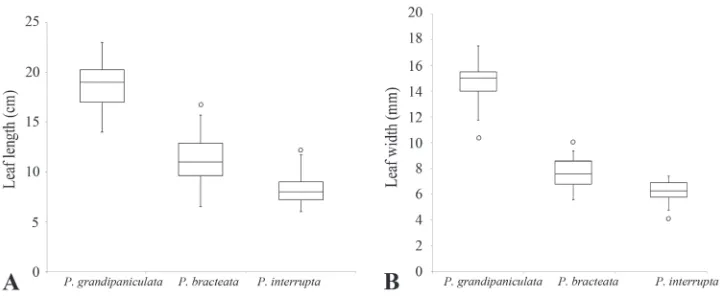
Figure 3. Box plots of two quantitative characters, leaf length (A) and leaf width (B), of Premna gran-dipaniculata, P. bracteata and P. interrupta. The boxes (rectangle region) represent the interquartile range and the whiskers (vertical line) represent the range excluding the outliers (circles). The three upper, middle and lower lines on the boxes represent the 75%, 50% and 25% of the variables, respectively. The upper and lower ends of the whiskers represent the maximum and minimum values of the variables, respectively. The circles represent the single value, where the variable value exceeds 1.5 times the difference between the 75% and 25%.
Geographically, P. bracteata is mainly recorded from the southern and eastern slopes of the Himalayas with several collections from Bangladesh, Bhutan, Myanmar, north eastern India and southeast Tibet of China and has also been collected from a rare and isolated population in Xishuangbanna, south Yunnan of China (Chen and Gilbert 1994, Govaerts et al. 2008, unpublished data). Premna interrupta frequently occurs from southwest China (Guangxi, Guizhou, Sichuan, Xizang and Yunnan prov-inces) to southern and south east Asia (Bangladesh, Bhutan, Cambodia, Laos, Myan-mar, north eastern India, Nepal, Peninsular Malaysia, Thailand and Vietnam) (Chen and Gilbert 1994, Govaerts et al. 2008). In Myanmar, P. bracteata is recorded from Chin, Mandalay and Sagaing, while P. interrupta from Kachin, Rakhine and Sagaing (Kress et al. 2003). In Kachin States, the distribution of P. interrupta overlaps that of
P. grandipaniculata and their habitat and habit are also similar, but P. grandipaniculata
significantly differs from P. interrupta in morphology as mentioned above.
Acknowledgements
References
Aung YL, Jin X-H, Schuiteman A (2017) Coelogyne putaoensis (Orchidaceae), a new species from Myanmar. Phytokeys 82: 27–34. https://doi.org/10.3897/phytokeys.82.13172 Barthlott W, Mutke J, Rafiqpoor MD, Kier G, Kreft H (2005) Global centres of vascular plant
diversity. Nova Acta Leopoldina 92: 61–83.
Brooks TM, Mittermeier RA, da Fonseca GA, Gerlach J, Hoffmann M, Lamoreux JF, Mit-termeier CG, Pilgrim JD, Rodrigues AS (2006) Global biodiversity conservation priori-ties. Science 313: 58–61. https://doi.org/10.1126/science.1127609
Govaerts R, Paton A, Harvey Y, Navarro T (2008) World Checklist of Lamiaceae. The Board of Trunsteens of the Royal Botanic Gardens, Kew, published on the Internet. Available from: http://www.kew.org/wcsp/[accessed 2 November 2017]
Kress WJ, DeFilipps RA, Farr E, Yin Yin Kyi D (2003) A checklist of the trees, shrubs, herbs and climbers of Myanmar (revised from the original works by JH Lace, R. Rodger, HG Hundley and U Chit Ko Ko on the “List of trees, shrubs, herbs and principal climbers etc. recorded from Burma”). Contributions from the United States National Herbarium 45: 1–590. Liu Q, Zhou S-S, Li R, Zhang MX, Zyaw M, Lone S, Quan RC (2017) Bulbophyllum
putaoen-sis (Orchidaceae: Epidendroideae; Malaxideae), a new species from Kachin State, Myan-mar. Phytotaxa 305: 57–60. https://doi.org/10.11646/phytotaxa.305.1.9
IUCN (2012) IUCN Red List Categories and Criteria, Version 3.1 (2nd edn). Gland and Cam-bridge, 32 pp.
Tan Y-H, Li DR, Chen Y-J, Li B (2017) Premna bhamoensis (Lamiaceae, Premnoideae), a new species from Kachin State, northeastern Myanmar. PhytoKeys 83: 93–101. https://doi. org/10.3897/phytokeys.83.12869
Thiers B (2017) Index Herbariorum: A global directory of public herbaria and associated staff. New York Botanical Garden’s Virtual Herbarium. http://sweetgum.nybg.org/ih/[accessed 1 July 2017]
Yang B, Zhou S-S, Maung KW, Tan Y-H (2017a) Reinwardtia glandulifera (Linaceae), a new species from Kachin State, northern Myanmar. Phytotaxa 316: 297–300. https://doi. org/10.11646/phytotaxa.316.3.10
Yang B, Zhou S-S, Maung KW, Tan Y-H (2017b) Two new species ofImpatiens(Balsaminaceae) from Putao, Kachin State, northern Myanmar. Phytotaxa 321: 103–113. https://doi. org/10.11646/phytotaxa.321.1.4
Yang B, Zhou S-S, Liu Q, Maung KW, Li R, Quan RC, Tan Y-H (2017c) Coelogyne magnifica