O R I G I N A L A R T I C L E
Open Access
Isolation of two iron-reducing facultative
anaerobic electricigens and probing the
application performance in eutrophication
water
Xia Zhang
1,2, Hongpei Zhang
1,2, Chuan Wang
2, Qianru Chen
1,2, Yuqing Zhao
1,2, Qiaohong Zhou
2*and
Zhenbin Wu
2*Abstract
Purpose:Sediment microbial fuel cell (SMFC) is a promising bioremediation technology in which microbes play an important role. Electricigens as the bio-catalysts have effect on pollution control and electricity generation. It is of great significance to screen the microorganisms with the ability of generating electricity.
Methods:The SMFC anode biofilm was used as microbiological source to study the feasibility of electricigens with iron-reducing property for eutrophication water treatment. Preliminarily, we isolated 20 facultative anaerobic pure bacteria and evaluated their cyclic voltammogram (CV) through the three-electrode system and electrochemical workstation. The power generation performance of strains was verified by air-cathode microbial fuel cells (AC-MFCs) under different single carbon sources.
Result:According to its morphological, physiological, and biochemical characteristics, along with phylogenetic analysis, the two strains (SMFC-7 and SMFC-17) with electrical characteristics were identified asBacillus cereus. Compared with SMFC-7, SMFC-17 exhibited efficient NH4
+
-N and NO3−-N removal and PO4
3−-P accumulation from
eutrophic solution with a removal rate of 79.91 ± 6.34% and 81.26 ± 1.11% and accumulation rate of 57.68 ± 4.36%, respectively.
Conclusion:The isolated bacteria SMFC-17 showed a good performance in eutrophic solution, and it might be a useful biocatalyst to enable the industrialized application of SMFC in eutrophic water treatment.
Keywords:Sediment microbial fuel cell (SMFC), Electricigens, Cyclic voltammograms (CVs), Biocatalyst, Eutrophic water,Bacillus
Introduction
Eutrophication of water body has an important impact on the living environment of human beings (Morgane et al.,2019). The input of nutrients, such as the diffusion loss of nitrogen and phosphorus, is the main drivers of eutrophication (Beusen, Bouwman, Van Beek, Mogollón,
& Middelburg,2016). Exogenous pollution has been kept down to some extent with the strengthening of water pollution management and treatment, whereas the treat-ment of endogenous pollution has become the important issue of eutrophication treatment (Wang et al., 2017; Wang et al., 2019). As an important component of the water environment, the sediment presents not only a natural reservoir but also a potential source of long-term releasing contaminants to the water. Thus, the remedi-ation of sediment is the key link to improve the quality
© The Author(s). 2020Open AccessThis article is licensed under a Creative Commons Attribution 4.0 International License, which permits use, sharing, adaptation, distribution and reproduction in any medium or format, as long as you give appropriate credit to the original author(s) and the source, provide a link to the Creative Commons licence, and indicate if changes were made. The images or other third party material in this article are included in the article's Creative Commons licence, unless indicated otherwise in a credit line to the material. If material is not included in the article's Creative Commons licence and your intended use is not permitted by statutory regulation or exceeds the permitted use, you will need to obtain permission directly from the copyright holder. To view a copy of this licence, visithttp://creativecommons.org/licenses/by/4.0/.
* Correspondence:[email protected];[email protected]
2State Key Laboratory of Freshwater Ecology and Biotechnology, Institute of
Hydrobiology, Chinese Academy of Sciences, Wuhan 430072, People’s Republic of China
of the water environment (Karra et al., 2014; Li & Yu, 2015).
Sediment microbial fuel cells (SMFCs) have been used to utilize bioelectricity from water-based ecosystems, where electro-chemically active microbes metabolize biodegradable organic matter (OM) in sediments and produce electrons (Xu et al.,2017). Due to the capacities of power generation and pollution control, SMFCs have lots of potential for future application. For instance, SMFCs have been used for bioremediation of the overly-ing water in the sediment-water systems (Sajana, Ghan-grekar, & Mitra, 2013; Sajana, Ghangrekar, & Mitra, 2014), sediment remediation by biodegradation of or-ganic pollutants (Hong, Kim, & Chung,2010), and phos-phorus immobilization (Martins et al.,2014). As the bio-catalysts, electricigens play a role in pollution control and electricity generation. Electricigens are a kind of mi-croorganisms that can directly or indirectly oxidize and decompose pollutants to obtain electrons and transfer them to anode to generate current (Lovley, 2006). They may be denitrifying bacteria (Virdis, Rabaey, Rozendal, Yuan, & Keller, 2010; Xiao, Zheng, Wu, Yang, & Zhao, 2015), phosphorous accumulating bacteria (Tao et al., 2014), or bacteria that degrade other difficult pollutants (Pham et al.,2003; Xu et al.,2005; Biffinger et al.,2011). To date, many studies have focused on characterizing the microbiological community structure of the anode biofilm to analyze the microbial species (Ewing, Ha, & Beyenal, 2017; Kabutey et al.,2019; Xu et al.,2017). Re-ferring to the reported literatures on electricigens (Kumar, Singh, & Zularisam, 2016), we can speculate which bacteria in the biofilm play a role in electricity production. However, the specific electricity-producing properties under specific conditions still need to be fur-ther verified, because the electricity-producing proper-ties of each strain are different under different conditions. Moreover, the types of electricigens obtained by analysis were difficult to specific species. Therefore, it is of great significance to screen the microorganisms with the ability of generating electricity. Several studies have developed methods and devices that can be used for isolating electricigens, such as U-tube MFCs (Zuo, Xing, Regan, & Logan, 2008), WO3 nanocluster probe (Yang et al., 2016), and electrodeplate-culture (EPC) method (Ueoka, Kouzuma, & Watanabe, 2018). At present, there is no unified screening method for electri-cigens, and most of the electricigens are obtained through anaerobic separation technology. Wu et al. (2014) used traditional aerobic separation technology to obtain 3 electricigens from micro-oxygen anode. The screened electricigens had similar direct extracellular electron transfer mechanism, indicating that micro-oxygen anode could be oriented to screen for electrici-gens with similar electrochemical properties. Successive
experiments have proved that many iron-reducing bac-teria have the ability to produce electricity (Liu et al.,
2016; Liu & Wang,2016; Park et al.,2001) and most of
the electricigens are facultative anaerobic bacteria (Seo & Roh, 2018). Screening iron-reducing bacteria capable of rapidly transforming organic matter into electricity-producing bacteria has become an urgent need to pro-mote the development of MFC. It is a trend to isolate and screen iron-reducing bacteria suitable for MFC dir-ectly from well-functioning MFC anodes, so that the physiological conditions (such as pH, temperature, and electron donors) of the strains are close to their original habitats. Thus, we speculate that screening the micro-organism with iron-reducing property in the anode bio-film by micro-oxygen condition is beneficial to obtain the electrogenic microorganism with a similar property quickly.
In pursuance of our quest for the desired microbes, this research work presents the isolation and identifica-tion of two bacterial strains from a lab-scale SMFC used for the treatment of eutrophic water. The objectives of the study include the following: (1) verifying the feasibil-ity of the screening method through screening iron-reducing bacteria under micro-oxygen environment to obtain electricigens and (2) exploring the nitrogen re-moval performance and phosphorus accumulation effi-ciency of the isolated strains under experimental conditions to demonstrate the potential applications of the microbe in the treatment of eutrophic water bodies.
Materials and methods
Growth medium, inoculation, and cultivation
IRM and LB medium and then incubated at 30 °C for 3 days in an anaerobic incubator. This process was re-peated at least 5 times to obtain a batch of purified strains.
Electrochemical analysis
Three-electrode system was prepared for testing cyclic voltammograms (CVs) of strains, which consist of a working electrode, counter electrode, and saturated calo-mel reference electrode (SCE, Hg/Hg2Cl2saturated KCl, + 0.244 V vs. hydrogen standard electrode (SHE)). The purified strains were inoculated separately into IRM medium and cultured under anaerobic conditions for 3 days. Sixty milliliters of bacterial solution was taken under anaerobic conditions for CVs scanning. The CVs of the cell suspensions were obtained using a CS 2350 electrochemical workstation. The scan rate of 100 mV/s was employed over the range from−0.8 to 0.8 V.
To test the electricity production of strains that have obvious redox peaks, a series of membrane-free single chamber air-cathode microbial fuel cells (AC-MFCs, 28 mL working volume) were constructed to evaluate the current production of the purified strains under different single carbon sources. The reaction chamber is a cylin-der with a column length of 4 cm and an inner diameter of 4 cm. Both electrodes were carbon cloth (the area is 3.14 cm2). The air cathode is a platinum-loaded carbon cloth with a platinum loading of 0.5 mg cm−2and four layers of polytetrafluoroethylene (PTFE) coated on the air to prevent leakage and regulate oxygen permeation. The anode was treated with acetone for 24 h to remove some non-compatible impurities from the surface of the carbon cloth.
For the AC-MFCs inoculation, the pure bacteria under logarithmic stage were centrifuged and dissolved again in 50 mmol L−1PBS buffer (sterilization at 121 °C for 20 min), and this process was repeated 3 times. The bacter-ial suspension was mixed with a nutrient solution con-taining 20 mmol L−1 single electron donor (sodium citrate, glucose, sodium acetate, sodium lactate, sodium oxalate, glycerol) in a ratio of 1:5 and then inoculated into AC-MFCs. All operations are carried out under aseptic conditions. External resistance is 1000Ω, operat-ing at 30 ± 1 °C constant temperature. The output volt-age (V) of the AC-MFCs is measured using R6016/U (Shanghai Jisheng Electric) every 10 min.
16S rDNA gene sequencing and analysis
The single purified strains were used as template for PCR-mediated amplification of 16S rDNA with the uni-versal primers 27f and 1492r. The PCR amplification was performed in a 30-μL reaction volume containing 1
μL of DNA, 1μL of each primer (10 Mp), 15 μL of 2 × Power Taq PCR MasterMix, and 12 μL ddH2O. PCR
amplification was carried out with an initial pre-denaturation of DNA at 95 °C for 3 min, pre-denaturation at 95 °C for 30 s, annealing at 58 °C for 30 s, extension at 72 °C for 50 s, 30 cycles, and finally at 72 °C for 5 min. Agarose gel electrophoresis analysis was amplified by product PCR for sequence determination. The 16S rDNA gene sequences were queried against the Gen-Bank using the BioCloud (www.ezbiocloud.net/identify). Phylogenetic relationships were analyzed by the evolu-tionary distance matrix calculated using the neighbor-joining method with Kimura’s two-parameter method. A neighbor-joining tree was constructed with the program MEGA7.
Biochemical tests of the isolated strains were per-formed with Solarbio Gram stain kit andBacillus cereus
biochemical identification box.
Performance analysis of electricigens
Effects of temperature and pH The pure bacteria
under logarithmic stage were streaked on LB solid medium and placed in a constant temperature incubator at 4, 10, 20, 30, 35, 37, and 45 °C. To determine the optimum growth pH of the strain, the strain was inocu-lated in 50% LB liquid medium at a 1% inoculum, and the pH was adjusted to 4, 5, 6, 7, 8, and 9 with 1 M HCl and 1 M NaOH, respectively.
Iron reduction performance The pure bacteria under
logarithmic stage were centrifuged 3 times and reset in sterile water with an OD600 of 0.5. The bacterial liquid was inoculated into 50 mL iron-reducing medium (IRM) with different concentrations of ferric citrate (5 mM and 20 mM) at a 1% inoculum, respectively. The anaerobic bottle is filled with a sterile N2 (5 min) to maintain a micro-oxygen environment and then placed at 30 °C. The sample was centrifuged at 3500 r/min for 5 min every 24 h, and the contents of Fe(II) and Fe(III) in the supernatant were determined for 7 days. The medium without the addition of bacteria was blank control. All experiments were conducted in triplicate.
Nitrogen removal efficiency and phosphorus
inoculation amount and incubated at 30 °C for 7 days. The sample was centrifuged at 8000 r/min for 5 min every 24 h, and the contents of NO3−-N, NO2−-N, NH4+-N, and PO43− in the supernatant were determined for 7 days. The medium without the addition of bacteria was blank. All experiments were conducted in triplicate.
The trace element solution was Na2EDTA, 63.7 mg/L; MnCl2·4H2O, 5.06 mg/L; ZnSO4, 2.2 mg/L; FeSO4·7H2O, 5.0 mg/L; CaCl2, 5.5 mg/L; CuSO4·5H2O, 1.57 mg/L; Na2MoO4·4H2O, 1.1 mg/L; CoCl2·6H2O, 1.61 mg/L; and pH 7.0 ± 0.2.
Analytical methods
Cell density in the form of OD was measured against the blank using a spectrophotometer at an absorbance of 600 nm. The reduction of Fe(III), concentration of nitrate-nitrogen (NO3−-N), nitrite-nitrogen (NO2−-N), ammonium-nitrogen (NH4+-N), and phosphate (PO43
−-P) were measured by O-phenanthroline
spectropho-tometry, sulfamic acid method, sulfanilic acid method, Nessler’s reagent method, and persulfate digestion method, respectively (State EPA of China,2002).
In this study, the amounts of biological assimilation, organic nitrogen, gaseous nitrogen, and absorbance were not measured. Accordingly, the nitrogen removal effi-ciency was calculated only based on measured values of nitrate, nitrite, and ammonium in aqueous solutions.
The calculation formula is as follows (Islam, Ethiraj, Cheng, Yousuf, & Khan,2017):
RNð Þ ¼%
N O−3
iþ NO
−
2
iþ N Hþ4
i−N O
−
3
f−N O
−
2
f−N Hþ4
f
N O−3
iþ NO−2
iþ N Hþ4
i
100
Statistical analysis
The experimental data, which were statistically calcu-lated and drawn by office 2010 and origin 2019, were an-alyzed with analysis of variance (ANOVA) andttest. All data were presented as the mean value and standard de-viation (SD). The SPSS 18.0 was used to evaluate the sig-nificant differences among treatments by a one-way ANOVA test at the 0.05 probability level.
Results and discussion Strain selection
According to the difference of colonies on LB and ferric citrate solid medium, a total of 20 strains were obtained from the anode biofilm, which were numbered SMFC-1 to SMFC-20. The purified 20 strains and the blank cul-ture solution were tested for electrochemical activity. The peak value of pure bacterial suspension measured by cyclic voltammetry can represent the electrochemical activity of the strain (Wu et al.,2014). It was found that the system without adding microorganisms was no redox
peak in the cyclic voltammetry curve, indicating that the system itself had substantially no electrochemical activ-ity. The cyclic voltammetry curves of the strains SMFC-1, SMFC-7, SMFC-15, SMFC-17, and SMFC-20 (Fig. 1) show certain oxidation peaks or reduction peaks, indi-cating the selected microorganisms have different de-grees of electrochemical activity. We found that the strains SMFC7 and SMFC17 had significant redox peaks, which indicated that they had strong electrogenetic properties (Kim et al.,2002).
Voltage output
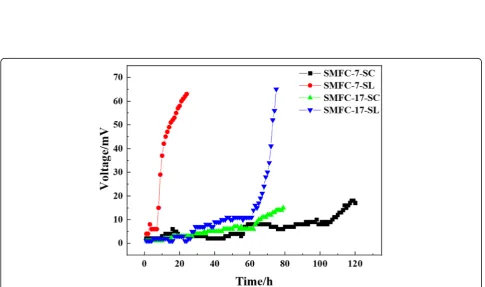
Strains SMFC-7 and SMFC-17 were inoculated into AC-MFC, respectively. The results (Fig. 2) showed that under the condition of a single carbon source, both strains SMFC-7 and SMFC-17 could produce electricity using sodium citrate and sodium lactate and could not use glucose, sodium acetate, sodium oxalate, or glycerol as a single carbon source to produce electricity. When strain SMFC-7 was used to produce electricity by so-dium lactate (SL), the voltage reached the maximum value of 63 mV in the first cycle after 24 h. When the electricity was produced by sodium citrate (SC), the volt-age reached the maximum value of 18 mV in the first cycle after about 120 h. When strain SMFC-17 was used to produce electricity by sodium lactate, the voltage reached the maximum value of 65 mV in the first cycle after 75 h. When the electricity was produced by sodium citrate, the voltage reached the maximum value of 15 mV in the first cycle after about 80 h of starting. It can be seen that strains SMFC-7 and SMFC-17 have certain similarities in electrical performance. Compared with the control experiment (the highest voltage value is 2 mV when glucose, sodium acetate, sodium oxalate, and gly-cerol are the single carbon sources), we demonstrated that strains SMFC-7 and SMFC-17 possess a significant ability to produce electricity.
While numerous electricigens have been observed, the majority of research focused on a group of highly elec-troactive species, such as Geobacter and Shewanella.
Geobacter, however, was a strict anaerobe with a rela-tively high level of electroactivity, but it was usually ac-companied by slower growth rates, which could pose challenges in real-world applications. On the contrary,
Fig. 1Cyclic voltammetry curves of strains:aSMFC-7,bSMFC-17,cSMFC-1,dSMFC-15,eSMFC-20
electricigens (Doyle & Marsili, 2018). Weak electrici-gens could be broadly distributed across nature (Cha-bert, Amin, & Achouak, 2015; Cournet, Délia, Bergel, Roques, & Bergé, 2010). Compared with strong elec-tricigens, weak electricigens could compensate for metabolic shortcomings and realize more stable bio-process in a mixed community (Doyle & Marsili,
2018). Bacillus is a type of weak electricigen. Bacillus
thuringiensis DRR-1 from cow rumen produced a small potential and current when cultivated in an MFC with an unspecified medium (Jothinathan & Wilson, 2017). Nonetheless, Bacillus spp. may also play a synergistic role in co-culture bioelectrochemical devices. When co-cultured Bacillus subtilis RH33 with
Shewanella oneidensis MR-1, Liu, Yu, Chen, and Chen (2017) found that the power output increased signifi-cantly and confirmed that MR-1 could efficiently utilize the high concentration of riboflavin produced by RH33 to improved MFC performance. Wu, Xiabo, et al. (2014) and You et al. (2018) also found that Ba-cillus could secrete flavins which were able to act as electron shuttles, strengthening the electron transfer from microorganism to the electrode. According to the above studies, Bacillus had the ability to secrete riboflavin. Previous researches have been reported that some species of Geobacter, Shewanella, Bacillus, and other microorganisms could rely on flavin mole-cules for mediated electron transfer (MET) (Kumar et al., 2016; Li, Tiedje, Chiu, & Worden, 2012; Wu et al., 2013; You et al., 2018). Therefore, as an elec-tron shuttles, riboflavin played an important role in extracellular electron transfer.
Identification of strains SMFC-7 and SMFC-17
Morphological character
The colony morphology of SMFC-7 on nutrient agar under aerobic conditions was faint yellow, domed, and was approximately 3 mm in diameter. The edge condi-tion was regular and the varnish was glossy. Compared with SMFC-7, the diameter of SMFC-17 is bigger, ap-proximately 5 mm under the same culture time, and its color is milk white. They were facultative anaerobe, Gram-positive bacteria. A subset of the study reported that electricigens are facultative anaerobic bacteria, e.g.,
Shewanella putrefaciens (Rabaey, Boon, Siciliano, Ver-haege, & Verstraete, 2004), Pseudomonas aeruginosa
(Nimje et al., 2009),Bacillus subtilis (Zhou et al.,2017), and Citrobacter freundii(Seo & Roh,2018). Since facul-tative strains possess many desirable properties com-pared to anaerobic strains, such as their ability to survive in anaerobic and aerobic conditions, these strains represent a promising exoelectrogenic species in engin-eering of biological catalysts for microbial electrochemistry.
Phylogenetic analysis
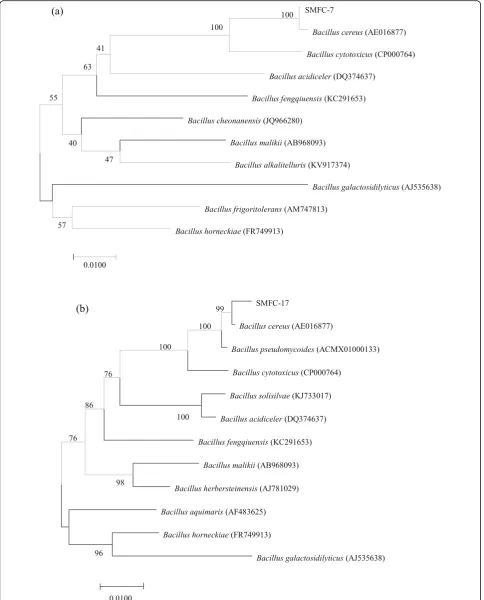
One thousand four hundred two base pairs and 1425 bp target fragments were amplified by PCR using strain SMFC-7 and strain SMFC-17 genome DNA as template. The sequence similarity of the 16S rDNA gene was com-pared with those of reference microorganisms obtained from GenBank data libraries. The result showed that the isolated strains SMFC-7 and SMFC-17 belonged to the genus Bacillus (Fig. 3). Bacillus cereus was the nearest neighbor of both strains, with a 16S rDNA sequence similarity of 100% (SMFC-7) and 99% (SMFC-17). In the systematic classification and identification, when the homology of 16S rDNA gene sequence is greater than 97%, it can be considered as one species (Embley & Stackebrandt, 1994). According to its morphological, physiological, and biochemical characteristics, along with phylogenetic analysis, these two strains were identified as Bacillus cereus (Table 1). The highest proportion of
Bacillus was found by testing the microbial community structure of the anode biofilm, reaching 22.5% of micro-bial community (Xu et al., 2017). Through our experi-ment, it can be proved that the type of electricigens present in the anode of SMFC belongs toBacillus.
Some performances of SMFC-7 and SMFC-17
Optimum growth conditions and growth curve
It was found that two strains both can grow in the range of 20–45 °C and grows fastest between 30–37 °C. From the growth curves of the two strains at different pH, we know that the optimum pH condition of SMFC-7 is 6–8, and the optimum pH condition of SMFC-17 is 6–9 (Fig. 4). Compared with SMFC7, SMFC17 is more tolerant to acid and base conditions.
Iron reduction rate
Most of the electricigens have iron reducing properties (Liu et al., 2016; Liu & Wang, 2016; Park et al., 2001). We enriched iron-reducing bacteria through SMFC anode biofilm and found that strains SMFC-7 and SMFC-17 had strong redox properties and could use or-ganic carbon sources to produce electricity. Electro-chemical experiment verified the feasibility of obtaining electricigens by screening iron-reducing bacteria. Test results of the iron reduction ability of two strains of electrogenic microorganisms were shown in Fig. 5, and we found that both strains SMFC-7 and SMFC-17 have significant iron reducibility. The maximum iron reduc-tion rate under the condireduc-tion of 20 mM ferric citrate is 15.92 ± 0.13% and 15.16 ± 0.80% (p = 0.450), respect-ively. It increased under 5 mM ferric citrate conditions, reaching 29.59 ± 1.99% and 21.43 ± 1.67% (p = 0.011), respectively.
the stronger reduction of Fe(III) during the growth of strains SMFC-7 and SMFC-17 (García-Balboa et al., 2010; Liu & Wang,2016). At the ferric citrate concentra-tion of 20 mM, we found the decrease on Fe(III) reduc-tion compared to 5 mM ferric citrate. Compared with the 5 mM ferric citrate solution, the 20 mM ferric citrate solution had more Fe(III), and these excess Fe(III) may negatively impact the enrichment of Fe(III)-reducing bacteria (Liu & Wang, 2016). The reason may be that the excess amount of Fe (III) caused Fe(III) reducing bacteria to form an iron mineral coatings on cell surface, which was detrimental to cell growth and microbial ac-tivity (Liu, Zachara, Gorby, Szecsody, & Brown,2001).
Concentration variation of nitrogen and phosphorus
As shown in Fig.6a–c, the concentration of NO3−-N de-creased sharply on the second day compared with the initial concentration (p = 0.000) and fluctuated within a small range in the following days in the system of
inoculation of strain SMFC-7. The lowest concentration reached 3.72 ± 0.26 mg/L and the removal rate was 83.48 ± 1.16%. The concentration of NH4+-N declined slowly compared with SMFC-17 and the mixed bacteria system, and the removal rate reaches 18.97 ± 3.17% on the 7th day. The concentration of NO2−-N rose sharply on the second day, reaching 37.6 ± 0.04 mg/L, and then basically stayed the same. The concentration changes of NO3−-N and NO2−-N in the system when inoculating strain SMFC-17 is similar to the one observed after the inoculation of SMFC-7. The lowest concentration of NO3−-N reached 4.22 ± 0.25 mg/L and the removal rate was 81.26 ± 1.11%, while the concentration of NH4+-N dropped significantly on the third day and dropped to 29.10 ± 9.19 mg/L on the 7th day; the removal rate reaches about 79.91 ± 6.34% on the 7th day. For the pure bacteria system, the concentration of NO3−-N de-creased while the concentration of NO2−-N increased. We confirmed the capability of the high capability of Ba-cillus strain to convert nitrate in nitrite, as already ob-served by Cho and Rhee (2019). The concentration of NO2−-N increased was higher than that of NO3−-N, which may be due to the conversion of ammonium to nitrite. Yang, Lin, and Huang (2017) isolated an aerobic denitrifying bacterium from a bio-trickling filter treating NOx, Bacillus sp. K5. It was found that hydroxylamine oxidase (HAO) played a key role. Higher nitrite accumu-lation was observed during ammonium oxidization by a pure strain of ammonia-oxidizing bacteria (AOB) or a population of AOB in an activated sludge system (Fuma-soli et al.,2017; Miao et al.,2017; Zou, Yao, & Ni,2014). We can suspect the possibility that isolated bacteria SMFC-7 and SMFC-17 also oxidize ammonia by HAO. In the system-inoculated SMFC-17, we found that the
Table 1Parts of physiological and biochemical properties of strains
Characteristics SMFC-7 SMFC-17 Bacillus cereus
Gram reaction + + +
Dynamic test + + ±
Nitrate test + + +
VP test − − ±
Catalase + + +
Xylose-gelatin − − ±
Mannitol − − −
Lysozyme tolerance + + +
Protein toxin crystal − − −
Fig. 5Iron reduction rate of SMFC-7 and SMFC-17:a20 mM ferric citrate,b5 mM ferric citrate
concentration of NO3−-N and NH4+-N decreased by 17.72 mg/L and 114.20 mg/L, respectively, and NO2−-N increased by 40.94 mg/L. After the second day, the con-centration of NO3−-N and NO2−-N showed no signifi-cant change, while NH4+-N decreased significantly (p= 0.000). All these results indicate that strain SMFC-17 preferred to remove ammonium in the mixed N-source, which might be attributed to the higher enzyme activity of ammonium oxidization than that of nitrate reduction (Yang, Liu, & Wang,2019).
The variation trends of nitrogen and phosphorus con-centration of mixed bacteria system and pure bacteria system were different. In the mixed bacteria system, the concentration of NO3−-N changes slowly, and the lowest concentration reaches 18.74 ± 0.45 mg/L on the 6th day. The NH4+-N concentration displayed obvious fluctua-tions, presenting a first decline and then slowly increas-ing durincreas-ing the first 3 days. It had a perfect performance in the removal of NH4+-N, the highest removal rate reached to 90.49 ± 1.86%, and almost no nitrite nitrogen accumulation in the first 4 days. Nakano, Shimizu, Oku-mura, Sugahara, and Maeda (2008) constructed a con-sortium comprising AOB, and denitrifying bacteria removed roughly 90% of NH4+-N in 37 days when they were incubated in an ANA3 medium containing equal concentrations of NH4+-N and NO3−-N (56 mg L−1). However, the NO2−-N in the medium increased to 74.2 mg L−1. Yang, Liu, and Wang (2019) isolated a consor-tium of AOB from landfill leachate through persistent domestication, and the consortium showed approxi-mately 90.85 ± 0.80% and 77.88 ± 1.86% removal of NH4+-N in a bioaugmentation treatment of eutrophic wastewater with an initial concentration of 1.80 ± 0.04 mg L−1and 40.31 ± 0.57 mg L−1, respectively. A high ef-ficiency of ammoxidation and relatively low accumula-tion of nitrite were obtained by these mixed bacteria systems in the present study compared with those con-sortiums. In the 5th day, the concentration of NH4+-N was accumulated, it probably owing to the strains en-tered decline phase and the release of ammonium from the dead bacteria cell caused by insufficient organic compound (Yang, Wang, Chen, & Lyu, 2019). The re-moval efficiency of NO3−-N in mixed bacteria is much lower than that in pure bacteria, indicating that denitrifi-cation exists to convert NO2−-N or NH4+-N into NO3− -N. The maximum nitrogen removal efficiency of inocu-lation with SMFC-7, SMFC-17, and mixed bacteria reached about 8%, 55%, and 76%, respectively. The mechanism of nitrogen removal needs to be explained by further experiments.
The concentration of PO43− varied under three sys-tems (as shown in Fig. 6d). The inoculation of strain SMFC-7 produced minimal variation in phosphate con-centration and the lowest concon-centration was around 8.39
± 0.00 mg/L, while significant variations were observed after inoculating strain SMFC-17 and the mixed-species inoculum. When inoculating strain SMFC-17, phosphate content stabilized to 4.59 ± 0.08 mg/L. With the mixed-species inoculum, the concentration dropped to the low-est amount of 1.29 ± 0.10 mg/L.
PO43−-accumulating organisms (PAOs) can accumu-late abundant PO43−under aerobic conditions and trans-fer poly-PO43− to ATP under anaerobic conditions to assist in the synthesis of polyhydroxyalkanoates (Han et al., 2018). The strain SMFC-7 had weak absorption capacity of PO43−, the accumulation rate only reaches 15.25 ± 0.00%, and the change is small within 7 days; we can speculate that the strain is not a PAO. Strain SMFC-17 has a strong absorption capacity for PO43−, and its absorption efficiency is as high as 57.68 ± 4.36%; the loss might be due to adsorptive PO43−removal by extra poly-meric substances (EPS) of the microbial cell (Rout, Bhu-nia, & Dash, 2017). Due to the decrease of electron acceptors or DO, there were changes after the 4th day. Strain SMFC-17 was metabolically capable of utilizing nitrate or nitrite without any inhibitory effect on phos-phate uptake, so it might be a denitrifying phosphos-phate- phosphate-accumulating organism (DPAO). Under the mixed bac-teria condition, the phosphorus absorption capacity reached to 86.97 ± 1.01% on the third day, followed by a small amount of release, which might be owing to the strains entering the decline phase and the release of PO43− from the dead bacteria cell caused by insufficient organic compound; the production of NO2−-N in the 4th day has a certain toxic effect on some strains or the system DO drops (Rout et al., 2017; Weon, Lee, Lee, & Koopman, 2002; Zhou et al., 2010; Zhou, Pijuan, & Yuan, 2007). During the system of inoculating strain SMFC-17 and mixed bacteria, the nitrogen removal per-formance and phosphorus accumulation efficiency proved that P removal could occur during with hetero-trophic nitrification aerobic denitrification process.
relative abundance of electricigens, had a significant ef-fect on the performance of SMFC (Zhou et al. 2015; Ewing et al., 2017). As a solid electron acceptor, electri-cigens could grow and attach on the electrode surface (Doyle & Marsili, 2015; Pandey et al., 2016). Since mi-crobial immobilization has been considered to be an ef-fective strategy to induce biofortification performance (Liu, Li, Shi, Zhu, & Gao,2013; Wang et al.,2013), fixing strain SMFC-17 to the anode of SMFC might also be an effective means to improve SMFC performance. Shi et al. (2019) co-cultivated the active carbon fibers withS. oneidensisMR-1 at 150 rpm and 30 °C for 6 days to en-sure the strain MR-1 got immobilized on the anode sur-face sufficiently. As a facultative anaerobe, SMFC-17 could not only be fixed in the anaerobic anode but also in the aerobic cathode, which is expected to improve the treatment effect of SMFC on sediments and overlying water pollutants. In order to improve the performance of strain SMFC-17 in the treatment of reagent contami-nants, it can also be considered to be combined with other technologies. Seo and Roh (2018) used the com-bination of biologically synthesized Pd-FeS andBacillus cereus to enhance the efficiency of aerobic nitrogen re-moval at a circumneutral condition.
Conclusion
In this study, two strains of iron-reducing electricigens were obtained by screening from the anode biofilm under micro-oxygen conditions. According to its mor-phological, physiological, and biochemical characteris-tics, along with phylogenetic analysis, these two strains were identified as Bacillus cereus. Compared with SFMC-7, the strain SMFC-17 exhibited outstanding abil-ity to remove nitrogen and accumulate phosphorous simultaneously from eutrophic solution under experi-mental condition and the efficiency of NH4+-N, NO3−-N removal, and PO43−-P accumulation with the removal rate of 79.91 ± 6.34% and 81.26 ± 1.11% and accumula-tion rate of 57.68 ± 4.36%, respectively. Strain SMFC-17 might be a useful biocatalyst to enable the industrialized application of SMFC in eutrophic water treatment.
Additional files
Additional file 1Genne sequence.
Additional file 2Original data.
Publisher’s note
Springer Nature remains neutral with regard to jurisdictional claims in published maps and institutional affiliations.
Acknowledgements
We thank the other members of our group, who gave us advice and suggestions regarding this work, for their selfless contributions. This work was supported by the Strategic Priority Research Program of the Chinese Academy of Sciences, Grant No. XDA23040401.
Competing interests
The authors declare that they have no conflict of interest.
Ethics approval and consent to participate
N/A.
Consent for publication
N/A.
Authors’contributions
XZ performed the experiments and drafted the manuscript. XZ, HpZ, and QrC analyzed the data. CW and YqZ contributed reagents/materials/analysis tools. QhZ and ZbW conceived of the study and participated in its design and coordination. The authors read and approved the final manuscript.
Funding
The Strategic Priority Research Program of the Chinese Academy of Sciences, Grant No. XDA23040401.
Author details
1College of Resources and Environmental Engineering, Wuhan University of
Technology, Wuhan 430070, People’s Republic of China.2State Key Laboratory of Freshwater Ecology and Biotechnology, Institute of Hydrobiology, Chinese Academy of Sciences, Wuhan 430072, People’s Republic of China.
Received: 11 September 2019 Accepted: 23 April 2020
References
Beusen AHW, Bouwman AF, Van Beek LPH, Mogollón JM, Middelburg JJ (2016) Global riverine N and P transport to ocean increased during the 20th century despite increased retention along the aquatic continuum. Biogeosciences 13: 2441–2451https://doi.org/10.5194/bg-13-2441-2016
Biffinger JC, Fitzgerald LA, Ray R, Little BJ, Lizewski SE, Petersen ER, Ringeisen BR, Sanders WC, Sheehan PE, Pietron JJ, Baldwin JW, Nadeau LJ, Johnson GR, Ribbens M, Finkel SE, Nealson KH (2011) The utility ofShewanella japonicafor microbial fuel cells. Bioresource Technology 102:290–297.https://doi.org/10. 1016/j.biortech.2010.06.078
Chabert N, Amin AO, Achouak W (2015) All ecosystems potentially host electrogenic bacteria. Bioelectrochem 106:88–96https://doi.org/10.1016/j. bioelechem.2015.07.004
Cho TJ, Rhee MS (2019) Underrecognized niche of spore-forming bacilli as a nitrite-producer isolated from the processing lines and end-products of powdered infant formula. Food Microbiology 80:50–61https://doi.org/10. 1016/j.fm.2018.12.012
Cournet A, Délia M, Bergel A, Roques C, Bergé M (2010) Electrochemical reduction of oxygen catalyzed by a wide range of bacteria including Gram-positive. Electrochemistry Communications 12:505–508https://doi.org/10. 1016/j.elecom.2010.01.026
Doyle LE, Marsili E (2015) Methods for enrichment of novel electrochemically-active microorganisms. Bioresource Technology 195:273–282https://doi.org/ 10.1016/j.biortech.2015.07.025
Doyle LE, Marsili E (2018) Weak electricigens: A new avenue for
bioelectrochemical research. Bioresource Technology 258:354–364https:// doi.org/10.1016/j.biortech.2018.02.073
Embley TM, Stackebrandt E (1994) The molecular phylogeny and systematics of the actinomycetes. Annual Review of Microbiology 48:257–289https://doi. org/10.1146/annurev.micro.48.1.257
Ewing T, Ha PT, Beyenal H (2017) Evaluation of long-term performance of sediment microbial fuel cells and the role of natural resources. Applied Energy 192:490–497https://doi.org/10.1016/j.apenergy.2016.08.177
Fumasoli A, Bürgmann H, Weissbrodt DG, Wells GF, Beck K, Mohn J, Morgenroth E, Udert KM (2017) Growth ofNitrosococcus-related ammonia oxidizing bacteria coincides with extremely low pH values in wastewater with high ammonia content. Environmental Science & Technology 51:6857–6866
https://doi.org/10.1021/acs.est.7b00392
consortium. Bioresource Technology 101:7864–7871https://doi.org/10.1016/j. biortech.2010.05.015
Han YH, Fu T, Wang SS, Yu HT, Xiang P, Zhang WX, Chen DL, Li M (2018) Efficient phosphate accumulation in the newly isolatedAcinetobacter juniistrain LH4. 3 Biotech 8:313–325https://doi.org/10.1007/s13205-018-1338-4
Hong SW, Kim HS, Chung TH (2010) Alteration of sediment organic matter in sediment microbial fuel cells. Environmental Pollution 158:185–191https:// doi.org/10.1016/j.envpol.2009.07.022
Islam MA, Ethiraj B, Cheng CK, Yousuf A, Khan MMR (2017) Electrogenic and antimethanogenic properties ofBacillus cereusfor enhanced power generation in anaerobic sludge-driven microbial fuel cells. Energy and Fuels 31:6132–6139https://doi.org/10.1021/acs.energyfuels.7b00434
Jothinathan D, Wilson RT (2017) Comparative analysis of power production of pure, coculture, and mixed culture in a microbial fuel cell. Energy Sources, Part A: Recovery, Utilization, and Environmental Effects 39:520–527https:// doi.org/10.1080/15567036.2016.1233306
Kabutey FT, Ding J, Zhao QL, Antwi P, Quashie FK, Tankapa V, Zhang WX (2019) Pollutant removal and bioelectricity generation from urban river sediment using a macrophyte cathode sediment microbial fuel cell (mSMFC). Bioelectrochemistry 128:241–251https://doi.org/10.1016/j.bioelechem.2019. 01.007
Karra U, Muto E, Umaz R, Kölln M, Santoro C, Wang L, Li B (2014) Performance evaluation of activated carbon-based electrodes with novel power management system for long-term benthic microbial fuel cells. International Journal of Hydrogen Energy 39:21847–21856https://doi.org/10.1016/j. ijhydene.2014.06.095
Kim HJ, Park HS, Hyun MS, Chang IS, Kim M, Kim BH (2002) A mediator-less microbial fuel cell using a metal reducing bacterium,Shewanella putrefaciens. Enzyme and Microbial Technology 30:145–152 https://doi.org/10.1016/S0141-0229(01)00478-1
Kumar R, Singh L, Zularisam AW (2016) Exoelectrogens: Recent advances in molecular drivers involved in extracellular electron transfer and strategies used to improve it for microbial fuel cell applications. Renewable and Sustainable Energy Reviews 56:1322–1336https://doi.org/10.1016/j.rser.2015. 12.029
Li R, Tiedje JM, Chiu C, Worden RM (2012) Soluble electron shuttles can mediate energy taxis toward insoluble electron acceptors. Environmental Science & Technology 46:2813–2820https://doi.org/10.1021/es204302w
Li WW, Yu HQ (2015) Stimulating sediment bioremediation with benthic microbial fuel cells. Biotechnology Advances 33:1–12https://doi.org/10.1016/ j.biotechadv.2014.12.011
Liu C, Zachara JM, Gorby YA, Szecsody JE, Brown CF (2001) Microbial reduction of Fe(III) and sorption/precipitation of Fe(II) onShewanella putrefaciensstrain CN32. Environmental Science & Technology 35:1385–1393https://dio.org/1 0.1021/es0015139
Liu HY, Wang HY (2016) Characterization of Fe (III)-reducing enrichment culture and isolation of Fe (III)-reducing bacteriumEnterobactersp. L6 from marine sediment. Journal of Bioscience and Bioengineering 122:92–96https://doi. org/10.1016/j.jbiosc.2015.12.014
Liu LH, Lee DJ, Wang AJ, Ren NQ, Su A, Lai JY (2016) Isolation of Fe(III)-reducing bacterium,Citrobactersp. LAR-1, for startup of microbial fuel cell. International Journal of Hydrogen Energy 41:4498–4503https://doi.org/10. 1016/j.ijhydene.2015.07.072
Liu N, Li HJ, Shi YE, Zhu BL, Gao S (2013) Biodegradation of high concentration of nitrobenzene byPseudomonas corrugataembedded in peat-phosphate esterified polyvinyl alcohol. World Journal of Microbiology and Biotechnology 29:1859–1867https://doi.org/10.1007/s11274-013-1348-7
Liu T, Yu YY, Chen T, Chen WN (2017) A synthetic microbial consortium ofShewanella
andBacillusfor enhanced generation of bioelectricity. Biotechnology and Bioengineering 114:526–532https://doi.org/10.1002/bit.26094
Lovley DR (2006) Microbial fuel cells: novel microbial physiologies and engineering approaches. Current Opinion in Biotechnology 17:327–332 Martins G, Peixoto L, Teodorescu S, Parpot P, Nogueira R, Brito AG (2014) Impact
of an external electron acceptor on phosphorus mobility between water and sediments. Bioresource Technology 151:419–423https://doi.org/10.1016/j. biortech.2013.10.048
Miao YY, Zhang L, Li BK, Zhang Q, Wang SM, Peng YZ (2017) Enhancing ammonium oxidizing bacteria activity was key to single-stage partial nitrification-anammox system treating low-strength sewage under intermittent aeration condition. Bioresource Technology 231:36–44https:// doi.org/10.1016/j.biortech.2017.01.045
Morgane LM, Chantal GO, Ménesguen A, Souchon Y, Étrillard C, Levain A, Moatar F, Pannard A, Souchu P, Lefebvre A, Pinay G (2019) Eutrophication: a new wine in an old bottle? Sci Total Environ 651:1–11https://doi.org/10.1016/j. scitotenv.2018.09.139
Nakano M, Shimizu Y, Okumura H, Sugahara I, Maeda H (2008) Construction of a consortium comprising ammonia-oxidizing bacteria and denitrifying bacteria isolated from marine sedimen. Biocontrol Science 13:73–89https://doi.org/ 10.4265/bio.13.73
Nimje VR, Chen CY, Chen CC, Jean JS, Reddy AS, Fan CW, Pan KY, Liu HT, Chen JL (2009) Stable and high energy generation by a strain ofBacillus subtilisin a microbial fuel cell. Journal of Power Sources 190:258–263https://doi.org/10. 4265/bio.13.73
Ong WK, Vu TT, Lovendahl KN, Llull JM, Serres MH, Romine MF, Reed J (2014) Comparisons of Shewanella strains based on genome annotations, modeling, and experiments. BMC Systems Biology 8:31https://doi.org/10.1186/1752-0509-8-31
Pandey P, Shinde VN, Deopurkar RL, Kale SP, Patil SA, Pant D (2016) Recent advances in the use of different substrates in microbial fuel cells toward wastewater treatment and simultaneous energy recovery. Applied Energy 168:706–723https://doi.org/10.1016/j.apenergy.2016.01.056
Park HS, Kim BH, Kim HS, Kim HJ, Kim GT, Kim M, Chang IS, Park YK, Chang HI (2001) A novel electrochemically active and Fe(III)-reducing bacterium phylogenetically related toClostridium butyricumisolated from a microbial fuel cell. Anaerobe 7:297–306https://doi.org/10.1006/anae.2001.0399
Pham CA, Jung SJ, Phung NT, Lee JY, Chang IS, Kim BH, Yi HN, Chun J (2003) A novel electrochemically active and Fe(III)-reducing bacterium
phylogenetically related toAeromonas hydrophila, isolated from a microbial fuel cell. FEMS Microbiology Letters 223:129–134.https://doi.org/10.1016/ S0378-1097(03)00354-9
Rabaey K, Boon N, Siciliano SD, Verhaege M, Verstraete W (2004) Biofuel cells select for microbial consortia that self-mediate electron transfer. Applied and Environmental Microbiology 70:5373–5382https://doi.org/10.1128/aem.70.9. 5373-5382.2004
Rout PR, Bhunia P, Dash RR (2017) Simultaneous removal of nitrogen and phosphorous from domestic wastewater usingBacillus cereusGS-5 strain exhibiting heterotrophic nitrification, aerobic denitrification and denitrifying phosphorous removal. Bioresource Technology 244:484–495https://doi.org/ 10.1016/j.biortech.2017.07.186
Sajana TK, Ghangrekar MM, Mitra A (2013) Application of sediment microbial fuel cell for in situ reclamation of aquaculture pond water quality. Aquacultural Engineering 57:101–107https://doi.org/10.1128/aem.70.9.5373-5382.2004
Sajana TK, Ghangrekar MM, Mitra A (2014) Effect of operating parameters on the performance of sediment microbial fuel cell treating aquaculture water. Aquacultural Engineering 61:17–26https://doi.org/10.1016/j.aquaeng.2014.05.004
Seo H, Roh Y (2018) Bio-minerals combined withBacillus cereusfor enhancing the nitrogen removal efficiency under aerobic conditions. Minerals 8:253–266
https://doi.org/10.3390/min8060253
Shi J, Zhao S, Yu X, Zhou T, Khan A, Yu Z, Feng P, Wang J, Liu P, Li X (2019) Enhanced performance of sediment microbial fuel cell by immobilization of
Shewanella oneidensisMR-1 on an anode surface. International Journal of Hydrogen Energy 44:10091–10101https://doi.org/10.1016/j.ijhydene.2018.11.225
State EPA of China (2002) Monitoring and determination methods for water and wastewater, 4th edn. China Environmental Science Press, Beijing
Tao QQ, Luo JJ, Zhou J, Zhou SQ, Liu GL, Zhang RD (2014) Effect of dissolved oxygen on nitrogen and phosphorus removal and electricity production in microbial fuel cell. Bioresource Technology 164:402–407https://doi.org/10. 1016/j.biortech.2014.05.002
Ueoka N, Kouzuma A, Watanabe K (2018) Electrode plate-culture methods for colony isolation of exoelectrogens from anode microbiomes.
Bioelectrochemistry 124:1–6https://doi.org/10.1016/j.bioelechem.2018.06.008
Virdis B, Rabaey K, Rozendal RA, Yuan ZG, Keller J (2010) Simultaneous nitrification, denitrification and carbon removal in microbial fuel cells. Water Research 44: 0-2980. doi:https://doi.org/10.1016/j.watres.2010.02.022
Wang C, He R, Wu Y, Lürling M, Cai H, Jiang HL, Liu X (2017) Bioavailable phosphorus (P) reduction is less than mobile P immobilization in lake sediment for eutrophication control by inactivating agents. Water Research 109:196–206https://doi.org/10.1016/j.watres.2016.11.045
Wang Y, Wang WH, Yan FL, Ding Z, Feng LL, Zhao JC (2019) Effects and
mechanisms of calcium peroxide on purification of severely eutrophic water. Sci Total Environ 650:2796–2806https://doi.org/10.1016/j.scitotenv.2018.10.040
Weon SY, Lee CW, Lee SI, Koopman B (2002) Nitrite inhibition of aerobic growth ofAcinetobactersp. Water Research 36:0-4476. https://doi.org/10.1016/s0043-1354(02)00185-9
Wu C, Cheng YY, Li BB, Li WW, Li DB, Yu HQ (2013) Electron acceptor dependence of electron shuttle secretion and extracellular electron transfer byShewanella oneidensisMR-1. Bioresource Technology 136:711–714https:// doi.org/10.1016/j.biortech.2013.02.072
Wu S, Xiabo Y, Wang L, Zheng Y, Chang K, Zheng ZY, Yang ZH, Varcoe JR, Zhao F (2014) Extracellular electron transfer mediated by flavins in gram-positive
Bacillussp. WS-XY1 and YeastPichia stipitis. Electrochimica Acta 146:564–567
https://doi.org/10.1016/j.electacta.2014.09.096
Wu S, Xiao Y, Zheng ZW, Zheng Y, Yang ZH, Zhao F (2014) Isolation and identification of electrochemically active microorganism from micro-aerobic environment. Environmental Sciences 35:3933–3939 (in Chinese)https://doi. org/10.13227/j.hjkx.2014.10.041
Xiao Y, Zheng Y, Wu S, Yang ZH, Zhao F (2015) Bacterial community structure of autotrophic denitrification biocathode by 454 pyrosequencing of the 16S rRNA gene. Microbial Ecology 69:492–499.https://doi.org/10.1007/s00248-014-0492-4
Xu M, Guo J, Cen Y, Zhang X, Cao W, Sun G (2005)Shewanella decolorationissp. nov. a dye-decolorizing bacterium isolated from activated sludge of a waste-water treatment plant. International Journal of Systematic and Evolutionary Microbiology 55:363–368.https://doi.org/10.1099/ijs.0.63157-0
Xu P, Xiao ER, Xu D, Zhou Y, He F, Liu BY, Zeng L, Wu ZB (2017) Internal nitrogen removal from sediments by the hybrid system of microbial fuel cells and submerged aquatic plants. PLoS One 12:e0172757https://doi.org/10.1371/ journal.pone.0172757
Yang JR, Wang Y, Chen H, Lyu YK (2019) Ammonium removal characteristics of an acid-resistant bacteriumAcinetobactersp. JR1 from pharmaceutical wastewater capable of heterotrophic nitrification-aerobic denitrification. Bioresource Technology 274:56–64https://doi.org/10.1016/j.biortech.2018.10.052
Yang XL, Liu LH, Wang SB (2019) A strategy of high-efficient nitrogen removal by an ammonia-oxidizing bacterium consortium. Bioresource Technology 275: 216–224https://doi.org/10.1016/j.biortech.2018.12.057
Yang YL, Lin ES, Huang SB (2017) Heterotrophic nitrogen removal inBacillussp. K5: involvement of a novel hydroxylamine oxidase. Water Science and Technology 76:3461–3467https://doi.org/10.2166/wst.2017.510
Yang ZZ, Cheng YY, Zhang F, Li BB, Mu Y, Li WW, Yu HQ (2016) Rapid detection and enumeration of exoelectrogenic bacteria in lake sediments and a wastewater treatment plant using a coupled WO3nanoclusters and most probable number method. Environmental Science & Technology Letters 3: 133–137https://doi.org/10.1021/acs.estlett.6b00112
You LX, Liu LD, Xiao Y, Dai YF, Chen BL, Jiang YX, Zhao F (2018) Flavins mediate extracellular electron transfer in Gram-positiveBacillus megateriumstrain LLD-1. Bioelectrochemistry 119:196–202https://doi.org/10.1016/j.bioelechem.2017.10.005
Zhou L, Deng DD, Zhang YC, Zhou W, Jiang YJ, Liu Y (2017) Isolation of a facultative anaerobic exoelectrogenic strain LZ-1 and probing electron transfer mechanism in situ by linking UV/Vis spectroscopy and
electrochemistry. Biosensors & Bioelectronics 90:264–268https://doi.org/10. 1016/j.bios.2016.11.059
Zhou Y, Ganda L, Lim M, Yuan Z, Kjelleberg S, Ng WJ (2010) Free nitrous acid (FNA) inhibition on denitrifying poly-phosphate accumulating organisms (DPAOs). Applied Microbiology and Biotechnology 88:359–369https://doi. org/10.1007/s00253-010-2780-3
Zhou Y, Pijuan M, Yuan Z (2007) Free nitrous acid inhibition on anoxic phosphorus uptake and denitrification by poly-phosphate accumulating organisms. Biotechnology and Bioengineering 98:903–912https://doi.org/10.1002/bit.21458
Zhou YL, Jiang HL, Cai HY (2015) To prevent the occurrence of black water agglomerate through delaying decomposition of cyanobacterial bloom biomass by sediment microbial fuel cell. J Hazard Mater 287:7–15https://doi. org/10.1016/j.jhazmat.2015.01.036
Zou S, Yao S, Ni JR (2014) High-efficient nitrogen removal by coupling enriched autotrophic-nitrification and aerobic-denitrification consortiums at cold temperature. Bioresource Technology 161:288–296https://doi.org/10.1016/j. biortech.2014.03.066