ISSN: 2347-7474
International Journal Advances in Social Science and Humanities
Available Online at: www.ijassh.com
RESEARCH ARTICLE
Role of Talent Acquisition Processes on Competitive Advantage of
Telecommunication Firms in Nairobi City County, Kenya
Charles Kireru, Kabare Karanja
*,
G.S Namusonge
*Jomo Kenyatta University of Agriculture and Technology Nairobi, Kenya.
*Corresponding Author:Kabare Karanja*, G.S Namusonge*
Abstract
The days when human resources were considered like asset and lamped together with land, money, and machinery as sources of organization competitive advantage are long gone. The human talent has tremendously evolved, grown and become a source of competitive advantage in the emerging knowledge economy driven by information technology. Organizations can hardly compete without adopting competitive talent acquisitions approaches to attract and retain talented workers with unique capabilities. To have the right talent in the right place and in the right time has become the game changer for successful organizations. The purpose of this study was to determine the role of talent management processes on competitive advantage of telecommunication firms in Nairobi City County Kenya. The study found that 77.6%) of the respondents agreed that talent acquisition plan contributes to competitive advantage of telecommunication firms while 16.4% disagreed. The study also established that 259 (69.9%) of the respondents agreed that talent acquisition had a significant relationship with determinant of competitive advantage namely superior innovation speed, and knowledge management. The study recommended that Telecommunication firm’s should consider implementing the determinants of talent acquisition processes, namely talent resources plans to guide workforce planning, and talent placement methods to ensure talent is placed at the right job at the right time. Telecommunication firms should also consider implementing talent selection frameworks, and set up departments that focuses on talent management.
Keywords: Talent Acquisition, Competitive Advantage, Talent management.
Introduction
In today’s dynamic, uncertain and highly competitive global markets, organizations are facing major challenges in global talent management Collings, & Caligiuri, [1]. In a competitive marketplace, talent management is a primary driver for organizational competitive advantage.
The combination of all the trends we’re seeing around the globe regarding the future world of work, demographics, the skills shortage, and the fact that technology has changed everything being done, makes it more and more difficult for employers to find their talent. According to Porter, [2] talent is at the heart of competitive advantage. The study conducted by human resource consultants, showed that 85% of human resource executives were of the view that the single greatest challenge in workforce management is creating or maintaining their
organizations ability to compete for talent. Study by Kehinde, [3]. Found that for an organization to increase its competitive advantage it must invest in its human capital. Established that neglecting talent management is suicidal for any organization.
According to the study by the demand for superior talent far outweighs the supply. Other studies have also established that more organizations are experiencing the impact of shortage of talent as they compete in the global market due to workplace reforms and changes in the demographic composition of the workforce according to Manpower Talent Shortage Survey as cited
in Garr [4]. Iqbal, Qureshi, Khan, & Hijazi,
Competitive advantage is defined as gained advantage over competitors by offering more value to customers, either through lower prices or through the provision of additional benefits and services [6]. According to (Ma 199a) competitive advantage is the basis for superior performance.
In addition, understanding sources of competitive advantage has become a major area of research in the field of strategic management [2].According to annual survey, conducted by Price water-house Coopers, CEO’s acknowledged that human capital is the key source of sustained economic value to any organization.
This is why developed countries are engaged in a struggle to attract talent and reduce the migration of their skilled professionals to other countries .In Africa many countries have lost some of their highly skilled professionals to the United States, Canada, France, the United Kingdom, Australia and the Gulf States. The African Association for Public Administration and Management observed that African continent fails to retain talent due to poor compensation and an uncompetitive working environment opined that despite high employment rate in Africa, organizations continues to experience acute shortage of critical talent.
The exodus of highly skilled professionals to Europe and the United States is a daily occurrence in many African countries such as Nigeria, Ghana, Kenya and Ethiopia, and is largely responsible for talent scarcity [7].
Kehinde [3] study on talent management and
organization performance in Nigeria
concluded that talent management,
profitability and return on investment were highly correlated. According to Ben, the realization of a productive human capital in public organizations to a greater extent in Nigeria depends on how a diverse array of appropriately skilled people is sourced.
According to study by Kwamboka, [8] who investigated factors affecting integrated talent management in state corporations in Kenya (a case study of KPLC) found that state corporations which adopts Integrated talent management approach are able to recruit talented employees to drive their organization competitive advantage.
Telecommunication Sector
Mobile phone sector is one of the pillars of the economic growth of many economies today. According to the knowledge canter, Mexico, global mobile subscription increased from 3,367.8 million in 2007 to more than 6,915 million in 2014. Asia-Pacific region, lead with 3,604 million (52.1% of the total world subscriptions). In the same year, the Americas, with 15.3% share, surpassed
Europe that was 2nd in 2007. Other study
indicates that in 2013 Sub-Saharan Africa was the fastest growing region in this market growing by 18% annually over the last five years. In other instances, studies show that mobile market makes up 6% of the region’s gross domestic products, higher than any other region. It is also expected to increase to 8% by 2020. This is due to easier access to
mobile than other telecommunication
services.
The Chinese Mobile telecommunication industry contributed about 16 percent of the total Chinese Gross Domestic Product (GDP) in the year 2011. In the year 2012 Kenya registered 9% according to Communication Commission of In the year ended March 2014, Safaricom posted a Sh31.9 billion profit after tax which translates to 38.4 percent increase. Its closest follower recorded Shs14.7 billion from Sh8.7 billion The mobile market of Latin America is dominated by Brazil, which supply more than a third of the region’s unique subscribers (114 million) by September 2014. Globally, Brazil ranks fifth in terms of subscribers and is expected to take Japan’s place as fourth-largest by the end of 2015.
Essar Telecom Kenya Limited was
However they have continued to register different experiences in terms of growth and market share, especially among the urban population. Statistics from Communication Commission of Kenya indicated that most of the Kenyan mobile subscribers comprise of 73% in voice and message services with 15% using mobile money transfer and banking services. Over 12% of the population use internet and blackberry services. The report further indicated that Kenya's telecom market has huge growth potential.
This is because of increased penetration in both fixed and mobile markets. However, the sector has also experienced threat of new entrants like Equitel which has heightened fierce competition in form of changes in entrepreneurship and innovation. According to competitive advantage in organizations is now anchored on intangible knowledge assets, specifically; talent. However, the key challenge is the implementation of talent acquisition processes. Talent acquisition which is a critical driver of organizations
competitive advantage is tragically
overlooked component of talent management systems.
A number of studies have stablished that a
well implemented talent acquisition
processes is a source of sustainable competitive advantage also found that while firms in the telecom industry employs a great talent acquisition framework, they still lose
their top talent through poaching,
headhunting and competitive acquisition strategies from their competitors which affects their competitive advantage. The ‘war for talent’ advanced by appear synonymous in telcom sector due to the increasing need for the requirements for highly skilled employees. According to CCK Essa Telecom Kenya Limited has been struggling to remain competitive while others are posting supernormal profits.
Telecom Kenya and Airtel Kenya increased their growth rates by 4.5% and 1.7% respectively. However, reports on the growth of the industry indicated that there are strong indicators that the country's mobile subscriber base is expected to increase further over the next few years. It is projected that mobile subscriber base will increase to 30.58 million with a penetration rate of 68 percent by the end of 2016. Kenya's
mobile market has experienced rapid growth throughout the last fifteen years and is forecasted to grow even further over the next five years. This is due to the expansion in mobile data services, mobile banking and improved infrastructure by the government. Increased competition, entry of new players and potential of the market will be another driver of growth According to study by Ayoola & Azeez as cited by Kaunyangi, [10] organizations which will stay afloat in the market will be based on strategies firms employ on talent acquisition. This is despite the fact that a firm may adopt prices, differentiation or focus in pursuit of its competitive advantage.
Again talent acquisition defies potential sources of competitive advantage which have
emerged everywhere among different
organization such as a firm infrastructure,
operational effectiveness, technology,
strategic position and competition. According to talent management is a key strategic resource in today’s competitive environment where growth is largely a product of innovation and technological advancement which is driven by talent acquisition. Until recently telecommunication industry in Kenya faced unprecedented increased level of unpredictability of business environment and
competitiveness of market due to
globalization, the shift from production to knowledge based economy and the speed of innovation, customer service levels, and information communications technology.
Statement of the Problem
Sstudies conducted on the sources of competitive advantage of telecommunication firms have largely not focussed on the role of talent acquisition processes.conducted a case study on Safaricom Kenya Limited and found that it depends on differentiation, cost leadership strategy, focus strategy, product choice and market penetration.
In addition Wandia, [10] established that talent management positively influences performance and competitive advantage of Symphony (K) Ltd. The findings of the study conducted by Rabii, [11] found that talent management contributes to effectiveness and
operational efficiency in majority of
overall competitive advantage. According to the literature review there is scanty of studies on the relationship between talent acquisition and organization competitive advantage specifically in telecommunication industry. This is despite studies conducted in Nigeria indicated that talent acquisition had a positive correlation with competitive
advantage of Fidelity Bank Plc.
Telecommunication firms in Kenya have a huge market growth potential and strong link with economic growth.
They have been a catalyst of improved communication, social inclusion, economic activities and productivity in majorly all sectors. This is because they have the resources to attract talented workers with capabilities to drive innovation, digital communication and deliver through high level mobile platforms. This is the reason why the industry is experiencing heightened and fierce competition for talented workers. Unfortunately implementation of talent acquisition processes appear tragically overlooked, underutilized or disjointed.
These processes are mired in ineffective
practices that makes impossible for
telecommunication firms to consistently recruit talented workforce who should be at the center of their competitive advantage. This affects product innovation speed, service
delivery, quality, loss of market
opportunities, delayed key strategic
initiatives and inability to achieve high growth forecast. This has culminated to
mergers, acquisition, institutional
restructuring and staff rationalization which affected their competitive advantage. This is the reason why this study sought to explore the role of talent acquisition processes on competitive advantage of telecommunication firmsin Nairobi City County Kenya.
Research Objectives General Objective
The general objective of this study was to explore the role of integrated talent management processes on competitive advantage of telecommunication firms in Nairobi City County, Kenya.
Specific Objectives
This study sought to achieve the following objectives.
To determine the role of talent acquisition
process on competitive advantage of telecommunication firms in Nairobi City County, Kenya.
To establish the role of talent development
process on competitive advantage of telecommunication firms in Nairobi City County, Kenya
Significance of the Study
The world of work has undergone drastic changes associated with talented workforce and emergence of the knowledge economy. The findings will therefore enable leadership of organizations to formulate work place policies and operational plans that will help them spot and recruit talent which should be at the heart of their strategies.
Methodology
The study employed a descriptive cross
sectional survey design using both
quantitative and qualitative approaches. The purpose of the study was to explore and examine specific testable phenomenon. The sample frame consisted of Safaricom Kenya limited, Airtel Network and Telecom Kenya-Orange located in Nairobi City County Kenya with around 6687 employees. The list was drawn for the firm’s reports, website and oral interviews.
The rationale for choosing these firms was because they are major contributors to Kenya economic development and it’s one of the most competitive sectors. According to the Business Monitor, [13] Safaricom Kenya Limited controlled 65%, Telkom Kenya Orange 11% while Airtel Networks 15% which provided the rationale for the study. The sampling frame consisted of all 6687 staff.
𝑛 = 𝑁 1 + 𝑁(𝑒2) Where: n = the sample size
N = Target population e = Error of tolerance
The study population (N) is 6,687 at 95% confidence level; hence the margin of error
was 0.05. The sample size 𝑛 = 6687
1+6687(0.05)2=
378 as shown below:
Table1: Sample size
Company Population Sample size Sample percentage (%)
Safaricom Kenya Ltd 4500 253 67
Airtel Networks Kenya 564 32 9
Telkom Kenya (Orange) 1623 92 24
Total 6687 377 100
Questionnaires and interview schedules were utilized in data collection. Descriptive statistics such as measures of central tendency were used to describe levels of dispersion on the relationship between role of talent acquisition and competitive advantage in telecommunication firms. Findings were presented using tables and figures.
Theoretical Framework
The study was based on talent based theory of the firm which states that talent is the only resource critical to competitive advantage of organizations [11]. The theory is used to explain the concept of talent in a firm and its impact on organization. Talent-based theory of the firm illustrates that talent is the only resource that provides sustainable competitive advantage, and, therefore, the firm’s attention and decision making should focus primarily on talent and the competitive capabilities derived from it as cited in Moturi [13]. Roberts further established that the firm is considered a
talent integrating institution which
integrates the individually owned talent by providing structural arrangements of co-ordination and co-operation of specialized talent workers. That is, the firm focus on the organizational processes flowing through these structural arrangements, through which individuals engage in talent creation, storage, and deployment. The theory envisages that the role of firms is neither the
creation of talent nor the acquisition of talent.
Rather the firm is considered as a talent integration institute since talent resides in the head of individuals and firms only integrates and provides system and structural arrangements for coordination and co-operation between the talented workers. opined that organizations need talent
management strategy for systematic
identification of key positions which are critical to the organization's competitive advantage. These positions are critical to the organization, therefore a talent pool of high potential and high performing incumbents to fill these positions are required to be developed. Success in today’s global, interconnected economy springs from the fast and efficient exchange of information. Sustainable competitive advantage is no longer rooted in physical assets and financial capital but in effective channeling of intellectual capital, as cited in Hence for an organization to experience competitive advantage it must invest in talent acquisition processes and more so ensure they are integrated with the business strategy.
Conceptual Framework
The specific objective of this study was to determine the role of talent acquisition processes on competitive advantage of telecommunication firms in Nairobi City County, Kenya.
Figure 1: Conceptual Framework
Independent
Variables
Independent Variables
Dependent Variable Talent Acquisition
Human resource plans
Talent Placement methods
Competitive Advantage Knowledge capital investment.
Superior Innovation speed
The conceptual framework above show the link between independent variable which is talent acquisition and dependent variable ,competitive advantage. Attributes of talent acquisition are human resource plans and Talent placement methods while those of competitive advantage are knowledge capital investment, superior innovation speed and organization capabilities.
Competitive Advantage
Competitive advantage is what enables a business organization to thrive. It is the objective of strategy. It is the combination of elements in the business model which enables a business to better satisfy the needs in its environment, earning economic rents in the process.
The demand for telecommunication services has increased rapidly during the last few years particularly in the areas of mobile telephony. This global demand is very much triggered by the globalisation of business operations across all industries, and the associated labour, capital and resource mobility. At national level the increasing demand for information and communication services comes along with changes in life style and living standards of people.
According to competitive advantage starts with a premise that it can arise from many sources of a firm such as financial resources, strategic positioning, and technology among
others. Also noted that competitive
advantage is the process by which a firm assesses its position in its niche, compares itself to competitors and enhances its position by adding more value to suppliers and customers than do to its competitors. Other critical sources of competitive advantage are found in the business’ cost structure and its ability to differentiate the business from its competitors studied the basis of competition in the mobile phone industry in Kenya and found that it is based on their products and services, advertising, customer care, network infrastructure, Supply Chain Management Policies, Corporate Social Responsibility and human resource, among others. Recent studies indicate that superior organizations are usually supported by proactive and systematic human resources management practices. For an Organization to attain a competitive advantage it should have a systematic step in implementing talent
management activities as a way to optimize the ability to create long lasting competitive advantage organizations. In order to build a talent mindset culture in organization, it must begin from top level management in organization as a role model and spread to other levels.
This should be demonstrated through commitment of the leader in promoting staff development in the organization. Key determinants of competitive advantage are knowledge capital investment, superior innovation and speed and organizational capabilities. These attributes are derived from the expectation of the resource-based theory of competitive advantage. The theory envisages that firms are expected to transform and organise resources into capabilities, which are selectively employed to build competitive advantage that protects their market share, their customer base, or their profit margins .A firm is also said to
have a competitive advantage when it is
implementing a value creating strategy not simultaneously being implemented by any current or potential competitors.
Talent Acquisition Process
The attributes of talent acquisition processes for the purpose of the study are human resource planning and talent placement. The survival and growth of any organization relies on its human capital, which can be regarded as its most prime resource [14]. Human capital is not just another input into the production of goods or services, but is indeed the most valuable resource that has stood the test of time even before the inception of machines and advancement of technology. observed that nothing happens unless a human being makes a concise decision to act.
particular organization [15]. The recruitment of members of talent pool is the first task of talent acquisition process. The talent pool is a group of employees with special traits and is the source of future senior executives [16]. The sources of talented employees can be internal or external. The best way to create a talent pool is the internal sourcing since the employees already have the knowledge of how business processes work. Internally sourced employees can be incorporated directly into the new position and uplift the morale of the workers However, if the organization wants to introduce radical changes or to renew the culture external sources are the best [16].
Employer branding includes development of an organization’s image, good enough to attract scarce talent from the market. In order to attract the required capabilities organizational branding is a useful strategy. The organizations that manages its corporate brands effectively, gains advantage in the highly competitive global market place. Lack of good brand image makes it difficult to attract the right talents [17]. Top rated companies have one characteristic in common, that is they give clear and consistent messages about themselves and that translates into a strong pull on talents. Employee value proposition is characterized by the potential employee’s perception of the value of an organization seeking to recruit.
According to World at work, study examined the relative influence of five reward elements on individual attraction, motivation and retention to an organization. Using policy-capturing analysis, the study tested these propositions by surveying three cohorts of professional accounting college students at stages ranging from pre-consulting to post-hire. Findings revealed that development and career opportunities were most important to attracting talented employees to all the big certified public accounting firms in the United States.
According to companies have realized that if they are to attract and hire top talent, they will have a competitive advantage over their competitors. In essence, companies are competing on the basis of their intellectual capital. Their ability to acquire top talent is critical due to the “war for talent,” in which organizations are always looking to lure the
“best and the brightest”. These talented individuals tend to have several choices as to where they can work because they are in high demand. Knowing that they can no longer rely on-nor desire – lifetime employment, talented individuals seek something else: lifetime employability. These increased capabilities help ensure their employability throughout their career, thus giving them even more job choices. For
today's talented candidate, lifetime
employability is the mantra.
Companies with poor training and
development opportunities are at a severe disadvantage in attracting star employees. Candidates see a lack of learning opportunities, or minimal tuition-assistance benefits, as a sign that an organization is not truly committed to employee growth, making job offers from such firms less attractive. Iles & Preece, [18] argued that employers have no choice but to brand themselves as employers of choice. This implies that companies must have a good image in terms of employee working conditions and rewards. Related talent attraction to successful talent
management hence good organization
performance. For this reason, and in order for talent management to be successful, then they have to ensure that they have a ‘talent pool’ where they can draw their workforce from when need arises.
Other studies have shown that companies that can identify and match an applicant’s inherent talents with their jobs and culture enjoy a competitive advantage by building a much more solid foundation for their existence. The acquisition process should help a firm in finding and attracting capable applicants for employment. Hence it is critical to determine the influence of Talent sourcing on competitive advantage of telecommunication firms.
Empirical Review
Research undertaken in the US showed that 75 % of companies focused on talent acquisition as one of their top priorities in pursuit of competitive advantage. In the UK, studies found that 90 % of all corporations assess talent acquisition as positive driver for the bottom line, where above 50 % of UK firm’s state to have implemented talent acquisition activities Study by found that talent management is a key source of organization competitive advantage in Malaysia.
The study considered talent as independent variable with talent management as the moderating variable. Study by Anwar, [12] on talent management: strategic priority of organizations in banking sector in Pakistan concluded that talent management has a positive and strong association with competitive advantage. The study was descriptive and qualitative in nature. Its independent variables are talent attraction, employee engagement, retention and the moderating variable is talent management argued that talent management has become a key component of business success for any organization across the globe because of the fact that the major assets of an organization are its high worth individuals. The study also noted that organizations which plan and implement the best talent management practices specifically talent acquisition are more likely prepared than their competitors to compete in the highly dynamic business environment.
They also found that talent management can play a pioneering role in rescuing the organizations from the competitive struggles. In this regard organizations need to plan for talent acquisition because it is ultimately the critical knowledge skills of talented people who drive greater value for organizations in
competitive settings. Porter, [2] also found that competitive advantage should be at the heart of a firm’s performance in competitive markets and is driven by talent recruited into an organization... The study by also corroborated these findings. The study findings are that competitive advantage results in high profits.
The study concluded that, competitive advantage must reside in a firm's value chain. researched on the impact of talent acquisition on organization performance using Fidelity Bank Plc, Lagos Nigeria as focal point. The analyses of 130 valid responses obtained through a questionnaire that was administered to randomly selected respondents revealed that talent acquisition had significant effect on organization’s performance. This study adopted survey research design and structured questionnaire
was used to collect data. The research
population covered the six (6) main business divisions of Fidelity Bank Plc in Lagos State. Data was analyzed using descriptive and inferential statistics while Chi-square was used to test the relatedness of the hypothesis
Study by established that there was a significant positive correlation between talent acquisition and performance of SMEs at α = .01 of SMEs in Kyushu Municipality, Kenya. Data was collected using semi-structured questionnaires of ranking and Liker scale type, and Focus Group Interviews. Quantitative data was analyzed using percentages and multiple regression techniques. Makwaro & Abok [8] investigated factors affecting talent management in state corporations. The study used stratified random sampling to select 224 staff doctors and nurses in Kenyatta National hospital in Kenya.
These findings concur with Kenya power and lighting company limited. The regression coefficients of the study indicated that talent acquisition had positive and statistically significant effect in integrated talent management at Kenya power and lighting company in Kenya. The study found out that factor such as organizational culture, reward,
career development and workforce
environment significantly affect
Findings
Talent Acquisition Process on Competitive Advantage
The specific objective of the study was to determine the role of talent acquisition on competitive advantage of telecommunication firms in Nairobi City County, Kenya. The
respondents were supposed to provide information on how talent acquisition process determines competitive advantage. The study findings revealed that 312(84.1%) of the respondents agreed that talent acquisition process positively determine competitive advantage.
Figure 2: Talent acquisition and competitive edge
According to Figure 3 below majority of the respondents at 68.7% overwhelmingly agreed that talent acquisition determine competitive advantage. This clearly showed that telecommunication firms invest their
resources on talent acquisition process to ensure they attract talented employees. According to the findings only a small proportion of the respondents at 24.8% disagreed while there was no response from a meager 6.5%.
Figure 3: Talent acquisition process on competitive advantage
Table 2: Talent acquisition process on competitive advantage
S
tr
ong
ly
d
is
agr
ee
d
is
agr
ee
Un
d
ec
id
ed
Ag
re
e
S
tr
ong
ly
agr
ee
NR Mn Stdv X2
Talent acquisition is key driver of competitive advantage of my
organization.
F 42 25 55 101 144 4 3.763 1.339 X2=128.2
45, p=.000
% 11.3 6.7 14.8 27.2 38.8 1.1
There is a talent plan in place that guides talent management in the
organization.
F 38 35 56 114 118 10 3.662 1.307 X2=92.255,
p=.000
% 10.2 9.4 15.1 30.7 31.8 2.7
There is talent placement strategy F 35 44 51 114 122 5 3.667 1.307 X2=93.590,
Yes, 84.1 No, 12.7 No Response, 1.4
Yes No No Response
Yes, 87.9 No , 8.9 No response, 3.2
that guides appropriate placement of
talent in my organization % 9.4 11.9 13.7 30.7 32.9 1.3 p=.000
There is significant relationship between talent acquisition and
competitive advantage in my organization
F 28 32 58 97 151 5 3.850 1.261 X2=144.683
, p=.000
% 7.5 8.6 15.6 26.1 40.7 1.3
There is effective talent management policy that supports high level staff
acquisition
F 33 44 47 113 125 9 3.699 1.302 X2=102.475
, p=.000
% 8.9 11.9 12.7 30.5 33.7 2.4
There is talent acquisition policy framework that guides management
decision making in the company.
F 34 40 71 93 122 11 3.636 1.305 X2=75.139,
p=.000
% 9.2 10.8 19.1 25.1 32.9 3.0
Talent selection is key activity in our organization for all vacant positions.
F 28 33 63 101 140 6 3.800 1.254 X2=123.260
, p=.000
% 7.5 8.9 17.0 27.2 37.7 1.6
Talent acquisition has significant relationship with superior innovation
speed in the company
F 29 34 39 122 137 10 3.848 1.255 X2=254.110
, p=.000
% 7.8 9.2 10.5 32.9 36.9 2.7
Talent acquisition greatly influences knowledge management in the
company
F 29 31 41 123 136 11 3.850 1.242 X2=155.389
, p=.000
% 7.8 8.4 11.1 33.2 36.7 3.0
Talent management is the basis for development of my organization
capabilities.
F 34 31 39 123 132 12 3.802 1.280 X2=145.053
, p=.000
% 9.2 8.4 10.5 33.2 35.6 3.2
We have a department that specifically deals with talent management in the
organization.
F 45 32 48 98 129 19 3.665 1.382 X2=96.835,
p=.000
% 12.1 8.6 12.9 26.4 34.8 5.1
Test-value=3
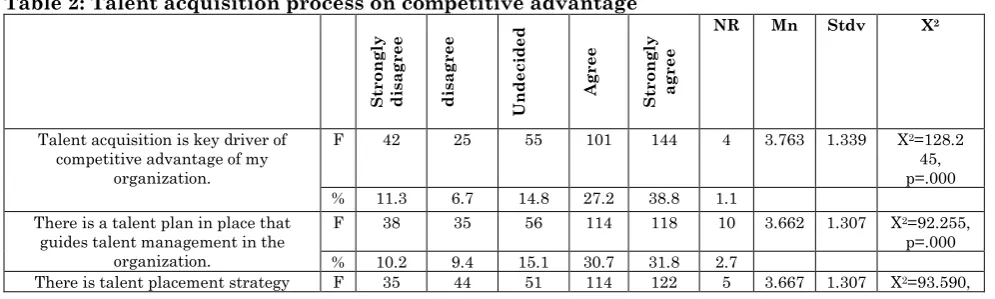
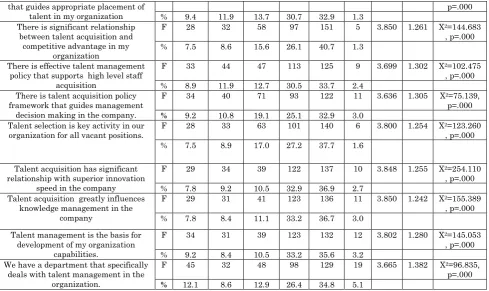
The study sought to determine the role of talent acquisition process on competitive advantage. According to the literature review talent acquisition is understood to be the process of searching for and obtaining applicants for jobs, from among whom the right people are selected. Key measures of talent acquisition process which were used to determine its significance were human resource planning and talent placements methods... According to the findings a unit change in talent acquisition process led to 13.6%% change in competitive advantage. The study also found that (288)77.6% of the respondents agreed that talent acquisition plan had a positive significant on competitive advantage of telecommunication firms while,
63.5% of the respondents agreed that
telecommunication firms had talent
placement methods that guided appropriate placement of talent in their organization. In addition 64.2% of the respondents agreed that telecom firms had effective talent management policy which directed staff acquisition, while 58% of respondents indicated that the existence of talent
acquisition policy framework guided
management decision making and 64.9% of the respondents agreed that talent selection was key activity that was undertaken when filling vacant positions. The study findings also indicated that 69.9% of the respondents agreed that talent acquisition process drive
superior innovation speed in the
telecommunications firms.
Talent Acquisition Processes on Competitive Advantage
Table 3: Model summary influence of talent acquisition processes on competitive advantage Model Summary
Model R R
Square Adjusted R Square Std. Error of the Estimate
Change Statistics Durbin-Watson R Square
Change
F Change df1 df2 Sig. F Change
1 .369a .136 .134 .217171 .136 58.201 1 369 .000 1.667
a. Predictors: (Constant), Talent Acquisition b. Dependent Variable: Competitive Advantage F= 156.201
Probability= 0.000 = 0.136
These findings showed the variation of variables used in the analysis. R-square which is the coefficient of determinant indicated how much variation took place in
place in competitive advantage due to the change in talent acquisition. The value of F-statistic is 156.201 which is more than 4
indicated that the model is overall good fit. The regression results showed the effect of style 1 on dimension 1 as follows:
Figure 4: Talent acquisition process on competitive advantage
Table 4: Anova role of talent acquisition process on competitive advantage
ANOVAa
Model Sum of Squares df Mean Square F Sig.
1
Regression 2.745 1 2.745 58.201 .000b
Residual 17.403 369 .047
Total 20.148 370
a. Dependent Variable: Competitive Advantage b. Predictors: (Constant), Talent Acquisition Process
According to t table 4 and figure 4.28 talent acquisition significantly affected competitive advantage in a positive way. The Coefficient values of talent acquisition process indicated that it had a positive role on competitive advantage. At α=0.05 significance level the study p=0.000 implied that there was significant relationship between the role of talent acquisition and competitive advantage. In the above table 4.12, β showed that change in talent acquisition process by one unit affected competitive advantage by 0.369
when the value of t indicated the significance
or insignificance of independent variable on dependent variable. If the value of t> 2, then the results were significant... Thus, the null hypothesis was rejected and alternative hypothesis accepted.
Summary
According to the findings telecommunication firms in Nairobi City County Kenya invest heavily on the determinants of talent acquisition namely such as talent acquisition plan which supports talent acquisition process. The study also found that they have
effective talent management policy that guide decision making in talent acquisition. These processes ensured that right decisions are taken at the right time. In addition, there was strong correlation between talent acquisition and determinant of competitive advantage namely, superior innovation speed, investment in knowledge capital and organization capabilities. They also have specific functions which deals with talent management. In overall a change in unit of talent acquisition process contributed to 13.6%% change in competitive advantage which was significant.
Recommendation
According to the study it is recommended that telecommunication firms should invest in human resource plans and talent placement methods which are key attributes of talent acquisition process. They should also focus on the determinants of their competitive advantage which in this study are knowledge capital investment, superior
innovation speed and organizational
capabilities [20-45].
References
1.Vaiman V, Holden N (2011) Talent management’s perplexing landscape in Central and Eastern Europe. Scullion, H. and Collings, D.G. (Eds), Global Talent Management, Routledge, London. 178-93. 2.Porter ME (2004) Competitive Advantage; Creating and Sustaining
Superior Performance. New York, NY 10020
3.Kehinde JS (2012) Talent Management Effect on Organizational Performance: Journal of Management Research 4 (2). 4.Garr SS (2012) Integrated Talent Management: A Roadmap for
Success Berlin and Associates. Oakl and.
5.Iqbal S, Qureshi TM, Khan MA, Hijazi ST (2013) Talent management is not an old wine in a new bottle. African Journal of Business Management,7 (35):3609-3619.
6.Golob U, Podnar K (2007) Competitive advantage in the marketing of products within the enlarged European Union. European Journal of Marketing. 41(3/4): 245-256
7.Gara R (2007) Talent management in Egypt. Paper prepared for presentation at the Global Talent management Centre.
8.Makworo A, Kwamboka (2014) Factors Affecting Integrated Talent Management in State Corporations in Kenya (A Case Study of
Competitive Advantage
Talent Acquisition
13.6%
Kenya Power and Lighting Company).Strategic Journals of Business and Change Management. 2(6):112-111
9.Kaunyangi TW (2014) the Impact of Competition on Performance of Firms in the Mobile Telecommunication Sector in Kenya: International Journal of Scientific and Research Publications,4:11-1 ISSN 2250-3153
10. Wandia SM (2013) Talent Management as a source of Competitive Advantage: a Case Study of Symphony (K) Ltd. The University of Nairobi
11. Rabii F (2015) Talent Management as Source of Competitive Advantage. Asian Economic and Social Society. ISSM (P) 2309-8895) 5-2015
12. Anwar A (2014) Qasim Nadia Zubair Ahmad Khan, and Aqifa Sana1 Talent Management: Strategic Priority of Organizations International Journal of Innovation and Applied Studies ISSN 2028-9324 9(3):1148-1154 © Innovative Space of Scientific Research Journals http
13. Moturi KA (2013) Talent Management as a Source of Competitive Advantage for Kenya Data Networks Ltd. The University of Nairobi.
14. Armstrong Michael (2009) Armstrong’s Handbook of Human Resource Management Practice. 11th Ed. Kogan Page
Limited: USA.
15. Armstrong M (2006) 10th Edition A Handbook of Human Resource
Management Practice
16. Ballesteros Sara R, Inmaculada De, la Fuente (2010) Talents; the key for successful Organization. Unpublished thesis, Linnaeus School of Business &Economics,
17. Ana Harvat (2009) War of talent, Faculty of Social sciences and Behavioral sciences. Tilburg University.
18. Iles P, Chuai X, Preece D (2010) Talent Management and HRM. Multinational Indian Journal of Research 3-12 Implementation and Control. McGraw Hill Irwin, New York
19. Botha A, Bussin M, Swardt L (2011) An employer brand predictive model for talent attraction and retention. Open Journals, Retrieved 23rd may 2013 from http://www Sajhrm.co.za.v9i1.388
20. Ashton C, Morton L (2005) Managing talent for competitive Advantage. Strategic HR Review, 4(5):28-31.
21. Azara S, Mohammed AK (2013) Employee training and Organizational Performance: Mediation by employee Performance. Interdisciplinary Journal of Contemporary Research in Business. 5(4):490-503.
22. Makworo A (2014) Talent Management. Strategic Journal of Business Management; Vol 2(6):112-120
23. Egessa RKW (2005) Factors Affecting Training and Development of the Sugar Industry in Kenya: A case of Nzoia Sugar Company. Unpublished Master`s Thesis, Kenyatta University.
24. Ekwoaba OJ, Ikeije UU, Ufona N (2015) the Impact of Recruitment and Selection Criteria on Organizational Performance: Global Journal of Human Resource Management 3(2):22-33, March 2015 Published by European Centre for Research Training and Development UK
25. Gara R (2007) Talent management in Egypt. Paper prepared for presentation at the Global Talent management Centre. 26. Grønhaug K, Ottesen G (2007) Can theoretical knowledge and
application yield competitive advantage? Marketing Intelligence and Planning. 25(3):232-240.
27. Halawia L, Aronson J, McCarthy (2005) Resource Based View of Knowledge Management for Competitive Advantage. The Electronic Journal of Knowledge Management 3(2);75-86.
28. Hatum A (2010) Next Generation Talent Management: Talent Management to Survive the Turmoil. Palgrave Macmillan. 29. Javalgi R, Radulovich L, Scherer G (2005) Sustainable competitive
advantage of internet firms a strategic framework and implications for global marketers. International Marketing Review, 22 (6):658-672
30. Kagwira Rita, GS Namusonge, Kabare Karanja (2014) Effects of Talent Management on organizational performance in companies listed in Nairobi Exchange in Kenya.
31. Kahinde James Sunday (2012) Talent management effect on organization performance. Journal of management research. 4(2). 32. Kaptoo JS, Njeru A (2014) Strategies adopted by mobile phone
companies in Kenya to gain competitive advantage: European Journal of Business Management: 2(1);352-367
33. Kenani DM (2011) Strategic options to human resource challenges in geothermal operations in Kenya. Proceedings, Kenya Geothermal Conference Kenyatta International Conference Centre, Nairobi.
34. Lyria R K (2013) Role of Talent Management on Organizational Performance in Companies Listed in Nairobi Security Exchange in Kenya: Literature Review.
35. Mathur G, Jugdev K, Fung T (2007) Intangible project management assets as determinants of competitive advantage. Management Research News 3(7):460-475
36. Iqbal S, Qureshi TM, Khan MA, Hijazi ST (2013) Talent management is not an old wine in a new bottle. African Journal of Business Management, 7 (35):3609-3619.
37. Lathitha C (2012) Managing employee attrition-The HR role and challenge. International journal of research in management, economics and commerce, 12.
38. Njiru K (2008) Challenges facing Human Resource Management Practices in State Corporations. Journal of Management, 22.
39. Mwangi M (2009) Factors Affecting Talent Management at Nation Media Group. Unpublished thesis (business administration). Strathmore University.
40. Price Water House Coopers (2012) Talent management in Africa: The CEO mindset in Africa PWC. July Issue. Retrieved 30th April 2013 from http://www.pwc.com/ke/en/pdf/theafrica-business-agenda-2012-talentagenda.pdf.
41. Njoroge SW, Kwisira J (2015) influence of compensation and rewardOn performance of employees at Nakuru county government: IOSR Journal of Business and Management (iosr-jbm) e-issn: 2278-487x, p-issn: 2319-7668. 17 (11):87-93 www.iosrjournals.org
42. Rita KL, Namusonge GS, Karanja K (2014) Effect of talent retention on Organisation performance in companies listed in Nairobi securities exchange in Kenya: European Journal of Business and Social Science, 3 (1):47-58
43. Shenawy E, Baker T, Lemak D (2007) A meta-analysis of the effect of TQM on competitive advantage. International Journal of Quality & Reliability Management 24 (5):442-471
44. Vaiman V, Vance CM (2008) Smart talent management: building knowledge assets for competitive advantage. Edward Elgar Publishing Ltd.