PLEASE CITE AS: Oteíza, T. (2020). Language resources to negotiate official and alternative memories of human rights violations in Chilean history: A study on classroom interactions. Historical Encounters: A journal of historical
consciousness, historical cultures, and history education, 7(2), 26-49.
ISSN 2203 7543 | © Authors | This work is published under a Creative Commons Attribution 4.0 International License
Publication Date: 6 April 2020 | Available Online: http://hej.hermes-history.net
Language resources to negotiate official and
alternative memories of human rights
violations in Chilean history: A study on
classroom interactions
Teresa Oteíza
Pontificia Universidad Católica de Chile, Chile
ABSTRACT: This article explores social and historical memories of recent Chilean history in
pedagogical recontextualisations of disciplinary knowledge in Grade 11 history classes. The discourse of history analysed relates to human rights violations committed during Pinochet’s dictatorship (1973-1990) and the ways this traumatic past is negotiated in classroom interactions. The aim of this work is to contribute to understanding how the process of human rights violations is transmitted to new generations. The focus here is specifically on how historical processes and events are evaluated in these discourses, drawing on Martin and White’s (2005) appraisal framework. As well as proposals by Oteíza and Pinuer (2012), and Oteíza (2017), for the semantic domain of
APPRECIATION, an elaboration developed to take into account the particularity and complexity of the
processual cline (events, processes and situations) in historical discourses. In addition, the article analyses semantic gravity and semantic density from Legitimation Code Theory (Maton, 2014, 2016), to explore the levels of abstraction that, not only build cumulative knowledge, but also integrate personal and social memories of the recent past and ‘historize memories’ of a sensitive period of Chilean history. This discourse analysis of classroom interactions is complemented with what teachers and students have reported regarding their experiences and memories of the recent past in interviews. The analysis of how evaluative prosodies of official and alternative memories regarding the recent Chilean past, are built in the discourse is informed by a socio-semiotic perspective of systemic functional linguistics (Achugar, 2016; Achugar, et al., 2014; Martin & White, 2005; Martin et al., 2010; Oteíza, 2014; 2018).
KEYWORDS: historical memories, history classroom interaction, appraisal analysis, transmission of memories, semantic density, semantic gravity
Introduction1
Functional Linguistics (SFL), and the dimension of semantics from Legitimation Code Theory (LCT) helps interpret this transmission of social and historical memories to new generations of Chilean young people, in a nation that was highly affected by state violence from its last dictatorship, and in which competing official and alternative memories that have different levels of visibility and hegemony co-exist in Chilean society. The historical period covered in this research goes from Allende’s Popular Unity Government (1970-1973) to Gen. Augusto Pinochet’s right wing conservative civilian-military dictatorship2 (1973-1990).
The transmission of Chilean historical memories – that is, memories that are informed by historical explanations based on primary and secondary sources that collaborate with the understanding of a traumatic recent past (Jelin, 2002; Winn, et al., 2014) - regarding human rights violations, is approached from the analysis of evaluative prosodies. That is, the intersubjective meanings that work by accumulation in given discourse. Explored in this article is how teachers and students combine axiological and epistemological knowledge, which is based primarily on their personal and social memories, to legitimise certain memories regarding national recent past. Nevertheless, in this pedagogical discourse, teachers also bring to the class a recontextualisation of a specialised disciplinary knowledge with the purpose of building historical explanations that are informed by evidence elaborated from primary and secondary sources. Teachers, therefore, integrate social memories into a historical reasoning of recent events and processes, and in doing so, collaborate with the process of ‘historizing’ memories.
This pedagogical commemoration of the past realised in history classroom interactions is built by teachers and students in the form of historical explanations that require more or less specialised language to construct axiological semantic density, when moral, political and affective meanings are privileged; or epistemic semantic density, when empirical descriptions are favoured in the discourse (Oteíza, et al., 2015; Oteíza 2017, 2018).
This article is organised in the following manner: the first section deals briefly with the transmission of historical memories; the second section is a general presentation of the appraisal framework (Martin & White, 2005) and the elaboration of the domain of appreciation in relation to the construction of events and processes in historical discourses (Oteíza & Pinuer, 2012; Oteíza, 2017, 2018). The following section deals with an extract of Grade 11 classroom interaction, as an example of a recontextualisation of history discourse. The appraisal analysis is reconsidered in relation to the sociological concepts from LCT of semantic gravity and semantic density (Maton, 2014). Presented in the following section is some of the memory positioning of the teacher and students regarding the construction of personal, social, and historical memories of the Chilean recent past. The article concludes with final remarks related to the construction and transmission of official and alternative historical memories negotiated in the space of history classroom interactions.
Transmission of historical memories
Memories are not only transmitted, but rather jointly constructed as personal and social memories by previous and new generations (Halbwachs, 1992; Nora, 1989; Jelin, 2001, 2010). This process of remembering and forgetting from the perspective of how it is built in the micro social practice of ‘doing’ memory inside history classroom interactions (Binnenkade, 2015; Macgilchrist, et al., 2015; Oteíza, 2017, 2018) is analysed in this article.
the traumatic memory of the last coup d’état and human rights violations committed by Pinochet’s dictatorship (1973-1990) is still a matter of dispute among the different social and political sectors of society (Lira, 2013; Stern, 2006a, 2006b, 2013).
As Stern (2006a, 2013) postulates,
in Chilean society it is possible to identify key social mental frameworks that are used to give value and meaning to the past; the events that started on 11 September are remembered by Chileans as ‘salvation’, ‘rupture’, ‘persecution and awakening’, and as a ‘closed box’ (Oteíza, et al., 2015, p. 47).
These ‘key social mental frameworks’ are understood by Stern (2006a), as “sufficiently differentiated narratives” that a society, in this case the Chilean one, has constructed as the fundamental or decisive set of values and beliefs regarding the collective experience of recent traumatic past. Therefore, emblematic memories are part of the social memories that exist in a given society. In this manner, personal memories and social memories are seen as processes that have a two way of influence, which in Stern’s terms, implies top-down and bottom-up social dynamics:
on the one hand, an emblematic memory framework imparts broad interpretative meaning an criteria of selection to personal memory, based on experiences directly lived by an individual or on lore told by relatives, friends, comrades, or other acquaintances. When this happens, the mysterious vanishing of “my” son is no longer a story of personal misfortune or accident that floats loosely, disconnected from a larger meaning. The vanishing is part of a crucial larger story: the story of state terror that inflicts devastating rupture upon thousands of families treated as subhuman enemies (Stern, 2006b, p. 5).
The appraisal framework
The appraisal model (Martin & White, 2005), which was elaborated under the theoretical framework of systemic functional linguistics, aims to provide a comprehensive theoretical and descriptive systematisation of the linguistic resources that authors can use to construct the value of social experience, and to have a richer understanding of the patterns of interpersonal meaning beyond the manifestation of only the emotionality across discourse (Oteíza, 2017).
From Martin and White’s (2005) perspective, this framework, which works at the discursive-semantic level of language, deals with the negotiation of meanings among real or potential writers and readers, who interact in every text from a determinate social and cultural place. The evaluative meanings work by accumulation in the discourse creating determinate value positions. Consequently,
the appraisal framework considers that every element in a text, whether considered discretely or in tandem with other meanings, is a potential instance of subjectivity; interpersonal meanings are accordingly considered as a prosody that works in a cumulative way to create a radiating pattern of evaluative meaning in discourse (Oteíza, 2019, p.179 ).
The appraisal framework organises interpersonal meanings in three main semantic areas (Martin & White, 2005, pp. 42-43): ENGAGEMENT, ATTITUDE and GRADUATION. The subsystem
of ATTITUDE deals with the ways in which feelings are seen as socially organised system of
meanings. ATTITUDE is further specified into three semantic domains: (a) emotions (AFFECT),
which deals with the expression of positive and negative feelings; (b) ethics/morality (JUDGEMENT), which is concerned with attitudes toward character and behaviour of people (to
admire or to criticise, to praise or to condemn); and (c) aesthetics/values (APPRECIATION), which
involves evaluations of semiotic and natural phenomena according to the ways in which they are valued in a given field. The semantic subsystem of ENGAGEMENT allows an exploration of
the source of attitudes, which in turn, collaborates with the identification of the dialogic nature of every discourse. In this manner, this analytical tool enables it to be determined if a discourse is built with a more heteroglossic or monoglossic orientation, depending on the extent to which authors recognise or not, alternative positions. Finally, the subsystem of GRADUATION has to do
with the fact that expressions of attitude can be raised or lowered in the discourse, that is, meanings of attitude can be intensified or weakened showing different levels of alignment with the value positions advanced by the text (Martin & White, 2005). In this article, the main categories for analysing ATTITUDE created by Martin and White (2005) are followed. However,
also incorporated is an elaboration of the domain of APPRECIATION to better deal with the
analysis of historical discourses and its recontextualisation in classroom interaction. This proposal, that includes the categories of power, impact, integrity and conflict (Oteíza & Pinuer, 2012; Oteíza, 2014, 2017), provides an explanation in a more adequate manner how events, situations and processes are evaluated as being part of historical explanations. In the following section, these four notions are defined and illustrated.
The category of conflict deals with the manifestation of a social, political and/or economic tension that can be expressed with different grades of radicalism along a cline, as for example: “A loss of control was the distinctive feature of the last years of the 1960” (-ve APPRECIATION:
high conflict)3. The category of power, which interacts with the semantic category of conflict, and also works as a cline, is associated with the action and influence of powerful and dominant groups (Oteíza & Pinuer, 2012; Oteíza, 2014, 2017). An example of the realisation of this meaning in the language form of a nominalisation is the “arbitrary arrest” that the state agents were able to do during Pinochet’s dictatorship (-ve APPRECIATION: high power, integrity).
through nominalisations. For example, the nominalisation “outbreak of cruelty” (-ve
APPRECIATION: integrity) in the context of human rights violations during Pinochet’s
dictatorship, although implies the action of people, is codified in the discourse as a historical process that ‘happened’ during the first years of the dictatorship, without any mention of human agency (Oteíza & Pinuer, 2012). The last category of impact deals with the importance and social value that authors attribute to historical events, processes or situations in the discourse, as for example “the ‘peaceful path’ was a culminative moment in the history of Chile” (+ve
APPRECIATION: impact).
These four categories can be inscribed (explicit) or invoked (implicit), and they work together to build discourses of historical legitimation or delegitimisation. Figure 1 presents Martin & White’s categories for analysing the semantic area of APPRECIATION and Figure 2
presents Oteíza & Pinuer’s (2012) proposal for the analysis of historical events and processes:
Figure 1: Appreciation domain (Martin & White, 2005)
Figure 2: Appreciation domain for analysing events, situations and processes (Oteíza & Pinuer 2012; Oteíza 2014)
ATTITUDE' JUDGEMENT'
Happiness(
APPRECIATION'
AFFECT' Security(
(Social(Esteem(
Capacity(
Social(Sanc4on(
Composi4on( Reac4on(
Propriety( Subsystem(of(ATTITUDE(
Sa4sfac4on(
Normality(
Integrity(
Valua4on(
Tenacity(
ATTITUDE JUDGEMENT
APPRECIATION*
AFFECT*
power* impact*
conflict*
high* medium*
medium* low*
In the following section, the concepts of semantic gravity and semantic density from LCT (Maton 2013, 2014) are explained. The purpose is to explore the possibilities of a joint analysis between the evaluative prosodies and the use of semantic waves for analysing the transmission of memories of the recent past in history classroom interactions.
Semantic gravity and semantic density
Legitimation Code Theory (LCT) is a sociological theory that has been elaborated to analyse socio-cultural practices from a particular set of organizing principles (Maton, 2014, 2016). The dimension of Semantics and in particular on two key concepts: semantic gravity and semantic density (Maton, 2013, 2014) take focus in this article.
Semantic gravity (SG) is defined by Maton (2014, p. 110) as “the degree to which meaning relates to its context.” Semantic gravity refers then to the different levels of meaning dependence to its context in a particular social practice. Therefore, in a determinate social practice, it is possible to realise changes over time creating recurrent movements from abstract and general ideas (weaker semantic gravity SG-) to concrete ideas and examples of everyday life (strong semantic gravity, SG+) and vice versa.
The notion of semantic density (SD) refers to a condensation of meaning in a given socio-cultural practice (Maton, 2014, 2016). This condensation of meaning can be expressed with higher or lower levels of abstraction of terms, concepts or actions that can be of an epistemological or axiological nature. Therefore, semantic density may also involve
epistemological condensation of formal definitions of concepts and empirical descriptions or
axiological condensation of affective, aesthetic, ethical, political and moral stances.
The movements between stronger and weaker semantic gravity and semantic density are built through language resources, in part by the process of packing, unpacking and repacking meanings (Matruglio, et al., 2013; Maton, 2014). These two notions of semantic gravity and
semantic density can be very useful for analysing pedagogical practices according to Maton (2014, p. 110), because one condition for cumulative knowledge-building and learning may be the capacity to master semantic gravity, in order for knowledge to be decontextualised, transferred and recontextualised into new contexts.
Proposed here is that the LCT concepts of semantic gravity and semantic density can be linked with the language resources that are used by social actors in a determinate socio-cultural practice. Thus, in the case of the analysis offered in this article, special attention is paid to the language resources that teachers and students use to construct both specialised and non-specialised meanings, and the language realisations that they use to evaluate events, processes and actors in the history classroom interactions.
History classroom interaction and the transmission of historical memories of human rights violations through epistemological condensation and strong semantic gravity
This section presents an extract of Grade 11 history classroom interaction from a private school. Students in this grade are 16 to 17 years old, and this is the penultimate year of the Chilean secondary education. The teacher is a very experienced female educator that had eight years of teaching recent national history in high schools. As observed in her classroom interactions, the teacher tries to develop in her students a high level of comprehension of historical processes with the purpose of helping them to move beyond their personal memories of a national traumatic past, towards a construction of a historical memory. The larger study analyses history classroom interactions from every type of school that co-exist in the Chilean educational system (government subsidised, partially government subsidised, and private schools);4 this article includes one fragment of a private school to illustrate how historical memories of human rights violations are negotiated by teacher and students. Among the History classrooms analysed, they show similarities in terms of how teachers not only follow the curriculum very carefully, but also on how they all bring additional historical knowledge and alternative social memories through the inclusion of testimonies of political detainees, biographical documentaries, alternative historical recounts written by specialists, among others.
The selected fragment is part of the history unit entitled The breakdown of democracy and the military dictatorship. The proposed general learning outcome stated in the Chilean curricula establishes the development of the following two necessary skills for analysing and valuing different points of view regarding the recent national past:
(a) to critically analyse and compare different political views and historiographical interpretations of the past that led to the crisis of 1973 and the democratic breakdown; and
(b) to characterise the main features of the coup and the military dictatorship in Chile, including the systematic violation of human rights, the political violence, and the suppression of therule of law (MINEDUC, 2015, p. 38).
Consequently, students at this year of their education are asked to achieve a high level of technicality and abstraction in order to have the analytical tools to deal with historical meanings of recent national history.
The fragment selected illustrates well one of the fundamental issues that students need to understand and that contributes to their process of historizing memory, that is, the critical issues of political and state violence during Pinochet’s dictatorship (1973–1990), and their impact on the historical understanding of new generations regarding the severe human rights violations committed by the dictatorship (Oteíza, 2018).
PowerPoints (cartoons and photograph) are included here, because they are fundamental to fully understand the teacher and students’ meaning construction.5
A reproduction of a brief fragment of the lesson as Example 1reads:
Example 1:6
Teacher:
1. The National Intelligence Directorate was also created in 1974, it is another fact that it was created in that
2. time period (2) National Intelligence Directorate organized from the Military Junta and with leaders
3. that will form part of it (1) nowadays, a great part of those who belonged to the DINA (1) are 4. imprisoned (2) are in [two or three parts/places]
Student: 6. [El Mamo]7 Teacher:
7. As, for example, Manuel Contreras who is imprisoned, yes? Student:
8. Ms., in what was the DINA supposedly focused? Teacher:
9. the DINA ((signaling what was already written by her on the blackboard)) neutralize the opposition (1)
10. maintain [the population controlled] Student:
11. [so] Teacher:
12. [so] that there isn’t dissent, dissent is not agreeing with the military government Student:
13. So, there will be the CNI afterwards? Teacher:
14. There will be the CNI, the DINA changes its name and becomes the CNI and the “non-identified 15. civilians” are those ((signaling the cartoon/caricature on the power point)) For this, Rufino8 describes
16. them like this in his cartoon, these are the civilians who appear when someone is talking and they
17. take people away, arrest, arbitrary arrest of the people, he does it in a comic manner so that they don’t
18. censor him (1) so, with that he is also denouncing what happens with the DINA, for example, 19. another (1) fact, and with this we finish this first part (2) this, for example,
20. this is Rufino says: ((the teacher reads another of Rufino’s caricatures from the blackboard)) 21. “We wish to have a small ideological debate with you” and this person is there, they are taking them, they 22. are like men in black with black glasses, which is like the, the typical attire of, of the security of Augusto 23. Pinochet, [and he is there singing and he has there
Student:
((at this moment, two picket signs appear on the power point with the words: Where are they?)) Teacher:
25. Originates in 1974 also, all of this is from ‘74, its ehm the Association of Relatives of the Disappeared
26. Detainees product of this ehm search of the first detainees that began to be taken from ‘73 onwards.
27. These relatives begin to get together and to say let’s agree to go together because if we go together, the
28. majority were women, we may avoid a grave incident because many people who went alone to the
29. police station or to the penitentiary where their husbands were being held, their sons, relatives, they could 30. tell them they’re not here period (1) therefore with this they create an association, create an organism
31. that goes and gets these people (3) in September of ‘74, begins what for Chile will be called the Condor
32. Operation, I will also show you another cartoon of the Condor Operation that Calle 13 sings (--) if you
33. want more information of that (3) the Condor Operation is an operation between different Latin 34. American countries and the Secretary of State ehm of the United States, Henry Kissinger, where they
35. also look to neutralize the enemy that is outside the country (1) that is, Carlos Prats
36. (2) remember that he was the General in Chief of Allende’s Army, do all of you remember Carlos Prats?
Student: 37. Yes Teacher:
38. Yes? Ok. Carlos Prats renounces in august of ‘73 and recommends for the position Augusto Pinochet
39. because they were close, and he considered that the institutional order would prosper, he was wrong
40. (2) and Carlos Prats receives ehm diplomatic ehm protection in Argentina (1) and in Argentina ehm
39. through a bomb attack that they place in the car, in the parking lot, he works right
40. next to the parking lot of his house there they place a bomb, so when he starts the engine (2) 41. the car explodes (2) in September of ‘74 they assassinate him, and the Condor Operation assassinates him,
42. he is assassinated by a military operation of the military intelligence in different countries of Latin
43. America, including Argentina (1) born in ‘74, as I was telling you, the Association of Relatives of
44. Disappeared Detainees and (1) is established that the Junta will exercise the constitutive legislative power
45. and the executive, but the executive exclusively in charge of Augusto Pinochet (1) the
47. Mireya García ((signaling her photo on the power point)) will function to this day and they will have
48. afterwards the support of many international organisms.
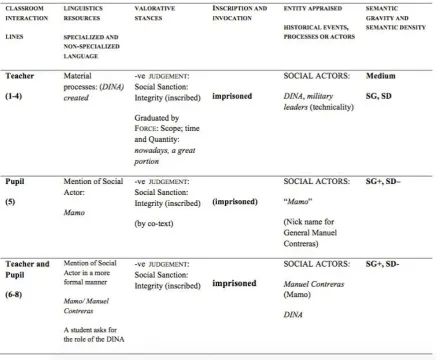
In this class interaction, the teacher tends to use technical terms (“institutionalization” of Pinochet’s regime) and nominalisations (“neutralization of the enemy”) to explain the historical significance of the process of human rights’ violations committed during the Pinochet’s dictatorship. Nevertheless, the teacher relies mainly on a strong semantic gravity (SG+), centring her historical recount on what social actors did, said and thought. In the first lines of the interaction (1-8), she talks about the organisms of secret police, and the discourse is centred in what happened to several of the military leaders that were part of the DINA (National Directorate of Intelligence) and of the CNI (National Intelligence Central) who, at the present, are imprisoned or dead. These social actors are evaluated with an inscribed negative social sanction of integrity for their actions. In line 5, a student mentions one of them by his nickname, “Mamo”, and the teacher acknowledges his participation naming the state agent by his real name, Manuel Contreras,9 and then changing the register of the interaction into a more formal one, as it is showed Table 1.10
Table 1: Analysis of classroom interaction
“neutralising” the enemy. This euphemism was previously unpacked by the teacher at the beginning of the class giving voice to the state agents:
“they use a euphemism (1) a word that doesn’t sound too strong [unless] saying we are going to kill everyone that is opposed (1) neutralization (1) the idea of neutralizing the opposition means for the military government in Chile assassinate”
Regarding the level of technicality that the teacher uses to explain the process of human rights violations, it is possible to argue that the semantic gravity is strengthened (SG+) and the
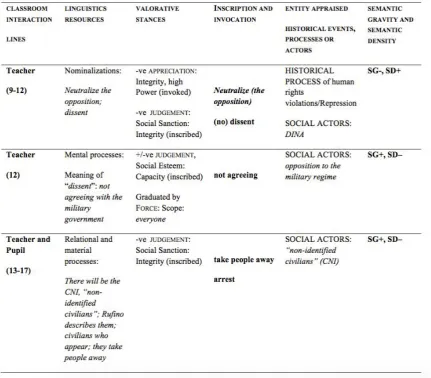
semantic density is weakened (SD-) with the inclusion of social actors such as the DINA, the CNI and Manuel Contreras, which are evaluated with an inscribed negative judgement of social sanction of integrity. However, those institutions are still part of the technicality of the state process of repression that operated inside the country and in the rest of Latin America. Consequently, although they constitute a general knowledge, and a part of a social memory that a Chilean secondary school student may have, the teacher incorporates them as key participants within a broader historical explanation. In the following lines (12-17), both teacher and student, maintain a semantic gravity (SG+) when building a historical recount, in which they refer to the material and mental actions that social actors, the DINA and the opposition to the military regime, did and thought.
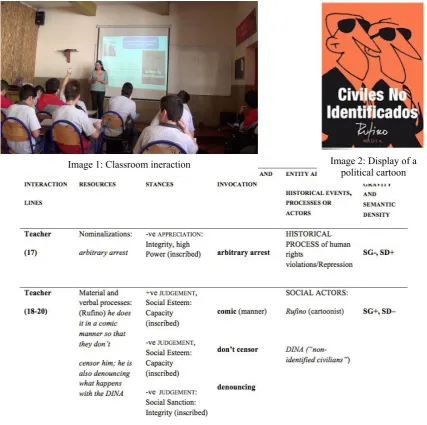
In line 13, the teacher displays a cartoon drawn by Rufino in which two state agents with black glasses are represented in a conceptual image with the ironic wording, “non-identified civilians” included in the bottom of the drawing (see Image 1). Here, the visual mode reinforces the DINA and CNI state agents of Pinochet’s dictatorship who “arrest” and “take people away” as part of the state terrorism of the dictatorship, a political icon well known in Chilean society. This cartoon and the representation of state agents are both part of a social memory of which students are generally well aware. It is relevant to mention that these kinds of images and political cartoons are not included in history textbooks (Oteíza & Pinuer, 2016; Oteíza, 2018).
While showing this PowerPoint with Rufino’s political cartoon, the teacher strengthens the
semantic density again (SD+), and specifies that the arrest was an “arbitrary arrest” (line 17), presenting a negative evaluation of appreciation of integrity and high power of the historical process in which these “non-identified civilians” were involved. Later on, the teacher makes a
semantic wave when she weakens the semantic density (SD-) by specifying what Rufino needed to do in order to denounce repression in the country. A semantic wave, according to Maton
Image 1: Classroom ineraction Image 2: Display of a political cartoon
(2014), refers to recurrent movements between stronger and weaker semantic gravity and
semantic density. This wave profile has been proved to be a key feature of cumulative knowledge building (Matruglio, et al., 2013). The semantic wave is created in this case by the teacher while building historical knowledge, on one hand, by means of using everyday language to indicate what the cartoonist Rufino did with his political humour to denounce the state violence that was being committed during the dictatorship (‘they take away people’). On the other hand, through the use of a more technical and specialised language that allows the teacher to connect concrete events with more global and broader historical processes that the Chilean society was living during the seventies and eighties and that is codified by nominalisations (‘arbitrary arrest’, ‘neutralize the opposition’). With this cartoon, it is possible to appreciate that “civilians” were also part of the organisation of state terror and not only the military forces of the country. This analysis is shown in Table 3.
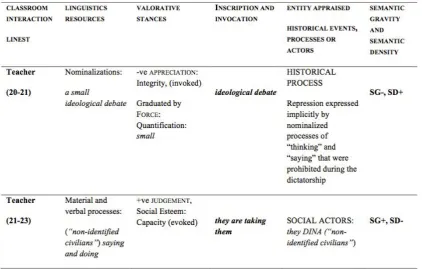
The teacher again strengthens the semantic density (SD+), but now, rather interestingly by quoting Rufino’s humorous words of the next cartoon that she shows in the following slide (Image 3 and 4), in which four “non-identified civilians” are involved in an action while mentioning ironically the two things that were censored in the country during Pinochet’s dictatorship: to have a political opinion, especially if that was a left wing position; and to talk about your ideas (“We would like to have a small ideological debate with you”/ “Quisiéramos tener un pequeño debate ideológico con usted”). The term “ideology” was highly stigmatised and it was considered as a kind of semantic collocation of a “Marxist ideology” (Oteíza, 2018). This notion is evaluated with an evoked negative appreciation of integrity whereas the DINA is constructed with an evoked positive social esteem of capacity. These differentiated evaluations also contribute to the political humour that the teacher is trying to explain to their students, and by doing so, she offers alternative historical knowledge to their students. The irony is also built by the fact that people were arbitrarily arrested without having any possibility of talking and even less, of defending themselves.
In lines 20 to 23 (Table 4), it is possible to appreciate the wording that the teacher is saying while showing this political cartoon, and the invoked negative evaluation of integrity regarding the repression that people were experiencing.
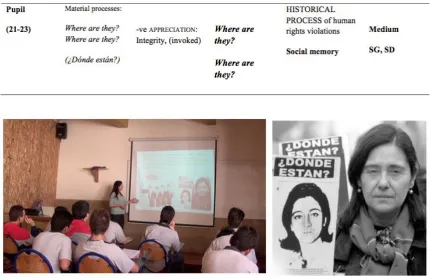
In line 21, before the teacher refers to the photograph of Mireya García, one of the founders of the Association of Relatives of the Disappeared Detainees, one student recognises the well-known sign with the wording “where are they” (“¿Dónde están?”), which was a symbol of the fight of the relatives of the Disappeared Detainees,11 who were claiming justice and continue to do so in the present. The image of these words as well as that of the secret agents with dark suits and dark glasses are part of the social memory that students must have learnt from home and in their communities. The historical process of human rights violations is evaluated in an evoked manner with a negative appreciation of integrity. These images are not privative of Chilean society, but rather they are well known icons or “political bondicons” of injustice and denounce (Oteíza & Pinuer, 2016; Oteíza, 2018) in many other countries of Latin America (see the verbal analysis and image in Table 5).
Table 5: Analysis of classroom interaction. Display of political photograph
The teacher continues her historical recount using a medium semantic gravity in lines 25 to 31, when referring to the material actions that the state organisms did: “detainees that began to be taken from ‘73 [the year 1973]”, and she incorporates a new social actor to the recount: The Association of Relatives of the Disappeared Detainees. The teacher also refers very concretely (SG+) to the necessity, especially of women, to get together and to defend themselves from possible abuses that they could have had when inquiring after their relatives that were detained. The mention of the Association of Relatives of the Disappeared-Detainees is constructed by the teacher with a positive valuation of social esteem of capacity. This inclusion also helps to highlight the alternative political positions that co-existed during the dictatorship and the movements of resistance, which needed a great deal of courage to carry on their political and cultural actions. Later on, the teacher introduces another historical actor: Carlos Prats, who was the General in Chief of the Armed Forces during Allende’s government, relying in a strong
semantic gravity (SG+). Prats was the one that “recommended” Pinochet to Allende and the one that was “wrong” in making that decision. Next, the teacher strengthens the semantic density (SD+) once again when she explains that the political motivation was to make the institution of Allende’s government more powerful.
The “Condor Operation” was a coordinated action of the repression and intelligence organisms of military dictatorships from the South Cone of Latin America. Chile, Argentina, Brazil, Bolivia, Paraguay and Uruguay participated in this ‘operation.’ The teacher does not mention anything regarding the also well-known drawing that shows a condor (a particularly large bird that lives in the Andes Mountains, that forms part of the Chilean national emblem), and a person that is attached to a train rail, visibly hurt (tortured) and screaming (Image 3).12 The use of language resources that construct a strong semantic gravity (SG+) helps to include agency to the social events, and this plays a crucial role in the construction of more abstract historical explanations.
Finally, in lines 37 to 43 (Table 7), the teacher refers to the historical process of institutionalisation of the Military Junta. The Military Junta is constructed in the discourse with an inscribed positive evaluation of high power and, Pinochet in particular, is represented with a positive social esteem of capacity due to the fact that he is the one that became “in charge” of the executive power of the country. Here, the semantic density is strong again (SD+), and it is followed by a weak semantic density (SD-) and strong semantic gravity (SG+) in relation to the actions of the Association of Relatives of the Disappeared Detainees, particularly of one of its founders, Mireya García, who is represented visually in the photograph beside Rufino’s comic (Table 5). The inclusion of a broader semiotic repertoire than the one included in textbooks
(Oteíza, 2018), collaborates to strengthen the axiological semantic density (SD+) that helps the teacher to construct historical significance in the classroom.
Table 7: Analysis of classroom interaction
An illustration of the semantic waves constructed by the teacher and students in this fragment of history classroom interaction is presented in Figure 3. The use of nominalisations and technical words reflects a more specialised discourse, that is, a discourse that deals with the process of human rights violations that goes beyond the common sense of everyday language and constructs a more abstract historical significance and contextualisation. This discourse, which is characterised by a strong semantic density (SD+), works in combination with a more familiar language that helps the teacher and her students to incorporate historical evidence and agency that was constructed in the interaction with a stronger semantic gravity (SG+).
Figure 4 shows the whole extract, in two semantic profiles (1–23 and 23–48).
Teacher and students’ positionings regarding personal and social memories
All teachers who participated in the study were interviewed; and somestudents who voluntarily accepted to be interviewed at the end of the unit on The breakdown of democracy and the military dictatorship. Some of the axiological and epistemological positions that teacher and students have regarding the study of human rights violations at school, and of the background knowledge that they have brought into the class from other social, cultural and political sources are outlined here. Included how the teacher dealt with this sensitive topic in her History class and exploring some of the students’ positions.
The teacher highlights the importance of being explicit about her political position with her students. She thinks that teaching recent national history to young people entails a significant responsibility that can only be taken from teachers that see themselves as political and social actors. The teacher’s stance is that her personal memories should be also part of her teaching: “I’m subjective and I tell that to my students openly.” Therefore, the teacher’s position is that her personal memories are incorporated in her pedagogical practices. She positions herself as a teacher that gives special importance to teach the subject and to include both official and alternative historical memories, such as the memories of resistance through political humour exemplified with the cartoonist Rufino, and the political cartoon about the Condor Operation that shows the brutal violence committed during Pinochet’s dictatorship.
She also considers that to teach the subject of human rights violations requires a special preparation for teachers, who must be well equipped to be able to discuss this topic with his or her students from a broad variety of historical sources. For her, it is crucial to avoid teaching
from the accepted dichotomy of either a right or left wing political position. As it is possible to appreciate in the brief extract of classroom interaction analysed, she gives fundamental importance to historical facts:
I give my opinion of the situations that happened, but I always try to ascribe my opinion in objective facts (…) one can be from the right or from the left, one can consider him or herself not being part of politics or even feel unidentified with a political movement, but one cannot validate a government imposed through violence and that has done all what it did, particularly if we think about human rights,
In this manner, the teacher makes a great effort to bring primary and secondary sources to her lesson, in an attempt to teach her students not only ethical values but also how to reason historically, which in turn, contributes to their process of historizing memories.
The Grade 11 students that agreed to be interviewed regarding this unit on the military dictatorship, similarly pointed out that teaching this subject at school is of particular relevance. They also emphasised that teachers need special training to teach national recent history. In the interview, two students openly manifested their political positions, one from the extreme left wing and the other one from a moderate right wing position. Both of them considered that what they have learned in other social spaces was relevant to better comprehend the historical perspective of memory advanced by the History teacher in her classes. In addition, both of them condemn the coup d’état and consider that Salvador Allende was a great leader of this country; they especially praised his integrity and values, expressing an ethical stance regarding his figure as President. The one from the right considers that all the explicit treatment of human rights violations, especially of the brutal tortures that thousands of people suffered in the country, was taught with too much detail by the teacher. However, the other student believes that it was necessary to raise sensibility amongst his classmates, and therefore, he thought that the amount of explicit and detailed references regarding the state terror was necessary to assure that this kind of violence does not occur again in the future. This positioning regarding the importance of raising sensibility among young people who did not live during the dictatorship and did not experience the human rights violations directly, also shows students’ axiological stances about recent national past.
All the students interviewed across the three schools (private, partially and completely subsidised by the government) manifested that as society Chileans cannot forget what happened in the country, which shows their ethical commitment to human rights. This is also congruent with the official view of recent national past, that is, their opinion on the significance of teaching this historical period, their empathy with the suffering of others and their willingness to learn more in depth about how people who lived during that time survived and resisted the state terror. A positioning that was also very strong among them was that they think that, as part of a generation that did not witness the events, they feel the need to be well informed of the recent national past; in part because they consider that it is their responsibility as citizens, and in part because they manifest their desire of being part of a crucial social trauma that Chileans lived as society, of which they do not want to be left out because they did not live it directly.
Final remarks
It has been postulated that history classroom interactions can be understood as micro spaces of commemoration of personal and social memories (Binnenkade, 2015; Macgilchrist, et al.,
Students also learn how to remember and forget about this recent past in their families and in other social and cultural environments; however, the possibility of thinking about it from a historical perspective is something that needs an educational and specialised environment.
As the students of this research have reported, they need and want to know more about their national past. They need to have a denser condensation of axiological and epistemic meanings that can help them to think historically about a national trauma. This is not an easy endeavour and as teachers have reported, it is complex to teach recent national history of human rights violations in high schools, because it implies a fair amount of knowledge. Also because, as a teacher, you need to be willing to deal with your own memory positions when teaching this sensitive matter for the Chilean society. This issue could be also more relevant, as several historians, sociologists and social psychologists have highlighted, since Chilean society has not fully processed the trauma of human rights violations it experienced from 1973 to 1990 (Oteíza, 2018).
In the classroom interaction analysed, the teacher and students create semantic waves while building historical explanations. This process implies using a combination of specialised language, mainly manifested in nominalisations and technical words (that is, ‘neutralization of the enemy’, ‘institutionalization of the military regime’), and non-specialised language, mainly by the use of clauses in which social actors do (material clauses), think (mental cognitive clauses) and feel (mental affective clauses), while showing different levels of agency as part of historical events. This learning process might help students to build onto their own personal memories and to better comprehend alternative social memories that are not included in the official History curriculum and in History textbooks. The analysis has demonstrated that for building historical significance both the specialised language and the everyday language are used. The teacher assumes that students need to incorporate historical evidence and social actors’ motivations to actually understand how more abstract historical explanations are constructed by historians. Therefore, the semantic waves that are created by means of the combination of stronger and weaker semantic gravity and semantic density help to build more complex explanations of the past and travel beyond personal and emotional views, so it is possible to have a better understanding of the social mental frames or emblematic memories that coexist in Chilean society. As it has been demonstrated in the discursive analysis, historical explanations built as semantic waves in the classroom carried on determinate axiological and epistemological values or evaluative prosodies.
It has been also shown in this article that the accumulation of evaluative meanings or
evaluative prosody that both teacher and students construct. This is relevant because what is evaluated (‘entity appraised’) are not only historical collective actors as the DINA, CNI, or individual actors as Pinochet, Prat, Allende or individual actors that represent alternative memories like Mireya García or the political cartoonist Rufino; but also both teacher and students evaluate historical processes, as the policies for installing a state terror or Pinochet’s process of institutionalisation of his regime, which in turn collaborate to historize memories and to better understand the symbolic meanings that are part of every social and personal memory in a society.
References
Achugar, M. (2016). Discursive processes of intergenerational transmission of recent history: (Re)making our past. NewYork: Palgrave Macmillan.
Achugar, M. (2008). What we remember. The construction of memory in military discourse. Amsterdam: John Benjamins Publishing Company.
Achugar, M., Fernández, A., & Morales, N. (2014). La dictadura uruguaya en la cultura popular: recontextualización de “A redoblar”. Discurso & Sociedad, 8(1), 83–108. Binnenkade, A. (2015). Doing Memory: Teaching as a Discursive Node. Journal of
Educational Media, Memory, and Society, 7(2), 29-43.
Coffin, C. (2006). Historical discourse: the language of time, cause and evaluation. London/New York: Continuum.
Halbwachs, M. (1992). On collective memory. Chicago: University Chicago Press.
Jelin, E. (2010). The past in the present: Memories of state violence in contemporary Latin America. In A. Assman & S. Conrad (Eds.), Memory in a global age: discourses, practices and trajectories (pp. 61-78). New York: Palgrave Macmillan.
Jelin, E. (2002). Los trabajos de la memoria. Madrid: Siglo Veintiuno de España Editores, S.A.
Lira, E. (2013). Algunas reflexiones a Propósito de los 40 años del Golpe Militar en Chile y las Condiciones de la Reconciliación Política. Psykhe, 22(2), 5–18.
Macgilchrist, F., Christophe B., & Binnenkade, A. (2015). Introduction: memory practices and history education. Journal of Educational Media, Memory, and Society, 7(2), 1-9. Martin, J.R., & Maton, K. (2017). Systemic functional linguistics and legitimation code
theory on education: rethinking field and knowledge structure. Onomázein, Número Especial, (1), 12-45.
Martin, J.R., Maton, K. & Matruglio, E. (2010). Historical cosmologies: epistemology and axiology in Australian secondary school history discourse. Revista Signos, 43(74), 433– 463.
Martin, J.R. & White, P. (2005). The language of evaluation: Appraisal in English. New York: Palgrave Macmillan.
Maton, K. (2016). Legitimation code theory: Building knowledge about knowledge- building. In K. Maton, S. Hood, & S. Shay (Eds.), Knowledge-building: Educational studies in Legitimation Code Theory (pp. 1-24). London: Routledge.
Maton, K. (2014). Knowledge and knowers. Towards a realist sociology of education. London: Routledge.
Maton, K. (2013). Making semantic waves: a key to cumulative knowledge–building.
Linguistics and Education, 24(1), 8–22.
Matruglio, E., Maton, K., & Martin, J.R. (2013). Time travel: the role of temporality in enabling semantic waves in secondary school teaching. Linguistics and Education, 24(1), 38–49.
Nora, P. (1989). Between memory and history: Les lieux de mémoire. Representations, 26, 7-24.
Oteíza, T. (2019). Historical events and processes in the discourse of disciplinary History and classroom interaction. In J.R. Martin, K. Maton & J. Doran (Eds.), Academic discourse: Systemic functional linguistics and legitimation code Theory. (pp. 177-207). London/New York: Routledge.
Oteíza, T. (2018). Prácticas de la memoria en clases de historia: construcción de la evidencia multimodal e intertextual del pasado reciente chileno. Discurso & Sociedad, 12(1), 112-160.
Oteíza, T. (2017). The appraisal framework and discourse analysis. In T. Bartlett & G.
O’Grady, (Eds.), The Routledge handbook of systemic functional linguistics (pp. 457-472). London/New York: Routledge.
Oteíza, T. (2014). Intertextualidad en la recontextualización pedagógica del pasado Reciente chileno. Discurso & Sociedad, 8(1), 109–136.
Oteíza, T., Henríquez, R., & Pinuer, C. (2015). History class interactions and the transmission of recent Chilean memory of human rights violations. Journal of Educational Media, Memory, and Society, 7(2), 44-67.
Oteíza, T., & Pinuer, C. (2016). Appraisal framework and critical discourse studies: a joint approach to the study of historical memories from an intermodal perspective. International Journal of Language Studies, 10(2), 5–32.
Oteíza, T., & Pinuer, C. (2012). Prosodia valorativa: construcción de eventos y procesos en el discurso de la historia. Discurso & Sociedad, 6(2), 418– 446.
Ricoeur, P. (2010). Memoria, historia y olvido. México: Fondo de Cultura Económica. Ridenti, M. (2016). The debate over military (or civilian-military?) dictatorship in Brazil in
historiographical context. Boletin of Latin American Research, 37(1), 33-42.
Stern, S. (2006a). Remembering Pinochet’s Chile: On the eve of London 1998. Durkam/ London: Duke University Press.
Stern, S. (2006b). Battling for hearts and minds: Memory struggles in Pinochets’s Chile, 1973-1988. Durkam/London: Duke University Press.
Stern, S. (2013). Luchando por mentes y corazones. Las batallas de la memoria en el Chilede Pinochet. Santiago: Ediciones Universidad Diego Portales.
Wertsch, J. (2002). Voices of collective remembering. Cambridge: Cambridge University Press.
Endnotes
1 This article presents findings from research grant FONDECYT 1170331 (National Funds for Science and Technology
Development, Chile).
2 Ridenti, Marcelo (2016).
3 “-ve” means negative evaluation; “+ve” means positive evaluation. Evaluations of power and conflict can be graded as high
medium or low, depending on the meaning of the attitudinal words employed and/or if they are graduated by sub-modification. The co-text should be always be taken into consideration.
4 The extract presented in this article was selected from a total of more than 80h of filmed history classroom interactions.
5 For a multimodal analysis of part of this fragment, see Author 2018.
6 Notation for the class interaction: (T): teacher, (S): student. Numbers in parenthesis indicate the length of pauses in seconds;
words underlined indicate intonational emphasis/volume. Double parenthesis indicates relevant contextual information. Question marks have been added to facilitate reading the text. Square brackets: overlapping; when teacher and or students speak at the same time. The original language of the class interaction was Spanish. A semi-literal/idiomatic translation into English, trying to maintain as far as possible the kind of lexicogrammatical choices made by teachers and students.
7 Alias or nickname for Manuel Contreras.
8 Alejandro Montenegro Gallardo, better known as “Rufino” is a famous Chilean cartoonist who made political graphic humour during the eighties. He published a book with an anthology of his best drawings in 2009 entitled precisely: “Non-identified civilians”. The image that the teacher presents in her power point is the cover of that book.
9 Manuel Contreras was the director of the DINA. He was charged guilty of human rights violations in 2002 and later
condemned to 500 years of prison. He died in prison in 2015 at 85 years old.
10 Inscribed evaluations of ATTITUDE are written in bold; invoked evaluations of ATTITUDE in bold and italicized. Negative
evaluations are marked with ‘-ve’, and positive evaluations with ‘+ve’.
11 The Spanish term “Disappeared” works as a technical word in Chilean context. It refers to a well-known process of forced
disappearance of people that were secretly abducted and later killed by State organisms of secret police during the Pinochet’s dictatorship (1973-1990).
12 There is no verbal language, neither by the teacher nor the students, that accompanies this explicit political cartoon that
shows the state terror in the form of torture. However, in previous classes, as well as in some of the classes that followed, the teacher devoted a whole session to read and reflect with her students on the concentration camps and the tortures that were well documented by The National Commission on Torture and Political Prison (2004, 2011).
About the Author
Acknowledgements