(Asteraceae, Senecioneae) from South Peru
Daniel B. Montesinos Tubée1,2,3
1 Nature Conservation & Plant Ecology Group, Wageningen University, Netherlands. Droevendaalsesteeg 3a,
6708PB Wageningen, The Netherlands 2 Naturalis Biodiversity Centre, Botany Section, National
Herba-rium of The Netherlands, HerbaHerba-rium Vadense. Darwinweg 2, 2333 CR Leiden, The Netherlands 3 Instituto
Científico Michael Owen Dillon, Av. Jorge Chávez 610, Cercado, Arequipa, Perú
Corresponding author:Daniel B. Montesinos Tubée ([email protected]; [email protected])
Academic editor:A. Sennikov | Received 8 April 2014 | Accepted 3 June 2014 | Published 19 June 2014
Citation: Montesinos Tubée DB (2014) Three new caespitose species of Senecio (Asteraceae, Senecioneae) from South Peru. PhytoKeys 39: 1–17. doi: 10.3897/phytokeys.39.7668
Abstract
Three new species of the genus Senecio (Asteraceae, Senecioneae) belonging to S. ser. Suffruticosi subser.
Caespitosi were discovered in the tributaries of the upper Tambo River, Moquegua Department, South
Peru. Descriptions, diagnoses and discussions about their distribution, a table with the morphological similarities with other species of Senecio, a distribution map, conservation status assessments, and a key to the caespitose Peruvian species of S. subser. Caespitosi are provided. The new species are Senecio
moqueg-uensis Montesinos, sp. nov. (Critically Endangered) which most closely resembles Senecio pucapampaensis
Beltrán, Senecio sykorae Montesinos, sp. nov. (Critically Endangered) which most closely resembles Senecio
gamolepis Cabrera,and Senecio tassaensis Montesinos, sp. nov. (Critically Endangered) which most closely
resembles Senecio moqueguensis Montesinos.
Resumen
Tres nuevas especies del género Senecio (Asteraceae, Senecioneae) pertenecientes a S. ser. Suffuticosi subser.
Caespitosi fueron descubiertas en las alturas de la cuenca del río Alto Tambo, Departamento Moquegua,
Sur de Perú. Las especies se describen y tipifican, una diagnosis y discusión acerca de su distribución, una tabla con las similitudes morfológicas con otras especies de Senecio,un mapa de distribución, el estatus de conservación y una clave para las especies peruanas cespitosas de S. subser. Caespitosi son presentadas. Las nuevas especies son Senecio moqueguensis Montesinos, sp. nov. (En Peligro Crítico) el cual se asemeja más a
Senecio pucapampaensis Beltrán, Senecio sykorae Montesinos, sp. nov. (En Peligro Crítico) el cual se asemeja
más Senecio gamolepis Cabrera, y Senecio tassaensis Montesinos, sp. nov. (En Peligro Crítico) el cual se
ase-meja más a Senecio moqueguensis Montesinos.
Keywords
Compositae, new species, Senecio subser. Caespitosi, South America, taxonomy
Palabras clave
Compositae, nuevas especies, Senecio subser. Caespitosi, Sudamérica, taxonomía
Introduction
Senecio contains about 175 species in Peru (Brako and Zaruchi 1993, Vision and
Dil-lon 1996) including several recently described new species (Beltrán 2009). The genus has 94 species endemic to Peru which have been evaluated and classified according to IUCN criteria (Beltrán et al. 2007). In the Department of Moquegua, 30 spe-cies have been recorded (Arakaki and Cano 2003, Montesinos 2012). The spespe-cies of
Senecio described here were discovered in the tributaries of the upper Tambo River in
southern Peru, an area of extraordinary species richness and a high level of endemism (Montesinos 2011, 2012).
Senecio ser. Suffruticosi Cabrera accounts for 143 species occurring on the
Ameri-can continent, especially in the Andes and Patagonia (Cabrera 1949, Cabrera 1985, Cabrera et al. 1999). Cabrera et al. (1999) divided S. ser. Suffruticosi into five subseries and described it as embracing suffruticose or perennial herbs, glabrous or glandulose, with entire leaves which are dentate or, more rarely, incised, involucres discoid, and capitula isomorphic. Among those subseries, S. subser. Caespitosi Cabrera contains 50 species (Cabrera et al. 1999), of which thirteen occur in Peru at altitudes between 3500 m and 5000 m (Brako and Zaruchi 1993, Beltrán et al. 2007): S. adenophyllus Meyen & Walp., S. algens Wedd., S. scorzonerifolius Meyen & Walp. and S. trifurcifolius Hi-eron. also distributed in northwestern Argentina, Bolivia and north of Chile, S. danai
A. Gray and S. pucapampaensis Beltrán occurring only in central Peru (Beltrán 2007),
S. evacoides Sch. Bip., S. expansus Wedd. and S. humillimus Sch. Bip. also distributed
in northwestern Argentina and Bolivia, S. gamolepis Cabrera, endemic to central and southern Peru, S. rufescens DC. distributed from Colombia to northwestern Argentina,
S. repens Stokes distributed from south Ecuador through Peru and northwestern
Bo-livia, and S. vegetus (Wedd.) Cabrera, also distributed in Bolivia. In S. subser. Caespitosi
plants are characterized as suffruticose (or herbaceous), glabrous or glandulose; leaves entire, dentate or, more rarely, incised; capitula discoid, medium or small; and flowers isomorphic (Cabrera et al. 1999).
review of the literature and taxonomic keys, has shown that these collections include three new species of S. subser. Caespitosi which are described below. These new species were separated from the other species of this subseries on the basis of a set of characters such as habit, the presence or absence of trichomes, flower color, the number of phyl-laries and involucral bracts, the involucre length and the achene type (Cabrera 1955, 1985, Cabrera et al. 1999). The new species can be found at elevations above 4500 m as terrestrial plants on bare rocky soils on the summits of high mountains in the north of Moquegua department, where they co-occur with several other acaulescent
Senecio-neae from S. subser. Caespitosi such as S. gamolepis, S. evacoides, and S. algens.
Methods
Based on morphological characters, an overview of the genus Senecio with an emphasis on S. subser. Caespitosi from Peru and adjacent areas (Ecuador, Bolivia, Argentina and northern Chile) has been prepared, based on Cabrera (1955, 1985) and Cabrera et al. (1999). Since 2009 I have examined more than 450 specimens of S. subser. Caespitosi
housed in Peruvian herbaria (CUZ, HSP, HUPCH, HUSA, MOL, USM), relevant collections from institutions abroad (B, BR, F, L, LPB, MO, P, WAG), and mate-rial from my recent fieldwork. Digitised specimens were viewed via online herbarium catalogues (http://tropicos.org and http://fm1.fieldmuseum.org/vrrc/) or via JSTOR (2013). All morphological characters were studied under a NSZ-405 1X-4.5X stereo microscope and an AmScope M100C-LED 40×-1000× compound microscope. The descriptions were made using the terminology presented by Cabrera (1955, 1985), Cabrera et al. (1999), Vision and Dillon (1996), Beltrán (2009), Nordenstam et al. (2009) and Roque et al. (2009). Conservation assessments were undertaken using the IUCN criteria (IUCN 2001).
Taxonomy
Senecio moqueguensis Montesinos, sp. nov.
urn:lsid:ipni.org:names:77140249-1
Figs 1, 4A, 5
covered by thin trichomes (vs. glabrous), corolla yellow (vs. white), calycular bracts lin-ear-oblong, 6–9 mm long (vs. linear, 6–7 mm long), and phyllaries 9–12 (vs. 12–14).
Type. PERU. Moquegua Region, General Sánchez Cerro Province, Ubinas Dis-trict, NW of Tassa, terrestrial on clayey rocky soils on the plateau peaks near Lake Pacosani, elevation 4653 m, 16°06'43"S, 70°44'45"W, 3 April 2009, Montesinos 2400
(holotype USM!, isotypes MO 2383567, HUPCH 4185, CPUN, WAG 0246107).
Description.Perennial herb, rhizomatous, creeping, low-growing, forming mats 2–4 cm tall and up to 60 cm in diam. Trichomes glandular, somewhat dense and irreg-ularly distributed, multicellular, whitish transparent, 0.1–0.3 mm long and 0.05–0.1 mm wide and composed of 4–8 subrotund cells (each 30–50 µm long), apical cell ro-tund. Stems 1–3 cm long, often densely branched and leafy in the central part, rooting.
Leaves cauline, lamina oblong-spathulate, 8–12 mm × 1–2.5 mm, sparsely covered by
thin trichomes on the margins, lower and upper surfaces except at the base; base trun-cated, apex subpinnatifid; young leaves dark green with yellowish margins, turning light green-greyish with age. Synflorescences of solitary sessile or subsessile terminal ca-pitula. Capitula homogamous, discoid. Involucres at first broadly cylindrical, gradually turning campanulate with age, ca. 7–10 mm long × 6–8.5 mm wide). Calycular bracts
linear-oblong (6–9 mm × 1–2.5 mm), whitish green on the surface and whitish along the margins, with scarce trichomes near the midrib and margins, apex dark brown covered with short light-brown trichomes. Phyllaries 9–12, connate, 5–8 mm long × 0.7–1.2 mm wide, oblong-lanceolate, covered with thin trichomes sparsely on the surface and densely along the margins, apex greenish grey and dark brown with short white multicellular trichomes. Florets 24–28; corolla tubular, abruptly constricted near the base, 5-lobed, each lobe 0.5 mm long, bright yellow, tube 3–5 mm long × 0.8–1 mm wide; anthers linear-lanceolate, 1.5–2.5 mm long, 0.2–0.4 mm wide, ecalcarate, terminal appendages lanceolate, obtuse, margin whitish transparent and becoming yel-low towards the centre; style dark yelyel-low, truncate, papillae covering the whole surface of the apex. Achenes cylindrical, covered with trichomes, 1.8–2.5 mm long and 0.4–0.8 mm wide, light brown; carpopodium symmetrical in a small ring; pappus of smooth bristles, white, silky, 5–6 mm long, with fine single setulae.
Ecology and distribution. Terrestrial plant on clayey rocky soils on the peaks of the highland summits and grasslands in the north of Moquegua Region, at elevations of ca. 4500 to 4800 m. Co-occurring species include Azorella compacta Phil.,
Calama-grostis vicunarum (Wedd.) Pilg., Pycnophyllum molle Remy,and Festuca spp. Flowers
and fruits between March and April.
Etymology. The specific epithet refers to Moquegua, where the only three collec-tions are known from the north of the department.
the road to Lake Cochapata, elevation 4687 m, 16°08'56"S, 70°43'0.30"W, 9 Decem-ber 2013, Montesinos 4200 (CUZ).
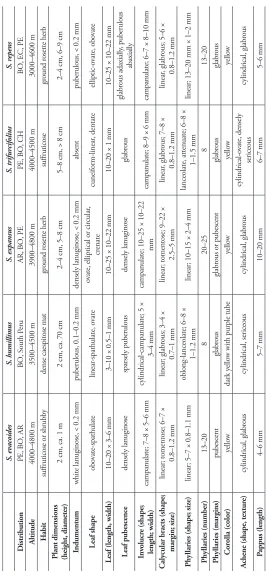
Discussion. A comparison of the material has shown that S. moqueguensis is most similar to S. pucapampaensis and S. tassaensis sp. nov. Together with S.
eva-coides, S. expansus, S. repens and S. humillimus, it forms a coherent morphological
and geographical group within S. subser. Caespitosi which occurs from central Peru to northwest Argentina and is characterized by the presence of trichomes on stems, leaves and involucres. Senecio moqueguensis can be distinguished from S.
pucapam-paensis by the dense caespitose mat habit, leaves, calycular bracts, corolla color,
in-volucres and achene morphology as summarised in Table 1. Senecio moqueguensis
can be distinguished from S. evacoides, S. expansus and S. repens by the habit, density of trichomes, leaf shape and length, as well as by the calycular bracts and phyllary length and form.
Conservation status. Following the criteria and categories of IUCN (2001), a preliminary status of Critically Endangered (CR) is assigned. The new species deserves protection because its total area of occupancy is less than 100 km² (ca. 50 km²) (B1); only three populations are known (B1b); habitat inferred to be continuing to decline (B1b(i-iii)); population estimated to number fewer than 300 individuals (D). The suit-able habitats for S. moqueguensis on the mountain summits near the set of lakes in the Ubinas district are regarded as endangered because overgrazing of grasslands, changes in annual rainfall, volcanic activity, and exploitation of natural resources may all po-tentially reduce their extent.
Senecio sykorae Montesinos, sp. nov.
urn:lsid:ipni.org:names:77140250-1
Figs 2, 4B, 5
Diagnosis. Morphologically similar to Senecio gamolepis but clearly distinguished by the tuft mat habit (vs. cushion mats), the leaf shape being obovate-spathulate (vs. linear-lanceolate), corolla white (vs. yellow), phyllaries 12–14 (vs. 7–9), disc length 7–9 mm (vs. 8–12 mm), and achene length 1.5–2 mm (vs. 1–1.3 mm).
Type. PERU: Moquegua Region, General Sánchez Cerro Province, Yunga Dis-trict, E of Yunga, terrestrial on bare clayey soils on the peaks of Perusa mountain, elevation 4802 m, 16°11'08"S, 70°38'14"W, 13 April 2012, Montesinos & Calisaya
3805 (holotype USM!, isotype HUSA!).
Table 1. Comparison between Senecio moqueguensis , S. sykorae , S. tassaensis
and their closest relatives.
S. moqueguensis S. sykor ae S. tassaensis S. pucapampaensis S. gamolepis S. algens D istribution PE (M oquegua) PE (M oquegua) PE (M oquegua) PE ( Junin)
PE, CH, AR, BO
PE, BO, AR
Altitude 4500–4800 m 4550–4800 m 4650–4700 m 4500–4600 m 4000–4800 m 4500–5000 m H abit
dense caespitose mat
tuft mat
tuft
postrate, decumbent
dense caespitose mat
caespitose subshr
ub
Plant dimensions (height, diameter)
2–4 cm, > 60 cm
4–6 cm, > 6 cm
2–4 cm, > 4 cm
5–9 cm, > 8 cm
2–3 cm, > 1 m
4–6 cm, > 6 cm
Indumentum glandular , multicelular , 0.1–0.3 mm absent glandular , multicelular , 0.3–1.2 mm finely puber ulous, <0.1 mm absent absent Leaf shape oblong-spathulate, subpin -natifid obo vate-spathulate obo
vate-spathulate, incised or acuminate
cuneiform-subpinnatifid,
incised
linear-lanceolate
spathulate, obtuse
Leaf (length, width)
8–12 × 1–2.5 mm
9–14 × 1–2.2 mm
6–9 × 1–2.5 mm
9–15 × 3–4 mm
8–12 × 2–4 mm
10–35 × 2–5 mm
Leaf pubescence sparsely co ver ed b y thin trichomes glabr ous densely co ver ed b y trichomes ciliate margins glabr ous glabr ous Inv olucr e (shape; length; width)
cylindrical-campanulate; 7–10 × 6–8.5 mm
cylindrical-campanulate;
7–9 × 3–5 mm
cylindrical-campanulate; 6–8
× 5–7 mm
campanulate; 7–8 ×
8–9 mm
cylindrical-campanulate;
8–11 × 4–6 mm
cylindrical-campanulate; 7.5–10 × 8–12 mm
C
aly
cular bracts
(shape; margin; siz
e)
linear-oblong; sparse tri
-chomes; 6–9 × 1–2.5 mm
linear-oblong; scar
ce tri
-chomes; 6–8 × 0.7–1 mm
ov
ate-oblong; dense tri
-chomes; 4–6 × 1 mm
linear; ciliate; 6–7 × 1 mm
linear; glabr
ous; 7–10
×
0.8–1.2 mm
linear; glabr
ous; 6–9 ×
0.8–1.1 mm
Phyllaries (shape; siz
e)
oblong-lanceolate; 5–8 ×
0.7–1.2 mm
linear-lanceolate; 5–6.5 ×
0.6–1 mm
linear-lanceolate; 5–8 ×
0.8–1.2 mm
linear; 6–7 × 1.2 mm
oblong; 6–8 × 1.8–2.3
mm
linear; 7–9 × 2–3 mm
Phyllaries (number) 9–12 12–14 12–16 12–14 7–9 10–15 Phyllaries (margins) densely co ver ed with trichomes glabr ous densely co ver ed with trichomes scarious, ciliate glabr ous glabr ous Cor olla (color) bright y ello w white
purple-pink to pale white
white yello w yello w Achene (shape, textur e)
cylindrical, with trichomes
cylindrical, with trichomes
ov
ate, striate, with trichomes
Table 1. Continue S. ev acoides S. humillimus S. e xpansus S. trifur cifolius D istribution
PE, BO, AR
BO, S
outh P
er
u
AR, BO, P
E
PE, BO, CH
Altitude 4000–4800 m 3500–4500 m 3900–4800 m 4000–4500 m H abit suffr
uticose or shr
ubb
y
dense caespitose mat
gr ound r osette herb suffr uticose gr
Plant dimensions (height, diameter)
2 cm, ca. 1 m
2 cm, ca. 70 cm
2–4 cm, 5–8 cm
5–8 cm, > 8 cm
Indumentum
white lanuginose, < 0.2 mm
puber
ulous, 0.1–0.2 mm
densely lanuginose, < 0.2 mm
absent puber Leaf shape obo vate-spathulate linear-spathulate, o vate ov
ate, elliptical or cir
cular , cr enate cuneiform-linear , dentate elliptic-o
Leaf (length, width)
10–20 × 3–6 mm
3–10 × 0.5–1 mm
10–25 × 10–22 mm
10–20 × 1 mm
10–25 × 10–22 mm
Leaf pubescence densely lanuginose sparsely puber ulous densely lanuginose glabr ous glabr ous adaxially Inv olucr e (shape; length; width)
campanulate; 7–8 × 5–6 mm
cylindrical-campanulate; 5 ×
3–4 mm
campanulate; 10–25 × 10–22
mm
campanulate; 8–9 × 6 mm
campanulate; 6–7 × 8–10 mm
C
aly
cular bracts (shape; margin; siz
e)
linear; tomentose; 6–7 ×
0.8–1.2 mm
linear; glabr
ous; 3–4 ×
0.7–1 mm
linear; tomentose; 9–22 ×
2.5–5 mm
linear
, glabr
ous; 7–8 ×
0.8–1.2 mm
linear
Phyllaries (shape; siz
e)
linear; 5–7 × 0.8–1.1 mm
oblong-lanceolate; 6–8 ×
1–1.2 mm
linear; 10–15 × 2–4 mm
lanceolate, attenuate; 6–8 ×
1–1.5 mm
linear; 13–20 mm × 1–2 mm
Phyllaries (number) 13–20 8 20–25 8 Phyllaries (margins) pubescent glabr ous glabr
ous or pubescent
glabr ous Cor olla (color) yello w dar k y ello
w with purple tube
yello
w
yello
w
Achene (shape, textur
homogamous, discoid and pedicled (5–10 mm long). Involucres at first narrowly cy-lindrical becoming cycy-lindrical-campanulate with age (7–9 mm long × 3–5 mm wide).
Calycular bracts linear-oblong (6–8 mm × 0.7–1 mm), dark green on the surface and
light green along the margins, with dark brown-black apex covered with inconspicuous trichomes or glabrous. Phyllaries 12–14, connate, 5–6.5 mm long × 0.6–1 mm wide, linear-lanceolate, margins glabrous, apex dark brown with short trichomes. Florets
13–16; corolla tubular, abruptly constricted near the base, 5-lobed, each lobe 0.2–0.3 mm long, white, tube 2.5–4 mm long × 0.5–0.8 mm wide; anthers linear-lanceolate, 1.5–2 mm long × 0.2–0.3 mm wide, truncate, terminal appendages lanceolate, ob-tuse; margin whitish transparent and becoming darker towards the centre; style dark purple, truncate, apically covered by papillae equally distributed. Achenes cylindrical, pale green, finely covered with trichomes, 1.5–2 mm long × 0.6–0.9 mm wide; carpo-podium symmetrical in a shallow ring; pappus of smooth fine bristles, white, 4–6 mm long, with fine alternate single setulae.
Ecology and distribution. Terrestrial plant on bare clayey soils on the summits of mountain peaks and grassland plateaus in the north of the Moquegua Region at eleva-tions of 4550–4800 m. Co-occurring with Belloa pickeringii (A. Gray) Sagást. & M.O. Dillon, Nototriche obcuneata (Baker f.) A.W. Hill, Pycnophyllum molle Remy, Senecio
candollei Wedd. and Xenophyllum ciliolatum (A. Gray) V.A. Funk. Flowers and fruits
between March and April.
Etymology. This Senecio is named after Karlè Sýkora, a well-known Dutch vegeta-tion scientist who was my mentor in phytosociology.
Additional material examined (paratypes). PERU. Moquegua Region, General Sánchez Cerro Province, Ubinas District, S of Pillone, terrestrial on bare clayey soils in the verges of the road to Pillone town, elevation 4584 m, 16°10'02"S, 70°49'56"W, 24 March 2013, Montesinos 4023 (USM).
Discussion. Senecio sykorae appears to be closely related to S. gamolepis which grows at higher elevations but approaches the known range of S. sykorae within a few hundred metres. While S. gamolepis is generally distinctive in the genus for its large size, attaining widths of up to 1 meter in diameter, and for its larger, capitu-late form, S. sykorae is a smaller plant, of about 4–6 cm wide and has shorter corolla, less than 9 mm long. Senecio sykorae is also distinctive in that it has 12–14 phyllaries per capitulum instead of 7–9 phyllaries in S. gamolepis. Likely the leaves of S. syko-rae are distinctive in that they are obovate-spathulate vs. linear-lanceolate. Also, the achenes in S. sykorae are larger (1.5–2 mm long) vs. 1–1.3 mm long in S. gamolepis.
Senecio sykorae also differs from S. algens by the leaf and capitula length (shorter
in S. sykorae), and from both species by the corolla colour (white vs. yellow). Less
similarity is found in S. algens, S. humillimus, S. trifurcifolius, S. pucapampaensis and
S. evacoides, and from which S. sykorae can be distinguished on the basis of its habit,
trichomes, leaf shape and length, calycular bracts and phyllary length and shape as summarized in Table 1.
Senecio tassaensis Montesinos, sp. nov.
urn:lsid:ipni.org:names:77140251-1
Figs 3, 4C, 5
Diagnosis. Similar to Senecio moqueguensis but clearly distinguished by the leaf lamina obovate-spathulate (vs. oblong-spathulate), leaf length 6–9 mm (vs. 8–12 mm), leaf surface densely covered by trichomes (vs. sparsely covered), trichomes 0.3–1.2 mm long (vs. 0.1–0.3 mm long), corolla white (vs. yellow), calycular bracts 4–6 mm long (vs. 6–9 mm), phyllaries 12–16 (vs. 9–12), involucre length 6–8 mm (vs. 7–10 mm), and achene length 1–1.2 mm (vs. 1.8–2.5 mm).
Type. PERU. Moquegua Region, General Sánchez Cerro Province, Ubinas Dis-trict, NW of Tassa, terrestrial on clayey rocky soils on the summits of Pirhuani peak, elevation 4657 m, 16°09'58"S, 70°43'49"W, 07 April 2011, Montesinos 3103 (holo-type HUSA!, iso(holo-types MOL, USM).
Description.Perennial herb, tufted, up to 2–4 cm high and up to 4 cm in diam.
Trichomes glandular, densely covering the plant, multicellular, whitish transparent,
0.3–1.2 mm long × 0.1–0.2 mm wide, composed of 6–10 ovate or elongate cells (each 60–80 µm long), apical cell rotund. Stems thick, < 1 cm long, often densely branched and leafy in the central portion. Leaves arranged in irregular rosettes, lamina obovate-spathulate, 6–9 mm × 1–2.5 mm, densely covered by thin trichomes on the margins; base truncated and apex pinnatifid; lower and upper surface of the leaves gradually be-coming shorter towards the tip; margin incised with 5–7 obtuse lobes or rarely acumi-nate; mature leaves with involute margins; young leaves green yellow turning greenish grey with age. Synflorescences of solitary sessile or subsessile terminal capitula. Capitula
Figure 4. Habit photographs of: ASenecio moqueguensis BSenecio sykorae CSenecio tassaensis.
Figure 5.Distribution map showing collection and recorded sites for Senecio moqueguensis (red circles),
S. sykorae (yellow squares) and S. tassaensis (green triangles). Inset: Photograph of the highland plains of
the centre; style dark purple, truncate, papillae covering the whole surface of the apex.
Achenes ovate, striate, covered with trichomes, 1–1.2 mm long and 0.6–0.8 mm wide,
pale yellow; carpopodium symmetrical in a shallow ring; pappus of smooth bristles, white, silky, 3.5–5 mm long, with fine single setulae.
Ecology and distribution. Terrestrial plant on clayey rocky soils on the peaks of the highland summits of the Pirhuani peak, near Tassa town, Moquegua Region, at elevations of 4650–4700 m. It occurs with Azorella, Calamagrostis, Pycnophyllum,
Mniodes, Senecio,and Xenophyllum. Flowers and fruits between March and April.
Etymology. This Senecio is named after the town of Tassa (Moquegua Region), downslope of Pirhuani peak where the species was found.
Discussion. Senecio tassaensis appears to be closely related to S. moqueguensis which grows at the same elevational range but approaches the known range of S. tassaensis
within a few hundred metres. Senecio moqueguensis is generally distinctive in the series for its larger size, attaining dense ground mats, and for its yellow corolla. Senecio
tas-saensis has 12–16 phyllaries (vs. 9–12), an involucre length of 6–8 mm and achene
length of 1–1.2 mm, being much shorter than in S. moqueguensis. Senecio tassaensis is relatively a very rare species with an estimated 100 individuals known. Itis less similar
to S. pucapampaensis, S. evacoides, S. expansus and S. repens, and can be distinguished
on the basis of the habit, trichomes, leaf shape and length, calycular bracts and phyl-laries length and shape as summarized in Table 1.
Conservation status. Following the criteria and categories of IUCN (2001), a preliminary status of Critically Endangered (CR) is assigned. The new species deserves protection because its total area of occupancy is less than 10 km² (ca. 5 km²) (B2); only one population is known (B2b); habitat inferred to be continuing to decline(B2b(i-iii)); population estimated to number fewer than 100 individuals (D). The suitable habitats for S. tassaensis on the mountain summits of Pirhuani peak in the Ubinas district are indicated as endangered, because changes in the annual rainfall, volcanic activity and exploitation of natural resources, may all reduce their extent.
Key to the species of Senecio ser. Suffruticosi subser. Caespitosi in Peru
(adapted from Cabrera 1985, Cabrera et al. 1999)
1a Plants shrubby; involucres longer than 11 mm ...2
1b Plants caespitose; involucres shorter than 11 mm long ...5
2a Achenes densely pubescent; leaves 1–2 cm long, deeply dentate or lobulate .. ...S. adenophyllus 2b Achenes glabrous; leaves 1–3.5 cm long, entire ...3
3a Leaves 3–5 mm wide; involucre bracts oblong ...S. rufescens 3b Leaves 0.7–2 mm wide; involucre bracts linear ...4
8a Plants with dense pubescence covering all plant parts ...9
8b Plants with sparse pubescence not covering all plant parts ...11
9a Leaves spathulate, 10–20 mm long; involucre 7–8 mm tall; phyllaries 13–20 ...S. evacoides 9b Leaves ovate, elliptic or circular, crenate, 10–65 mm long; involucre 6–10
mm tall; phyllaries 13–25 ...10
10a Involucre 10–25 mm long; phyllaries 20–25 ...S. expansus 10b Involucre 6–7 mm long; phyllaries 13–20 ...S. repens 11a Leaves cuneiform, lamina glabrous except puberulous margins ... ...S. pucapampaensis 11b Leaves oblong, lamina with trichomes on surfaces and margins ...12
12a Leaves 8–12 mm long, lamina oblong-spathulate; involucre 7–10 mm; phyl-laries 9–12 ...S. moqueguensis 12b Leaves 6–9 mm long, lamina obovate-spathulate; involucre 6–8 mm; phyllaries
12–16 ...S. tassaensis 13a Leaves dentate, linear-cuneiform ...S. trifurcifolius 13b Leaves entire ...14
14a Leaves 10–35 mm long ...S. algens 14b Leaves less than 14 mm long ...15
15a Leaves 8–12 mm, linear-lanceolate; involucre 8–11 mm; phyllaries 6–8 ... ...S. gamolepis 15b Leaves 9–14 mm, obovate-spathulate; involucre 7–9 mm; phyllaries 12–14 ... ...S. sykorae
Acknowledgements
to their material; Cuzzi y Cía., S.A. for facilitating the scanning of images; and Ruben Sierra for assisting with the literature. This work was done as part of the phytosocio-logical studies sponsored by Alberta Mennega Stichting and Hugo de Vries Fonds, the Netherlands. The language editor was Joy Burrough.
References
Arakaki M, Cano A (2003) Composición florística de la cuenca del río Ilo–Moquegua y lomas de Ilo, Moquegua, Perú. Revista Peruana de Biología 10(1):5–19.
Beltrán H (2009) Dos especies nuevas de Senecio (Asteraceae: Senecioneae) del Perú. Arnaldoa 15(2): 211–215.
Beltrán H, Granda A, León B, Sagástegui A, Sánchez I, Zapata M (2007) Asteráceas endémicas del Perú. In: León B, Roque J, Ulloa C, Pitman N, Jorgensen PM, Cano A (Eds) El Libro Rojo de las Plantas endémicas del Perú. Revista Peruana de Biología. Número Especial 13(2): 64–164.
Brako L, Zarucchi J (1993) Catálogo de las Angiospermas y Gimnospermas del Perú. Mono-graphs in Systematic Botany from the Missouri Botanical Garden 45: 1–1286.
Bremer K (1994) Asteraceae: Cladistics and Classification. Timber Press, Portland, 1–752. Cabrera A (1949) El género Senecio en Chile. Lilloa 15: 27–501.
Cabrera A (1955) Notas sobre los Senecio sudamericanos, VIII. Notas Museo de la La Plata, Botánica 18(89): 191–240.
Cabrera A (1985) El Género Senecio (Compositae) en Bolivia. Darwiniana 26: 79–217. Cabrera A, Freire SE, Ariza Espinar L (1999) Tribu VIII. Senecioneae. In: Hunziker AT, Flora
Fanerogámica Argentina 62. Museo Botánico de Córdoba, Córdoba, 3–164, 171–179. IUCN (2001) IUCN Red List Categories and Criteria: Version 3.1. Second Edition. Gland,
Switzerland and Cambridge, UK.
JSTOR (2013) JSTOR Plant Science http://plants.jstor.org/ [accessed 15.12.2013]
Montesinos D (2011) Diversidad Florística de la cuenca alta del rio Tambo–Ichuña, Moquegua, Peru. Revista Peruana de Biología 18(1): 119–132.
Montesinos D (2012) Lista anotada de nuevas adiciones para la flora andina de Moquegua, Perú. Revista Peruana de Biología 19(3): 303–312.
Neotropical Herbarium Specimens (2013) The Field Museum http://fm1.fieldmuseum.org/ vrrc/ [accessed 15.12.2013]
Nordenstam B (1977) Senecioneae and Liabeae–systematic review. In: Heywood VH, Har-borne JB, Turner BL (Eds) The biology and Chemistry of the Compositae, vol. 2. Aca-demic Press, London, 799–830.
781–805.
Tropicos.org (2013) Missouri Botanical Garden http://tropicos.org [accessed 15.12.2013] Vision TJ, Dillon MO (1996) Sinopsis de Senecio L. (Senecioneae, Asteraceae) para el Perú.