Proceedings of the
Sixth International Workshop on
Graph Transformation and Visual Modeling Techniques
(GT-VMT 2007)
Visual Programming with Recursion Patterns in Interaction Nets
Ian Mackie,, Jorge Sousa Pinto and Miguel Vilac¸a
12 pages
Guest Editors: Karsten Ehrig, Holger Giese
Managing Editors: Tiziana Margaria, Julia Padberg, Gabriele Taentzer
Visual Programming with Recursion Patterns in Interaction Nets
Ian Mackie1,2, Jorge Sousa Pinto3and Miguel Vilac¸a3
1LIX, CNRS UMR 7161, ´Ecole Polytechnique, 91128 Palaiseau Cedex, France 2King’s College London, Department of Computer Science, Strand, London WC2R 2LS, U.K.
3Departamento de Inform´atica, Universidade do Minho , 4710 Braga, Portugal
Abstract: In this paper we propose to use Interaction Nets as a formalism for
Vi-sual Functional Programming. We consider the use of recursion patterns as a pro-gramming idiom, and introduce a suitable archetype/instantiation mechanism for interaction agents, which allows one to define agents whose behaviour is based on recursion patterns.
Keywords:Interaction nets, recursion patterns
1
Introduction
This paper is about visual programming with Interaction Nets, a graph-rewriting formalism intro-duced by Lafont [Laf90], inspired by Proof-nets for Multiplicative Linear Logic. In Interaction Nets, a program consists of a number of interaction rules and an initial net that will be reduced by repeated application of the rules. The formalism combines the usual advantages of visual programming languages, but with the following additional features:
– Programs and data structures are represented in the same framework, which is useful for tracing and debugging purposes;
– All aspects of computations, such as duplication and garbage-collection, are explicit. Interaction Nets have been extensively used for functional programming as an efficient in-termediate (or implementation) language. In particular, functional programs can beencodedin Interaction Nets, using one of the many encodings of theλ-calculus. Section 3 reviews how a
functional language can be encoded in Interaction Nets following this approach, without enter-ing the details of any particular encodenter-ing ofβ-reduction. The focus of this paper will be the adequate treatment of inductive datatypes, pattern-matching, and recursive function definitions.
The remaining sections of the paper introduce and systematise the use of a functional style for programming with Interaction Nets withrecursion patterns, and introduce a new construct
(thearchetype,Section 4) which captures the behaviour of recursion patterns. We claim that this
style is a good choice for defining and executing visual functional programs.
The style of programming we refer to is widely used by functional programmers: it is based on programs that perform iteration on their arguments, usually known in the field asfolds, and (the dual notion) programs that construct results by co-iteration,unfolds. Among other advantages of using folds and unfolds for programming, they can be composed to construct complex recursive programs, and they are particularly adequate for equational reasoning: proofs of equality can be done using afusion lawinstead of recursion.
The body of theoretical work on recursion patterns comes from the field ofdatatype-generic
datatype-parameterized way. The examples in the paper use lists, but it is straightforward to generalize the ideas to arbitrary regular datatypes.
Section 5introduces interaction net programming with recursion patterns;Section 6and Sec-tion 7then present archetypes for folds and unfolds respectively. Section 8concludes and dis-cusses future work.
2
Background
Recursion Patterns. The ideas developed in this paper for Interaction Nets are very much
inspired by Functional Programming. One fundamental aspect that we will use extensively is the ability to use a set ofrecursion patternsfor each datatype. For instance few Haskell programmers would write a list sum program with explicit recursion as
sum [] = 0
sum (x:xs) = x + (sum xs)
Most would define sum = foldr (+) 0, wherefoldr is a recursion pattern encoded as the following higher-order function:
foldr f z [] = z
foldr f z (x:xs) = f x (foldr f z xs)
A function like sum is often called afold. The use of recursion patterns has the advantage of being appropriate for program transformation and reasoning using the so-called
calculation-based style [Bir84]. To see how less obvious folds can be defined, consider the list append
function:
app :: [a] -> [a] -> [a]
app [] l = l
app (x:xs) l = x:(app xs l)
This is a higher-order fold that iterates over its first argument to produce a function (idis the identity function):app = foldr (\x r l -> x:(r l)) id.
The dual notion of fold is the co-recursiveunfoldthat allows one to produce lists whose tails are constructed recursively by the function being defined. For instance the Haskell function
downfrom 0 = []
downfrom (n+1) = (n+1):(downfrom n)
can be written alternatively asdownfrom = unfold (==0) id predwherepredis the prede-cessor function, andunfoldis defined as follows
unfold :: (t -> Bool) -> (t -> a) -> (t -> t) -> t -> [a] unfold p f g x = if p x then [] else f x : unfold p f g (g x)
One of the reasons why unfolds are important [GJ99] is that together with folds they give us back the power of arbitrary recursion: the composition of a fold with an unfold is a function (known
as ahylomorphism[MFP91]) whose recursion tree is the intermediate structure constructed by
Interaction Nets. An interaction net system [Laf90] is specified by giving a setΣof symbols, and a setR of interaction rules. Each symbolα ∈Σhas an associated (fixed)arity. An occur-rence of a symbolα∈Σwill be called anagent. If the arity ofα isn, then the agent hasn+1
ports: a distinguished one called theprincipal port, andn auxiliary portslabelledx1, . . . ,xn.
A net built onΣis a graph (not necessarily connected) where the nodes are agents. The edges between nodes of the graph are connected toportsin the agents, such that there is at most one edge connected to every port in the net. Edges may be connected to two ports of the same agent. Principal ports of agents are depicted by an arrow. The ports of agents that have no edge connected are called thefree portsof the net. The set of free ports define theinterfaceof the net. The dynamics of Interaction Nets are based on the notion ofactive pair: any pair of agents
(α,β) in a net, with an edge connecting together their principal ports. An interaction rule ((α,β) =⇒N)∈R replaces an occurrence of the active pair(α,β)by the netN. Rules must satisfy two conditions: the interfaces of the left-hand side and right-hand side are equal (this implies that the free ports are preserved during reduction), and there is at most one rule for each pair of agents, so there is no ambiguity regarding which rule to apply.
If a net does not contain any active pairs then we say that it is in normal form. We use the notation=⇒for one-step reduction and=⇒∗ for its transitive reflexive closure. Additionally, we writeN⇓N0 if there is a sequence of interaction stepsN=⇒∗ N0, such thatN0 is a net in
normal form. The strong constraints on the definition of interaction rules imply that reduction is strongly commutative (the one-step diamond property holds), and thus confluence is easily obtained. Consequently, any normalizing interaction net is strongly normalizing.
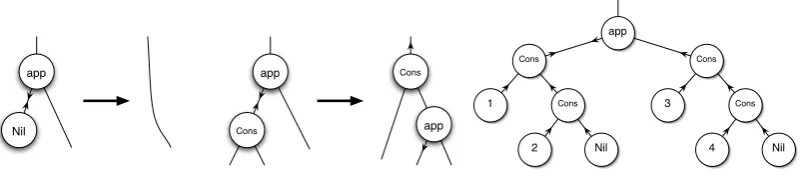
As an example, we show a system for representing lists of numbers. Lists are inductively defined by an agent Nil of arity 0 representing the empty list, and an agent Cons of arity 2 representing a cell in the list, containing an element and a tail list. Lists are constructed such that the principal port of eachConsagent corresponds to the root of the list.
To implement, for instance, list concatenation, we need an additional binary agentapp. Con-catenation is defined recursively on one of the argument lists, as expected. As such, the principal port of the agent must be used for interacting with this argument. The necessary interaction rules are given inFigure 1, together with an example net, representing the concatenation of lists [1,2] and [3,4].
app
Nil
app
Cons app
Cons
app
Cons Cons
1 Cons 3
2 Nil
Cons
4 Nil
Figure 1: Interaction rules of agentappand an example net
Related Work: Visual Functional Programming. Work in this area has addressed different aspects of visual programming. The Pivotal project [Han02] offers a visual notation (and Haskell programming environment) for data structures, not programs. Reekie’s Visual Haskell [Ree95] more or less stands at the opposite side of the spectrum of possibilities: this is a dataflow-style visualnotationfor Haskell programs, which allows programmers to define their programs visu-ally (with the assistance of a tool) and then have them translated automaticvisu-ally to Haskell code. Kelso’s VFP system [Kel02] is a complete environment that allows one to define functional pro-grams visually and then reduce them step by step. Finally, VisualLambda [DV96] is a formalism based on graph-rewriting: programs are defined as graphs whose reduction mimics the execution of a functional program. As far as we know none of these systems is widely used.
Visual Haskell and VisualLambda have in common that functions are represented as boxes with input ports for the arguments and an output port for the result; the contents of the box correspond to the body of the function. They differ in that Visual Haskell uses variables to refer to function arguments, while VisualLambda uses a purely graphical notation based on arrows.
Kelso’s VFP uses a notation without boxes, more inspired by the traditional representations of functional programs used in implementation-oriented abstract machines (seeSection 5). In particular, it allows for named functions but also forλ-abstractions, and an explicit application
node exists. Variables are used for arguments, as in Visual Haskell.
Higher-order programming is a fundamental feature of functional programming. A function
f can take functiongas an argument andgcan then applied within the body of f. Expressing this feature is easy if variables are used as in Visual Haskell and VFP; in VisualLambda a special box would be used as a placeholder forg(in the body of f) to be instantiated later, and an arrow would link an input port in the box of f to the box ofg.
The work presented in the present paper uses a pure visual representation of programs, without variables. In this aspect it resembles VisualLambda, however our work differs significantly from this in that no boxes are used, and all the graph-rewriting operations arelocalin the sense that only two nodes of the graph are involved in each step.
A second difficulty arising from the higher-order nature of programs is that a (curried) function of two arguments may receive only its first argument and return as result a function. In a box-based representation this means that it must be possible for a box to lose its input ports one by one—a complicated process. Interaction nets treat this problem naturally as will become clear. Moreover in this paper we introduce a new notion (the archetype), which captures precisely the behaviour of many typical curried functions.
3
Visual Functional Programming with Interaction Nets Using
Ex-plicit Abstraction and Application Nodes
In this section we explain how a very simple functional programming language can beencodedin Interaction Nets. The language has inductive types, pattern-matching on these types, and explicit recursion.
The usual way of representing functional programs with interaction nets is based on a pair of symbolsλ, @ of arity 2, such that aβ-reduction step corresponds to an interaction between
an agent λ and an agent @. These representations are based on an explicit depiction of the
λ-abstractions in the program, as well as applications of functions to arguments.
While this may be visually more complicated than the boxes used by some of the systems reviewed in Section 2, it certainly solves the “higher-order” problem in a natural way, since function arguments are treated like any other arguments. The definition of the application
func-tionap f x = f xinFigure 2(left) illustrates this point.
λ λ
@
λ @
Figure 2:apdefinition (left) andβ rule (right)
We only discuss the features of the linearλ-calculus here, which is shared by all encodings.
It is beyond the scope of this paper to include the details of the non-linear aspects, but refer the reader to [Mac98,Mac04] for the encodings of the fullλ-calculus.
Consider an interaction system containing the symbols{@,λ}as explained above, as well as
theβ interaction rule ofFigure 2(right). This system defines the visual programming language
for the linearλ-calculus. A visual functional program consists of this interaction system, to-gether with a closed functional expression to be evaluated, represented by a net with a single free port. We now outline how other features can be introduced in the interaction system to enrich this core language.
The next feature is Inductive Types and Pattern-matching. Consider a datatype T with con-structorsC1. . .Cn, with aritiesa1. . .an . This can be modelled in a straightforward way by an
interaction system containing n agents labelled Ci with arity ai, i=1. . .n ; values of type T
correspond to closed trees built exclusively from these agents (in a tree all principal ports are oriented in the same direction). In a constructor agent, auxiliary ports are input ports, and the principal port is an output port. An example of this is the datatype of lists with constructorsNil
andCons, as inFigure 1.
Pattern-matching over an inductive typeT can be implemented by a special agentTcase. For instance, theListCaseagent has arity 5, and its behaviour is defined by the two rules:
List Case
Nil
ε ε ε
List Case
Cons
ε
tail of a non-empty list. Observe that one of these nets is not used in each rule, and must be erased with ε agents. The interaction of an ε agent with any other agent erases the latter and
propagates newεagents along its auxiliary ports.
The approach outlined above allows for unnamed functions only. In a visual language one would like to have the possibility of defining named functions, which would most naturally correspond to agents in the interaction system. A special agentdef can be used for unfolding named function definitions. For instance a function isEmpty can be defined by the following interaction rule for the agentdef:
List Case True def is Empty λ False ε ε
The following figure shows the reduction of the visual program corresponding to the application ofisEmptyto the list[1,2].
List Case True def is Empty λ False ε ε Cons 1 Cons 2 Nil @ Cons 1 Cons 2 Nil @ List Case True False ε ε Cons 1 Cons 2 Nil True False ε ε 1 Cons 2 Nil ε
This agent also allows for a visually appealing treatment of recursion: it suffices that the right-hand side of interaction rules involvingdefreintroduces an active pair (the left-hand side of the rule) as a sub-net.
To sum up, Interaction Nets allow to visually represent functional programs and data struc-tures in the same very simple formalism; moreover higher-order feastruc-tures, which are a typical difficulty in the visual setting, are treated in a natural way, and the execution of the program can be efficiently implemented within the formalism.
4
Agent Archetypes
Although no standard programming language exists as a front-end for programming with Inter-action Nets, it is generally well accepted that any such language should contain some form of support for modularity and reusability. In particular, a mechanism should exist to facilitate the definition of interaction rules that follow identical patterns.
NilandCons, and the right hand sides of the corresponding rules are nets to be instantiated, that will be called respectivelyNf,NilandNf,Cons.
ArchetypeListCasef
f
Nil
Nf,Nil
f
Cons
Nf,Cons
To define a new agent following the archetype, aninstanceis created, by simply providing the nets in the right-hand side of the interaction rules. This implicitly includes the agent declaration, as well as the instantiated interaction rules for this agent, in the interaction system being defined. As an example, theisEmpty agent (and its behaviour) is defined as an instance of theListCase
archetype. ε agents are used to explicitlyerasethe head and tail of the list, which are not used
in the result.
InstanceListCase isEmpty
NisZero, Nil
NisZero, Cons
= True =
False
ε ε
For a second example, take the agentdefused inSection 5for function definitions. We create an archetype fordefined functions, whose only mandatory rule is for interaction withdef, with the right-hand side to be instantiated.
Recursive archetypes are most interesting, and will be very useful in the rest of the paper
(inSection 6a recursive archetype will be given for theappagent). Although archetypes can be useful for programming with interaction nets in general, our examples of using them here concern features of functional programming languages.
The ListCase example shows that archetypes allow for a natural treatment of higher-order concepts:ListCasecan be seen as a function that takes certain arguments (the instantiated nets) and returns another function (an agent with its own rules) as result.
5
Interaction Net Programming with Recursion Patterns
Section 3was about using Interaction Nets forencodingfunctional programs, with the practical goal of producing efficient functional compilers. From the point of view of visual program-ming, the drawbacks of this approach are that the introduction of explicit abstraction and ap-plication nodes complicates the visual representation of programs (the same is true of explicit case constructs), and also raises the matching duplicators problem. Solving this problem implies introducing in the system machinery that destroys the clean visual representation of terms.
again the interaction rules given inFigure 1. It is easy to see that both define a behaviour for the agentappsimilar to the standard list concatenation function, which can be written in Haskell as shown inSection 2.
In both cases, a program consists of a collection of function definitions encoded directly as interaction rules in a particular interaction system, together with a closed functional expression to be evaluated in the context of those definitions, represented by a net with a single free port. While in the second approach a function definition corresponds to interaction rules for a special agentdef, inFigure 1there is a direct correspondence between the clauses in the definition of a function f and the interaction rules defining the behaviour of the agent f. A comparison of both definitions reveals that the first approach is visually simpler, and thus more appropriate for representing programs, than the second, standard approach.
Naturally, there are important limitations to the class of programs with which the simplified representation can be used. The example above takes advantage of a fundamental aspect of Interaction Nets, which is that pattern-matching on the outermost constructor isbuilt-inthrough the rule selection mechanism (in the definition ofappinFigure 1, only the outermost constructor is matched). Matching deeper constructors, or matching more than one argument in the same clause, would force us to use an explicit case agent.
For a certain class of patterns (match-sequential systems [Tha87]) there are known transfor-mations which result in a system which examines arguments one at a time. We can use this transformation to obtain an explicit system. We refer the reader to [Ken90] for a detailed presen-tation of one such transformation.
It will now be shown that the use of a programming style based on recursion patterns allows precisely for the direct representation to be used, since these operators perform pattern-matching on a single top-level constructor.
Iteration: Fold Agents. The simplest form of recursion is iteration, which substitutes the
datatype constructors by some given functions. Taking lists as an example, a fold is a function that combines the head of the list with the result of recursively applying the function to the tail of the list, to produce the result (a given value is returned at the end of the list).
Since this requires matching on the outermost constructor only, iteration neatly fits the inter-action paradigm. The following is the definition of theproductfold, which computes the product of all the numbers in a list (it uses an agent ∗ for multiplication of numbers; we assume the arithmetics to be correctly implemented in the current interaction system).
prod
Nil
prod
Cons prod
* S
0
It is easy to see that other, more powerful recursion patterns on an inductive type can be captured in the same way. For instance,primitive recursion on a list would allow for thetailof the list itself to be used as well.
Co-recursion Patterns: Unfold Agents. Co-recursivefunctions provide structured ways to
pattern, which is the dual of fold, corresponds to functions that construct lists by giving an element to be placed at the head position, together with a seed used as an argument to recursively construct the tail of the list. This is the simplest form of co-recursion.
Let us consider an unfold agent downfrom (df) which interacts with a natural number n to construct the list containing all the numbers fromn down to 1, in this order. Its rules are the following (where∂ returns two copies of the given argument):
df df Cons
Nil
* * df
0 S
S
∂
6
Fold Archetypes
The rules that characterize the behaviour of a fold agent (on a particular inductive type) can be described by arecursive archetype, in the sense that the parameterized agent occurs in the right-hand side of one of the rules.
Taking the case of lists, interaction rules must be defined for f to interact with bothNiland
Cons. The archetype is:
Archetypefoldrf
f
Nil
Nf,Nil
f
Cons
Nf,Cons
f
where interaction withNilresults in an arbitrary net, and interaction withConssends an f agent along the tail of the argument list, and a netNf,Consthen combines the head of the list with the
recursive result. As an example, the agent prodcan be alternatively defined as the following instance:
Instancefoldr prod
Nprod, Nil
Nprod, Cons
=
0
= *
S
The principles developed above can be applied to folds over any regular inductive type.
Higher-order Folds. Our current definition of a fold agent is still not satisfactory, and will
be defined with Interaction Nets as a binary agent (seeFigure 1), which clearly does not match our current definition of the fold archetype.
Functions of more than one argument defined as folds over one of the arguments lead us to the generalization of thefoldrarchetype, as shown in the following figure. This is parameterized by the number of extra arguments of the fold agent; our previous definition is of course a particular case of this wherek=0.
Archetypefoldrf(k)
f
Nil
Nf,Nil
f
Cons
Nf,Cons
f
k k
k
k k head tail
args
head
rec. result args args'
args args
The definition ofappend as an instance of this archetype, fork=1, can be seen below. The open wire in the net Napp,Cons corresponds to the fact that the second argument of the fold is
preserved in the recursive call.
Instancefoldr app(1)
Napp, Nil
Napp, Cons
= = Cons
head rec. result y
y'
y
y'
head rec. result
y y
7
Unfold Archetypes
It is less obvious to define an archetype for unfolds. Consider again the case of lists; it is clear that there must be two rules (to produce empty and non-empty lists respectively); the contents of the right-hand side of each interaction rule is also clear (with a parameter net appearing in the second rule). However, since the arguments of an unfold are arbitrary, the two rules cannot correspond to interactions between the unfold and its arguments. Instead, we will consider two special agents that interact with the unfold.
Archetypeunfoldu
u u
Nu Cons
c1 c2
u Nil
Instanceunfold dfu
Ndfu = g
simply an agent (see right of previous figure) whose behaviour is given by the rules on the left in the following figure. Then the following macro (on the right) can be defined:
S
∂
c2 g
0
c1 g
S df'
dfu
g =
8
Conclusions and Future Work
One of our long-term goals is to develop a full environment for interaction net programming— a tool is currently being developed. We are currently working on the archetype definition and instantiation mechanism. Subsequently, we plan to incorporate in the programming environment a mechanism that generates the appropriate archetype for a given user-defined inductive type.
This paper opens a number of other research questions at the theoretical level. One of the main reasons for using recursion patterns and datatype-generic programming is that this style of programming is good forreasoningabout programs equationally. The work in this paper allows us to reason about functional programs visually. In [MPV05] we derive afusion law for the fold archetype, that already makes it possible to transpose to the visual setting classic program transformation techniques such as the introduction of accumulators or tupling.
A different approach that we intend to explore is to establish a formal correspondence between a core functional language with recursion patterns and an interaction system for that language. This will allows us to be more precise in the study of the calculation laws for visual programs.
At the level of the programming environment, the graphical notation then becomes an alter-native to writing functional programs textually. The environment should be able to translate between visual programs and textual programs, and all operations performed on programs at the visual level correspond closely to the same operations at the expression level.
Acknowledgements: The work of the third author is financed by FCT (SFRH/BD/18874/2004).
This work is partially supported by the British Council Treaty of Windsor Grant: “Visual Pro-gramming”.
Bibliography
[Bir84] R. S. Bird. The Promotion and Accumulation Strategies in Transformational Program-ming. ACM Transactions on Programming Languages and Systems 6(4):487–504, Oct. 1984.
http://dx.doi.org/10.1145/1780.1781
[DV96] L. Dami, D. Vallet. Higher-Order Functional Composition in Visual Form. Technical report, University of Geneva, 1996.
[Fer98] M. Fern´andez. Type Assignment and Termination of Interaction Nets.Mathematical
Structures in Computer Science8(6):593–636, 1998.
[FM98] M. Fern´andez, I. Mackie. Coinductive Techniques for Operational Equivalence of Interaction Nets. InLICS. Pp. 321–332. 1998.
[Gib02] J. Gibbons. Calculating Functional Programs. In Backhouse et al. (eds.),Algebraic
and Coalgebraic Methods in the Mathematics of Program Construction. LNCS 2297,
chapter 5, pp. 148–203. Springer-Verlag, 2002.
[GJ99] J. Gibbons, G. Jones. The Under-Appreciated Unfold. In Proceedings of the ACM
SIGPLAN International Conference on Functional Programming (ICFP ’98).
SIG-PLAN 34(1), pp. 273–279. June 1999.
[Han02] K. Hanna. Interactive Visual Functional Programming. In Jones (ed.), Proc. Intnl
Conf. on Functional Programming. Pp. 100–112. ACM, October 2002.
http://www.cs.ukc.ac.uk/pubs/2002/1516
[Kel02] J. Kelso.A Visual Programming Environment for Functional Languages. PhD thesis, Murdoch University, 2002.
[Ken90] J. Kennaway. Implementing term rewrite languages in DACTL.Theoretical Computer
Science72:225–249, 1990.
[Laf90] Y. Lafont. Interaction Nets. In Conference Record of the Seventeenth Annual ACM
Symposium on Principles of Programming Languages. Pp. 95–108. ACM, Jan. 1990.
[Mac98] I. Mackie. YALE: Yet Another Lambda Evaluator Based on Interaction Nets. InICFP. Pp. 117–128. 1998.
[Mac04] I. Mackie. Efficient λ-evaluation with Interaction Nets. In Oostrom (ed.),
Rewrit-ing Techniques and Applications, 15th International Conference (RTA 2004). Lecture
Notes in Computer Science 3091. Springer, June 2004.
[MFP91] E. Meijer, M. Fokkinga, R. Paterson. Functional Programming with Bananas, Lenses, Envelopes and Barbed Wire. In Hughes (ed.),Proceedings of the 5th ACM
Confer-ence on Functional Programming Languages and Computer Architecture (FPCA’91).
LNCS 523. Springer-Verlag, 1991.
[MPV05] I. Mackie, J. S. Pinto, M. Vilac¸a. Functional Programming and Program Transforma-tion with InteracTransforma-tion Nets. Technical report 05.05.02, Universidade do Minho, 2005.
[Ree95] H. J. Reekie. Realtime Signal Processing – Dataflow, Visual, and Functional
Pro-gramming. PhD thesis, University of Technology at Sydney, 1995.
[Sin06] F.-R. Sinot. Token-Passing Nets: Call-by-Need for Free.Electr. Notes Theor. Comput. Sci.135(3):129–139, 2006.