ISSN: 2501 - 1235 ISSN-L: 2501 - 1235 Available on-line at: www.oapub.org/edu
doi: 10.5281/zenodo.3700095 Volume 6 │ Issue 2 │ 2020
THE EFFECT OF KNOWLEGE OF PERFORMANCE
FEEDBACK AND TASK DIFFICULTY ON PERFORMANCE
AND LEARNING OF BASKETBALL CHEST PASS:
CHALLENGE BASED LEARNING APPROACH
Sayed Kavos Salehi1i, Leila Lajm Orak2
1Department of Motor Behavior,
Faculty of Physical Education and Sport Sciences, Shahid Rajaee Teacher Training University, Lavizan, Tehran, Iran
2Department of Motor Behavior,
Faculty of Physical Education and Sport Sciences, Shoushtar Branch, Islamic Azad University, Shoushtar, Iran
Abstract:
The purpose of this study was to investigate the effects of the knowledge of performance feedback and task difficulty on basketball chest pass performance and learning with challenge point hypothesis. In order to achieve the research goals, 96 non-experienced and unfamiliar students were selected in a targeted and accessible manner and randomly classified into 8 groups. Each of the groups practiced with its own protocols, combining different levels. Two-way variance analysis with repeated measurements and two-way analysis of variance were used to analyze the data. The results showed that the knowledge of performance feedback (confirmatory and corrective) had a significant effect on the acquisition and learning of the basketball chest pass and the effect of confirmation feedback was greater than the correction in the retention phase. Also, the task difficulty (nominal and functional) had an effect on the performance and learning of basketball chest pass, and this effect was high in the retention test for functional difficulty. Additionally, the interaction of knowledge of performance and the task difficulty was not significant. In general, the results of this study find that it is beneficial to use the trainings-based challenge point -framework- to improve performance and learning.
Keywords: task difficulty, nominal difficulty, task difficulty, confirmation feedback, correlation feedback
1. Introduction
In recent years, research in theories and models of motor learning has accelerated significantly; one of them is the Challenge Point Framework proposed by Guadagnoli and Lee (2004). The purpose of the theoretical framework of the point of challenge is to formulate different ideas into a conceptual framework. A framework that describes how the interaction between different factors, namely feedback and task difficulty, designs an exercise protocol (Guadagnoli & Lee, 2004).
According to Magill (2007), feedback refers to information that one receives about the outcome or performance of the skill during or after the exercise. When practicing a motor skill, various sources provide information on the outcome of the movement and the cause of the outcome. Researchers have substantiated the role of feedback in physical activity (Goh, Kantak, & Sullivan, 2012; Magill & Anderson, 2007; Rice & Hernandez, 2006; Sidaway, Bates, Occhiogrosso, Schlagenhaufer, & Wilkes, 2012; Vander Linden, Cauraugh, & Greene, 1993).
Clearly, practice alone is not effective in learning, but practice variables are also important. Reducing training requirements (easy training) increases the potential for execution, while increasing cognitive requirements reduces execution potential, However, there is a point where these two types of needs (exercise and cognitive) are in balance and learning is optimal and it's called that point of challenge. This optimal range varies, depending on the skill level of the individual and the difficulty of the task being learned (Guadagnoli & Lee, 2004). According to this view, contextual interaction variables and feedback are strongly correlated with the level of learning skill and difficulty of the task being learned (Guadagnoli & Lee, 2004).
The basic principle of the challenge point framework is to manipulate the training variables to reach the optimal challenge point. In general, in order to optimally learn, the learner must be challenged (get involved in learning skills). If the challenge is less than optimal, it will increase performance and decrease learning, if the training challenge is too desirable, it will reduce performance and learning; but if the challenge is optimal, it will reduce performance and increase learning. Importantly, at this point of challenge, is the shift from focusing on short-term practice to long-term learning. In fact, this view examines the paradox between learning and practice and states that training conditions that reduce performance to an optimum point will improve the retention test, which is a better estimate of learning. In fact, the decline in performance is because; skill is more challenging and it promotes learning. According to the Challenge Point Framework, interpretations between the nominal difficulty of the task and the skill level of the subject can produce levels of functional difficulty in specific training situations that can determine how much information is available for motor learning (Guadagnoli & Lee, 2004).
Frequency of high feedback during the acquisition phase is better than low frequency, but in retention, low frequency is better. In fact, when feedback is low or feedback is delayed, the difficulty of the task is high and this level of difficulty depends on the skill level of the performer. According to the theoretical framework of the challenge point justification, learning relates to accessible and interpretable information. That is, a beginner may have information available but cannot be interpreted and immediate feedback, or after every attempt, is appropriate for him to maintain the optimal challenge point (Guadagnoli & Lee, 2004). The results of the study by Sidaway et al. (2012) showed that: more feedback is needed to create optimal learning in the task at hand, while it was the opposite of easy task (Schmidt, Lee, Winstein, Wulf, & Zelaznik, 2018; Sidaway et al., 2012).
In a study by Pollock et al. (2014), was tested the theoretical framework hypothesis of the challenge point in designing balance training programs in people with stroke. In this study, feedback was given to each participant individually according to level to maintain optimal challenge point for each individual. The results of this study showed that: The difficulty level of the learning task and the information processing needs interact with each other during training and play an important role in learning motor skills. The positive results of this study supported the predictions of the theoretical framework of the challenge point. But the important point is that previous studies have used feedback more than outcome awareness and manipulated feedback alternatives (Hitchcock & Mcallister Byun, 2015; Pollock, Boyd, Hunt, & Garland, 2014; Sidaway & Trzaska, 2005).
One of the few studies that have manipulated the type of feedback has been the study of Andrews et al. (2016). In this study, we compared the effects of task difficulty with manipulating frequency and timing of early and late exercise self-control feedback on motor learning. The results of this study emphasize the use of another type of feedback (outcome awareness) (Andrieux, Boutin, & Thon, 2016). Accordingly, given the scarcity of research into the application of exercises based on the challenge point framework, and in particular its combination with motor learning variables such as feedback, the present study aims to investigate the effect of feedback on performance (confirmatory and corrective) and task difficulty (nominal, functional) on motor learning of a cognitive-motor skill.
In the present study was investigated the effect of feedback on performance awareness and task difficulty on performance and learning of a chest-pass basketball skill with a challenge point approach to answer the questions like:
• does performance awareness feedback impact basketball chest-pass performance and learning on basketball?
• does task difficulty affect performance and learning chest-pass basketball skills?
2. Methodology
The present study is a cross-sectional quasi-experimental research conducted by field method. The statistical population of this study was all female high school students in Izeh city who were studying in the academic year 2018-2019. The final sample of this study consisted of 96 girl students who were purposefully selected and had no professional experience in basketball chest pass skills and they were homogeneous in height, length, and arm. These students were randomly assigned to one of eight experimental groups (n = 12) as follows:
1) low nominal difficulty - low functional difficulty - feedback from confirmation implementation;
2) low nominal difficulty - low functional difficulty - feedback from corrective action awareness;
3) low nominal difficulty - high functional difficulty - feedback from confirmation implementation;
4) low nominal difficulty - high functional difficulty - feedback from corrective action awareness;
5) high nominal difficulty - low functional difficulty - confirmation performance awareness feedback;
6) high nominal difficulty - low functional difficulty - feedback from corrective action awareness;
7) high nominal difficulty - low functional difficulty - feedback from confirmation implementation;
8) high nominal difficulty - high functional difficulty - feedback from corrective performance.
In this research, Porter and Magill (2010) basketball pass test was used to evaluate and score basketball two - hand over head pass skill, which had a validity coefficient of 0.97 and a reliability coefficient of 0.78 (Porter & Magill, 2010). The test is that participants throw two-hand over head pass a basketball from a distance of 3 meters. The target used in this test was a 190 x 190 cm square target mounted on the wall. The square goal was divided into 19 parts by 10 cm and the way it was scored was that if the ball hit the middle zone, the maximum score would be zero and if the ball hits the two ends of the goal, the minimum score is +9 and -9, how to calculate points was in absolute error.
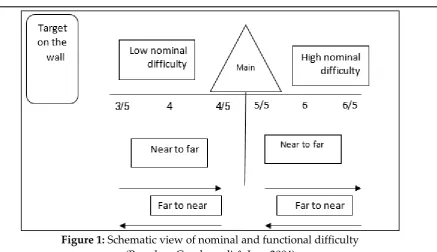
This study included the nominal and functional difficulty of the task. To create the nominal difficulty of the task, the upper and lower distances of the target (ie 5 m) were considered as high and low nominal difficulty. Three half-meter distances were assigned to each of the up and down nominal difficulties to create task difficulty (How to create a nominal and functional difficulty of the task is modeled from the study of San Lee and Lee (2015).
Figure 1: Schematic view of nominal and functional difficulty (Based on Guadagnoli & Lee, 2004)
This study included pre-test, acquisition and retention stages. In the pre-test phase, participants performed 9 two-hand over head throw basketball throws 5 yards away. After the pre-test scores were recorded, the acquisition phase (practice) was performed in 3 sessions (according to Porter & Magill, 2010) and in each session, the subjects performed 27 training attempts (3 blocks of 9 trials).
First group: participants performed low nominal difficulty, low functional difficulty, confirmatory performance awareness feedback, 9 launches (one block) from 3.5 m distance and in 33% of the efforts on the right movements received feedback on performance; they then performed 9 launches (one block) from a distance of 4 meters and received feedback on 33 percent of attempts on the correct movements. Finally, they performed 9 launches (one block) at 4.5 m distance and received 33% of the effort on the correct movement's feedback. These steps were repeated at each training session.
Second group: in this group, the same protocol as in the first group, except that they received feedback on corrections after attempts to correct and attempt wrong movements.
Third group: participants performed low nominal difficulty, high functional difficulty, confirmatory performance awareness feedback, 9 launches (one block) at 4.5 m distance and in 33% of efforts on the right movements they received feedback on performance; they then made 9 throws (one block) from a distance of 4 meters and received 33% of the effort on the correct movement feedback; finally, they made 9 throws (one block) at 3.5 m distance and received 33% of the effort on the correct movement feedback. These steps will be repeated at each training session.
Fifth group: participants in the high nominal difficulty, low functional difficulty, confirmation performance awareness feedback, performed 9 launches (one block) at a distance of 5.5 m and in 33% of efforts on the right movements they received feedback on performance; they then made 9 throws (one block) from a distance of 6 meters and received feedback on the correct movements in 33 percent of the attempts; finally, they made 9 launches (one block) from a distance of 6.5 meters and in 33% of the efforts on the right movements they received feedback about the performance. These steps will be repeated at each training session.
Sixth group: participants received high nominal difficulty, low functional difficulty, feedback on corrective performance, and attempts on erroneous gestures of performance feedback. These steps will be repeated at each training session.
Seventh group: participants in the high nominal difficulty, high functional difficulty, confirmation performance awareness feedback, performed 9 launches (one block) at a distance of 6.5 m and in 33% of efforts on the right movements they received feedback on performance; they then performed 9 throws (one block) from a distance of 6 meters and received feedback on the correct movements in 33 percent of the attempts; and finally, they made 9 throws (one block) at a distance of 5.5 meters and received 33% of the effort on the correct movement feedback. These steps will be repeated at each training session.
Eighth group: participants received high nominal difficulty, high functional difficulty, feedback awareness of corrective action, and attempts at erroneous gestures of performance awareness feedback. These steps will be repeated at each training session.
After the acquisition phase, post-test was performed immediately. At this stage, like the pre-test phase, subjects will perform 9 two-hand over head basketball throws from a distance of 5 meters. The retention phase was performed from 24 hours to two weeks after the posttest completion. In this phase, participants also made 9 basketballs two - hand over head from a distance of 5 meters.
To analyze the results, descriptive statistics were used to classify and adjust the data and determine the central index (mean) and dispersion index (standard deviation) and plotted charts and tables. Shapiro-Wilk test was used to check the normality of the data and Levon's test was used to test the equality of variance. Two-way ANOVA with repeated measures in acquisition stage and two-way ANOVA test in retention stage were used to investigate and analyze research hypotheses using SPSS software version 18 and significance level 0.05.
3. Results
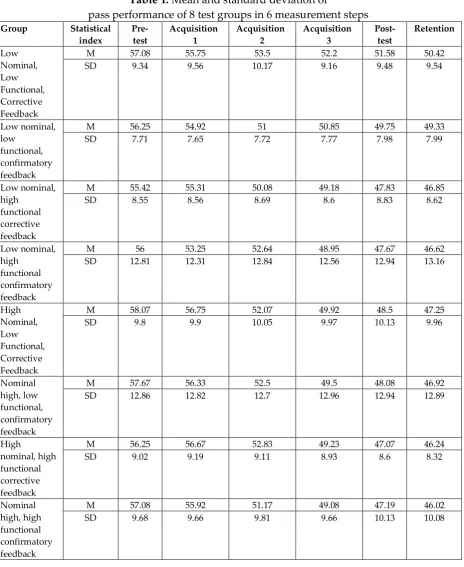
Table 1: Mean and standard deviation of
pass performance of 8 test groups in 6 measurement steps
Group Statistical index Pre- test Acquisition
1 Acquisition
2 Acquisition
3 Post-test Retention Low Nominal, Low Functional, Corrective Feedback
M 57.08 55.75 53.5 52.2 51.58 50.42
SD 9.34 9.56 10.17 9.16 9.48 9.54
Low nominal, low
functional, confirmatory feedback
M 56.25 54.92 51 50.85 49.75 49.33
SD 7.71 7.65 7.72 7.77 7.98 7.99
Low nominal, high
functional corrective feedback
M 55.42 55.31 50.08 49.18 47.83 46.85
SD 8.55 8.56 8.69 8.6 8.83 8.62
Low nominal, high
functional confirmatory feedback
M 56 53.25 52.64 48.95 47.67 46.62
SD 12.81 12.31 12.84 12.56 12.94 13.16
High Nominal, Low Functional, Corrective Feedback
M 58.07 56.75 52.07 49.92 48.5 47.25
SD 9.8 9.9 10.05 9.97 10.13 9.96
Nominal high, low functional, confirmatory feedback
M 57.67 56.33 52.5 49.5 48.08 46.92
SD 12.86 12.82 12.7 12.96 12.94 12.89
High
nominal, high functional corrective feedback
M 56.25 56.67 52.83 49.23 47.07 46.24
SD 9.02 9.19 9.11 8.93 8.6 8.32
Nominal high, high functional confirmatory feedback
M 57.08 55.92 51.17 49.08 47.19 46.02
SD 9.68 9.66 9.81 9.66 10.13 10.08
Table 2: Evaluation of homogeneity of mean basketball pass values in 8 groups in pre-test by Levon's test
Levon's amount Degree of freedom 1
Degree of freedom 2 Significance level
1.18 7
88 0.32
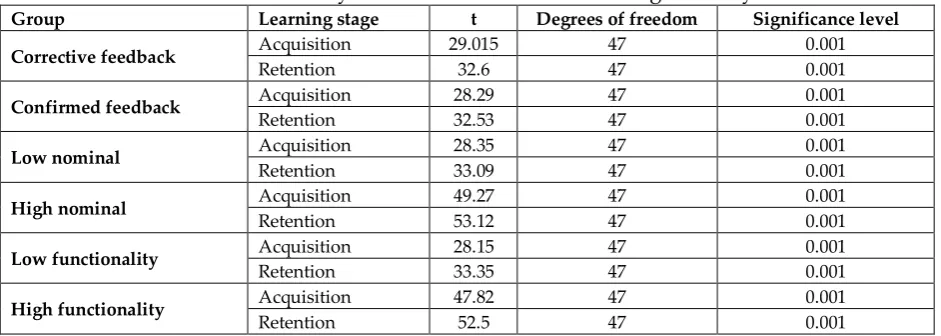
Correlated t-test was used to evaluate the performance of subjects in each group pre and post the test. Results showed that post-test basketball pass score significantly improved in both confirmatory (P = 0.001) and corrective (P = 0.001) feedback groups. Post-test basketball pass scores in all four groups were low (P = 0.001) and high (P = 0.001) and low functional difficulty (P = 0.001) and high (0.001), respectively. = P) has significantly improved. Basketball pass scores in the retention test significantly improved in both the confirmatory (P = 0.001) and corrective (P = 0.001) feedback groups.
Basketball pass scores in retention test compared to pre-test in all four groups Low nominal difficulty (P = 0.001) and high (P = 0.001) and low functional difficulty (P = 0.001) and high (P = 0.001) significantly improved (Table 3).
Table 3: Comparison of changes in basketball pass values in post-test compared to acquisition and retention in 8 groups, correlation between type of
feedback and difficulty of nominal and functional assignment by t-test
Group Learning stage t Degrees of freedom Significance level
Corrective feedback Acquisition 29.015 47 0.001
Retention 32.6 47 0.001
Confirmed feedback Acquisition 28.29 47 0.001
Retention 32.53 47 0.001
Low nominal Acquisition 28.35 47 0.001
Retention 33.09 47 0.001
High nominal Acquisition 49.27 47 0.001
Retention 53.12 47 0.001
Low functionality Acquisition 28.15 47 0.001
Retention 33.35 47 0.001
High functionality Acquisition 47.82 47 0.001
Retention 52.5 47 0.001
The repeated measures ANOVA was used to compare changes in basketball pass values in eight groups of high and low nominal and functional difficulty, and confirmatory and corrective feedback in the acquisition phase. The results showed that only the effect of time factor (p = 0.001) on basketball pass skill performance in acquisition phase was significant and the effect of other factors on performance of this skill was not different. Also, the results of one-way ANOVA test regarding basketball pass performance values in post-test showed that there was no significant difference between groups (P = 0.173). This means that there is no difference in the acquisition of basketball pass skill between the 8 groups of nominal difficulty, functionality and type of feedback.
interaction of these three interventions had no significant effect (P = 0.98) (Table 4). Also, each of the methods of practicing high and low nominal difficulty, high and low functional difficulty, and confirmatory and corrective feedback increased significantly the learning of basketball pass skill and the interaction of each of these independent variables together increased basketball pass skill, but the sum of the statistical analysis showed that; there was no significant difference in learning basketball pass skill in 8 groups of nominal difficulty, functionality and type of feedback. Significant effect of each intervention was observed on performance awareness (confirmatory and corrective) and task difficulty (nominal and functional) on learning basketball chest pass basketball but feedback factor of performance awareness (confirmatory and corrective) and task difficulty (nominal and functional) did not affect the learning of basketball chest pass.
Table 5: Comparison of changes in basketball pass values during the retention
phase by type of training difficulty and feedback by two-way analysis of variance
Source of work Sum of
squares
Degree of freedom
Mean
square F
Significance level
Nominal difficulty 543.03 1 543.03 184.35 0.001
Functional difficulty 558.7 1 558.7 189.67 0.001
Feedback 311.16 1 311.16 102.06 0.001
Nominal * functional difficulty 34.37 1 34.37 11.67 0.001
Nominal difficulty * feedback 0.68 1 0.68 0.23 0.631
Functional difficulty * feedback 0.79 1 0.79 0.27 0.606
Nominal difficulty * functionality *
feedback 0.01 1 0.01 0.01 0.98
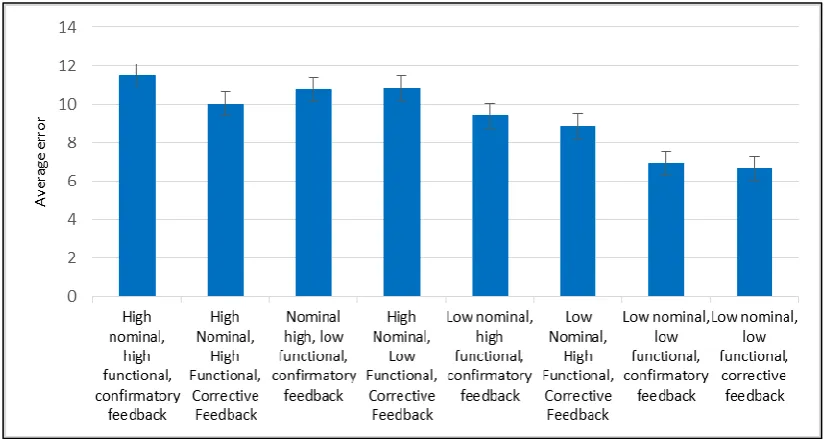
In Diagram 1, the mean difference of basketball pass skill performance of 8 subjects in the retention test was compared to the pre-test.
4. Conclusion
The purpose of the present study was to investigate the effect of feedback on task performance and task difficulty on performance and learning of a chest pass basketball skill with a challenge point approach. The results showed that performance awareness feedback (confirmatory and corrective) had an impact on the performance of basketball chest pass. Although the effect of confirmatory feedback was slightly greater, there was no significant difference between the performance of the two groups of confirmatory and corrective feedback. The study also found that performance awareness feedback (confirmatory and corrective) affects basketball chest pass learning and the changes in skill learning in the feedback group were significantly more than the correction group. Perhaps the reason behind the confirmation feedback group's progress in the acquisition phase could be stated as: approval of the correct motions is likely to encourage learners to repeat the motion and create a pattern of stability by reducing variability and creating a pattern of motion. Feedback to correction efforts results in unpredictable response variability to correct for small errors, and this variability prevents the creation of a consistent movement pattern during acquisition but in retention and transfer, it results in effective learning. Based on duplicate evidence, a successful motion pattern is easier than changing a motion pattern for error correction and leads to implicit learning (Chiviacowsky, Wulf, Wally, & Borges, 2009).
The results of the present study showed that task difficulty (nominal and functional) affects basketball chest pass performance but there was no difference between the two types of task difficulty. The results of the present study also showed that: Difficulty of homework (nominal and functional) affects basketball pass learning and there was a significant difference between the retention of basketball pass skill between the low nominal difficulty group, the low functional group and the high nominal difficulty group, high functional one. Also, there was a significant difference between the two groups with low nominal difficulty, low functionality and low nominal difficulty, high functionality which finally revealed that; High and low functional difficulty have different effects on learning basketball pass skill and are superior to high functional difficulty. It should be noted, however, that the greatest improvement in performance and learning occurred in the high-difficulty and high-functional training group. These results are consistent with the findings of Sanli and Lee (Sanli & Lee, 2015), Canton and et al (Cantin, Ryan, & Polatajko, 2014), Sidaway et al (Sidaway et al., 2012), Albert and Tone (Albaret & Thon, 1998) is consistent. Research has also shown that task difficulty can decrease performance but increase learning.
implications for performance and learning skills. As observed in the acquisition phase of performance results, but more long-term learning with high task difficulty occurred, which is consistent with the results of this study. In this regard, one can refer to the difficulty theory of the task of Gadagnoli and Lee (2004). Practice alone is obviously not effective in learning, but practice variables are important as well. Gadagnoli and Lee (2004) propose a theoretical perspective for conceptualizing the effect of practice variables on learning. In it, they describe the relationship between contextual interference and feedback on outcome awareness with regard to the learner's skill level and the difficulty of the task learning. In accordance with the theoretical framework of the challenge point, learning is highly correlated with the information available and interpretable in a practice case and on the one hand, it depends on the functional difficulty of the skill. Information is seen as a challenge for the performer. Once the information is available, there will actually be learning potential through it. According to this theory for learning, there is an optimal amount of information that varies with the level of one's skill and the difficulty of the task being learned. Task difficulty is a variable that is hidden in the control of learning (Sanli & Lee, 2015; Schmidt et al., 2018; Sidaway & Trzaska, 2005).
Schema theory holds that error is useful for learning. In fact, successful and unsuccessful experiences make the scheme stronger. On the contrary, the theory of reinvestment holds that error undermines learning. The results of the study by Sanli & Lee (2015) showed; those who practiced "near to far" showed less error in acquisition, transfer, and dual task than "far to near", which contradicts schema theory. According to the theoretical framework, the group's challenge point was in terms of cognitive effort or challenge. Both groups had the same intrinsic difficulty because they showed the same goals in the same effort. However, the functional difficulty differed between the two groups with regard to the difficult or easy onset. Another study by Sanli and Lee (2015) also found results consistent with the results of this study. Because they reported high and low functional difficulty in the acquisition phase, there was little difference in performance. But the effect of training with higher functional difficulty on retention is more pronounced than training with lower functional difficulty. Here's the importance of feedback: In both beginners and skilled people, the inherent difficulty of the task is low in the near basket but in the basket, for beginners is a difficult task, that is, the beginner does not know whether the motion map is correct, as a result, feedback becomes important but in skilled people, because the motion map seems to be right, the feedback information is of little importance (Guadagnoli & Lee, 2004; Sanli & Lee, 2015).
Overall, the results of the present study showed that: of the two methods of training with high and low nominal difficulty, high nominal difficulty has the greatest effect on learning, Functional difficulty is also more useful when practiced in high functional difficulty conditions. Also, positive feedback type is more effective in learning basketball pass skill by positively motivating than corrective feedback. Finally, comparing the types of training conditions with the interactions of the functional, nominal, and feedback task difficulty interventions showed that; practicing feedback conditions with high nominal difficulty and high functionality has greater impact on learning basketball pass skills. Obviously, these results can be used in practice in designing sports programs.
Article message
Given the results of this research on the optimal part of the exercises based on the challenge point framework, it is recommended that educators and teachers should identify and apply the Challenge Point Framework by adapting the nominal and functional difficulty of the task along with confirmatory feedback to teach basketball pass skills to adolescent girls.
Acknowledgments
References
Albaret, J.-M., & Thon, B. (1998). Differential effects of task complexity on contextual interference in a drawing task. Acta psychologica, 100(1-2), 9-24.
Andrieux, M., Boutin, A., & Thon, B. (2016). Self-control of task difficulty during early practice promotes motor skill learning. Journal of motor behavior, 48(1), 57-65. Cantin, N., Ryan, J., & Polatajko, H. J. (2014). Impact of task difficulty and motor ability
on visual-motor task performance of children with and without developmental coordination disorder. Human movement science, 34, 217-232.
Chiviacowsky, S., Wulf, G., Wally, R., & Borges, T. (2009). Knowledge of results after good trials enhances learning in older adults. Research quarterly for exercise and sport, 80(3), 663-668.
Goh, H.-T., Kantak, S. S., & Sullivan, K. J. (2012). Movement pattern and parameter learning in children: Effects of feedback frequency. Research quarterly for exercise and sport, 83(2), 346-352.
Guadagnoli, M. A., & Lee, T. D. (2004). Challenge point: a framework for conceptualizing the effects of various practice conditions in motor learning. Journal of motor behavior, 36(2), 212-224.
Hitchcock, E. R., & Mcallister Byun, T. (2015). Enhancing generalisation in biofeedback intervention using the challenge point framework: A case study. Clinical linguistics & phonetics, 29(1), 59-75.
Magill, R. A., & Anderson, D. I. (2007). Motor learning and control: Concepts and applications (Vol. 11): McGraw-Hill New York.
Pollock, C. L., Boyd, L. A., Hunt, M. A., & Garland, S. J. (2014). Use of the challenge point framework to guide motor learning of stepping reactions for improved balance control in people with stroke: a case series. Physical therapy, 94(4), 562-570.
Porter, J. M., & Magill, R. A. (2010). Systematically increasing contextual interference is beneficial for learning sport skills. Journal of sports sciences, 28(12), 1277-1285. Rice, M. S., & Hernandez, H. G. (2006). Frequency of knowledge of results and motor
learning in persons with developmental delay. Occupational therapy international, 13(1), 35-48.
Sanli, E. A., & Lee, T. D. (2015). Nominal and functional task difficulty in skill acquisition: Effects on performance in two tests of transfer. Human movement science, 41, 218-229.
Schmidt, R. A., Lee, T. D., Winstein, C., Wulf, G., & Zelaznik, H. N. (2018). Motor control and learning: A behavioral emphasis: Human kinetics.
Sidaway, B., Bates, J., Occhiogrosso, B., Schlagenhaufer, J., & Wilkes, D. (2012). Interaction of feedback frequency and task difficulty in children's motor skill learning. Physical therapy, 92(7), 948-957.
Vander Linden, D. W., Cauraugh, J. H., & Greene, T. A. (1993). The effect of frequency of kinetic feedback on learning an isometric force production task in nondisabled subjects. Physical therapy, 73(2), 79-87.
Creative Commons licensing terms