Reference & User Services Quarterly, vol. 56, no. 4, pp. 268–276
© 2017 American Library Association. All rights reserved.
Permission granted to reproduce for nonprofit, educational use.
As reference service environments con-tinue to evolve, service providers and ad-ministrators are encountering numerous challenges and opportunities. This article examines the specialized reference services at the University of Illinois. Using refer-ence transactional data from two academ-ic years (69,630 transactions), this study focuses on five specialized service points and two general service points. Moreover, this study analyzed READ Scale scores, duration of the transaction, question type, and subject area covered during these transactions.
L
ike many research institutions today, the University of Illinois has been investigating ques-tions related to service mod-els, staffing, and the role of depart-mental units, and working toward an adaptable service plan that is capable of addressing the short- and long-term research needs of users. Refer-ence services are contributing to these ongoing discussions proactively, thus engaging users, administrators, and colleagues to design and implement innovative services. To contribute to this discussion on reference services, this study aims to provide a fresh lookat specialized reference services at a large research library by examining in-person, phone, and email transactions from five specialized and two general reference service points for the period July 1, 2013 to June 30, 2015. The refer-ence transactional analysis also focuses on duration of the transaction, Refer-ence Effort Assessment Data (READ) Scale scores, question type, and subject area. Through quantitative analysis, we hope to shed some light on the intrica-cies that link reference environments and shape their evolving roles at aca-demic libraries.
Since their inception in the late nineteenth and early twentieth cen-turies, reference services at public, academic, and special libraries have experienced numerous shifts in service models, scope, and capabilities. Some of the shifts in service models were the result of evidence-based findings, and others were the product of systemic changes in higher education. As refer-ence service models evolved, the role of reference professionals also went through a transformation. In his his-torical narrative of reference services and libraries, Thomas J. Galvin assigns eight additional functions for reference
Joe Lenkart and Jen-chien Yu
Joe Lenkart ([email protected]) is International Reference Librarian and Jen-chien Yu ([email protected]) is Coordinator, Library Assessment, University of Illinois at Urbana-Champaign, Urbana-Champaign, Illinois.
Specialized Reference Services at
Illinois
University of Illinois at Urbana-Champaign: Final Report and Recommendations of the Budget Group Plus.7 Citing transforma-tional changes in information technology, scholarly commu-nication, and higher education, this report saw three major areas of concern in relation to the departmental library ser-vice model: the nature of collections, needs of users, and the changing academic environment. To address these changes, the University Library administration began a process of in-tegration and realignment of service points, which dramati-cally altered the departmental library structure at Illinois. As during previous periods of change in service structure, the specialized reference services at the University of Illinois were affected by local environmental conditions and shifts in administrative priorities.
The restructuring of reference services at Illinois began with the Reference New Service Model report, which called for the formation of a Reference Services Planning Team. In addition, this report identified structural problems with the Library’s reference services:
The Library’s current system for reference has a num-ber of disadvantages. Because each unit handles ref-erence separately, there is great inconsistency in the type, quality and hours of service, in the materials that support reference transactions, such as web pages and guides, in the training of staff and graduate assistants, and in the assessment of services. Another disadvan-tage is that patrons often have difficulty finding help. This is particularly true of patrons who seek assistance in the Main Library where reference desks are located in hard-to-find places and good signage is lacking.8
The work of the Reference Services Planning Team and later the Reference Services Implementation Team led to the final implementation report, which called for a new cohesive service structure with reference hubs and specialized refer-ence services at realigned and consolidated departmental li-braries. Within this new structure, the specialized reference services at Illinois not only support reference hubs but also maintain a robust service infrastructure in their respective departments for affiliated students, faculty, and academic departments.
The realigned departmental structure at Illinois relies on the expertise of subject specialists, unique collections of print and online reference materials, and an extensive di-rectory of online research resources to deliver services. This extensive directory includes research databases (subject and foreign language ones) and a vast portfolio of bibliographic guides designed for supporting undergraduate and graduate students, courses, teaching faculty, and the service param-eters of each reformed unit. Furthermore, subject specialists and staff at the departmental level now participate in the referral management system, and help staff the hub service points at the University Library. This evolving service model continues to incorporate shifts in research trends and needs of patron groups at the University of Illinois.
professionals in “amplified reference services.” In addition to instruction- and assistance-related duties, these functions include compiling bibliographies, topical guides, indexes, and collections aids; indexing and abstracting; “translation”; and “editorial and publishing services.”1 Although some of these functions are still performed by reference profession-als, in most academic libraries the vast majority of these functions are now conducted by library vendors and service suppliers. The reference environment now rests heavily on subscription-based resources and the extensive possibilities associated with online resources. Moreover, the most recent realignments and consolidations experienced by academic libraries have fundamentally altered the identities of refer-ence services and their historical role at these institutions. Yet this reference environment still retains its vitality and continues to explore alternative service models to provide research services to diverse groups of academic commu-nities. As Steiner,2 Hess,3 and Lenkart et al.4 have shown, reference services continue to evolve and play a vital role in the research process of students and faculty. The reference service landscape now operates on different modes of activity with multiple integrated service points to support the needs of diverse communities of scholars at academic, public, and special libraries. As we move forward with innovative service models, it becomes increasingly imperative for reference pro-fessionals and library administrators to examine the intrica-cies of managing integrated service “hubs,” specialized refer-ence services, staff training, quality control, and the referral infrastructure at academic institutions. Through internal discussions and assessment, the three reference “hubs” at University of Illinois were designed to address service gaps, enhance subject expertise, and maximize the capacity of the Library to provide research assistance to users across cam-pus. These reference hubs act as the main triaging points for reference transactions. Many large academic libraries have similar service structures to manage incoming queries.
The University of Illinois Library is one such institution. Founded in 1867, the Library currently supports 44,880 students (33,467 undergraduate level, 10,428 graduate lev-el, and 985 professional level) and 2,456.57 FTE faculty members.5 With more than twenty departmental libraries, designed to support the research needs of fifteen colleges and instructional units, and seven area studies centers, the University of Illinois Library is one of the largest public re-search libraries in the world. Its various service points are staffed by faculty librarians, graduate assistants, hourly staff, civil service staff, and academic professionals. As with other research libraries, this library system has undergone signifi-cant changes over the last ten years to contend with internal and external challenges and opportunities.
and assessment . . . and organizational structure and per-sonnel.”22 Gerlich and Whatley have also contributed to this discussion by using the READ Scale as a staff calibrat-ing tool.23 Moreover, De Groote et al. assessed cooperative digital reference services by coding reference transactions into categories, which included specialized services and subject areas.24
Scholarship on reference services and transactional as-sessments reflects a multifaceted approach to examining general and specialized reference services at academic li-braries. Jean McLaughlin’s survey of reference assessment literature from 2001 to 2010 revealed a lack of a “universally accepted set of standard approaches, study methodologies, and reporting formats for comparison and analysis.”25 This lack of accepted standards and methodologies was also observed by Murfin in her survey of seventy-one academic libraries and their reference transactions: “Without accepted units of measurement, data for different libraries cannot be compared.”26
In terms of specific examples of reference transactional assessments and case studies, Olszewski and Rumbaugh, in their international comparison of virtual reference services, reviewed reference transaction data from twenty-three li-braries in ten countries.27 Moreover, Olszewski and Rum-baugh analyzed the data using seven categories: institution type (academic or public), language, question type, answer type, user status, subject classification, and response time. The observations and patterns documented by Olszewski and Rumbaugh provide a structural framework for study-ing specialized reference services at academic libraries.28 In contrast, studying the correlation of electronic resource expenditure and reference transactions, Dubnjakovic re-ported that “spending more on electronic resources in aca-demic libraries leads to an increase rather than a decrease in numbers of reference transactions.”29 This is an essential variable for conducting transactional analysis; however, in order to observe the complexities associated with specialized reference services, a holistic approach is needed to address the various challenges confronted by specialized reference service providers.
Chan,30 Bennett and Siming,31 Ryan,32 Bishop and Bartlett,33 Sugimoto,34 and Barrett35 have conducted trans-actional analyses in conjunction with specialized reference environments, subject expertise, staffing, and embedded librarians, which are directly relevant to this study. In ad-dition, Magi and Mardeusz36 directly address two vital components of specialized reference: face-to-face in-depth research consultations and sources-based competencies. Furthermore, Magi and Mardeusz articulate the importance of the entire service structure, including referral systems and the multifaceted nature of reference work. As academic libraries move forward with service realignments and con-solidations, the reliability of specialized services depends on the communicative model of the proposed realignment, and the ability to staff service points with competent profession-als who possess the necessary subject expertise.
LITERATURE REVIEW
In 1876, Samuel S. Green observed that “a librarian is fre-quently asked to give information in regard to things and processes which he knows nothing about.”9 This insight-ful observation remains poignant today. The predicament Green described continues to present information profes-sionals and library administrators with both challenges and untapped potential for developing innovative reference services.
The impact of reference services is documented in five relevant bibliographies: Reference Service: An Annotated Bib-liographic Guide;10Reference Service: An Annotated Bibliographic Guide Supplement 1976–1982;11 “Cooperative Reference Ser-vices and the Referred Reference Question: An Annotated Bibliography, 1983–1994”;12 “Success, Failure, Innovation and Uncertainty in Changing Times: A Selective Bibliogra-phy of Literature on Reference Services since the 1980s”;13 and Performance Measures: A Bibliography.14 These bibliogra-phies collectively chronicle published material on reference and reference services since 1876. Specifically, these sources list numerous case studies and impact analysis of reference services at academic, public, and special libraries. Thomas J. Galvin’s aforementioned historical narrative provides ad-ditional sources for exploring the evolution of reference ser-vices at public, academic, and special libraries.
Since reference service environments are impacted by structural changes at the departmental and administrative level, scholarship that tracks restructuring and realign-ment of service points is prevalent. In her study, University Library Effectiveness: A Case Study of the Perceived Outcomes of Structural Change,15 Jennifer Younger critically examines the relationship between professional activities such as ser-vices, organizational structure, and effectiveness at academic libraries. Younger’s study focuses on the University Library at University of Illinois at Urbana-Champaign (UIUC). In addition, her analysis of the structural changes at UIUC, Columbia University, and Pennsylvania State University Library ought to be an integral component for examining new service models and their impact on public services and service providers at academic libraries. Recently, Holder and Lannon reported the closings and consolidations of academic libraries and their implications for service points.16 General and specialized reference environments are susceptible to systemic changes, including to the infrastructure that sup-ports their overall management.
RESULTS
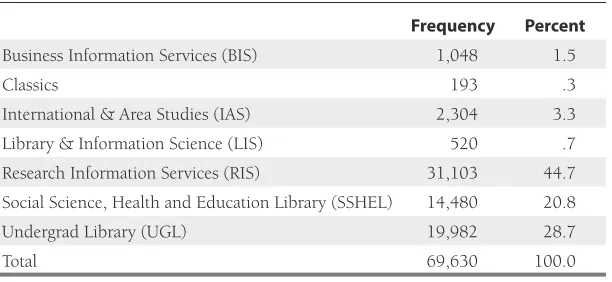
The analysis of this dataset, which consisted of 69,630 transactions for the stated period, revealed that 73.4% of the transactions were addressed by UGL and RIS (see table 1), followed by SSHEL at 20.8%, IAS at 3.3%, BEL at 1.5%, LIS (Virtual) at 0.7%, and Classics at 0.3%. The results for UGL and RIS are understandable because they are primary components of the “Main/UGL Hub,” fielding and triaging questions as they come through various modes of commu-nication. Moreover, the “Main/UGL Hub” receives strong support in terms of personnel from departmental libraries staffing reference shifts, thus enabling coverage and subject expertise at the Main/UGL Hub.
Further analysis of the dataset for “Question Type” (see table 2) (from all 69,630 transactions recorded at the ser-vices points in this study, 66,638 transactions had data for “Questions Type”) showed that 30.9% of the total number of transactions were directional inquiries, and 18.1% of the transactions were about library policies and services. Fur-thermore, 22.8% of the transactions involved finding specific library materials, and only 6.3% of the total transactions were directly classified as providing research assistance, with 1,653 (2.5%) transactions entered as “ready reference;” 4,328 transactions (6.2%) were entered as “other.” As with previous transactional studies, there is a strong showing for inquiries related to technical issues (e.g., printers, scanners, software), with 7,739 transactions (11.6%).
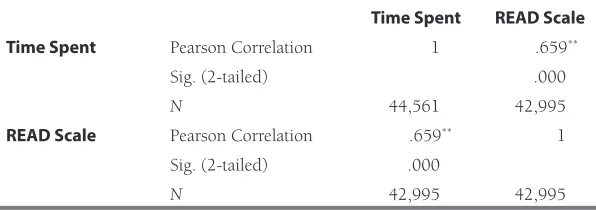
The dataset for this study showed that 77.8% (51,580 transactions) of the 66,281 transactions that reported “Time Spent” data took less than five minutes (see table 3). The du-ration analysis also revealed a positive correlation between time spent and READ Scale (see table 4). We conclude that there is a strong positive correlation between the two vari-ables (r = .675, p < .001), which indicates that the amount of time spent and READ Scale are correlated with statistical significance. We excluded transactions that took less than one minute as well as directional/hour questions and con-ducted the other duration analysis (see table 5). This correla-tion remains significant (r = .659, p < .001). Moreover, a cross tabulation (see table 6) between service points and READ scores revealed the following: RIS and UGL addressed the
METHODOLOGY
With the main hubs supporting general ref-erence at the University of Illinois Library, the new departmental structure developed a reputation among students and faculty for providing in-depth research services through email and in-person consultations. To assess these departmental service points, this study examined in-person, phone, and email transactions from five specialized ref-erence service points for the period July 1, 2013, to June 30, 2015 (two academic years). The dataset was derived from Desk Tracker37
reference statistics as compiled by the following specialized reference service points: Social Sciences, Health, and Educa-tion Library (SSHEL); Business InformaEduca-tion Services (BIS); Classics; International and Area Studies (IAS); and Library and Information Science (LIS).38 In addition to these five spe-cialized reference service points, transaction statistics from two general reference service points, Undergraduate Library (UGL) and Reference and Information Services (RIS), which manages the day-to-day operation of the Main/UGL refer-ence hub, were also included as part of this dataset.
Together these services support the research needs of students, staff, and faculty. According to the University of Illinois enrollment data, for the academic period 2016–17 the iSchool (library science) supports 640 graduate students, while the College of Business has 4,627 students (2,896 un-dergrad level and 1,513 graduate level). In addition to these colleges, reference hubs and the various service points are frequently used by students and faculty from arts and hu-manities and life, social, and physical sciences, with a user population of over 10,000 individuals. Data analysis was conducted using the SPSS statistical software.
Furthermore, this study conducted descriptive analysis and focused on four specific areas: duration of the transac-tion (time spent), questransac-tion Type, subject area, and READ Scale scores covered during this period. The READ Scale is “a six-point scale tool for recording vital supplemental qualitative statistics gathered when reference librarians as-sist users with their inquiries or research related activities by placing an emphasis on recording the effort, skills, knowl-edge, teaching moment, techniques and tools utilized by the librarian during a reference transaction.”39 A reference trans-action recorded as READ Scale “1” by a librarian means it took the least amount of effort and knowledge to answer it. A READ Scale “6” transaction would require extensive subject knowledge and in some cases consultations with multiple librarians. Correlations between time spent and READ Scale scores were also analyzed. Although subject areas in Desk Tracker vary slightly among service points, and READ Scale scores are dependent on the perception of reference service providers, the inclusion of these assessment variables would nonetheless be beneficial to this analysis.40 A follow-up study will focus on additional specialized service points at UIUC.
Table 1. Service Points
Frequency Percent
Business Information Services (BIS) 1,048 1.5
Classics 193 .3
International & Area Studies (IAS) 2,304 3.3 Library & Information Science (LIS) 520 .7 Research Information Services (RIS) 31,103 44.7 Social Science, Health and Education Library (SSHEL) 14,480 20.8 Undergrad Library (UGL) 19,982 28.7
READ Scale 1 and READ Scale 2. Meanwhile IAS answered the most questions at READ level 6 (91.6%) and level 5 (71%). These high percentage points are partly due to the Slavic Reference Service, a highly specialized interdisciplinary reference team within IAS, which fields queries from UIUC students and faculty, and supports research needs of academic communities outside of Illinois. In addition to showing a strong correlation between time spent and READ Scale, the transactions analysis showed (see table 7) that the most popular subjects recorded by Desk Tracker were business (18.8%), edu-cation (11.3%), history (7.8%), and library science (7.3%).
DISCUSSION
In their respective studies, Marjorie Murfin and Jean E. McLaughlin observed the lack of accepted standards and methodologies for comparative analysis, and as Murfin noted, “without accepted units of measurement,” comparative analysis of data from different libraries would be problematic. Although this study is a reflection of reference trans-actions at a single research library, the ana-lyzed data raise interesting questions in re-gard to signage, accessibility, comprehension of library policies, instruction, and training for reference service providers for reporting statistics at other institutions. These ques-tions include the following: (1) Are the hub model and referral system currently utilized at the University of Illinois and similar mod-els at other institutions working cohesively with specialized reference services? (2) What structural reconfigurations and adaptive measures can service providers introduce to address the influx of directional, policies-related, and general inquiries of under five minute duration? The answers to these ques-tions are, once again, tied to the intricacies of managing services and to the willingness of service providers to explore strengths and weakness of their service infrastructure.
By conducting transactional analysis on the dataset from five specialized service points with additional data from two gen-eral service points, this study made sevgen-eral observations, which will be beneficial to ser-vice coordinators and library administrators in similar reference environments. Based on the analysis, reference service managers should address the need for highest number of inquiries (45.3% and 28.0%,
respective-ly). However, the majority of the inquiries were assessed at Table 2. Question Type
Frequency Percent
Data Assistance 170 0.3%
Database/eJournal, SFX Access Problems 699 1.0% Directional/Hours 20,570 30.9% Finding Specific Library Materials 15,198 22.8% Library Policies and Services 12,085 18.1%
Other 4,328 6.5%
Ready Reference 1,653 2.5%
Research Assistance 4,196 6.3% Technical Issues (printers, scanners, software) 7,739 11.6%
Total 66,638 100.0%
Table 3. Time Spent
Frequency Percent
5-15 Minutes 11,054 16.7%
15-30 Minutes 2,103 3.2%
30 Minutes – 1 Hour 1,095 1.7%
1-3 Hours 313 0.5%
More Than 3 Hours 136 0.2%
Total 66,281 100.0%
Table 4. Correlations (All Transactions)
Time Spent READ Scale
Time Spent Pearson Correlation 1 .675**
Sig. (2-tailed) .000
N 69,630 65,815
READ Scale Pearson Correlation .675** 1
Sig. (2-tailed) .000
N 65,815 65,815
** Correlation is significant at the 0.01 level (2-tailed).
Table 5. Correlations (Exclude 0 minutes and Directional/Hour Transactions)
Time Spent READ Scale
Time Spent Pearson Correlation 1 .659**
Sig. (2-tailed) .000
N 44,561 42,995
READ Scale Pearson Correlation .659** 1
Sig. (2-tailed) .000
N 42,995 42,995
research assistance, should service managers and library ad-ministrators review their commitments to underperforming service points? Should they undergo another round of service realignments? Unfortunately, there are no quick answers to these important service-related questions; however, based on the analyzed data, some immediate steps can be taken to support the service structure at the University of Illinois and institutions with similar service models.
CONCLUSIONS
The symbiotic relationship between general and specialized reference services at academic libraries supports diverse groups of academic communities, departments, colleges, data-input training, consistency among service points on
recording reference transactions using Desk Tracker (e.g., standardized forms and subjects), and accuracy in assign-ing READ Scale scores for reference transactions. Moreover, managers and administrators should examine whether these assessment tools are ideal for dynamic reference environ-ments with differing perceptions, service philosophies, and viewpoints on reference transactions.
In addition to structural issues and based on the analyzed data, this study raises questions about staffing at service points. As indicated above, if the vast majority of inquiries (74%) took less than five minutes, then is it viable to sup-port these service points with graduate assistants, academic professionals, civil service staff, and professional librar-ians? Furthermore, if 6% of the total transactions required Table 6. READ Scale and Reference Service Points Crosstabulation
Reference Service Points
BEL Classics IAS LIS RIS SSHEL UGL Total READ 1 Count 134 6 184 3 10,767 4,593 8,091 23,778
(Least effort needed)
% within READ Scale 0.6% 0.0% 0.8% 0.0% 45.3% 19.3% 34.0% 100.0% % within branch 15.9% 3.2% 9.4% 0.6% 36.1% 32.7% 43.9% 36.1% % of Total 0.2% 0.0% 0.3% 0.0% 16.4% 7.0% 12.3% 36.1% READ 2 Count 81 90 199 91 11,333 7,143 9,088 28,025 % within READ Scale 0.3% 0.3% 0.7% 0.3% 40.4% 25.5% 32.4% 100.0% % within branch 9.6% 48.6% 10.2% 17.6% 38.0% 50.9% 49.3% 42.6% % of Total 0.1% 0.1% 0.3% 0.1% 17.2% 10.9% 13.8% 42.6% READ 3 Count 229 52 191 189 6,400 1,804 1,070 9,935 % within READ Scale 2.3% 0.5% 1.9% 1.9% 64.4% 18.2% 10.8% 100.0% % within branch 27.1% 28.1% 9.8% 36.6% 21.4% 12.9% 5.8% 15.1% % of Total 0.3% 0.1% 0.3% 0.3% 9.7% 2.7% 1.6% 15.1% READ 4 Count 319 18 408 202 1,275 404 177 2,803 % within READ Scale 11.4% 0.6% 14.6% 7.2% 45.5% 14.4% 6.3% 100.0% % within branch 37.8% 9.7% 20.8% 39.1% 4.3% 2.9% 1.0% 4.3% % of Total 0.5% 0.0% 0.6% 0.3% 1.9% 0.6% 0.3% 4.3%
READ 5 Count 68 12 658 32 64 85 8 927
% within READ Scale 7.3% 1.3% 71.0% 3.5% 6.9% 9.2% 0.9% 100.0% % within branch 8.1% 6.5% 33.6% 6.2% 0.2% 0.6% 0.0% 1.4% % of Total 0.1% 0.0% 1.0% 0.0% 0.1% 0.1% 0.0% 1.4%
READ 6 Count 13 7 318 0 6 1 2 347
(Most effort needed)
and affiliated research centers. In order to nurture this relationship, service providers have developed innovative models to address the complexities asso-ciated with reference services. Adapting to emerging trends and incorporating user needs and expecta-tions have been the hallmark of reference services. The data analyzed by this study revealed the need for a multitiered service system and a functioning referral system, which efficiently manages the avail-able human resources and expertise not only at the University of Illinois but also at other institutions. These immediate steps will strengthen these service points and reference environments. Moreover, the data analysis showed strong correlation between duration (time spent) and READ Scale scores. This is particularly true at the specialized reference ser-vices level.
As these specialized service environments con-tinue to take on more complicated research inqui-ries, which in turn demand expertise, training, and time, perhaps libraries will invest in specialized service points by redirecting experienced service providers to in-depth consultation services. Specifi-cally, we believe libraries should consider investing in the development of specialized interdisciplinary reference teams to take on the influx of complex research inquiries.
The model for this approach has already been in existence since 1976. The Slavic Reference Service at UIUC is an interdisciplinary reference team that pro-vides year-round assistance to scholars in arts and humanities and life, social, and physical sciences with a set geographic focus: East Europe, Russia, and Central Asia. Currently, the reference hub model at UIUC relies heavily on subject specialists accessed by patrons through a referral system to resolve diffi-cult research inquiries. In some cases a single subject specialist is responsible for providing expertise for geographically large and culturally diverse regions, with queries addressing multiple subject areas. We postulate that a trained team of interdisciplinary reference specialists working together on a daily ba-sis would be better equipped and much more effec-tive at engaging graduate students and faculty than reference hubs, when resolving advanced research inquiries. The reference hubs are effective in triag-ing and addresstriag-ing straightforward queries, but the interdisciplinary reference team approach appears to be better suited when responding to advanced and complex reference requests.
The Reference Management Team41 and the Uni-versity Library Administration at the UniUni-versity of Illinois are taking immediate steps to address some of the questions raised in this study. A multitiered service system and a consultation scheduling pilot program will be introduced this fall. The select Table 7. Subject Main Heading
Frequency Percent
Agriculture 38 0.8%
Anthropology 91 2.0%
Art/Architecture 83 1.8%
Astronomy 2 0.0%
Atmospheric Sciences 3 0.1%
Biology 53 1.1%
Business 874 18.8%
Chemistry 30 0.6%
Children's Literature 349 7.5%
Communication 74 1.6%
Computer Science 17 0.4% Current Events/Popular Topics 14 0.3%
Dance 8 0.2%
Disabilities 9 0.2%
Economics 81 1.7%
Education 525 11.3%
Engineering 82 1.8%
English as a Second Language 11 0.2% Environmental Studies 22 0.5%
Ethnic Studies 26 0.6%
Gender and Women's Studies 36 0.8%
Geography 38 0.8%
Geology 4 0.1%
Government Information 82 1.8%
Health/Medical 160 3.4%
History 360 7.8%
Kinesiology 25 0.5%
Labor and Employment Relations 21 0.5%
Law 51 1.1%
LGBT 5 0.1%
Library Science 337 7.3%
Linguistics 71 1.5%
Literature 139 3.0%
Mathematics 23 0.5%
Music 55 1.2%
Natural Resources 6 0.1%
Other 123 2.6%
Physics 13 0.3%
Political Science 78 1.7%
Psychology 168 3.6%
Recreation, Sport and Tourism 58 1.2%
Religion 73 1.6%
Social Work 64 1.4%
Sociology 115 2.5%
Special Collections/Archives 14 0.3% Speech and Hearing Science 42 0.9%
Statistics 23 0.5%
Testing Materials (Health and Social Sciences) 16 0.3% Theatre/Film/Television 53 1.1%
Reference Services Since the 1980s,” Reference Librarian 48, no. 2 (2007): 31–40.
14. Patricia Layzell Ward, Performance Measures: A Bibliography
(Loughborough, UK: CLAIM, Loughborough University of Technology, 1982).
15. Jennifer Ann Younger, University Library Effectiveness: A Case Study of the Perceived Outcomes of Structural Change (PhD diss., University of Wisconsin-Madison, 1990).
16. Sarah Holder and Amber Butler Lannon, eds., Difficult Decisions: Closing and Merging Academic Libraries (Chicago: Association of College and Research Libraries, 2015).
17. Stephanie Schulte, “Eliminating Traditional Reference Services in an Academic Health Sciences Library: A Case Study,” Journal of the Medical Library Association 99, no. 4 (2011): 273–79. 18. Aditi Bandyopadhyay and Mary Kate Boyd-Byrnes, “Is the Need
for Mediated Reference Service in Academic Libraries Fading Away in the Digital Environment?,” Reference Services Review 44, no. 4 (2016): 596–626.
19. Clark Nall, Perceen Rustomfram, and Mary Freilich, “Con-solidation of Reference Services: Coping with and Training for Change,” Tennessee Libraries 58, no. 2 (2008): 1–3.
20. David Ward and Eric Phetteplace, “Staffing by Design: A Meth-odology for Staffing Reference,” Public Services Quarterly 8, no. 3 (2012): 193–207.
21. Timothy Peters, “Taking Librarians Off the Desk: One Library Changes Its Reference Desk Staffing Model,” Performance Mea-surement and Metrics 16, no. 1 (2015): 18–27.
22. “Call for Presentations: 2016 Reference Research Forum,”
RUSA News (blog), October 8, 2015, http://rusa.ala.org/blog/ 2015/10/08/call-for-presentations-2016-reference-research-forum/.
23. Bella Karr Gerlich and Edward Whatley, “Using the READ Scale for Staffing Strategies: The Georgia College and State Univer-sity Experience,” Library Leadership and Management 23, no. 1 (2009): 26–30.
24. Sandra DeGroote et al., “Quantifying Cooperation: Collabora-tive Digital Reference Service in the Large Academic Library,”
College & Research Libraries 66, no. 5 (2005): 436–54.
25. Jean E. McLaughlin, “Reference Transaction Assessment: Survey of a Multiple Perspectives Approach, 2001 to 2010,” Reference Services Review 39, no. 4 (2011): 536.
26. Majorie Murfin, “National Reference Measurement: What Can It Tell Us about Staffing?,” College and Research Libraries News 44, no. 5 (September 1983): 321.
27. Lawrence Olszewski and Paula Rumbaugh, “An International Comparison of Virtual Reference Services,” Reference & User Services Quarterly 49, no. 4 (2010): 360.
28. Ibid., 367–68.
29. Ana Dubnjakovic, “Electronic Resource Expenditure and the Decline in Reference Transaction Statistics in Academic Librar-ies,” Journal of Academic Librarianship 38, no. 2 (March 2012): 99. 30. Emily K. Chan, “Analyzing Recorded Transactions to Extrapo-late the Required Knowledge, Skills, and Abilities of Reference Desk Providers at an Urban, Academic/Public Library,” Journal of Library Administration 54, no. 1 (2014): 23–32.
31. Erika Bennett and Jennie Simning, “Embedded Librarians and Reference Traffic: A Quantitative Analysis,” Journal of Library Administration 50, no. 5–6 (2010): 443–57.
32. Susan M. Ryan, “Reference Transactions Analysis: The Cost-Effectiveness of Staffing a Traditional Academic Reference Desk,” Journal of Academic Librarianship 34, no. 5 (September 2008): 389–99.
33. Bradley Wade Bishop and Jennifer A Bartlett, “Where Do We Go from Here? Informing Academic Library Staffing through Refer-ence Transaction Analysis,” College & Research Libraries 74, no. 5 (September 2013): 489–500.
34. Cassidy R. Sugimoto, “Evaluating Reference Transactions in group of specialized reference services will be participating
in this pilot program. In addition, a robust referral system will be a component of this pilot program. If the pilot phase proves successful, the consultation scheduling service will be open to all service points.
The specialized reference services have entered a period of significant changes that present librarians with chal-lenges and opportunities for unlocking the full potential of reference services at an academic library. The challenges encountered by Samuel S. Green so long ago, of librarians being asked to give information on subjects and processes they know nothing about, continue to shape reference envi-ronments. His poignant statement still stands as a reminder for every reference librarian to adapt and improve services. As new innovative teaching and learning methodologies are introduced into higher education, specialized reference ser-vices at large research libraries have a historic opportunity to integrate themselves in the research process of students and faculty. As this study has demonstrated, assessment of these specialized outlets is the first critical step in designing the next generation of research services.
References and Notes
1. Encyclopedia of Library and Information Science, edited by Allen Kent and Harold Lancour (New York: Marcel Dekker, 1968), s.v. “Reference Services and Libraries.”
2. Heidi Steiner, “Bridging Physical and Virtual Reference with Virtual Research Consultations,” Reference Services Review 39, no. 3 (2011): 439–50.
3. Amanda Nichols Hess, “Scheduling Research Consultations with YouCanBook.Me: Low Effort, High Yield,” College & Research Libraries News 75, no. 9 (October 2014): 510–13. 4. Joseph Lenkart, Alexandra Krogman, and David Ward, “Beyond
Satisfaction: Investigating Patron Use of Reference Information,”
Internet Reference Services Quarterly, 2017 (forthcoming). 5. The Division of Management Information (DMI) is responsible
for compiling university wide statistics. These figures are based on published reports hosted by DMI. See http://dmi.illinois.edu/. 6. University of Illinois at Urbana-Champaign, New Service Models: Report to the Provost (Urbana-Champaign, IL: University Library, 2009), 3, http://www.library.illinois.edu/nsm/actionplan/NSM _Report_09.pdf.
7. University of Illinois at Urbana-Champaign, Library Services for the 21st Century at the University of Illinois at Urbana-Champaign: Final Report and Recommendations of the Budget Group Plus
(Urbana-Champaign, IL: University Library, 2008), http://www .library.illinois.edu/nsm/background/nsmfinal/nmsreport.pdf. 8. University of Illinois at Urbana-Champaign, Reference Services
NSM Team Report and Recommendations (Urbana-Champaign, IL: University Library, 2010), 2, http://www.library.illinois.edu /nsm/reference/planning_team/RefServices_NSM_Report__ draft.pdf.
9. Samuel S. Green, “Personal Relations between Librarians and Readers,” Library Journal 1: 2–3 (November 30, 1876): 77. 10. Marjorie Murfin, Reference Service: An Annotated Bibliographic
Guide (Littleton, Colorado: Libraries Unlimited, 1977). 11. Ibid.
12. Donna R. Hogan, “Cooperative Reference Services and the Referred Reference Question: An Annotated Bibliography, 1983–1994,” Reference Services Review 24, no. 1 (1996): 57–64. 13. Anna Carlin, “Success, Failure, Innovation and Uncertainty
Library Media Desk?” “Where is the International Area Studies Library?”; (2) READ 1 from IAS: “What are the Slavic peri-odicals?” “Where can I find a Japanese-English dictionary?” (3) READ 6 from RIS: “Grad student researching Costa Rican par-ticipation in World Fairs, and immigration to the U.S. We had a research consultation already scheduled with a subject liaison for tomorrow.” “Wanted articles and technical papers about dif-ferent skyscrapers. searched many difdif-ferent databases and had trouble finding anything. Referred to Art and Arch.”; (4) READ 6 from IAS: “May I ask a question here in Grossman, zhizn’ i trudy dostoevskogo, 52. May 28, 1848. there is a letter from stepan yanovsky to Apollon Maikov written sometime in 1881 on Dostoevsky, lamenting the death of Belinsky and having an attack of ‘falling illness’—the term for epilepsy at the time—at Vanovsky’s house. can you give me a citation for this letter so i can order it on ill?”
41. David Ward, Erin Kerby, Cara Bertram, Carissa Phillips, Alex Krogman, Melanie Emerson, Joe Lenkart, and Beth Sheehan are members of the Reference Management Team. “Reference Management Team,” Library Committee Handbook, University of Illinois at Urbana-Champaign, accessed March 14, 2017, http://www.library.illinois.edu/committee/Reference_Manage ment_Team/Charge.html.
Academic Music Libraries,” Music Reference Services Quarterly 11, no. 1 (2008): 1–32.
35. Felicia A. Barrett, “An Analysis of Reference Services Usage at a Regional Academic Health Sciences Library,” Journal of the Medi-cal Library Association 98, no. 4 (October 2010): 308–11. 36. Trina J. Magi and Patricia E. Mardeusz, “What Students Need
from Reference Librarians: Exploring the Complexity of the Individual Consultation,” College & Research Libraries News 74, no. 6 (June 2013): 288–91; Trina J. Magi and Patricia Mardeusz, “Why Some Students Continue to Value Individual, Face-to-Face Research Consultations in a Technology-Rich World,”
College & Research Libraries 74, no. 6 (November 2013): 605–18. 37. For additional information about Desk Tracker software, see
http://www.compendiumlib.com/desk-tracker/.
38. Among the five specialized reference service points, the Busi-ness Information Services (BIS) and the Library and Informa-tion Services (LIS) have no physical service desks. They are embedded library services developed after the closure of the Business and Economic Library and Library and Information Science Library.
39. Bella Karr Gerlich, “The READ Scale,” The READ Scale Research Web Site, accessed March 14, 2017, http://readscale.org. 40. READ Scale examples from service points include: (1) READ