Volume 14 (2008)
Proceedings of the
Third Workshop on Petri Nets and Graph Transformations
(PNGT 2008)
Implementing Petri Net Transformations
using Graph Transformation Tools
Enrico Biermann, Claudia Ermel, Tony Modica and Peggy Sylopp
14 pages
Guest Editors: Paolo Baldan, Barbara K ¨onig
Managing Editors: Tiziana Margaria, Julia Padberg, Gabriele Taentzer
Implementing Petri Net Transformations
using Graph Transformation Tools
Enrico Biermann, Claudia Ermel, Tony Modica and Peggy Sylopp
Institut f¨ur Softwaretechnik und Theoretische Informatik Technische Universit¨at Berlin, Germany
Abstract: Petri net transformations have been defined formally in the abstract framework of adhesive HLR categories, which allows rule-based rewriting of graph-like structures, similar to graph transformation. In this paper we discuss differences between Petri net rewriting and graph rewriting which makes it necessary to add checks and conditions when implementing Petri net transformations using an exist-ing graph transformation tool like AGG. The extensions concern the preservation of Petri net transition firing behavior and the mapping of markings. As a running example, we present the RON environment, a visual editor, simulator and net trans-formation tool for reconfigurable Petri nets which has been developed as a plug-in for ECLIPSEbased on the graph transformation engine AGG.
Keywords: Petri nets, net transformation, graph transformation, visual editor, re-configurable Petri nets, Petri net tool
1
Introduction
Modeling the adaption of a system to a changing environment becomes more and more impor-tant. Application areas cover e.g. computer-supported cooperative work, multi agent systems, dynamic process mining or mobile networks. One approach to combine formal modeling of dy-namic systems and controlled model adaption areReconfigurable Petri nets[HEP07,EHP+07]. The main idea is the stepwise reconfiguration of place/transition nets by given net transformation rules [EHP+08,EHP06]. Think of these rules as replacement systems where the left-hand side is replaced by the right-hand side while preserving a context. This approach increases the expres-siveness of Petri nets and allows in addition to the well known token game a formal description of structural changes.
the reconfiguration of nets, but does not preserve the firing behavior. Instead, reconfiguration focuses on the modification of the flow relation, i.e. only arcs are added / deleted or reconnected. Our paper is structured as follows: In Section 2 we review the formal definitions of graph and net morphisms, as well as of graph and net transformations. Section 3 outlines the main differences between both transformation formalisms, dealing in particular with markings and the preservation of transition-firing behavior. We present solutions that allow a simulation of Petri net transformations by graph transformation. Finally, in Section4, we sketch a prototypical implementation of a visual Petri net simulation and transformation tool, which converts Petri nets and net transformation rules to graphs and graph transformation rules and uses the graph transformation engine AGG [AGG] to compute net transformations.
2
Graph and Petri Net Transformation
2.1 Graph Transformation
The research area of graph transformation [EEPT06,Roz97] dates back to the early seventies. Methods, techniques, and results from the area of graph transformation have already been studied and applied in many fields of computer science such as formal language theory, pattern recog-nition and generation, software engineering, concurrent and distributed system modeling, model transformation, and visual language design.
For our aim to represent Petri net transformations by graph transformation we need typed, attributed graphs and graph morphisms which are especially suited for visual language modeling: a visual language (VL) is modeled by an attributed type graph capturing the definition of the underlying visual alphabet, i.e. the symbols and relations which are available. Sentences or diagrams of the VL are given by attributed graphs typed over (i.e. conforming to) the type graph. Such a VL type graph corresponds closely to a meta model.
The following definitions are taken from [EEPT06]. The key idea is to model an attributed graph with node and edge attribution, where the underlying graphGis a new kind of graph, called an E-graph, which allows attribution edges not only from graph nodes to attribute nodes but also from graph edges to attribute nodes. This new kind of attributed graph, combined with the concept of typing, leads to a categoryAGraphsATGof attributed graphs typed over an attributed type graph AT G. This category proved to be an adequate formal model not only for various applications in software engineering and visual languages but also for the internal representation of attributed graphs in our graph transformation tool AGG [TER99,AGG].
Definition 1(E-graph and E-graph morphism) AnE-graph GwithG= (VG,VD,EG,ENA,EEA,
(sourcej,targetj)j∈{G,NA,EA})consists of the sets
EG,ENA, andEEA called the graph edges, node at-tribute edges, and edge atat-tribute edges;
srcG:EG→VG,tarG:EG→VG, source and target functions for graph edges;
srcNA:ENA→VG, tarNA:ENA→VD, source and target functions for node attribute edges;
srcEA:EEA →EG, tarEA :EEA →VD, source and target functions for edge attribute edges.
Consider the E-graphsG1andG2withGk= (VGk,VDk,EGk,ENAk ,EEAk ,(sourcekj,targetkj)j∈{G,NA,EA})
fork=1,2. AnE-graph morphism f :G1→G2 is a tuple(fVG,fVD,fEG,fENA,fEEA) with fVi :
Vi1 →Vi2 and fEj :E
1
j →E2j for i∈ {G,D}, j∈ {G,NA,EA} such that f commutes with all source and target functions, for example fVG◦source
1
G=source2G◦fEG.
An attributed graph is an E-graph combined with an algebra over a data signatureDSIG. In the signature, we distinguish a set of attribute value sorts. The corresponding carrier sets in the algebra can be used for the attribution.
Definition 2 (Attributed graph and attributed graph morphism) Let DSIG= (SD,OPD) be a data signature with attribute value sortsS0D⊆SD. Anattributed graph AG= (G,D)consists of an E-graphGtogether with aDSIG-algebraDsuch that∪s∈S0
D Ds=VD.
For two attributed graphsAG1= (G1,D1)andAG2= (G2,D2), an attributed graph morphism f :AG1→AG2is a pair f = (fG,fD) with an E-graph morphism fG:G1→G2 and an algebra homo-morphism fD:D1 →D2 such that (1) commutes for all s∈S0D, where the vertical arrows are inclusions:
For the typing of attributed graphs, we use a distinguished graph attributed over the final DSIG-algebraZ(see [EEPT06]). This graph defines the set of all possible types.
Definition 3(Typed attributed graph and typed attributed graph morphism) Given a data sig-natureDSIG, anattributed type graphis an attributed graphAT G= (T G,Z), whereZis the final DSIG-algebra.
A typed attributed graph (AG,t) over AT G consists of an at-tributed graph AG together with an attributed graph morphism t:AG→AT G.
Atyped attributed graph morphism f :(AG1,t1)→(AG2,t2)is an attributed graph morphism f:AG1→AG2such thatt2◦f =t1:
As an example for typed, attributed graphs we refer to Def.11in Section3.
transforming the source graph into the target graph of the graph transformation.
Intuitively, the application of rule p= (L←l K→r R) to graphGvia a matchmfromLtoG deletes the imagem(L)fromGand replaces it by a copy of the right-hand sidem∗(R). Note that a rule may only be applied if the so-calledgluing conditionis satisfied, i.e. the deletion step must not leavedangling edges, and for two objects which are identified by the match, the rule must not preserve one of them and delete the other one.
Definition 4(Typed attributed graph rule) Given an attributed type graphAT Gwith a data sig-natureDSIG, a typed attributed graph rule, or “rule” for short,p= (L←l K→r R)consists of typed attributed graphs L, K, andRwith a commonDSIG-algebra TDSIG(X), the DSIG-termalgebra with variablesX, and injective typed attributed graph morphismsl:K→L,r:K→R, where the DSIG-part oflandris the identity onTDSIG(X).
For the definition of graph transformations we need pushouts in the categoryAGraphsATG, the existence of which is shown in [EEPT06].
Definition 5(Typed attributed graph transformation) Given a rule p= (L←l K→r R) as de-fined above and a typed attributed graphGwith a typed attributed graph morphismm:L→G, called match, a direct typed attributed graph transformation, or “direct graph transformation” for short,G=p⇒,m H fromGto a typed attributed graphHis given by the following double pushout
(DPO) diagram in the category AGraphsATG, where (1) and(2) are pushouts. Informally, a pushout in a category CAT is a gluing construction of two objects over a specific interface. The rulermay be extended by a set ofnegative application
conditions(NACs) [HHT96,EEPT06]. A matchL−→m G satisfies a NAC with the injective NAC morphismn:L→
NAC, if there is no injective graph morphism NAC−→q G withq◦n=m.
NAC q| D D D D ! ! D D D D L m n o o
(1)
K
k
r // l
o
o
(2)
R
m∗
Goo D //H
A sequenceG0⇒G1⇒...⇒Gnof graph transformation steps is calledgraph transformation and denoted asG0⇒∗ Gn.
Note that for flexible rule application, variables for attributes can be used in rules, which are instantiated by concrete values by the rule match. Moreover, Boolean attribute conditions (expressions over attributes) may be combined with a rule to control rule application.
2.2 Petri Net Transformation
Definition 6(P/T net, P/T system) AP/T-net is given byPN = (P,T,pre,post) with sets of placesPand transitionsT, and pre- and post domain functionspre,post:T →P⊕, whereP⊕ is the free commutative monoid over the setPof places with binary operation⊕(e.g. the monoid notationM=2p1⊕3p2means that we have two tokens on placep1and three tokens onp2).
AP/T-systemis given by(PN,M)with markingM∈P⊕, Note thatMcan also be considered as functionM:P→Nwhere only for a finite setP0⊆Pwe haveM(p)≥1 withp∈P0. We can switch between these notations by defining∑p∈PM(p)·p=M∈P⊕. Moreover, forM1,M2∈P⊕ we haveM1≤M2ifM1(p)≤M2(p)for allp∈P.
A transitiont∈T isM-enabled for a markingM∈P⊕if we havepre(t)≤M, and in this case the successor markingM0 is given byM0=M pre(t)⊕post(t)and(PN,M)−→t (PN,M0) is called firing step. Note that the inverse of⊕is only defined inM1 M2if we haveM2≤M1.
In order to define rules and transformations of P/T-systems we introduce P/T-morphisms which preserve firing steps by Condition (1) below. Additionally they require that the initial marking at corresponding places is increasing (Condition (2)) or even stronger (Condition (3)).
Definition 7(P/T-morphisms) Given P/T-systemsPNi= (PNi,Mi)withPNi= (Pi,Ti,prei,posti) fori=1,2, a P/T-morphism f :(PN1,M1)→(PN2,M2)is given by f= (fP,fT)with functions
fP:P1→P2and fT :T1→T2satisfying
(1) fP⊕◦pre1=pre2◦fT and fP⊕◦post1=post2◦fT and
(2) M1(p)≤M2(fP(p))for allp∈P1.
Note that the extension fP⊕:P1⊕→P2⊕of fP:P1→P2is defined by fP⊕(∑ni=1ki·pi) =∑ni=1ki·fP(pi). (1) means that f is compatible with pre- and post domain (as shown in the diagram to the right), and (2) that the initial marking ofPN1 at place p is smaller or equal to that ofPN2at fP(p).
Moreover the P/T-morphism f is called strict if fPand fT are injective and
(3) M1(p) =M2(fP(p))for allp∈P1.
The category defined by P/T-systems and P/T-morphisms is denoted byPTSyswhere the com-position of P/T-morphisms is defined componentwise for places and transitions.
Remark1 For our morphisms we do not always have fP⊕(M1)≤M2. E.g.M1=p1⊕p2,M2=p and fP(p1) =fP(p2) =pimplies fP⊕(M1) =2p>p=M2, butM1(p1) =M1(p2) =1=M2(p).
We now define the gluing of P/T-systems via P/T-morphisms by pushouts in the category PTSys. Given the left-hand side of a rule (K,MK)
l
−→(L,ML) (see Def. 9) and a matchm:
This requires the following gluing condition, which has to be sat-isfied in order to apply a rule at a given match. The characteri-zation of specific points is a sufficient condition for the existence and uniqueness of the pushout complement(PN0,M0), because it allows checking for the applicability of a rule to a given match.
(K,MK)
l //
c
(1)
(L,ML) m
(PN0,M0) //(PN1,M1)
Definition 8(Gluing condition for P/T-systems) Let(L,ML) m
→(PN1,M1)be a P/T-morphism and(K,MK)
l
→(L,ML)a strict morphism. We define the gluing pointsGP, dangling pointsDP, and identification pointsIPofLas in [EHP+07]:
GP= l(PK∪TK)
DP= {p∈PL|∃t∈(T1\mT(TL)):mP(p)∈pre1(t)⊕post1(t)} IP= {p∈PL|∃p0∈PL:p=6 p0∧mP(p) =mP(p0)}
∪{t∈TL|∃t0∈TL:t6=t0∧mT(t) =mT(t0)}
A P/T-morphism(L,ML) m
→(PN1,M1)and a strict morphism (K,MK) l
→(L,ML) satisfy the gluing condition, if
1. all dangling and identification points are gluing points, i.eDP∪IP⊆GP, and
2. mis strict on places to be deleted (see [EHP+07]), i.e.∀p∈PL\l(PK):ML(p) =M1(m(p)).
Note that only places are considered as dangling points because a transition can be matched only if its complete environment is matched too (see Def.7).
Next, we present rule-based transformations of P/T-systems following the DPO approach of graph transformations, which is restrictive concerning the treatment of unmatched transitions at places which should be deleted. Here, the gluing condition forbids the application of rules in this case. Furthermore, items which are identified by a non-injective match are both deleted by or preserved by rule applications.
Definition 9 (P/T-system rule) A rule p= ((L,ML) l
←(K,MK) r
→(R,MR)) of P/T-systems consists of P/T-systems(L,ML),(K,MK), and(R,MR), and two strict P/T-morphisms(K,MK)
l
→
(L,ML)and(K,MK) r
→(R,MR) [EHP+07].
Definition 10(P/T-system transformation) A rulep= ((L,ML) l
←(K,MK) r
→(R,MR))is called applicable at the match(L,ML)
m
→(PN1,M1)if the gluing condition is satisfied forlandm. In this case we obtain a P/T-system(PN0,M0)leading to a net transformation step
(PN1,M1) p,m
=⇒ (PN2,M2) consisting of the following pushout diagrams (1) and (2). The P/T-morphismn:(R,MR)→(PN2,M2)is called comatch of the transformation step.
(L,ML) m
(1)
(K,MK) l
o
o r //
c
(2)
(R,MR) n
(PN1,M1) (PN0,M0)
l∗
o
o
3
Simulating Petri Net Transformations by Graph Transformation
For the simulation of Petri net transformations with graph transformations, we need a suitable Petri net representation in the domain of graphs. Hence, we define a type graph for the VL of Petri nets.
Definition 11 (Type graph for Petri nets) The attributed graph below shows the type graph modelling the Petri net VL. We use the concrete syntax from AGG, i.e. attribute type names and data types are written inside their node type nodes or below their arc type names.
APlaceNode has two attributes, aname (a String), and a token number (for simplicity we took the Java datatypeintinstead of defining a more suitable datatypenat). Arc edges are attributed by a weight number, and Transition nodes also carry a name at-tribute. All graphs typed over this type graph are considered as graph representations of Petri nets.
On the basis of the Petri net type graph, we now define the obvious translation from Petri nets and Petri systems to typed attributed graphs. This translation can be extended in a straightfor-ward way to the translation of P/T-morphisms and rules. We then discuss the problems with this translation leading to graph transformations which do not correspond to original Petri net transformations. As a solution, we propose extensions of the rule translation by adding negative application conditions and attribute conditions to the graph rules. We claim that these extensions lead to an equivalence of Petri net transformations by Petri net rules on the one hand and the transformations of graphs (the translated Petri nets) by graph rules (the extended translated Petri net rules) on the other hand (see Section5).
Definition 12(Translating P/T systems to typed, attributed graphs) Let(N,M)be a P/T system with P/T-netN= (P,T,pre,post)and markingM∈P⊕according to Def.6. Then, the PT2Graph translation of(N,M)is an attributed graphAG= (G,D)withDbeing aDSIG-algebra over the datatype signatureDSIGwith sortsStringandInteger, and the obvious operations, andGbeing an E-graph according to Def.1which is typed over the type graph for Petri nets (Def.11).Gis defined as follows:
• VG=PlaceNode∪TransitionNode, withPlaceNode=PandTransitionNode=T.
• EG=ArcPT∪ArcT Pis constructed from the pre- and post-domain functions:
– ∀t ∈T :∀p∈ pre(t) :∃e∈ArcPT with sourceG(e) = p and targetG(e) =t and
∃eweight∈EEA withsourceEA(eweight) =eandtargetEA(eweight) =pre(t)(p) (an ArcPT edge is attributed by the weight of the corresponding arc)
– ∀t ∈T :∀p ∈ post(t):∃e∈ArcT P with sourceG(e) =t andtargetG(e) = p and
∃eweight∈EEA withsourceEA(eweight) =eandtargetEA(eweight) =post(t)(p) (an ArcTP edge is attributed by the weight of the corresponding arc)
Note that this translation is not a functor between the corresponding categories PTSysand AGraphsATG, because Petri net morphisms allow to map a place marking to a different marking, but the corresponding graph morphisms do not allow to map place nodes with different token at-tributes. The extension of Def.12to translate P/T morphisms and rules to graph morphisms and rules is straightforward only for the net components, since place mappings are translated to Pla-ceNode mappings, and transition mappings to TransitionNode mappings. The typing of graphs over the P/T type graph in Def.11ensures that net components are mapped according to the P/T morphism parts fP and fT. If we restrict to injective P/T morphisms only, then we get ArcPT mappings and ArcTP mappings with identical weight attributes, which corresponds to translated pre and post-domains. We would run into a problem if we had non-injective morphisms since P/T morphisms allow to merge arcs, provided that the sum of arc weights remains constant. This problem is still open (see Section5).
In this section we discuss and solve two other problems:
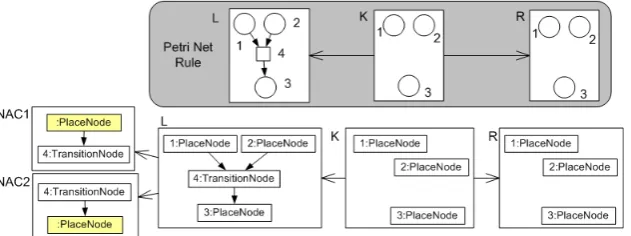
1. Given a translated rule, a match into the graph of a translated net might be found, where the match morphism does not correspond to a firing-behaviour-preserving P/T morphism;
2. The token attribute of a PlaceNode must be mapped to an identical token attribute of another PlaceNode, which does not correspond to more general mapping of markings in P/T morphisms.
3.1 Problem 1: Preserving Firing Behavior of Petri Net Transitions
As described in Section2, Petri net morphisms preserve the firing behavior of the Petri nets by preserving the pre- and post domains of transitions. Graph morphisms are not restricted in this way and graph morphisms could match aTransitionNodeeven if its pre- and post domain in the transition’s image is different from that of the original transition’s pre- or post domain.
Figure 1: Translation to firing behavior preserving graph rules
3.2 Problem 2: Mapping the Marking for Petri Systems
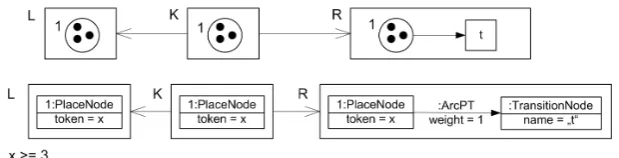
Another problem is the use of tokens on places. By modeling tokens as attributes of PlaceNodes, we restrict the matching of PlaceNodes to other PlaceNodes with the same number of tokens. But Petri net morphisms (see Def.7) allow matching of places to places that contain the same number of tokensor more.
Let us consider a different possibility to model tokens that would solve this mapping problem: In contrast to their definition asPlaceNode attributes, tokens could alternatively be represented as nodes typed over an additionalTokennode type. As shown in Fig. 2, this would result in valid graph morphisms that allow matching a PlaceNode with less tokens to a PlaceNode that contains more tokens. However, in graph rules that delete PlaceNodes it would now be required to specify
Figure 2: Marking modeled as nodes
the exact number of token nodes connected to the PlaceNode that will be deleted. Otherwise the graph rule is either not applicable (because of the gluing condition of the DPO approach) or unconnected token nodes would remain in the graph (in the case of the SPO approach).
For this reason, we keep our attribute representation of tokens but replace the fixed number of tokens in a PlaceNode in the LHS by a variable. Additionally, we add an attribute condition which ensures that a match is valid only if the number of tokens in the PlaceNode in the graph is at least as large as required (see Fig.3). For example, for a PlaceNode with 3 tokens in the
Figure 3: Marking modeled as token variables and attribute conditions in rules
which is exactly the expected behavior of the corresponding Petri net match morphism.1
4
Implementing Petri Net Transformations based on AGG
The main idea behind Reconfigurable Object Nets (RONs) is to support the visual specification of controlled rule-based net transformations of place/transition nets (P/T nets) [BM08,BEHM07]. RONs are high-level nets with two types of tokens: object nets (place/transition nets) and net transformation rules (a dedicated type of graph transformation rules).
4.1 RON Architecture
In a student project in summer 2007 a visual editor for RONs has been realized as a plug-in for ECLIPSEusing the ECLIPSE Modeling Framework (EMF) [EMF08] and Graphical Editor Framework (GEF) [GEF06] plug-ins. (GEF) [GEF06] is based on ECLIPSE’s Standard Widget Toolkit (SWT) and provides implementing a visual editor based on the Model-View-Controller pattern. It supports many operations and features common to most graphical editors like zoom-ing, various layouting of figures, support for drag and drop etc.
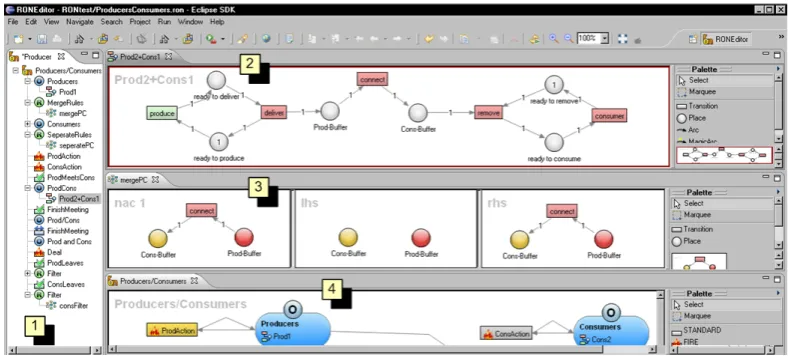
The RON environment [BEHM07] consists of four main components, i.e. the RON tree view based on an EMF model for RONs, and the visual editors for object nets, for transformation rules and for high-level nets. The visual net editor also supports the simulation of an edited object net or high-level net. Fig.4shows the RON environment including all views and editors.
RON Tree View. View 1 in Fig. 4 shows the main editor component, a tree view for the complete RON model from which the graphical views can be opened by double-click.
Figure 4: The RON Environment for Editing and Simulating Reconfigurable Object Nets
Object Net Editor. Fig.4, View 2 shows the kernel component, a place/transition net edi-tor with the possibility of the simulation of transition firing. The object netProdConsmodels producer-consumer interaction.
Transformation Rule Editor. The editor for transformation rules 3 in Fig.4consists of three panels, one for the left-hand side (LHS), one for the right-hand side (RHS), and one showing one of the rule’s negative application conditions (NACs). With themapping toolin the palette, you can define mappings from LHS objects to RHS objects and from LHS objects to NAC objects.
High-Level Net Editor. High-Level Net Editor, shown in Fig.4, View 4 allows the editing of a high-level net, which controls object net behavior and rule applications to object nets. The blue containers marked by an “O” forObject NetsareNETplaces, the green marked by an “R” forRulesareRULEplaces. Enabled HL-transitions are colored, disabled ones are gray.
4.2 Defining ON Transformation Rules
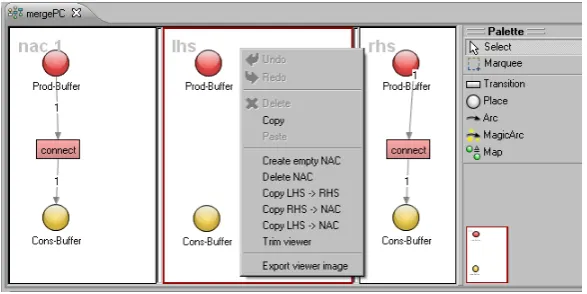
The rule editor (Fig.5) provides a palette with the objects to generate: places. transitions and arcs. In order to define mappings, the palette entryMaphas to be selected, clicking on places first in LHS, then RHS or NAC. Mapped places are high-lighted in the same color. By right-clicking with the mouse on a panel there are several copy services provided like copying the object net from the LHS to the RHS or to the current NAC.
Figure 5: Defining Rules
4.3 Translating ON Transformation Rules to AGG: TheRON2AGG Converter
In order to calculate possible rule matches or transformation results, the graph transformation engineAGG is used. Therefore, the RON editor is extended by aRON2AGGconverter, which converts object nets to graphs and net transformation rules to graph rules using the extensions of simple translations discussed in Sections3.1and3.2.
functioncalculate completionslets AGG compute all matches for the selected rule. For example in Fig.6a), there are two places in the object net (p1 and p2) with equal and more tokens than the place in the LHS of the rule. Hence, AGG computes two matches: p1→p1 andp1→p2.
Figure 6: Match Dialogs: a) places with different markings and b) transitions with different pre-and post-domains
To ensure the user-specified mapping being a valid Petri net morphism, each mapped transi-tion’s pre- and post-domain is checked if it is preserved by the mapping. E.g., consider Fig.6
b) showing the state after application ofcalculate completions. A match from t1 to t2 would be invalid, because t1’s pre-domain could not be preserved. Hence, AGG offers only the currently high-lighted match.
5
Conclusion
We have defined a formal translation of Petri nets and Petri net transformation rules to graphs and graph transformation rules. The result graphs of the application of translated rules to translated Petri nets can be interpreted as Petri nets. With this encoding, transformation of Petri nets can be simulated in common graph transformation tools. We presented a prototype that simulates Petri net transformation systems by first translating rules and Petri nets to AGG rules and graphs and then invoking the AGG graph transformation engine.
As future work, we plan to cover also non-injective matches of Petri nets with arc weights. Merging weighted arcs has further compatibility properties, which constrain the applicability of rules. These restrictions would have to be reflected by corresponding translated graph rules.
desirable to know for sure that the behaviour defined by a graph transformation rule (the result of the translation) and the behaviour of the original Petri net rule are equivalent.
This means, we have to show that the diagram to the right com-mutes, i.e. that a translation of a P/T-system followed by an plication of a translated rule results in the same graph as first ap-plying the Petri net rule and afterwards translating the resulting net.
N1
trans/o /o /o /o /o //
/o
/o
pN,mN
G1
pG,mG
trans/o /o /o /o /o /o //
/o
/o
/o
N2 /o /o trans/o /o /o /o /o //G2
As an important benefit of our approach, we could use the graph transformation analysis fea-tures offered by AGG (e.g. Critical Pair Analysis and dependence analysis for sets of rules) also for Petri net transformations.
Bibliography
[AGG] AGG Homepage.http://tfs.cs.tu-berlin.de/agg.
[BEHM07] E. Biermann, C. Ermel, F. Hermann, T. Modica. A Visual Editor for Reconfigurable Object Nets based on the ECLIPSE Graphical Editor Framework.Proc. Workshop on Algorithms and Tools for Petri Nets (AWPN’07). 2007.
http://tfs.cs.tu-berlin.de/roneditor
[BM08] E. Biermann, T. Modica. Independence Analysis of Firing and Rule-based Net Transfor-mations in Reconfigurable Object Nets.Proc. Workshop on Graph Transformation and Vi-sual Modeling Techniques. (GT-VMT’08). Vol. 10. EC-EASST, 2008.http://tfs.cs.tu-berlin. de/gtvmt08/GTVMT-program.htm
[EEPT06] H. Ehrig, K. Ehrig, U. Prange, G. Taentzer.Fundamentals of Algebraic Graph Transforma-tion. EATCS Monographs in Theoretical Computer Science. Springer, 2006.
[EHP06] H. Ehrig, K. Hoffmann, J. Padberg. Transformations of Petri Nets.Proc. School of SegraVis Research Training Network on Foundations of Visual Modelling Techniques. ENTCS 148 / 1, pp. 151–172. Elsevier Science, 2006.
[EHP+07] H. Ehrig, K. Hoffmann, J. Padberg, U. Prange, C. Ermel. Independence of Net Transforma-tions and Token Firing in Reconfigurable Place/Transition Systems.Proc. Conf. on Applica-tion and Theory of Petri Nets and Other Models of Concurrency. LNCS 4546, pp. 104–123. Springer, 2007.
[EHP+08] H. Ehrig, K. Hoffmann, J. Padberg, C. Ermel, U. Prange, E. Biermann, T. Modica. Petri Net Transformations. InPetri Net Theory and Applications. Pp. 1–16. I-Tech Education and Publication, 2008.
[EMF08] Eclipse Consortium. Eclipse Modeling Framework (EMF) – Version 2.4. 2008.http://www. eclipse.org/emf.
[EP04] H. Ehrig, J. Padberg. Graph Grammars and Petri Net Transformations. InLectures on Con-currency and Petri Nets. LNCS 3098, pp. 496–536. Springer, 2004.
[GEF06] Eclipse Consortium. Eclipse Graphical Editing Framework (GEF) – Version 3.2. 2006.http: //www.eclipse.org/gef.
[HHT96] A. Habel, R. Heckel, G. Taentzer. Graph Grammars with Negative Application Conditions. Special issue of Fundamenta Informaticae26(3,4):287–313, 1996.
[LO04] M. Llorens, J. Oliver. Structural and Dynamic Changes in Concurrent Systems: Reconfig-urable Petri Nets.IEEE Transactions on Computers53(9):1147–1158, 2004.
[LVA04] J. de Lara, H. Vangheluwe, M. Alfonseca. Meta-Modelling and Graph Grammars for Multi-Paradigm Modelling in AToM3.Software and System Modeling: Special Section on Graph
Transformations and Visual Modeling Techniques3(3):194–209, 2004.
[Roz97] G. Rozenberg (ed.).Handbook of Graph Grammars and Computing by Graph Transforma-tions, Vol. 1: Foundations. World Scientific, 1997.