679
© 2017 by the Serbian Biological Society How to cite this article: Vuksanović V, Kovačević B, Katanić M, Orlović S, Miladinović D. In vitro evaluation of copper tolerance and accumulation in Populus nigra. Arch Biol Sci. 2017;69(4):679-87.
In vitro
Evaluation of Copper Tolerance and Accumulation in
Populus nigra
Vanja Vuksanović1, Branislav Kovačević2,*, Marina Katanić2, Saša Orlović2 and Dragana Miladinović3
1University of Novi Sad, Faculty of Agriculture, 21000 Novi Sad, Republic of Serbia
1University of Novi Sad, Institute of Lowland Forestry and Environment, 21000 Novi Sad, Republic of Serbia
2Institute of Field and Vegetable Crops, Novi Sad, Republic of Serbia
*Corresponding author: [email protected]
Received: February 10, 2017; Revised: April 6, 2017; Accepted: April 26, 2017; Published online: May 15, 2017
Abstract: Phytoextraction is an efficient and cheap way to extract copper from soils in riparian zones. In this work five
genotypes of the endangered tree species Populus nigra L. were tested for their copper tolerance and accumulation in vitro
when cultivated on media with three Cu concentrations: 10-3, 10-4 and 10-7 M (buffered with citric acid/Na-citrate buffer,
pH 3 before sterilization). After five-weeks cultivation of rooted shoots, the highest increases in morphological and
bio-mass parameters were observed at 10-7 M Cu2+. As the medium with 10-3 M Cu2+ exhibited a toxic effect, the effect of 10-4
M Cu2+ and pH 3 was used for further genotype evaluation. According to the measured morphological and parameters of
photosynthetic pigment contents, the best performance was achieved by the genotype Populus nigra cl. DN3. The highest
copper accumulation on the same medium was achieved by genotype Populus nigra cl. BN5. The obtained data point to
the considerable potential of the applied method in the evaluation of Populus nigra genotypes for use in projects of copper
phytoextraction.
Key words: European black poplar; phytoextraction; low pH; tissue culture; microwave sterilization
INTRODUCTION
Heavy metals are among the most important pollut-ants threatening the ecosystem. Human habitable zones contain heavy metals that are potentially harmful to human health, as well as that of plants and other living organisms [1]. The toxic effect of most heavy metals is caused by their bonding to protein sulfhydryl groups, which leads to the inhibition of enzyme activity, com-promises protein structure and causes the substitution of essential elements in biomolecules [2]; high concen-trations of metal ions in the soil limit the assimilation of important micro- and macronutrients by plants [3,4].
Copper is an essential microelement, necessary for metabolism in all living organisms. However, excess concentrations of copper in plants can cause problems in the formation of the root system and plant growth in general. This effect is increased in soils with a fine texture and high cation exchange capacity because they contain more organic matter and have a low pH [5]. Recent research has described the accumulation of
copper in alluvial zones [6], zones around mine sites, areas polluted after accidents in mine facilities [7] and agricultural soils treated with sewage sledge [8]. Thus, phytoremediation projects are of interest as they could improve cultivation in copper polluted areas by sta-bilizing this pollutant in the soil, thus preventing its excess in groundwater and its spread by wind; they could also be used to extract copper from the soil and thereby lower its presence. Research on the influence of different plant species on contaminated soils and underground water began in the early 1980s [9-11]. Trees have been suggested as a low-cost, sustainable and ecologically sound solution for the remediation of heavy metal-contaminated land [12], especially by phytoextraction [13].
species that are often used in phytoremediation due to their rapid growth, adaptability, well-developed root system that reaches underground waters, and the ability to transpire considerable amounts of water [15]. Poplars are not hyperaccumulators, but because of their large biomass production [12] and relatively high quantity of extracted metal per plant [13], potentially large quanti-ties of heavy metals could be extracted. The European black poplar is of special interest as an endangered in-digenous species that could be used in riparian areas under different protection regimes. The use of this species in phytoremediation projects in riparian zones could also contribute to improving the stability and biodiversity of this species and related ecosystems [16].
Aside from its importance as a rapid means of producing clonal planting stock, in vitro culture of tree species can also facilitate studies on the effects of elevated heavy metal concentrations and on the selection of tolerant genotypes. The molecular data obtained by Castiglione et al. [17] in the white poplar suggest that the in vitro model is a sensitive and reli-able system for the study of responses to heavy metal stress. This is an important fact when considering the difficulties encountered in experiments on large long-lived organisms. Heavy metal tolerance and accumu-lation of the European black poplar has been poorly tested in vitro and needs further research.
In this work, five different European black pop-lar (Populus nigra L.) genotypes were studied in vitro
for their tolerance to copper based on morphological parameters, biomass accumulation and pigment con-tent, as well as copper accumulation in aboveground plant parts. Also, the effect of the pH of the medium and copper concentration were examined in order to optimize the evaluation of copper tolerance in vitro. The aim of our work was to examine and select cop-per tolerant and accumulating genotypes, which are potentially interesting for copper phytoextraction in soils contaminated with copper.
MATERIALS AND METHODS
Plant material and shoot multiplication
The following five European black poplar (Populus nigra L.) genotypes from natural populations were
used: DN3 form the population Deronje (45°26’N 19°12’E), PN2 from the population Padej (45°51’N 20°05’E), BN5 from the population Babatovo (45°26’N 20°13’E), TRN2 from the population Vražogrnac (44°00’N 22°21’E), and GN5 from the population Ap-atin (45°37’N 18°56’E). All examined genotypes were selected as vigorous and vital trees and introduced into tissue culture in spring as microcuttings, after sterilization in a 3.68 mM HgCl2 solution for 5 min, followed by a 30-min rinse in sterilized distilled water. Micropropagation was performed by shoot tips and axillary buds to preserve clonal fidelity [18, 19]. ACM (Aspen Culture Medium), described by Ahuja [20], supplemented with 1 μM kinetin, 0.75 μM benzyl-aminopurine (BAP), 0.1 μM indolebutyric acid (IBA), 108.6 μM adenine-sulphate, 166.5 μM myo-inositol, 0.9 % agar, 58,43 mM sucrose, pH 4.5 adjusted before sterilization, was used for shoot multiplication. The cultures were kept at 26±2oC under white fluorescent light (3500 lux) with a 16-h photoperiod and subcul-tured at 4-week intervals.
Copper treatments
in order to eliminate the influence of cytokinins from the multiplication medium. For the experiment, three jars with five plants per jar were set per each combi-nation of genotype×medium in three repetitions. For pigment content determination, an additional three jars with five shoot per jar were established per each combination of genotype×medium.
Copper tolerance assessment
After 35 days of culture, the following characters were determined: morphological characters: num-ber of roots per shoot and shoot height; characters describing the biomass and water content: fresh shoot mass per plant, dry shoot mass per plant, the shoot moisture content; characters describing the contents of photosynthetic pigments in fresh shoot mass: the contents of chlorophyll a (Chl a), chlorophyll b (Chl b), total carotenoids, chlorophyll a and b (Chl a+b), the chlorophyll a/b ratio. The concentrations of chlo-roplast pigments (Chl a, Chl b and total carotenoids) were determined spectrophotometrically [23]. The Chl a+b and chlorophyll a/b ratios were calculated.
Copper accumulation assessment
Two characters of copper accumulation were deter-mined: copper accumulation (copper content per shoot dry mass) and copper content (copper content per shoot). In order to determine copper accumula-tion, i.e. the copper concentration in dry biomass (mg kg-1), samples were mineralized by wet-washing in a microwave digester in 65% HNO3 and 30% H2O2 (5:1 v/v). The copper content in a sample was determined by atomic absorption spectrometry (AA 240FS Fast Sequential Atomic Absorption Spectrometer, Varian, Australia).
Statistical analysis
The entire experiment was designed to be completely randomized. The data for the number of roots were transformed by square transformation ( X+1), and the data for the percentage of rooted shoots by arcsine transformation (arcsin X). These transformations were conducted in order to meet the normal distribu-tion of frequencies of data required for the
implemen-tation of the used statistical methods. The obtained data were analyzed by two-way ANOVA and the LSD test with R statistical program [24].
RESULTS
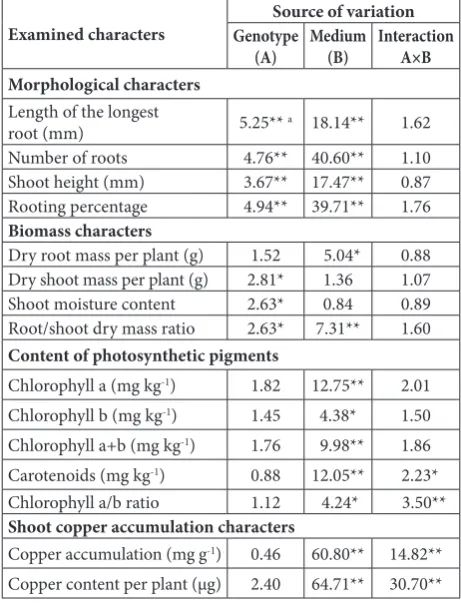
According to the results of ANOVA, the differences among genotypes were significant only in the mor-phological and biomass characters, with the exception of dry root mass. However, the examined media had a significant effect on the variation of all examined characters, except dry shoot mass, whereas the inter-action genotype×medium had a significant influence on copper accumulation characters and some charac-ters of the photosynthetic pigment content (Table 1).
Morphological characters
There is a considerable difference in the effects of the media on the examined genotypes. Chlorosis, ne-crosis and absolute absence of root formation were
Table 1. F-test of ANOVA for the examined characters.
Examined characters Genotype Source of variation
(A) Medium (B) Interaction A×B Morphological characters
Length of the longest
root (mm) 5.25** a 18.14** 1.62
Number of roots 4.76** 40.60** 1.10
Shoot height (mm) 3.67** 17.47** 0.87
Rooting percentage 4.94** 39.71** 1.76
Biomass characters
Dry root mass per plant (g) 1.52 5.04* 0.88
Dry shoot mass per plant (g) 2.81* 1.36 1.07
Shoot moisture content 2.63* 0.84 0.89
Root/shoot dry mass ratio 2.63* 7.31** 1.60
Content of photosynthetic pigments
Chlorophyll а (mg kg-1) 1.82 12.75** 2.01
Chlorophyll b (mg kg-1) 1.45 4.38* 1.50
Chlorophyll а+b (mg kg-1) 1.76 9.98** 1.86
Carotenoids (mg kg-1) 0.88 12.05** 2.23*
Chlorophyll а/b ratio 1.12 4.24* 3.50**
Shoot copper accumulation characters
Copper accumulation (mg g-1) 0.46 60.80** 14.82**
Copper content per plant (μg) 2.40 64.71** 30.70**
Table 2. Morphological characters of rooted shoots of Populus nigra grown on the examined media (LSD test).
Genotype Medium1 Length of the
longest root (mm) Numberof roots height (mm)Shoot percentageRooting
BN5 C0 8.40 bcd 2 1.68 cde 14.28 bde 24.05 cdef
BN5 C1 16.58 abc 4.55 ab 14.65 bcde 85.94 a
BN5 C2 3.13 de 1.38 de 16.07 bcd 17.91 def
BN5 C3 0 e 0 f 10.91 e 0 h
DN3 C0 14.69 b 3.98 a 16.51 bcd 79.99 a
DN3 C1 26.77 a 5.07 a 23.20 a 69.07 a
DN3 C2 14.35 b 3.47 ab 19.39 ac 53.73 abc
DN3 C3 0 e 0 f 11.09 e 0 h
GN5 C0 13.25 bc 3.16 abc 16.77 bcd 60.18 ab
GN5 C1 14.32 b 3.87 a 23.96 a 51.57 abcd
GN5 C2 8.68 bcd 1.97 bcde 19.52 abc 14.00 defg
GN5 C3 0 e 0 f 10.33 e 0 h
PN2 C0 0.83 bcde 0.67 cdef 9.17 de 1.85 efgh
PN2 C1 7.30 bcde 2.96 abcd 18.10 abcd 53.95 abcd
PN2 C2 3.80 cde 0.73 def 13.07 de 5.78 efgh
PN2 C3 0 de 0 f 9.93 e 0 gh
TRN2 C0 14.70 b 1.85 cde 13.67 de 33.29 bcde
TRN2 C1 11.50 bc 4.22 a 19.73 ac 51.92 abc
TRN2 C2 3.31 de 0.87 ef 16.74 bcd 7.02 fgh
TRN2 C3 0 e 0 f 12.55 de 0 h
BN5 4.70 b 1.12 b 13.68 c 13.61 b
DN3 14.82 a 2.88 a 18.02 a 38.42 a
GN5 7.88 b 1.71 b 16.69 ab 16.54 b
PN2 2.98 b 0.84 b 12.71 c 7.61 b
TRN2 6.68 b 1.35 b 15.48 bc 11.85 b
C0 8.40 bcd 1.68 cde 14.28 bde 24.05 cdef
C1 16.58 abc 4.55 ab 14.65 bcde 85.94 a
C2 3.13 de 1.38 de 16.07 bcd 17.91 def
C3 0 e 0 f 10.91 e 0 h
1Labels of the examined media: C0 – 10-7Cu2+, pH 5.5, C1 – 10-7Cu2+, pH 3, C2 – 10-4 Cu2+, pH 3, C3 – 10-3 Cu2+, pH 3 before autoclaving 2The differences among values marked with the same letter are not significant at the level α=0.05
Table 3. Biomass characters of rooted shoots of Populus nigra grown on examined media (LSD test).
Genotype Medium1 Dry root mass
per plant (g) Dry shoot massper plant (g) Shoot moisturecontent Root/shoot drymass ratio
BN5 C0 0.0009 bcd 2 0.0127 abc 0.8589 a 0.0673 bcde
BN5 C1 0.0010 bcd 0.0132 abc 0.7962 abc 0.0791 bcde
BN5 C2 0.0008 bcd 0.0144 abc 0.7454 abc 0.0590 bcde
BN5 C3 0 cd 0.0077 bc 0.8197 ab 0 de
DN3 C0 0.0019 bc 0.0159 ab 0.8367 ab 0.1234 bcde
DN3 C1 0.0020 b 0.0206 a 0.7977 ab 0.1091 bcde
DN3 C2 0.0014 bcd 0.0130 bc 0.8526 a 0.1047 bcde
DN3 C3 0 cd 0.0084 bc 0.8367 a 0 de
GN5 C0 0.0013 bcd 0.0090 bc 0.8390 ab 0.1356 bcd
GN5 C1 0.0045 a 0.0083 bc 0.8372 ab 0.3919 a
GN5 C2 0.0009 bcd 0.0091 bc 0.8381 ab 0.0992 bcde
GN5 C3 0 d 0.0088 bc 0.7549 abc 0 e
observed on C3 medium in all genotypes. The best rooting performance was achieved on C1 medium, while there was no significant effect of media on shoot height (Table 2).
The best performance according to all four ex-amined morphological characters was achieved by genotype DN3, while the poorest results for the mor-phological characters was achieved by PN2. Although the effect of the interaction genotype x medium was not significant, GN5 showed a specific response on C1 medium that was not significantly different from that obtained on the control (C0) (Table 2).
Other tested genotypes achieved significantly higher morphological characters on C1 than on C0. For medium C2, the results were considerably lower than on the control, while on medium C3 growth was almost absent. Only genotype DN3 attained signifi-cant results with regard to morphological characters on C2, which was at the level of the control.
Biomass characters
Although genotype DN3 had the highest values for dry root and shoot mass, differences among the exam-ined genotypes in biomass characters were not statisti-cally significant. However, there were differences in the reaction of the genotypes on the examined media.
DN3 achieved a significantly higher shoot dry mass on C2 than on C1, while GN5 achieved higher dry root mass on C1 than on other media (Table 3).
In general, there were no significant differences between the treatments and the control for most of the examined biomass characters. Shoot moisture content and root/shoot dry mass ratio were significantly lower on the medium with the toxic copper concentration (C3). Furthermore, significantly greater root dry mass and root/shoot dry mass ratio were observed on the C1 medium than on C2 (Table 3).
Photosynthetic pigment content
The genotype DN3 had significantly higher photo-synthetic pigment contents than the other genotypes. It also differed from the others by its reaction on the media. For this genotype, the pigment contents on C2 were significantly higher than on the control, while the differences were not significant in the other geno-types (Table 4). The photosynthetic pigment content calculated for fresh mass revealed almost the same relations among the genotypes and media (data not shown).
The highest content of photosynthetic pigments was achieved on C2, and the lowest on C3. However, only the content of Chl b on C2 significantly differed
PN2 C1 0.0010 bcd 0.0105 abc 0.8535 ab 0.0870 bcde
PN2 C2 0.0004 bcd 0.0114 abc 0.8086 ab 0.0419 bcde
PN2 C3 0 bcd 0.0062 bc 0.8324 ab 0 cde
TRN2 C0 0.0013 bcd 0.0067 c 0.8003 ab 0.1867 b
TRN2 C1 0.0015 bcd 0.0112 bc 0.6935 bc 0.1564 bc
TRN2 C2 0.0005 bcd 0.0068 c 0.8063 ab 0.0628 bcde
TRN2 C3 0 d 0.0114 bc 0.639 c 0 e
BN5 0.0006 a 0.0115 ab 0.8049 a 0.0424 b
DN3 0.0014 a 0.0148 a 0.8281 a 0.0833 ab
GN5 0.0015 a 0.0088 b 0.8092 a 0.1362 a
PN2 0.0004 a 0.0093 b 0.8305 a 0.0333 b
TRN2 0.0007 a 0.0091 b 0.7303 b 0.0925 ab
C0 0.0013 ab 0.0108 ab 0.8327 a 0.1251 ab
C1 0.0022 a 0.0142 a 0.7844 ab 0.1755 a
C2 0.0009 b 0.0109 ab 0.8108 ab 0.0767 b
C3 0 c 0.0089 b 0.7650 b 0 c
1Labels of examined media: C0 – 10-7 Cu2+, pH 5.5, C1 – 10-7Cu2+, pH 3, C2 – 10-4 Cu2+, pH 3, C3 – 10-3 Cu2+, pH 3 before autoclaving 2The differences among values marked with the same letter are not significant at the level α=0.05
from C0. Also, only on C3 were the carotenoid content and chlorophyll a/b ratio significantly lower than on the other media.
Copper accumulation and content
There were no significant differences in copper accumulation and content between C0 and C1, while C2 and C3 differed significantly from C0 and C1 in both characters (Table 5). The highest value of copper accumulation and copper content in most genotypes was observed on C3 medium, except for BN5, which displayed the highest copper accumulation and con-tent on C2.
DISCUSSION
High copper tolerance and the ability to accu-mulate this metal in the aboveground parts of plants are principal criteria in the evaluation of genotypes in order to be considered for use in phytoextraction [13]. Di Lonardo et al. [13] established that woody plant medium (WPM) with 10-3 M Cu2+ and pH 5.2 had no inhibitory effect on the growth and develop-ment of white poplar genotypes. In our work we con-ducted the test at pH 3, using citric acid to lower and stabilize the pH. It is well known that the pH of the media could be altered by many factors during both sterilization and cultivation in vitro [21]. Citric acid
Table 4. Photosynthetic pigments’ content in dry shoot mass of rooted shoots of Populus nigra grown on examined media (LSD test).
Genotype Medium1 Chlorophyll (mg kg-1) Carotenoids
(mg kg-1) Chlorophyllа/b ratio
а b a+b
BN5 C0 4.92 bc 2) 1.46 b 6.38 bc 1.80 b 3.34 bcdef
BN5 C1 4.18 bcd 1.17 bcd 5.35 bcd 1.24 bcd 3.59 abcdef
BN5 C2 5.11 b 1.77 b 6.88 b 1.59 bc 2.92 defg
BN5 C3 1.29 e 0.32 d 1.61 e 0.54 de 4.11 abc
DN3 C0 3.85 bcd 1.30 bcd 5.14 bcd 1.28 bc 2.97 def
DN3 C1 4.96 bc 1.69 b 6.65 bc 1.51 bc 2.94 cdefgh
DN3 C2 8.72 a 3.02 a 11.74 a 2.59 a 2.91 efg
DN3 C3 2.20 bcde 0.60 bcd 2.80 bcde 0.79 cde 3.63 abcdef
GN5 C0 4.62 bc 1.25 bcd 5.88 bc 1.64 bc 3.73 abcdef
GN5 C1 4.13 bcd 1.12 bcd 5.25 bcd 1.36 bc 3.66 abcdef
GN5 C2 4.21 bcd 1.41 bc 5.62 bc 1.41 bc 2.98 def
GN5 C3 1.35 e 0.78 bcd 2.13 de 0.57 de 2.63 fgh
PN2 C0 3.15 bcde 0.67 bcd 3.82 bcde 1.30 bcde 4.72 ab
PN2 C1 4.99 bc 1.45 bcd 6.44 bc 1.75 bc 3.96 abcde
PN2 C2 1.76 cde 0.35 bcd 2.11 cde 0.80 cde 5.07 a
PN2 C3 1.88 de 1.15 bcd 3.03 cde 0.95 cde 1.62 h
TRN2 C0 4.6 bc 1.19 bcd 5.8 bc 1.62 bc 3.86 abcde
TRN2 C1 5.02 bc 1.41 bc 6.43 bc 1.61 bc 3.62 abcdef
TRN2 C2 4.26 bcd 1.37 bc 5.62 bc 1.36 bc 4.03 abcd
TRN2 C3 0.71 e 0.42 cd 1.13 e 0.34 e 1.84 gh
BN5 3.85 b 1.18 b 5.03 b 1.30 b 3.48 a
DN3 5.54 a 1.88 a 7.42 a 1.72 a 3.02 a
GN5 3.58 b 1.14 b 4.72 b 1.24 b 3.25 a
PN2 3.11 b 1.04 b 4.14 b 1.25 b 3.49 a
TRN2 3.65 b 1.10 b 4.74 b 1.23 b 3.34 a
C0 4.39 a 1.25 b 5.65 a 1.56 a 3.57 a
C1 4.64 a 1.35 ab 5.99 a 1.49 a 3.57 a
C2 5.28 a 1.77 a 7.05 a 1.67 a 3.35 a
C3 1.33 b 0.62 c 1.96 b 0.59 b 2.72 b
is also known as a low molecular weight organic acid (LMWOA) capable of forming chelates with heavy metals, improving their mobility and bioavailability without causing leaching of heavy metals into lower soil strata [25,26]. According to Evangelou et al. [26], the effect on copper bioavailability in research on Ni-cotiana tabacum was even better with citric acid than with EDTA. Chen et al. [27] showed that the effect of citric acid on the uptake of lead and cadmium, anions that have even less mobility, is strongly related to pH lowering. In our work, in presence of citric acid (1.2 mM) and low pH, the concentration of 10-3 M Cu2+ in
medium C3 was sufficient to produce a toxic effect in the examined European poplar genotypes. Therefore, a copper concentration of 10-4 M in media with pH 3 should be recommended in future work on copper tolerance and the evaluation of its accumulation in
Populus nigra in vitro. In addition, these results should be taken into consideration in further research in field conditions on acidic soils and in cases when citric acid is used to improve copper availability.
The effect of low pH was tested by comparing the results of C1 and C0. The number of roots and the percentage of rooted shoots were significantly higher on C1; however, the shoot height and shoot dry mass on this medium were similar to those on C0. Kovačević et al. [21] observed significant growth and improved development of white poplar with re-gard to both shoot and root in plants grown in vitro
on medium with an initially low (before sterilization) pH of 3.0. The authors did not use citric acid nor any additional buffer system. At the end of cultivation, the final pH of the media differed significantly from the initial value. The Na-citrate/citrate buffer system together with microwave sterilization could be a use-ful approach for further studies of the effect of low pH in vitro.
Among the examined morphological characters, the best differentiation among genotypes on C2 medi-um was observed on root formation, in particular the rooting percentage. Genotype DN3 had the highest scores for rooting characters, which points to a high tolerance to increased copper concentration of this genotype. Greater differences in rooting characters than in shoot height between the among genotypes could be related to the fact that the roots of poplar genotypes in vitro seem to be more sensitive to high heavy metal concentrations in media compared to the shoots [13]. It seems that morphological differences in the response to C2 medium among the genotypes were most intensively expressed by their most sensi-tive organ, the root. Thus, we assumed that the root-ing characters could be proposed for quick copper tolerance in vitro tests in Populus nigra in the future. There were significant differences among geno-types in photosynthetic pigment contents, especially on the C2 medium. On this medium, genotype DN3 differed significantly from the others, with higher
chlo-Table 5. Copper accumulation and content in rooted shoots of
Populus nigra grown on examined media (LSD test).
Genotype Medium1 accumulationCopper
(mg g-1)
Copper content (μg plant-1)
BN5 C0 0.257 d 2) 3.271 d
BN5 C1 0.080 d 1.048 d
BN5 C2 2.182 c 31.366 a
BN5 C3 0.391 d 3.004 d
DN3 C0 0.103 d 1.639 d
DN3 C1 0.020 d 0.416 d
DN3 C2 0.180 d 2.336 d
DN3 C3 2.987 b 25.200 b
GN5 C0 0.069 d 0.624 d
GN5 C1 0.105 d 0.877 d
GN5 C2 0.177 d 1.612 d
GN5 C3 3.066 ab 27.047 ab
PN2 C0 0.081 d 0.785 d
PN2 C1 0.412 d 4.343 cd
PN2 C2 0.239 d 2.725 d
PN2 C3 1.719 c 10.706 c
TRN2 C0 0.072 d 0.481 d
TRN2 C1 0.032 d 0.353 d
TRN2 C2 0.519 d 3.535 d
TRN2 C3 2.227 ac 25.332 b
BN5 1.007 a 13.429 a
DN3 0.975 a 8.672 b
GN5 0.854 a 7.540 bc
PN2 0.735 a 5.332 c
TRN2 0.933 a 9.761 b
C0 0.114 c 1.407 c
C1 0.112 c 1.242 c
C2 0.798 b 10.476 b
C3 1.917 a 16.703 a
1Labels of examined media: C0 – 10-7 Cu2+, pH 5.5, C1 – 10-7 Cu2+, pH 3, C2 – 10-4 Cu2+, pH 3, C3 – 10-3 Cu2+, pH 3 before autoclaving
rophyll and carotenoid contents, while the genotype PN2 had the highest chlorophyll a/b ratio (Table 4).
In our study, chlorosis was observed on C3 me-dium in all genotypes. The loss of photosynthetic pig-ments is a common reaction of plants to excessive copper, and is related to disturbances in the chloro-plast inner structure caused by alterations in lipopro-teins in thylakoid membranes [29]. No significant dif-ference in the content of examined photosynthetic pigments were observed on C2 compared to C0 and C1, whereas the chlorophyll a/b ratio was significantly lower in samples grown on the C3 medium than on C1. In contrast to our results, Borghi et al. [14] ob-served an increment in the chlorophyll a content in treatments with copper concentrations ranging from 0.4 to 500 10-6 M Cu2+, which was followed by a sig-nificant decline in Populus × euramericana cl. Adda leaves after growth in 10-3 M Cu2+ in hydroponic cul-ture. The same author found that the excess of copper produced a significant difference in the chlorophyll a/b ratio of the rooted cuttings.
In general, copper accumulation increased with the increment of copper concentration in the medi-um. In the Euramerican poplar clone Adda grown in hydroponics, Borghi et al. [14] found such an incre-ment only in roots, but not in the stem and leaves. The highest copper accumulation and copper content in shoot tissue of the examined European black poplar genotypes was observed on C2 and C3 media.
We propose the C2 medium for application in further tests of copper tolerance and accumulation in
Populus nigra tissue culture, since the C3 medium had a toxic effect on all tested genotypes. The C2 medium had an inhibitory but not toxic effect, and significant differences in most of the examined characters as compared to the control medium. Furthermore, it pro-vided the best differentiation among the genotypes.
The examined genotypes considerably differed in copper tolerance and accumulation. Genotype DN3 achieved the best performance according to mor-phometrics, biomass and photosynthetic pigment contents. High scores in morphometrics, especially in rooting characters and in the photosynthetic pig-ment contents, on C2 suggest that this genotype could tolerate the presence of copper in the substrate at in-creased concentrations. The highest copper
accumula-tion on C2, the medium preferred for copper tolerance evaluation tests, was achieved by BN5, while all the other genotypes had the highest copper accumulation when grown on the C3 medium. These results favor BN5 to be tested beside DN3 in phytoextraction proj-ects on soils where the copper content is low enough to be sufficiently tolerated by this genotype. Here it could achieve a higher copper accumulation than the other genotypes and would be more appropriate for copper phytoextraction on soils with a near to toxic copper concentration. Further field tests should be performed in order to examine the effect of copper on biomass accumulation, which is the other compo-nent of a plant’s phytoextraction potential. The use of
Populus nigra genotypes on highly contaminated soils should be done with caution, especially considering the inhibitory effect of high copper concentration on root formation.
The general opinion is that differences in the bio-availability of contaminants and the processes of pol-lutant uptake and metabolite distribution are likely to be substantial in tissue culture and field conditions. In Salix sp. it was shown that the results obtained in hydroponics and in the field are comparable [29,30]. Also, in [31] and [32], the authors support the idea that the response of plants to environmental contami-nants can be predicted based on results from tissue cultures, reducing the cost of subsequent conventional whole-plant experiments.
Considering the observed differences among the examined genotypes with regard to copper tolerance and accumulation, in vitro tests can serve to narrow the group of candidate genotypes for copper phytoex-traction projects. However, for the final evaluation of a particular genotype, research should be performed in the field, considering the lower availability of lead in soil, higher juvenility of the material in vitro and com-plexity of the interaction between plant and the habitat.
Acknowledgements: This article was realized as a part of the proj-ect “Studying climate change and its influence on the environment: impacts, adaptation and mitigation” (III 43007), financed by the Ministry of Education, Science and Technological Development of the Republic of Serbia.
Authors’ contribution: Vanja Vuksanović and Branislav
planned and organized the research; Dragana Miladinović took part in the writing of the manuscript.
Conflict of interest disclosure: There is no conflict of interest
regarding the results presented in this work.
REFERENCES
1. Arora M, Kiran B, Rani S, Rani A, Kaur B, Mittal N. Heavy metal accumulation in vegetables irrigated with water from different sources. Food Chem. 2008;111:811-15.
2. Van Assche F, Clijsters H. Effects of metals on enzyme activ-ity in plants. Plant Cell Environ. 1990;13:195-206. 3. Burzyński M, Buczek J. Uptake and assimilation of
ammo-nium ions by cucumber seedlings from solutions with dif-ferent pH and addition of heavy metals. Acta Soc Bot Pol. 1998;76:197-200.
4. Oleksyn J, Karolewski P, Giertych MJ, Werner A, Tjoelker MG, Reich PB. Altered root growth and plant chemistry of
Pinus sylvestris seedlings subjected to aluminum in nutrient solution. Trees. 1996;10:135-44.
5. Landis TD, Van Steenis E. Micronutrients: Copper. Tree Plant Notes. 2000;49(3):44-8.
6. Sakan SM, Đorđević DS, Manojlović DD, Polić PS. Assess-ment of heavy metal pollutants accumulation in the Tisza river sediments. J Environ Manage. 2009;90:3382-90. 7. Antonijević M, Marić M. Determination of the content of
heavy metals in pyrite contaminated soil and plants. Sensors. 2008;8:5857-65.
8. Bozkurt MA, Yarilga T. The effects of sewage sludge applica-tions on the yield, growth, nutrition and heavy metal accu-mulation in apple trees growing in dry conditions. Turk J Agric For. 2003;27:285-92.
9. Pivetz BE. Ground water issue: Phytoremediation of con-taminated soil and ground water at hazardous waste sites. Washington, DC: U.S. Environmental Protection Agency, Technology Innovation Office, Office of Solid Waste and Emergency Response; 2001. 36 p.
10. Barcelo J, Poschenrieder C. Phytoremediation: principles and perspectives. Contrib Sci. 2003;2:333-44.
11. Ghosh M, Singh SP. A review on phytoremediation of heavy metals and utilization of its byproducts. Appl Ecol Env Res. 2005;3:1-18.
12. Pulford ID, Watson C. Phytoremediation of heavy metal-con-taminated land by trees - a review. Environ Int. 2003;29:529-40. 13. Di Lonardo S, Capuana M, Arnetoli M, Gabbrielli R, Gon-nelli C. Exploring the metal phytoremediation potential of three Populus alba L. clones using an in vitro screening. Environ Sci Pollut R. 2011; 18: 82-90.
14. Borghi M, Tognetti R, Monteforti R, Sebastiani L. Responses of Populus×euramericana (P. deltoides×P. nigra) clone Adda to increasing copper concentrations. Environ Exp Bot. 2007;61:66-73.
15. Aitchison EW, Kelley SL, Alvarez PJJ, Schoor JL. Phytoreme-diation of 1,4-dioxane by hybrid poplar trees. Water Environ Res. 2000;72:313-21.
16. Kovačević B, Tomović Z, Štajner D, Katanić M, Drekić M, Stojnić S. Restoration of autochthonous poplar species ( Pop-ulus sp.) in riparian zone – genofond establishment. Topola (Poplar). 2010;185/186:61-8. Serbian.
17. Castiglione S, Franchin C, Fossati T, Lingua G, Torrigiani P, Biondi S. High zinc concentrations reduce rooting capac-ity and alter metallothionein gene expression in white poplar (Populus alba L. cv. Villafranca). Chemosphere. 2007;67:1117-26.
18. Rani V, Raina SN. Genetic fidelity of organized meristem-derived micropropagated plants: A critical reappraisal. In Vitro Cell Dev Biol Plant. 2000;36:319-30.
19. Confalonieri M, Balestrazzi A, Bisoffi S, Carbonera D. In vitro culture and genetic engineering of Populus spp.: syn-ergy for forest tree improvement. Plant Cell Tissue Org Cult. 2003;72:109-38.
20. Ahuja MR. A commercially feasible micropropagation method for aspen. Silvae Genetica. 1984;32:174-6.
21. Kovačević B, Miladinović D, Katanić M, Tomović Z, Pekeč S. The effect of low initial me dium pH on in vitro white poplar growth. Bull Fac Forest. 2013;108:67-80.
22. Skirvin RM, Chu MC, Mann ML, Young H, Sullivan J, Fer-manian T. Stability of tissue culture medium pH as a func-tion of autoclaving, time and cultured plant material. Plant Cell Rep. 1986;5:292-94.
23. Wettstein D. Chlorophyll-letale und der submikroskopische Formwechsel der Plastiden. Exp Cell Res. 1957;12:427-506. 24. R Development Core Team. R: A language and environment
for statistical computing. Vienna: R Foundation for Statisti-cal Computing; 2008. 3501 p.
25. Do Nascimento CWA, Amarasiriwardena D, Xing B. Com-parison of natural organic acids and synthetic chelates at enhancing phytoextraction of metals from a multi-metal contaminated soil. Environ Pollut. 2006;140:114-23. 26. Evangelou MWH, Ebel M, Schaeffer A. Chelate assisted
phytoextraction of heavy metals from soil. Effect, mecha-nism, toxicity, and fate of chelating agents. Chemosphere. 2007;68:989-1003.
27. Chen YX, Lin Q, Luo YM, He YF, Zhen SJ, Yu YL, Tian GM, Wong MH. The role of citric acid on the phytoreme-diation of heavy metal contaminated soil. Chemosphere. 2002;50:807-11.
28. Maksymiec W. Signaling responses in plants to heavy metal stress. Acta Physiol Plant. 2007;29:177-87.
29. Watson C, Pulford ID, Riddell-Black D. Screening of wil-low species for resistance to heavy metals: Comparison of performance in a hydroponics system and field trials. Int J Phytoremediat. 2003;5:351-65.
30. Pulford ID, Riddell-Black D, Stewart C. Heavy metal uptake by willow clones from sewage sludge-treated soil: the poten-tial for phytoremediation. Int J Phytoremediat. 2002;4:59-72. 31. Doran PM. Application of Plant Tissue Cultures in Phytore-mediation Research: Incentives and Limitations. Biotechnol Bioeng. 2009;103:60-76.