A NEW KEY FOR OLD LOCK: GLYCEROL, AS AN OH-ACID,
CATALYZED ONE-POT THREE-COMPONENT AND FULLY
GREEN SYNTHESIS OF 3,4-DIHYDROPYRIMIDIN-2(1H)-ONE
AND -THIONES
S. Golshani Anvar
[a]and F. K. Behbahani
[a]*Keywords: Organic OH-acid, reusable catalyst, glycerol, dihydropyrimidin-2(1H)thione, dihydropyrimidin-2(1H)one.
Synthesis of 3,4-dihydropyrimidin-2(1H)-one and 3,4-dihydropyrimidin-2(1H)-thione derivatives from aldehydes, ethyl acetoacetate and urea or thiourea using glycerol as an organo OH-acid, green and reusable catalyst is reported. The practical and simple protocol led to excellent yields of the dihydropyrimidin-2(1H)-one and thiones under mild reaction conditions and within short span of reaction times with easy reaction workup by maintaining excellent atom economy.
*Corresponding Authors Fax:
E-Mail: [email protected] [a] Author Address line 1
[b] Author Address line 2
INTRODUCTION
Aryl-3,4-dihydropyrimidines derivatives (DHPMs) have
received great attention because of their wide range of
therapeutic and pharmacological properties, such as
antiviral,
7antitumor, antibacterial and antifungal,
8anti-inflammatory,
9antihypertensive agents, and neuropeptide Y
(NPY) antagonists.
10Furthermore, these compounds have
emerged as the integral backbones of several
calcium-channel blockers.
11Also, several alkaloids containing the
dihydropyrimidine were isolated from marine sources, for
example, of these are the batzelladine alkaloids, which are
found to be potent HIVgp-120-CD4 inhibitors.
12,13After the
classic Biginelli approach to 3,4-dihydropyrimidinones, the
development of multistep synthetic strategies that produce
relatively higher yields was demand. So, various protocols
for synthesis of 3,4-dihydropyrimidines were explored by
varying components and catalysts.
14Scheme 1.
Preparation of DHPMs in glycerol as a solvent.In this communication, we report glycerol as an organic
OH-acid, green and reusable catalyst for the synthesis of
DHPMs via a one-pot three component condensation of
aldehydes, ethyl acetoacetate, urea and thiourea at 100 °C
(Scheme 1).
EXPERIMENTAL
Melting points were measured by using the capillary tube
method with an electro thermal 9200 apparatus. IR spectra
were recorded on a Perkin Elmer FT-IR spectrometer
between 4000-400 cm
-1.
1HNMR spectra were obtained on
Bruker DRX- 300 MHZ NMR instrument. Analytical TLC
of all reactions was performed on Merck precoated plates
(silica gel 60 F-254 on aluminium). Elemental analyses of
the new products were done using a Vario EL III apparatus.
Their results are in good agreement with the calculated
values.
General procedure for the synthesis of arylidene pyrimidinones using glycerol
A mixture of the 2.0 mmol aldehyde, 2.0 mmol, 0.26 g
ethyl acetoacetate (2.0 mmol), 5.0 mmol, 0.072 g or 0.0913
g urea or thiourea and 1 cm
3glycerol was heated in an oil
bath at 100 °C for the specified times. The reaction was
monitered by TLC (ethyl acetate/n-hexane, 1:2). After
completion of the reaction, crushed ice was added and
stirred for 10 min. The product was collected by filtration,
washed with water and then crystallized from methanol to
afford the pure product.
Ethyl 6-methyl-4-(3-nitrophenyl)-2-oxo-1,2,3,4-tetrahyd-ropyrimidine-5-carboxylate
IR [KBr] υ(cm
-1): 3331, 3101, 2966, 1710, 1689, 1631,
1525, 1456, 1347, 1317, 1266, 1225, 1088, 901, 808, 794,
739, 685.
1H NMR (300 MHz, DMSO-d
6
) δ: 1.11 (t, J =
7.5 Hz, 3H), 2.26 (s, 3H), 4.01 (q, J = 7.5 Hz, 2H), 5.28 (d, J
= 3.0 Hz, 1H), 7.61-7.70 (m, 2H), 7.87 (s, 1H, NH),
8.07-8.13 (m, 2H), 9.34 (s, 1H, NH).
R1 = 3-(NO2)-C6H4, 2-(OH)-C6H4, 4-N(Me)2-C6H4,
Ph-CH=CH, C4H4O; X= O, S R1 H
O
H2N NH2 X
+
EtO Me O O
N H
NH R1
EtO
X Me
O
Ethyl 4-(4-(dimethylamino)phenyl)-6-methyl-2-oxo-1,2,3,4-tetrahydropyrimidine-5-carboxylate
IR [KBr] υ(cm
-1): 3246, 3116, 2926, 1721, 1702, 1650,
1527, 1457, 1366, 1289, 1222, 1169, 1093, 785.
1H NMR
(300 MHz, DMSO-d
6) δ: 1.12 (t, J = 7.5 Hz, 3H, CH
3),
2.21(s, 3H, CH
3), 2.83 (s, 6H, N(CH
3)
2), 4.0 (q, J = 7.5 Hz,
2H, -OCH
2), 5.02 (s, 1H, CH), 6.65 (d, J = 9.1 Hz, 2H,
arom), 7.03 (d, J = 9.1 Hz, 2H, arom), 7.55 (s, 1H, NH), 9.0
(s, 1H, NH).
Ethyl 4-(furan-2-yl)-6-methyl-2-oxo-1,2,3,4-tetrahydropyrimi-dine-5-carboxylate
IR [KBr] υ(cm
-1): 3347, 2982, 1698, 1650, 1489, 1370,
1332, 1302, 1263, 1211, 1122, 1096, 1050, 1022, 806, 750,
730.
1H NMR (300 MHz, DMSO-d
6
) δ: 2.2 (t, J = 7.0 Hz,
3H), 3.6 (s, 3H), 3.8 (q, J = 7.0 Hz, 2H), 6.1 (d, J = 3.0 Hz,
2H), 6.3 (q, J = 2 Hz, 1H), 7.6 (s, 1H), 7.8 (s, 1H, NH), 9.3
(s, 1H, NH).
Ethyl (E)-6-methyl-2-oxo-4-styryl-1,2,3,4-tetrahydropyrimidi-ne-5-carboxylate
IR [KBr] υ(cm
-1): 3244, 3113, 2977, 1723, 1652, 1451,
1286, 1228, 1095, 967, 778, 692.
1H NMR (300 MHz,
DMSO-d
6) δ: 1.21 (t, J = 7.0 Hz, 3H), 2.34 (s, 3H), 4.11 (q,
J = 7.05 Hz, 2H), 4.73 (d, J = 4.80 Hz, 1H), 6.21 (d, J = 6.0
Hz, 1H), 6.37 (d, J = 15.9 Hz, 1H), 7.19-7.40 (m, 5H), 7.52
(s, 1H, NH), 9.11 (s, 1H, NH).
Ethyl 4-(2-hydroxyphenyl)-6-methyl-2-thioxo-1,2,3,4-tetrahyd-ropyrimidine-5-carboxylate
IR [KBr] υ(cm
-1): 3364, 3166, 3084, 2948, 1727, 1610,
1589, 1564, 1491, 1475, 1371, 1323, 1223, 1187, 1152.
1H
NMR (300 MHz, DMSO-d
6) δ: 1.04 (t, J = 7.2 Hz, 3H),
2.15 (s, 3H), 4.10 (d, 1H), 4.22 (q, J = 7.2 Hz, 2H), 4.22 (s,
1H), 6.81-7.21 (m, 4H), 8.46 (s, 1H, NH), 9.57 (s, 1H, NH).
Ethyl 4-(4-(dimethylamino)phenyl)-6-methyl-2-thioxo-1,2,3,4-tetrahydropyrimidine-5-carboxylate
IR [KBr] υ(cm
-1): 3296, 3177, 2989, 1662, 1575, 1523,
1458, 1370, 1332, 1287, 1180, 1113, 943, 814, 771, 572.
1H
NMR (300 MHz, DMSO-d
6) δ: 1.11 (t, J = 7.0 Hz, 3H),
2.28 (s, 3H), 2.85 (s, 6H), 3.97 (q, J = 7.0 Hz, 2H), 5.04 (d, J
= 3.2 Hz, 1H), 6.66 (d, J = 8.5 Hz, 2H), 7.01 (d, J = 8.5 Hz,
2H), 9.55 (s, 1H, NH), 10.24 (s, 1H, NH).
Ethyl 6-methyl-4-(3-nitrophenyl)-2-thioxo-1,2,3,4-tetrahydropyrimidine-5-carboxylate
IR [KBr] υ(cm
-1): 3087, 2987, 1729, 1661, 1628, 1528,
1400, 1351, 1299, 1209, 1103, 1045, 1019, 812, 734, 678.
1H NMR (250 MHz, DMSO-d
6
) δ: 1.13 (t, J = 7.1 Hz, 3H),
2.34 (s, 3H), 4.05 (q, J = 7.1Hz, 2H), 5.36 (d, J = 3.6 Hz,
1H), 7.70-7.72 (m, 2H), 8.10-8.11 (m, 1H), 8.17-8.20 (m,
1H), 9.81 (s, 1H, NH), 10.55 (s, 1H, NH).
RESULTS AND DISCUSSION
On basis of our previous investigation that synthesis of
dihydropyrimidinones need to temperature and acidic
condition as mention in introduction section. Thus the
authors decided to set up a model reaction to achieve a fully
green procedure for the synthesis of
3,4-dihydropyrimidin-2(1
H
)-one and -thione derivatives in the presence of
glycerol as green solvent and organic OH-acid catalyst.
Then the synthesis of compound
5-(ethoxycarbonyl)-6-methyl-4-phenyl-3,4-dihydropyrimidin-2(1H)-ones(Table 1)
was selected as a model reaction to determine suitable
reaction conditions. The reaction was carried out by
employing benzaldehyde (2.0 mmol), ethyl acetoacetate (2.0
mmol),urea (5.0 mmol) and different amount of glycerol
(5.0, 4.0, 3.0 and 1.0 ml) at 100 °C. Found that increasing
amount of glycerol does not effect to yield and rection time,
therefore, we selected 1.0 ml of glycerol as green organic
OH-acid catalyst for this reaction. To generalize of this
method the reaction of ethyl acetoacetate with different
kinds of aromatic aldehydes and urea/thiourea using
glycerol as catalyst at 100 °C was examined.
Several aromatic aldehydes (Table 1) carrying either
electron releasing or electron withdrawing sustituents in the
ortho, meta and para positions afforded high yields of the
products. An important feature of this procedure is the
survival of variety of functional groups such as ether, nitro
groups, and halides under the reaction conditions. Thiourea
also reacts under similar conditions to give their
corresponding 3, 4-dihydropyrimido-2(1H)thiones. The
proposed mechanism for the synthesis of
3,4-dihydropyrimidin-2(1
H
)-one and thione derivatives in the
glycerol media has been shown in Scheme 2.
Scheme 2. Suggested mechanism for the synthesis of 3,4-dihydropyrimidin-2(1H)-one/thiones.
R1 H
+ H2N NH2
X R1 OH
HN
X NH2
- H2O
H
N X
NH2
NH H R1
R2O2C
O Me
NH2
X
R1
NH R2O2C
X N H HO
Me H R1
- H2O NH
X N H R2O2C
Me R1
O
OR2
O
Me H H
O O
OH
H O
H
O O
H HO
H O
Table 1. Synthesis of 3,4-dihydropyrimidin-2(1H)-one and thion derivatives in the presence of glycerol.
M. P. °C
Found; Reportedref Yield, %
Time, h Product
X Aldehyde
Entry
202-203 203-20415
85 2.0
N H
NH EtO
O
H3C O
O
CHO
1
224-227 225-22715
80 1.0
N H
NH EtO
O
H3C O
NO2
O
CHO
NO2
2
254-257 257-25915
70 3.5
N H
NH EtO
O
H3C O
N(CH3)2
O
CHO
N(CH3)2
3
203-205 206-20816
65 3.0
N H
NH EtO
O
O O
H3C
O
O
H O
4
237-240 240-24216
68 1.0
N H
NH EtO
O H3C
O
O
CHO
5
237-239 240-24117
35 1.0
N H
NH EtO
O
H3C S
OH
S
CHO
OH
204-207 206-20815 60 2.0 N H NH EtO O
H3C S
N(CH3)2
S
CHO
N(CH3)2
7 203-205 206-20915 65 2.0 N H NH EtO O
H3C S
NO2
S
CHO NO2 8 180-182 18516 30 1.5 N H NH EtO O S OH3C
S
O
H O
9
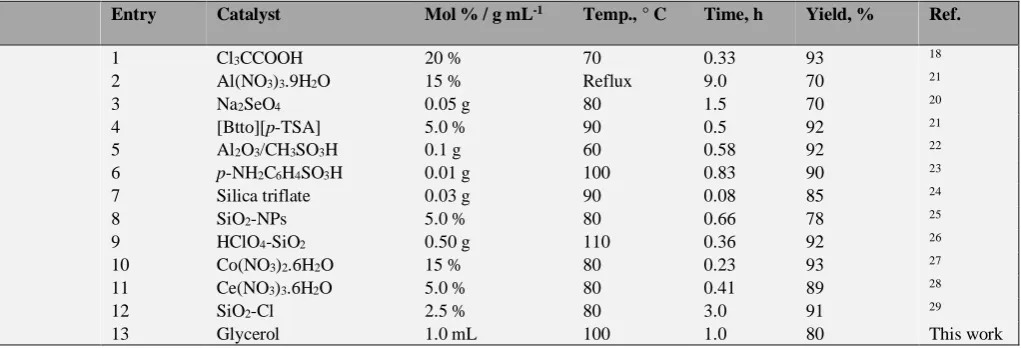
Table 2. Comparison of efficiency of various catalysts in synthesis of ethyl 6-methyl-4-(3-nitrophenyl)-2-oxo-1,2,3,4-tetrahydropyrimidine-5-carboxylate.
Ref. Yield, %
Time, h Temp., ° C
Mol % / g mL-1 Catalyst Entry 18 93 0.33 70 20 %
Cl3CCOOH
1 21 70 9.0 Reflux 15 %
Al(NO3)3.9H2O
2 20 70 1.5 80 0.05 g
Na2SeO4
3 21 92 0.5 90 5.0 %
[Btto][p-TSA] 4 22 92 0.58 60 0.1 g
Al2O3/CH3SO3H
5 23 90 0.83 100 0.01 g
p-NH2C6H4SO3H
6 24 85 0.08 90 0.03 g Silica triflate 7 25 78 0.66 80 5.0 %
SiO2-NPs
8 26 92 0.36 110 0.50 g
HClO4-SiO2
9 27 93 0.23 80 15 %
Co(NO3)2.6H2O
10 28 89 0.41 80 5.0 %
Ce(NO3)3.6H2O
11 29 91 3.0 80 2.5 %
SiO2-Cl
12 This work 80 1.0 100 1.0 mL Glycerol 13
In order to show the merit of the present work, we
compared the results of the synthesis of ethyl
6-methyl-4-(3-
nitrophenyl)-2-oxo-1,2,3,4-tetrahydropyrimidine-5-carboxy-late (Entry 1 in Table l) with some previously reported
catalysts. The yield of product in the presence of glycerol is
comparable to the reported catalysts. However, reaction in
the presence of these catalysts required less catalyst than this
work (Table 2).
CONCLUSION
In continuation of our earlier work, carried to develop
convenient synthetic protocols for the synthesis of bioactive
heterocycles
30-32by employing green tools and considering
the above urgent need to provide convenient rapid route for
the DHPMs, here we report for the first time the Biginelli
reaction by subjecting substituted quinoline methoxy
benzaldehydes, ethyl acetoacetate, urea and thiourea in
glycerol medium and catalyst for obtaining new DHPMs.
REFERENCES
1Yanlong, G. U., Jérôme F., Glycerol as a sustainable solvent for
green chemistry., Green Chem., 2010, 12, 1127-1138.
https://doi.org/10.1039/C001628D
2Wolfson, A., Dlugy C. Glycerol as an alternative green medium
3García, J. I., Mayoral, G. M. H., Pérez, P., Glycerol based
solvents: synthesis, properties and applications. Green Chem.,
2010, 12, 426-434.https://doi.org/10.1039/B923631G
4 Ying A., Zhang Q., Li, H., Shen, G., Gong, W., He, M., An
environmentally benign protocol: catalyst-free Michael
addition of aromatic amines to α,β-unsaturated ketones in glycerol, Res. Chem. Intermed., 2013, 39, 517.
https://doi.org/10.1007/s11164-012-0575-0
5Díaz-Álvarez, A. E., Cadierno, V., Glycerol: A promising green
solvent and reducing agent for metal-catalyzed transfer hydrogenation reactions and nanoparticles formation. Appl. Sci., 2013, 3, 55. https://doi.org/10.3390/app3010055 6Jovanović, M. B., Konstantinović, S. S., Ilić, S. B., Veljković, V.
B., The synthesis of vanillin-semicarbazone in crude glycerol as a green solvent, Adv. Technol., 2013, 2, 38.
7Hurst, E. W., and Hull, R., Two new synthetic substances active
against viruses of the psittacosis-lymphogranuloma-trachoma group. J. Med. Chem., 1960, 3, 215.
https://doi.org/10.1021/jm50015a002
8Ashok, M., Holla, B. S., Kumari, N. S., Convenient one pot
synthesis of some novel derivatives of thiazolo [2,3-b] dihydropyrimidinone possessing 4-methylthiophenyl moiety and evaluation of their antibacterial and antifungal activities,
Eur J. Med. Chem., 2007, 42, 380.
https://doi.org/10.1016/j.ejmech.2006.09.003
9Bahekar, S. S., Hinde, D. B., Synthesis and anti-inflammatory
activity of some [4, 6-(4-substituted aryl)-2-thioxo-1,2,3,4-tetrahydropyrimidin-5-yl]acetic acid derivatives, Bioorg. Med. Chem. Lett., 2004, 14, 1733.
10Mayer, T. U., Kapoor, T. M., Haggarty, S. J., King, R. W.,
Schreiber, S. L., and Mitchison, T. J., Small molecule inhibitor of mitotic spindle bipolarity identified in a phenotype-based screen. Science, 1999, 286, 971.
https://doi.org/10.1126/science.286.5441.971
11Oliver, K. C., Recent advances in the Biginelli dihydropyrimidine
synthesis: new tricks from an old dog, Acc. Chem. Res., 2000,
33, 879. https://doi.org/10.1021/ar000048h
12Patil, A. D., and Kumar, N. V., Kokke, W. C., Bean, M. F.,
Freyer, A. J., De Brosse, C., Shing Mai, C.D., Truneh, A., Carte, B., Novel alkaloids from the sponge Batzella sp.: inhibitors of HIV gp120-human CD4 binding. J. Org. Chem.1995, 60, 1182. https://doi.org/10.1021/jo00110a021 13Snide, B. B., Chen, J., Patil, A. D., Freyer, A. J. Synthesis of the
tricyclic portions of batzelladines A, B and D. Revision of the stereochemistry of batzelladines A and D., Tetrahedron Lett.,1996, 37, 6977. https://doi.org/10.1016/0040-4039(96)01575-4
14Oliver, K. C. 100 years of the Biginelli dihydropyrimidine
synthesis, Tetrahedron, 1993, 49, 6937.
https://doi.org/10.1016/S0040-4020(01)87971-0
15Rômulo, F. C., Bernardi, A., Battastini, A. M. O., Russowsky, D.,
Eifler-Lima, V. L., Synthesis of dihydropyrimidin-2-one/thione library and cytotoxic activity against the human U138-MG and Rat C6 glioma cell lines. J. Brazil. Chem. Soc., 2011, 22, 1379. https://doi.org/10.1590/S0103-50532011000700025
16Salehi, H., Guo, Q. X., A facile and efficient one‐pot synthesis of
dihydropyrimidinones catalyzed by magnesium bromide under solvent‐free conditions. Synthetic Commun., 2004, 34, 171. https://doi.org/10.1081/SCC-120027250
17Salehi, H., Guo, Q. X., Efficient Magnesium Bromide‐Catalyzed
One‐pot Synthesis of Substituted 1,2,3,4‐Tetrahydropyrimidin‐2‐ones Under Solvent‐free Conditions. Chin. J. Chem., 2005, 23, 91.
https://doi.org/10.1002/cjoc.200590021
18Karimi-Jaberi, Z., Moaddeli, M. S., Synthesis of
3,4-dihydropyrimidin-2(1H)-ones and their corresponding 2(1H) thiones using trichloroacetic acid as a catalyst under
solvent-free conditions. ISRN Org. Chem., 2012, 2012.
https://doi.org/10.5402/2012/474626
19Kolvari, E., Mirzaeeyan, M., Al(NO
3)3 · 9H2O: An Efficient
Catalyst for the One-Pot Synthesis of 3,4-Dihydropyrimidin-2(1H)-ones Both under Reflux or Solvent-Free Conditions. J. Chem., 2012, 2013. https://doi.org/10.1155/2013/325268 20Hekmatshoar, R., Heidari, M., Heravi, M. M., Baghernejad, B.
Efficient sodium selenate-catalyzed synthesis of 3,4-dihydro-2(1H)-pyrimidinones and –thiones under solvent-free conditions. Bull. Chem. Soc. Ethiop., 2009, 23, 141.
https://doi.org/10.4314/bcse.v23i1.21312
21Zhang, Y., Wang, B., Zhang, X., Huang, J., Liu, C., An efficient
synthesis of 3,4-dihydropyrimidin-2(1H)-ones and thiones catalyzed by a novel Brønsted acidic ionic liquid under solvent-free conditions. Molecules, 2015, 20, 3811.
https://doi.org/10.3390/molecules20045680
22Sharghi, H., and Jokar, M. Al
2O3/MeSO3H: a novel and
recyclable catalyst for one-pot synthesis of 3,4-dihydropyrimidinones or their sulfur derivatives in Biginelli condensation, Synth. Commun.,2009, 39, 958.
https://doi.org/10.1080/00397910802444258
23Wu, M. S., He, P., and Zhang, X. Z., An Environmentally
Friendly Solvent-free Synthesis of 3,4-Dihydropyrimidinones using a p-Aminobenzene Sulfonic Acid Catalyzed Biginelli Reaction. South African J. Chem.,2010, 63, 224.
24Shirini, F., Marjani, K., and Nahzomi, H. T. Silica triflate as an
efficient catalyst for the solvent-free synthesis of 3,4-dihydropyrimidin-2(1H)-ones. Arkivoc, 2007, i, 51.
https://doi.org/10.3998/ark.5550190.0008.106
25Monjezi, J., Noei, M., Dezaki, A. S. Cheap and efficient protocol
for the one- pot multicomponent synthesis of dihydropyrimidinone derivatives using silica nanoparticles as reusable catalyst. Indian J. Fund. Appl. Life Sci., 2014, 4, 120.
26Maheswara, M., Oh, S. H., Kim, K. T., and Do, J. Y., Synthesis
of 3,4-Dihydropyrimidin-2(1H)-ones Using HClO 4-SiO2 as a Heterogeneous and Recyclable Catalyst, Bull. Korean Chem. Soc., 2008, 29, 1752.
https://doi.org/10.5012/bkcs.2008.29.9.1752
27Nasr-Esfahani, M., Montazerozohori, M., Aghel-Mirrezaee, M.,
Kashi, H. Efficient and green catalytic synthesis of dihydropyrimidinone (thione) derivatives using cobalt nitrate in solvent-free conditions. J. Chilean Chem. Soc., 2014, 59, 2311. https://doi.org/10.4067/S0717-97072014000100015 28Adib, M., Ghanbary, K., Mostofi, M., Ganjali, M. R., Efficient
Ce(NO3)3·6H2O-catalyzed solvent-free synthesis of
3,4-dihydropyrimidin-2(1H)-ones. Molecules, 2006, 11, 649.
https://doi.org/10.1055/s-2006-934508
29Karade, H. N., Sathe, M., Kaushik, M. P. Synthesis of 4-aryl
substituted 3,4-dihydropyrimidinones using silica-chloride under solvent free conditions. Molecules, 2007, 12, 1341.
https://doi.org/10.3390/12071341
30Behbahani, F. K., Yektanezhad, T., a) A greener route for the
one-pot synthesis of 1,2,4,5-tetraarylated imidazoles,
Monatsch. Chem., 2012, 143, 1529.
https://doi.org/10.1007/s00706-012-0724-6; b) Behbahani, F. K., Naeini, S., Suzangarzadeh, S., FePO4-catalyzed synthesis
of ß-amido carbonyl compounds, Eur. Chem. Bull., 2013,
2(11), 832-835; DOI:
http://dx.doi.org/10.17628/ecb.2013.2.832-835; c)Behbahani, F. K., Mohammadlo, M., L-Proline-catalyzed synthesis of fused dihydropyridines through Hantzsch, Eur. Chem. Bull.,
2013, 2(11), 916-919; DOI:
http://dx.doi.org/10.17628/ecb.2013.2.916-919; d)Behbahani, F. K., Mohammadi Ziarani, L., One pot three-component Mannich reaction Promoted by iron(III) phosphate. Eur. Chem. Bull., 2013, 2(10), 782-784;
http://dx.doi.org/10.17628/ecb.2013.2.782-784; e) Behbahani, F. K., Lotfi, A., Catalytic performance of SiO2-supported
Fe(ClO4)3.6H2O in synthesis of 2-substituted benzimidazoles.
Eur. Chem. Bull., 2013, 2(9), 694-697.
31Zadpour, M., Behbahani, F.K. Iron (III) phosphate as a green and
reusable catalyst for the synthesis of 4,6-disubstituted 2-aminopyridine-3-carbonitriles. Monat. Chem.,2015, 146, 1865.
https://doi.org/10.1007/s00706-015-1456-1
32Behbahani, F. K., and Homafar, M. Synthesis of
Polyhydroquinoline Derivatives Through the Hantzsch Four Component Using Iron(III) Phosphate as a Catalyst. Synth. React. Inorg. Metal-Org. Chem., 2012, 42, 291.
https://doi.org/10.1080/15533174.2011.610020