AJPRHC
Research Article
EMERGING TRENDS OF PROBIOTICS IN FORMULATION DEVELOPMENT AS A BIOTHERAPEUTICSAGENT
HIMANSHU K.SOLANKI *, ARNAZ Z. MISTRY, DUSHYANT A. SHAH, VIPUL D. PRAJAPATI
For Author affiliations see end of the text This paper is available online at www.jprhc.in
ABSTRACT:
Every being wants to live a healthy life. The increase in the discovery and development of medicines is the provoking demand of mankind to meet with the increasing and spreading illness of the society. Pharmaceutical Sciences have proved its worth to meet with the emerging problems with thorough challenges.The concept of probiosis, prebiosis and symbiosis have been recently emerged and being implemented in pharmaceutics to develop, design and delivery of probiotic drugs which can be administered orally as other medicines with its efficient efficacy and least jeopardy.However with the undergoing trends of its designing and discovery, the emphasis has been focused on to its bimolecular mode of action. The present review work would also emphasize the pros and cons of the probiotic food supplements with the necessity for the invention of preceding probiotic drugs which would rapidly pounce, quell and substitute the use of probiotic foods. The idea of this probiotic drug designing will be salutary to the society and would also meet with the cost.
KEYWORDS:
Probiotics; Health benefit; Formulation development; bio therapeutics agent
1. INTRODUCTION:
A Probiotic term derives from the combined Greek/Latin word “pro” and “bios”, meaning for life. The concept of probiotic was probably firstly introduced by the Russian Nobel laureate Elie Metchnikoff in 1907 “The Prolongation of Life: Optimistic Studies” where he proposed the idea that ingesting microbes could have beneficial effects for human beings, especially to treat digestive diseases.” [1].
The term “probiotic” was firstly used in 1965, by Lilly and Stillwell, to describe substances secreted by one organism which stimulates the growth of another.
Probiotic is a defined as “live microorganisms that beneficially affect the host’s health by improving its microbial balance” [2].
More recently, probiotics have been defined as “live microorganisms that, when administered in adequate amounts, confer a health benefit on the host” [3]
The objective of present review work is to make the Indian society and particularly the poor mass aware about the less recognized, affordable but the most beneficial ways of improving their health by probiotic formulation.
1.1 Gut Ecology
The GIT of the human body is a complex ecosystem with a diverse and concentrated microbial population that mediates numerous interactions with the chemical environment, such as digestion, adhesion and colonization in the GIT.
The human body consists of 10 Crore cells but we harbor 100 Crore bacteria in different parts of body [4] Microorganisms are present all over the body except heart and brain.
Human Body is comprised of 1013cells
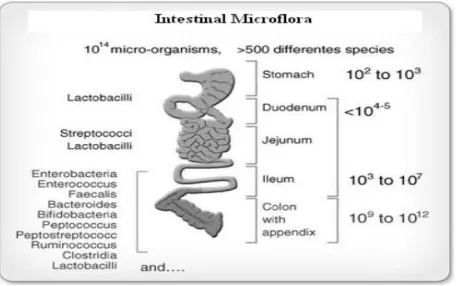
Our Digestive system contains 1014Bacterial cells. 10 Times more Bacteria than Human Cells. More than 500 different bacterial species inhabit the human gut. Some of them are beneficial and some of them are harmful. Normal intestinal flora is a complex collection and balance of microorganisms that normally inhabit the G.I. tract.
Figure 1. Key physiologic and microbiological features of the gut and relative concentrations of microflora in GIT.
1.2 Role of Microflora in the GIT[6]
The normal flora which colonizes the GI tract exerts several functions:
synthesizing and excreting vitamins in excess of their own needs, which can be absorbed as nutrients by their hosts (enteric bacteria secrete Vitamin K and Vitamin B12, and lactic acid bacteria produce certain B-vitamins)
preventing the pathogens colonization by competing for attachment sites or essential nutrients being likely to produce substances which inhibit or kill non indigenous species
stimulating the development of certain tissues, i.e., the caecum and certain lymphatic tissues in the GI tract stimulating the production of natural antibodies
producing a variety of substances ranging from relatively non-specific fatty acids and peroxides to highly specific bacteriocins which inhibit or kill other bacteria
1.3 Mechanisms of Action of Probiotics[7-13] 1.3.1 Antimicrobial Effects of Probiotics.
Modify microflora to suppress pathogens. Secrete antibacterial substances.
Probiotic bacteria produce a variety of substances that are inhibitory to both gram-positive and gram-negative bacteria. These include organic acids, hydrogen peroxide and bacteriocins. These compounds may reduce not only the number of viable pathogenic organisms but may also affect bacterial metabolism and toxin production. This occurs through reduction of luminal pH through the production of volatile short-chain fatty acids, mainly acetates, propionates and butyrates. And of course, through production of lactic acid (Bifidobacterium, Lactobacillus, Streptococcus), leading to a reduction in colonic pH
Compete with pathogens to prevent their adhesion to the intestine Compete for nutrients necessary for pathogen survive
Antitoxin effect
1.3.2 Effect of Probiotics on the Intestinal Epithelium.
Promote tight contact between epithelial cells forming a functional barrier. Reducing the secretory and inflammatory consequences of bacterial infection. Enhancing the production of defensive molecules such as mucins.
1.3.3 Immune Effects of Probiotics
Probiotics as vehicles to deliver anti-inflammatory molecules to the Intestine. Enhance signaling in host cells to reduce inflammatory response.
Switch in immune response to reduce allergy. Reduce the production of inflammatory substances. 1.4 Characteristics of probiotic[14, 15]
The probiotic bacteria selected should have the following main characteristics: They should have “non-pathogenic’ activity
They should be “resistant to bile salts” and gastric acids
They should have the “desired technological and organoleptic properties”
They should have “biological efficiency” on humans, including ‘adhesion to epithelial cells’ in the intestine They should interact with “enteropathogenic” bacteria
They should be able to “colonize” in the gut
1.5 Taxonomy of probiotic
Table 1. Commonly used probiotics species for human use
Lactobacillus Bifidobacterium Streptococcus Enterococcus L.acidophilus
L.rhamnosus
B.bifidum ,
B.breve
S.cremoris E.faecium
L.brevis
L.gallinarum
B.bifidus,
B.adolescentis
S.diacetylactis E.faecalis
L.bulgaricus
L.plantarum
B.longum S.intermedus
L.casei
L. GG
B.lactis S.salivarius
L. fermentum
L.reuteri
B.infantis
2. IMPORTANT PROPERTIES OF PROBIOTICS
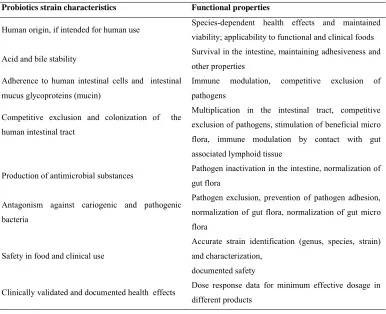
The most important properties for current and future probiotics include the acid and bile tolerance, adherence to human intestinal mucosa, temporary colonization of the human gastrointestinal tract, production of antimicrobial substances and inhibition of pathogen growth [17]
Table 2.
Essential properties of probiotics
Probiotics strain characteristics Functional properties
Human origin, if intended for human use Species-dependent health effects and maintained viability; applicability to functional and clinical foods
Acid and bile stability Survival in the intestine, maintaining adhesiveness and other properties
Adherence to human intestinal cells and intestinal mucus glycoproteins (mucin)
Immune modulation, competitive exclusion of pathogens
Competitive exclusion and colonization of the human intestinal tract
Multiplication in the intestinal tract, competitive exclusion of pathogens, stimulation of beneficial micro flora, immune modulation by contact with gut associated lymphoid tissue
Production of antimicrobial substances Pathogen inactivation in the intestine, normalization of gut flora
Antagonism against cariogenic and pathogenic bacteria
Pathogen exclusion, prevention of pathogen adhesion, normalization of gut flora, normalization of gut micro flora
Safety in food and clinical use
Accurate strain identification (genus, species, strain) and characterization,
documented safety
Table 2. Important Properties of probiotics[18] 3. FORMULATION ASPECTS OF PROBIOTIC
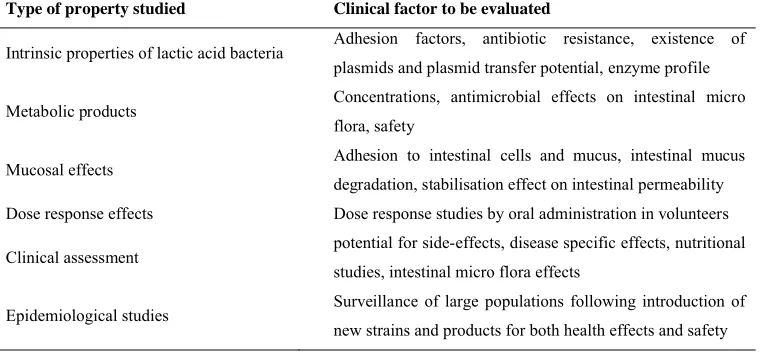
Formulation development of probiotic begins with the product design and moves forward through clinical studies to the development of the commercial manufacturing process. Important clinical studies for the clinical assessment of probiotic are shown in the table 3. [19]
Type of property studied Clinical factor to be evaluated
Intrinsic properties of lactic acid bacteria Adhesion factors, antibiotic resistance, existence of plasmids and plasmid transfer potential, enzyme profile
Metabolic products Concentrations, antimicrobial effects on intestinal micro flora, safety
Mucosal effects Adhesion to intestinal cells and mucus, intestinal mucus degradation, stabilisation effect on intestinal permeability Dose response effects Dose response studies by oral administration in volunteers
Clinical assessment potential for side-effects, disease specific effects, nutritional studies, intestinal micro flora effects
Epidemiological studies Surveillance of large populations following introduction of new strains and products for both health effects and safety
Table 3. Important clinical studies for the clinical assessment of probiotic
The goal of product design is a fully validated, good manufacturing practice (GMP)–compliant process that will ensure the continued and consistent quality of the final product for its intended use.
The manufacturing process should be designed and adjusted as needed to ensure the safety, purity, and stability of the live microorganism in its final dosage form.
Safe and effective use of a live biotherapeutic biological drug depends on consistent manufacture and release according to valid specifications.
Product design for probiotics starts with the selection of a strain of bacteria or yeast that has characteristics thought to be associated with healthy functioning of human body systems.
3.1 Selection of production strains
Microorganisms chosen for the production of probiotics are subject to a careful selection process. [20] They are isolated from their natural environment and subjected to specific studies.
First, microbiological tests and selection procedures are carried out to evaluate their suitability. Their fermentation profiles are determined revealing which substrates are fermented to which metabolites, For example: API assay for the fermentation of sugar to lactic acid. Comprehensive and accurate characterisation of the microorganism is also necessary. Amongst others, the genetic fingerprint, which is determined by molecular biological tests such as DNA analysis, is used for this purpose. In addition, the behaviour of the microorganism in the animal is studied, i.e. whether it survives the intestinal passage, how long it remains in the intestine and how it regulates the intestinal ecosystem. All this is the basis for an additional selection criterion – the efficacy in the animal. In addition, safety aspects also play a decisive role.[21]
Strain Identification by Phenotypic and Genotypic Methods
Flow Diagram of Guidelines for the Evaluation of Probiotics is given in the figure 2 3.2 Production
Probiotics are manufactured by fermentation which is a biological procedure under the controlled supply of nutrients. All raw materials used are subject to strict quality controls. The sterile fermentation vessel is inoculated with the master seed culture either directly or indirectly after a pre-culture stage with all important parameters of production being monitored continuously. This is followed by concentration, also called cell harvesting. Special drying stages and, if necessary, the addition of specific stabilisers, complete the manufacturing process.
In some products, the microorganisms are protected by microcapsules or microspheres for better stability. [22] A schematic illustration of the manufacturing process is shown in Figure 3
Usually, a concentrated harvest is adjusted by dilution, or a dried preparation is blended with other dry ingredients, such as stabilizers or fillers. Liquid preparations to be frozen may be stabilized with cryoprotectants.
Uniformity of the dosage form is ensured by monitoring of weights and volume during the filling of vials, capsules, or sachets or during compression into tablets. Tablets and capsules may be enteric coated to ensure passage through the stomach and dissolution in the intestine. Powdered product may be supplied with prepackaged buffered reconstituting solutions. [23]
3.3 Probiotic product Specification
Specifications are acceptance criteria to which active ingredients and drug product must conform before they can be released as products for human use. Acceptance criteria are dependent on the methods used to obtain the results. Specifications should be established for critical materials used in the manufacture of human drugs and biologics, for intermediates, and for the final products. Specifications for product release are chosen to confirm the product quality, rather than to characterize the product.
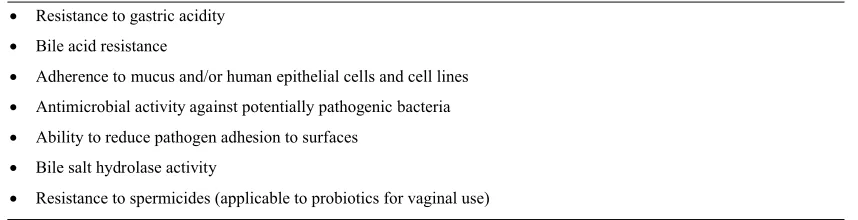
Table 4. Main currently used in vitro tests for the study of probiotic strains Resistance to gastric acidity
Bile acid resistance
Adherence to mucus and/or human epithelial cells and cell lines Antimicrobial activity against potentially pathogenic bacteria Ability to reduce pathogen adhesion to surfaces
Bile salt hydrolase activity
Resistance to spermicides (applicable to probiotics for vaginal use)
Table 4. Main currently used in vitro tests for the study of probiotic strains 3.4 Quality assurance and regularity issues of probiotics
The harvested live organism is the active pharmaceutical ingredient. Before formulation, the active pharmaceutical ingredient is tested and released against acceptance criteria that ensure the quality of the final product. [24]
Specific identity testing is performed to confirm the strain and its critical characteristics. For recombinant strains, products of transgene expression should be verified.
Microbiological purity should be assessed for the purified active pharmaceutical ingredient and after high-risk manufacturing steps that might allow extraneous contamination. Testing methods, such as the may be used to ensure freedom from extraneous organisms. [25] Purity testing at the stage of the active pharmaceutical ingredient is more sensitive than is testing after dilution to prepare the final dosage form. Test methods are selected to detect the most likely contaminants. Although sterility of the live product and intermediates is not claimed, extraneous bioburden should be controlled by GMP and should be monitored at significant points in the manufacturing process. [26]
Finally, an accurate quantity of viable organisms is determined using sample dilution and colony counts. Yield of the active ingredient should be measured as colony-forming units per product unit. This value guides formulation and is a useful monitor of process consistency.
The regulations for Probiotic list the product qualities that must be evaluated for each lot of product: potency, general safety, sterility, purity, and identity. [27] For some qualities, the methodology is also specified.
3.4.1 Potency:
Potency is the specific ability or capacity of the product to affect a given result. Potency is defined as a quantitative measure of an attribute linked to relevant biological properties. [28] The simplest measure of potency for a live biotherapeutic is colony-forming units per dose unit. The accuracy of the measure of colony-forming units will be determined by the sample size, homogeneity of the sample, and number of replicate plates per diluted sample. If an end product of the microbe is associated with or predictive of therapeutic activity, then an assay of the end product is also appropriate. A semiquantitative assay of an expressed product may be sufficient when combined with measurement of colony-forming units or another quantitative biochemical assay. Potency is often measured against a reference material or a specially prepared batch of active pharmaceutical ingredient.
3.4.2 Viability
Many scientists insist on the viability of the microorganisms used as probiotics, several studies have shown that non-viable probiotics, too, can attach to the intestinal wall and reduce duration of diarrheal diseases [29]
Studies examining probiotics immunological attributes have indicated that when living cells were given to patients, it led to a considerable increase in the number of cells that secrete IgA. [30]
The viability of the probiotic cells is essential for the probiotic antigens to be taken up through the Peyer’s patch, and also to adhere to the M-cells within the intestine [31-33]
Probiotic encapsulation technology used to ensure the probiotic viability which can sometimes solve this problem.[34]
3.4.3 Survival within the GI tract
In order for the colonization to happen, probiotic must adhere to intestine’s epithelial and mucosal cells. This affects the length of time the bacteria stays within the intestine. Also, it has an impact on the functional performance of the bacteria. The bacteria are strained by a number of stress factors while moving forward in the intestine. One such factor is the extremely low acidity (pH 1.5-3) of the stomach. The lowest acidity in which LAB can survive is 3.0, considerably higher than the acidity in stomach [35].
The extremely high pH environment in the stomach is a crucial parameter in choosing LAB strains. This harsh condition has a powerful impact on the viability of bacteria in the stomach. Olejnik et al. demonstrated that yoghurt’s pH reduced viable L. casei cells, for 13 days, by 2 log-cycles, and when the pH reached 6.5, more than 30 days. These figures were 3 and 30 days at pH 4 and 6.6, respectively, for L.acidophilus [35].
3.4.4 Adhesion
It has been suggested that probiotic bacteria’s attachment to the intestine’s wall and their colonization of the gastro-intestinal tract is a vital precondition for their survival and functioning. Strains of probiotic bacteria with adherent properties are likely to stay longer in the intestine. They, thus, have better chances for manifesting immunological and metabolic effects, compared to the strains with no adhesion properties. [36] The bacteria’s adhesion property causes them to interact with the mucosal surface and makes contact with gut associated lymphoid tissue (GALT) possible. It also plays a role in intestinal and systemic immune effects. Only probiotics with adherent properties are believed to stabilize the intestinal mucosal barrier and to be instrumental in inducing the immune effects. [37] Adhesion may also administer routes of exclusion of harmful bacteria and keep them away from the epithelium. Various strains of probiotic bacteria possess different adhesive properties. It could be suggested that powerful capability for adhesion may raise the risk of infection in the individual. Certain strains of probiotics which are poorly adhering in vivo or in vitro still can show positive effects in the hosts.
3.4.5 Safety
The general safety test method specifies doses given by intraperitoneal injection to mice and guinea pigs observed for adverse effects for 7 days. The general safety test is intended to detect extraneous toxic contaminants in the final product. [38,39] It is not intended as a test of inherent product toxicity and must be modified for products that are toxic by nature (e.g., live organisms given parenterally in high doses).[40] A regulatory exemption from the general safety test may be requested, provided that GMP and quality controls are in place. [41, 42]
In short, safety issues concerning probiotics cover the following attributes: [43, 44]
Figure 4. Safety aspect of probiotics 3.4.6 Sterility
Sterility testing is usually not appropriate for live biotherapeutics. A modification of the test method might be designed with consideration of the special characteristics of the organism, such as generation time or anaerobic growth requirements. Sterility testing may be waived for products that are administered orally [45]
3.4.7 Purity
Purity testing is repeated for the dosage form, to rule out extraneous contamination during formulation and finishing steps. For certain dosage forms, dissolution or resistances to gastric acid are appropriate tests to ensure that the active ingredient will reach its most effective site for activity. [24]
3.4.8 Identity
Stability studies are performed to ensure that the product remains safe and effective for its intended use throughout its specified shelf life. The dosage form should be tested in the actual container or closure system intended for marketing and should be stored at the recommended temperature.
The FDA will review data that support the recommended usage and administration instructions in the package insert as follows. [47, 48]
1.
If a powdered drug product is supplied with a liquid for reconstitution, the stability of the reconstituted product should be studied.2.
If a powdered or liquid product is combined with a consumer-supplied matrix, support for the recommendation must be presented as stability data. Limits on the kinds of diluents or appropriate foods should be stated in the package insert.3.
Consumers should be instructed on the limits of storage time after reconstitution or combination with any recommended diluent or matrix.A stability protocol defines the kinds of testing to be performed and a schedule for each test. Most release testing is included, but every test may not be required at every time point. The kinds of assays to include are those that test potency, purity, moisture, and bioburden.
4.
LABELING GUIDELINES PROBIOTIC FORMULATION[49] The probiotic formulation label should contain the following information: Genus, species and strain designation Functionality of the strains(s)
Minimum viable numbers of each probiotic strain (CFU/g) at the end of the shelf-life.
The suggested serving size must deliver the effective dose of probiotic related to the health claim(s) Total servings per container
Health claim(s) if any (substantiated with scientific research) Storage condition requirements
Nutrition/Supplement facts Manufacturer's name and address
Manufacturer's lot number and expiration date.
5.
FUTURE PROSPECTIVEThe probiotic concept is today widely spread in the scientific and industrial fields. However, further scientific input is required. Important target research areas, including GI-tract diagnostics and immunology, methodology, biomarkers, and functionality, will lead to tools and scientifically sound methods for well-designed informative human studies. Controlled human studies are essential for the success of probiotic functional foods, and they should be tailored for specific population groups such as the paediatric and elderly. Future research on probiotic bacteria will centre on selecting new and more specific strains for the well being of the host (age groups, healthy populations, disease specific).
The future scientific and technological research trends will be:
To study the mechanisms of action of probiotics in the GI-tract, and develop diagnostic tools and biomarkers for their assessment.
Studies on gut microbiota interactions with metabolic phenotypes -(so called functional metagenomics) Understanding of microbiota diversity on a population level and across various cultural and ethnic groups. To standardize the microbiota analysis methodology, sample collection, storage, analysis methods Correlating microbiota composition with disease risk, require large prospective epidemiological studies. To examine the effects of probiotics on GI-diseases, GI-infections, and allergies.
To ensure the stability and viability of probiotic products by developing feasible technologies (e.g. process and material development for microencapsulation).
To develop technology for pharmaceutical applications of novel or artificial probiotic. To evaluate the role of probiotics in healthy consumer groups and to address consumer aspects.
REFERENCES:
[1] Metchnikoff E. “The prolongation of life: optimistic studies”.London: William Heinemann; 1907. [2] Fuller R. A review: Probiotics in man and animals. J Appl Bacteriol 1989, 66: 365-78.
[3] FAO/WHO. Guidelines for the Evaluation of Probiotics in Food. London Ontario, Canada 2002. [4] Gosbach S.L, “Probiotics in the Third Millenium”, Digest Liver Dis 2002, 34 (supple.2): S2-7.
[5] Goktepe, I., Juneja, V. K. and Ahmedna, M. Probiotics in food safety and human health. Boca Raton, FL: Taylor and Francis group, 2006.
[6] Guarner F, Malagelada JR. Gut flora in health and disease. Lancet, 2003, 361(9356): 512-9.
[7] Isolauri E, Salminen S. Probiotics: use in allergic disorders: a Nutrition, Allergy, Mucosal Immunology, and Intestinal Microbiota (NAMI) Research Group Report. J Clin Gastroenterol, 2008, 42(Suppl):2:S91-96.
[8] Isolauri E, Sutas Y, Kankaanpaa P, Arvilommi H, Salminen S. Probiotics: effects on immunity. Amer J Clin Nutr, 2001, 73(2):444S-450S.
[10] Salminen S, Benno Y, de Vos W. Intestinal colonisation, microbiota and future probiotics? Asia Pac J Clin Nutr, 2006, 15(4):558-562
[11] Walker Rand M Buckley, Probiotic microbes: The scientific basis. American Academy of Microbiology, Washington DC, 2006, 28 pp.
[12] Ingrassia I, Leplingard A, Darfeuille-Michaud A. Lactobacillus casei DN-114 001 inhibits the ability of adherent-invasive Escherichia coli isolated from Crohn's disease patients to adhere to and to invade intestinal epithelial cells. Appl Environ Microbiol. 2005, 71(6):2880-2887.
[13] Candela M, Perna F, Carnevali P, Vitali B, Ciati R, Gionchetti P, Rizzello F, Campieri M, Brigidi P. Interaction of probiotic Lactobacillus and Bifidobacterium strains with human intestinal epithelial cells: adhesion properties, competition against enteropathogens and modulation of IL-8 production. Int J Food Microbiol. 2008, 125(3):286-92.
[14] De Vrese M, Schrezenmeir J. Probiotics, prebiotics, and synbiotics. Adv Biochem Eng Biotechnology. 2008, 111:1-66.
[15] Krishnakumar. Probiotic Cultures – Opportunities and Threats. G IRACT, 2001.
[16] Holzapfel, W. H., Haberer, P., Geisen, R., Bjorkroth, J., and Schillinger, U., Taxonomy and important features of probiotic microorganisms in food and nutrition. Am. J. Clin. Nutr. 2001, 73: 365S-73S.
[17] Barbara Mombelli, Maria Rita Gismondo, The use of probiotics in medical practice, International Journal of Antimicrobial Agents, 2000, 16: 531–536
[18] Aysun Cebeci,Candan G.urakan, Properties of potential probiotic Lactobacillus plantarum strains, Food Microbiology 2003,20: 511–518
[19] MacFie J. et.al., “Probiotics in Clinical Practise:A critical review of the evidence” Nutrition Research,2001, 21: 343–353
[20] Havenaar, R. et al: Selection of strains for probiotics use. Probiotics – The Scientific Basis. 1992, 210-224. [21] Reid, G., Kim, S. O., & Kohler, G. A., Selecting, testing and understanding probiotic microorganisms. FEMS
Immunology and Medical Microbiology, 2006, 46: 149– 157.
[22] Anal, A.K. & Singh, H., Recent advances in microencapsulation of probiotics for industrial applications and targeted delivery. Trends Food Science and Technology, 2007, 18(5): 813 240-251.
[23] Meurman JH, Stamatova I. Probiotics: Contributions to oral health. Oral Dis 2007, 13:443-51
[24] Elina Tuomola, Ross Crittenden, Martin Playne, Erika Isolauri and Seppo Salminen, Quality assurance criteria for probiotic bacteria, American Journal of Clinical Nutrition, February 2001, 73(2): 393S-398s,
[25] United States Pharmacopoeia microbial-limits tests United States Pharmacopoeia. Microbial limits tests. In: United States Pharmacopoeia—National Formulary. 30th ed. Rockville, Maryland: USPC; 2007.
[26] Guidelines and criteria for evaluation of efficacy, safety and health claim of probiotic in food products in India, 2008.
[27] US Food and Drug Administration. Food and drugs: Biologic products: general [600]; Licensing [601]; General biological standards [610]. Code of Federal Regulations title 21, parts 600, 601, and 610. 2006
[28] ICH Expert Working Group. Specifications: test procedures and acceptance criteria for biotechnological/biological products. Guideline Q6B. 2006
[29] Guarner F, Perdigon G, Corthier G, Salminen S, Koletzko B, Morelli L. should yoghurt cultures be considered probiotic? Br J Nutr, 2005, 93(6):783-786.
[30] Gilliland, S.E., Reilly, S.S., Kim, G.B., Kim, H.S. Viability during storage of selected probiotic Lactobacilli and Bifidobacteria in a yogurt like product. J. Fd. Sci. 2002, 67 (8):3091–3095.
[31] Vinderola, C.G., Prosello, W., Ghiberto, T.D. and Reinheimer, J.A. Viability of probiotic (Bifidobacterium, Lactobacillus acidophilus and Lactobacillus casei) and nonprobiotic microflora in Argentinian Fresco cheese. Journal of Dairy Science, 2000, 83: 1905-1911.
[32] Guandalini S, Pensabene L, Zikri MA, Dias JA, Casali LG, Hoekstra H, Kolacek S, Massar K, Micetic-Turk D, Papadopoulou A, de Sousa JS, Sandhu B, Szajewska H, Weizman Z. Lactobacillus GG administered in oral rehydration solution to children with acute diarrhea: A multicenter European trial. J Pediatr Gastroenterol Nutr, 2000, 30:54–60.
[33] Szajewska H, Skórka A, Ruszczyński M, Gieruszczak-Białek D. Meta-analysis: Lactobacillus GG for treating acute diarrhoea in children. Aliment Pharmacol Ther, 2007, 15:25(8):871-881.
[34] Vidhyalakshmi R., Bhakyaraj R. and Subhasre R.S., Encapsulation “The Future of Probiotics”-A Review, Advances in Biological Research 2009, 3(3-4): 96-103.
[35] Olejnik A, Lewandowska M, Obarska M, Grajek W. Tolerance of Lactobacillus and Bfidobacterium strains to low pH, bile salts and digestive enzymes. Electronic Journal of Polish Agricultural Universities, Food Science and Technology. 2005, 8 (1):05
[36] Carmen M. et al., In vitro analysis of probiotic strain combinations to inhibit pathogenadhesion to human intestinal mucus, Food Research International, 2007, 40: 629–636
[37] Arthur C. Ouwehanda, Elina M. Tuomolab, Seppo Salminena, Assessment of adhesion properties of novel probiotic strains to human intestinal mucus, International Journal of Food Microbiology, 2001, 64: 119–126 [38] Marteau P. Safety aspects of probiotic products. Scandinavian Journal of Nutrition, 2001, 45:22−30.
[39] Donohue, D.C. Safety of probiotics. Asia Pacific Journal of Clinical Nutrition 2006, 15: 563-569. [40] Snydman, D.R., The safety of probiotics, Clinical infectious diseases, 2008 46: S104-S111.
[44] Saarela M, Mogensen G, Fonden R, Matto J, Mattila-Sandholm T. Probiotic bacteria: Safety, functional and technological properties. J Biotechnol, 2000, 84 (3):197-215.
[45] US Food and Drug Administration. Food and drugs: General biological products standards: Sterility. 2006. Code of Federal Regulations title 21, part 610.12.
[46] Establishing Standards for Probiotic Products: ISAPP’s Role As discussed at the 2004 ISAPP IAC meeting Copper Mountain, Colorado June 22, 2005.
[47] Abe, F., Miyauchi, H., Uchijima, A., Yaeshima, K. and Iwatsuki, K. Stability of bifidobacteria in powdered formula. Inter J Food Sci Tech, 2009b, 44: 718-724.
[48] Abe, F., Tomita, S., Yaeshima, K. and Iwatsuki, K. Effect of production conditions on the stability of a human bifidobacterial species Bifidobacterium longum in yogurt. J Appl Microbiol, 2009c, 49(6):715-20.
[49] Weese JS. Evaluation of deficiencies in labeling of commercial probiotics. Canadian Veterinary Journal, 2003, 44 (12):982-983.
AUTHORS AFFILIATIONS AND ADDRESS FOR CORRESPONDENCE
Himanshu K.Solanki a*, Arnaz Z. Mistry a, Dushyant A. Shah b, Vipul D. Prajapati a, aSSR College of Pharmacy, Sayli-Silvassa road, Sayli, UT of DN & H-396230, India.
Tele-Fax: +91-0260-2681104 Mobile Phone: +91-9974811379
E-mail address: [email protected], [email protected]
bAPMC College of Pharmaceutical Education and Research, Motipura, Himmatnagar 383001, Dist: Sabarkantha. Gujarat,