THERMAL BEHAVIOR OF INORGANIC HYDROGEL
COMPOSITES
Sinan Temel
[a], Fatma Özge Gökmen
[a]*and Elif Yaman
[a]Keywords: Nano-SiO2; TiO2; poly(acrylic acid) (PAA); thermal behavior; hydrogels.
The objective of this work was to examine the effect of inorganic additives on thermal behavior of homo- and hetero-polymeric hydrogel. Nano SiO2 and TiO2 doped acrylic acid (AA) based homo-polymeric and acrylic acid/vinyl pyrrolidone (AA/VP) based hetero-polymeric
hydrogels were synthesized by using in-situ free radical polymerization technique. Additives were used in the ratio of 0.005, 0.5 and 1 (wt %) on AA based homo-polymeric hydrogels. Hetero-polymeric hydrogels were prepared in ratios of 1:3, 2:2 and 3:1 (AA/VP). Additives were used in only AA/VP (3:1) and they were added 0.5 and 1 (wt %). Thermal behaviour of hydrogels, were investigated by TGA-DTA analysis. The effect of doping on pore structure of hydrogels was demonstrated by SEM analysis. SEM/EDX measurements confirmed the presence of additives in the hydrogels. The dispersions of SiO2 and TiO2 on hydrogel were indicated by elemental mapping
and their amounts were compared with EDX analysis.
* Corresponding Authors Fax: +90 228 214 14 27
E-Mail: [email protected] [a] Bilecik Şeyh Edebali University, Central Research
Laboratory, Gulumbe Campus, Bilecik, Turkey.
INTRODUCTION
Polymeric materials are chosen of due to the ease of fabrication, flexibility and biocompatible nature as well as their wide range of mechanical, electrical, chemical and thermal behaviors when combined with different materials as composites.1-3 Hydrogels are a class of wet and soft
structures, composed by weakly cross-linked polymer matrixes that are hydrophilic three dimensional (3D) network.4,5 Hydrogels provide high physical, chemical and
mechanical stability in their swollen state.6 Hydrogels have
been defined which can be modified in order to achieve the unique properties. This special soft-wet structure of hydrogels makes possible them to be applied as biocompatible materials for a variety of biomedical applications including controlled drug delivery systems,7
wound dressing,8 coating for biosensors,9 membranes for bio
separation10 and tissue scaffold engineering.11 Poly(acrylic
acid)(PAA) and poly(vinylpyrrolidinone)(PVP) re water soluble synthetic polymers widely used in medical applications. They have low toxicity and are used in medical, food, cosmetics and as a film forming agent.12-14 There are
many techniques reported for preparation of composites such as sol–gel, in situ dispersion polymerization processing, focused pulsed laser ablation, spin coating, blend process and in situ polymerization, etc.15-17 Among these, in situ
polymerization is a facile approach that involves less time consumption, easy preparation, low cost of production and is also easily scalable.Titanium dioxide (TiO2) and
nano-SiO2 are considered to best choices of proficient inorganic
material due to their outstanding biocompatibility and biomechanical properties (Mohanaprina).
In this study, acrylic acid (AA) and acrylic acid-co-vinyl pyrrolidone (VP) were used as a monomer. Nano SiO2 and
TiO2 were added to the solution of AA and AA-co-VP (3:1)
with the crosslinking agent and initiator, cross-linked disk-shaped nanocomposite hydrogels were obtained. The nano-SiO2 and TiO2 are used as inorganic reinforcement materials
and they are supplied by commercially. In the preparation of nanocomposite hydrogels, AA and AA-co-VP monomers were preferred because of their biocompatibility properties. Both homopolymeric and heteropolymeric nanocomposite hydrogels were synthesized by using free radical in-situ polymerization method.
EXPERIMENTAL
Materials used throughout this study; nano-SiO2 (20-30
nm), TiO2, acrylic acid, vinyl pyrrolidone, ammonium
persulfate, N,N’-methylenebisacrylamide (N,N’-MBAAm) were purchased from Sigma-Aldrich. The cross-linked homo-polymeric and hetero-polymeric hydrogels were prepared by using AA and AA-co-VP monomers in PVC straws. The hydrogel solution containing monomer, initiator, crosslinking agent, solvent, and also nanoparticles was heated in a temperature-controlled water bath (at 80°C) for 2 h. The experimental part was used similar to that described in our previous publication.18
Measurements
FT-IR analysis were recorded by Perkin Elmer, Spectrum 100 model FT-IR in the range of 400-4000 cm-1. ATR mode
was selected and each spectrum was scanned 4 times and worked at a resolution of 4 cm-1. FESEM analyses were
performed with Carl Zeiss, Supra 40VP model SEM. Prior to analysis, samples were swollen to equilibrium and then lyophilized. Lyophilized hydrogel discs were sputter coated with Au/Pd alloy. Inorganic particle distributions in nanocomposite hydrogels were determined by applying the mapping technique with the Bruker EDX detector. TGA analyses were performed with the SETARAM simultaneous TG / DTA instrument. The heating was carried out at a temperature range of 30°C-650 °C with a heating rate of 10 °C min-1 in N
2 atmosphere. All analyses were performed
RESULTS AND DISCUSSION
In this study, both synthetic homo-polymeric and two monomers (AA, VP) including hetero-polymeric nanocomposite hydrogels were produced using two separate reinforcing materials (SiO2, TiO2). Thermal behavior,
chemical interaction and surface morphology of the obtained hydrogels have been examined and the results are discussed.
Thermal analysis
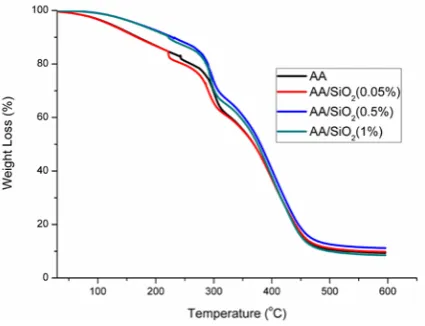
TGA curves of nano-SiO2-free AA hydrogel and AA
based homo-polymeric nanocomposite hydrogels with SiO2
doped in the ratio of 0.05, 0.5 and 1 (wt %) are given in Figure 1. Mass of the 0.5 and 1 wt % SiO2 doped
nanocomposites were found to increase thermal strength. The 0.05 wt % SiO2 addition had no effect as thermal
resistance as compared to that of the pure AA hydrogel. Two-step decomposition curves were obtained at approximately 200-300 °C and 300-400 °C. In both steps 0.5 and 1 wt% SiO2 was found to increase the heat loss mass
resistance.
Figure 1. TGA curve of AA hydrogel and 0.05, 0.5, 1 wt % nano-SiO2 doped AA based nanocomposite hydrogels
Figure 2 shows the TG curves of 0.05, 0.5 and 1 wt % TiO2 doped AA hydrogels. According to this curve, the
contribution of TiO2 in the ratio of 0.05 wt % increased the
thermal degradation resistance of AA based hydrogel.
Figure 2. TGA curve of AA hydrogel and 0.05, 0.5, 1 wt% TiO2
doped AA based composite hydrogels.
As the amount of TiO2 increased, the thermal resistance of
AA hydrogel decreased. The TiO2 addition did not alter the
2-step chemical degradation process of the pure AA hydrogel.
Figure 3 shows the TGA curve of homo-polymeric AA hydrogel and with optimized AA/VP at a ratio of 1:3, 2:2 and 1:3. The thermal strength of the hetero-polymeric hydrogel obtained with the optimized AA/VP ratios was higher than the homo-polymeric hydrogel. With the increase of VP ratio, not only the thermal strength of the composite was increased, but also the 2-step thermal degradation behavior of acrylic acid was realized in one step. AA and AA/VP obtained in a 3:1 ratio showed similar thermal behavior. For this reason, nano-SiO2 and TiO2 additions
were compared by applying to both hydrogels.
Figure 3. TGA curve of homo-polymeric AA and hetero-polymeric AA/VP in the ratio of 1:3, 2:2 and 3:1 hydrogels.
Figure 4 shows the differential thermal analysis curves of AA/VP (3:1) hetero-polymeric hydrogels with nano-SiO2
and TiO2 doping at 0.5 and 1% by mass. Although 0.5 wt %
doped SiO2 did not change the maximum decomposition
temperature, it showed the highest thermal resistance behavior compared to other doped and undoped AA/VP (3:1) nanocomposite hydrogels. The maximum thermal decomposition temperature in the second step was most reduced in 1 wt % TiO2 doped AA/VP (3:1) hydrogel.
Figure 4. Differential thermal analysis of nano-SiO2 and TiO2 (0.5
Table 1. Thermogravimetricdata of the SiO2and TiO2additive AA-homopolymericand AA/VP-heteropolymeric nanocomposite hydrogels.
AA, % VP, % SiO2,
wt. %
TiO2,
wt. %
degradation step, °C Td(max),
°C
Weight loss (%) at degradation steps, °C
1st 2nd 1st 2nd
100 0 - - 30-249 249-343 245; 18 25 100 0 0.005 - 30-225 225-345 225; 16 27 100 0 0.5 - 30-275 275-342 228; 15 22 100 0 1 - 30-227 227-307 222; 11 23 100 0 - 0.05 30-240 240-297 227; 12 15 100 0 - 0.5 30-268 268-342 275 20 27 100 0 - 1 30-252 252-345 297 8 25 25 75 - - 30-293 293-497 384; 16 67 50 50 - - 30-222 222-308 220; 12 15 75 25 - - 30-265 265-340 280 21 15 75 25 0.5 - 30-215 215-290 212; 13 22 75 25 1 - 30-252 252-315 215; 16 22 75 25 - 0.5 30-268 268-487 282; 18 18 75 25 - 1 30-273 273-336 292 20 21
In Table 1, the thermal decomposition steps of AA homo-polymeric hydrogel with nano-SiO2 and TiO2 added in mass
ratios of 0.005, 0.5, 1%; AA/VP hetero-polymeric hydrogels which were prepared in different ratios (1:3, 2:2, 3:1) as well as AA/VP (3:1) hydrogel with nano-SiO2 and TiO2
added at a ratio of 0.5 and 1 wt%, the maximum decomposition temperatures in these steps of all samples and the percent mass losses in the thermal decomposition intervals are given. According to this table, water separation in the hydrogel structure and thermal decomposition of the hydrogel structures occurred in the first step (30-250 °C). Chemical degradation in AA and AA/VP based hydrogels occurred in 2-steps due to thermal behavior of acrylic acid.19
Thermal degradation in the second step occurred between about 250-350 °C. As a result of the addition to homo-polymeric hydrogels, the maximum thermal decomposition was observed in the AA-TiO2 composite hydrogel with 0.5
and 1 wt % TiO2. There was a low increase in the 1 % TiO2
addition at the maximum thermal decomposition temperature in the second step. Other additions did not cause a change in the maximum decomposition temperature. AA:VP hetero-polymers were prepared using AA and VP monomers in a 1:3, 2:2 and 3:1 ratio. Accordingly, as the VP amount increased, the thermal behavior changed and the maximum decomposition temperature increased by approximately 100 °C (at 384 °C).
FTIR analysis
In Figure 5, the FTIR spectrum of 1 wt % nano-SiO2 and
TiO2 doped and undoped AA hydrogels are given. Since the
chemical effect of the additives on the hydrogel were not observed in the amounts of 0.05 and 0.5 wt %, the comparison was made in 1 wt % SiO2 and TiO2 doping
results. OH groups of the nanocomposite hydrogels gave a broad peak at approximately 2700-3600 cm-1. The band at
1695 cm-1 is the C = O tensile vibration of the COOH group
of AA. The symmetrical stress peak of Si-O-Si was observed in 1050 cm-1 and 441 cm-1 on 1 wt % SiO
2 added
AA hydrogel.
The chemical interaction of Ti-O with hydrogel was not found in the spectrum because of large particle size agglomeration.
Figure 5. FTIR spectrum of 1 (wt %) nano-SiO2 and TiO2 doped
and undoped AA hydrogel.
Figure 6. FTIR spectrum of 1 (wt %) nano-SiO2 and TiO2 doped
Figure 7. SEM images and elemental map distribution of (a) SiO2 (wt %) doped AA hydrogel (b) SiO2 (wt% ) doped AA/VP (3:1)
hydrogel.
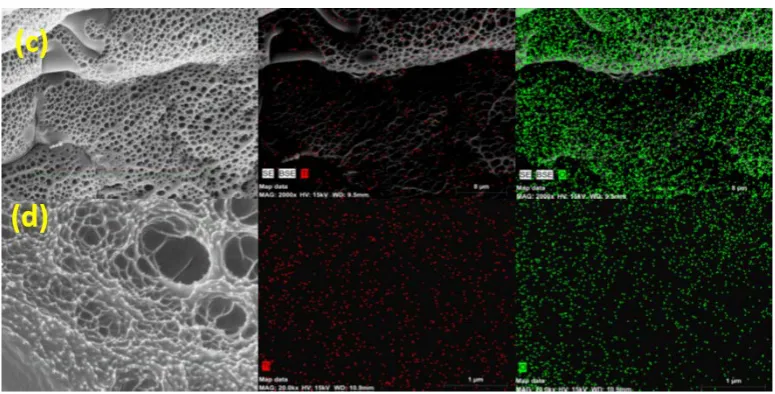
Figure 8. SEM images and elemental map distribution of (c) TiO2 (wt %) doped AA hydrogel (d) TiO2 (wt %) doped AA/VP (3:1) hydrogel.
The FTIR spectra of a 1 wt % nano-SiO2 and TiO2 doped
and an undoped AA/VP (3:1) hetero-polymeric hydrogel’s are given in Figure 6. According to spectrum, Si-O-Si stress interaction of SiO2 doped at 466 cm-1 was observed. No
structural change was observed in TiO2 doped AA/VP (3:1)
composite hydrogel.
SEM analysis
SEM images of SiO2 doped AA (Fig. 7 (a)) and AA/VP
(3:1) (Fig. 7 (b)) hydrogels, also silica (Si) and oxygen (O) distribution are given in Fig 7. Homogeneous pore structures were observed in both hydrogels. Si and O distributions are homogeneous on the hydrogels surface. SEM images of TiO2 doped AA (Fig. 8 (c)) and AA/VP (3:1) (Fig. 8 (d))
hydrogel, and titanium (Ti), oxygen (O) distribution are shown in Fig 8. The pore distributions of TiO2 doped
hydrogels are not homogeneous. In the structure, the Ti and
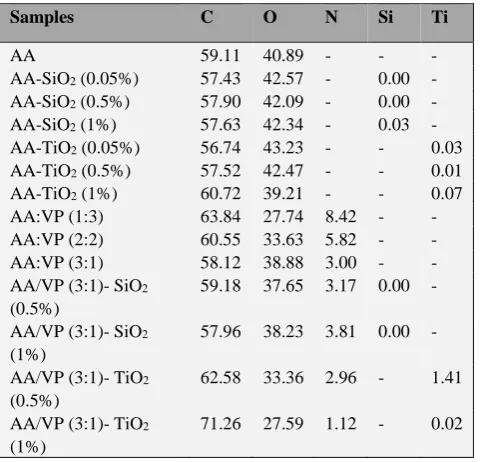
O distributions were distributed homogeneously on the polymer matrix. The EDX analysis results of all obtained samples are given in Table 2 in percent by atom. EDX signals are seen low, especially in nano-SiO2 additive, since
there is low percentage mass addition. The presence of SiO2
on the hydrogel can be demonstrated by an increase in the total oxygen content.
CONCLUSION
It was observed that low amount (0.05 wt. %) of SiO2 had
no thermal contribution to homo-polymeric AA hydrogel. 0.5 and 1 wt% nano-SiO2 increased the thermal degradation
resistance of AA hydrogel. The TiO2 additive, which was
not used in the nanoscale, decreased the thermal strength of the AA-TiO2 composite hydrogel, as expected, due to
Table 2. Atomic % of C, O, N, Si and Ti contents in homo- and hetero-polymeric nanocomposite hydrogels.
Samples C O N Si Ti
AA 59.11 40.89 - - - AA-SiO2 (0.05%) 57.43 42.57 - 0.00 -
AA-SiO2 (0.5%) 57.90 42.09 - 0.00 -
AA-SiO2 (1%) 57.63 42.34 - 0.03 -
AA-TiO2 (0.05%) 56.74 43.23 - - 0.03
AA-TiO2 (0.5%) 57.52 42.47 - - 0.01
AA-TiO2 (1%) 60.72 39.21 - - 0.07
AA:VP (1:3) 63.84 27.74 8.42 - - AA:VP (2:2) 60.55 33.63 5.82 - - AA:VP (3:1) 58.12 38.88 3.00 - - AA/VP (3:1)- SiO2
(0.5%)
59.18 37.65 3.17 0.00 -
AA/VP (3:1)- SiO2
(1%)
57.96 38.23 3.81 0.00 -
AA/VP (3:1)- TiO2
(0.5%)
62.58 33.36 2.96 - 1.41
AA/VP (3:1)- TiO2
(1%)
71.26 27.59 1.12 - 0.02
The best thermal degradation resistance was seen in AA hydrogel with 0.05 TiO2 doped. The AA/VP
hetero-polymeric hydrogel was optimized by preparing in 1:3, 2:2 and 3:1 AA:VP ratios and 3:1 AA/VP hydrogel was selected as the hydrogel. When the amount of VP increased from two different monomers, apart from the increase in thermal strength, degradation began to occur in one step. Due to the effect of reinforcing materials on hydrogels, AA and AA/VP (3:1) hydrogels with similar thermal behaviors were used as matrix in the composite.
Changing of the chemical structure of TiO2 and SiO2
doped homo-polymeric and hetero-polymeric hydrogels was investigated by FTIR analysis. Binding vibrations of SiO2,
homogeneously distributed on AA in nanoscale, were obtained in the FTIR spectrum. Due to the larger particle size, no structural change was observed in the same amount of TiO2 doped AA/VP (3:1) composite hydrogel. In
homo-polymeric and hetero-homo-polymeric hydrogels, the pore and Si, O element distribution is homogeneous as a result of nano-SiO2 doping. As a result of TiO2 doping with large particle
size, both polymer matrices lost homogeneity in pore distribution.
ACKNOWLEDGMENT
The authors thank to the Bilecik Seyh Edebali University Central Research Laboratory for the characterization measurements. Also, would like to thank Hacettepe University, Hünitek Center for TG-DTA analysis.
REFERENCES
1Mohanapriya, S., Mumjitha, M., Purna-Sai, K., Raj, V.,
Fabrication and Characterization of Poly(vinyl alcohol)-TiO2
Nanocomposite films for Orthopaedic applications J. Mech.
Behav. Biomed., 2016, 63, 141-156.
http://dx.doi.org/10.1016/j.jmbbm.2016.06.009
2Tanan, W., Panichpakdee, J., Saengsuwan, S., Novel
Biodegradable Hydrogel Based on Natural Polymers: Synthesis, Characterization, Swelling/Reswelling and Biodegradability, Eur. Polym. J., 2019, 112, 678-687.
https://doi.org/10.1016/j.eurpolymj.2018.10.033
3Balasubramanian, R., Kim, S. S., Lee, J., Lee, J., Effect of TiO2
on highly elastic, stretchable UV protective nanocomposite films formed by using a combination of k-Carrageenan, xanthan gum and gellan gum, Int. J. Biol. Macromol., 2019,
123, 1020-1027.
https://doi.org/10.1016/j.ijbiomac.2018.11.151
4Abdollahi, R., Taghizadeh, M. T., Savani, S., Thermal and
mechanical properties of graphene oxide nanocomposite hydrogel based on poly (acrylic acid) grafted onto amylose,
Polym. Degrad. Stabil., 2018, 147, 151-158.
https://doi.org/10.1016/j.polymdegradstab.2017.11.022
5Rasool, A., Ata, S., Islam, A., Stimuli responsive biopolymer
(chitosan) based blend hydrogels for wound healing application, Carbohyd. Polym ., 2019, 203, 423-429.
https://doi.org/10.1016/j.carbpol.2018.09.083
6Raphael, M., Springer Science Business Media, LLC.,
Springer-Verlag, New York, Kinam Park Teruo Okano, 2010.
https://www.springer.com/gp/book/9781441959188
7Sagiri, S. S., Singh, V. K., Kulanthaivel, S., Banerjee, I., Basak, P.,
Battachrya, M. K., Pal, K., Stearate organogel–gelatin hydrogel based bigels: Physicochemical, thermal, mechanical characterizations and in vitro drug delivery applications, J.
Mech. Behav. Biomed. l Mater., 2015, 43, 1–17.
https://doi.org/10.1016/j.jmbbm.2014.11.026
8Li, D., Ye, Y., Li D., Li, X., Biological properties of dialdehyde
carboxymethyl cellulose crosslinked gelatin–PEG composite hydrogel fibers for wound dressings, Carbohydr. Polym.,
2016, 137, 508–514.
https://doi.org/10.1016/j.carbpol.2015.11.024
9Wang, Y., Papadimitrakopoulos, F., Burgess, D. J., Polymeric
“smart” coatings to prevent foreign body response to implantable biosensors, J. Control. Release, 2013, 169(3),
341–347. https://doi.org/10.1016/j.jconrel.2012.12.028
10Huang, R., Kostanski, L. K., Filipe, C. D. M., Ghosh, R.,
Environment-responsive hydrogel-based ultrafiltration membranes for protein bioseparation, J. Membr. Sci., 2009,
336(1–2), 42–49.
https://doi.org/10.1016/j.memsci.2009.03.002
11Fan, C., Wang, D. A., A biodegradable PEG-based
micro-cavitary hydrogel as scaffold for cartilage tissue engineering,
Eur. Polym. J., 2015, 72, 651–660.
https://doi.org/10.1016/j.eurpolymj.2015.02.038
12Krezovic, B. D., Miljkovic, M. G., Stojanovic, S. T., Najman, S.
J., Filipovic, J. M., Tomic, S. Lj., Structural, thermal, mechanical, swelling, drug release, antibacterial and cytotoxic properties of P(HEA/IA)/PVP semi-IPN hydrogels,
Chem. Eng. Res. Des., 2017, 121, 368-380.
http://dx.doi.org/10.1016/j.cherd.2017.03.030
13Wang, Y., Cao, Z., Wu, J., Ma, C., Qiu, C., Zhao, Y., Shao, F.,
Wang, H., Zheng, J., Huang, G., Mechanically robust, ultrastretchable and thermal conducting composite hydrogel and its biomedical applications, Chem. Eng. J., 2019, 360, 231-242. https://doi.org/10.1016/j.cej.2018.11.223
14Chen, K., Liu, J., Yang, X., Zhang, D., Preparation, optimization
and property of PVA-HA/PAA composite hydrogel, Mat. Sci.
Eng. C-Mater. Biol. Appl., 2017, 78, 520-529.
http://dx.doi.org/10.1016/j.msec.2017.04.117
15Hussain, F., Hojjati, M., Okamoto, M., Gorga, R. E., Review
article: Polymer-matrix Nanocomposites, Processing, Manufacturing, and Application: An Overview, J. Compos.
Mater., 2006, 40, 1511–1575.
https://doi.org/10.1177/0021998306067321
17Niu, H., Li, X., Li, H., Fan, Z., Ma, J., Guan, J., Thermosensitive,
degradable hydrogels for stem cell delivery, Acta Biomater.,
2019, 83, 96-108.
https://doi.org/10.1016/j.actbio.2018.10.038
18Mittal, H., Ray, S. S., A study on the adsorption of methylene
blue onto gum ghatti/TiO2 nanoparticles-based hydrogel nanocomposite, Int. J. Biol. Macromol., 2016, 88, 66-80.
http://dx.doi.org/10.1016/j.ijbiomac.2016.03.032
19Gökmen, F. Ö., Pekel, B. N., Synthesis and Characterization of
N-[3-(Dimethylamino)propyl]methacrylamide/(nano SiO2,
amine-modified nano SiO2, and expanded perlite)
Nanocomposite Hydrogels, Eur. Chem. Bull., 2017, 6(11),
514-418. DOI: 10.17628/ecb.2017.6. 514-518.
20Kabra, S., Katara, S., Rani, A., Characterization and study of
Turkish perlite, Int. J. Innov. Res. Sci. Eng. Tech.,2013, 2, 4319-4326.