581
© 2018 by the Serbian Biological Society How to cite this article: Berić T, Biočanin M, Stanković S, Dimkić I, Janakiev T, Fira Đ, Lozo J. Identification and antibiotic resistance of Bacillus spp. isolates from natural samples. Arch Biol Sci. 2018;70(3):581-8.
Identification and antibiotic resistance of
Bacillus
spp. isolates from natural samples
Tanja Berić1,*, Marjan Biočanin1,2, Slaviša Stanković1, Ivica Dimkić1, Tamara Janakiev1, Đorđe Fira1 and Jelena
Lozo1
1University of Belgrade, Faculty of Biology, Studentski trg 16, 11000 Belgrade, Serbia
2Swiss Federal Institute of Technology in Lausanne, School of Life Sciences, Institute for Bioengineering, Laboratory of
Systems Biology and Genetics, Lausanne, Switzerland
*Corresponding author: [email protected]
Received: March 2, 2018; Revised: April 10, 2018; Accepted: April 23, 2018; Published online: May 14, 2018
Abstract: Identification of 33 Bacillus spp. isolates from different environmental samples collected from the territory of Serbia was performed by sequencing of the 5ʹ-hypervariable section of 16S rRNA gene. Eight species were identified within four phylogenetic groups: B. pumilus, B. megaterium, B. subtilis and B. cereus. Determination of their antibiotic resistance was performed using the minimum inhibitory concentration (MIC) assay. We found that just one isolate was resistant to gentamicin, 9 were resistant to clindamycin and all were resistant to vancomycin. Based on the profile of resistance, the isolates were categorized into 4 categories. In silico analysis of the erythromycin-resistance(erm)gene for clindamycin resistance showed their distribution between related and nonrelated soil and human isolates including different species of Bacillus genera. This finding indicates that Bacillus spp. from the environment could be a source of resistance to clindamy-cin. The potential for the presence and spread of resistance determinants in the soil and similar ecosystems exists so that monitoring of antibiotic resistance genes in nonpathogenic Bacillus strains from the environment is advised.
Key words:Bacillus; 5ʹ hypervariable 16S rRNA; antibiotic resistance; erythromycin-resistance(erm)
INTRODUCTION
Nature in its widest sense is an abundant source of many different species of the genus Bacillus. In various habitats associated with soil, in water, on and in plants, in special types of food, even in clinical specimens,
Bacillus spp. can be found. Hallmarks of the genus
are its rod-shape, endospore formation and predomi-nantly Gram-positive aerobic bacteria. The number of described species in the latest edition of Bergey’s Manual of Systematic Bacteriology reached 142 spe-cies [1]. For decades, the golden standard in molecular identification of prokaryotes was analysis of the se-quence of the gene for 16S rRNA [2,3]. Although sat-isfactory resolution at species level for some Bacillus
spp. can be achieved using universal primers for 16S rDNA, the majority of sequences could be gathered into phylogenetic groups at best [1]. Many species fall into several distinct phylogenetic groups, such as B. subtilis, B. cereus, B. pumilus and B. sphaericus that can be even phenotypically distinguishable, but issues
regarding identification within the group remain [4]. One solution to overcoming this problem was to fo-cus on different variable regions within the 16S rRNA gene [5]. Goto et al. [6] identified a 275-bp-long 5’-end region of the 16S rRNA gene that is hypervariable and highly specific and can be used for more precise identification of Bacillus spp.
Most species of Bacillus have no, or a very weak, pathogenic potential and they are seldom associated with disease occurrence in humans and animals, with the exception of B. anthracis (the causative agent of anthrax) [7], and B. thuringiensis and B. sphaericus
nonpathogen-ic strains. Examples can be found in the deployment of fertilizers in agriculture that contain antibiotics as well as to the broad usage of antibiotics as growth factors in farming [10,11]. Traditionally, the spread of antibiotic resistance includes the results of analysis of human or relevant animal pathogens. However, the necessity of also considering nonpathogenic microor-ganisms with which pathogens interact in the environ-ment has become obvious. In this way, it is possible to track down and eventually prevent the development of antibiotic resistance before it becomes relevant in the clinical context [12,13]. The idea that soil ecosys-tems could be reservoirs of antibiotic resistance for clinical pathogens is old. Benveniste and Davies [14] found similarities in resistance mechanisms between nonpathogenic soil bacteria and clinically relevant pathogenic bacteria. Evidence is now available for the presence of a vast environmental pool of genes with the potential to be captured and expressed as resistance determinants for any overused antibiotic. However, more studies are necessary to establish a strong environment-clinic connection [15].
Clindamycin is a class of antibiotics that exhibit activity by binding to the large subunit of ribosomes [16]. Resistance to clindamycin appears in three forms, and possible mechanisms include efflux pump activity encoded by mrsA and mefA genes [17,18] and inactivation of clindamycin through the activity of O-nucleotidyltransferase encoded by the linA gene [19]. One more mechanism involves the activity of the erm genes (also known as mls genes), which en-able modification of 23S rRNA of the ribosomes [17]. This study was aimed at identifying a collection of
33 Bacillus spp. strains isolated from natural samples
of soil, hay and manure by sequencing of the 5’ hy-pervariable segment of the 16S rRNA gene, testing identified strains for antibiotic resistance and in silico
analysis of the genetic determinants of clindamycin resistance in order to examine whether they represent a reservoir of resistance in the natural environment.
MATERIALS AND METHODS
Bacterial strains and growth conditions
The 33 Bacillus spp. isolates used in this work are part of a larger collection that belongs to the Laboratory
of Microbiology, Faculty of Biology in Belgrade, and were isolated from different localities in Serbia. Iso-lates were collected from the soil, manure and hay derived from different localities in Serbia during 1999 and 2000. The bacterial strains used in this study as reference strains were B. subtilis Marburg, B. atropha-eus ATCC 9372, B. subtilis ATCC 6633, B. thuringien-sis HD1 ΔCryB from the Laboratory of Microbiology, Faculty of Biology, and B. megaterium OP3-4S from the Laboratory for Molecular Microbiology, Institute of Molecular Genetics and Genetic Engineering. The
Bacillus spp. isolates and reference strains were
rou-tinely cultured in Luria-Bertani (LB) medium and in Müller-Hinton (MH) (HiMedia, Mumbai, India) for the MIC assay. Isolates and reference strains were grown under aerobic conditions at 30°C.
DNA manipulation
Genomic DNA from the Bacillus spp. isolates was iso-lated as described earlier [20]. The 5’ hypervariable region of the 16S rRNA gene, about 300 bp in length, was amplified with PCR mix (KAPA Biosystems, Boston, USA) as follows: 1x KAPA Taq ready mix, 10 μM 16S-HV Bacillus spp. specific primers 16S-HV-F (5ʹ-TGTAAAACGACGGCCAGTGCCTAATACAT-GCAAGTCGAGCG-3ʹ) and 16S-HV-R (5ʹ-CAG- GAAACAGCTATGACCACTGCTGCCTCCCGTAG-GAGT-3ʹ) [6] and 1.5 μL of DNA sample. The PCR conditions were as follows: initial denaturation step at 94°C for 5 min, followed by 30 cycles, each with 30 s of denaturation at 94°C, annealing at 50°C for 30 s and 90 s of extension at 72°C; a final extension step was at 72°C for 7 min. Prior to sequencing, the PCR products were purified with the GeneJET PCR cleanup purification Kit (Thermo Scientific) and sent to the Macrogen commercial sequencing service (Am-sterdam, Netherlands).
Phylogenetic analysis of Bacillus spp.
on the aligned reference sequences was created in BioEdit v7.1.3 [22] and aligned once more using the Clustal W algorithm for sequence editing. The isolate sequences were manually edited. The mega BLAST algorithm [23,24] was used for identification of the bacterial strains. The edited sequences and reference strain sequences from GenBank were aligned with the ClustalW algorithm in MEGA 6.0 [25]. Phyloge-netic trees were constructed in MEGA 6.0 software using the neighbor-joining method based on a pair-wise distance matrix with the Kimura two-parameter nucleotide substitution model. The topology of the trees was evaluated by the bootstrap resampling meth-od with 1000 replicates and Clostridium botulinum
NR_036786 was included as an outgroup.
Determination and analysis of antibiotic resistance
Antibiotic susceptibility of the selected isolates and reference strains was tested by the broth microdilution method. Overnight cultures were adjusted to optical density 0.1 that corresponds to 0.5 McFarland dard turbidity. According to the CLSI M45-P stan-dard [22], the sensitivity of the selected isolates and reference strains was tested for clindamycin (Sigma Aldrich, tested range 0,25 - 32 μg/mL), vancomycin (Sigma Aldrich, tested range 0.5-16 μg/mL) and gen-tamicin (Sigma Aldrich, tested range 1-32 μg/mL). All dilutions were done in triplicate. Microtiter plates were incubated for 18 h at 30oC. The optical density
was read at 600 nm using the Multiskan FC reader (Thermo Scientific). Finally, 22 μL of resazurin (con-centration 0.675 mg/mL) was added to each well and incubated for 3 h at 30oC. The lowest concentration
showing no change in color was defined as the MIC (minimum inhibitory concentration). The results are expressed in mg/mL. MIC values were compared to the CLSI M45-P standard [26].
In silico analysis of erm genes
The genetic determinants responsible for clindamy-cin resistance were identified by analyzing data from the GenBank database and available literature. The obtained sequences were searched for homology with gene sequences deposited in GenBank through the BLAST algorithm. Sequences were aligned using the
CLUSTAL W algorithm and were presented in the MEGA 6 program using the Tamura 3-parameter model with a 50% cutoff value, and were evaluated by the bootstrap resampling method with 1000 replicates.
RESULTS
Phylogenetic analysis of Bacillus spp.
The total DNA from overnight cultures of 33 Bacillus
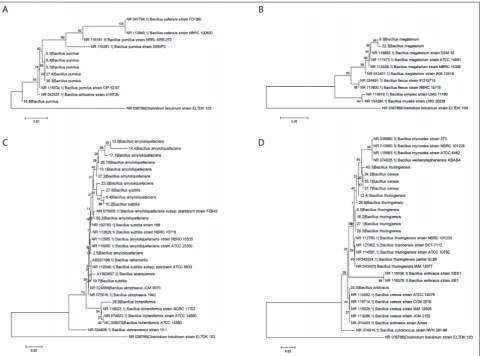
spp. isolates was extracted and the 5’ hypervariable region of 16S rRNA gene was amplified using 16S-HV primers. All isolates gave one distinct DNA band of appropriate length of about 275 bp. Purified amplified DNA was sequenced and after BLAST analysis den-drograms were constructed according to the analysis of the acquired sequences (Fig. 1). As an outliner, the sequence of the 16S rRNA gene of Clostridium
botu-linum ELTDK 103 was used. The BLAST database
search revealed eight species with the following distri-bution: six isolates clustered with Bacillus pumilus, two with Bacillus megaterium, three with B. subtilis, ten with B. amyloliquefaciens, one with B. licheniformis,
and three that were most similar to B. cereus, seven to
B. thuringiensis and one to B. anthracis. Based on the
analyzed sequences, four phylogenetic clusters were distinguished: B. pumilus (Fig. 1A), B. megaterium
(Fig. 1B), B. subtilis (Fig. 1C) and B. cereus (Fig. 1D). Most of the isolates were derived from the soil (60%) and they belong to all four identified phylogenetic groups and 7 identified species, except B. lichenifor-mis. Nine isolates from manure were scattered over the three phylogenetic groups, while only 4 isolates from hay were identified as B. pumilus, except one that was identified as B. amyloliquefaciens (Supplementary Table S1).
Determination and analysis of the antibiotic resistance
The results of testing the antibiotic susceptibility of
Bacillus isolates and reference strains to gentamycin
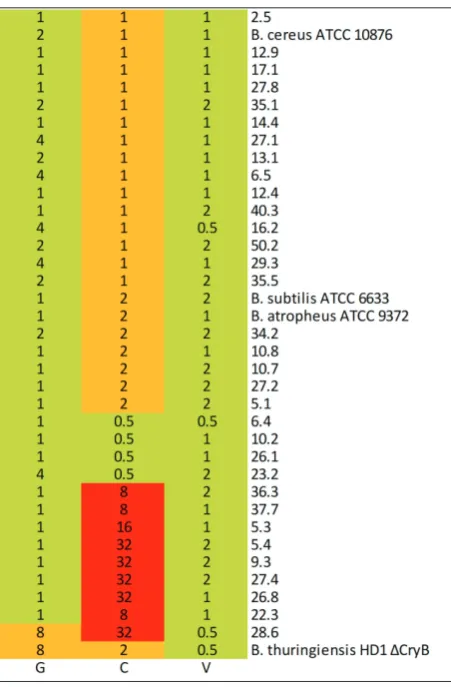
isolate and one reference strain were intermediary re-sistant to gentamycin. All strains tested were sensitive to vancomycin. Twenty isolates and 4 reference strains were intermediary resistant, while 9 were resistant to clindamycin. Based on the profile of resistance, the isolates were categorized into 4 groups (categories); these are Category 1: GSCSVS; Category 2: GSCIRVS;
Category 3: GSCRVS; Category 4: GIR CIR VS/GIR CR
VS. The distribution of categories is shown in Fig. 3.
In silico analysis of erm gene distribution
The analysis of sequence data from the existing BLAST database showed that the erm gene was
dis-tributed among Staphylococcus, Streptococcus and
Bacteroides genera. Fig. 4 presents the dendrogram
of resistance carriers of erm. As can be seen, a large group of ermG, ermC and ermT genes was spread across the species of Lactobacillus, Bacillus,
Staphy-lococcus, Streptococcus and Bacteroides. In addition,
ermD, ermK and ermJ genes represented in Bacillus
spp. branched out.
DISCUSSION
The collection of 33 isolates of Bacillus spp. was iden-tified based on the sequence of the 5’ hypervariable sections of the 16S rRNA gene. Using this approach,
Fig. 1. Phylogenetic relationships of Bacillus spp. isolates of A – B. pumilus; B – B. megaterium; C – B. subtilis;D – B. cereus phylogenetic groups based on the sequence of the 5’ HPV 16S rRNA region. The branching pattern, which is rooted by using Clostridium botulinum
as the outgroup, was generated by the neighbor-joining method, and the distances were calculated with the Kimura two-parameter model. Bootstrap values are given for each node as having 50% or greater support, with 1000 replicates. Bar=0.05 (except for B. cereus
a clear resolution was obtained for the B. pumilus
and B. megaterium phylogenetic groups. Within the
B. pumilus group, clustering of identified isolates with
related reference strains was apparent for all except isolate 10.8, although it was determined as B. pumi-lus. Additional characterization is needed to confirm this finding. In the B. megaterium group, isolates and reference strains clustered together, with a high per-centage of sequence identity, confirming the iden-tification of isolates 9.3 and 22.3 as B. megaterium.
All B. amyloliquefaciens isolates belonged in the B.
subtilis phylogenetic group; thus, to obtain a clear
dis-tinction between B. subtilis and B. amyloliquefaciens,
additional analysis is required. Also, the sole isolate identified as B. licheniformis was clustered with this large group. In the work of Draganić et al. [27], the
Bacillus isolates that belong to the same collection as
the ones used in this study were identified according to the sequence of the gene for elongation factor Tu (tuf gene), and very satisfactory results in dividing
B. subtilis,B. amyloliquefaciens and B. licheniformis
isolates were achieved. For the B. cereus group, iso-lates identified as B. cereus clustered amongst them-selves but not together with the reference strains. On the other hand, most of the isolates determined as
Fig. 3. Distribution of isolates categorized according to antibiotic resistance. Category 1: GSCSVS; Category 2: GSCIVS;Category 3:
GSCRVS;Category 4: GICIVS/GICRVS.
Fig. 2. Heat map with antibiotic susceptibility results of Bacillus
isolates and reference strains to gentamycin (G), clindamycin (C) and vancomycin (V). MIC values are presented. According to the CLSI M45-P standard, the tested isolates and strains were catego-rized as: – resistant, – intermediary resistant and – sensitive.
B. thuringiensis clustered closely with the reference strains and were separated from B. cereus strains. Only isolate 40.3, identified also as B. thuringiensis, clustered with the B. cereus group. According to its sequence, one isolate was singled out as B. anthracis, but, as can be seen, sequences of numerous B. cereus
strains from the BLAST database cluster together with it (Fig. 1D). Additional characterization is required to clarify this finding. Goto et al. [6] in their study of 5’ hypervariable 16S rRNA of 69 type strains of Bacillus
spp. showed that this sequence has very good resolu-tion power for most species; however, the B. cereus
group remained unresolved. Similarly, although the amplified ribosomal DNA restriction analysis (AR-DRA) assay developed by Wu et al. [28] was capable of differentiating B. subtilis and B. licheniformis strains from other species of the B. subtilis phylogenetic clus-ter, it could not differentiate two species within the B.
cereus cluster. The problem of reliable identification
of B. cereus, B. thuringiensis and B. anthracis is
on-going and still requires a proper solution. Since this phylogenetic group contains potentially pathogenic bacteria, it was of great interest for research into Bacil-lus spp. and many approaches were applied over the years, but a reliable method is still lacking [29-31]. A similar diversity of Bacillus spp. isolated from marine sediment as in our study was determined using a par-tial sequence of 16S rRNA combined with tDNA-PCR fingerprinting in species of B. subtilis, B. licheniformis,
B. cereus and B. pumilus [32] and in the research of
Amin et al. [33] a similar diversity was determined for isolates from soil, identified only by their phenotypic and biochemical characteristics. Correlation between the phylogenetic affiliation and the source of isolation
of Bacillus spp. in our research was not determined.
According to the Clinical and Laboratory Stan-dards Institute (CLSI), which prescribes primary sensitivity tests for relevant antibiotics, testing sen-sitivity to vancomycin, clindamycin and gentamycin for the first tier of screening for Bacillus species is advised [26]. Isolates belonging to category 1 (GSCSVS)
were a phylogenetically tight group of only B. subtilis
and B. amyloliquefaciens isolates. The isolate 28.6 (B.
thuringiensis) was the only one resistant to
clindamy-cin and gentamyclindamy-cin. The majority of isolates from our collection showed resistance or intermediary resis-tance only to clindamycin. Categories 2 (GSCIVS) and
3 (GSCRVS) were most abundant amongst the strains
tested for antibiotic susceptibility. An increased inci-dence of resistant and intermediary resistant strains of
Bacillus to clindamycin was reported earlier [34,35].
A similar strategy towards sensitivity analysis of
Ba-cillus soil isolates to antibiotics was applied by Aslim
et al. [36]. This type of approach enables a broader insight into the entrance of clinically relevant bacterial isolates into the food chain. Comparison of results of clindamycin resistance and phylogenetic affiliation of isolates showed an even distribution for category 2. All identified species, except B. megaterium and B.
licheniformis, were represented with an isolate with
intermediary resistance to clindamycin. On the other hand, category 3 (resistant to clindamycin) is com-prised of three out of the four identified B. pumilus
isolates, two B. megaterium isolates, one B. cereus, and a sole isolate of B. licheniformis. Most of the resistant and intermediary resistant isolates are not significant clinical pathogens. However, isolates 34.2 and 35.1, identified as B. cereus, and isolate 35.5, identified as
B. anthracis, showed intermediary resistance, while
isolate 37.7 (B. cereus) was resistant to clindamycin. Since these species are potential human and animal pathogens, the significance of clindamycin resistance is obvious. However, in the wider context, the resis-tance to clindamycin in any Bacillus spp. points out two important facts. First, in the ecological context, this resistance could play a role in complex inter- and intraspecies interactions in soil ecosystems [12]. In favor of this is the fact that over 80% of known antibi-otics were isolated from soil microorganisms. Experi-mental data show that antibiotics as active substances could play a role in the modulation of gene expression and interactions in and among bacterial populations [12,37-40]. Second, within the clinical context, detect-ed antibiotic resistance could be seen as a reservoir of resistance for clinically relevant pathogens [11-12,41]. Dworkin et al. [4] showed that conjugation between bacteria of the genus Bacillus and clinically relevant pathogens is possible. In addition, experimental data showed that transposons could be exchanged by con-jugation between Enterococcus faecalis and B. subtilis
[42], as well as between Clostridium difficile and B. subtilis [43].
these two species [44]. The erm genes (ermB, ermF,
ermG, ermC and ermD), carried on transposons and
plasmids, are responsible for resistance to clindamycin [45,46]. Cooper et al. [47] showed that Lysinibacillus
sphaericus and Bacteroides sp. can exchange
transpo-sons with erm genes, proving that antibiotic resistance determinants could be transferred from soil bacteria to gut bacteria [45,47]. A considerable contribution to the dissemination of resistance genes stems from manure application to agricultural fields [11].
The data acquired in silico by analyzing the ex-isting database points to a wide distribution of erm
genes in related and unrelated soil and human bac-teria. Throughout BLAST hits, erm genes and com-plete genomes of bacteria from genera Staphylococcus,
Streptococcus and Bacteroides could be distinguished.
All the elements responsible for antibiotic resistance were detected on plasmids or transposons that can be located on plasmids or chromosomes. As can be seen in Fig. 4, a large group of genes (ermD, ermK and
ermJ) was represented in Bacillus spp., indicating a possible horizontal transfer between these clindamy-cin resistance elements. This is in agreement with lit-erature data showing that the horizontal gene transfer of resistance genes is very common in soil ecosystems and between soil and other ecosystems [46]. In con-clusion, although our study of antibiotic resistance of
Bacillus spp. from different environments in Serbia is
of limited character, it indicates that the potential for the presence and spread of resistance determinants in the soil and similar ecosystems exists and should be monitored closely.
Acknowledgments: This work was supported by the Ministry of Education, Science and Technological Development, Republic of Serbia (Grant No. 173026).
Author contributions: All authors participated in the research and article preparation. T.B. and M.B. participated in the acqui-sition, analysis and interpretation of data and T.B. drafted the article. S.S., I.D, T.J. and Đ.F. participated in the analysis of data and manuscript revision. J.L. provided the concept and design of the study, participated in the acquisition of data and revision of the article. All authors have approved the submitted version of the article.
Conflict of interest disclosure: We declare that there is no actual and potential conflict of interest including any financial, personal or other relationships with other people or organizations that could inappropriately influence our work.
REFERENCES
1. Logan NA, De Vos P. Genus I. Bacillus Cohn 1872, 174AL. In: De Vos P, Garrity GM, Jones D, Krieg NR, Ludwig W, Rainey FA, Schleifer KH, Whitman WB, editors. Bergey’s Manual of Systematic Bacteriology. Vol. 3 The Firmicutes. 2nd ed. New York: Springer;2009. p.21-128.
2. Olsen GJ, Woese CR. Ribosomal RNA: a key to phylogeny. FASEB J. 1993;7:113-23.
3. Janda MJ, Abbott SL. 16S rRNA Gene Sequencing for Bacte-rial Identification in the Diagnostic Laboratory: Pluses, Perils, and Pitfalls. J Clin Microbiol. 2007;45(9):2761-4.
4. Dworkin M, Falkow S, Rosenberg E, Schleifer KH, Stacke-brandt E. The Prokaryotes. Vol. 3. Firmicutes. 3rd ed. New York: Springer-Verlag; 2006.
5. Te Giffel MC, Beumer RR, Klijn N, Wagendorp A, Rombouts FM. Discrimination between Bacillus cereus and Bacillus
thuringiensis using specific DNA probes based on variable
regions of 16S rRNA. FEMS Microbiol Lett. 1997;146:47-51. 6. Goto K, Omura T, Hara Y, Sadaie Y. Application of the par-tial 16S rDNA sequence as an index for rapid identifica-tion of species in the genus Bacillus. J Gen Appl Microbiol. 2000;46:1-8.
7. Cote CK, Welkos SL. Anthrax toxins in context of
Bacil-lus anthracis spores and spore germination. Toxins (Basel).
2015;7:3167-78.
8. Lacey LA, Grzywacz D, Shapiro-Ilan DI, Frutos R, Brown-bridge M, Goettel MS. Insect pathogens as biological control agents: Back to the future. J Invertebr Pathol. 2015;132:1-41.9. Logan NA. Bacillus and relatives in foodborne illness. J Appl Microbiol. 2012;112:417-29.
10. Bartelt-Hunt S, Snow DD, Damon-Powell T, Miesbach D. Occurrence of steroid hormones and antibiotics in shallow groundwater impacted by livestock waste control facilities. J Contam Hydrol. 2011;123:94-103.
11. Heuer H, Schmitt H, Smalla K. Antibiotic resistance gene spread due to manure application on agricultural fields. Curr Opin Microbiol. 2011;14:236-43.
12. D’Costa VM, Griffiths E, Wright GD. Expanding the soil antibiotic resistome: exploring environmental diversity. Curr Opin Microbiol. 2007;10:481-9.
13. Witte W. Ecological impact of antibiotic use in animals on different complex microflora: Environment. Int J Antimicrob Agents. 2000;14:321-5.
14. Benveniste R, Davies J. Aminoglycoside antibiotic-inacti-vating enzymes in actinomycetes similar to those present in clinical isolates of antibiotic-resistant bacteria. Proc Natl Acad Sci USA. 1973;70:2276-80.
15. Canton R. Antibiotic resistance genes from the environment: a perspective through newly identified antibiotic resistance mechanisms in the clinical setting. Clin Microbiol Infect. 2009;15(Suppl. 1):20-5.
16. Tenson T, Lovmar M, Ehrenberg, M. The mechanism of action of macrolides, lincosamides and streptogramin B reveals the nascent peptide exit path in the ribosome. J Mol Biol. 2003;330:1005-14.
18. Eitel Z, Sóki J, Urbán E, Nagy E. The prevalence of antibiotic resistance genes in Bacteroides fragilis group strains isolated in different European countries. Anaerobe. 2013;21:43-9. 19. Brisson-Noël A, Courvalin P. Nucleotide sequence of gene
linA encoding resistance to lincosamides in Staphylococcus
haemolyticus. Gene (Amst.). 1986;43(3):247-53.
20. Dimkić I, Živković S, Berić T, Ivanović Ž, Gavrilović V, Stanković S, Fira Đ. Characterization and evaluation of two
Bacillus strains, SS-12.6 and SS-13.1, as potential agents for
the control of phytopathogenic bacteria and fungi. Biol Con-trol. 2013;65(3):312-21.
21. Thompson JD, Higgins DG, Gibson TJ. CLUSTAL W: improv-ing the sensitivity of progressive multiple sequence alignment through sequence weighting, position-specific gap penalties and weight matrix choice. Nucleic Acids Res. 1994;22:4673-80. 22. Hall TA. BioEdit: a user-friendly biological sequence align-ment editor and analysis program for Windows 95/98/NT. Nucl Acids Symp Ser. 1999;41:95-8.
23. Morgulis A, Coulouris G, Raytselis Y, Madden TL, Agar-wala R, Schäffer AA. Database indexing for production MegaBLAST searches. Bioinformatics. 2008:24;1757-64. 24. Altschul S, Gish W, Miller W. Basic Local Alignment Search
Tool. J Mol Biol. 1990:215;403-10.
25. Tamura K, Stecher G, Peterson D, Filipski A, Kumar S. MEGA6: Molecular evolutionary genetics analysis version 6.0. Mol Biol Evol. 2013;30:2725-9.
26. CLSI. Methods for Antimicrobial Dilution and Disk Suscep-tibility Testing of Infrequently Isolated or Fastidious Bacte-ria: Proposed Guideline. CLSI document M45-P. Wayne, PA: Clinical and Laboratory Standards Institute; 2006.
27. Draganić V, Lozo J, Biočanin M, Dimkić I, Garalejić E, Fira Đ, Stanković S, Berić T. Genotyping of Bacillus spp. isolate collection from natural samples. Genetika. 2017;49(2):445-56. 28. Wu XY, Walker MJ, Hornitzky M, Chin J. Development of a
group-specific PCR combined with ARDRA for the identi-fication of Bacillus species of environmental significance. J Microbiol Methods. 2006;64:107-19.
29. Helgason E, Økstad OA, Caugant DA, Johansen HA, Fouet A, Mock M, Hegna I, Kolstø AB. Bacillus anthracis, Bacillus cereus, and Bacillus thuringiensis - one species on the basis of genetic evidence. Appl Environ Microbiol. 2000:66;2627-30. 30. La Duc MT, Satomi M, Agata N, Venkateswaram K. gyrB as
a phylogenetic discrimination for members of the Bacillus
anthracis-cereus-thuringiensis group. J Microbial Methods.
2004:56;383-94.
31. Ogawa H, Fujikura D, Ohnuma M, Ohnishi N, Hang’ombe BM, Mimuro H, Ezaki T, Mweene AS, Higashi H. A Novel Multiplex PCR Discriminates Bacillus anthracis and Its Genetically Related Strains from Other Bacillus cereus Group Species. PLoS One. 2015;10(3):e0122004. 32. Miranda CA, Martins OB, Clementino MM. Species-level identification of
Bacillus strains isolates from marine sediments by
conven-tional biochemical, 16S rRNA gene sequencing and
inter-tRNA gene sequence lengths analysis. Antonie Van Leeuwen-hoek. 2008;93:297-304.
33. Amin M, Rakhisi Z, Ahmady AZ. Isolation and identification of Bacillus Species from soil and evaluation of their antibacte-rial properties. Avicenna J Clin Microb Infec. 2015;2:e23233. 34. Chaves JQ, Pires ES, Vivoni AM. Genetic diversity, antimicro-bial resistance and toxigenic profiles of Bacillus cereus isolated from food in Brazil over three decades. Int J Food Microbiol. 2011;147:12-6.
35. Gigantelli JW, Torres Gomez J, Osato MS. In vitro susceptibili-ties of ocular Bacillus cereus isolates to clindamycin, genta-micin, and vancomycin alone or in combination. Antimicrob Agents Chemother. 1991;35:201-2.
36. Aslim B, Saglam N, Beyatli Y. Determination of Some Proper-ties of Bacillus Isolated from Soil. Turk J Biol. 2002;26:41-8. 37. Martínez JL. Antibiotics and antibiotic resistance genes in
natural environments. Science. 2008;321:365-7.
38. Yim G, Wang HH, Davies J. Antibiotics as signalling mole-cules. Philos Trans R Soc Lond B Biol Sci. 2007;362:1195-200. 39. Wright GD. The antibiotic resistome: the nexus of chemical
and genetic diversity. Nat Rev Microbiol. 2007;5:175-86. 40. Goh EB, Yim G, Tsui W, McClure J, Surette MG, Davies J.
Transcriptional modulation of bacterial gene expression by subinhibitory concentrations of antibiotics. Proc Natl Acad Sci USA. 2002;99:17025-30.
41. Riesenfeld CS, Goodman RM, Handelsman J. Uncultured soil bacteria are a reservoir of new antibiotic resistance genes. Environ Microbiol. 2004;6:981-9.
42. Christie PJ, Korman RZ, Zahler SA, Adsit JC, Dunny GM. Two conjugation systems associated with Streptococcus faeca-lis plasmid pCF10: Identification of a conjugative transposon that transfers between S. faecalis and Bacillus subtilis. J Bacte-riol. 1987;169:2529-36.
43. Mullany P, Wilks M, Lamb I, Clayton C, Wren B, Tabaqchali S. Genetic analysis of a tetracycline resistance element from
Clostridium difficile and its conjugal transfer to and from
Bacillus subtilis. J Gen Microbiol. 1990;136:1343-9.
44. Hächler H, Berger-Bachi B, Kayser FH. Genetic Character-ization of a Clostridium difficile Erythromycin- Clindamycin Resistance Determinant That Is Transferable to
Staphylococ-cus aureus. Microbiology. 1987;31:1039-45.
45. Eitel Z, Sóki J, Urbán E, Nagy E. The prevalence of antibiotic resistance genes in Bacteroides fragilis group strains isolated in different European countries. Anaerobe. 2013;21:43-9. 46. Nwosu VC. Antibiotic resistance with particular reference to
soil microorganisms. Res Microbiol. 2001;152:421-30. 47. Cooper AJ, Shoemaker NB, Salyers AA. The erythromycin
resistance gene from the Bacteroides conjugal transposon Tcr Emr 7853 is nearly identical to ermG from Bacillus sphaeri-cus. Antimicrob Agents Chemother. 1996;40(2):506-8.
Supplementary Table S1