ARTIGO ORIGINAL
RESUMO
Introdução: O abandono de doentes do serviço de urgência pediátrico antes da observação médica constitui um problema multifatorial. Procurámos comparar características sociodemográficas de crianças que abandonaram a urgência e das que não abandonaram, assim como avaliar os motivos, recurso subsequente a cuidados de saúde e outcome clínico.
Material e Métodos: Estudo caso-controlo prospetivo de amostra aleatória de crianças que abandonaram a urgência e de controlos pareados durante um período de três meses. Foi realizado um questionário telefónico para recolha de informação relacionada com os motivos para o abandono, outcomes clínicos e opiniões gerais.
Resultados: Durante o período do estudo, 18 200 doentes recorreram ao Serviço de Urgência Pediátrica, dos quais 92 (0,5%) abandonaram. Um total de 55 casos (59,8%) e 82 controlos completaram o questionário. As razões mais comuns para o abandono foram ‘tempo de espera excessivo’ (92,7%) e ‘problema podia esperar’ (21,8%). Um número significativamente superior de doentes que abandonaram recorreu subsequentemente a cuidados de saúde (78,2% vs 11%), não tendo contudo apresentado uma incidência superior de outcomes adversos.
Discussão: O tempo de espera parece ser o fator prioritário que motiva a decisão de abandonar a urgência. A segurança referida pelos pais aquando da decisão e a incidência reduzida de outcomes adversos parecem reforçar a noção de que se trata de doentes com casos clínicos de baixa gravidade.
Conclusão: A redução do tempo de espera parece ser a medida estratégica lógica para diminuir as taxas de abandono. No entanto, a preocupação associada ao outcome clínico após o abandono poderá ser parcialmente injustificada.
Palavras-chave: Aceitação pelo Doente de Cuidados de Saúde; Avaliação de Resultados (Cuidados de Saúde); Criança; Listas de Espera; Portugal; Saídas de Doentes; Serviço de Urgência Hospitalar
Children Who Leave the Emergency Department Without
Being Seen: Why Did They Leave and What Would Make
Them Stay?
Abandono do Serviço de Urgência Pediátrico Antes da
Observação Médica: Quais os Motivos e o Que o Teria
Impedido?
1. Departamento de Pediatria. Hospital Beatriz Ângelo. Loures. Portugal.
2. Departamento de Pediatria. Hospital São Francisco Xavier. Centro Hospitalar Lisboa Ocidental. Lisboa. Portugal. 3. Departamento de Pediatria. Hospital Dona Estefânia. Centro Hospitalar Lisboa Central. Lisboa. Portugal. Autor correspondente: Rodrigo Sousa. [email protected]
Recebido: 21 de novembro de 2017 - Aceite: 26 de janeiro de 2018 | Copyright © Ordem dos Médicos 2018
Rodrigo SOUSA1, Cátia CORREIA1,2, Rita VALSASSINA1, Sofia MOEDA1, Teresa PAINHO1,3, Paulo OOM1
Acta Med Port 2018 Feb;31(2):109-114 ▪ https://doi.org/10.20344/amp.9962 ABSTRACT
Introduction: Children who visit emergency departments and leave without being seen represent a multifactorial problem. We aimed to compare the sociodemographic characteristics of children who left and of those who did not leave, as well as to evaluate parental reasoning, subsequent use of medical care and patient outcome.
Material and Methods: This was a prospective case-control study of a random sample of children who left without being seen and their matched controls from an emergency department during a three-month period. We performed a phone questionnaire to obtain information concerning reasons for leaving, patient outcomes and general feedback.
Results: During the study period, 18 200 patients presented to the emergency department, of whom 92 (0.5%) left without being seen. Fifty-five (59.8%) completed the questionnaire and there were 82 controls. The most common reasons for leaving were ‘excessive waiting time’ (92.7%) and ‘problem could wait’ (21.8%). A significantly higher number of patients who left sought further medical care (78.2% vs 11%) but they did not experience higher levels of unfavourable outcomes.
Discussion: The waiting time seems to be the major factor that drives the decision to leave. The fact that parents felt safe in leaving and the low level of adverse outcomes highlights the low-acuity nature of the majority of patients who leave.
Conclusion: Reducing the waiting times may be the logical strategic mean to decrease the rates of patients who leave without being seen. However, our data seems to indicate that the concerns surrounding clinical outcome after leaving may be partly unwarranted.
Keywords: Child; Emergency Service, Hospital; Outcome Assessment (Health Care); Patient Acceptance of Health Care; Patient Dropouts; Portugal; Waiting Lists
INTRODUCTION
Patients who leave without being seen (LWBS) are a common reality in emergency departments (EDs) in many
countries.1–11 In the paediatric setting, the reported rates are
lower than in adult EDs, ranging from 0.5% to 7.6%.1,12–19
It is a multifactorial problem that is, at its core, related to an imbalance between ED crowding and available
resources.20,21
LWBS rates are globally considered to be direct quality of
care indicators,3,25,28–30 especially in paediatric services,31,32
representing concerns for health care providers and
policymakers.3 Although some studies have indicated that
ARTIGO ORIGINAL others have highlighted the potential risk of adverse outcomes, including the deterioration of patients’ condition
secondary to the delayed diagnosis or treatment.11,14 In
addition, a significant proportion of these patients end up
seeking medical care on the following days,1,9,11,14,15 which
increases ED overcrowding and constitutes a misuse of
available resources with the inherent financial costs.8
Previous studies have analysed how different factors (including demographic, temporal and care related features)
influence the incidence of LWBS.1,9,12–15,17,22–25 For the most
part, prolonged waiting time seems to play a major role.12–
14,17,18,23,25 In a previous study by our group, we demonstrated
that, after adjusting for the waiting time, the lower triage category and admission between 4 pm and midnight were
associated with a higher risk of LWBS.18 However, only few
studies have analysed parental reasons for leaving14,17,23,25,26
and subsequent outcome.9,14,15,23–25,27
In this study, we aimed to compare the sociodemographic characteristics of children who LWBS and of those who did not leave. Moreover, we intended to evaluate parental reasoning for leaving, subsequent use of medical care and patient outcome.
MATERIAL AND METHODS Study design and setting
This was a prospective case-control study using a phone follow-up among a random sample of children who LWBS and their matched controls from a paediatric ED. The study was conducted between 1 October and 31 December 2015 at the paediatric ED at Hospital Beatriz Angelo, in Loures, Portugal, with a catchment population of about 60 000 children and adolescents. Acute presentations to the paediatric ED numbered 55 000 in the 2015 calendar year with 18 200 (33.1%) of those occurring during the study period. The study site ED operates on a 24/7 basis.
Selection of participants
Eligible participants were all patients younger than 18 years of age triaged in the paediatric ED. On arrival, patients in the ED are triaged by a dedicated nurse using the
Manchester triage system.33 After that, patients are called
to be evaluated by a physician. The study population was grouped into those who LWBS after being registered and triaged and those who were seen by a physician (control group). The children in the control group were identified by selecting the first two following patients with the same triage acuity score (ratio of 1:2).
Interventions
Identified patients were reached by telephone by one of the research physicians in the first two weeks following the ED visit. Three telephone calls were performed for each potential participant at different times of the day and on different days. If no answer was obtained after three calls, the patient was excluded. After obtaining verbal informed consent from the parent, the research assistant performed a standardized phone questionnaire to obtain additional
information concerning the reasons for LWBS, patient outcomes and general feedback. The study was approved by the hospital ethics committee.
Measurements
We gathered information regarding patient demo-graphics (age and gender) and their ED visits (distance to ED) through a review of their electronic medical records. Additional information was obtained through the telephone questionnaire, including: employment status, routine healthcare access (primary physician and private healthcare insurance), travel to ED (travel time and means of transportation), reasons for leaving before being seen, patient follow-up (clinical evolution, subsequent health care visits, need for blood tests, radiographs, intravenous or intramuscular medication, fracture reduction, bone casting, surgical intervention, hospitalisation), expectations regarding ED (appropriate waiting time) and suggestions
to improve the quality of care. We used Gravel et al
definition of unfavourable event as hospitalisation, the need for an invasive procedure (intravenous or intramuscular medication, fracture reduction, bone casting, or surgical intervention), suicide attempt, or death in the 72 hours
following leaving without having been seen by a physician.21
Primary data analysis
Socio-demographic characteristics, routine health care access, travel to ED, reasons for LWBS, follow-up and general feedback data was analysed using descriptive statistics (mean and standard deviation for continuous variables, frequencies and percentages for categorical variables). Significant associations were evaluated by
applying chi-squared test, Fisher’s exact test, t-test or Mann
Whitney test when appropriate. Data were analysed using SPSS (version 20.0; SPSS Inc., Chicago, IL). Significance
for all the results was defined as p < 0.05.
RESULTS
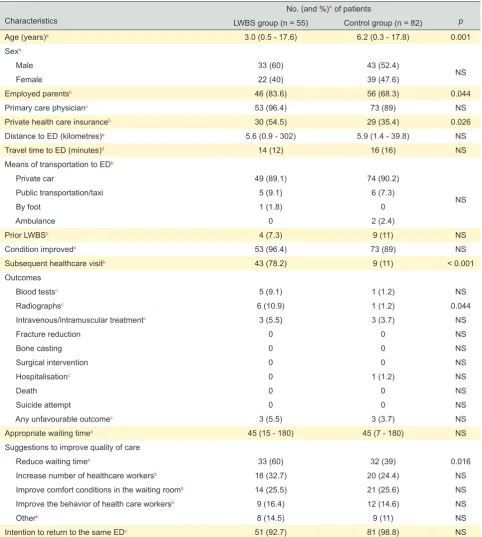
During the study period, 18 200 patients presented to the ED, of whom 92 (0.5%) LWBS. The study group consisted of the families of 55 (59.8%) of these patients that completed the standardised phone questionnaire. The remaining 37 (40.2%) were excluded because of an incorrect phone number (four cases) or because their families could not be reached by phone (29 cases) or refused to complete the questionnaire (four cases). The control group consisted of 82 children. The characteristics of the two groups and the main results are given in Table 1.
As far as socio-demographic characteristics are concerned, gender distribution was similar in both groups but the patients who LWBS were significantly younger
(median of three years versus 6.2 in the control group).
In addition, the percentage of employed parents was
significantly higher in the study group (83.6% vs 68.3%).
ARTIGO ORIGINAL
difference among them. However, a significant higher proportion of patients who LWBS had private health
insurance (54.5% vs 35.4%).
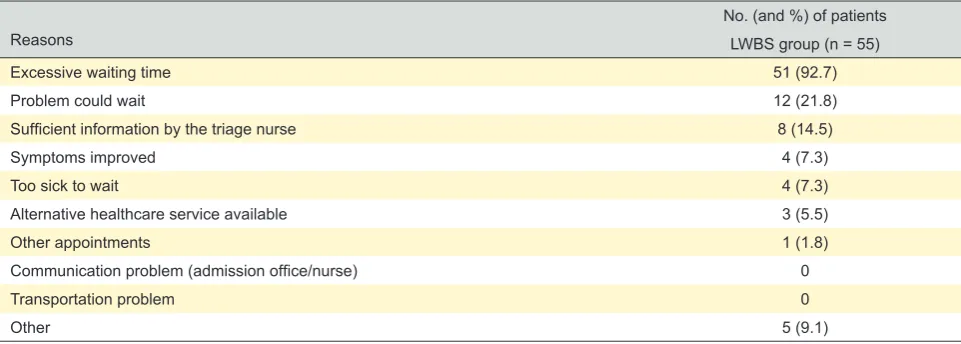
There were no significant differences between both groups on what travel to ED is concerned, as distance, travel time and means of transportation were similar. When asked about the reasons for leaving the ED before being seen (Table 2), the more common answers reported
by parents from the study group were ‘excessive waiting time’ (92.7%), ‘problem could wait’ (21.8%) and ‘sufficient information provided by the triage nurse’ (14.5%). Only a small percentage of parents from both groups admitted to having left before being seen in a previous ED visit (7.3%
in the study group versus 11% in the control group), with no
significant difference among them.
As regards patient follow-up, the patient’s condition Table 1 - Patient’s characteristics, follow-up, expectations and suggestions to improve the quality of care
Characteristics
No. (and %)* of patients
p
LWBS group (n = 55) Control group (n = 82)
Age (years)a 3.0 (0.5 - 17.6) 6.2 (0.3 - 17.8) 0.001
Sexb
Male 33 (60) 43 (52.4)
NS
Female 22 (40) 39 (47.6)
Employed parentsb 46 (83.6) 56 (68.3) 0.044
Primary care physicianc 53 (96.4) 73 (89) NS
Private health care insuranceb 30 (54.5) 29 (35.4) 0.026
Distance to ED (kilometres)a 5.6 (0.9 - 302) 5.9 (1.4 - 39.8) NS
Travel time to ED (minutes)d 14 (12) 16 (16) NS
Means of transportation to EDb
Private car 49 (89.1) 74 (90.2)
NS
Public transportation/taxi 5 (9.1) 6 (7.3)
By foot 1 (1.8) 0
Ambulance 0 2 (2.4)
Prior LWBSb 4 (7.3) 9 (11) NS
Condition improvedb 53 (96.4) 73 (89) NS
Subsequent healthcare visitb 43 (78.2) 9 (11) < 0.001
Outcomes
Blood testsc 5 (9.1) 1 (1.2) NS
Radiographsc 6 (10.9) 1 (1.2) 0.044
Intravenous/intramuscular treatmentc 3 (5.5) 3 (3.7) NS
Fracture reduction 0 0 NS
Bone casting 0 0 NS
Surgical intervention 0 0 NS
Hospitalisationc 0 1 (1.2) NS
Death 0 0 NS
Suicide attempt 0 0 NS
Any unfavourable outcomec 3 (5.5) 3 (3.7) NS
Appropriate waiting timeb 45 (15 - 180) 45 (7 - 180) NS
Suggestions to improve quality of care
Reduce waiting timeb 33 (60) 32 (39) 0.016
Increase number of healthcare workersb 18 (32.7) 20 (24.4) NS
Improve comfort conditions in the waiting roomb 14 (25.5) 21 (25.6) NS
Improve the behavior of health care workersb 9 (16.4) 12 (14.6) NS
Otherb 8 (14.5) 9 (11) NS
Intention to return to the same EDc 51 (92.7) 81 (98.8) NS
LWBS: left without being seen; NS: not significant; ED: emergency department. * Unless where otherwise noted. a Presented as median (range), statistical analysis using the
Mann-Whitney test. b Presented as percentage, statistical analysis using Pearson’s chi-squared test. c Presented as percentage, statistical analysis using Fisher’s exact test. dPresented as
ARTIGO ORIGINAL
improved in the majority of the patients from both groups (96.4% in the study group, 89% in the control group), with no significant difference among them. A significantly higher number of patients in the LWBS group sought further
medical care on the following two weeks (78.2% vs 11%).
On subsequent health care visits, significantly more patients
from the LWBS group required radiographs (10.9% vs
1.2%). No significant difference was documented regarding the need for blood tests, intravenous or intramuscular medication, fracture reduction, bone casting or surgical intervention. There were no deaths or suicide attempts. Only one patient from the control group required hospitalisation. As a whole, there were no significant differences regarding the occurrence of an unfavourable outcome between the LWBS and the controls.
Parents from both groups had similar responses for what would be an appropriate waiting time for an ED visit (median of 45 minutes for both groups). When asked for suggestions to improve the quality of care in the ED, ‘reduce waiting time’ was the most common reply by parents from both groups, with a significantly higher proportion in the group that LWBS (60% in the study group and 39% in the control group). The secondary measures were ‘increase the number of healthcare workers’ at the ED (32.7% in the study group and 24.4% in the control group) and ‘improve comfort conditions in the waiting room’ (25.5% in the study group and 25.6% in the control group). A majority of parents from both groups replied that they would consider returning to the same ED in the future (92.7% in the study group and 98.8% in the control group).
DISCUSSION
We present a prospective study involving a telephone questionnaire conducted with families who LWBS after attending a paediatric ED, as well as their matched controls. By selecting controls that arrived at the same time at the ED and that were assigned the same triage acuity index, we intended to minimise the effect of waiting time and clinical severity in the decision to leave before medical observation, in order to draw more focus onto other possible factors.
We observed an LWBS rate of 0.5% over the three-month study period, which is lower than what is documented in the
literature1,12–17,19 and approximately the same of a previous
study by our group in the same ED. Furthermore, this value falls well below what is recommended by the Board of
Emergency Medicine (< 5%) to avoid adverse events.34
Patients who LWBS were significantly younger than the
ones who waited, as demonstrated by other studies.9,12,17,27
We found that parents who LWBS were more likely to be employed than those in the control group. To our knowledge, this factor has not been previously analysed in a paediatric
setting. Ding et al found no influence of employment status
on the decision to LWBS on an adult setting.35
On what the effect of private health insurance is concerned, we have found that parents who LWBS were more likely to have private health insurance. This might indicate that parents who decided to leave before medical observation might have done so, in part, due to easy access to an alternative health care provider. This finding was
previously documented by Ng,17 but other studies in both
pediatric12 and adult8,36 settings have found contrary results.
However, caution must be taken while interpreting these data, as the majority of these studies were conducted in countries where single-payer universal health care access is not available, unlike Portugal.
When asked about the reasoning behind the decision to LWBS, parents from the study group cited ‘excessive waiting time’, as has been extensively documented in
various studies.12,13,15,17,23,25 Furthermore, ‘problem could
wait’ was the second most common answer, which is a finding already found in a study with adults, despite in a
lower percentage.37 Likewise, ‘sufficient information by the
triage nurse’ was the third more common answer given by parents. This reinforces the idea that many of the patients who LWBS did in fact present with non-urgent illness and that their parents were adequately satisfied with the basic health information, deciding that it was not worth it to wait to be seen by a physician.
Regarding patients’ follow-up after the ED visit, the great majority of parents from both groups reported an Table 2 - Reasons for leaving the ED
Reasons
No. (and %) of patients LWBS group (n = 55)
Excessive waiting time 51 (92.7)
Problem could wait 12 (21.8)
Sufficient information by the triage nurse 8 (14.5)
Symptoms improved 4 (7.3)
Too sick to wait 4 (7.3)
Alternative healthcare service available 3 (5.5)
Other appointments 1 (1.8)
Communication problem (admission office/nurse) 0
Transportation problem 0
Other 5 (9.1)
ARTIGO ORIGINAL
improvement of the patients’ condition, as previously
demonstrated by the literature.21 In our sample, patients
who LWBS sought further medical care significantly more
than controls (78.2% vs 11%).1,13,15,17,21 This value is higher
than the one reported in previous studies (13% - 67%). However, this variability might be due to different temporal definitions of ‘follow-up period’ adopted by each study. With the exception of the fact that patients from the LWBS group required significantly more radiographs upon subsequent health care visits, there was no significant difference among the groups on what concerns the need for other ancillary diagnostic methods, invasive procedures, hospitalisation or surgery. Despite being relatively low, the rate of unfavourable outcomes in our sample was slightly higher
than the one reported by Gravel et al21 (5.5% vs 2.4%).
Even though the definition varies in the literature, this lack of adverse outcomes had been previously highlighted by
other authors.1,11,13–15,17 In other words, when comparing both
groups, we documented that, despite the fact that patients who LWBS sought subsequent care to a higher degree, they did not experience more unfavourable outcomes. This further emphasises the notion that many of those who LWBS are in fact patients with non-serious conditions, as
documented by other studies.9,11
When asked what would be an appropriate waiting time for an ED visit, parents from both LWBS and control groups responded similar values (median of 45 minutes). This value is lower than the one reported by an adult group in a previous
study (60 minutes).26 This finding indicates that parents from
both groups seemed to have similar expectations regarding the waiting time. Nonetheless, when asked for suggestions on how to improve the quality of care, the only difference between the groups is that a significantly higher proportion of parents who LWBS considered the reduction of waiting times to be a priority. Despite the different experiences of the ED visit, it is important to highlight that parents from both groups seemed to have a positive attitude about it, as they would equally consider returning to the same ED in the future.
Some limitations pertain to our study. First, as only a three-month period was considered, some potential seasonal variability in LWBS rates might not have been reflected by the data. The study was conducted in a single centre from a country with a single-payer, universal coverage health system. For this reason, our results are not generalizable to other EDs with different demographics, staffing and practices, as well as to diverse health systems. A different limitation of this study is the possibility of non-response bias, since we were unable to contact 40.2% of patients who LWBS. However, after secondary analysis, these patients had similar age, gender and triage acuity score compared with the final sample. In addition, our
response rate was higher than the one reported by similar
studies.11,24–26
Finally, the format of the telephone survey constitutes another possible limitation, as responses might have been different through anonymous feedback. Furthermore, the time passed between the ED visit and the telephone survey introduces the potential for recall bias.
CONCLUSION
In summary, the waiting time seems to be a ubiquitous factor that drives the decision to leave the ED before medical observation. Previous studies have broadly demonstrated that the waiting time plays an objective role in the decision to leave the ED prior to medical observation. Furthermore, we have documented that it also plays a subjective part (it is mentioned as the main reason for LWBS) and is seen as a possible solution (its reduction is cited as the number one priority to improve medical care). For these reasons, reducing the waiting time may be a strategic method to improve LWBS rates and policymakers must implement wide-ranging measures that include reinforcing ED staffing and promoting a more rational use of ED use.
Parents from our study group felt generally safe in leaving the ED, as indicated by their satisfaction with the information given by the triage nurse and their decision that symptoms could wait. The lack of unfavourable outcomes at follow-up further reinforces the idea that many of these patients presented to the ED with low-acuity conditions. The role of LWBS rates as a quality of care indicator seems to lack clinical significance and the concern surrounding it might be partially unwarranted.
PROTECTION OF HUMANS AND ANIMALS
The authors declare that the study was approved by the hospital ethics committee and that in accordance to the regulations established by the Clinical Research and Ethics Committee and to the Helsinki Declaration of the World Medical Association.
DATA CONFIDENTIALITY
The authors declare having followed the protocols in use at their working center regarding patients’ data publication. Verbal informed consent was obtained from the parents.
CONFLICTS OF INTEREST
All authors report no conflict of interest.
FUNDING SOURCES
This research received no specific grant from any funding agency in the public, commercial, or not-for-profit sectors.
REFERENCES
1. Sparrow N, Pestell T, Clancy M. Children who leave the emergency department without being seen: a retrospective case note review. Emerg Med J. 2015;32:712–5.
ARTIGO ORIGINAL
3. Melton N, Mitchell M, Crilly J, Cooke M. Patient characteristics and institutional factors associated with those who ‘did not wait’ at a South East Queensland Emergency Department: who are those who ‘did not wait’ in ED? Australas Emerg Nurs J. 2014;17:11–8.
4. van der Linden MC, Lindeboom R, van der Linden N, van den Brand CL, Lam RC, Lucas C, et al. Walkouts from the emergency department: characteristics, reasons and medical care needs. Eur J Emerg Med. 2014;21:354–9.
5. Machado V, Peças S, Periquito I, Mota A, Veiga E, Balseiro M de J. Children who leave the emergency department: missing ppportunities? Acta Med Port. 2014;27:568–75.
6. Fayyaz J, Khursheed M, Mir MU, Mehmood A. Missing the boat: odds for the patients who leave ED without being seen. BMC Emerg Med. 2013;13:1.
7. Parekh KP, Russ S, Amsalem DA, Rambaran N, Wright SW. Who leaves the emergency department without being seen? A public hospital experience in Georgetown, Guyana. BMC Emerg Med. 2013;13: 0. 8. Clarey AJ, Cooke MW. Patients who leave emergency departments
without being seen: literature review and English data analysis. Emerg Med J. 2012;29:617–21.
9. Tothy AS, Staley S, Dean EK, Johnson S, Johnson D. Pediatric left-without-being-seen patients: what happens to them after they leave the pediatric emergency department? Pediatr Emerg Care. 2013;29:1194– 6.
10. Cross KP, Cammack VH, Calhoun AW, Gracely EJ, Kim IK, Stevenson MD, et al. Premature departure from the pediatric emergency department: a cohort analysis of process- and patient-related factors. Pediatr Emerg Care. 2010;26:349–56.
11. Kronfol RN, Childers K, Caviness AC. Patients who leave our emergency department without being seen: the Texas Children’s Hospital experience. Pediatr Emerg Care. 2006;22:550–4.
12. Bourgeois FT, Shannon MW, Stack AM. ‘Left without being seen’: a national profile of children who leave the emergency department before evaluation. Ann Emerg Med. 2008;52:599–605.
13. Browne G, McCaskill M, Giles H, Lam L, Fasher B, Exley B. Paediatric walk-out patients: characteristics and outcomes. J Paediatr Child Health. 2001;37:235–9.
14. dos Santos LM, Stewart G, Rosenberg NM. Pediatric emergency department walk-outs. Pediatr Emerg Care. 1994;10:76–8.
15. Goldman RD, Macpherson A, Schuh S, Mulligan C, Pirie J. Patients who leave the pediatric emergency department without being seen: A case-control study. CMAJ. 2005;172:39–43.
16. Hanson R, Clifton-Smith B, Fasher B. Patient dissatisfaction in a paediatric accident and emergency department. J Qual Clin Pract. 1994;14:137–43.
17. Ng Y, Lewena S. Leaving the paediatric emergency department without being seen: understanding the patient and the risks. J Paediatr Child Health. 2012;48:10–5.
18. Sousa R, Escária A, Mota M, Costa Lima S, Oom P. Que fatores levam ao abandono de crianças do serviço de urgência antes da observação médica? Acta Pediatr Port. 2016;47:301–7.
19. Oliveira A, Pires Guerra M, Cunha FI, Peralta L, Almeida S, Bicho A. Serviço de urgência pediátrico: casuística de um hospital com serviço de pediatria geral. Saúde Infant. 2010;32:53–8.
20. Holleman-Duray D, Kaupie D, Weiss MG. Heated humidified high-flow nasal cannula: use and a neonatal early extubation protocol. J Perinatol. 2007;27:776–81.
21. Gravel J, Gouin S, Carrière B, Gaucher N, Bailey B. Unfavourable outcome for children leaving the emergency department without being seen by a physician. CJEM. 2013;15:1–11.
22. Kim BB, Delbridge TR, Kendrick DB. Improving process quality for pediatric emergency department. Int J Health Care Qual Assur. 2014;27:336–46.
23. Mohsin M, Forero R, Ieraci S, Bauman AE, Young L, Santiano N. A population follow-up study of patients who left an emergency department without being seen by a medical officer. Emerg Med J. 2007;24:175–9. 24. Crilly J, Bost N, Gleeson H, Timms J. Patients who presented to an
Australian emergency department and did not wait or left against medical advice: a prospective cohort follow-up study. Adv Emerg Nurs J. 2012;34:357–68.
25. Rowe BH, Channan P, Bullard M, Blitz S, Saunders LD, Rosychuk RJ, et al. Characteristics of patients who leave emergency departments without being seen. Acad Emerg Med. 2006;13:848–52.
26. Arendt KW, Sadosty AT, Weaver AL, Brent CR, Boie ET. The left-without-being-seen patients: what would keep them from leaving? Ann Emerg Med. 2003;42:317–23.
27. Gaucher N, Bailey B, Gravel J. Who are the children leaving the emergency department without being seen by a physician? Acad Emerg Med. 2011;18:152–7.
28. Goodacre S, Webster A. Who waits longest in the emergency department and who leaves without being seen? Emerg Med J. 2005;22:93–6. 29. Tropea J, Sundararajan V, Gorelik A, Kennedy M, Cameron P, Brand
CA. Patients who leave without being seen in emergency departments: an analysis of predictive factors and outcomes. Acad Emerg Med. 2012;19:439–47.
30. Polevoi SK, Quinn JV, Kramer NR. Factors associated with patients who leave without being seen. Acad Emerg Med. 2005;12:232–6.
31. Hung GR, Chalut D. A consensus-established set of important indicators of pediatric emergency department performance. Pediatr Emerg Care. 2008;24:9–15.
32. Alessandrini E, Varadarajan K, Alpern ER, Gorelick MH, Shaw K, Ruddy RM, et al. Emergency department quality: an analysis of existing pediatric measures. Acad Emerg Med. 2011;18:519–26.
33. Mackway-Jones K, Marsden J, Windle J. Emergency triage. London: BMJ Publishing Group; 2005.
34. The College of Emergency Medicine. Emergency department clinical quality indicators — A CEM guide to implementation, 2011 [accessed 2017 Oct 3] Available from: https://secure.rcem.ac.uk/code/document. asp?ID=5832.
35. Ding R, McCarthy ML, Li G, Kirsch TD, Jung JJ, Kelen GD. Patients who leave without being seen: their characteristics and history of emergency department use. Ann Emerg Med. 2006;48:686–93.
36. Hsia RY, Asch SM, Weiss RE, Zingmond D, Liang LJ, Han W, et al. Hospital determinants of emergency department left without being seen rates. Ann Emerg Med. 2011;58:24–32.e3.