ISSN-L: 2501 - 1235 Available on-line at: www.oapub.org/edu
doi: 10.5281/zenodo.2667372 Volume 5 │ Issue 8 │ 2019
THE EXAMINATION OF ENGAGEMENT LEVELS OF UNIVERSITY
STUDENTS STUDYING AT THE FACULTY OF SPORTS SCIENCES
Çisem Demirdöken1,
Salih Tutku Yaylacı2,
Gül Yağar3i,
Gamze Deryahanoğlu4,
Elif Aybike Ünlü5
1,3Hitit University,
Faculty of Sports Sciences, Turkey
2,5Hitit University,
Graduate School of Health Sciences, Turkey
4Hitit University,
Bayat Vocational School, Turkey
Abstract:
This study aims to investigate the athlete engagement levels of students studying at the Faculty of Sports Sciences. 242 females and 592 males participated in the study. “Athlete Engagement Questionnaire” developed by Lonsdale et al. was used as the data collection tool. Validity and reliability study of the scale in Turkish was carried out by Kelecek et al. (2018). The scale consists of 16 questions and sub-dimensions as trust, commitment, robustness, and enthusiasm. Independent Sample T-Test for comparison of binary groups, One-Way ANOVA for comparison of more than two groups, and Tukey comparison test for the determination of the direction of difference were applied. While there is a significant difference in the dimension of ‘enthusiasm’ according to the departments of female students, a significant difference is observed in the dimensions of trust, commitment, and enthusiasm for male students (p<0.05). Also, while the subdimension of robustness in female students according to their status regarding individual sports or team sports shows a significant difference, the subdimension of enthusiasm in male students differentiates (p<0.05). According to the sports age, it is found that there is a significant difference in all sub-dimensions for female students and all sub-dimensions for male students except for commitment (p <0.05). According to the result of this study, it can be said that different demographic characteristics affect the engagement of athletes.
Keywords: athlete, engagement, student
1. Introduction
The examination of athlete engagement in sports environments is critical due to its relationship with performance level (Gould, 2002). Therefore, in accordance with the positive psychology principles in recent years, the concept of engagement taken as the opposite of exhaustion is encouraged as the best method to prevent exhaustion (Schaufeli & Salanova, 2007). This premise comes from positive psychology principle that wellness includes (not just the disease and the absence of disease) and involves the practicing of the strengths of individuals rather than only weaknesses (Diener, 2003).
The concept of athlete engagement generally has a positive effect on the individual's participation in sports practice and is defined as a result of a relatively stable and permanent sports experience (Lonsdale et al., 2007; Lonsdale et al., 2007). Other studies in the literature emphasize that expert performance results from a deliberate practice in a field, and long-term systematic participation (Ericsson et al., 1993; Martin, 2008). In this sense, it may be of vital importance to examine the role of athletes at different levels of competition, and to understand how they are directed to their mastery skills, and to continue to pursue their sports (Liem & Martin, 2012; Martin, 2008).
Athlete Engagement was defined as characterized by trust, commitment, enthusiasm, and dynamism and a lasting, positive, cognitive-emotional experience
(Lonsdale, Hodge, & Raedeke, 2007). In this context, while trust represents “a belief in a
person's ability to achieve high performance and to achieve the desired goals”, commitment refers to “desire to spend time and effort to achieve goals as a single goal”. Robustness is defined as “the feeling of physical and mental dynamism,” and enthusiasm is defined as “emotions of excitement and high entertainment level” (Lonsdale, Hodge, & Jackson, 2007). Concordantly, when considering the development of sport not only physically but also psychosocially, the purpose of the study that we carried out is to compare the commitment status of individuals according to their sport ages and by considering the gender variable.
2. Material and Methods
(2018). The scale is 5-point Likert-type and consists of 16 questions and four sub-dimensions as Trust, Commitment, Robustness, and Enthusiasm. The internal consistency coefficients of the sub-dimensions obtained in the validity and reliability study of the scale ranges from 0.75 (Commitment subdimension) to 0.91 (Trust subdimension). In this study, Cronbach Alpha coefficient is between 0.77 and 0.90.
In the study, the fact of whether the data are normally distributed before the statistical analysis was performed was tested and after the conclusion that the data showed normal distribution (p <0.05), Independent Sample T-Test for comparison of binary groups, One-Way ANOVA for comparison of more than two groups, and Tukey comparison test for the determination of the direction of difference were applied. The analyses were done in SPSS package program, and the significance level was taken as 0.05.
3. Results
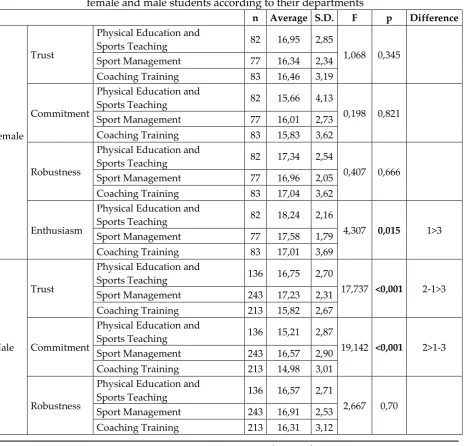
Table 1: The comparison of the athlete engagement levels of female and male students according to their departments
n Average S.D. F p Difference
Female Trust
Physical Education and
Sports Teaching 82 16,95 2,85
1,068 0,345 Sport Management 77 16,34 2,34
Coaching Training 83 16,46 3,19
Commitment
Physical Education and
Sports Teaching 82 15,66 4,13
0,198 0,821 Sport Management 77 16,01 2,73
Coaching Training 83 15,83 3,62
Robustness
Physical Education and
Sports Teaching 82 17,34 2,54
0,407 0,666 Sport Management 77 16,96 2,05
Coaching Training 83 17,04 3,62
Enthusiasm
Physical Education and
Sports Teaching 82 18,24 2,16
4,307 0,015 1>3 Sport Management 77 17,58 1,79
Coaching Training 83 17,01 3,69
Male
Trust
Physical Education and
Sports Teaching 136 16,75 2,70
17,737 <0,001 2-1>3 Sport Management 243 17,23 2,31
Coaching Training 213 15,82 2,67
Commitment
Physical Education and
Sports Teaching 136 15,21 2,87
19,142 <0,001 2>1-3 Sport Management 243 16,57 2,90
Coaching Training 213 14,98 3,01
Robustness
Physical Education and
Sports Teaching 136 16,57 2,71
2,667 0,70 Sport Management 243 16,91 2,53
Enthusiasm
Physical Education and
Sports Teaching 136 17,22 2,40
7,81 <0,001 2>3 Sport Management 243 17,69 2,06
Coaching Training 213 16,77 2,92
When female and male students' levels of athlete engagement are compared according to departments, it is found that the subdimension of enthusiasm in female students is high in Physical education and sports teaching students and Coaching training students (p=0,015). For male students, it is found that sport management students have higher scores than physical education and sports teaching and coaching training in the subdimension of trust and commitment (p<0,001). As for the subdimension of enthusiasm, sport management students have higher scores than coaching training students (p<0,001).
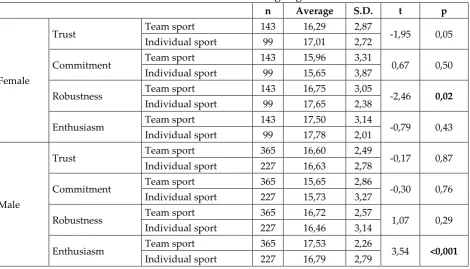
Table 2: The comparison of athlete engagement subdimensions of individual and team athletes according to gender variable
n Average S.D. t p
Female
Trust Team sport 143 16,29 2,87 -1,95 0,05
Individual sport 99 17,01 2,72
Commitment Team sport 143 15,96 3,31 0,67 0,50 Individual sport 99 15,65 3,87
Robustness Team sport 143 16,75 3,05 -2,46 0,02
Individual sport 99 17,65 2,38
Enthusiasm Team sport 143 17,50 3,14 -0,79 0,43 Individual sport 99 17,78 2,01
Male
Trust Team sport 365 16,60 2,49 -0,17 0,87
Individual sport 227 16,63 2,78
Commitment Team sport 365 15,65 2,86 -0,30 0,76 Individual sport 227 15,73 3,27
Robustness Team sport 365 16,72 2,57 1,07 0,29 Individual sport 227 16,46 3,14
Enthusiasm Team sport 365 17,53 2,26 3,54 <0,001
Individual sport 227 16,79 2,79
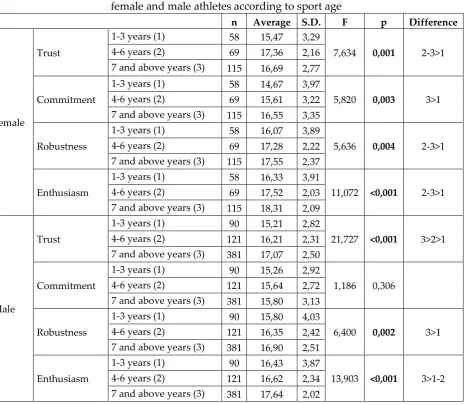
Table 3: The comparison of athlete engagement levels of female and male athletes according to sport age
n Average S.D. F p Difference
Female
Trust
1-3 years (1) 58 15,47 3,29
7,634 0,001 2-3>1 4-6 years (2) 69 17,36 2,16
7 and above years (3) 115 16,69 2,77
Commitment
1-3 years (1) 58 14,67 3,97
5,820 0,003 3>1 4-6 years (2) 69 15,61 3,22
7 and above years (3) 115 16,55 3,35
Robustness
1-3 years (1) 58 16,07 3,89
5,636 0,004 2-3>1 4-6 years (2) 69 17,28 2,22
7 and above years (3) 115 17,55 2,37
Enthusiasm
1-3 years (1) 58 16,33 3,91
11,072 <0,001 2-3>1 4-6 years (2) 69 17,52 2,03
7 and above years (3) 115 18,31 2,09
Male
Trust
1-3 years (1) 90 15,21 2,82
21,727 <0,001 3>2>1 4-6 years (2) 121 16,21 2,31
7 and above years (3) 381 17,07 2,50
Commitment
1-3 years (1) 90 15,26 2,92
1,186 0,306 4-6 years (2) 121 15,64 2,72
7 and above years (3) 381 15,80 3,13
Robustness
1-3 years (1) 90 15,80 4,03
6,400 0,002 3>1 4-6 years (2) 121 16,35 2,42
7 and above years (3) 381 16,90 2,51
Enthusiasm
1-3 years (1) 90 16,43 3,87
13,903 <0,001 3>1-2 4-6 years (2) 121 16,62 2,34
7 and above years (3) 381 17,64 2,02
The statistically significant difference is observed in all sub-dimensions of female athletes when the engagement levels of female and male athletes are compared according to sports age. Groups that create this difference are; in the subdimensions of trust, robustness, and enthusiasm in female athletes, athletes performing 1-3 years and 7 and above years have higher scores than those performing 4-6 years; in the subdimension of commitment, those performing 4-6 years have higher scores than 1-3 years. As for male athletes, it is found that those performing 7 and above years in the subdimension of trust, robustness, and enthusiasm have higher scores than other years (p<0,05).
3.1 Discussion
preferred departments in the faculties of sports sciences. As well as the curriculum of this department is the same as the all teaching curriculums, only domain-specific courses differ. It can be said that the difference may emerge as a result of the content of the courses taken by the physical education students. In the study done with the women football players by Kelecek and Göktürk (2017), they state that as their commitment to the branch of the sport that they play increases, their level of exhaustion decreases. It can be said that a student’s choice is effective in the emergence of this result.
When the subdimensions of the engagement level of the female are were examined, it is found that the robustness subdimension of the athletes performing individual sports have a high score. The practices done with the intent of fulfilling the requirements of the branch in order to focus on high-level success may have an effect on the emergence of this situation (Curran, Hill, Hall and Jowett, 2015). The emergence of the subdimension of enthusiasm found in male team athletes can be explained by the fact that they are satisfied with their personal development and are hopeful for their future sportive performances (Kristensen, 2013). Besides, this sense of enthusiasm can be influential in the development of the feeling of team awareness.
When the effects of the sport years on the engagement status are examined, female athletes with a sport history of 4-6 years are found to have higher scores in “trust”, “robustness”, and “enthusiasm” subdimensions. Depending on the status of playing sports, some feelings may develop over time. The social and psychological effects of sports may cause this process. The feelings such as competition, winning, and losing on athletes with a sport age of 4-6 years may have an impact on the engagement status. For those who have sports age of 7 years and above, these feelings may decrease because the long-lasting sport has an influence on exhaustion. The fact that male athletes have higher scores in the subdimensions of “trust”, “robustness”, and “enthusiasm” can be a result of males’ point of view that sees sport as a profession. Sport played for many years can be turned into a form of engagement by becoming a profession.
4. Conclusion
References
Aracı H., 2001. Okullarda beden eğitimi. Ankara: Bağırgan Yayınevi.
Curran T., Hill A. P., Hall H. K., Jowett G. E., 2015. Relationships between the Coach-Created Motivational Climate and Athlete Engagement in Youth Sport. Journal of Sport & Exercise Psychology, 37: 193-198
Doğan S., Kılıç S., 2007. Örgütsel Bağlılığın Sağlanmasında Personel Güçlendirmenin Yeri ve Önemi Güçlendirmenin Yeri ve Önemi, Erciyes Üniversitesi İktisadi ve İdari Bilimler Fakültesi Dergisi, 29: 37-61
Diener E., 2003. What is positive about positive psychology: The curmudgeon and pollyanna. Psychological Inquiry, 14: 115–120
Ericsson K. A., Krampe R. T., Tesch-Römer C., 1993. The Role of Deliberate Practice in The Acquisition of Expert Performance. Psychological Review, 100(3): 363-406. doi: 10.1037/0033- 295X.100.3.363
Heper E., 2012. Sporla ilgili kavramlar ve sporun tarihsel gelişimi, Spor Bilimlerine Giriş, Eskişehir: Anadolu Üniversitesi Yayınları no: 2509
Hodge K., Lonsdale C., Jackson S.A., 2009. Athlete Engagement in Elite Sport: An Exploratory Investigation of Antecedents and Consequences. The Sport Psychologist, 23: 186-202
Gould D., 2002. Sport Psychology in the New Millennium: The Psychology of Athletic Excellence and Beyond. Journal of Applied Sport Psychology, 14: 137–139
Kelecek S., Göktürk E., 2017. Kadın Futbolcularda Sporcu Bağlılığının Sporcu Tükenmişliğini Belirlemedeki Rolü. Başkent Üniversitesi Sağlık Bilimleri Fakültesi Dergisi 2(2): 162-173
Kelecek S., Kara F. M., Aşçı F. H., 2018. Sporcu Bağlılık Ölçeği’nin Geçerlik ve Güvenirlik Çalışması. Spormetre. 16(3): 39-47
Kristensen, J. A., 2013. Motivation and athlete engagement. A cross-sectional study in youth ice hockey players. Master Thesis, Norwegian School of Sport Sciences Liem G. A. D., Martin A. J., 2012. The Motivation and Engagement Scale: Theoretical
Framework, Psychometric Properties, and Applied Yields. Australian Psychologist, 47(1): 3-13. doi: 10.1111/j.1742-9544.2011.00049.x
Lonsdale C., Hodge K., Jackson S. A., 2007. Athlete Engagement: II. Development and Initial Validation of the Athlete Engagement Questionnaire. Int J Sport Psychol, 38: 471-492
Lonsdale C., Hodge K., Raedeke T. D. 2007. Athlete Engagement: I. A Qualitative Investigation of Relevance and Dimensions. International Journal Of Sport Psychology, 38: 451-470
Schaufeli W. B., Salanova M., 2007. Work Engagement: An Emerging Psychological Concept and Its Implications for Organizations. Managing social and ethical issues in organizations. Greenwich, CT: Information Age Publishers, pp 135-177
Creative Commons licensing terms