Research Article
a
June
2018
Computer Science and Software Engineering
ISSN: 2277-128X (Volume-8, Issue-6)
Face Spoof Detection System Based on Genetic Algorithm
and Artificial Intelligence Technique: A Review
Diksha Anand, Kamal Gupta(Assistant Professor) GNIT Mullana, Ambala, Haryana, India
[email protected], [email protected]
Abstract: Face recognition is an alternative means to authenticate a person in different applications for access control. Instead of many improvements, this method is prone to various attacks like photos, 3D masks and video replay attack. Due to these attacks, system should require a face spoof detection system. A face spoof detection systems have an ability to identify whether a face is from a real person or a fake image. Face spoofing effect the image by adding deformation in it and also degrades the image pattern quality. Face spoofing detection system automatically identifies the human face is a true face or a fake face. In today's era, face recognition method is widely used to authenticate the face (like for unlocking mobile phones etc.) and providing access to the services or facilities but some intruders use various trick to crack the authentication system by presenting the false face in front of the authentication system, so it become necessity to prevent our face authentication system from face spoofing attack. So the choice of the technique to detect the face spoofing attack should be accurate and highly efficient.
Keywords: LBP, PCA, DMD, SVM, RBF
I. INTRODUCTION
Face spoofing is the technique to know the true face and avoid the false face detection. It is similar to the concept of face recognition [1]. The popularity of face recognition has raised concerns about face spoof attacks (also called biometric sensor presentation attacks), where a photo, video or 3D mask of an authorized person's face could be used to gain access to services or facilities. Here FR represents the face recognition system which is described below[2].
1.1 Face Recognition Process
In face recognition process, system used mainly two approaches to recognize a face image. Firstly, the face is recognized on the basis of location, shape and spatial relationship between facial attributes like eyes, eyebrows, nose, lip and chin. Secondly system treats the whole face image as a combination of a number of canonical faces [3]. to know if there is any person inside, where his or her face locate at [4], and who he or she is. Towards this goal, we usually divide the face recognition process into three steps:
Figure 1: Flow of face recoginition
1.1.1 Face Detection: The major function of this step is to decide (1) whether human faces come into view of a given image, and (2) where these face is present in the image. The expected outcome of this step are patches contain each part of the face of the input image. In order to make additional face recognition system more healthy and easy to design, face position are perform to give reason for the scales and orientations of these patches. In addition serving as the pre-processing for face recognition, face detection could be used for region-of-interest detection and image classification, etc [5].
1.1.2 Feature Extraction: The following the face detection step, human-face patches are extracted from images. Directly with these patch for face detection have some disadvantage, first, each patch may contain over 1000 pixels, which are too large enough to build a robust recognition system. Second, face patch may be taken from different camera alignments, with different facial expressions, illuminations, and may suffer from occlusion and acne. To overcome these drawbacks, feature extraction is performed [6] to collected required information, dimension reduction, edges extraction, and noise attack. Various feature extraction techniques are describe below.
ISSN(E): 2277-128X, ISSN(P): 2277-6451, pp. 51-58
labels describing texture of images that can be summarised into a histogram. Image texture has two complemntary aspects, pattern and strength. LBP is operated on 3X3 pixels.
Figure 2: calculation of LBP
The pixels in this block are 1) thresholded by its center pixel value, 2) multiplied by powers of two (Decimal) 3) then summed to obtain a label for the center pixel 4) 256 different labels.
2. Principal Component Analysis (PCA): PCA is a popular feature extraction method described in 1930. Its a linear transformation technique that transforms the data from high dimension to more reduced dimension. If the data is highly correlated, there is a redundant data is available. PCA decrease the amount of redundant information by decor relating the input vectors. PCA is a powerful tool to compress the data. to a new coordinate system such that the greatest variance by some projection of the data comes to lie on the first coordinate which is called the first principal component, the second greatest variance which is called second coordinate, and so on.
3. Dynamic mode decomposition (DMD) is a dimension reduction algorithm developed by Peter Schmid in 2008. In this, time series of data is given, DMD calculates a set of modes each of which is associated with a fixed number of oscillation frequency and decay/growth rate. For linear systems in particular, these modes and frequencies are analogous to the normal mode of the system, but more generally, they are approximations of the modes and eigen values of the composition operator.
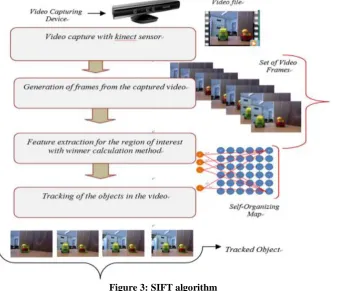
4. SIFT (Scale Invariant Feature Transform) : It is an image descriptor used for image based matching with the recognition give by David Lowe. This descriptor and the related image descriptors are utilized for number of purposes in computer vision connected to point matching among varied views of a 3-D scene and recognition of view-based object. Its descriptor is constant to rotations, translations and scaling transformations presented in the image domain and tough for sensible perspective transformations and illumination variations. Practically, the SIFT descriptor is taken as very useful for image matching as well as object recognition in real-world conditions[11].
ISSN(E): 2277-128X, ISSN(P): 2277-6451, pp. 51-58 1.1.3Face Recognition: The following formulizing the symbol of each face, the last step is to recognize the 1 we’ll commence the concept of “curse of dimensionality”. Identity of these faces. In order to achieve routine recognition, a face file is required to build. For each being, several imagery is taken and their features are extracting and stored in the database. Then when an input face image is taken, we perform feature extraction and face detection, and compare its feature with each face class stored in the database while training [7]. For face recognition various classifiers can be used some are described below.
1. Support Vector Machine (SVM) :SVM is a concept which is based on decision planes that describes the decision boundaries. A decision plane separates a set of objects that belongs to different class memberships. An example is taken in which the objects can belongs either to class GREEN or RED. The separating line defines a boundary, on the right side of which all objects are GREEN and on the left side of which all objects are RED. Any new object like white circle falling in the right is labelled as the selected class, i.e., it is classified, as GREEN. SVM supports both classification and regression tasks and it can handle multiple continuous and categorical variables.
Figure 4: SVM Classification
2. Radial Basis Function(RBF) Neutral Networks: A radial basis function network(RBFN) is an Artificial Neural Network(ANN) that uses radial basis function as an activation functions. RBFN has various uses like classification, function approximation etc. An RBFN performs classification by measuring the similarities of inputs with the training set. Each RBFN neuron saves a “prototype”, which is just one of the examples from the training set. When we want to classify an input, each neuron computes the Euclidean distance between the input and its prototype. If the input is more similar to the class A prototypes than class B prototypes, then it is classified that, input belongs to class A.
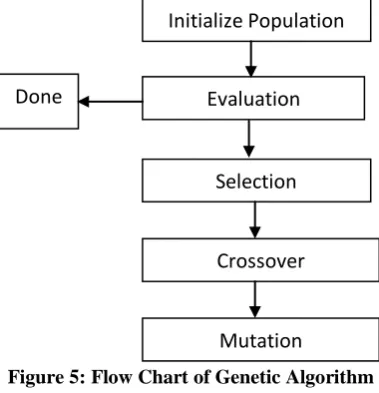
3. Genetic Algorithm (GA): Genetic Algorithm is used in the applications where the examination space is large. The advantage of a GA is that the procedure is fully automatic and it avoids the local minima. The major components of Genetic Algorithm are crossover, mutation, and a fitness function. The crossover operations are used for generating a novel chromosome from parent sets while the mutation operators are used to add variations. The fitness function is implemented on a chromosome dependent on the predefined criteria. An improved fitness value of a chromosome will increase its survival chance. The population is a collection of various chromosomes. A novel population is carried out by using standard genetic operations like single-point or multiple point crossover, mutation, and selection operator [12].
Figure 5: Flow Chart of Genetic Algorithm
II. FACE RECOGNITION TECHNIQUES
In face recognition system, the distance between the different points on the face has been recognized e.g. to determine the distance between the eye or measuring angles at different facial mechanism. A number of researchers used different techniques to recognise face some of them are listed below:
Initialize Population
Evaluation
Selection
Crossover
ISSN(E): 2277-128X, ISSN(P): 2277-6451, pp. 51-58 1. Holistic Method: In holistic advance, the total face region is taken into account as input data into face infectious system. One of the best instances of holistic methods is Eigen faces Suhas et.al [8], Principal Component Analysis, Linear Discriminated Analysis and independent component analysis etc.
2. Feature Based Method: in these methods local features such as eyes, nose and mouth are first of all extract and their locations and local figures are fed into a structural classifier. A big face up to for feature drawing out methods is feature "reinstallation", this is when the system tries to rescue features that are invisible due to large variation, e.g. head Pose when we are comparable a frontal image with a contour image Rao et.al [9].
3. Hybrid Methods: Hybrid face recognition systems use a grouping of both holistic and feature extraction methods. An usually 3D Images are used in hybrid methods. The image of a person's face is wedged in 3D, allowing the system to notice the curves of the eye sockets, for example, the shapes of the chin or forehead. Even a face in profile would serve since the system uses depth, and an axis of extent, which gives it enough information to build a full face. The 3D system usually proceeds with: Detection, Position, Measurement, Representation and Matching [10].
Following is the breif summary of the review papers:
1. Kudzaishe Mhou et.al, 2017 [14] has implemented a system with Gabor filters, Laplacian blur detection, color moments and LBP (Local Binary Patterns) that measures the light reflection on varied material and the classification has been done with the provided face being fake or real. The authors have noticed the enhancement in the results with the system being working better in the lightning environment being contrasted to few related systems. Particularly, the light source while sample capturing for the pre-processing has given the best results. The researchers has also drawn the data set with 40 individuals with different cameras that may serve as other source with the related with CASIA-FASD and the MSU MFSD public datasets.
2. Boulkenafet, Z.et. al, 2016 [18] has defined a new method for the detection of face spoofing with the analysis of color texture. The author has exploited the information of joint colour texture by means of luminance with chrominance channels with the extraction of complementary low-level feature definition from varied colour spaces. The feature histograms are calculated from every image band individually. The implementation on the three most challenging benchmark datasets termed as, Replay-Attack Database, CASIA Face Anti-Spoofing Database with MSU Mobile Face Spoof Database and depicted outstanding results as compared to the existing work.
3. Tirunagari, S. et al, 2015 [15] has presented a classification infrastructure with DMD(Dynamic Mode Decomposition), LBP (Local binary pattern) and SVM (Support vector machine) with the histogram kernel of intersection. Single DMD property has the capability to show the temporary full video information as one image with similar dimensions being enclosed in video. The hybridization of the mentioned algorithms has came out to be effective, easy to utilize and efficient. The efficiency of the method has been analyzed with the mentioned data bases(replay-attack, print-attack and CASIA-FASD) and the proposed work has come out to be better as compared to the existing one.
4. Wen, D et.al, 2015 [16] has presented an effective and an algorithm of robust face spoofing for IDA (Image distortion analysis). Four varied features have been extracted to produce IDA feature vector. The ensemble classifier is consisted of varied SVM classifiers being trained for varied attacks of face spoofing being utilized for distinguish amo ng spoof and genuine faces. The presented method has been extended for the detection in videos by utilizing a scheme of voting based. The researchers have collected the database of face spoofing with two mobile devices having three types of spoof attacks. The researchers has resulted on two databases of two public domain and the MSU MFSD database has shown that the presented method has performed well than the spoof detection approaches. The outcome has also shown the separating genuine difficulty mostly in cross data base and cross device scenarios.
5. Best-Rowden et. al, 2014[17] has analyzed the person interest identification in the scenario of unconstrained imaging having the uncooperative subjects. With the collection of face media of person interest like the video clips and the face images from the video as well as image frames. The researchers have examined the enhancement in identifying the accuracy of COTS system of face matching. If has been concluded that the most value for the forensic investigation with the light out operations of watch list as the full probe matching compilation outcome a single candidate single rank than the ranked list for every sample of face media. The investigations are given in the similar scenarios of identification of closed set, identification of open set with the gallery and the verification.
ISSN(E): 2277-128X, ISSN(P): 2277-6451, pp. 51-58 7. Mr. Deepak Mishra et.al, 2013 [21] presented thatface discovery is a method of detect any face from a set of images. Face can be detected on the basis of facial appearance of the face such as height, pose, width etc. Though many techniques are implemented for the discovery of faces, to detect face using neural networks, but neural network is not sufficient to extract features and has low correctness. Hence in this paper a well-organized planned technique is implemented using GA(Genetic Algorithm) and SIFT(Scale Invariant Feature Transform) algorithm. Genetic algorithm is applied first and then SIFT algorithm is practical for the feature extraction which may product in a better accuracy.
8. Tran Binh Long et.al, 2012 [20] presented a method of recognize faces from front pose images by using Circularly Orthogonal Moments. In the on hand method, first Zernike Moment , Pseudo Zernike Moment and Polar Cosine Transform were in work to extract features from the images, and then Radial Basis Function Network and Genetic Algorithm were used for face appreciation based on the skin that had been already extract by PZM, ZM, and PCT. Also, the images were pre-processed to enhance their gray level, which helps to increase the accuracy of recognition. . To test this method Yale database is use. The results of this experiment shows that COM gives higher accuracy than these single feature domain ns.
Table1: Summarizing all the research paper
Author Proposed Work Technique Conclusion
Kudzaishe Mhou et.al, 2017
Face Spoof Detection
Using Light
Reflection in
Moderate to Low
Lighting
Gabor filters + Laplacian blur detection + color moments + Local Binary Patterns (LBP)
This method worked well in the environments where the lighting is low. The use of infrared also improves the classification rate of the system.
Boulkenafet, Z.et. al, 2016
Face Spoofing
Detection Using
Colour Texture
Analysis
Color texture Analysis
using color moments
(RGB, HSV and YCbCr colour space)
YCbCr and HSV
colour spaces give better performance compared
to RGB colour space. On comparing the result YCrCb and HSV, YCrCb performs better.
Tirunagari, S. et al, 2015
Detection of Face
Spoofing Using
Visual Dynamics
DMD + LBP + SVM the performance reported in the paper is improved from the capability of DMD to
extract the dynamics
of video automatically, and from the unique
combination of
DMD+LBP+SVM in a classification pipeline
Wen, D et.al, 2015
Face Spoof Detection
with Image
Distortion Analysis
Image Distortion Analysis
based on specular
reflection, bluriness , chromatic moment and color diversity features + Ensembler classifier
A mobile face spoof database is collected called MSU MFSD using two mobile phones. This face spoof method provide improved results over state-of-the-art methods in intra-database and out perform the baseline methods of cross database scenarios.
Best-Rowden et. al, 2014
Unconstrained Face Recognition:
Identifying a Person of Interest from a Media Collection
Commercial Off The
Shelf (COTS)
Incremental improvements in the accuracy of identification through COTS face matching system. For each sample face media, one single ranked list of candidates are returned as output.
Mona
Omidyeganeh et.al, 2013
Face Identification
Using Wavelet
Transform Of SIFT Features
Scale Invariant Feature
Transform (SIFT) +
Wavelet Transform
This method selects suitable features from face image based on wavelet transform, representing more appropriate characteristics of the signal that lead to a more intelligent recognition
Mr. Deepak Mishra et.al, 2013
Face Detection using Genetic based SIFT algorithm
Genetic Algorithm(GA) + Scale Invariant Feature Transform (SIFT)
ISSN(E): 2277-128X, ISSN(P): 2277-6451, pp. 51-58 Tran Binh
Long et.al, 2012
Face Recognition
Using Circularly
Orthogonal
Moments and Radial
Basis Function
Neural Network
& Genetic Algorithm
Circular orthogonal
moment (Pseudo Zernike Moment, Zernike moment
and Polar Cosine
Transform) + RBF Neural
Networks + Genetic
algorithm
The combination of circular orthogonal moments at high order, RBF NN and GA contain more information about the face image and thus improve the face recognition rate
III. RESULTS
The performance of different proposed method is different.
Using light reflection method in moderate lighting environment on 20 samples using infrared camera improves the face detection rate. When this algorithm is implemented on the MSU MFSD database and it result in low classification accuracy which averaged to 69%. On CASIA-FASD database averaged to 72% and the KM-SD database had an average of 77%. If ability of the system is improved to adapt the different light intensities then it will return improved results. Images taken in intense lightening conditions result in lot of light obstacles but if a moderate to low lightening condition are more suitable for proposed method.
Using Colour texture analysis method, the performance of different feature descriptors applied on RGB, HSV and YCbCr is improved compared to grey scale. When compare on the bases of different colour spaces then YCbCr and HSV perform better than RGB. the CoALBP colour-texture feature improves performance on CASIA and Replay Attack databases with percentages of 63.5% and 71.6%, respectively. On MSU MFSD, the best results are obtained using LPQ descriptor where the features extracted from the YCbCr colour space and performance is improved with a percentage of 69.0% compared with the gray-scale LPQ features. The features extraction from HSV and YCbCr results in good performance enhancement. The EER on the CASIA-FASD and MSU-MFSD has been reduced from 4.0% to 3.2% and from 4.9% to 3.5%, respectively, whereas the HTER on the Replay-Attack Database has been decreased from 4.3% to 3.3%. When the system is trained on the CASIA FASD, the average of the HTER values on the different subsets is 20.4% for MSU-MFSD and 30.3% for Replay Attack Database. When the model is trained on Replay Attack Database, average HTER on CASIA-FASD and MSU-MFSD is 37.7% and 34.1%, respectively. When the cross-database performance is evaluated on CASIA-FASD and Replay-Attack Database while training the model using the MSU-MFSD, the average HTER is 46% and 33.9% for CASIA-FASD and Replay Attack Database, respectively. From these results, it is observed that models trained on MSU-MFSD and Replay-Attack Database are not able to generalize as good as the model trained on the CASIA-FASD. The reason behind this is that the CASIA-FASD contains more variations in collected data (e.g. proximity between the camera and the face, image qualities etc) compared to the Replay Attack and MSU databases. Therefore, the model optimization for these databases has difficulties to perform well in the new additional conditions.
By using potential of DMD as a pre-processing technique in emphasising the facial texture, lip movement and eye blinking across the whole video sequence. Effects of various LBP parameters are studied for the classification performance. By using the DMD + LBP + SVM classification performance in terms of HTER(Half Total Error Rate) is 21.75% and recognition performance at HTER on print attack dataset is 0% and for Replay Attack 0.5% and 0% is recorded on development and test data set.
Image Distortion Analysis(IDA) features outshine LBP and DoG LBP features in cross database. For the Replay Attack database samples, the IDA features achieve nearly perfect separation of real and fake image in the MSU database with the classifier trained on Idiap database (average TPR = 90.5% @ FAR = 0.01). For the printed attack database samples, the IDA features report an average TPR of 31.2% @ FAR = 0.01 when trained on Idiap and tested on MSU, which is still much better than the LBP and DoG-LBP features. IDA features show better cross-database performance in various cases like Replay-attack samples compared to printed attack samples, when samples are taken from similar cameras and when samples contain replayed video attack and printed photo attacks.
COTS face matcher performs better on face images that have been pose corrected using the Aureus 3D SDK. Matching the original images to the pose corrected images performs the best out of all four match scores, by achieving a 7.25% improvement in Rank-1 accuracy over the baseline. Furthermore, fusion of all four scores (s 1, s 2, s 3, and s 4) with the simple sum rule provides an additional 2.6% improvement at Rank-1. When multiple images are plotted as a baseline in which addition of videos to the media collection improves identification accuracy. This method propose that quality base fusion result in higher accuracy for the rank 1 set of images. This proposed method uses PCSO database which contains 1M face images generalize well to the large general set of gallery.
ISSN(E): 2277-128X, ISSN(P): 2277-6451, pp. 51-58
Using SIFT with Genetic Algorithm leads to achieve 88% of classification rate in face detection. Face detection accuracy on CIT data set will be 98.56%, on BAOFACE dataset it gives 97.43% accuracy and on ESSEX it gives 97.96% accuracy.
Using PZM-ZM-PCT-RBFN-GA approach on Yale database recognition rate is obtained by 99.43%. the testing results of verification rate with 20 order moments by setting 20 (moments order 20) for PZM-ZM-PCT, based on their defined threshold value. Threshold value 0.2954, FAR(False acceptance Rate) will be 0.7998%, FRR(False Rejection Rate) will be 1.1674% and TSR(Total success rate) will be 99.43%.
IV. CONCLUSION
In this paper, we have studied various research paper, which propose various techniques or hybrid methods to extract the best features from the images and compare with the provided input image for face detection, face recognition or for face spoofing detection. According to the above results, we can conclude that light reflection technique need further improvement to improve this result in face detection. For pre-processing an input image we can prefer DMD method over YCbCr colour texture model as DMD method focuses on the moment of named features like eye blinking and lips moment which improve accuracy in video attacks. By using COTS there was an improvement in the identification accuracy in case of when individual face media sample is of low quality for face matching. Pose correction in unconstrained 2D images are 3D frames(videos) improves the accuracy of state of the art COTS face matcher. The face detection recognition rate is improved using SIFT based on wavelet transform to 97.7%. It is further improved when SIFT based Genetic algorithm is implemented to 98.57% on some other face detection database. Using orthogonal moment at high order with RFB Neural Network and GA improves it further more on Yale database. It is able to minimize information redundancy as well as increase the discrimination power. So, we conclude that further research on this topic can be done by combining the SIFT for feature extraction and GA and artificial Neural Network (ANN) for face spoof detection also.
REFERENCES
[1] W. Zhao, R. Chellappa, P.J. Phillips, and A. Rosenfeld, “Face recognition: A literature survey,” ACM Computing Surveys, vol. 35, no. 4, pp. 399–458, 2003.
[2] B. Heisele, P. Ho, J. Wu, and T. Poggio, “Face recognition: Component-based versus global approaches,” Comput. Vis. Image Understand, vol. 91, no. 1, pp. 6–12, 2003.
[3] Q. Yang and X.O. Tang, “Recent advances in subspace analysis for face recognition,” in Advances in Biometric Person Authentication, pp. 275–287. 2005.
[4] M. Brown and D.G. Lowe, “Invariant features from interest point groups,” in British Machine Vision Conference, 2002, pp. 656–665.
[5] D.G. Lowe, “Distinctive image features from scale-invariant keypoints,” International Journal of Computer Vision, vol. 60, pp. 91–110, 2004.
[6] T. Lindeberg, “Feature detection with automatic scale selection,” International Journal of Computer Vision, vol. 30, no. 2, pp. 79–116, 1998.
[7] M. Bicego, A. Lagorio, E. Grosso, and M. Tistarelli, “On the use of sift features for face authentication,” Computer Vision and Pattern Recognition Workshop, 2006 Conference on, pp. 35–35, June 2006.
[8] D.R. Kisku, A. Rattani, E. Grosso, and M. Tistarelli, “Face identification by sift-based complete graph topology,” Automatic Identification Advanced Technologies, 2007 IEEE Workshop on, pp. 63–68, June 2007. [9] Hua Gu Guangda Su Cheng Du, “Feature Points Extraction from Faces”, Image and Vision Computing NZ,
pp.154-158, 2006.
[10] T. Baltrušaitis, D. McDuff, N. Banda et al., “Real-time inference of mental states from facial expressions and upper body gestures,” in Proceedings of the IEEE International Conference on Automatic Face and Gesture Recognition and Workshops (FG '11), pp. 909–914, March 2011
[11] G. Littlewort, M. S. Bartlett, L. P. Salamanca, and J. Reilly, “Automated measurement of children’s facial expressions during problem solving tasks,” in Proceedings of the IEEE International Conference on Automatic Face and Gesture Recognition and Workshops (FG '11), pp. 30–35, 2011.
[12] Jun Luo, Yong Ma, ErinaTakikawa, Shihong Lao, Masato Kawade, Bao-Liang Lu: Person-Specific SIFT Features for Face Recognition. ICASSP (2) 2007: 593-596.
[13] Geng, Cong, and Xudong Jiang. "Face recognition using sift features." Image Processing (ICIP), 2009 16th IEEE International Conference on. IEEE, 2009.
ISSN(E): 2277-128X, ISSN(P): 2277-6451, pp. 51-58
[15] Tirunagari, S., Poh, N., Windridge, D., Iorliam, A., Suki, N. and Ho, A.T., 2015. Detection of face spoofing using visual dynamics. IEEE transactions on information forensics and security, 10(4), pp.762-777.
[16] Wen, D., Han, H. and Jain, A.K., 2015. Face spoof detection with image distortion analysis. IEEE Transactions
on Information Forensics and Security, 10(4), pp.746-761.
[17] Best-Rowden, L., Han, H., Otto, C., Klare, B.F. and Jain, A.K., 2014. Unconstrained face recognition: Identifying a person of interest from a media collection. IEEE Transactions on Information Forensics and Security, 9(12), pp.2144-2157.
[18] Boulkenafet, Z., Komulainen, J. and Hadid, A., 2016. Face spoofing detection using colour texture
analysis. IEEE Transactions on Information Forensics and Security, 11(8), pp.1818-1830.
[19] Omidyeganeh, Mona, et al. "Face identification using wavelet transform of SIFT features." Multimedia and Expo Workshops (ICMEW), 2013 IEEE International Conference on. IEEE, 2013.
[20] Gautam Narang, Soumya Singh et.al "Robust Face Recognition Method Based on SIFT Features Using Levenberg-Marquardt Backpropagation Neural Networks" Measurement 46.10 (2013): 4179-4188.