Electronic Communications of the EASST
Volume 47 (2012)
Proceedings of the
11th International Workshop on Graph Transformation and
Visual Modeling Techniques
(GT-VMT 2012)
Instance Generation from Type Graphs with Arbitrary Multiplicities
Gabriele Taentzer
15 pages
Guest Editors: Andrew Fish, Leen Lambers
Managing Editors: Tiziana Margaria, Julia Padberg, Gabriele Taentzer
Instance Generation from Type Graphs with Arbitrary
Multiplicities
Gabriele Taentzer
Philipps-Universit¨at Marburg, Germany
Abstract: Meta modeling is a wide-spread technique to define visual languages, with the UML being the most prominent one. Despite several advantages of meta modeling such as ease of use, the meta modeling approach has a major disadvan-tage: It does not offer a direct means for generating its language elements. This disadvantage poses a severe limitation on certain applications. For example, when developing model transformations, it is desirable to have enough valid instance mod-els available for large-scale testing. Producing such a large set by hand is tedious. In the related problem of compiler testing, a string grammar together with a simple generation algorithm is typically used to produce words of the language automati-cally. In this paper, we formalize a restricted form of meta-models by type graphs with multiplicities and introduce instance-generating graph grammars for creating instance graphs representing the abstract syntax structures of models. Thereby, a further step is taken to overcome the main deficit of the meta-modeling approach.
Keywords:Meta modeling, graph transformation, model transformation
1
Introduction
Model-driven engineering (MDE) is a software engineering discipline that uses models as main artifacts throughout the software development process, adopting (automatic) model transforma-tions for software development steps, model optimization and code generation. Models are writ-ten in domain-specific languages (DSLs), usually defined by meta-models. More concretely, a meta model defines the abstract syntax of a modeling language. The way a meta model defines a modeling language is a declarative one, i.e., it enumerates all the model elements with its at-tributes and its inter-relations. Moreover, well-formedness rules, usually written in OCL, can be used to specify invariants. The meta-modeling approach has several advantages, one of them being that a visual meta model allows a quick grasp of the concepts being defined. Furthermore, the meta-modeling approach is also beneficial when it comes to defining complex modeling lan-guages, consisting of several sub-languages. Nevertheless, there is also a major disadvantage: Whereas constructing words of a language defined by a string grammar can easily be done by applying grammar derivations, meta model instantiation is hard to operationalize, due to the declarative form of a meta model.
In other words, instead of the declarative meta model an equivalent operational description of the language defined by the meta model is required.
Important applications of an operational definition approach for modeling languages include automated testing of model transformations [K¨us06,MBT06]. Model-driven architecture favors a widespread usage of model transformations. The quality of model transformations is thus cru-cial for their successful and widespread usage. For automated testing of model transformations, the generation of instance models is required. However, not all elements of the input language are usually interesting test cases. Further work has to be done to restrict the test case generation to representative cases only. These restrictions could be formulated by additional OCL constraints to be taken into account for instance generation. Furthermore, result models have to be checked wrt. test assertions. At least, result models have to be elements of the result language.
Another kind of applications are editor generations for DSLs. Automatically generated editors for domain-specific languages being defined by meta-models only offer simple editor operations only. An operational language description may help also to automatically generate advanced editor operations: First of all, the application of simple operations does not always yield models of the specified DSL. Grammar rules shall be used to deduce quick fixes for indicated syntax errors. Moreover, there are certainly larger editing steps where several closely related model elements are edited together. Grammar rules show which model elements are closely related in the sense that editing them all or none of them form yields consistent models again. Even further, larger editing operations such as refactorings can be defined by composing several previously defined editing operations to new ones.
Graph grammars [Roz97] provide a constructive, well-studied approach to language defini-tion with a formal foundadefini-tion that allows to prove important properties. First approaches have emerged to generate graph grammars from restricted forms of meta-models. In [HM10] and [HM11], generalized hyperedge replacement grammars are constructed from a restricted form of class diagrams to generate instances. In [EKT09], we construct graph grammars over type graphs with inheritance for instance generation. Moreover, basic OCL constraints can be trans-lated to graph constraints and further to application conditions of rules [WTEK08]. In this paper, a new form of instance generation graph grammar is presented, allowing meta-models to have arbitrary multiplicities. However, other restrictions, especially concerning supported kinds of well-formedness rules, still hold.
This work of translating the declarative specification of the language into an operational one can be seen as a foundational technique within model engineering because it will allow the adoption of techniques well-known for modeling languages and thereby closes an important conceptual gap. To achieve this aim, the instance generating graph grammar derived from a type graph formalizing a restricted form of meta-models has to generate all possible instances of the type graph and should not generate any graph that is not an instance of the type. In terms of graph grammar derivations, one has to ensure that every graph being created by a derivation of the graph grammar, is a valid instance of the type graph and furthermore that for every instance of the type graph there exists a derivation in the graph grammar. This completeness of the instance generating graph grammar is important for their applications.
present instance generating graph grammars for the generalized case of arbitrary multiplicities in Section4. Finally, we conclude with a short consideration of related work, summary, and outlook.
2
Type graphs with multiplicities and their languages
In this section, we recall type graphs with inheritance as introduced in [BELT04] and extend them by multiplicities as in [TR05]. This setting is well suited to formally define a restricted form of meta-models with arbitrary multiplicities, but without attributes, special forms of associations, and any further kinds of constraints. Compared to the work in [EKT09], type graphs are allowed to have arbitrary multiplicities (a major extension) and loop edges (a minor extension).
Definition 1 (type graph with inheritance) Atype graph with inheritance is a triple TGI = (TG,I,Abs)consisting of a graphTG= (T GV,T GE,srcT G,tgtT G)(with a setT GV of vertices, a
setT GEof edges, source and target functionssrcT G,tgtT G:T GE→T GV), an acyclic inheritance
relation I ⊆T GV×T GV, and a set Abs⊆T GV, called abstract nodes. For each x ∈T GV,
theinheritance clanis defined byclanI(x) ={y∈T GV |(y,x)∈I∗}, where I∗ is the
reflexive-transitive closure ofI.
A graph can be typed over a type graph with inheritance by a pair of functions, from nodes to vertex types and from edges to edge types, respectively. This pair of functions does not constitute a graph morphism, but will be called clan morphism; it uniquely characterizes the type morphism into the flattened type graph. Between clan-typed graphs we use type-refining morphisms (see also Def. 5 in [TR05]) where a vertex with typetcan be mapped to a vertex with a type in the clan oft.
Definition 2(clan morphism and typed graph) LetTGI= (TG,I,Abs)withTG= (T GV,T GE,
srcT G,tgtT G)be a type graph with inheritance. Aclan morphism type:G→TGI from a graph
G= (GV,GE,srcG,tgtG)toTGIis a pairtype= (typeV:GV →T GV,typeE:GE →T GE)such
that, for alle∈GE,
• typeV◦srcG(e)∈clanI(srcTG◦typeE(e))and
• typeV◦tgtG(e)∈clanI(tgtTG◦typeE(e)).
(G,type)is called atyped graphor evenclan-typedgraph. Given two typed graphs(G,typeG)
and(H,typeH), a graph morphism f:G→H is a type-refining morphism if for all v∈GV :
typeHV(fN(v))∈clan(typeGV(v)) andtypeHE(fE(n)) =typeGE. f is called type-preserving
iftypeHV(fN(v)) =typeGV(v) holds. In the following, we call a type-refining morphism just
morphism.
Definition 3(multiplicities) Amultiplicityis a pair[i,j]∈N×(N∪ {∗})withi≤ j∧j>0 or
Now we define an induced graph language over a type graph with multiplicitiesTGImult. As
usual, we use multiplicities to decorate the edges of type graphs. The multiplicities express the number of incoming, respectively outgoing edges for each target, respectively source instance.
Definition 4(Type graph with inheritance and multiplicities) A type graph with multiplicities is a tupleTGImult= (TGI,msrc,mtgt)consisting of a type graph with inheritanceTGIand additional
functionsmsrc,mtgt:TGIE →Mult, callededge multiplicity functions.
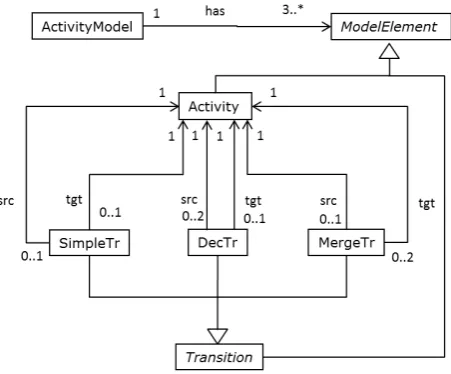
Example1 In Figure1, a type graph for simple activity models is shown. The minimal activity model consists of a start and an end activity with a transition in between. That’s why it has at least 3 model elements. I.e., model elements are activities and transitions. There are three kinds of transitions: transitions running between simple transitions, transitions coming out from decision activities, and transitions running into merge activities. This means that decisions split the control flow, i.e. have one incoming and two outgoing transitions while merge activities merge two control flows.
Figure 1: A type graph for simple well-structured activity models
Definition 5(TGImult-induced graph language) Given a type graphTGImultwith multiplicities,
the inducedgraph languageis defined by:
L(TGImult) ={(G= (GV,GE,srcG,tgtG),typeG:G→TGI)|
∀e∈TGIE∧ ∀v∈type−G1(t)witht∈clanI(src(e)): |type−G1(e)∩srcG−1(v)| ∈mtgt(e)and
∀e∈TGIE∧ ∀v∈type−G1(t) with t∈clan(tgt(e)): |type−G1(e)∩tgtG−1(v)| ∈msrc(e)}, where
typeGis a clan morphism.
Definition 6(Finitely satisfiable type graph with inheritance and multiplicities) A type graph TGImultwith multiplicities is calledfinitely satisfiableif the following condition is satisfied:
LetI be an in-equation system withTGIV0 ∪TGI0E as variable set containing an integer variable for each element inTGIV∪TGIE correspondingly named. ∀e∈TGIE withmsrc(e) = [k,l]and
mtgt(e) = [m,n]:
• m×src(e)0≤e0≤n×src(e)0is inI
• k×tgt(e)0≤e0≤l×tgt(e)0is inI
Ihas to be solvable such that all variables inTGIV0 ∪TGI0E are positive.
Example2 (Finite satisfiability)
The type graph shown in Figure 1 is finitely satisfi-able since the in-equation system on the right is solv-able by positive integers. Actually, a possible solution is AM0=1,ME0=has0=3,A0=6,SimpleTr0=src0Simple= tgtSimple0 =2,DecTr0 =srcDec0 =tgtDec0 =2,MergeTr0 = src0Merge=tgtMerge0 =2(Note that ActivityModel is abbre-viated by AM, ModelElement by ME, and Activity by A.)
ME0=has0≥3AM0 SimpleTr0=src0Simple≤A0 SimpleTr0=tgtSimple0 ≤A0 DecTr0=src0Dec≤2A0 DecTr0=tgtDec0 ≤A0 MergeTr0=src0Merge≤A0 MergeTr0=tgtMerge0 ≤2A0
3
Graph transformation based on type graphs with inheritance
In this section we present the formal background for instance generating graph grammars (IGGG) based on the formal theory of typed graph transformations with inheritance (see [BELT04]).
The main ingredients of graph grammars are graph rules which will be defined in Def. 8. For controlling a rule application, simple negative application conditions and atomic application conditions are defined which are needed in Section4.
Definition 7 (application condition) A simple negative application condition is of the form NAC(x), wherex:L→X is an injective morphism. A morphism m:L→G satisfies NAC(x) if there does not exist an injective morphism p:X →Gwith p◦x=m. Anatomic application conditionis of the form P(x,∧i∈Ixi) where x:L→X andxi :X →Ci with i∈I are injective
morphisms. A morphismm:L→G satisfies P(x,∧i∈Ixi)if for all injective morphismsp:X→G
withp◦x=mthere does exist ani∈I and an injective morphismqi:Ci→Gwithqi◦xi=p.
Remarks. Note thatNAC(x)is equal toP(x,∧i∈Ixi))withI=/0, since there does not exist any
i∈Ito reachqi◦xi=p. Hence, there does not exist apwithp◦x=mwhich is exactly the
sat-isfaction condition forNAC(x). Nevertheless, we introduce both kinds of application conditions, since they allow a clearer definition of instance generating rules. In examples, morphismsxand xiare often not shown totally, but can always be made total. A more general kind of application
conditions, called nested application condition, is presented in [HP09] but not needed here.
injective graph morphisms,type−R1(Abs)⊆r(KV), andApis a set of application conditions of the
formNAC(x)orP(x,∧i∈Ixi).
Definition 9(rule matching and application) Given a rulepand a clan-typed graph(G,typeG),
thenmis a match ofpinGif
• mis an injectivematchof the rulep= (L←−l K−→r R,Ap)in the graphG;
• tK(x1) =tK(x2)fortK=typeG◦m◦landx1,x2∈KV withr(x1) =r(x2);
• msatisfies all simple negative application conditions and all atomic applications inAp.
Given a matchm, a direct derivation(G,typeG) p,m
=⇒(H,typeH)
exists if there is a span of graph morphismsG←−D−→Hand a co-matchm∗:R→H of pinH that give rise to a derivation in the double-pushout (DPO) approach of graph transformation as defined in [CMR96, EEPT06] where pushouts are used to model the gluing of graphs. (See the DPO on the right.)
L
m
(PO1)
K k l o
o r //
(PO2)
R
m0
Goo g D h //H
Given a rule setR, (G,typeG)
∗
⇒R(H,typeH)is a finite sequence of an arbitrary number of
direct derivations by rules ofR. A derivation(G,typeG)
∗
⇒R(H,typeH)terminates, if6 ∃r∈R:
(H,typeH)⇒r(H0,typeH0).
Example rules are shown in the next section where the instance generating graph grammar for the meta model in Figure1is presented.
4
Instance generating graph grammars
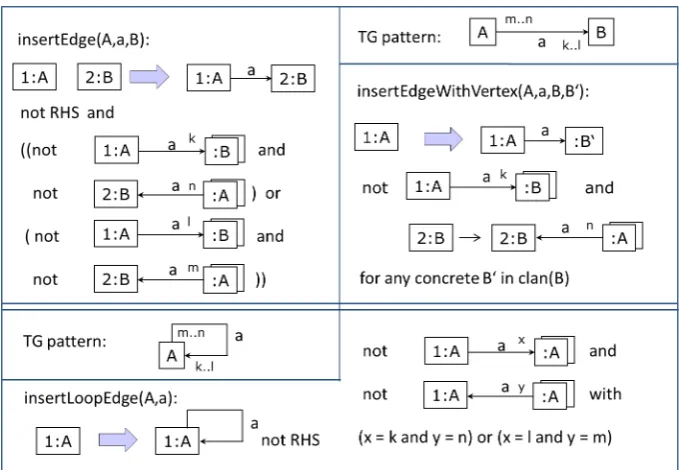
Having formalized a restricted form of meta models by type graphs with inheritance and multi-plicities, we are now ready to define a language by an instance generating graph grammar. Based on a given type graph with multiplicities, we mainly formalize the set of rules needed for instance generation. The rules are given in Figures2to4. They are applied in three layers:
1. Starting from the empty graph, an arbitrary number of vertices is created. This layer does not terminate, i.e., all its rules remain applicable after their (recurring) applications. Thus, rule application has to be stopped by user interaction or specification of application time or number. In any case, the result is a discrete graph.
3. Finally, additional edges may be inserted as long as upper bounds are not reached. This applies to loop edges as well.
As the main result of this paper, we present the equivalence of instance sets generated by an instance generating graph grammar on the one hand, and induced by a type graph with multiplic-ities on the other hand.
Definition 10(instance generating graph grammar and language) Given a type graphTGImult
with multiplicities, aninstance generating graph grammaris denoted by IGGG= (TGI,/0,R), whereR=R1∪R2∪R3 is the union of the following sets of rules. The rules are depicted in Figures2-4and are formalized in the obvious way according to Def.8.
• R1={createVertex(A’)| ∀A0∈TGIV∧A06∈Abs}with rulecreateVertexas in Fig.2
• R2=R21∪R22with
R21={insertEdge(A,a,B)| ∀A,B∈TGIV,a∈TGIE:(msrc(a) = [m,n]∧mtgt(a) = [k,l])}∪
{insertLoopEdge(A,a)| ∀A∈TGIV,a∈TGIE:(msrc(a) = [m,n]∧mtgt(a) = [k,l])}
R22={insertEdgeWithVertex(A,a,B,B’)| ∀A,B,B0∈TGIV,a∈TGIE : with
msrc(a) = [m,n]∧mtgt(a) = [k,l]∧k>0∧n6=”∗”∧B0∈clan(B)∧B06∈Abs}
with rulesinsertEdge,insertEdgeWithVertex, andinsertLoopEdgeas in Fig.3
• R3={insertAdditionalEdge(A,a,B)| ∀A,B∈TGIV,a∈TGIE with
msrc(a) = [m,n]∧mtgt(a) = [k,l]}with rulesinsertAdditionalEdgeas in Fig.4
If boundskormare equal to 0 or boundslornare equal to ”*”, the corresponding negated appli-cation conditions are equal to true in rulesinsertEdge,insertAdditionalEdge, andinsertLoopEdge. Atomic application conditions of the formP(x:L→X,x1:X→C1) withX consisting of one
vertex being mapped to a vertex with infinite many adjacent edges inCiis semantically equal to
a negative application condition containing a vertex of the same type (see below).
Ris layered, i.e. there is a function rl:R→Nwithrl(r) =ifor allr∈Ri fori={1,2,3}.
Functionrlis calledrule layer function.
Thegraph languagegenerated byIGGGconsists of typed graphs(G,typeG)such thatL(IGGG) =
{(G,typeG)|/0
∗
⇒R1(H,typeH)
∗
⇒R2(K,typeK)
∗
⇒R3(G,typeG))}.(K,typeK)is in normal form, i.e., there does not exist a ruler∈R2applicable to(K,typeK).
Layered graph grammars are presented in [EEL+05]. The order of rule applications described above can also be considered as a special graph program [HP01]:R1; as long as possibleR2;R3
Note that:
• It is obvious that all graphs inL(IGGG)are clan-typed overTGImult.
• If the type graph contains edge loops, A may become equal to B. E.g. given an edge loop a on A, there are also rulesinsertEdge(A,a,A), insertEdgeWithNode(A,a,A,A’), and insertAdditionalEdge(A,a,A).
• It is straight forward to see that instance generating graph grammars as defined in [EKT09] for special multiplicities are covered by instance generating graph grammar as defined here for arbitrary multiplicities.
Figure 2: Instance generation: creation of nodes in layer 1
Figure 3: Instance generation: creation of required edges in layer 2
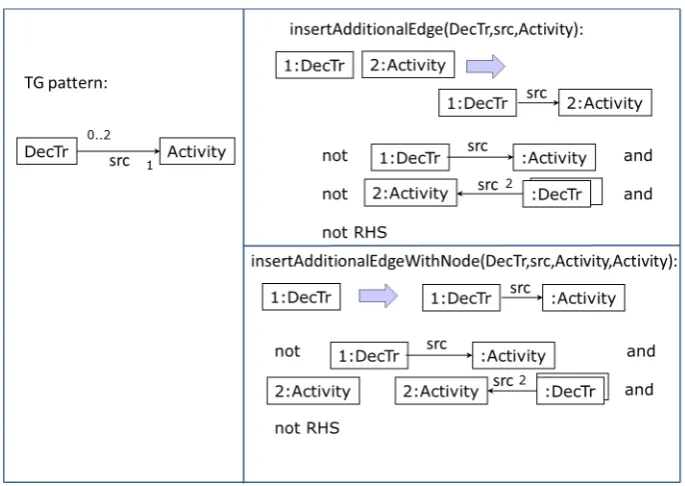
Example3 (instance generation) In Figures5to7, example rules for the instance generation of simple activity models are shown. They are built strictly according to the general algorithm. Create vertex rules are generated for all concrete types as indicated in Figure5. Layer 2 and 3 rules have to be generated for 7 edges. In Figures6and7we consider the insertion rules needed for the src-edge between DecTr andActivity. Note that the layer 2 rules in Figure 6 does not contain insertion rules in case that newDecTrinstances have to be created.
Figure 4: Instance generation: creation of optional edges in layer 3
Figure 5: Example rules of layer 1
Figure 7: Example rules of layer 3
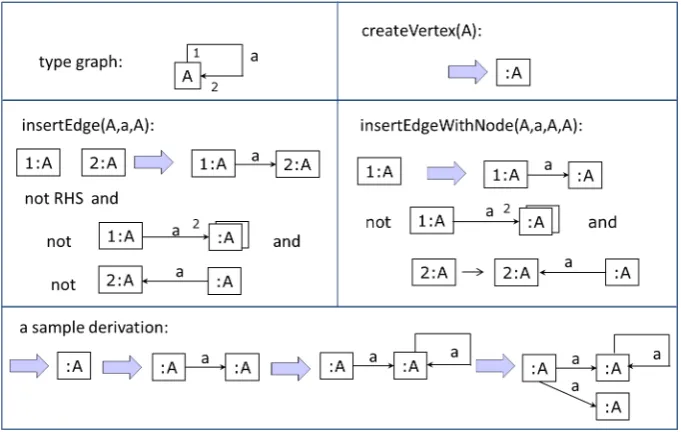
upper row of Figure 8. Its in-equation system consists the following equation: A0 =a=2A0 not being solvable by finite numbers. Figure8 also shows rules of Layers 1 and 2. Those of Layer 3 are omitted since Layer 2 is not terminating and therefore, rules of Layer 3 will never be applied. In the lower row of Figure 8, a sample derivation is depicted also using the rule insertLoopEdge(A,a) not being depicted in figure8. Since only one edge may go out but two have to come in to each vertex, we have to continue creating new vertices which leads to non-termination of Layer 2.
Figure 8: Example of a non-terminating IGGG
In the previous example, we have seen that Layer 2 can become non-terminating if the input type graph is not finitely satisfiable. However, in the following lemma we can show that Layer 2 is terminating if the input type graph is finitely satisfiable.
multiplic-ities TGImult that is finitely satisfiable and an instance generating graph grammar IGGG =
(TGI,/0,R), let L1(IGGG) ={(H,typeH) | /0
∗
⇒R1 (H,typeH)} constructed as in Def. 10. All derivation sequences(H,typeH)
∗
⇒R2 (G,typeG)with(H,typeH)∈L1(IGGG)terminate.
Proof. We show that if there is a derivation(H,typeH)
∗
⇒R2(G,typeG)with(H,typeH)∈L1(IGGG) not terminating, thenTGImult is not finitely satisfiable. Such a derivation is non-terminating, if
after any derivation step there is still a match for some rule of layer 2. Considering the rules in layer 2, it is obvious that rulesinsertEdgeWithVertex()are the only ones that insert new matches. The others just consume matches. W.l.o.g. there is ruleinsertEdgeWithVertex(A,a,B,B’)that is applied infinitely often. This means that the number of instances of type B’ grows over all limits. Thus,T GImultis not finitely satisfiable.
As main result, the following theorem states that the instance sets generated by anIGGGand those induced by a type graph with multiplicities (being finitely satisfiable) are equal.
Theorem 1 (equality of languages) Given a type graph TGImult with inheritance and
multi-plicities and an instance generating graph grammar IGGG= (TGI,/0,R)for TGImult, we have
L(IGGG) =L(TGImult).
Proof. LetRi={r|rl(r) =i}fori={1,2,3}.
1. L(IGGG) ⊆L(TGImult): Given any derivation /0
∗
⇒R1 (H,typeH)
∗
⇒R2 (K,typeK)
∗ ⇒R3 (G,typeG), we have to show that (G,typeG)∈L(TGImult). Let /0
∗
⇒R1 (H,typeH) con-sist ofnsteps, i.e.(H,typeH)hasnnodes.
What can be said after(H,typeH)
∗
⇒R2 (K,typeK)?
Due to Lemma1, we know that this derivation sequence does always terminate. Let graph (K,typeK)be the result graph to which none of the rules of layer 2 is applicable. We have
to show that(K,typeK)∈L(TGImult):
• NoinsertEdgeWithVertex(A,a,B,B’)is applicable: Either the lower bounds are reached for all edges and thus, (K,typeK)∈L(TGImult) or there is a vertex of type B0 for
which the upper bound has not been reached. Then, there is still a pair of A and B-typed vertices not connected by an a-typed edge and thus, there is a match of insertEdge(A,a,B)which contradicts our assumption that no rule of layer 2 is appli-cable.
• NoinsertEdge(A,a,B)is applicable: Either the lower bounds are reached for all edges and thus,(K,typeK)∈L(TGImult)or there is a vertex of typeAor typeBfor which
the upper bound has been reached. This situation would lead to a match of rule insertEdgeWithVertex(A,a,B,B’)or ruleinsertEdgeWithVertex(B,a,A,A’)for a concrete typeB0∈clan(B)orA0∈clan(A)which contradicts our assumption that no rule of layer 2 is applicable.
• NoinsertLoopEdge(A,a)is applicable: Either the lower bounds are reached for all edges and thus,(K,typeK)∈L(TGImult)or there is a vertex of typeAfor which one
insertEdgeWithVertex(A,a,A,A’)for a concrete type A0 ∈clan(A) which contradicts our assumption that no rule of layer 2 is applicable.
Applications of rules inR3always lead to graphs inL(TGImult), since they just add edges
as long as upper bounds have not reached.
2. L(TGImult)⊆L(IGGG): Given a graph(G,typeG)∈L(TGImult), we have to construct a
derivation sequence /0⇒∗ (G,typeG)overIGGG. SinceTGImult is finitely satisfiable, for
all(A,a,B)there arei(A)vertices of typeA,i(a)edges of typea, andi(B)vertices of type BinGV such that all multiplicities are satisfied.
Since R1 contains a creation rule for every vertex type, the vertices in GV are created
in|GV|steps by applying rules of R1 to graph /0, i.e. we construct a derivation /0
|GV|
⇒R1 (H,typeH)withH= (HV,/0,/0,/0),HV =GV, andtypeH= (typeGV,/0).
Since all nodes needed have already been created in layer 1, rules of setR21are used only
to create all required edges in layer 2. Let a be an edge in TGIE with src(a) =A and
tgt(a) =B:
• A6=B: Sincem×i(A)≤i(a)≤n×i(A)andk×i(B)≤i(a)≤l×i(B), rule insert-Edge(A,a,B)is applied as long asi(a)≤m×i(A)ori(a)≤k×i(B). When they are not applicable anymore, both lower bounds,kandm, have been reached.
• A=B: Since m×i(A)≤i(a)≤n×i(A) and k×i(A)≤i(a)≤l×i(A), rules in-sertEdge(A,a,A)andinsertLoopEdge(A,a)are applied as long as i(a)≤m×i(A)or i(a)≤k×i(A). When it is not applicable anymore, both lower bounds,kandm, have been reached.
Thus, if no rule ofR21is applicable anymore, we have reached graph(K,typeK)∈L(TGImult)
withKV =GV andKE⊆GE.
Additional edges are created by the application of rules inR3. Sincei(a)≤l×i(B)and
i(a)≤n×i(A), the upper bounds, l and n, are not reached and the rules in R3 can be
applied as long as all edges inGE have been created. Thus, the resulting graph(G,typeG)
is inL(IGGG).
5
Related Work
There is work on the relation of different kinds of grammars to meta-models. In all approaches, meta-models come without additional well-formedness rules:
with composite associations between meta classes, restricting it to tree-like meta models which is a severe limitation for practical usage. Furthermore, the algorithm does not support ordinary associations with arbitrary multiplicities. This limitation is not surprising given the properties of context-free string grammars. It represents one reason for the approach to use graph grammars instead of context-free grammars.
The approach by Hoffmann and Minas [HM10,HM11] translates a restricted form of class di-agrams into contextual star grammars being a kind of hyperedge replacement grammars extended by contextual rules including path expressions and variable parts. Hence the instance generation process uses non-terminals during instance construction, similarly to context-free string gram-mars, and constructs instances along spanning trees. In contrast, our instance generation is purely graph-oriented. It restricts rule application by using rules with application conditions and lay-ering their application. While Hoffmann and Minas focus on parsing of meta model instances, the approach in this paper shall be used to generate test cases for model transformations and to provide users of graphical editors with advanced editing operations deduced from our grammar rules. Especially for the second application case, rules without non-terminals are better suited.
Instance generation for meta-models has also been considered in further approaches not using grammars: A related problem is the automated snapshot generation for class diagrams for vali-dation and testing purposes, tackled by Gogolla et al. [GBR05]. In their approach, properties that the snapshot has to fulfill are specified in OCL. Formal methods such as Alloy [Jac02,ABGR07] can also be used for instance generation: After translating a class diagram to Alloy one can use the instance generation within Alloy to generate an instance or to show that no instances exist. This instance generation relies on the use of SAT solvers and can also enumerate all possible instances. While these approaches are pretty promising for automatic test case generation, they seem to fit less for the automatic deduction of advanced editing operations, since incremental structure modifications are needed in this case. Instead, grammar rules seem to be well suited to deduce such incremental modifications.
6
Conclusion
In this paper, we have presented how a restricted form of meta-models can be formalized by type graphs with inheritance and arbitrary multiplicities. This kind of type graphs can be translated to instance generating graph grammars. We have shown that the languages defined by each of these concepts are equal if the type graph has multiplicities that are finitely satisfiable, i.e., that can be satisfied by a finite instance. This work is a direct extension of the translation shown in [EKT09]. The main new contribution of this paper is the extension from restricted multiplicities such as 0..1, 1, 1..*, and 0..* to arbitrary multiplicities. Thus, another step is taken to close the conceptual gap in modeling language definition by allowing the adoption of grammar-based definition techniques also to languages defined by meta models.
have to be erased step-by-step to close the conceptual gap between meta-models and grammars finally.
Future work is also needed to elaborate on possible applications of our technique: The instance generation shall be applied to further and especially larger type graphs than shown in the running example, proving that this approach can scale. For testing model transformations, techniques are needed that allow the generation of selected instances that are representative test cases. For editor generation, it needs to be explored how the graph grammar generated from a meta model can provide a basis to automatically deduce advanced visual editing rules.
Acknowledgements
Many thanks to Annegret Habel and Thorsten Arendt who gave valuable comments on this paper.
References
[ABGR07] K. Anastasakis, B. Bordbar, G. Georg, I. Ray. UML2Alloy: A Challenging Model Transformation. In Engels et al. (eds.),Model Driven Engineering Languages and Systems, 10th International Conference, MoDELS 2007, Nashville, USA, September 30 - October 5, 2007, Proceedings. LNCS 4735, pp. 436–450. Springer, 2007.
[AP03] M. Alanen, I. Porres. A relation between context-free grammars and meta object fa-cility metamodels. Technical report 606, TUCS Turku Center for Computer Science, March 2003.
[BCCG05] D. Berardi, A. Cali, D. Calvanese, G. D. Giacomo. Reasoning on UML Class Dia-grams.Artifical Intelligence168:70–118, 2005.
[BELT04] R. Bardohl, H. Ehrig, J. de Lara, G. Taentzer. Integrating Meta-modelling Aspects with Graph Transformation for Efficient Visual Language Definition and Model Ma-nipulation. In Wermelinger and Margaria (eds.),Fundamental Approaches to Soft-ware Engineering (FASE 2004), Proceedings. LNCS 2984, pp. 214–228. Springer, 2004.
[CCM04] M. Cadoli, D. Calvanese, T. Mancini. Finite satisfiability of UML class diagrams by Constraint Programming. InProc. of the 2004 International Workshop on Descrip-tion Logics (DL 2004). Volume 104. CEUR-WS.org, 2004.
[CMR96] A. Corradini, U. Montanari, F. Rossi. Graph Processes. Fundam. Inform. 26(3/4):241–265, 1996.
[EEPT06] H. Ehrig, K. Ehrig, U. Prange, G. Taentzer. Fundamentals of Algebraic Graph Transformation. EATCS Monographs in Theor. Comp. Science. 2006.
[EKT09] K. Ehrig, J. M. K¨uster, G. Taentzer. Generating instance models from meta models. Software and System Modeling8(4):479–500, 2009.
[GBR05] M. Gogolla, J. Bohling, M. Richters. Validating UML and OCL Models in USE by Automatic Snapshot Generation.Software and Systems Modeling4(4):386–398, 2005.
[HM10] B. Hoffmann, M. Minas. Defining Models - Meta Models versus Graph Grammars. ECEASST29, 2010.
[HM11] B. Hoffmann, M. Minas. Generating Instance Graphs from Class Diagrams with Adaptive Star Grammars.ECEASST39, 2011.
[HP01] A. Habel, D. Plump. Computational Completeness of Programming Languages Based on Graph Transformation. In Proc. Foundations of Software Science and Computation Structures (FOSSACS 2001). Volume 2030, pp. 230–245. 2001.
[HP09] A. Habel, K.-H. Pennemann. Correctness of high-level transformation systems rela-tive to nested conditions.Mathematical Structures in Computer Science19(2):245– 296, 2009.
[Jac02] D. Jackson. Alloy: a lightweight object modelling notation.ACM Trans. Softw. Eng. Methodol.11(2):256–290, 2002.
[K¨us06] J. M. K¨uster. Definition and validation of model transformations.Software and Sys-tem Modeling5(3):233–259, 2006.
[MBT06] J.-M. Mottu, B. Baudry, Y. L. Traon. Mutation Analysis Testing for Model Transfor-mations. In Rensink and Warmer (eds.),Model Driven Architecture - Foundations and Applications, Second European Conference, ECMDA-FA 2006, Bilbao, Spain, July 10-13, 2006, Proceedings. LNCS 4066, pp. 376–390. Springer, 2006.
[Roz97] G. Rozenberg (ed.). Handbook of Graph Grammars and Computing by Graph Transformations, Volume 1: Foundations. World Scientific, 1997.
[TR05] G. Taentzer, A. Rensink. Ensuring Structural Constraints in Graph-Based Models with Type Inheritance. InFundamental Approaches to Software Engineering (FASE 2005), Proceedings. LNCS 3442, pp. 64–79. Springer, 2005.