On Packet Marking Function of Active Queue Management Mechanism:
Should It Be Linear, Concave, or Convex?
Abstract
Recently, several gateway-based congestion control mechanisms have been proposed to support the
end-to-end congestion control mechanism of TCP (Transmission Control Protocol). In this paper, we focus on
RED (Random Early Detection), which is a promising gateway-based congestion control mechanism. RED
randomly drops an arriving packet with a probability proportional to its average queue length (i.e., the
num-ber of packets in the buffer). However, it is still unclear whether the packet marking function of RED is
optimal or not. In this paper, we investigate what type of packet marking function, which determines the
packet marking probability from the average queue length, is suitable from the viewpoint of both steady
state and transient state performances. Presenting several numerical examples, we investigate the
advan-tages and disadvanadvan-tages of three packet marking functions: linear, concave, and convex. We show that,
although the average queue length in the steady state becomes larger, use of a concave function improves
the transient behavior of RED and also realizes robustness against network status changes such as variation
in the number of active TCP connections. Moreover, by applying our analytic approach to Adaptive RED,
we discuss its steady state performance and transient state performance. Our analytic results show that
Adaptive RED is effective for improving steady state performance compared with the original RED, but it
has little performance gain in terms of transient state performance and robustness.
keywords: AQM (Active Queue Management) Mechanism, RED (Random Early Detection), Packet
Marking Function, Steady State Performance, Transient State Performance, Robustness
1
Introduction
In recent years, AQM (Active Queue Management) mechanisms have been extensively studied by many
re-searchers [1, 2]. The AQM mechanism supports the congestion control mechanism of TCP (Transmission
Control Protocol), which operates on an end-to-end basis. RED (Random Early Detection) is a representative
AQM mechanism [3], which randomly discards an arriving packet to control the router’s queue length (i.e, the
number of packets in the router’s buffer). Compared with the conventional Drop Tail router, the RED router
is claimed to be more effective since RED keeps the average queue length small and achieves high
through-put [3, 4]. Moreover, the operation algorithm of RED is quite simple since it does not distinguish each TCP
However, RED has the well-known problem that its effectiveness is greatly dependent on the setting of
four control parameters,minth, maxth,maxp, andqw, so that the effectiveness of RED has been denied by
many researchers [5-8]. Another problem associated with RED is that its average queue length is dependent on
the number of active TCP connections; i.e., the optimal setting of RED control parameters is affected by the
number of active TCP connections. Many research efforts have so far been devoted to solve such problems (e.g.,
[9-15]). For example, SRED (Stabilized RED) is proposed in [13]. SRED estimates the number of active TCP
connections at the router, so that it can control its average queue length regardless of the number of active TCP
connections. However, SRED still has many control parameters, and configuration difficulty of these control
parameters is not addressed. Moreover, another approach called Adaptive RED is proposed in [14]. Adaptive
RED dynamically increases or decreases the maximum packet marking probabilitymaxp, which is one of the RED control parameters, according to its average queue length. More specifically, when the average queue
length is smaller thanminth, Adaptive RED decreasesmaxp by(1/α−1)maxp. On the contrary, when the
average queue length is larger thanmaxth,maxpis increased by(1−β)maxp. Because of introducing two
additional control parameters,αandβ, parameter tuning of Adaptive RED is more complicated than RED. In addition, its transient state performance and robustness has not been qualitatively investigated.
As explained above, various approaches to solving the problems associated with RED have been proposed
in the literature. However, these problems originate from the fact that the RED algorithm was designed with an
ad hoc approach. For example, RED randomly discards an arriving packet with a probability that is proportional
to its average queue length. Upon considering the purposes of AQM mechanisms, it seems reasonable to raise
the packet marking probability when the average queue length is large, and to lower it when the average queue
length is small. However, little investigation has been done to discuss “whether the packet marking probability
should be proportional to the average queue length or not”. RED randomly discards an arriving packet with a
probability which is determined from a linear function to the average queue length. More specifically, when the
difference between the average queue length and minthis increased by∆, RED increases its packet marking probability linearly in relation to∆. However, it is analytically known that TCP throughput is inversely propor-tional to√p, which is the packet loss probability in the network [16]. Also, it is known that, if the bottleneck router in the network can be modeled by a singleM/M/1queueing system, the average queue length is given byρ/(1−ρ), whereρis the utilization factor [17]. Hence, on the basis of the fact that the primary purpose of AQM mechanisms is to control the average queue length, it is considered that the packet marking probability
a simple queuing model such as M/M/1, it is necessary to model the interaction between the TCP conges-tion control mechanism and the network more precisely. For this reason, if the packet marking probability pb
is determined by taking account of the characteristic of the TCP window-based flow control, the steady state
performances and/or transient state performances of RED can be improved. In this paper, we therefore address
this problem — how the packet marking probabilitypb of RED should be determined from its average queue
length for achieving good steady state and transient state performances.
According to the literature [18-24], there have recently been analytical studies on AQM mechanisms, which
have modeled both the TCP congestion control mechanism and the AQM mechanism. For example, in [18-20],
TCP and RED are modeled by independent discrete systems. By combining these two systems, the entire
network can then be modeled by a single feedback system. By applying control theory, the authors of this
paper analyzed the stability, steady state behavior, and transient behavior of TCP and RED. Moreover, in
[21-23], TCP and RED are modeled by independent continuous systems, and the stability and steady state behavior
of RED are analyzed. In particular, a new AQM mechanism is proposed in [23] by applying classical control
theory to the mathematical model of TCP. In this paper, the PI (Proportional Integral) controller in classical
control theory, rather than an ad hoc approach, is proposed for the AQM mechanism. The PI controller is a
simple linear controller that uses the difference between the average queue length and the target queue length.
As yet, there has been little investigation on how the packet marking probability should be determined from the
average queue length; i.e., should the function determining the packet marking probability be a linear function
of the average queue length? However, we agree that the designing approaches based on mathematical models
of the TCP congestion control mechanism and the network are beneficial.
In this study, using an analytic approach, we therefore investigate how the function determining the packet
marking probability of RED affects its performance, particularly in terms of steady state performance and
tran-sient state performance. Specifically, we utilize results of the TCP steady state analysis [16] and the RED
steady state analysis [18], and show how the packet marking function of RED should be determined. In
nu-merical examples, we consider three classes of packet marking functions — linear, concave, and convex — and
show how the RED performance is affected by the choice of packet marking function. We show that when the
packet marking function is concave, RED achieves good transient state performance and robustness compared
with the case of linear or convex function. Moreover, by applying our analytic approach to Adaptive RED, we
discuss its steady state performance and transient state performance. The packet marking algorithm of
dynamically updated according to the network status for realizing robustness [25]. However, effectiveness of
Adaptive RED has not been fully investigated. We therefore apply our analytic results to Adaptive RED, and
investigate its effectiveness in terms of the steady state and transient state performance. Our analytic results
show that Adaptive RED is effective for improving steady state performance compared with the original RED,
but it has little performance gain in terms of transient state performance and robustness.
The organization of this paper is as follows. Section 2 briefly explains the operation algorithm of RED. In
Section 3, we investigate what type of packet marking function is appropriate by utilizing the analytic results
presented in [16, 18]. In Section 4, by examining several numerical examples, we show that when the packet
marking function is concave, the transient behavior and robustness of RED are improved compared with the
case of linear or convex function. We also show that Adaptive RED is effective for improving steady state
performance compared with the original RED, but it has little effect on improving transient performance and
robustness. Finally, in Section 5, we present our conclusions and discuss future works.
2
RED (Random Early Detection)
RED has four control parameters calledminth,maxth,maxp, andqw.minthandmaxthare the minimum and
the maximum thresholds, respectively. These thresholds are used to determine a packet marking probability,
according to which RED randomly discards an arriving packet. Moreover, RED estimates its average queue
length, which is calculated from the current queue length and its history using a low-pass filter. Letqandq be the current and the average queue length, respectively. When a new packet arrives at the router, RED updates
its average queue lengthqusing the following equation.
q ← (1−qw)q+qwq, (1)
where qw is a control parameter which determines the weight of the current queue length on the previously estimated average queue length.
Specifi-minth maxth 2maxth q
maxp
Pb
average queue length
packet marking probability
1
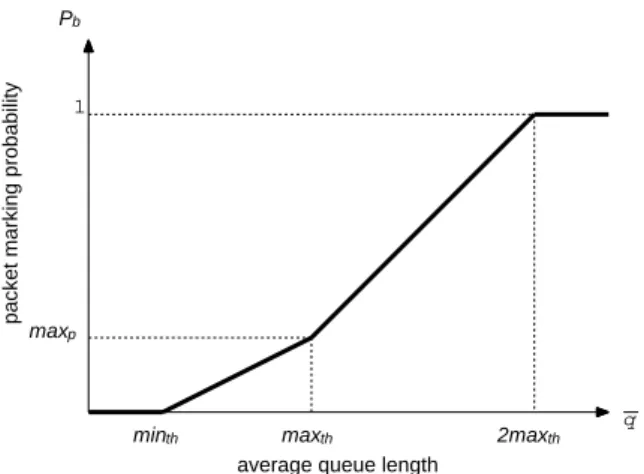
Figure 1: Packet marking function of RED — calculation of packet marking probabilitypbfrom average queue
lengthq.
cally, RED determines the packet marking probabilitypb with
pb = 0 ifq < minth maxp q−minth maxth−minth ifminth ≤q < maxth (1−maxp) q−maxth maxth
+maxp ifmaxth≤q <2maxth
1 ifq≥2maxth
wheremaxp is a control parameter which determines the upper bound of the packet marking probability (see Fig. 1). RED does not distinguish each TCP connection; i.e., RED applies the same packet marking probability
pbto all arriving packets. In what follows, Eq. (3) is referred to as the packet marking function.
Finally, RED discards the arriving packet with the probabilitypadefined by
pa = 1− pb
count×pb, (2)
wherecountis the number of packets that have arrived at the router since the last packet discard.
3
Analysis
In what follows, we consider the case when the AQM mechanism of RED is operating as expected, i.e.,
queue lengthqas pb = maxp q−minth maxth−minth . (3)
When the average queue lengthq is large,pb takes a value close tomaxp. On the contrary, when the average
queue length q is small, pb takes a value close to zero. As can be seen from Eq. (3), the packet marking
function of RED is a linear function in relation to(q−minth). However, use of a linear function has not been
fully validated by taking account of both steady-state and transient-state performances of RED. For example,
the window-based flow control of TCP changes its window size non-linearly according to the packet loss
probability in the network. For this reason, if the packet marking probabilitypbis determined by taking account of the characteristic of the TCP window-based flow control, the steady state performances and/or transient
state performances of RED can be improved. In what follows, we therefore discuss how the packet marking
probabilitypb should be determined by utilizing the analytic results of TCP [16] and RED [18].
In our analysis, by combining the stochastic model of the TCP window size and the deterministic model
of the RED queue length, we analyze how the average queue length is affected by the RED’s packet marking
mechanism. Specifically, we analyze toward what value the average queue length converges with the packet
marking mechanism of RED when the average queue length is given at some time. Consequently, we clarify
the effect of the packet marking function on the average queue length of RED in steady state (i.e., steady
state performance) the average queue length of RED in transient state (i.e., transient state performance), and
robustness against variation in the number of active TCP connections.
First, the packet marking function of RED as defined by Eq. (3) is replaced by
pb = maxpf q−minth maxth−minth , (4)
where f is a monotonically increasing function satisfying f(0) = 0 and f(1) = 1. We then introduce the notion of queue occupancy to indicate how many packets exist in the router’s buffer. The queue occupancy is
defined by
x≡ q−minth
maxth−minth (5)
forminth≤q < maxth. The purpose of the remainder of this section is to investigate how the packet marking
time TCP window size W(p) W(p)/2 w(p) packet loss
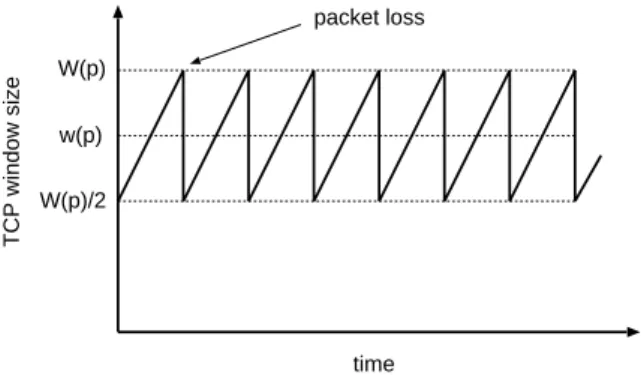
Figure 2: Evolution of TCP window size in congestion avoidance phase.
We consider the expected value of the TCP window size when the packet loss probability in the network
is given. In [16], the TCP throughput in steady state is derived. In the derivation process,W(p), which is the expected value of TCP window size just before TCP detects a packet loss, is also derived (see Eq. (6) in [16]).
W(p) = 2 +3 b b + 8(1−p) 3bp + 2 + b 3b 2 (6)
In the above equation, b is the number of packets required for the destination host to return an ACK packet (usually,b= 1orb= 2), andpis the packet loss probability in the network. In the analysis, the authors assume (1) TCP is operating in the congestion evasion phase, (2) all packet losses are detectable by duplicate ACKs
(i.e., no timeout is triggered), (3) the packet loss probability in the networks is constant, and (4) the maximum
window size is sufficiently large. Note that in [16], the second assumption (i.e., no timeouts) is relaxed and the
more detailed result of the TCP window size is derived. However, we use a simple result given by Eq. (6) since
it is more tractable than the detailed result, allowing us to know more insight on the packet marking function of
RED. Also, note that Eq. (6) gives the expected value of TCP window size just before a packet loss is detected.
Immediately after detecting the packet loss, the TCP window size is decreased to one half. Then, the TCP
window size is slowly increased until the next packet loss is detected. In this paper, we therefore usew(p)as the expected value of TCP window size (Fig. 2):
w(p) = 12 W(p) 2 +W(p) = 3W4(p). (7) Furthermore, we consider the queue length of RED in steady state when the TCP window sizewis given. In [18], the queue length q of RED is derived when the number N of TCP connections have the identical
window sizew.
q = N w−B τ, (8)
whereB is the maximum transmission capacity of the RED router (i.e., the smaller value between the process-ing speed of the RED router and the bandwidth of the outgoprocess-ing link). τ is the two-way propagation delay of the TCP connection excluding the queueing delay at the buffer. In the analysis, almost the same assumptions
as those of [16] are made.
As we have explained in Section 2, RED randomly discards an arriving packet with probabilitypb. Hence,
for a given packet marking probabilitypb, the packet loss probability to TCP connections is given by [3]
p = 1 2pb + 1 2 −1 . (9)
From Eqs. (4), (8), and (9), the average queue lengthqcan therefore be given by
q = N w(p)−B τ (10) = 4N b 2 +b+b 4−8b+b2+ max12pbf(x) b2 −B τ. (11) This equation indicates that the queue length of RED converges toq, when the packet marking probability pb
is determined according to the functionf. Note thatqis the expected value of the queue length since Eq. (7) is also the expected value. Letx∗ be the queue occupancy converged by the packet dropping mechanism of RED (i.e., the average queue length in steady state ifpbis fixed).x∗ is given by
x∗ = q(x)−minth
maxth−minth. (12)
Namely, this means that the probabilistic packet marking mechanism of RED with the packet marking function
f and the queue occupancyx governs the queue occupancy towardx∗. For example, by plotting Eq. (12) on thex–x∗plane, the effect of the packet marking functionf on the steady state and transient state performances of RED can be rigorously analyzed.
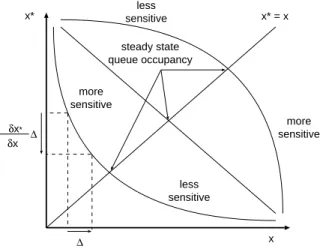
To analyze the relation between Eq. (12) and RED performance, we graphically plot the relation between
queue occupanciesxandx∗. An example of Eq. (12) is shown in Fig. 3. The straight linex∗ =xis also plotted in the figure. The following points can be inferred from this figure.
x x* x* = x steady state queue occupancy ∆ δx* δx ∆ more sensitive less sensitive more sensitive less sensitive
Figure 3: Queue occupancy in thex-x∗ plane.
1. The queue occupancy in steady state (t → ∞) is given by the intersection of the curve of Eq. (12) and the straight linex∗ =x.
2. The steeper the gradient (dx∗/dx) of Eq. (12), the larger the impact of variation in the queue occupancy
xon the average queue length of RED.
3. Conversely, when the gradient (dx∗/dx) of Eq. (12) is gentle, variation in the queue occupancyxhas a negligible effect on the average queue length of RED.
4. In order for the average queue length of RED to be stable when minth < q < maxth, the gradient (dx∗/dx) of Eq. (12) must be negative.
On the basis of these observations, we find the following points with regard to the steady state and transient
state performances of RED.
1. When Eq. (12) is convex (i.e.,d2x∗/dx2 <0), the average queue length of RED in steady state becomes small. Moreover, when the queue occupancy is small, transient state performance is good. Conversely,
when the queue occupancy is large, transient state performance becomes degraded.
2. When Eq. (12) is linear (i.e.,d2x∗/dx2 = 0), the average queue length of RED in steady state is larger than that with a convex function. Also, transient state behavior is not affected by the queue occupancy.
3. When Eq. (12) is concave (i.e.,d2x∗/dx2>0), the average queue length of RED in steady state is large, and the transient state behavior is not good when the queue occupancy is small. On the contrary, transient
On the basis of the above observations, it is considered that the packet marking function f should be chosen such that Eq. (12) becomes a linear function in relation tox. Namely, it is desirable for the gradientdq/dxof Eq. (10) given by the following equation to be constant.
dq dx = −3N f(x) 2maxp 4−8b+b2+max12pbf(x)f(x)2 (13)
This equation suggests that the gradient of Eq. (10) is determined by the parameter at the TCP destination hostb, the number of active TCP connectionsN, and the maximum packet marking probabilitymaxp. Conversely, it suggests that the gradient of Eq. (10) is almost independent of the propagation delay of TCP connectionsτ and the capacity of the RED routerB. This result agrees with conventional research results that the average queue length qof RED is dependent on the number of TCP connections [18, 13, 26]. Therefore, when considering how the packet marking functionf should be determined, the number of active TCP connectionsN should be primarily taken account of.
Moreover, the packet marking functionfthat makes Eq. (12) a linear function in relation toxcan be derived by equating dq/dx from Eq. (13) with a constant value αand by solving this ordinary differential equation. The solution is given by
f(x) = 12 maxp 8−4 b +b 16α2x2 N2 −1 −48α b √ maxpx C(1) N + 36b C(1) 2 −1 ,
whereC(1)is a constant. As can be seen from the above equation, for determiningfso that Eq. (10) becomes linear,f must be changed according to the number of active TCP connectionsN. Our analytic results clearly indicates that information on the number of active TCP connections is necessary for determining the packet
marking probability pb to optimize the steady state and transient state performances of RED. However, the RED router has no capability of knowing the number of active TCP connections since it does not distinguish
each TCP connection. Of course, it is not impossible to estimate the number of active TCP connections, for
example, by distinguishing each TCP connection as is done in SRED. However, adding such processing to
the AQM router makes its implementation very complex. Since implementation simplicity is one of important
features of RED, in reality, it is desirable to choose a packet marking functionfsuch thatfis as independent of the number of TCP connections as possible, and that Eq. (12) has as much linearity in relation toxas possible. Hence, in the next section, we consider three types of packet marking functions — linear, concave, and
that the actual steady state and transient state performances of RED such as throughput is determined by not
only the type of packet marking function but also the setting of its control parameters such asminth,maxth,
maxp, andqw. However, in what follows, we limit our attention to the packet marking function, and carefully
investigate how the packet marking function affects the steady state and transient state performances of RED.
4
Numerical Examples
4.1 Discussion on RED
In the following numerical examples, three types of function classes, Fφ,Gφ, and Hφ, are considered as the packet marking functionf.
• Linear
Fφ(x) = xφ (14)
Note that this function is linear whenφ= 1, is concave whenφ >1, and is convex whenφ <1. • Concave Gφ(x) = 1−1−x2 φ (15)
φ(> 0) is a parameter determining concavity. Namely, whenφis large,Gφ(x)takes a small value. In order forGφto be concave,
d2Gφ(x) dx2 = 1 (1−x2)32 φ 1−1−x2 φ−2 ×1 +1−x2 (φ−1) x2−1 ≥0 must be satisfied. By solving the above inequalities forφ, we have
φ ≥ lim x→0 −1 +√1−x2+x2√1−x2 x2√1−x2 = 1 2. (16) • Convex Hφ(x) = 1−(1−x)2 φ (17)
φ(>0)is a parameter determining convexness. Namely, whenφis large,Hφ(x)takes a small value. In order forHφto be convex,
d2Hφ(x) dx2 = φ(−((x−2) x)) φ−4 2 × φ(x−1)2−(x−2) x−2 ≤0 (18) must be satisfied. Similar to the previous case, by solving the above inequalities forφ, we have
φ ≤ lim
x→0
2−2x+x2
1−2x+x2 = 2. (19)
Note thatFφ(x)withφ= 1.0is identical to Eq. (3) of the original RED.
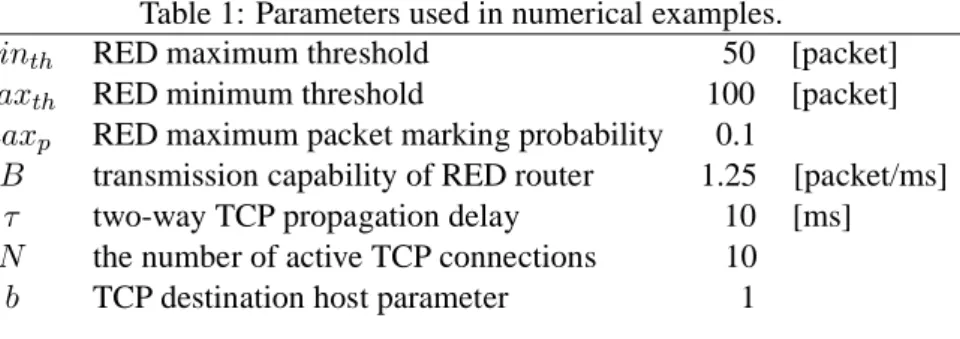
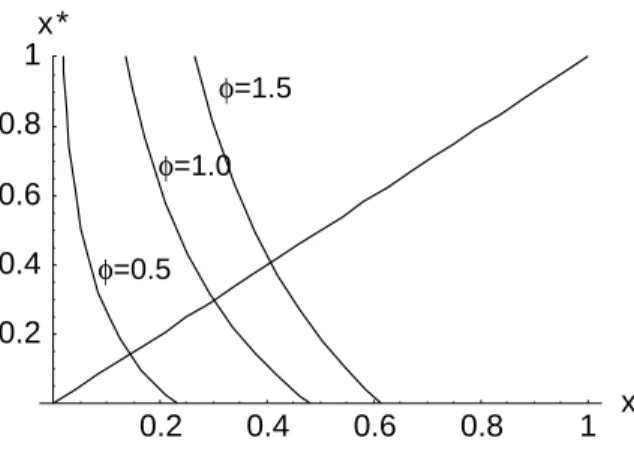
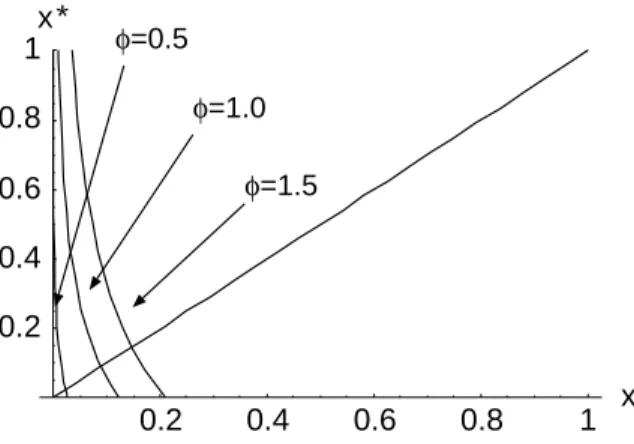
We investigate which packet marking function is the most desirable among Fφ (linear), Gφ (concave), and Hφ (convex) by showing several numerical examples. First, the queue occupancy in the x–x∗ plane is shown when control parameters and system parameters are configured according to Tab. 1. Figures 4, 5, and 6
respectively show results when Fφ (linear), Gφ (concave), and Hφ (convex) are used as the packet marking function. In these figures, φ is changed to 0.5, 1.0, and 1.5. The straight line x = x∗ is also plotted in all figures.
Table 1: Parameters used in numerical examples.
minth RED maximum threshold 50 [packet]
maxth RED minimum threshold 100 [packet]
maxp RED maximum packet marking probability 0.1
B transmission capability of RED router 1.25 [packet/ms]
τ two-way TCP propagation delay 10 [ms]
N the number of active TCP connections 10
b TCP destination host parameter 1
Figure 4 shows that the average queue length of RED (i.e., the intersection with the straight linex =x∗) increases as the value ofφbecomes large whenFφ(linear) is used as the packet marking functionf. Moreover, it is also found that when the queue occupancy x is small, the gradient (dx∗/dx) of Eq. (12) is steep. On the other hand, when the queue occupancy is large, the value of Eq. (12) is almost zero. Namely, in the state
where the queue occupancy is small, since RED discards arriving packets, the queue length is changed rapidly.
In the state where the queue occupancy is large, the queue length rapidly decreases tominth(i.e., the queue
0.2 0.4 0.6 0.8 1 x 0.2 0.4 0.6 0.8 1 x* φ=1.0 φ=0.5 φ=1.5
Figure 4: RED queue occupancy in thex–x∗plane withFφ(linear) forφ= 0.5, 1.0, and 1.5.
0.2 0.4 0.6 0.8 1 x 0.2 0.4 0.6 0.8 1 x* φ=0.5 φ=1.0 φ=1.5
Figure 5: RED queue occupancy in thex–x∗plane withGφ(concave) forφ=0.5, 1.0, and 1.5.
WhenGφ(concave) is used as the packet marking function, the gradient (dx∗/dx) of Eq. (12) is small (see Fig. 5). This figure indicates that as the value ofφbecomes larger (i.e., with increasingly stronger concavity), the average queue length of RED becomes larger. Moreover, this figure shows that Eq. (12) is closer to the
straight line as compared with Fig. 4. Namely, the effect that packet losses have on the queue length of RED is
almost independent of the queue occupancy.
The result when usingHφ(convex) as the packet marking functionf is shown in Fig. 6. This figure shows the relation of the queue occupancy in thex–x∗ plane. It is evident that the gradient (dx∗/dx) of Eq. (12) is quite steep when the queue occupancy is small. Moreover, it is also evident that, as the value of φbecomes large (i.e., with increasingly strong convexity), the gradient of Eq. (12) becomes even steeper. Namely, when Hφ(convex) is used as the functionf, the queue length of RED is changed rapidly when the queue occupancy is small.
0.2 0.4 0.6 0.8 1 x 0.2 0.4 0.6 0.8 1 x* φ=1.0 φ=0.5 φ=1.5
Figure 6: RED queue occupancy in thex–x∗ plane withHφ(convex) forφ= 0.5, 1, and 1.5.
Next, whenFφ(linear),Gφ(concave), andHφ(convex) are used as the packet marking functionf, we show the effect of variation in the number of active TCP connections on the steady state performance and transient
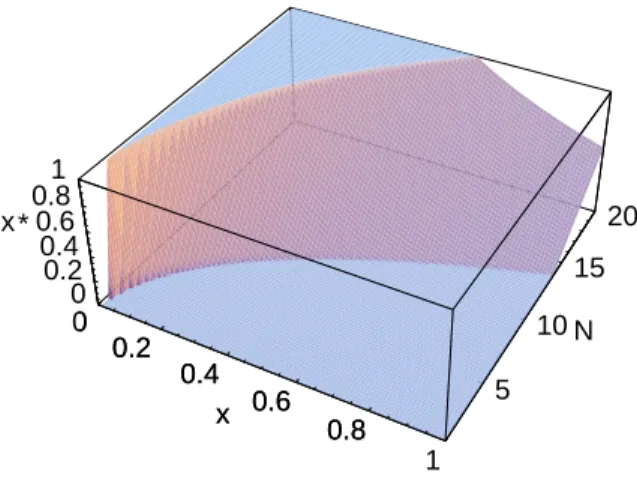
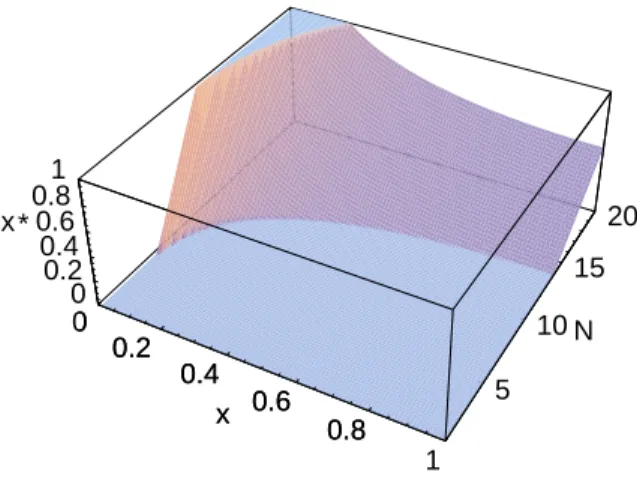
state performance of RED. The relation between the number of TCP connectionsN and the queue occupancy when usingFφ(linear) is shown in Fig. 7. In this figure, the number of TCP connections N is varied from 1 to 20, and the parameter values shown in Tab. 1 are used. As discussed in Section 3, the intersection of the
curved surface and thex–x∗ plane means the average queue length of RED in steady state. This indicates that the average queue length of RED in steady state becomes larger as the number of TCP connectionsN becomes large. In particular, it is evident that when the number of TCP connectionsN is small, the variation in the number of TCP connections significantly affects the average queue length. Furthermore, it is also evident that
the gradient (dx∗/dx) of Eq. (12) becomes small as the number of TCP connections N becomes large. This means that the transient state performance of RED is affected by changing the number of TCP connections.
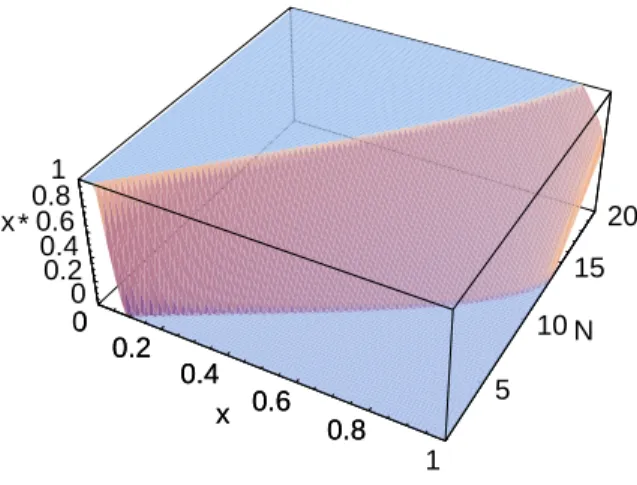
Figure 8 shows the result when usingGφ(concave) as the packet marking functionf. Except for usingGφ (concave) as the packet marking functionf, the same parameter values as those for Fig. 7 are used. This figure shows that the gradient (dx∗/dx) of Eq. (12) is negligibly dependent on the number of active TCP connections when Gφ(concave) is used. Furthermore, similar to Fig. 7, the average queue length of RED in steady state becomes larger as the number of active TCP connectionsN becomes large. However, the average queue length of RED is observed to increase almost linearly with the number of TCP connectionsN. Generally, the number of TCP connections changes according to time. For this reason, Fig. 8 would be more desirable than Fig. 7 in
the sense that the average queue length does not change excessively with the number of TCP connections.
Finally, the result when using Hφ (convex) as the packet marking function f is shown in Fig. 9. This figure shows that the average queue length in steady state becomes large as the number of TCP connections
0 0.2 0.4 0.6 0.8 1 x 5 10 15 20 N 0 0.2 0.4 0.6 0.81 x* 0 0.2 0.4 0.6 0.8 x
Figure 7: Relation between the number of active TCP connections N and RED queue occupancy with Fφ (linear) forφ=1.0.
N becomes large. Moreover, it indicates that the gradient (dx∗/dx) of Eq. (12) is significantly influenced by the number of TCP connections. For this reason, considering the steady state behavior and the transient state
behavior of RED, we consider thatHφ(convex) is unsuitable for application as the functionf.
From the above observations, we conclude that Gφ (concave) is the most suitable for application as the packet marking function f. Although the average queue length in steady state can be small when either Fφ (linear) orHφ(convex) is used, there is a drawback that the transient state performance is quite sensitive to the queue occupancy. On the other hand, whenGφ (concave) is used, variation in the queue occupancy and the number of TCP connections negligibly affects the transient state behavior of RED. In summary, whenGφ (concave) is used as the packet marking function, the transient state performance of RED and robustness to
variations in the number of active TCP connections are improved.
4.2 Discussion on Adaptive RED
As we have explained in Section 1, Adaptive RED solves the problem associated with RED that its average
queue length is dependent on the number of active TCP connections [25]. Adaptive RED adaptively changes
its maximum packet marking probabilitymaxp according to its average queue length. More specifically, when the average queue length is smaller than minth, maxp is decreased by (1/α−1)maxp. Conversely, when the average queue length is larger than maxth, maxp is increased by (1−β)maxp. The main purpose of the Adaptive RED control is to improve the steady state performance of RED. However, it has not been fully
0 0.2 0.4 0.6 0.8 1 x 5 10 15 20 N 0 0.2 0.4 0.6 0.81 x* 0 0.2 0.4 0.6 0.8 x
Figure 8: Relation between the number of active TCP connections N and RED queue occupancy with Gφ (concave) forφ= 1.0.
control mechanism. In what follows, we therefore apply our analytic results to Adaptive RED, and discuss the
steady state and transient state performances of Adaptive RED. Although our analysis is not for Adaptive RED
but for RED, much insight on Adaptive RED can be gained from our analytic results because of the following
reason. The algorithm of Adaptive RED is the same as that of RED except that Adaptive RED dynamically
adjusts the maximum packet marking probabilitymaxpaccording to its average queue length. Hence, at a rela-tively small time-scale, Adaptive RED can be considered as RED with the roughly optimized maximum packet
marking probability maxp. In other words, by analyzing the steady state and transient state performances of RED with different maximum packet marking probabilities, we can investigate the performance of Adaptive
RED. As we have explained in Section 3, the average queue length of RED is dependent on the number of
active TCP connections. We can therefore investigate how the performance of Adaptive RED is affected by
changing the maximum packet marking probabilitymaxpaccording to the number of active TCP connections.
We consider three cases: i.e., the number of active TCP connectionsN is fixed at 5, 10, or 20. In these cases, by the adaptive control of the maximum packet marking probabilitymaxp, the average queue length of Adaptive RED will be independent of the number of active TCP connections, and will converge to a constant
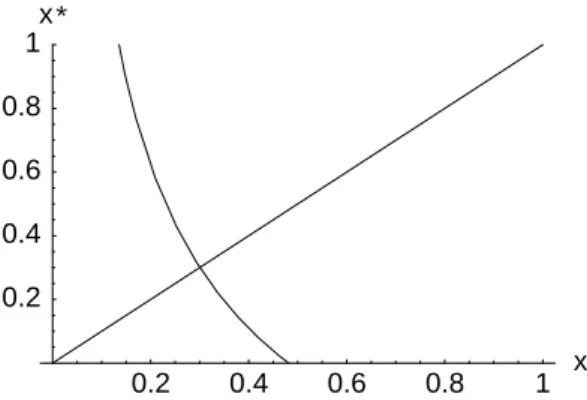
value in steady state. Hence, we assume that the maximum packet marking probabilitymaxp is fixed at 0.02, 0.1, or 0.4 by the control of Adaptive RED when the number of TCP connectionsN is 5, 10, or 20, respectively. For each case, the relation of the queue occupancy in thex–x∗plane is shown in Figs. 10, 11, or 12, respectively. By comparing these figures, it is evident that the average queue length of Adaptive RED in the steady state (i.e.,
0 0.2 0.4 0.6 0.8 1 x 5 10 15 20 N 0 0.2 0.4 0.6 0.81 x* 0 0.2 0.4 0.6 0.8 x
Figure 9: Relation between the number of TCP connectionsN and RED queue occupancy withHφ(convex) forφ= 1.0. 0.2 0.4 0.6 0.8 1 x 0.2 0.4 0.6 0.8 1 x*
Figure 10: Adaptive RED queue occupancy in thex–x∗plane forN = 5andmaxp = 0.02.
of Eq. (12) is negligibly affected by the maximum packet marking probability maxp. On the basis of these observation, we find that the adaptive control mechanism of Adaptive RED, which dynamically changes the
maximum packet marking probability, improves its steady state behavior, but it does not improve the transient
state behavior. However, the performance of Adaptive RED can be improved by using a concave function as
the packet marking function. Because of space limitation, more detailed investigation is beyond the scope of
this paper and will be addressed in the forthcoming paper.
5
Conclusion
In this paper, we have discussed how the packet loss probability of RED should be determined from its average
0.2 0.4 0.6 0.8 1 x 0.2 0.4 0.6 0.8 1 x*
Figure 11: Adaptive RED queue occupancy in thex–x∗plane forN = 10andmaxp = 0.1.
0.2 0.4 0.6 0.8 1 x 0.2 0.4 0.6 0.8 1 x*
Figure 12: Adaptive RED queue occupancy in thex–x∗plane forN = 20andmaxp = 0.4.
numerical examples, we have investigated the performance of the RED router in three cases — when the
function that determines the packet loss probability is either linear, concave, or convex. Consequently, we have
found that the transient behavior and the robustness to variation in the number of TCP connections can be
improved by using a concave function for determining the packet loss probability of RED. Moreover, we have
discussed the characteristics of Adaptive RED with respect to our analysis result. Consequently, we have found
that an adaptive control mechanism of Adaptive RED, which dynamically changes the maximum packet loss
probability, improves the steady state behavior, but it does not improve the transient state behavior.
Our analytic results have clearly shown that the control of RED, which discards arriving packets with a
probability proportional to its average queue length, has several problems associated with steady state behavior
and robustness. In recent years, various AQM mechanisms which solve these drawbacks of RED have been
proposed. However, most of these AQM mechanisms use a function which is linear to the average queue length
for determining the packet marking probability. Namely, the problems found in this paper have not been taken
design an AQM mechanism by taking account of not only steady state behavior but also transient state behavior
and robustness.
Because of space limitation, comparison between analytic and simulation results cannot be included in this
paper although several simulation results that we have obtained show validity of our approximate analysis.
However, more extensive study using simulation would be appropriate.
References
[1] B. Braden et al., “Recommendations on queue management and congestion avoidance in the Internet,”
Request for Comments (RFC) 2309, Apr. 1998.
[2] S. Floyd and K. Fall, “Promoting the use of end-to-end congestion control in the Internet,” IEEE
Trans-actions on Networking, May 1999.
[3] S. Floyd and V. Jacobson, “Random early detection gateways for congestion avoidance,” IEEE/ACM
Transactions on Networking, vol. 1, pp. 397–413, Aug. 1993.
[4] Y. Zhang and L. Qiu, “Understanding the end-to-end performance impact of RED in a heterogeneous environment,” Cornell CS Technical Report 2000-1802, July 2000.
[5] M. Christiansen, K. Jeffay, D. Ott, and F. D. Smith, “Tuning RED for web traffic,” in Proceedings of ACM
SIGCOMM 2000, pp. 139–150, Aug. 2000.
[6] M. May, J. Bolot, C. Diot, and B. Lyles, “Reasons not to deploy RED,” in Proceedings of IWQoS ’99, pp. 260–262, Mar. 1999.
[7] V. Misra, W.-B. Gong, and D. Towsley, “Fluid-based analysis of a network of AQM routers supporting TCP flows with an application to RED,” in Proceedings of ACM SIGCOMM 2000, pp. 151–160, Aug. 2000.
[8] C. Brandauer, G. Iannaccone, C. Diot, and T. Ziegler, “Comparision of tail drop and active queue man-agement performance for bulk-data and Web-like Internet traffic,” in Proceedings of the Sixth IEEE
Sym-posium on Computers and Communications, IEEE ISCC 2001, pp. 122–129, July 2001.
[9] S. Floyd, “Discussions on setting RED parameters,” Nov. 1997. available athttp://www.aciri. org/floyd/REDparameters.txt.
[10] S. Floyd, “Recommendations on using the gentle variant of RED,” May 2000. available at http:// www.aciri.org/floyd/red/gentle.html.
[11] D. Lin and R. Morris, “Dynamics of random early detection,” in Proceedings of ACM SIGCOMM ’97, pp. 127–137, Oct. 1997.
[12] J. Aweya, M. Ouellette, D. Y. Montuno, and A. Chapman, “An adaptive buffer management mechanism for improving TCP behavior under heavy load,” in Proceedings of IEEE International Conference on
Communications (ICC 2001), pp. 3217–3223, 2001.
[13] T. J. Ott, T. V. Lakshman, and L. Wong, “SRED: Stabilized RED,” in Proceedings of IEEE INFOCOM
[14] W.-C. Feng, D. D. Kandlur, D. Saha, and K. G. Shin, “Techniques for eliminating packet loss in congested TCP/IP networks,” Tech. Rep. CSE-TR-349-97, Oct. 1997.
[15] H. Wang and K. G. Shin, “Refined design of random early detection gateways,” in Proceedings of IEEE
GLOBECOM ’99, pp. 769–775, 1999.
[16] J. Padhye, V. Firoiu, D. Towsley, and J. Kurose, “Modeling TCP throughput: a simple model and its empirical validation,” in Proceedings of ACM SIGCOMM ’98, pp. 303–314, Sept. 1998.
[17] D. Bertsekas and R. Gallager, Data Networks. Englewood Cliffs, New Jersey: Prentice-Hall, 1987.
[18] H. Ohsaki and M. Murata, “Steady state analysis of the RED gateway: stability, transient behavior, and parameter setting,” IEICE Transactions on Communications, vol. E85-B, pp. 107–115, Jan. 2002.
[19] M. Kisimoto, H. Ohsaki, and M. Murata, “Analyzing the impact of TCP connections variation on tran-sient behavior of RED gateway,” in Proceedings of the 16th International Conference on Information
Networking (ICOIN-16), pp. 10A2.1–10A2.12, Jan. 2002.
[20] M. Kisimoto, H. Ohsaki, and M. Murata, “On transient behavior analysis of random early detection gate-way using a control theoretic approach,” in Proceedings of the IEEE Control Systems Society Conference
on Control Applications (CCA/CACSD 2002), pp. 1144–1149, Sept. 2002.
[21] V. Firoiu and M. Borden, “A study of active queue management for congestion control,” in Proceedings
of IEEE INFOCOM 2000, pp. 1435–1444, Mar. 2000.
[22] C. Hollot, V. Misra, D. Towsley, and W.-B. Gong, “A control theoretic analysis of RED,” Tech. Rep. TR 00-41, CMPSCI, July 2000.
[23] C. Hollot, V. Misra, D. Towsley, and W.-B. Gong, “On designing improved controllers for AQM routers supporting TCP flows,” in Proceedings of IEEE INFOCOM 2001, pp. 1726–1734, 2001.
[24] P. Kuusela, P. Lassila, and J. Virtamo, “Stability of TCP-RED congestion control,” in Proceedings of
Seventeenth International Teletraffic Congress, Dec. 2001.
[25] S. Floyd, R. Gummadi, and S. Shenker, “Adaptive RED: an algorithm for increasing the robustness of RED,” available athttp://www.icir.org/floyd/papers/adaptiveRed.pdf, Aug. 2001.
[26] M. May, T. Bonald, and J.-C. Bolot, “Analytic evaluation of RED performance,” in Proceedings of IEEE