SMART METERING &
INFRASTRUCTURE PROGRAM
BUSINESS CASE
TABLE OF CONTENTS
Executive Summary . . . 1
Introduction . . . 3
What is the Smart Metering Program? . . . 4
Benefits . . . 5
Improve Safety and Reliability . . . 5
Enhance Customer Service . . . 6
Reduce Electricity Theft . . . 6
Improve Operational Efficiency and Reduce Wasted Electricity . . . 7
Support Greater Customer Choice and Control . . . 7
Help Modernize BC Hydro’s Electricity System . . . 8
Financial Analysis . . . 8
Quantified Benefits . . . 8
Benefits Realization . . . 9
Program Costs . . . 11
Net Present Value . . . 11
Risks . . . 11
Lessons Learned from Other Jurisdictions . . . 11
Key Timeline for Customers . . . 13
Appendix 1: Smart Meter Security, Privacy and Safety . . . 14
Appendix 2: Program Scope . . . 18
Appendix 3: Research . . . 22
Appendix 4: Quantified Benefits and Key Assumptions . . . 24
Appendix 5: Additional Non-Quantified Benefits . . . 29
Appendix 6: Business Case Analysis . . . 31
Appendix 7: Rate Analysis . . . 33
Appendix 8: Key Business Risks . . . 35
Appendix 9: Managing Risk Through Procurement . . . 37
Glossary . . . 39
List of Tables
Table 1: Program Benefits as of December 2010—in Present Value . . . 9Table 2: Smart Metering Program Budget . . . 10
Table 3: Summary of Lessons Learned from Other Jurisdictions . . . 12
Table 4: Key Timeline for Customers . . . 13
List of Figures
Figure 1: Budget Components by Percentage with Specific Focus on the Implementation Phase . . . 11EXECUTIVE SUMMARY
In 2011, BC Hydro will begin implementation of the Smart Metering Program . The Smart Metering Program will pay for itself through reduced theft of electricity, energy savings, and operating efficiencies .
BC Hydro’s Smart Metering Program is an important foundational step in the modernization of BC Hydro’s electricity system . The program involves replacing existing customer meters, now becoming obsolete, with a comprehensive smart metering system . This system includes the technology and telecommunications infrastructure needed for BC Hydro to continue to manage the electricity system in a reliable, safe and cost-effective manner .
Substantial Benefits to Customers
The Smart Metering Program will:Improve safety and reliability
• through faster and precise outage notification and a reduction in the damage caused by
illegal electricity diversions .
• Enhance customer service by reporting electricity use more accurately, eliminating estimated bills, simplifying the process of opening and closing an account when moving, and reducing the need for onsite visits by field crews .
Reduce electricity theft
• that currently amounts to approximately $100 million a year in lost revenue—costs that are borne
by all legitimate BC Hydro customers .
Improve operational efficiency and reduce wasted electricity
• through voltage optimization . Lower operating costs are
passed on to all customers in rates .
• Support greater customer choice and control by offering optional in-home feedback tools that provide direct and timely information to customers about their electricity consumption .
• Help modernize British Columbia’s electricity system by replacing nearly obsolete meters, and creating the foundation for supporting new uses of electricity such as electric vehicles, customer generation and microgrids .
Implementation to be Prudent and On Budget
Smart meter installation will be on time and on budget . Installation of smart meters will begin in 2011 and will be complete by the end of 2012 with other elements of the program implemented through 2014 .
Security, privacy and safety features in smart metering infrastructure will include encryption of data similar to that used by online banking systems, and mandatory criteria was included in all procurement processes to ensure only proven technologies were considered .
BC Hydro will maintain existing rate structures throughout the meter installation process . Any new rate structures will be subject to public consultation and review by the independent British Columbia Utilities Commission .
The BC Utilities Commission will review the prudency of BC Hydro’s decisions and actions in relation to the implementation of the program .
Benefits for BC Hydro Customers Exceed Costs
The Smart Metering Program business case shows that the benefits exceed the cost by $520 million in today’s dollars . These benefits are attributed to four primary areas including:
• Operating Efficiencies—More efficient use of distribution assets and streamlining of business processes, reducing operating and future capital expenses;
• Energy Savings—Lower electricity use through improved system control, operational efficiencies and providing customers with new options to better manage their electricity consumption;
• Revenue Protection—Includes both recovery of revenue (e .g . back-billing) and prevention of future potential revenue loss (e .g . reduced theft); and
Capacity Savings—
• Lower electricity use at certain key periods, which reduces peak demand and capacity constraints . Almost 80 per cent of the quantified benefits delivered through the Smart Metering Program result from BC Hydro activities . If customers take advantage of the conservation tools to be implemented by the Smart Metering Program, the overall benefits increase significantly .
Positive Net Present Value
The Smart Metering Program business case has a net present value (NPV) of $520 million through F2033 . The NPV remains positive even if all costs are incurred but only the BC Hydro operational efficiencies are realized . The NPV also remains positive if all benefits are achieved at the low end of the estimated benefit range .
The following table summarizes the key financial components of the Smart Metering Program business case, resulting in the positive NPV of $520 million .
Rate Analysis
Net benefits will flow into lower rates for customers, reducing them below what they would otherwise be in the absence of BC Hydro’s investment in the program .
BUSINESS CASE SUMMARY IN NOMINAL ANd PRESENT VALUE
Business Case Summary Nominal Value ($M) Present Value ($M)
Gross Benefits attributable to Smart Metering Program, less costs related to the achievement of individual benefits
$4,658 $1,629
Less: Ongoing operating and maintenance expenses and incremental asset replacement capital
(745) (330)
Less: Smart Metering Program Costs (930) (779)
Total Net Value for the period F2006 to F2033 $2,983 $520
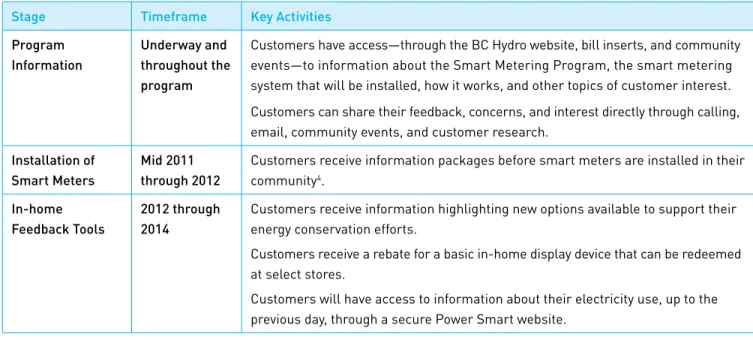
kEY TIMELINE FOR CUSTOMERS
Stage Timeframe Key Activities
Program Information
Underway and throughout the program
Customers have access—through the BC Hydro website, bill inserts, and community events—to information about the Smart Metering Program, the smart metering system that will be installed, how it works, and other topics of customer interest . Customers can share their feedback, concerns, and interest directly through calling, email, community events, and customer research .
Installation of Smart Meters
Mid 2011 through 2012
Customers receive information packages before smart meters are installed in their community1 .
In-home Feedback Tools
2012 through 2014
Customers receive information highlighting new options available to support their energy conservation efforts .
Customers receive a rebate for a basic in-home display device that can be redeemed at select stores .
Customers will have access to information about their electricity use, up to the previous day, through a secure Power Smart website .
____________________
INTROdUCTION
BC Hydro was created 50 years ago to plan, build and deliver a clean, reliable supply of electricity to homes and businesses throughout our growing province . Investments in dams, generating stations and transmission and distribution networks ensured a stable supply of electricity for generations of British Columbians that followed .
Thanks to this visionary planning and investment, BC Hydro has been reliably meeting our province’s growing energy needs for the last 50 years . However, vitally important elements of our electricity system infrastructure are reaching an age when significant investment is required to keep our system reliable .
At the same time that our electricity system is aging, demand for power is growing . The latest forecasts show demand for electricity in British Columbia growing by as much as 40 per cent over the next 20 years . That’s the equivalent of adding five more cities the size of Vancouver to our system .
The Need for Smart Metering
Home electronics, consumer products, and manufacturing automation are just a few examples of how technology has advanced, leading to more electricity use than ever before .The electricity system that supplies the energy to support this demand hasn’t kept pace . For example, meters— the devices that measure how much electricity customers are using—have not fundamentally changed since the 1950s . In fact, the electro-mechanical meter is becoming obsolete and will soon no longer be manufactured .
Today, BC Hydro’s meters provide a one-way flow of information (from the customer to the utility) that is very basic and not timely . For example, residential and commercial customers might be surprised to learn that BC Hydro does not know of outages until, and unless, customers call to tell us the power is out .
The electricity system must be updated to ensure that BC Hydro can continue to provide customers with safe and reliable electricity .
Modernizing British Columbia’s electricity system will also ensure that advances in technology can be accommodated . Without new investment in technology and systems the 20th century electricity system will be unable to support 21st century
innovations such as solar panels, electric vehicles and increased customer service options .
Utilities around the world are upgrading their electricity systems and adopting smart meters to enhance customer service, improve reliability and make their operations more efficient . By 2015, 250 million smart meters will be installed worldwide2 .
In short, investing in smart metering infrastructure is as important as renewing and reinvesting in our dams and generating facilities .
Over the next three years, BC Hydro will be investing $2 billion per year to build and renew dams, generating facilities, and transmission and distribution networks to ensure a safe and reliable supply of power continues to flow to B .C .’s homes and businesses . A key component of this investment is the Smart Metering Program .
WhAT IS ThE SMART METERING PROGRAM?
Smart meters are part of an integrated program that will pay for itself through reduced theft of electricity, energy savings, and operational efficiencies . This means that over the long term the Smart Metering Program will reduce customer rates below what they would otherwise be in the absence of BC Hydro’s investment in the program .
BC Hydro’s Smart Metering Program is an important foundational step in the modernization of BC Hydro’s electricity system . It involves replacing existing customer meters with smart meters and upgrading the technology and telecommunications infrastructure that allows BC Hydro to manage the electricity system in a reliable, safe and cost-effective manner . The program consists of:
Smart meters are digital meters that allow two-way communications between a customer’s meter and BC Hydro through •
a secure connection that captures the amount of electricity consumed and when . For more information about smart meter safety, security, and privacy, see Appendix 1 .
Optional in-home feedback tools to provide up-to-date energy consumption and price information directly to residential •
and commercial customers providing them with more choices to actively manage their electricity use .
Systems and infrastructure to reduce electricity theft that will help to create safer communities and mitigate rate impacts •
borne by legitimate customers .
Advanced telecommunications infrastructure to allow BC Hydro to more accurately measure the actual flow of electricity •
through the system and support advanced electricity system management and customer applications .
Information technology systems to integrate meter reading data into BC Hydro’s customer billing, load forecasting and •
outage management systems .
The broad scope of the Smart Metering Program is described further in Appendix 2 . Smart meter installation will begin in 2011 and will be complete by the end of 2012 . Customers will be notified in advance when the meter exchange will take place in their community . While customers do not need to be home for the meter exchange, they do need to ensure technicians have access to their current meter . There will be a brief service interruption during the meter exchange, which takes only minutes . Once smart meters are installed, customers will have the option of adopting in-home feedback tools . For example:
Customers can choose to take advantage of incentives to purchase an in-home •
display device that provides near real-time information about their energy use; and
All customers will have access to a secure website that provides prior day •
consumption data and other tools to analyze electricity use .
____________________ 2 Pike Research, November 2009
Your new smart meter will replace the existing meter on the outside of your home or in your meter bank if you live in a multi-dwelling unit . If you choose an optional in-home display, the smart meter can send real-time consumption and price information directly to you .
BENEFITS
BC Hydro’s Smart Metering Program delivers substantial benefits to customers . Specifically, the program will:
Improve safety and reliability; •
Enhance customer service; •
Reduce electricity theft; •
Improve operational efficiency and reduce wasted electricity; •
Support greater customer choice and control; and •
Help modernize British Columbia’s electricity system . •
Improve Safety and Reliability
Keeping customers’ power on requires BC Hydro to dispatch crews day and night, under all types of weather conditions to search for, assess, and repair faults on the electricity system . The current metering infrastructure does not provide any residential customer outage information to BC Hydro . In fact, BC Hydro is not aware of outages until customers call in to inform us that the power is out .
Due to this lack of detailed and specific outage information, field crews engage in significant travel to identify the location and cause of an outage, increasing personal risk as well as delaying restoration times . During storm season, the outages are frequently at multiple locations and the risk is even higher due to the need to drive and fly under adverse conditions .
In addition, theft of electricity is occurring in increasingly dangerous ways, posing major safety risks to the general public, first responders and BC Hydro employees through the threat of fire and electrocution . For example, in Surrey, approximately 50 per cent of marijuana growing operations inspected by the fire department involved diversion of electricity from BC Hydro distribution lines . Theft also causes strain on the distribution infrastructure resulting in an estimated 100 premature transformer failures a year .
The Smart Metering Program will deploy new technologies, better analysis and notification tools, and automated decision-making that will result in improved public and employee safety and shorter outage restoration times . Benefits include: • Faster outage notification—Real-time outage notification provided
automatically by smart meters will serve to pinpoint problems quickly and specifically, reducing the amount of travel required under adverse conditions and accelerating the restoration process .
• Reliable restoration notification—Allowing field crews to quickly confirm the outage has been addressed instead of driving along the electricity lines to look for secondary outage problems .
• Reduced risk and fewer outages from electricity diversions—By helping identify potential electricity diversions in a more consistent and automated way, the Smart Metering Program will reduce safety risks and customer outages that are caused by premature transformer failures .
Power line technician during a Campbell River snowstorm .
Smart meters will decrease illegal electricity diversion (shown here), keeping neighbourhoods safe from fires like the one that destroyed this house . Photo credit: Vancouver Fire and Rescue Services and Vancouver Police Department
Enhance Customer Service
Smart meters capture more accurate and detailed electricity use information, which will result in enhanced customer service including:
More accurate meter readings—
• Anomalies in reported electricity use can
be reconciled quickly and accurately with the use of hourly meter data rather than bi-monthly meter reads or estimated bills .
• Elimination of estimated billing—With smart meters in place, customer bills will be generated from actual electricity use, not from estimated readings based on profiles .
• More streamlined moving procedures—With automated meter reads available on request, customers can receive an accurate, up-to-date final bill and will no longer have to deal with transferring bill amounts when they move into or move out of a home or business .
• Better informed customer service representatives—BC Hydro call centre employees will have substantially more accurate information available to address customer questions related to their bills, electricity use, or opportunities for energy savings . • Increased privacy and convenience—Customers will no longer need to provide meter readers with regular access . • Reduced onsite visits—Automated meter reading, automated connection services, and more information available for
problem solving, will reduce the need for BC Hydro to send crews to customer homes and businesses resulting in direct savings that will be passed on to customers .
Reduce Electricity Theft
Legitimate customers bear the cost of electricity theft, which has grown significantly from approximately 500 GWh in 2006 to an estimate of at least 850 GWh today—that’s enough power to supply 77,000 homes for a year and amounts to approximately $100 million a year in energy cost .
Although BC Hydro has identified over 2,600 electricity thefts over the past five years, identifying and confirming theft is a time-consuming, inefficient and expensive manual process . While BC Hydro cannot reasonably expect to eliminate all electricity theft, augmenting the current manual process with new technology will substantially reduce current levels of theft by:
Theft detection—
• New distribution system meters (different from those to be
installed at customer homes or businesses) located at key points on BC Hydro’s system will measure electricity supplied to specific areas . Combined with soft-ware tools to enable electricity balancing analysis, distribution system meters will help BC Hydro identify electricity theft more accurately and address it more quickly .
• Tamper detection—Smart meters have a tamper detection feature that automatically notifies BC Hydro if they have been removed from the wall or otherwise manipulated .
Reducing electricity theft delivers tangible financial benefits through increased revenue, revenue recovery (e .g . back-billing), and reduced cost of energy .
Call centre agents will have more accurate information available to address customer questions related to their bills, electricity use, or opportunities for energy savings .
Electricity theft results in higher rates for legitimate customers .
Improve Operational Efficiency and Reduce Wasted Electricity
Currently, BC Hydro transmits more electricity than needed by customers to ensure there is acceptable power quality delivered to every customer . Reducing wasted electricity benefits all customers through lower operating costs .
The amount of excess energy required can be substantially reduced with better monitoring and control over the distribution system including:
• Voltage optimization—Use voltage information collected from smart meters to make existing electricity control devices (voltage regulators, capacitor banks, and transformers) along the distribution system more efficient . Simply put, less electricity will be required to be transmitted to maintain expected power quality, resulting in less electricity having to be generated or purchased, which in turn, lowers costs .
• Efficiencies in meter reading, meter sampling, distribution system maintenance, outage management, and load research—
Will significantly reduce operating costs .
Support Greater Customer Choice and Control
Today, customers have few tools to manage their electricity use because the current meters do not capture enough information . Without specific and timely information, it is difficult for customers to take advantage of new service options or make informed decisions to actively manage electricity in their own circumstances .
Research has shown that electricity is typically not something customers regularly think about, and that increasing customer awareness by enabling them to view their own consumption in a timely manner can achieve electricity savings of up to 15 per cent . See Appendix 3 for more information related to research .
More information and control will help customers to save money—and help to achieve BC Hydro’s goal of meeting two-thirds of incremental electricity demand through conservation by 2020 .
The Smart Metering Program will enable customers to have greater choice and control of their energy use through:
Optional in-home feedback tools—
• BC Hydro will provide incentives for customers
to adopt market available in-home displays, programmable thermostats, and energy management software products .
Power Smart website—
• Customers will also have the option of accessing their
own secure consumption information through BC Hydro’s expanded Power Smart website .
Rate Options—
• Smart meters capture information that will enable BC Hydro to design new rate structures that encourage conservation during peak periods, such as voluntary time-of-use . The design of these rates will involve consultation with customers and will be subject to review and approval by the BC Utilities Commission .
Optional in-home feedback tools will provide customers with more choices and control .
Hydroelectric Generation Transmission
BC Hydro Customer
Substation Distribution Home/Building
Today’s Electricity System Features of a Modern Electricity System
Customer Generation and Storage
Help Modernize BC Hydro’s Electricity System
BC Hydro’s electricity system, including the current base of electromechanical meters, has changed very little over the past 50 years . These older style meters are becoming obsolete, as meter vendors switch to producing smart meters .
Upgrading to a smart metering system is a key foundational step in modernizing BC Hydro’s overall electricity system . Additional measurement points throughout the electricity system combined with the ability to measure electricity to and from a customer site will enable:
Support for new customer applications—
• Advanced telecommunications infrastructure will support advanced electricity
system functions and emerging applications like customer generation and microgrids .
Support for large-scale clean energy initiatives—
• Implementation of smart metering and network operations functions will
help BC Hydro to manage new uses for the electricity system such as electric vehicles, electrification of public transportation, community-based generation, and integration of renewable fuel sources . For example, with a more modern electricity system, customers who invest in solar panels, or other clean sources of electricity, could sell excess power back to BC Hydro, or draw electricity from their electric vehicles during a power outage .
FINANCIAL ANALYSIS
The Smart Metering Program business case, originally developed beginning in 2006, was most recently updated in December 2010 and reflects updated benefit assumptions as well as increased cost certainty as a result of the procurement activity during 2010 . This section summarizes the benefits, costs, and net present value included in the business case .
Quantified Benefits
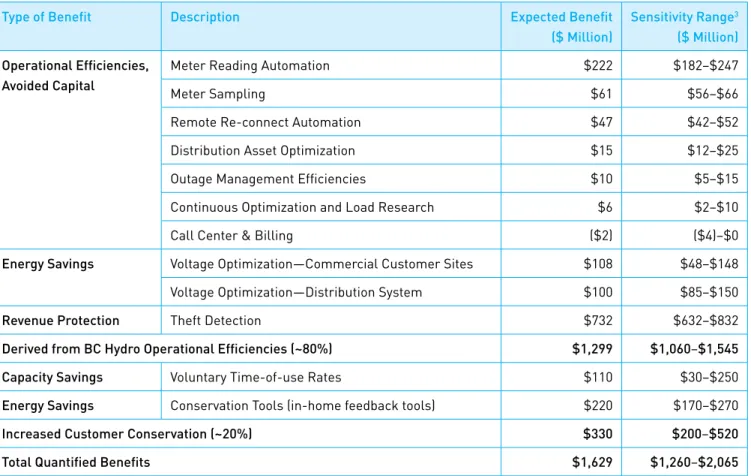
The Smart Metering Program business case includes approximately $1 .6 billion in quantified benefits (present value), to be realized over 20 years . These benefits are attributed to four primary areas including:
Operational Efficiencies—
• More efficient use of distribution assets and streamlining of business processes, thereby reducing
operational and future capital expenses;
Energy Savings—
• Lower electricity use through improved distribution system control, efficiencies and reduced consumption by customers;
Revenue Protection—
• Includes both recovery of revenue and prevention of future potential revenue loss through reduced theft; and
Capacity Savings—
• Lower electricity use at certain key periods, which reduces peak demand and capacity constraints .
Almost 80 per cent of the quantified benefits delivered through the Smart Metering Program result from operational efficiencies within BC Hydro . If customers take advantage of the conservation tools offered through the program, the overall benefits increase significantly . Additional information regarding each specific benefit stream, including key assumptions, is provided in Appendix 4 .
In addition to the quantified benefits, the Smart Metering Program will deliver numerous other benefits that have not been quantified in this business case or cannot be monetized . A summary of these additional benefits can be found in Appendix 5 . The operational savings delivered by the Smart Metering Program will benefit all BC Hydro customers . As a publically-owned cost-recovery utility, all benefits realized by BC Hydro are passed on to customers and will be reflected in rates . In addition, customers will not be billed separately for the cost of the new smart meters .
Benefits Realization
The Smart Metering Program is a large and complex project designed to deliver significant benefits from across several business groups at BC Hydro . The benefits described in this business case pay for the investment in the program . BC Hydro is implementing a formal benefit realization framework, base-lined with the benefit streams identified in this business case, to ensure accountability and transparency in the measurement and reporting of the benefits over time .
TABLE 1: PROGRAM BENEFITS AS OF dECEMBER 2010—IN PRESENT VALUE
Type of Benefit Description Expected Benefit ($ Million)
Sensitivity Range3
($ Million)
Operational Efficiencies, Avoided Capital
Meter Reading Automation $222 $182–$247
Meter Sampling $61 $56–$66
Remote Re-connect Automation $47 $42–$52
Distribution Asset Optimization $15 $12–$25
Outage Management Efficiencies $10 $5–$15
Continuous Optimization and Load Research $6 $2–$10
Call Center & Billing ($2) ($4)–$0
Energy Savings Voltage Optimization—Commercial Customer Sites $108 $48–$148
Voltage Optimization—Distribution System $100 $85–$150
Revenue Protection Theft Detection $732 $632–$832
Derived from BC Hydro Operational Efficiencies (~80%) $1,299 $1,060–$1,545
Capacity Savings Voluntary Time-of-use Rates $110 $30–$250
Energy Savings Conservation Tools (in-home feedback tools) $220 $170–$270
Increased Customer Conservation (~20%) $330 $200–$520
Total Quantified Benefits $1,629 $1,260–$2,065
____________________
3 Sensitivity ranges identified for each benefit bracket the probable benefit outcomes . The ranges are based on an assessment of the upside and downside in variability associated with the key drivers behind each benefit .
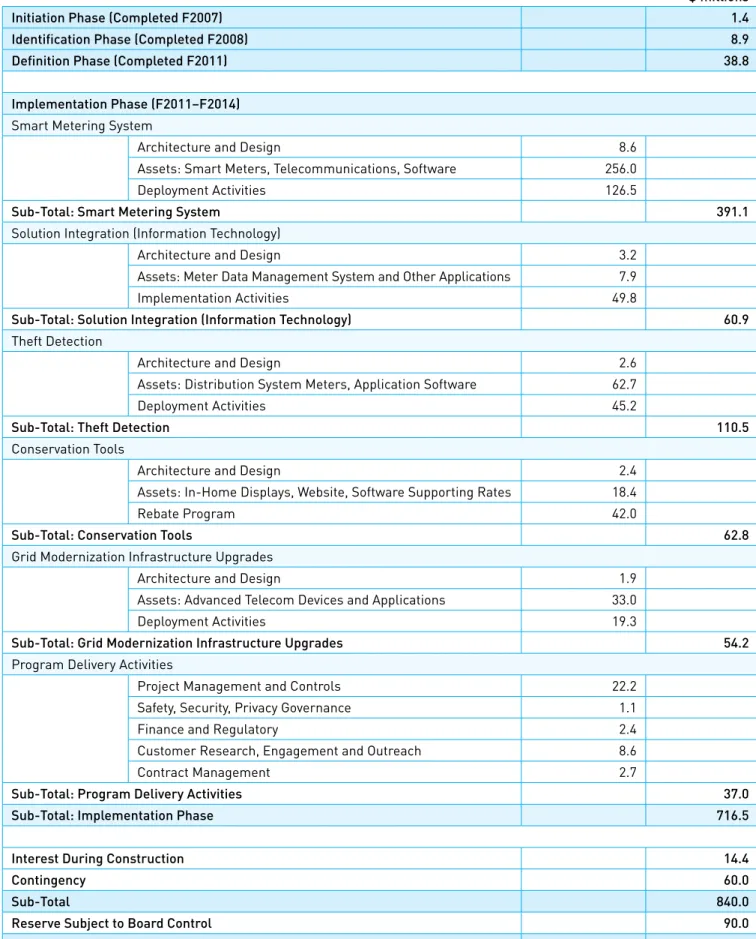
TABLE 2: SMART METERING PROGRAM BUdGET
$ millions
Initiation Phase (Completed F2007) 1 .4
Identification Phase (Completed F2008) 8 .9
Definition Phase (Completed F2011) 38 .8
Implementation Phase (F2011–F2014)
Smart Metering System
Architecture and Design 8 .6
Assets: Smart Meters, Telecommunications, Software 256 .0
Deployment Activities 126 .5
Sub-Total: Smart Metering System 391 .1
Solution Integration (Information Technology)
Architecture and Design 3 .2
Assets: Meter Data Management System and Other Applications 7 .9
Implementation Activities 49 .8
Sub-Total: Solution Integration (Information Technology) 60 .9
Theft Detection
Architecture and Design 2 .6
Assets: Distribution System Meters, Application Software 62 .7
Deployment Activities 45 .2
Sub-Total: Theft Detection 110 .5
Conservation Tools
Architecture and Design 2 .4
Assets: In-Home Displays, Website, Software Supporting Rates 18 .4
Rebate Program 42 .0
Sub-Total: Conservation Tools 62 .8
Grid Modernization Infrastructure Upgrades
Architecture and Design 1 .9
Assets: Advanced Telecom Devices and Applications 33 .0
Deployment Activities 19 .3
Sub-Total: Grid Modernization Infrastructure Upgrades 54 .2
Program Delivery Activities
Project Management and Controls 22 .2
Safety, Security, Privacy Governance 1 .1
Finance and Regulatory 2 .4
Customer Research, Engagement and Outreach 8 .6
Contract Management 2 .7
Sub-Total: Program Delivery Activities 37 .0
Sub-Total: Implementation Phase 716 .5
Interest During Construction 14 .4
Contingency 60 .0
Sub-Total 840 .0
Reserve Subject to Board Control 90 .0
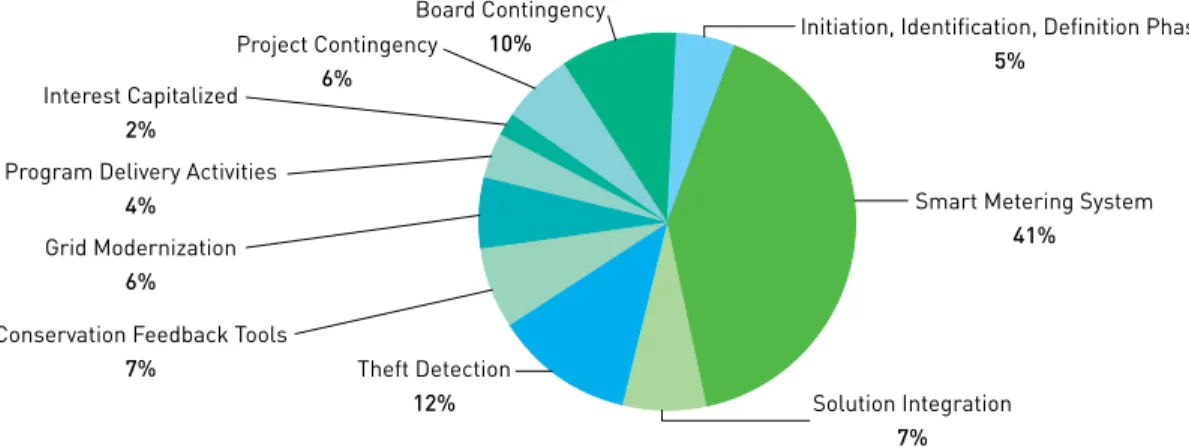
FIGURE 1: BUdGET COMPONENTS BY PERCENTAGE WITh SPECIFIC FOCUS ON ThE IMPLEMENTATION PhASE
Program Costs
The total Authorized Amount for the Smart Metering Program is $930 million (nominal value) including contingency . The budget was developed using BC Hydro’s standard project planning methodology, and is organized into four major phases (see Glossary for definition of phases):
Initiation Phase— • Completed in F2007 Identification Phase— • Completed in F2008 Definition Phase— • Completed in F2011 Implementation Phase—
• Scheduled to be fully completed in F2014, with the installation of customer meters on track for
the December 2012 date as legislated by the Province of British Columbia .
Net Present Value
The Smart Metering Program business case shows a net present value (NPV) of $520 million through F2033 . The NPV remains positive even if all costs are incurred and only the BC Hydro operational efficiencies are realized . The NPV also remains positive if all benefits are achieved at the low end of the estimated benefit range . A more detailed discussion of the business case analysis can be found in Appendix 6 .
The positive NPV of the Smart Metering Program will benefit all BC Hydro customers . These net benefits will flow, over time, into lower rates for customers, reducing them below what they would otherwise be in the absence of BC Hydro’s investment in the program . See Appendix 7 for a discussion of the Smart Metering Program rate analysis .
RISkS
BC Hydro has put in place a Risk Management process to identify, assess, and mitigate risks that could significantly impact the Smart Metering Program . Appendix 8 provides a summary of the key risks and mitigation strategies . The procurement process employed by the program has also played a significant role in mitigating technology, cost, and schedule risk . More information about how BC Hydro has managed risk through procurement can be found in Appendix 9 .
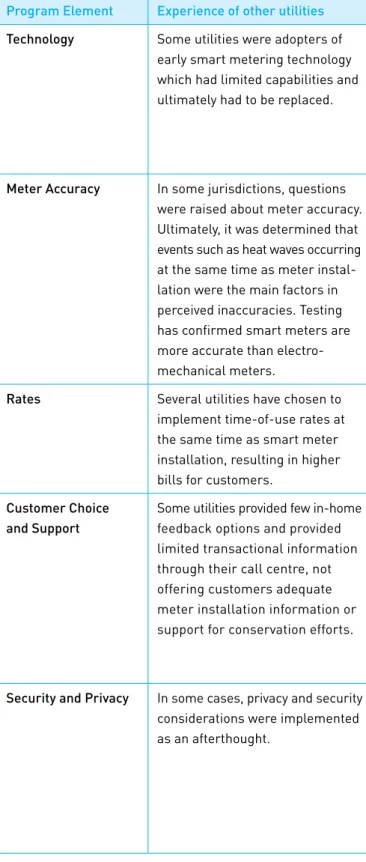
LESSONS LEARNEd FROM OThER jURISdICTIONS
BC Hydro has also managed risk through learning from others . By adopting smart meters after learning from the experience of other utilities, BC Hydro has the advantage of knowing what factors contribute to successful implementation and benefit realization . Some of these key learnings are included in Table 3 .
Initiation, Identification, Definition Phases
5%
Board Contingency
10%
Interest Capitalized
2%
Program Delivery Activities
4% Grid Modernization 6% Theft Detection 12% Solution Integration 7%
Smart Metering System
41%
Project Contingency
6%
Conservation Feedback Tools
TABLE 3: SUMMARY OF LESSONS LEARNEd FROM OThER jURISdICTIONS
Program Element Experience of other utilities Our approach
Technology Some utilities were adopters of early smart metering technology which had limited capabilities and ultimately had to be replaced .
BC Hydro is taking advantage of the fact that metering technology has stabilized, and technology standards are now more open, robust and secure . BC Hydro is actively involved in numerous industry standards and policy groups as outlined in Appendix 10 . BC Hydro has also included mandatory criteria in procurement packages to ensure only proven and scalable technology would be considered .
Meter Accuracy In some jurisdictions, questions were raised about meter accuracy . Ultimately, it was determined that events such as heat waves occurring at the same time as meter instal-lation were the main factors in perceived inaccuracies . Testing has confirmed smart meters are more accurate than electro- mechanical meters .
BC Hydro is governed by the testing requirements established by Measurement Canada, a federal agency . The installed base of meters in Canada has a very high degree of accuracy due to regular random testing .
Rates Several utilities have chosen to implement time-of-use rates at the same time as smart meter installation, resulting in higher bills for customers .
BC Hydro will maintain existing rate structures at the same time as meter installation . BC Hydro will engage customers in the design of any new rate structures and any new or modified rates will be subject to review and approval by the BC Utilities Commission .
Customer Choice and Support
Some utilities provided few in-home feedback options and provided limited transactional information through their call centre, not offering customers adequate meter installation information or support for conservation efforts .
BC Hydro will offer incentives for customers to adopt conservation tools such as in-home displays that will provide near real-time feedback, and a secure web page that provides next day consumption data, with tools to help analyze patterns . Trained call centre agents will be available to answer specific customer questions during the meter installation period, and to provide advice on how to maximize conservation savings through the use of new in-home feedback tools when they become available .
Security and Privacy In some cases, privacy and security considerations were implemented as an afterthought .
Privacy, security and safety features were key evaluation criteria in all procurement processes related to the Smart Metering Program . Privacy-by-Design and Security-by-Design processes are used for all design, development, and implementation activities . BC Hydro also has active and ongoing involvement with industry standards and policy groups, including those focused on security, privacy and safety standards .
kEY TIMELINE FOR CUSTOMERS
A key lesson learned from other smart meter initiatives is the importance of communication with customers . Accordingly, BC Hydro has developed a proactive approach to ensure open and frequent customer engagement . The following table provides highlights from the Smart Metering Program’s customer engagement approach .
____________________
4 Smart meter installation will begin simultaneously in communities throughout the province . TABLE 4: kEY TIMELINE FOR CUSTOMERS
Stage Timeframe Key Activities
Program Information
Underway and throughout the program
Customers have access—through the BC Hydro website, bill inserts, and community events—to information about the Smart Metering Program, the smart metering system that will be installed, how it works, and other topics of customer interest . Customers can share their feedback, concerns, and interest directly through calling, email, community events, and customer research .
Installation of Smart Meters
Mid 2011 through 2012
Customers receive information packages before smart meters are installed in their community4 .
In-home Feedback Tools
2012 through 2014
Customers receive information highlighting new options available to support their energy conservation efforts .
Customers receive a rebate for a basic in-home display device that can be redeemed at select stores .
Customers will have access to information about their electricity use, up to the previous day, through a secure Power Smart website .
APPENdIX 1: SMART METER SECURITY, PRIVACY ANd SAFETY
Security, privacy and safety have been considered key priorities throughout the development of the Smart Metering Program . The program redefines many of the existing business processes—and introduces new ones—requiring that security, privacy and safety are embedded in each and every aspect . The basic principles of Security-by-Design, Privacy-by-Design and Safety-by-Design have been incorporated throughout the planning of the program . Each of these disciplines are also intrinsically linked; for example, ensuring a security objective is achieved also enhances safety and privacy .
Procurement
Security, privacy and safety requirements are included throughout all of the Smart Metering Program Requests for Proposals (RFPs) . Examples of specific requirements include:
Ensuring vendors are provided with all BC Hydro safety standards and Smart Metering Program security and privacy •
specifications .
BC Hydro’s Safety-by-Design Practice referenced as a specification . Examples include the metering system specifications •
explicitly referencing:
Applicable American National Standards Institute (ANSI) and Institute of Electrical and Electronics Engineers (IEEE) •
safety standards; and
Generation Project and Service Delivery Practices: Safety-by-Design . •
In RFPs, proponents are required to describe their safety programs and how they propose to comply with BC Hydro safety •
principles .
Vendors are required to document, in detail, how their solutions to smart metering security standards demonstrate •
security best practices .
Security penetration testing is a mandatory deliverable before implementation of each component of the solution . •
Field Operations Safety and Work Methods staff members participated in vendor evaluation sessions where worker safety •
practices were thoroughly reviewed . This involvement will continue for future procurements associated with smart metering field devices and related work methods .
Enhanced meter safety and security design criteria was included in the metering system RFP . •
Security in the Smart Meter and Smart Metering System
There are a number of security and safety features within the smart meters themselves, including:
Use of the end-to-end 128-bit Advanced Encryption Standard (AES) algorithm, which is the same as typical online banking •
systems;
Use of an asymmetric key algorithm, which ensures the smart meter cannot read any information it generates once that •
information has been encrypted . This also means that a specific smart meter can not access or read any data generated by another smart meter; and
Limited historical data is stored on the smart meters mitigating any exposure of a customer’s private data . •
Additionally, BC Hydro has privacy requirements in place to ensure that employees protect the privacy of customers in accordance with the Freedom of Information and Protection of Privacy Act .
There are also security and safety features inherent in the smart metering system:
Home Area Network (HAN) components, such as in-home display devices, utilize a secure communication system that •
works only for the local network (i .e . the specific home) . Nearby in-home display devices will not be able to access information from another device .
The smart metering deployment architecture is designed to use different access keys for each localized area to •
ensure the overall system remains secure—essentially, the smart metering system is broken up into many isolated units . Gaining access to one isolated unit does not provide access to the whole . In other words, devices with a localized area key do not have access to the entire network and no one device is capable of accessing the entire electricity system .
When a customer moves to a home with an existing smart meter, BC Hydro will ensure that all current in-home device •
connections are cleared so that usage information from the previous home owner stays private .
Field tools, used to configure smart meters when remote configuration is not possible, are managed through a secure •
isolated network . Access to field tools will be limited to necessary staff members using unique passwords . Field tools also carry limited customer meter data and will be purged after each use .
Smart Meter Privacy
The Smart Metering Program has been focused on privacy concerns since its inception . BC Hydro’s Freedom of Information •
Coordination Office (FOICO) has been central in the discussion of privacy-related issues and participated in all aspects of the requirements and RFP phases of the project .
In addition to FOICO, resources with expertise in privacy are assigned to the Smart Metering Program to assess and ensure •
that privacy requirements are met through the life of the program .
A Privacy Impact Assessment (PIA) is completed for the entire Smart Metering Program, each individual release, •
and specific security or privacy sensitive components . In all, more than thirty PIAs are anticipated and each PIA will require FOICO sign-off to ensure privacy requirements are effectively managed throughout the program .
Security and privacy frameworks are being developed for each release of the program to ensure that BC Hydro standards •
for security and privacy meet or exceed compliance requirements and future expectations .
Smart Meters and Radio Frequency Safety
Smart meters will use radio frequency to communicate data to and from BC Hydro . The health effects of the frequencies employed have been thoroughly investigated by BC Hydro . In addition, many reputable health authorities such as the World Health Organization and Health Canada have conducted thorough reviews of all the different types of studies and research on electromagnetic fields and health . These health authorities have examined the scientific weight-of-evidence and have determined that when all of the epidemiological and experimental studies are considered together, the consensus is that there is no cause-effect relationship between exposure to electromagnetic fields and human health .
Specific to radio frequency exposure to the public, proposed Field Area Network devices must be certified by Industry Canada and in compliance with Health Canada’s Limits of Exposure to Radio Frequency Electromagnetic Energy in the Frequency Range from 3 kHz to 300 GHz [Safety Code 6] . BC Hydro will continue to monitor research related to radio frequency . General information and resources related to electromagnetic fields can be found on BC Hydro’s website at:
bchydro .com/safety/electric_magnetic_fields/magnetic_fields_and_health .html .
BC Hydro will collaborate with customers who are concerned about radio frequency with the objective of identifying solutions that can be mutually supported .
There are three key factors that contribute to radio frequency safety: duration of the signal, signal strength and distance from the signal .
Signal Duration 1 .
While the period during which a smart meter transmits data back to BC Hydro will vary depending on the specific metering system used, transmission is expected to last for only a few minutes per day .
Signal Strength 2 .
The signal strength emitted by a smart meter is considerably less than visible light and exposure common to everyday living, such as laptops, cell phones and handheld radios . For example, if you are standing adjacent to the smart meter and it is transmitting continually for those few minutes, exposure is between 60 times and 600 times below the acceptable level identified in Safety Code 6 .
Distance from the Signal 3 .
Smart meters will be located in the same place as the existing meter on the outside of a customer’s home, or in a meter bank in multi dwelling units such as town homes, condominiums or apartment buildings .
Standing 3 metres (10 feet) away from the meter while it is transmitting, exposure drops to 60,000 times to 600,000 times below the Safety Code 6 acceptable level . Excluding the built in safety factor in Health Canada’s Safety Code 6, standing adjacent to a smart meter device, the radio frequency radiation is 60 times less than the Safety Code 6 acceptable level . This is assuming the smart meter device is transmitting 100 per cent of the time, which it does not .
Some customers have expressed concerns about the potential effect of radio frequencies on their unique personal health condition . Individuals who have concerns or questions are invited to contact us at smartmeters@bchydro .com .
The following table compares the radio frequency generated by items common to everyday life .
Design and Operation of Equipment
BC Hydro’s Safety-by-Design practice addresses the design and operation of new and existing equipment throughout the system including:
Safe placement of equipment in energized locations (e .g . collectors requiring a power source); •
Safe operation of equipment (e .g . vehicles used for deployment); and •
Designing new components (e .g . integration of distribution system meters) from a safety perspective . •
An important component of the Smart Metering Program since 2008 has been the engagement of other utilities and research bodies throughout North America (e .g . Pacific Gas & Electric) to understand their safety challenges and experiences . BC Hydro is an active member of several industry groups where the focus is safety, security, and privacy standards .
dEVICE RELATIVE POWER dENSITY IN MICROWATTS PER SqUARE CENTIMETRE (μW/cm2)
Distance from the Signal Signal Strength
FM radio or TV broadcast station signal 0 .005 microwatts
Smart meter device at 3 metres (10 feet) 0 .01 microwatts*
Cyber cafe (Wi-Fi) 10–20 microwatts
Laptop computer 10–20 microwatts
Cell phone held up to head 30–10,000 microwatts
Hand-held radio at head 500–42,000 microwatts
Microwave oven, 5 cm (2 inches) from door 5,000 microwatts
Summer sunlight at earth’s surface 100,000 microwatts
BC Hydro has anticipated a possible risk of violence related to electricity theft from drug operations during the installation of smart meters . Measures to protect both employees and the public include:
The establishment of a police coordination program; •
The development of policies to ensure employees do not engage in unsafe situations; and •
Violence risk assessment training for all installation technicians . •
Internal Procedures
Internal procedures have been reviewed from a safety, security and privacy perspective . An outcome of this review is the development of enhanced and new training programs to reinforce safety awareness and safe work practices . Examples include:
A Safety-by-Design Project Hazard Matrix will be implemented for all planned technologies and the physical placement •
of meters, telecommunications components and system meters .
Standards design work is underway with the Distribution Engineering Standards department for the safe and secure •
placement of telecommunications components .
Meter installer training programs will be reviewed by the BC Hydro Work Methods department and scrutinized for compliance •
with safe work practices .
Mandatory safety requirements and qualifications for meter installation proponents include compliance with WorkSafeBC •
and the Safety Standards Act, with a specific focus on vehicle safety, and provision for safety audits of the installation work . Project team members are trained in, and will adhere to, applicable BC Hydro safe work practices in our field and •
laboratory environments .
Industry Standards Development
BC Hydro is participating in the National Electric Energy Testing Research and Applications Center (NEETRAC), testing and developing meter service connect/disconnect standards with respect to performance and safety . As part of BC Hydro’s metering system procurement process vendors must provide formal documentation related to their compliance with the testing requirements and acceptance criteria of NEETRAC . Further, BC Hydro is working as a member of an American National Standards Institute committee on advancing service connect/disconnect standards . BC Hydro’s commitment to service switch safety will enhance the safety of both customers and workers .
APPENdIX 2: PROGRAM SCOPE
For the past four years, BC Hydro has been defining the scope and approach for the Smart Metering Program . Key activities include: Developing a detailed set of specific functional, operational and technical requirements captured in a set of comprehensive •
use cases described later in this section .
Actively participating in technology and industry standards groups focused on smart metering and the emerging smart •
grid sectors to ensure BC Hydro business needs are captured in industry standards .
Monitoring the progress and results from utilities who were early implementers of smart metering projects— •
including Pacific Gas & Electric, Southern California Edison, San Diego Gas & Electric, Duke Power, ENEL (Italy), and in Ontario—Hydro One, Toronto Hydro—and incorporating their “lessons learned” into BC Hydro’s project planning . Tracking the market evolution of metering technologies, software products, and in-home energy management offerings •
to ensure BC Hydro’s solution choices are based on proven, secure technologies .
The activities listed above resulted in the final Smart Metering Program scope which includes the following six major components . Each will be managed and implemented as part of a single, integrated program:
Smart Metering System—Captures and communicates consumption data and meter events, such as outages, to both the customer and BC Hydro;
Solution Integration—Designs, develops, and implements the software components, business processes, and ongoing support structures required to enable smart metering capabilities;
Theft Detection—Enables BC Hydro to better localize sources of electricity diversion;
Conservation Tools—Provide information enabling customers to make informed and timely decisions in relation to their electricity consumption;
Grid Modernization Infrastructure Upgrades—Provide the smart meter operations centre, and advanced technology and telecommunications infrastructure, to help improve the reliability and security of the electricity system; and
Program Delivery Activities—Provide the overall project management activities and responsibilities designed to ensure a quality implementation of each solution component included in the program scope .
Following is a more detailed description of each scope component .
Smart Metering System
Included as part of the Smart Metering System5 are: Smart Meters—
• Digital meters—capable of two-way communications—with the ability to measure the incoming and
outgoing flow of electricity from a specific location such as a customer’s home or business . The two-way communication capability enables smart meters to provide use data to both customers and BC Hydro—in different formats . When paired with an in-home display, the smart meter can send real-time consumption and price information directly to the customer . Real-time customer use information will be transmitted through the Home Area Network directly to the customer and will not be available to BC Hydro . Smart meters will capture and store use on an hourly basis and transmit the data back to BC Hydro, through the Field Area Network and Wide Area Network, during short intervals (couple of minutes) at prescheduled times during the day .
Metering Telecommunications—
• Consisting of two parts—the Field Area Network (localized to meters in the field) and
the Wide Area Network connections (enterprise wide focus)—this communications infrastructure provides the physical devices required to enable two-way transmission of data between smart meters and BC Hydro . There are several different ways this field-based communications infrastructure can be implemented, depending on the metering system selected .
Automated Data Collection System—
• This software application is designed to aggregate meter usage and event data from
smart meters and manage the Field Area Network communications infrastructure . This software is provided by the metering system vendor .
____________________
Solution Integration
In addition to the overall smart metering system, the Smart Metering Program is responsible for the business environment that supports smart metering including implementation of new business software applications, changes to existing information systems, enhanced data warehouse and analytics capabilities, and all of the business transformation activities that will help BC Hydro adapt to the new technologies and systems . Specific elements of scope include:
Meter Data Management System—
• A software application that stores, validates, edits and analyses meter reading data
prior to releasing it for integration into other BC Hydro operational systems such as customer billing, load forecasting and outage management .
Interfaces and Integration—
• This systems integration work involves modifying existing applications to handle the enhanced
automated meter reading information, and building interfaces between new and existing enterprise applications to support BC Hydro’s end-to-end business processes .
Business Transformation—
• The major elements of business transformation work involve development of new and modified
business processes, design of organizational and job changes, rollout of training and knowledge management programs, employee engagement to facilitate cultural change, and effective transition to business operations for ongoing work .
Theft Detection
BC Hydro currently does not have the measurement devices and analytical tools to quickly and accurately identify where theft of electricity is occurring . A comprehensive theft detection solution, based on electricity balancing analysis, will be implemented as part of the program . Scope elements include:
• Distribution System Meters—New meters (different from those to be installed at customer homes or businesses) will be installed at key points on BC Hydro’s system to measure electricity supplied to localized areas .
• Theft Analytics—A suite of software tools that support enhanced electricity network modeling methods, as well as the business rules required to analyze measurement data captured from new distribution system and smart meters .
Conservation Tools
Smart meters will enable customers to take advantage of new tools to save energy and money . These include:
In-home Display—
• Customers will have the choice of whether or not they wish to acquire in-home display devices . BC Hydro will provide financial incentives to enable customers to acquire a basic market available in-home display device from their local retailer . In-home displays will be enabled through the Home Area Network, a communication channel between the smart meter and the customer’s home or business . This secure channel, an attribute of the smart metering system, enables customers to view their consumption either on a real-time or accumulated basis, represented in both cost and kilowatt-hours .
Power Smart Website—
• BC Hydro’s existing secure Power Smart website will be expanded to include new interactive
and informative applications—based on the hourly data captured from smart meters—designed to help customers better understand and model their energy use . Today, residential customer meters are read every two months, which provides little practical information for customers to determine which, if any, conservation actions they should pursue .
Rate Options—
• The smart metering system infrastructure will enable BC Hydro to design new rate structures that encourage conservation during peak periods . While the implementation of new rates is enabled by the Wide Area Network, Field Area Network and web interface, the design and implementation of new rate structures is a separate initiative . Key functional and data requirements to support rate options will be enabled by the new smart metering system and the Meter Data Management System . The design of these rate options will involve consultation with customers and key stakeholders, and will be subject to full review and approval by the BC Utilities Commission .
Grid Modernization Infrastructure Upgrades
This program scope element involves two key components; the specific requirements of each will depend on the metering technology selected:
• Advanced Telecommunications Infrastructure—Involves the design and installation of additional secure and reliable Wide Area Network telecommunications infrastructure to support advanced electricity system functions and emerging customer applications like customer generation and microgrids .
Advanced Operational Support—
• Involves the implementation of a smart metering and network operations function to
support real-time operations of the metering system . This support function will likely be implemented as an extension of BC Hydro’s distribution operations centre so that all real-time system and telecommunications operations can be managed seamlessly and efficiently .
Program Delivery Activities
Included in the scope of the Smart Metering Program are the overall program delivery activities and services which ensure all of the technical aspects of the project are successfully implemented, and accepted by BC Hydro’s customers and stakeholders . These activities include:
Project Management and Controls—
• Includes the personnel and support tools to manage and report on the overall delivery
of all aspects of the Smart Metering Program, including scope, schedule, budget, quality, issues resolution, environment management, and transition to operations .
Security, Privacy and Safety—
• This independent team ensures appropriate governance and compliance for all the physical
security, cyber security, data privacy, and employee, vendor and contractor safety aspects of the program . Security, privacy and safety have been fundamental drivers of the program .
Finance & Regulatory—
• This team provides financial oversight and regulatory support to the project team .
• Customer Research, Engagement and Outreach—Includes the resources required to support the Smart Metering Program with respect to research, community engagement, customer communications, employee engagement, and media .
Contract Management—
• Includes the personnel and processes required to manage procurement and tendering activities,
as well as manage contractual commitments and any contract issues that may emerge .
Use Cases
Use cases provide a starting point to inform the scope of complex, cross functional projects, and define the subsequent procurement requirements . Use case methodology is an industry-leading approach to matching functional needs to the appropriate technology and systems .
BC Hydro examined use cases from other utilities across North America involved in smart metering systems . From there the approach was expanded to create 17 individual use cases based on BC Hydro’s unique business needs and context . For example, BC Hydro’s requirements included enhanced customer service options and theft detection . The inclusion of these requirements improved program benefits and contributed to a stronger business case .
Organized into four main categories the use cases include: Customer Service, Distribution System Optimization, Home Area Network and in-home feedback, and network and meter management . Based on business scenarios the use cases capture the current and long-term (over 20 years) functional, operational and technical requirements for BC Hydro .
Category Use Cases Description
Customer Service
Customer Contact Collect Interval Data
Remote Connect or Disconnect Pre-pay Services
Bill an Account
These use cases describe the functional requirements and business processes required to achieve enhanced customer services through improved communications, more accurate account billing, automated meter data collection, remote connect and disconnect services, and new service offerings such as pre-paid options . Customer Service Represen- tatives will be better equipped to handle all customer requests regarding account enquiries, billing and payments, as well as help customers to monitor and adjust their energy consumption .
Distribution System Optimization
Extending or Reconfiguring the Distribution System Analyzing Meter Data for Load Research, Planning and Rates Detection of Tampering or Theft Distribution System
Optimization and Automation Outage Detection and Restoration
Customer Generation
These use cases describe the functional requirements, business processes, and operational aspects required to optimize the distribution system with respect to implementation of a new smart metering system . This includes the impact on BC Hydro’s network design and engineering processes to incorporate new features and capabilities .
Current and historical data captured through the Meter Data Management System includes accumulated energy consumption, demand profiles, aggregated time-of-use information, voltage information, and metering events (e .g . tamper flags) . This more detailed and timely information supports several distribution system business processes including outage detection and analysis, theft identification and mitigation, and customer generation .
Home Area Network
Home Area Networks Providing Demand Side Management Capabilities Plug-in Hybrid Vehicles
These use cases describe the functional and technical requirements, and the business processes required to enable a Home Area Network using new smart meters and various in-home feedback tools . This may include providing pro-active notifications to customers if they choose, and the ability to accommodate electric vehicles on the distribution network . As customers, especially industrial and commercial customers, become more interested in direct load control, they can use demand response capabilities included in the Smart Metering Program to configure, manage, monitor and settle various load programs .
Network and Meter Management
Meter Lifecycle Management Management and Recovery of the System
Installation and Configuration of the System
These use cases describe the requirements to configure, manage, recover and maintain the various metering units within the product lifecycle . A typical life cycle of a smart meter is described, including the installation, replacement, and remote troubleshooting methods involved .
Described within these use cases is the initial installation and
configuration of the smart metering system including meter procurement, quality assurance testing, logistics and installation .
APPENdIX 3: RESEARCh
In addition to applying lessons learned from other utilities, BC Hydro has reviewed research findings, conducted customer research, and field tested theft detection devices to assist in shaping the delivery of the Smart Metering Program . Key results are included below .
Research on Energy Conservation Effectiveness of In-home Feedback
BC Hydro has estimated that customers who use in-home feedback tools will realize an average 4 per cent energy savings . This estimate is considered to be conservative, based on various research findings, as outlined below .
Research in relation to the effectiveness of in-home feedback tools includes both academic research related to behaviour change and actual pilots and trials that have been conducted worldwide . This research has informed the savings assumption above, as well as the overall approach BC Hydro will be taking related to in-home feedback . Key research findings have found that saving from direct and indirect feedback can range from 3–15 per cent and 0–10 per cent respectively6 .
Specific industry initiatives have also provided a point of reference for potential energy conservation for the Smart Metering Program . For example, customer energy conservation has been reported as follows:
Pacific Gas & Electric states an average 6 .5 per cent reduction in energy use when using an in-home display
• 7,
Southern California Edison reports a 6 .5 per cent reduction in energy use when using Home Area Network devices and a •
2 per cent reduction in energy when using historical online feedback8, and
Commonwealth Edison reported a 2 per cent reduction in energy use when customers subscribed to monthly online reports
• 9 .
Research on Customer Participation for In-home Feedback
Customer participation will depend on several factors, including the cost of in-home feedback tools, their overall appeal and simplicity of use, the marketing campaign that supports their distribution, and their effectiveness in helping customers save electricity . Also reported in Southern California Edison and Pacific Gas & Electric’s application filing to the California Public Utilities Commission were their assumptions on participation . Southern California Edison assumes a 10 per cent penetration with 1 per cent growth per year for their online web pages while Pacific Gas & Electric assumes a 21 per cent penetration by 2030 for customer-purchased in-home displays .
BC Hydro qualitative focus group research, conducted with customers and employees, found there was strong interest in electricity feedback mechanisms . Based on focus groups completed in 2010, customers were optimistic that increased awareness via in-home feedback tools will help them conserve energy and save money . In general, most participants expressed interest in the program . In addition, it was found that 83 per cent of BC Hydro customers have at least one computer and 86 per cent had internet connectivity at home10 . Given these statistics, the potential use of a secure online feedback website should be widespread .
Conservation Research Initiative
Important feedback was also derived from the Conservation Research Initiative, a program launched by BC Hydro in 2006 . The goal of the Conservation Research Initiative was to examine how individual British Columbians could make a difference and help meet the growing demand for electricity in BC by conserving electricity in their homes .
____________________
6 The Effectiveness Of Feedback On Energy Consumption; Sarah Darby, Environmental Change Institute, Oxford University, April 2006; Residential Electricity Use Feedback: A Research Synthesis and Economic Framework; EPRI (Electric Power Research Institute), February 2009; Impact Of Informational Feedback On En-ergy Consumption—A Survey Of The Experimental Evidence; Ahmad Faruqui, Sanem Sergici and Ahmed Sharif, May 2009
7 Application filed to CPUC December 12, 2007 App No 07-12-009 8 Application filed to CPUC July 31, 2007 App No 07-07-026 8 Pilot findings: http://usweatherizing .com/blog/?p=923 10 Residential Customers Needs Survey F10 (February 2010)
This study was conducted in more than 1,800 residential homes across six communities: Vancouver, Burnaby, North Vancouver, West Vancouver, Campbell River and Fort St . John . The study tested time-of-use rates and smart meters to help BC Hydro better understand how adjusting the price of electricity at different times of the day influences electricity use by residential customers .
The results of the Conservation Research Initiative are summarized below: Overall consumption was reduced by 7 .6 per cent .
•
Energy use during peak hours was reduced by 11 .5 per cent . •
63 per cent of participants saved money by conserving and shifting their consumption to off-peak hours . •
Theft Detection Pilots
Since 2005, BC Hydro has implemented four theft detection pilots using distribution system meters to conduct energy inventory balances with customer smart meters . All of these pilots have successfully demonstrated that the energy inventory balance approach, conducted at either the primary or secondary voltage level, can readily identify localized areas of the electricity system where theft is occurring . In total these pilots, which are still operational, covered over 800 homes, and resulted in the identification and termination of 22 electricity thefts . Where thefts have been identified and shut down quickly, there has been little recurrence . Further details regarding the theft pilots can not be released for security reasons . These theft detection pilots identified key requirements for the design of a scalable solution including the following three major components in addition to the basic smart metering system: distribution system meters; theft analytics software; and new investigation techniques and processes .