Network Services
Programs
Lessons Learned
Report
General Services Administration
Office of Integrated Technology Services
Office of Network Services Programs
Table of Contents:
1 EXECUTIVE SUMMARY ... 4 2 INTRODUCTION ... 7 2.1PURPOSE ... 7
2.2
METHODOLOGY ... 7
2.3
BACKGROUND ... 8
2.4
OVERVIEW OF OFFICE OF INTEGRATED TECHNOLOGY SERVICES (ITS) ... 9
2.5
OVERVIEW OF NETWORK SERVICES PROGRAMS (NSP) ... 10
3 FINDINGS/STRATEGIC THEMES ... 19
3.1
ACQUISITION EFFICIENCY (AE) ... 20
3.2
TAILORED CUSTOMER SERVICE (TCS) ... 36
3.3
OPERATIONAL EFFICIENCY (OE) ... 44
3.4
CUSTOMER PARTNERSHIP (CP) ... 52
3.5
AGGREGATED REQUIREMENTS (AR) ... 58
4 CONCLUSION AND RECOMMENDATIONS ... 65
5 APPENDICES ... 74
5.1
APPENDIX A -‐ FINDINGS: TECHNOLOGY, MARKET, AND SERVICE TRENDS ... 74
5.2
APPENDIX B -‐ FINDINGS: NETWORX TECHNICAL AND PRICE REQUIREMENTS ... 84
5.3
APPENDIX C -‐ FINDINGS: NETWORX OPERATIONS ... 87
5.4
APPENDIX D -‐ ESTABLISHMENT OF THE NETWORX PROGRAM ... 89
List of Figures:
Figure 1: Infrastructure Cost Savings ... 5
Figure 2: ITS Organizational Chart. ... 10
Figure 3: NSP Annual Revenue per Program (FY11) ... 11
Figure 4: Growth of FTS2001/Networx Business Volume ... 15
Figure 5: Business Volume by Contract by Month ... 16
Figure 6: Regional Telecommunications Program Business Volume, with projects for 2012 and beyond. ... 18
Figure 7: Regional Revenue for FY11 ($M) ... 19
Figure 8: WITS Purchase Category Mix ... 33
Figure 9: Purchase patterns of major agency ... 56
Figure 10: Increasing data bandwidth demands of major agency ... 57
Figure 11: Overall Price Reductions-FTS2001/FTS2000 (left); FTS2001/Networx (right) ... 59
Figure 12: Comparison of FTS2001/Networx Prices to Best Commercial Prices ... 60
Figure 13: Program Cost Avoidance vs. Best Commercial Rates ... 61
Figure 14: Optical Carrier Level 3 (OC-3) port drop from Mar 2007 to Dec 2011 ... 62
List of Tables:
Table 2-1: Stakeholder Categories ... 7Table 2-2: Network Services Programs Financial Summary ... 15
Table 2-3: FTS2001/Networx Volume by Agency, FY11 ... 17
Table 3-1: Networx Supplier Business Volume Mix ... 31
Table 3-2: Most Common Service Categories used on the Networx Contract ... 50
Table 3-3: Unit Price Comparison, Selected Prices – Networx vs. FTS2001 ... 59
1
Executive Summary
The General Services Administration (GSA), Federal Acquisition Service, Integrated Technology Services, Network Services Program (NSP) establishes and manages a range of acquisition programs to meet the needs of Federal agencies for telecommunications and networking services and associated support. Responsibility for these programs is divided between the NSP National Office, which manages programs focused primarily on agency enterprise-level Wide Area Network (WAN) needs, and the eleven NSP Regional Offices, which manage programs focused primarily on agency local and regional needs and local voice services. The NSP is a strategic program that provides some service to almost every Federal agency and provides a benefit to almost every Federal agency. In the civilian agencies, there aren’t clear substitute programs to manage the acquisition of network services across multiple agencies, and the program also serves many defense customers. The NSP provides strategic sourcing for the Federal Government by aggregating agency requirements and providing a “single stop shop” for all network services.
The Networx program, based on 10-year contracts awarded in 2007, is the largest of the National Office programs and the largest of all NSP programs. FTS2001 is the predecessor program to Networx, and the two programs combined have annual revenues exceeding $1B. With the end of the transition process from FTS2001 to Networx approaching, NSP has taken the opportunity to execute a comprehensive review for the purpose of identifying lessons learned that can drive planning of program improvements and the strategy for the next generation of programs, known as Network Services 2020 (NS2020). The goal of NS2020 is to become the Federal government’s strategic sourcing center for network-based and network-enabled services.
NSP obtained and reviewed recommendations from internal and external program stakeholders to deduce lessons learned. Similar lessons learned were categorized under overarching themes to drive clear conclusions and action plans. This document summarizes the most significant findings of that review.
The following overarching themes capture the most important aspects of the more detailed findings contained herein:
• Acquisition Efficiency – The ability to reduce the total acquisition time, cost, and
risk of NSP's agency customers.
• Tailored Customer Service – The quality of support GSA provides its customers.
• Operational Efficiency – Maximizing efficiency of organizational structure, delivery
models, contracts inventory, supporting systems, business processes and costs of NSP operations.
• Customer Partnership – The forging of effective relationships between GSA and
other agency and government stakeholders. This includes other Federal agencies (who are GSA’s customers), Congress, and the Office of Management and Budget (OMB).
• Aggregated Requirements – The aggregation of requirements to leverage the
buying power of the government, which has been an integral component of the NSP's mission and cornerstone of its strategy.
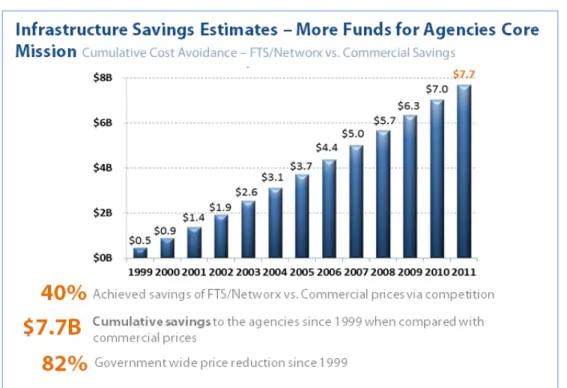
The creation of Networx and agency transition from FTS2001 was a major accomplishment. Networx revenue is estimated to be $1.3B in FY2012, of which
$800M will be technologically advanced IP-centric services. Networx prices are more than 50% lower than commercial rates. As shown in Figure 1, it is estimated that over the period FY2002 through FT2012, the Network Services Program will have amassed an estimated $7.0 Billion in cost avoidance.
Despite this accomplishment, the transition of existing services from the FTS2001 contract to Networx and use of the Networx contracts have fallen behind both expectations of GSA and the suppliers who have been awarded these contracts. Transition of essential networking services is inherently complex. For FTS2001, this meant transitioning over 5.1 million individual services. Networx has thousands of contract line items and millions of service permutations across eight contracts and two acquisitions. Over 50 services were initially defined by GSA and bid by the suppliers, but only six services account for over 80% of the business volume. Thus, it is no surprise that agencies indicate the Networx program is too complex to use easily; suppliers have noted the significant investment to meet the requirements of Networx, and the NSP has been consumed with transition for over half a decade. Through FY2011, four years after award, business volume on Networx was only 64% of the peak FTS2001 business volume while FTS2001 remained at 53% of its peak. As a result, the greatest potential benefit to government—cost savings—has not been fully realized.
The Networx program would have been considerably more successful (higher rate of adoption) if several key assumptions had proven true. First, agency buying methods were not as anticipated. The program intention that extensive use of specified contract line item numbers (CLINS) would allow many agency needs to be met without contract modifications was not fully achieved; many agencies decided to pursue individual customized statements of work (SOWs) for unique requirements instead. This became
a major source of contract complexity that added time and expense to the ordering agencies, NSP, and the service providers.
Secondly, agencies had a greater need for transition assistance than GSA had prepared to provide. Planning for transition support assumed an agency “self help” model as originally agreed to by GSA and with the agencies’ representative body, the Interagency Management Council (IMC). It was determined that agencies would take more responsibility for their own transitions than they did during the FTS2001 transition, and that GSA would provide guidance rather than in-depth assistance to agencies. In reality, more GSA support for inventory validation, Fair Opportunity decisions, and ordering would have greatly accelerated transition. GSA provided this assistance but not until after transition delays and challenges became significant and agencies reached out for help. This also highlights another significant lesson learned: senior leadership involvement from agencies, including Chief Information Officers, Chief Financial Officers and Chief Acquisition Officers is imperative and critical in the planning, execution and implementation phases of the program.
The “self help” model adopted for Networx could be contrasted with the approach taken in the Regional Program. Regional local services programs employ a business model that provides considerable customer support. The local contracts offer flexibility, speed and pre-competed services, which avoids delays due to customers needing to make Fair Opportunity decisions. The Regions’ strong relationships with local telecommunications providers facilitate prompt service delivery on local contracts, and GSA personnel will get actively involved to resolve any issues. This model produces a high degree of customer satisfaction and strong customer relations, but also results in a higher fee structure than the National Programs. Furthermore, the regional contracts in general do not achieve the same price efficiencies as Networx, which is primarily due to the telecommunications industry consolidation for local services. Lastly, it should be noted the Regional program suffers from deteriorating revenue due to the migration from traditional dial-tone voice service to Voice over Internet Protocol (VoIP) and from local to enterprise solutions, so the current Regional operating model may not be sustainable.
2
Introduction
2.1
Purpose
This document is one of a series of documents that combine to review lessons learned and apply them to formulate a better future strategy. It summarizes the key findings resulting from a program wide review of lessons learned from existing GSA FAS ITS network services programs and operations. These findings will serve as a foundational element in the planning for the next generation of network services programs, known as NS2020. Specifically, these findings serve as the starting point for identifying the strengths, areas for improvement and challenges identified by NSP stakeholders. The findings contained in this document will be shared with NSP stakeholders for discussion and concurrence before being used to establish a series of objectives to guide subsequent strategic planning and program development activities for the future NS2020 program.
The findings address both the National and Regional network services programs, and will be used to establish an integrated set of objectives for both. The follow-on documents will address the forward-looking strategy and portfolio of services.
2.2
Methodology
The methodology for GSA’s lesson’s learned study includes identifying a broad set of key stakeholders, developing tailored questionnaires and surveys, conducting direct in-person and phone interviews, performing qualitative and quantitative analysis of data followed by consolidation of lessons learned along relevant themes and capturing the associated recommendations for improvement of future programs.
Stakeholders:
As shown in Table 2-1, stakeholder groups were categorized into six areas that collectively form a comprehensive account of stakeholders associated with the program’s lifecycle. The categories include Networx and Regional customers, Network Services Program (NSP) and Regional personnel, management, and directors, and the GSA partners and vendors.
Table 2-1: Stakeholder Categories
Stakeholder Group Potential Data Points
Networx Customers
Represents the perspective of IMC, CIO, and
telecommunications manager stakeholder groups. This group reflects agency buyers that rely on GSA for telecommunications services via Networx.
Stakeholder Group Potential Data Points
Regional Customers
Represents the perspective of customers across the eleven GSA Regions. This group reflects agency buyers that rely on GSA Regions for telecommunications services, as well as Networx.
GSA
Represents the perspective of GSA Personnel from FAS, ITS, and NSP, not including Regional Directors. This group reflects a body of internal program practitioners and
subject matter experts (SMEs).
Regional Directors Represents the perspective of the Telecommunications Directors of the eleven GSA Regions.
OMB and Partners
Represents the perspective of the OMB’s E-Government & Information Technology representatives, contractor personnel that manage NSP’s business support systems, and other external SMEs.
Telecommunication Carriers
Represents the perspective of the Networx
telecommunications carriers, which includes the largest telecommunications service providers in the U.S. This group reflects the industry service providers that provide GSA with the telecommunications services it uses to support its customers.
Data Acquisition:
GSA developed tailored survey questions for each stakeholder group and conducted in-person and phone interviews to collect the best possible data from all aspects of the program under study. Interviews were scheduled via email and phone. GSA contacted 93% of the identified stakeholders and successfully performed 92 interviews (i.e., 58% of the identified stakeholders), which entailed interviewing well over 100 people since there were often multiple attendees at each meeting. The primary interviewees are listed in Appendix E.
Analysis:
GSA aggregated the interview data in an online survey tool to support the analysis of both qualitative and quantitative information and to develop the key themes and associated lessons learned. The data obtained through the aforementioned interviews was supplemented by additional subject matter expert input, such as the technology, market and service trends. Key themes were deduced to better characterize and convey the myriad of findings, and recommendations developed. Some recommendations were drawn directly from the interviewee responses and others developed during the analysis phase.
2.3
Background
GSA currently offers telecommunications products and services to the Federal Government through a broad portfolio of national and regional contracts, the largest of which are FTS2001 and its successor, Networx. FTS2001 contracts expire in May/June 2012. To replace FTS2001, GSA awarded two Networx contract vehicles in 2007. The first, Networx Universal, includes three service providers: AT&T, Verizon,
and CenturyLink. The second, Networx Enterprise, includes the three Networx Universal providers as well as Sprint and Level 3. The Networx Programs offer comprehensive and competitively priced telecommunications services allowing agencies to focus their resources on building seamless, secure operating environments while providing access to the latest telecommunications and networking technologies available.
The Networx Program has achieved the goal of providing a broad array of competitively priced telecommunications services. However, significant changes have taken place in the telecommunications marketplace in terms of the technologies and services that are now available and the types of providers that can deliver those services. This document addresses those challenges and identifies areas for improvement across the NSP portfolio.
In response to the changing environment, GSA is currently developing a comprehensive framework and acquisition strategy (Network Services 2020 Strategy) for the NSP to meet future Federal telecommunications needs. The goal of NS2020 is to become the Federal government’s strategic sourcing center for network-based and network-enabled services. Understanding telecommunications technology and markets, including regional, national, and worldwide markets, is the key to identifying an integrated portfolio of services as part of the Network Services 2020 strategy.
The transition from FTS2001 to Networx was subject to significant delays described in subsequent sections of this document. Originally, GSA estimated transition to Networx to complete by April 2010. As of May 4th, 2012 overall transition progress is 98.85% completed and is expected to be fully completed by March 2013. Delays have necessitated multiple extensions to the FTS2001 contracts that will now expire in March 2013 subjecting the program to criticism and decreased customer satisfaction levels.
2.4
Overview of Office of Integrated Technology Services (ITS)
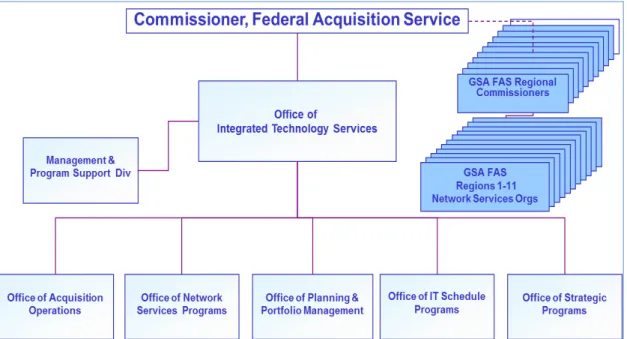
The Office of Integrated Technology Services (ITS) within the Federal Acquisition Service (FAS) is responsible for providing access to best-value information technology (IT) and telecommunications products, services, and solutions to Federal, state, local, and tribal government organizations, and provides national program leadership across the 11 regional Network Services organizations. ITS' contract vehicles help reduce or remove the need for government agencies to duplicate acquisition efforts so that they can focus on their core missions. ITS programs are designed to speed up the acquisition cycle and harness the government's buying power to reduce the prices that customer agencies have to pay.
The organizational structure of the Office of Integrated Technology Services is shown in Figure 2.
Figure 2: ITS Organizational Chart.
ITS manages the largest government contract vehicle in the world – IT Schedule 70 – and is the executive agent for several strategic and good-for-government IT acquisition programs, including Government-Wide Acquisition Contracts (GWACs), SmartBUY, and Federal Relay.
Schedule 70 makes up the largest segment of the organization’s revenue with volume of $16.16B in FY11, followed by the GWAC programs at $3.47B, and the Wide Area Network (WAN) $1.36B (representing the sum of Networx and FTS2001 programs). The Regional Telecom, Commodity Buy, and Strategic Solutions & Security Services make up a fraction of the total $21.54B annual ITS volume.
2.5
Overview of Network Services Programs (NSP)
The Office of Network Services Program (NSP) serves Federal civilian and military agencies, which rely on GSA for telecommunications, network services, and support including network transport services, equipment, and solutions. NSP develops and manages programs, which deliver cost effective administrative and technical support for services and solutions. The current approach to provide cost savings to customers is aggregating volume to drive down prices for the overall government. This approach encourages competition and increases GSA’s ability to offer available telecommunications services and solutions at an overall low price.
NSP currently offers the following contracts to support its customers:
• Networx: A replacement for the FTS2001 and crossover contracts, which
provides two broad contracts for comprehensive telecommunication services
• Local Telecommunications Services Contracts: A full range of local (first
mile/last mile) services and solutions provided by the GSA Regions
• SATCOM II / Future COMSATCOM Services Acquisition (FCSA): A full
• CONNECTIONS / CONNECTIONS-II: Provides equipment, support services,
or customized solutions for any office building, campus, or base environments
• Federal Relay: Provides telephonically and Internet-based communication
access for Federal employees who are deaf, hard of hearing and speech disabled
• Wireless Telecommunications Expense Management Services (TEMS):
Provides a single-source for ordering and managing wireless devices and service from regional carriers
• Wireless Federal Strategic Sourcing Initiative (FSSI): Blanket Purchase
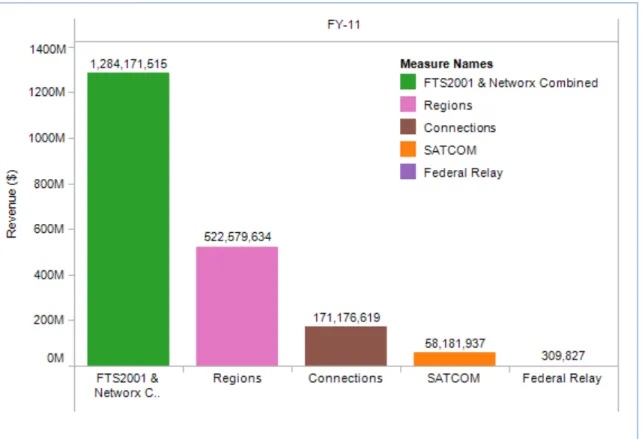
Agreement (BPA) for wireless devices and services. To be awarded in 2012 Figure 3 shows the FY11 revenue per program. The WAN services (FTS2001 & Networx combined) make up 63% of the overall NSP revenue, the Regions represent
about 26%, Connections1 and SATCOM represent 8% and 3%, respectively. Federal
Relay constitutes nearly 0.2% of the total portfolio revenue.2
Figure 3: NSP Annual Revenue per Program (FY11)
Collectively, these contracts provide the following services:
• Voice services, including Local, Long Distance, Combined Local/Long Distance,
and Toll Free services
• Voice over IP (VoIP) services, including VoIP Transport, IP Telephony, VoIP
with Managed LAN, and LAN/building/campus VoIP solutions
1 Connections program was replaced with Connections II in FY12.
• Legacy data services including Circuit Switched Data, Frame Relay and
Asynchronous Transfer Mode services
• Dedicated transmission services, including Private Line, Synchronous Optical
Network (SONET), Dark Fiber, and Optical Wavelength services
• Internet access services, including Internet Protocol Service and Managed
Trusted Internet Protocol Service (MTIPS) services
• IP/MPLS-based Virtual Private Network (VPN) and associated services,
including Ethernet, Premises-Based IP VPN, Network-Based IP VPN, and Layer 2 VPN services
• Conferencing services including Video, Audio, Web and Telepresence services
• Managed network and security services
• Secure networking services, including Managed Firewall Service, Intrusion
Detection and Prevention, Vulnerability Scanning, Anti-Virus Management, Incident Response, Managed E-Authentication, Secure Managed E-Mail and National Security/Emergency Preparedness (NS/EP) services
• Customer contact center services
• Hosting services including both dedicated and collocated services
• Satellite services including Fixed, Mobile, Broadcast services and custom
end-to-end satellite solutions
• Wireless voice and data services
• Network access services, including wireline, wireless and satellite access
services
• Equipment (hardware and software) required to complete or deliver network
services
• Professional and technical services relevant to network services, including
analysis, planning, design, specification, implementation, integration and management of network services and equipment, building/campus facility preparation, and Operations Administration and Management (OA&M), customer service, and technical support services.
Other agency support services provided by NSP include:
• Acquisition support
• Vendor and contract management
• Transition support
• Centralized billing and bill verification services
• Technology subject matter expertise and new service development
By providing customers with an array of contracts for telecommunications services and solutions, NSP is able to serve and support each agency’s telecommunication needs. As the program prepares for the future, the lessons learned from the current regional and national programs and contracts will be used to inform strategic and tactical planning.
2.5.1
The National Programs
The National Programs, also referred to as the Wide Area Network (WAN) Services Program, refers to those contracts managed centrally, including the Networx contract that is designed to offer comprehensive and competitively priced telecommunications services contributing to a more efficient and effective Federal Government. The program enables agencies to build seamless, secure operating environments while providing access to the latest telecommunications and networking technologies available.
Networx Goals
The goals for Networx were established by GSA and the Interagency Management Council (IMC). The IMC consists of senior executives from fourteen Cabinet-level departments and the Small Business Council. Ultimately, the IMC serves as an advisory body for the development, coordination, and oversight of GSA’s telecommunications programs. The IMC also provides GSA with recommendations and advice for managing telecommunications contracts.
As part of the design of Networx, the IMC developed the following eight goals (stated in original form):
• Service continuity: Agencies request that in structuring the follow-on
contract, GSA defines and includes all services that are currently provided on the FTS2001 contract. The realization of this goal will facilitate a smooth transition of all services from FTS2001 to the new contract.
• Highly competitive prices: Agencies aggregate their requirements
on a single contract in order to achieve better prices than they could negotiate individually. Given the volume of services on the FTS contract, agencies desire and expect that prices will continue to be better than prices available elsewhere in the telecommunications marketplace.
• High-quality service: Agencies request high-quality
telecommunications providers provide the services on Networx. Furthermore, agencies request that Networx include enforceable agreements that will ensure that high-quality service is delivered throughout the term of the contracts.
• Full service vendors: Agencies request that telecommunications
carriers awarded contracts on Networx provide a broad array of services and be able to provide follow-on service where desired to avoid costly duplication of administration and contracting processes and procedures.
• Alternative sources: Agencies request continuing competition among
a greater number of telecommunications carriers on new Enhanced services and emerging technologies in order to ensure best value throughout the life of the program.
• Operations support: Agencies request that GSA provide fully
integrated ordering, billing and inventory management to improve management and control costs of agency telecommunications programs.
• Transition assistance and support: Agencies request that the
contracts include provisions that facilitate transition coordination and support to ensure that transitions occur timely and efficiently.
• Performance-based contracts: Agencies request that GSA provide
performance based contracts with Service Level Agreements (SLA’s) to the extent possible.
The IMC goals guided the Networx acquisition process, which supports an agency’s need to receive high quality telecommunications services. While Networx achieves GSA’s desired result of providing a broad array of competitively-priced telecommunications services, several opportunities for improvement have been identified and are addressed in detail throughout this document.
2.5.2
The Regional Program
GSA delivers local telecommunications services through 11 GSA regional offices and over 40 field offices. Regional offices award and administer local service contracts and are responsible for day-to-day operations, customer service and cost recovery.
The Regional Program currently offers the following contracts to support its customers:
• Local Service Agreements (LSAs): State-wide or locality based
contracts serving 500+ telecommunications systems throughout the country
• Washington Interagency Telecommunications System (WITS):
Largest of the LSAs, WITS provides a full suite of voice solutions, from basic local and long distance service to VoIP, cable installation, satellite, teleconferencing and audiovisual services, and technical support for the Baltimore-Washington Metropolitan Area
2.5.3
State of NS Programs
The National network services programs generated approximately $1.3B in revenues in FY11, $1.1B of which was generated by the FTS2001/Networx program, making it the largest single component of the NSP portfolio. The WITS3 program serving the Washington, DC metropolitan area generated approximately $271 Million of revenue in FY11, making it the largest single component of the $523 Million Regional programs. Overall, NSP revenues have continued to increase 7% per year despite declining prices for many services on the NSP contracts.
NSP has shown success in its ability to support the growth and modernization of Federal government telecommunications while achieving significant value for its users. As changes in technology, new government mandates, initiatives and budget constraints continue to take place, the network services programs are presented with both challenges and opportunities in meeting agency needs.
Since the award of the Networx contracts in 2007, Federal agencies have been slow to transition successfully from the expiring FTS2001 contracts. This has necessitated a longer than anticipated set of FTS2001 bridge contracts to ensure continuity of Federal government communications during the transition period. It has also produced dissatisfaction and concern among Networx stakeholders and increased overall costs to the government.
The Regional NS program’s business model has traditionally been based on labor-intensive management of local switched voice services. Switched voice technology is being replaced by Voice-over-Internet Protocol (VoIP) and related technologies, raising concerns about the future financial viability of the regional program and how to best adapt its traditional strengths to better serve customer agencies. Upcoming NS2020 documents will detail GSA’s strategy to address these and other Regional challenges and opportunities.
FTS/Networx Business Volume has doubled since FY2002
Across all programs, the NSP has shown steady growth over the past decade, as shown in Table 1. Since FY2004, the Federal IT market has grown at a compound annual growth rate of approximately 5%; the NSP has had a compound annual growth rate of 7.4%.
Table 2-2: Network Services Programs Financial Summary
Despite significant contract price reductions, FTS2001/Networx Business Volume has increased from $650 million in 2002 to $1.3 billion in 2012, as shown in Figure 4. As of July 2011, Networx billing represented over 60% of the total Business Volume. This portion will continue on into FY12 as the billing process catches up with actual transition. Note that the transition to Networx is expected to complete in FY12; however, in the early months of FY12, some FTS2001 billing is expected to remain which is reflected in red portion of the FY12 bar in Figure 4.
Figure 4: Growth of FTS2001/Networx Business Volume
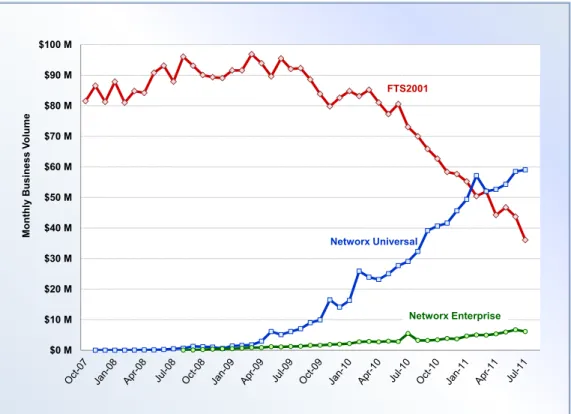
These figures also illustrate the effect of FTS2001 to Networx transition delays. To date, with over 40% of the Networx acquisition duration
$0M $200M $400M $600M $800M $1,000M $1,200M $1,400M 2002 2003 2004 2005 2006 2007 2008 2009 2010 2011 2012 A nnual Bu sine ss V olume Networx FTS2001 FTS2000
elapsed, the program has not reached the business volume of the FTS2001 program at its peak, as shown in Figure 5. Also, the total use of the contract through 4.5 years has not matched the peak single year use on FTS2001.
Figure 5: Business Volume by Contract by Month
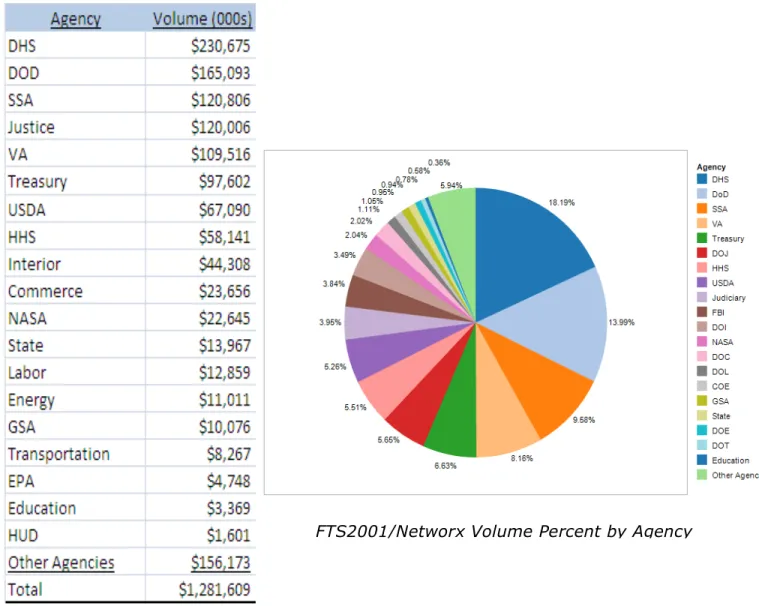
Although there are over 60 distinct agency customers for FTS2001/Networx, the majority of the volume lies with a much smaller set of large agencies. In fact, four agencies (DHS, DoD, SSA, and VA) make up 50% of the volume in FY11, and the top 10 agencies make up more than 80% of the volume. Table 2 and the associated pie chart illustrate customer concentration in terms of volume and identify GSA’s strategic customers. The large concentration of revenue through few agencies contribute to the overall program risks and opportunities and brings about strategic concerns that will be considered in subsequent strategy documents. In short, GSA must provide services that meet the needs of its strategic customers while remaining sensitive to the needs of other smaller agencies.
$0 M $10 M $20 M $30 M $40 M $50 M $60 M $70 M $80 M $90 M $100 M Monthly Bus ine s s V olu me Networx Universal FTS2001 Networx Enterprise
Table 2-3: FTS2001/Networx Volume by Agency, FY11
Regional Network Services’ revenue expected to decline in the out-years
During the past decade, the traditional public switched
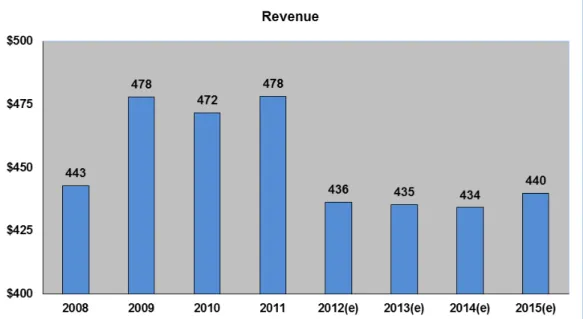
telecommunications network has been increasingly replaced by Internet Protocol (IP) fiber-based data networks. This new technology offers Federal agencies an array of choices to meet their local service and enterprise communications needs. Specifically, traditional local switched voice service is being replaced by Voice-over-Internet Protocol (VoIP) and related technologies. The widespread adoption of VoIP is projected to have a significant impact on the Regional NSP environment. Costs to deliver VoIP are significantly lower than traditional technology services, require less technical support, and can be purchased directly by the customer. As shown in Figure 6, revenues are expected to decline in the next few years. Actual business volume is represented through FY2011, and forecasted business volume is projected from FY2012-2015.
Figure 6: Regional Telecommunications Program Business Volume,
with projects for 2012 and beyond.
Furthermore, the United States telecommunications market has seen considerable consolidation among the service providers. As a result, three large service providers now account for over 80% of the GSA local service business and higher prices on recently-awarded local service contracts reflect the resultant lack of competition in the local services environment.
As illustrated in Figure 7, the National Capital Region (NCR) represents approximately half of the Regional Program revenue. NCR, which is also referred to as Region 11, has continued to post strong performance, while business in other regions continues to fluctuate.
The revenue from Regions can be categorized into two types, the Traditional Telecom services (primarily “dial-tone” business that are generally recurring on monthly basis) and the Project-Related services (that are non-recurring). The majority of the Traditional Telecom revenue is generated by PBX and Centrex services, whereas the Project-Related revenue is generated through other expanded services. This may change as more VoIP services are assigned to or replace the traditional services.
Traditional Telecom services offered by Regions generally pay for themselves and may be revenue neutral or positive; however, the non-traditional/project work is generally lower margin and often does not cover its costs. Some Regions may be better positioned than others to expand non-traditional telecommunications business; in particular, Regions 4 and 7 generate considerable project-related revenue. This may indicate strong customer relationships and can benefit from good coordination with GSA’s Assisted Acquisition Service.
Figure 7: Regional Revenue for FY11 ($M)
Clearly the landscape for Regional services is undergoing fundamental change and therefore the associated business model must adapt. Future strategy documents will visit and address these issues.
3
Findings/Strategic Themes
NSP obtained and reviewed recommendations from internal and external program stakeholders to deduce lessons learned. Similar lessons learned were categorized under overarching themes to drive clear conclusions and action plans. The findings and associated recommendations can be organized into five strategic themes, which are summarized as follows:
• Acquisition Efficiency (AE) – The ability to reduce the total acquisition
time, cost, and risk of NSP's agency customers.
• Tailored Customer Service (TCS) – The quality of support GSA provides its
customers.
• Operational Efficiency (OE) – Maximizing efficiency of organizational
structure, delivery models, contracts inventory, supporting systems, business processes and costs of NSP operations.
• Customer Partnership(CP) – The forging of effective relationships between
GSA and other agency and government stakeholders. This includes other Federal agencies (who are GSA’s customers), Congress, and the OMB.
• Aggregated Requirements (AR) – The aggregation of requirements to
leverage the buying power of the government, which has been an integral component of the NSP's mission and cornerstone of its strategy.
$0 $50 $100 $150 $200 $250 $300 Re gi on 1 Re gi on 2 Re gi on 3 Re gi on 4 Re gi on 5 Re gi on 6 Re gi on 7 Re gi on 8 Re gi on 9 Re gi on 1 0 Re gi on 1 1
3.1
Acquisition Efficiency (AE)
The following Lessons learned are associated with the Acquisition Efficiency theme.
AE.1
Current NSP programs deliver a broad spectrum of desired
services
The NSP programs in general, and the Networx program in particular, provides a broad spectrum of the telecommunications and networking services needed and desired by agency users. The contracts also have broad scopes that can accommodate new technology.
The NSP portfolio of acquisition programs delivers a wide range of telecommunications and networking services along with related hardware, software and support services. With the addition of the recently-awarded Connections II and FCSA contracts and the pending Wireless FSSI contracts, the NSP provides options for agency buyers from the LAN/building/campus level up through the enterprise backbone. The WITS3 and other Regional contracts likewise provide a range of services that have proven popular with agency customers.
In terms of suppliers, every major U.S.-based telecommunications supplier can be accessed through these contracts. New technologies or new pricing methodologies can be accommodated through a contract modification rather than the development of a new acquisition. For example, the emergence of cloud computing services, like unified communications as a service, is easily accommodated within Networx. And, maturing services, like Voice over Internet Protocol (VoIP), are already on Networx and can be modified to account for advances in the technology.
Although the Networx program in particular has been criticized for a “one size fits all approach,” Networx customers expressed great satisfaction with the variety of services Networx provides to meet most customer needs (they were very satisfied that there was sufficient breadth of services).3 The program
serves as a “one-stop-shop” for enterprise-level networking and
communications needs and network-centric applications. The
encompassment of a variety of services under one contract facilitates the acquisition of telecommunications and networking services for customers, who do not want to have to go through multiple vehicles to obtain services. Use of comprehensive contracts reduces agency acquisition and contract management workloads, freeing up resources for other activities. However, actual Networx buying patterns indicate that most agencies are splitting their telecommunications requirements into multiple acquisitions (e.g. one for voice services, one for data services, and one for SATCOM services).
Any strategy that forces additional work on agency buyers to integrate purchases across multiple GSA contracts may not be well-received. This does not necessarily imply monolithic omnibus contracts, since GSA could undertake the role of a contract integrator and assemble solutions from multiple contracts. Or a portfolio approach could be followed that matches customer buying patterns. By offering a comprehensive range of services, coupled with related support services such as billing and inventory, GSA’s NSP
could still provide “one-stop-shopping.” Regarding new technologies, in order to avoid the costly and time-consuming development of new contracts, it is important to have contracts with broad scopes to account for changes in technology and pricing methods.
Regarding the NSP Regional Offices, local service contracts have been found to be too limited in scope to easily address changes in technology and the marketplace. Most NSP Regional Office offerings are oriented to Centrex and PBX technologies, which are becoming obsolescent with the introduction of IP-centric technologies such as VoIP.
Appendix A details trends in the IT communications technology, services, and market. Most of these trends, such as IP becoming the standard communications protocol for all network services, are not new, but their impact is accelerating. The expected adoption of wireless technologies and shared services is particularly pronounced.
Recommendations
AE.1.1 The ability for agencies to buy comprehensive network solutions from
a single source (GSA) should remain an important one in planning for NS2020
AE.1.2 Contracts should have broad enough scopes to account for changes
in technology and pricing methods
AE.1.3 The range of NSP Regional Offices services offered should be
broadened in order to better fulfill customers’ needs and to move on from the current business model
AE.1.4 The NS2020 portfolio of service offerings should facilitate customers’
adoption of emerging technology trends, such as the proliferation of cloud services and wireless network access
AE.1.5 Enable access to solutions through the entire ITS portfolio of services
and capabilities
AE.1.6 Establish an integrated portfolio of contract vehicles to serve the full
range of agency needs
AE.1.7 Establish complementary contracts matching agency buying patterns
to market segments
AE.2
Federal policy compliance incorporated in services and
solutions
By doing the work to ensure that NSP service offerings deliver built-in compliance with relevant government policies, mandates and directives, also known as “safe harbor” solutions, NSP reduced the amount of time and expense agencies needed to spend to achieve that compliance individually. Examples of this included the requirements for socioeconomic participation, Section 508 compliance, National Security/Emergency Preparedness compliance, Davis-Bacon requirements, Service Contracting Act, Trade Agreement Act (TAA), and Federal Information Security and Management Act (FISMA) compliance.
The Managed Trusted Internet Protocol Service (MTIPS) is an example of a shared service that directly assisted agencies to meet Federal policy objectives. MTIPS facilitated the reduction of the number of Internet connections in government networks and provides standard security services to all government users. The service was designed to allow departments and agencies to meet the Office of Management and Budget (OMB) guidance for a Trusted Internet Connection (TIC) and fully implements the requirements of
Office of Management and Budget memo M-08-16
MTIPS took considerable effort to establish but did not result in rapid early adoption for a number of reasons beyond the control of GSA. The revenue for calendar year 2011 was only $3.7M. The superficial conclusion may be that MTIPS is unsuccessful; however, there are strong indications that this service will be utilized moving forward. Already, 27 out of the 89 potential agencies/bureaus have subscribed to the program. The rate of adoption is increasing, but is hindered by TIC being an unfunded mandate.
Another example is GSA’s current participation in DHS’ mobile security reference architecture initiative. MTIPS security will be a major consideration where GSA can add value to the overall mobile security challenge.
More recently, the integration of sustainability ("Green IT") has become a necessity for all future Federal IT contracts and should be included in any new NS program requirements. The recent Connections-II (CNX-II) acquisition added such sustainability requirements, as well as those for Supply Chain Risk Management (SCRM). For CNX-II, every vendor was required to submit Sustainability and SCRM plans, which were evaluated as part of the acquisition. The use of IT to reduce overall government costs, minimize energy consumption and greenhouse gas emissions, and improve environmental sustainability has become an important goal for the Federal government. Within the likely scope of NSP offerings, cloud services, teleworking and substitution of conferencing for travel are significant topics, as well as incorporation of emerging sustainability standards and practices into network services requirements definition. NSP programs already offer teleworking and conferencing services, such as the new TelePresence service.
Recommendations
AE.2.1 The practice of delivering built-in compliance with relevant
government policies, mandates and directives should be continued and expanded to include emerging requirements, such as those related to Green IT and “cloud first” IT acquisition.
AE.2.2 Since some of these Federal policies may constitute
government-specific requirements for telecommunications and converged IT networking services and solutions, future service offerings should be pre-negotiated to ensure compliance with such requirements.
AE.2.3 Cloud services, such as Infrastructure-as-a-Service, which offers
tremendous potential for Green IT benefits and on-demand services, should be considered as a particularly good fit for NSP programs.
AE.3
Service transition from FTS2001 to Networx was too slow
Despite the aforementioned benefits, the overwhelming stakeholder sentiment is dominated by concerns about the prolonged transition from FTS2001 to Networx. For the first two years after award of Networx, use of the expiring FTS2001 contract grew at an annual growth rate of 7%. In FY2011, four years after the Networx awards, business volume on the FTS2001 contracts remained at $500M compared to $700M in Networx business volume.
As of May 4th, 2012 (5 years after the start of the Networx program) the overall transition from FTS2001 is nearly complete (at 98.85%) and is expected to be fully completed by March 2013.
Even with advanced planning, lower prices, financial incentives agreed to by the IMC in the form of “credits” and support from GSA, transition extended three years beyond original projections. Various factors contributed to this transition delay as discussed below.
Planning for the Networx transition began in 2003 with a Lessons Learned analysis of the earlier FTS2001 transition. Explicit agency involvement in the planning and execution of the transition process also began in 2003 with the formation of the IMC Transition Working Group (TWG). The lessons learned were approved by the TWG for publication in August, 2005 and were incorporated into the subsequent Transition Strategy and Management Plan and Risk Management Plan. Virtually every GSA decision regarding transition has been made in consultation with the TWG, which has met more than 120 times since 2004, and the IMC Networx Steering Committee, which has met approximately 30 times since 2004.
Regarding financial incentives, the pricing on Networx is significantly lower than the pricing on FTS2001, and this has been well publicized to the agencies. If the most common service purchased from Networx, Network Based Internet Protocol Virtual Private Networks, was purchased from FTS2001, the government would have expended an additional $150M in FY2011. In addition to these price incentives to use Networx, GSA offered approximately $150M in transition credits to meet certain transition deadlines. GSA went to extraordinary lengths to provide this transition funding by extending deadlines to avoid damaging customer goodwill. It should be noted that although the use of transition credits may not have incented expeditious transition, the lack of such funding may have further impeded transition. Also, in cases where expeditious service ordering is more important than price—since Networx can be too slow to use—agency contracting officers may opt for other vehicles even though Networx provides a better price.
Regarding transition support, planning for transition support assumed an agency “self help” model as directed by GSA leadership and agreed with the IMC/TWG. For example, the initial transition cost estimate prepared in 2004 included an estimate of $70M for contractor transition support. The TWG determined that agencies would take more responsibility for their own transitions than they did during the FTS2001 transition, and that GSA would provide guidance rather than in-depth assistance to agencies. The estimate for contractor costs was subsequently reduced to $35M. Inventory validation, Fair Opportunity (FO) decisions, and ordering were clearly identified as the responsibilities of the agencies with guidance from GSA but no individual
agency support. GSA responsibilities included review of agency SOWs for in-scope determination, processing of contract modifications, and transition tracking. GSA also gave agencies considerable guidance on how to transition. Since the contract’s award, GSA has operated a “Transition Coordination Center” to assist agencies in performing transition. Guides, inventories, and checklists have been provided to the agencies to assist in their transition. Customers had a generally negative perspective on how well GSA supported the transition. They wished for more direct, accountable involvement from GSA during the transition. In a series of interviews, nearly one-third of customers indicated the implementation of Fair Opportunity created a burden that slowed transition. The guidance for Fair Opportunity and other matters was at times confusing and conflicting. Customers did not know where to begin after the award of the contract. For example, price is a mandatory component of making a Fair Opportunity decision, but many customers found the pricing tools to be too complicated. There are many components to the price of a service and each solution has multiple contract line items that must be priced. Agency ordering officials had to know what they were buying and how Networx pricing worked. And although GAO outlined the tenets of a successful transition, many agencies were not equipped to handle these. In fact, even GSA’s Chief Information Office was unable to execute GSA’s transition in a timely manner.
The FO process was arguably the primary reason for delay in transition, as it brought to halt the other downstream steps in the procurement lifecycle. This process took nearly two and half years to get resolved. Prior to completion of the FO process, a GSA Region could not transition circuits behind a GSA switch because it was unknown which agencies would choose which carrier. The GSA Region could not perform the necessary technical review for determining the target system requirements, and thus could not determine the type and number of trunk groups and services to order. The option of GSA placing an estimated order was considered, but was deemed unviable because many of the systems operated at capacity and could not accommodate additional dedicated circuits. (GSA could have ordered additional dedicated circuits for some switches in advance, but GSA would have had to bear the additional cost. In retrospect, the benefit of reduced transition delay would have outweighed these costs. GSA could have also been more proactive in grooming the circuits to prepare for transition. Circuit grooming is a process that optimizes capacity in a transport system.) Since the FO process provided the end user agency with the option to select the best value vendor, agencies were disinclined to GSA making this decision for them. Therefore, GSA could not have performed the FO process for the agencies in advance; it could only provide assistance to the agencies on an as-needed basis. Ultimately, the delays caused by the lengthy FO process prevented the Regions from being able to schedule the transition in a timely manner.
The first GAO tenet of a successful transition was having an accurate service inventory. GSA, with input and oversight from the TWG, created a Transition Baseline Inventory (TBI) database in 2005-2006 to serve as the basis of the more detailed inventories that agencies would need to complete to execute their transitions. This drew on all available sources, including FTS2001 billing records, contractor inventory data, agency input, and the FTS2001 location database. This was made available to agencies for their validation in January 2007, but agencies were able to validate the TBI only in December 2007 after
being given two schedule extensions and the support of an Inventory Assistance Team created by GSA. One contributing factor was that FTS2001 service providers often used Custom Design Documents (CDDs) to develop custom solutions for some agencies. The CDDs usually contained bundled pricing and did not provide sufficient transparency to allow identification or resolution of billing issues or maintenance of an accurate service inventory. An example of a major delay factor that was beyond GSA control includes a large agency customer that could not determine its sub-agency customers or POCs for long distance lines. Ultimately, GSA worked collaboratively with the agency to develop an agency-specific Agency Hierarchy Code (AHC) that enabled the Regions to proceed with transitioning the accounts under the GSA AHC until the sub-agencies responsible for paying the long-distance bills could be identified. This process delayed transition not only to the above agency, but also to other agencies that shared the same dedicated system.
Another factor that may have contributed to the overall transition delay was the natural tendency of some agencies to first address the “low-hanging fruit” or relatively easy-to-transition items early in the process and then addressing the long-lead items such as data networks and international services. This method of approach was encouraged both by the commercial and the Federal side. The carriers favored this behavior because it would give them revenue earlier, and agencies had incentive to do the easier transition items first because they could demonstrate progress sooner. However, it ultimately resulted in prolonging the overall transition because the long-lead items— which also often represented the largest budget items—were often ordered last.
Also, the IMC set eight goals for the NSP. However, the goal related to transition delegated the speed of the transition to the suppliers, even though suppliers, GSA, and, especially, the agencies all have a role in making transitions speedy. Anticipating early transition, carriers were positioned and resourced at contract award. However, due to transition delays, this did not match with agency readiness or transition plans. Subsequently, later in the process, as agencies finally began to order and transition, carrier resources were no longer available, which resulted in yet additional delays. Proactive communications and planning between GSA and all contract partners may minimize such issues in the future.
These and other lessons learned that directly contributed to the prolonged transition are further detailed in the ensuing sections.
Recommendations
AE.3.1 The Federal communications market is largely inelastic, and good
pricing is insufficient to realize cost saving or to incent transition. Therefore, ease of use and speed of purchase must be considered in future acquisitions.
AE.3.2 GSA’s award of an overall contract followed by agency award of
individual “Fair Opportunity” decisions may have delayed transition. GSA should consider making Fair Opportunity decisions for some agencies as part of the original award.
AE.3.3 GSA should directly involve its major customers with requirements
AE.3.4 Simplicity in contract structure, pricing, communication will speed transition.
AE.3.5 GSA must execute their own transition as an example to other
agencies.
AE.3.6 GSA should expect to perform FO process for Micro agencies.
AE.3.7 GSA should minimize the FO process delays in the future by
developing easy-to-understand and easy-to-price portfolio of services for the agencies to use.
AE.3.8 GSA should explore with agencies ways to stagger or phase
transition.
AE.3.9 Consideration should be given to transitioning long-lead items and
those representing the greatest savings first.
AE.3.10 GSA should facilitate effective and proactive communications and
planning between customers and service providers.
AE.3.11 To prepare for transition, GSA should proactively prepare GSA
switches, including grooming and ordering excess trunk line capacity where needed and possible.
AE.4
Networx complexity did not meet ease of use expectations
The complexity of the Networx contracts and CLIN structure did not meet stakeholder ease of use expectations. The telecommunications and networking services offered under the Networx program are inherently complex. Major drivers of contract and tool (Networx Pricer and Vendor Operational Support Systems) complexity include the breadth of services offered (previously identified as a program strength), commercial practices that vary prices based on physical location and bandwidth, and the short product life cycles of communications equipment. This complexity leads not only to a number of different potential technical solutions for any given requirement, but also to a large number of cost elements that must be addressed in pricing out any but the simplest cases. The contracts and associated support tools necessarily reflect this complexity.
Pricing for the services was based on fixed-price with orderable items represented by CLINs. The CLIN structures were based on extensive analysis of commercial pricing practices in use when the RFPs were under development. Wherever possible, standard commercial pricing structures were used; in instances where commercial practices varied among offerors, a generic pricing structure was developed with the intent of ensuring like-for-like cost comparisons while avoiding favoring any one vendor. Core network services were specified at the “port” level, i.e., without regard to the location of the port. Features or capabilities that were optional in commercial practice were typically specified as optional in the requirements. Since pricing for network access was (and remains) variable with transmission speed as well as physical location (e.g., serving wire center and building), CLINS of this type were priced accordingly. As a result, the same orderable CLIN can be represented by thousands of “unit prices” depending on where the ordered circuit is physically located. The original contracts included slightly more than 4800 defined CLINs for services and slightly more than 300 defined CLINs for Service Enabling Devices (SEDs, representing orderable equipment). As of
June 2011, the total number of defined CLINs has increased to approximately 13,400. The increase of approximately 8300 CLINs consists of about 4700 CLINs for new SEDs and about 3600 CLINs for new services, agency customizations, and contractor-proposed service enhancements.
The end result was that there are millions of service permutations across eight Networx contracts. The fact that the terminology of the Networx contracts differed from both FTS2001 and in some cases standard commercial terminology created additional problems for agency managers as they tried to identify services they could obtain through Networx. It should be noted that the Networx terminology attempted to enable better offering comparison between different vendors, and it may be one of the factors that led to lower prices. All of this taxed agency managers who lacked both program managers and qualified contracting officers to manage a contract of this magnitude and this complexity. It is not surprising that many customers and some NSP respondents found that the Networx contracts were too complex for them to understand and use easily.
Appendix B offers additional analysis and rationale for Networx's technical and pricing complexity.
The current CLIN structure requires a degree of technical telecommunications knowledge that is scarce among the customer end-users who order the services. This makes it difficult for customers to document their requirements and structure their orders, which in turn makes it harder for the vendors to understand the services sought. Specific customer comments identified the complexity, level of detail, naming conventions, and lack of bundling capabilities of the Networx CLIN structure to be problematic. Concerns exist among both customers and providers regarding the large number of CLINs required to process some routine orders.
As noted above, pricing often varies with the physical location. This is true for many data services as well as local dial tone rates, which vary with region and locality and are a function of the negotiated rates in each locality and the overhead applied. To simplify ordering, some regions have adopted flat rate pricing for services such as Primary Rate Interface (PRI) circuits, and some agencies have likewise asked for flat rate pricing on Networx for similar services. However, the Networx contracts do not currently support this. Ease-of-use concerns are somewhat asymmetric. Large agencies’ concerns are more likely to be based on the difficulty of packaging complex custom solutions. Small agencies’ concerns are more likely to be based on having too many poorly understood choices.
It is possible that technological trends and the retirement of legacy services will provide opportunities to reduce program complexity. However, there is no indication that the technological complexity of new services will decrease over time, or that the additional complexity driven by agency requirements customization will not continue to be a factor. In fact, the availability of wideband wireless communications options, and the convergence of basic telecommunications services with value-added services is likely to continue the trend toward more options and increased complexity.
Successfully addressing this finding will require trade-offs between potentially conflicting concerns. For example, agencies desire contracts that are comprehensive, up-to-date, and aggressively priced on the one hand, and
simple to understand and use on the other. Simplification and standardization are effective ways to reduce complexity, improve ease of use, and capture the economies of shared services solutions, but this also limits agency choices and directly conflicts with the desires of many agencies to create customized solutions. Bundling of complex elements into more simply-described custom solutions has the potential to reduce complexity but also to reduce agency and GSA visibility into what is being delivered (inventory) and how it is being priced, with possible negative downstream consequences including vendor lock-in, inability to negotiate better prices, and inability to specify requirements for recompetition. Creation of simple-to-use tools can greatly increase ease of use by unskilled individuals, but this might need to be balanced against the advisability of authorizing government staff to obligate millions of dollars to order services they do not understand as well as the cost of developing such tools. All of these potential issues imply a greater likelihood that ease of use will need to be improved by managing complexity more than by eliminating it.
Resolution of these inherent trade-offs will require significant creativity and innovation. Fortunately, a number of complementary options also exist, and are provided in the following recommendations. Furthermore, efforts to address this finding should not be postponed until the NS2020 program. Rather, opportunities to begin implementing improvements in current programs should be identified and considered.
Recommendations
AE.4.1 GSA should simplify contract requirements and CLIN structures
where possible.
AE.4.2 GSA should strengthen support for customers, including appropriate
outreach and training.
AE.4.3 GSA should develop more user-friendly automated tools to support
service planning, ordering, and implementation.
AE.4.4 GSA must develop contracts that match the abilities, skills and traits
of the program managers and contracting officers within the agencies.
AE.4.5 GSA should focus on contract terms and service definition stability to
limit the user learning curve and improve the transition ease for customer agencies.
AE.4.6 GSA should consider evaluating Flat Rate Pricing within its portfolio of
services.
AE.4.7 GSA to consider inclusion of POTS type contract vehicle with
readymade/priced solutions that can be ordered and delivered quickly.
AE.5
Contract and support structures should be designed to
match preferred agency buying methods
Networx customers and vendors find the Networx contracts inflexible, restricting service delivery speed and slowing adoption of new technologies and services.