WWW.WIPRO.COM
SOFTWARE DEFINED DATA CENTER:
TIME TO REIMAGINE THE CORE
01
06
Table of contents
Abstract
SDDC Vision
Benefits of SDDC
SDDC Architecture
SDDC Component
Software Defined Storage
Software Defined Compute
Software Defined Facilities
Software Defined Security
Automation and Orchestration
SDDC Vendor EcoSystem
SDDC Challenges
System Integrator: Filling the
Gaps
Summary : SI Helping in
Achiving SDDC Vision
About the Authors
About Global Infrastructure
Services
About Wipro Limited
02
03
05
04
06
06
07
07
08
09
0-9
12
13
13
13
components has helped create this as a perfect platform for supporting, adopting and nurturing almost all future changes in this industry. This is a platform which will enable customer to be agile, flexible, vendor agnostic while optimizing the cost.
It is very important to have a clear roadmap and implement the same in it`s true sprit to reap the maximum benefits of SDDC. A clear vision, weighing the benefits, evaluating multiple solutions to defining the roadmap and architecture platform of your future Data Center are the most important pre-requisites of successful deployment. The overall setup and solution has to be analyzed both from provider and consumer view point and this makes a consultants role very important to provide an unbiased, vendor agnostic and pragmatic solution. Let us try and have a broad look at SDDC vision, benefits, and available vendor solutions. “The only thing that is constant is change” by Heraclitus seems to be the
eternal truth in today’s context. The story of technology is no different. IT has been changing, moreover catering to the changing need of the era, whether it is data digitization, process automation, cost optimization or agility; an outward ever growing spiral.
Now is the time in IT when organizations need to move from a reactive approach of disruptive change to a more proactive, accommodating and organic approach. They have to inculcate and make change as a paramount principal of the future technology “platform”. And to achieve this organizations will have to reimagine the core (Data Center) and define the pillars of the Software Defined Data Center (SDDC) platform. SDDC is a platform which should be imagined to be built on three pillars - hardware, software and standard interfaces. The abstraction of
The gap between business demands and IT innovation has closed tremendously with needs and turnarounds moving at
the speed of thought. Today's scale, explosion and availability of data has business, expecting a powerful intervention to exploit
it. It is getting difficult to firm up the Data Center roadmap with solutions and products getting launched so rapidly.
This whitepaper attemps to give a perpective on Software Defined Data Center (SDDC) technology and drives
attention to the white spaces and possible gaps which a customer should consider while embarking on this Data Center
Transformation Journey.
Abstract
AGILITY & ADAPTABILITY
Interface Standardization
Storage Inter - Operability Orchestration& Automation
Time to Market
Future Proofing Growth
Mergers & Demergers New Business
• Manual allocation/ de-allocation
of resources
Automation
• Application centric dynamic allocation
/de-allocation of Infrastructure/resources
• Programmability deter-mined
by vendor solution
• Restful APIs to integrate customized application
• Policy management done at
different set of devices
Programmability
• Policies managed centrally for all kind of devices
• Not much innovation:
heterogeneous vendor devices
managed individually
Policy management
Instrumentation
• Instrumentation of infra-structure for
monitoring, publishing and intelligent analvtics
• Manual tasks by administrators
consuming time and resources
Orchestration
• Automation of tasks with policy based
optimization & enforcement
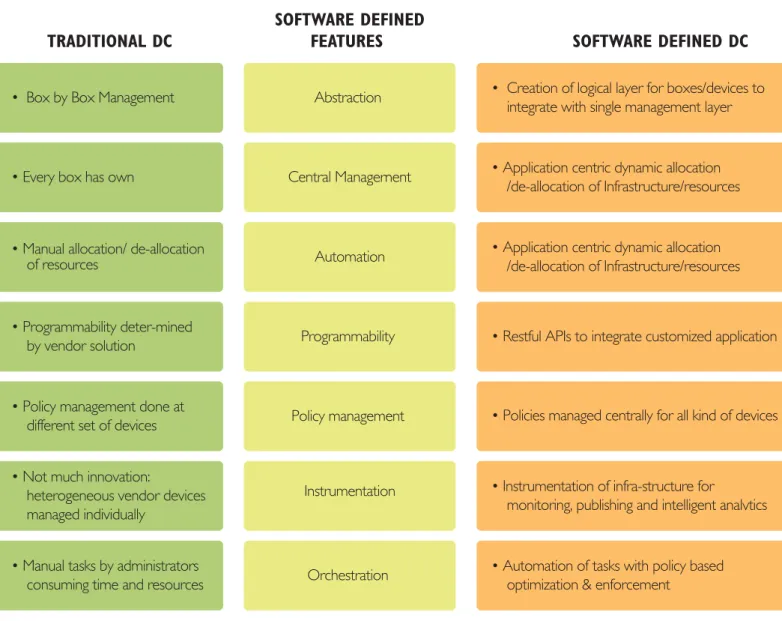
Figure 2 SDDC Features
VISION: A Workload centric architecture which will cut across vertical layers throuhg Cloud, Compute,
Storage, Networking and Non-IT (DCIM) to harmess the complete capability of a heterogeneous Infrastructure
& cloud in a variablized consumption model.
TRADITIONAL DC
SOFTWARE DEFINED DC
• Box by Box Management
Abstraction
• Creation of logical layer for boxes/devices to
integrate with single management layer
• Every box has own
Central Managernent
• Application centric dynamic allocation
/de-allocation of Infrastructure/resources
SOFTWARE DEFINED
FEATURES
SDDC Vision
Datacenters have been evolving and innovating perpetually but still provide siloed infrastructure services. With separate management for each components and human intervention required in different phases, service delivery has become sluggish.
But with the advent of “Software Defined concept”, data centers now have the vision around which they can evolve to enable IT as true business enabler.
Benefits of SDDC
Enterprise adoption of SDDC would fulfil the needs of evolving data centres focussed on agility, flexibility, scalability and security along with lower total cost of ownership (TCO). Abstraction of software from the hardware infrastructure layer will continue to be a key
driver. Intelligent software controls the hardware configurations and will help integrate with, and transform the traditional data centres of enterprises, which typically were hardware and device driven.
Figure 3 SDDC Benefit
RESOURCE EFFICIENCY
• Reduce over-provisioning of resources • Use of containers
• Enterprise Investment Protection • Fewer hardware devices to be purchased at next refresh cycle
MORE INNOVATIONS
• Use of analytics and intelligence tools to reduce incidents and problem tickets
SECURITY
• Policy based more granular security • Self-heal solution
COMPLIANCE
• Use of API for auditing and Collection of logs to get faster results which were done manually before
FLEXIBILITY
• Use of devices of your own choice • Integrations with existing infrastructure
MOBILITY/PORTABILITY
• Ease of migration of workloads & resources from datacenter to public/private cloud
AGILITY
• Management and provision agility while optimizing process and costs
• Faster time to market and business enablement
DISASTER RECOVERY
• Ease of migration of datacenters across backup DC or public/private cloud
NO VENDOR LOCK-INS
• SDDC if implemented using open standards can help in reducing vendor lock-ins
SCALABILITY
• Dynamic allocation of resources • Ease of Scale in/out/up/down
LOWER TCO
• Use of white boxes
• Repurpose/Reutilization of existing hardware • Automation of mundane tasks
• Use of software instead of hardware • Less Administrators required
GREEN IT
• Integration of advance power & cooling control and provision tools with infrastructure using APIs
EASE OF MANAGEMENT
• Management of devices from a single pane of glass
• User defined service portals
CLOUDFICATION MORE INNOVATION FUTURE PROOFING REDUCED TIME TO MARKET BUSINESS CONTINUITY VENDOR NEUTRALITY SELF-HEAL SOLUTIONS
Figure 4 High Level view of SDDC Architecture Figure 5 Consumption Model of SDDC
API
API
Application/Cloud/ Service Portals
Controller/ Management Devices
Application Layer Infrastructure (Physical/Virtual) Application Layer API API API
API South bound Interfaces
North bound Interfaces
Application Layer Controller Layer
Infrastructure Layer
SDDC Architecture
The architecture which forms the basics of SDx concept is shown in Figure1. There are two distinct interfaces in the SDDC high level
architecture. The southbound interface which talks to the infrastructure layer and the northbound interface that speaks to
Software Defined Management & Policy
Software Defined Security
Software Defined Compute Software Defined Network Software Defined Storage Software Defined Facilities Software Defined Data Center Service Models Orchestration & Automation
cloud, orchestration and management layer. The north-bound interface is pretty much standardized as REST APIs (Representational State Transfer - Application Programming Interface) is present in all the SDDC controllers that are available today. The southbound interface is specific to the vendor’s implementation. Some use open standards based protocols while some use proprietary interfaces.
Above dipicted SDDC architecture helps in providing unified view and management of resources including network, storage, compute, facilities managed securely via automation and orchestration layer and delivered via service models as shown in figure2.
We will discuss them individually now.
SaaS Services PaaS Services IaaS Services
Security
Service Management Governanace
API Management layer
Public Cloud
Self Service Portal Meeting - Billing - Chargeback
Cloud Migration Workload Movement Policy Engine Cloud Economics Orchestration
Automation, Workload Management A A A E C C A E C C Middleware Databases Open Standar ds Softwar e Defined Open Ar chitectur e
Agility Elasticity Cost
Compute Proprietary OS
Proprietary Appliance
Network Proprietary Switching A E
C
Proprietary Open SW Controller Proprietary Open HW
A E
C
Compute Proprietary Appliance Proprietary Open SW Controller
Proprietary Open HW
Proprietary Open OS Hyperviser/ Container Proprietary Open Hardware
SDDC Component
SOFTWARE DEFINED NETWORK
Network Virtualization techniques are not something new in the network world. VLANs, tunneling, and VPNs have been around for quite long. Talking about SDN, following the lines similar to the software defined concept it intends to centralize all intelligence in the
network on a software layer allowing centralized control and abstraction of the underlying complex infrastructure. Theoretically all network nodes would only need the muscle (forwarding or data plane) to push packets out which results in better management and control over network.
SDN Approaches:
Focus
Underlay Overlay Hybrid
Implementation
On hypervisor and uses tunneling and encapsulation
On top of existing network infrastructure, multiple networks and multiple layers
On virtual and physical network (Overall Fabric Management) Puts Software defined network in every point in your network
Combines both Underlay and Overlay approach
Software Defined Storage
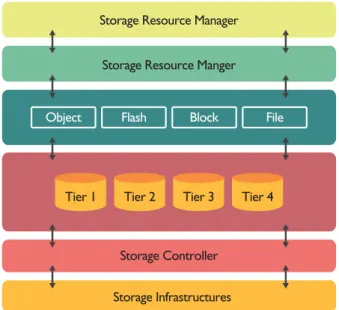
Similarly to SDN, different kinds of storage solutions can now be managed using storage resource manager which can in turn work with storage controllers to provide SDDC benefits along with automation of storage tiering, de duplication. In short, storage allocation can now be application driven with faster and optimal storage allocations. SDS also provides benefits of seamless integration with cloud storage, migration and archival of storage to public/private cloud or secondary DC. With enormous increase in storage requirement SDS can provide an economical solution for backup, disaster recovery, test and development environment .The savings can be anything between 20% to 50% both in capital and operating expense.
Software Defined Compute
Though the compute world has undergone virtualization a decade before, but it was specific to compute. SDC talks about abstraction of virtualization across different layers of physical servers, hosts, containers and virtual machines to provide unified management function.
Concept of containers is not something new, though it has received lot of attention recently, especially with declaration of support from many technology leaders. Several startups have popped up to focus on a host of container issues that haven’t been addressed yet, from storage to networking.
Containers have brought higher abstraction in virtualization. A container virtualizes a single OS for multiple applications (Shown in Figure). In simple terms, a container does effective OS process isolation. Containers are ideal tools for those applications that require agile development and change, horizontal compatibility and scalability.
Software Defined Facilities
With greater storage requirements and increment of virtualization, IT infrastructure requires more managed and device centric cooling and power supply. SDDC concept can help in integrating power/cooling management tools, DCIM tools (Data center Infrastructure Management), HVAC components (Heating, Ventilating and air conditioning) to have unified management of facilities of data center from a single plane of glass. This can help in averting possible device
Figure 2 SDDC Features Storage Resource Manager
Storage Resource Manger
Storage Controller Block
Object Flash File
Tier 1 Tier 2 Tier 3 Tier 4
Storage Infrastructures
Figure 8 SDC Architecture
APPs PAAS Cloud SAAS IAAS
Orchestration & Automation
Host OS Physical Infrastructure Hypervisor ContainerManager
Physical Servers
VM VM Container Container Container
Figure 8 SDC Architecture APP
A
APP
A APPA’ APPB Bin/ Lib Guest OS APP A’ Bin/ Lib Guest OS APP B Bin/ Lib Guest OS Hypervisor Host OS Hardware Container Daemon
failures, reducing the over provisioning of facilities resources and most importantly better management of resources. This will also help bring
the UPS, cooling, cabling, power monitoring and management to a central portal integrated with cloud layer.
Software Defined Security
Multiple startups on lines similar to SDDC architecture have come up with security tools which can have policy or application or resource based security managed centrally. There are existing vendors also which provide security management along with their SDx solution.
One of the major concerns in SDDC is security, but SDDC if implemented properly can help in overcoming existing security concerns.
Automation and Orchestration
This layer provides integration of all resources and components we talked above and automation of their management /allocation from a single pane of glass.
Integration could be with applications, cloud (Public/ Private), IaaS, PaaS, SaaS, tools involving monitoring, analytics, troubleshooting, governance, logging, auditing or any other third party tools (provided they have APIs).
Traditional Approach
Security Challenges SDDC based Approach Benefits
New Security Threats
• Provides network visibility derived from centralized configuration and network state
• Easier to track and automate cure of the threats
• Though threat might get detected but it keeps on spreading across network and difficult to trace path • Threats are cured mainly manually
Velocity and Proactive patch manage-ment
• Continuous, zero-touch centralized patch management
• Rapid analysis and response to ever-changing threats without the need to patch each individual networking device
• Difficult to achieve in a consistent manner due to finite resource availability in the embedded device
Scalability • Virtualized security processing
reduces hardware demands • Requires proportional increase in
hardware
Perimeter Security • Perimeter defined through
application-layer concepts (groups, type of device, etc.)
• Traffic can be monitored
independent of the physical location of the source
• Each device must be statically configured individually
• All traffic for each physical object must be monitored, typically using a single policy Self-Healing Visibility App-Centricity Granular Management Simplicity Agility Dynamic Low Touch Configurations
SDDC Vendor EcoSystem
Management, orchestration, controller software, operating systems, security, monitoring and logging tools, third party applications, customized applications etc. with APIs
• Support of hardware and software from different vendors
• Most of the software have their own HCL list (Hardware compatibility list) leading to interoperability issues
• No transparency of infrastructure • General public cloud
concerns like security, network latency
• Inability to make granular upgrades or tweaks
• Dependence on hardware vendor to maintain competitive pricing • Limitation in choosing additional
hardware and dependence on HCL • Upgradation requires addition of
hardware • Easy to install • Affordable • Less capex • Granular Features • Modularity
• On the fly provision • Pay as per use • No capex
• Scale up/down on demand
• Preconfigured and tested solutions from vendors • Easy adoption
• Hardware and software support from a single vendor in many cases
Software-centric architecture that tightly integrates resources and other technologies in a commodity hardware box supported by a single vendor
• Hardware boxes for installation of SDDC environment • White and brite boxes (NetworkDevices) • Open Compute • New concept • Compatibility guidelines need to be followed as per providers • Inability to make granular upgrades or tweaks New Startups and traditional players trying to enter • High scope of innovation • Less TCO • Increased Flexibility Communities and new startups Many startups and few traditional vendor collaborations Traditional vendors and multiple startups Mostly traditional players
• Hosting the SDDC platform on a public cloud
infrastructure, can also be delivered as a virtual private cloud
• Offers APIs for integrations • Some offers cloud
management/orchestration tools as well
Few existing cloud players and new startups
Pay-as-you-go model Software without associated
hardware PreconfiguredSystems Build-your-own-model Hardware for SDDC
Open Source Proprietary
Hardware for SDDC Solutions Converged and
Hyper-converged Model Cloud based Model
Software Only Model
What? Models Types How? Vendors Pros Cons
Different vendors across
layers of SDDC Architecture SDDC VENDOR ECOSYSTEM Mostly Traditional Players Many Startups & few traditional
players Startups & traditional players Crowded with Startups & traditional players Many Startups & traditional players Mostly Startups, a few traditional players Orchestration &
SDDC Challenges
CHALLENGES
BUYER‘S GUIDE
Know exact TCO savings offered by vendors as per your environment
LACK OF CLOUD ECONOMICS
• SDDC though cheaper than traditional but lacks granular and aggressive pricing offerings like cloud
SECURITY
• SDx solutions removes physical layers from the network design and virtualize it, then replaces it with exposed layer of highly sensitive network , open for attack.
Know security features offered in your SDx solution and follow best practices
ABSTRACTION NOT ATTRACTIVE
• Abstraction functionality may add more complexity due to the need of extensive compatibility testing and handling multi-vendor support for escalation and troubleshooting, thus adding to opex costs.
Know the limitations and act accordingly
HUGE VENDOR ECOSYSTEM
• There are many vendors in SDDC market with different offerings leading to confusion among end customers
Know what you need and analyze the solutions carefully
COMPREHENSIVE SOLUTION & SCOPE OF MANAGEMENT
• Though there are many vendors with different solutions but a comprehensive solution is still not available in today’s market
Know what you need and get detailed scope of manage-ment of solution offered
DIFFERENT INTEPRETATIONS
• SDDC has been interpreted by each vendor differently hence there is need to carefully look at vendor future SDS roadmap , architectural principals before finalizing any solution
Be Inquisitive and know scope of the solution offered
ENTERPRISE READINESS
• SDDC might be good bet for greenfield projects but introducing SDS in existing datacenters /brownfield projects requires detailed analysis
Start implementing in green-field projects & go step by step for brownfield projects
INTEGRATION
• SDDC offers Capability to have integration with any vendor hardware ,any monitoring, orchestration and cloud Solutions but Integration is challenging and requires skills and knowledge on various vendors solutions
Analyze the vendor solutions & use cases and find best fit for your environment
1. SDDC impact on organization and their data centers and the value a system integrator can bring in
TRADITIONAL APPROACH ORGANIZATION
COMPONENTS SDDC BASED APPROACH
Product • Provide comprehensive solutions and become single POC for
solutions
• Find the best use case for client and accordingly “integrate the right things”
• API development and management tools
• Service portals for developers to understand the resource allocations and management
• Infrastructure will be now delivered as service rather than as individual devices/solutions
• Build your own device models, given the modularity functionality offered by SDDC solutions
• “Datacenter in a Box” solutions for faster adoption • Customized application developments and
integration with existing infrastructure • DevOps friendly environment
Process • Modification of service delivery process to get best suit for
software defined data center
• Creation of customer specific SLA plans like “create your own SLA”
• Developing and managing self-help portals as per requirements
• Identification of the white spaces and automating the processes to provide more agility
• ITIL Framework of delivery would be changed • Self-service interfaces/portal rather than manual
administration
• SLAs will be changed as most of tasks will be automated
• Many processes will be more automated and delivered as service
Partners • Vendor agnostic approach
• Enhance the partner ecosystem
• Contract and relationship management with vendors • Single window support with ownership of the overall solution
– a Truly Hybrid Cloud on your terms • Data center services will involve multiple partners
involvement
• Sellers will have to remain on their toes to involve with new partners and compatibilities with their solution
People • More aligned to business with very flexible
consumption models • Selling pattern and revenue model of sellers will be
changed
Skill Set • Provide right skilled resources
• Provide Training to Customer Staff on Multiple technologies • Dual skill set ( Development + Administration )
• Cloud administration skills
Organization Structure
• Can provide consulting and help customers align the organization structure to the changing trends and needs • Identify the gaps and help develop required sill set • Environment will become more service focused
• More Level 1 and Level 3 administrators (Developers + Administration skills) would be required and level 2 engineers might not be required • New designations like cloud service architects,
service experts would rise
Strategy • Provide customized service delivery models and solutions
• Deliver an open environment based solution open to new solutions
• SI are rightly placed to provide help in true consumerization of IT • Changes in service models will be observed Pay as
you use / Pay per consumption models would rise • Flexible and open based solutions will be preferred
System • Develop APIs which could be integrated to provide security
standard specific desired results
• Help in App rationalization and containerization to foster portability of applications across different environments • Data/ Resources will be more mobile ( movement
from public/private cloud)
• Security compliance concerns would increase • Infrastructure will become more app-centric
2. How SI can help in SDDC adoption and optimize the delivery process
PLAN OPTIMIZE TEST SUPPORT & MANAGE DEPLOY• Discovery tool to identify customer environment’s readiness for SDDC deployment
• TCO calculator to educate customer how different SDN solutions reduce customer’s Capex and Opex and whether the investment in SDN is worth or not
• API Development Identifying the gaps and develop custom APIs to integrate with southbound and northbound interfaces
• Feedback Loop Providing mechanism to provide customized services on basis of feedback from application
• Simulator Labs to provide tested and proven solution as every customer’s environment is different from each other
• Vendor Agnostic While choosing best solution for customers, SIs have to be vendor agnostic and evaluate neutrally to provide best solution for customers
• Disaster Recovery Providing the best solution to have feasibility of failing over to secondary DC or to Public or Private Cloud
• Automatize Provision
Finding the gaps and automatize the migration and deployment process
• Integration of various infrastructure with controller and orchestration layer tools
• Integrating the right things
Best solution for customer specific environment
• Automatize Provision
Finding the gaps and automatize the migration and deployment process
• Integration of various infrastructure with controller and orchestration layer tools
• Integrating the right things
Best solution for customer specific environment
• Vertical Integration
Integration of SDN, SDC, SDN, SDsec, SDF to provide holistic SDDC solution
• API Management Tools To provide management of the APIs versions
• Communities Membership To stay abreast with latest developments and to contribute in SDDC community, SIs can be part of groups like ONF, IEEE, IETF, OpenStack, OpenDayLight, OEM’s Appstores
Summary : SI Helping in
Achiving SDDC Vision
SDDC provides vision for today’s data center solutions and most importantly provides great opportunity in channelizing existing data center solutions to provide agility, scalability, app-centricity and programmability which resonates with what is required from today’s business.
“Change may be risky but routine will be lethal” .Though the adoption may have few challenges, but a System Integrator can help
in reducing those adoption challenges and can give a comprehensive solution to reap the best benefits of SDDC.
Figure 11 shows some gist & recap of how SI can help in adoption journey
Figure 8 Roadmap for achieving SDDC benefits
VISION
MISSION
OBJECTIVES
STRATEGY
ACTION PLAN
Virtualized Comprehensive Solution Devops friendly environment Integration as ServiceNew Skill set Vendor
Agnostic Identify white spaces Automatize Vertical Integration Application Centricity
Tested & Proven Solution Ease the journey
of Adoption
Integrate the right things Controlled & Managed by
smart Softwares Delivered as service
About the Authors
Anuj Bhalla is a Vice President and Global Business Head for -System Integration, Maintenance Services, and Products in
Global Infrastructure Services, Wipro Limited. His recent initiatives have been Wipro Open Data Center, SDI Center of Excellence launched recently in Bangalore Wipro Campus, under his belt, which is first for any System Integrator or Technology Provider in the country.
With over 20 years of Professional Experience across the entire spectrum of IT including Business Development, Practice Development, Pre-Sales & Delivery, to IT Strategy, Transformation especially on new areas like Hybrid Cloud, Open Source / Open Stack and IOT. Also, he is in the panel of their Partner Advisory board. Joined in as a trainee graduate from Symbiosis, Pune in 1996 , he has grown ranks and has been instrumental in turning around various businesses that he has spearheaded within Wipro. He is proven to be a transformational leader rolling out initiatives on Telecom Support or new areas of Open Source namely in Open-stack, Cloud, SDX, and SD to cover a few.
About Global Infrastructure Services
Global Infrastructure Services (GIS), a unit of Wipro Limited, is an end to end IT infrastructure & outsourcing services provider to global customers across 60 countries. Its suite of Technology Infrastructure services spanning Data Center, End User Computing, Networks, Managed Services, Business Advisory and Global System Integration. Wipro, is a pioneer in Infrastructure Management services and is amongst the fastest-growing providers across the world. GIS enables customers to do business better by enabling innovation via standardization and automation, so that businesses can be more agile & scalable, so that they can find growth and succeed in their global business. Backed by our strong network of Integrated ServiceNXT™ Operation Centers and 14 owned data centres spread across US, Europe and APAC, this unit serves more than 700+ clients across with a global team of 32,000+ professionals and contributes to over 28% of Wipro’s IT Services revenues of Wipro Limited.
Gaurav Chaturvedi is an experienced engineering graduate and IT professional with 14+ years of experience in Enterprise IT
services encompassing System Integration, Support services, Service Delivery, Datacenter Architecture, and Pre-sales, have strong tecno-commeritial understanding and have design large complex DC Transformation solutions and delivery. He has handled various roles in delivery, pre-sales & practice, he is passionate about technology and have been instrumental in launching and help driving the new practice successfully. He is currently heading Software Defined Infrastructure (Open Data Center) CoE leading development, integration, Validation and testing of multiple SDDC, SDS, SDN solutions and tools.
Manjari Sharma has been a part of the Global 100 Intern program at Wipro and is currently enrolled in the Post Graduate Program
at Indian Institute of Management, Calcutta, Before starting her management journey, she worked for five and a half years in infrastructure management services at IT majors such as Infosys and Wipro. Her experience is primarily in computing and Network platform. She has a keen interest in Technology and Marketing.
© WIPRO LIMITED 2015
“No part of this booklet may be reproduced in any form by any electronic or mechanical means (including photocopying, recording and printing) without permission in writing from the publisher, except for reading and browsing via the world wide web. Users are not permitted to mount this booklet on any network server.”
WIPRO LIMITED, DODDAKANNELLI, SARJAPUR ROAD, BANGALORE - 560 035, INDIA TEL : +91 (80) 2844 0011, FAX : +91 (80) 2844 0256, EMAIL : [email protected] WWW.WIPRO.COM CONSULTING | SYSTEM INTEGRATION | BUSINESS PROCESS SERVICES
DO BUSINESS BETTER
North America Canada Brazil Mexico Argentina United Kingdom Germany France Switzerland Nordic Region Poland Austria Benelux Portugal Romania Africa Middle East India China Japan