A BRIEFING AND CONSULTATION DOCUMENT BY THE NATIONAL AUDIT OFFICE
March 2004
Ministry of Defence
Driving successful delivery of major defence projects:
drawing on wider practice in tracking the progress of major projects
The National Audit Office team consisted of: Tim Banfield, Ffiona Kyte and Mike Scott
Consultancy support was provided by a PA Consulting team consisted of:
Giles Beattie, Bill Dalton, Barry Smeaton, Emma Dobson and Robert Pillar
Dri
ving successful deli
very of major defence projects: dr
aw
ing on wider pr
actice in tr
ac
king the progress of major projects
EXECUTIVE SUMMARY
2
PART 1
Comparing the Ministry of Defence's
4
practices in managing major projects
Why we are comparing the Ministry 4
of Defence's practices
The key drivers of successful delivery of 4 major defence projects
Consulting on management of the key drivers 8
Disseminating the results of our work 9
PART 2
Consultation on tracking the progress
10
of major projects
Why tracking the progress of major projects 10 is important
The aspects of tracking progress we would 12 like views on
How to give your views 13
PART 3
Other major insights emerging
14
from the key drivers
Budgeting and funding major defence projects 14 Staffing major projects with suitably skilled and 16 experienced staff
Why competition is not amongst the key drivers 18
ANNEXES
Annex A: The sectors and organisations we 21 are seeking views from
Annex B: Giving your views - 22
The Questionnaire
Questionnaire 1 - 25
Tracking progress at project level
Questionnaire 2 - 32
Tracking progress at a strategic level
Appendix B1 Terminology Guide 37
Annex C: The Ministry of Defence's process 39 for acquiring major defence
equipment - the 'Acquisition Cycle' Annex D: How the key drivers were identified 40
Annex E: The models used 42
EXECUTIVE SUMMARY
Battlefield Light Utility Helicopter
2
Dri
ving successful deli
very of major defence projects: dr
aw
ing on wider pr
actice in tr
ac
king the progress of major projects
1 This briefing and consultation document is part of a programme of work by the National Audit Office (NAO) to bring better understanding to what drives the performance of major defence projects, and learn lessons from outside practice to feed into successful management of the drivers by the Ministry of Defence (MoD). The work builds on the annual Major Projects Report, published by the NAO and analysing the performance of major defence projects, by exploring the complex cultural and systemic drivers which the MoD and its industry partners need to manage. We are taking this work forwards in partnership with the MoD but the interim conclusions in this report are our own.
2 In early 2003, we began by commissioning PA Consulting to undertake some systems dynamics based analysis of the MoD's acquisition system to identify the key drivers of the performance of major defence projects. This analysis was unique in looking from the outside at the broader drivers bearing on the success of the MoD's internal processes, rather than at the processes themselves. Because of the new perspective this work brings, we have decided to publish the drivers that it identified now, without prejudice to further investigation by ourselves and the MoD of their effect on major defence project performance and how this is managed. We hope that providing this early sight of the identified drivers will be useful in raising awareness both within the MoD and more widely of the complexities surrounding the management of major defence projects. The analysis is not indicative of the strengths or weaknesses of management of the drivers by the MoD.
3
Dri
ving successful deli
very of major defence projects: dr
aw
ing on wider pr
actice in tr
ac
king the progress of major projects
3 A list of the key drivers identified through working with PA Consulting, the MoD and industry is presented in Part 1. Taking a through-life approach, budgeting and funding, and staffing emerged as the drivers having the biggest impact on performance. In a series of future reports and other outputs, we plan to examine some of these drivers in further detail to understand how well they are managed by the MoD and explore the scope for bringing improvements to MoD practice. 4 Our first examination, which is underway, is investigating how the progress of major projects is tracked. Tracking the progress of major projects emerged as a critical linking factor between a number of the key drivers, and informs effective decision-making. Tracking progress is the link through from management information to governance and assurance, risk and cost estimating, and ultimately budgeting and funding.
5 Part 2 explains the focus of our examination into tracking progress, which will cover how information is gathered, analysed and used to inform decision-making. We plan to publish our findings in late 2004 and would welcome you contributing to our work by giving us the benefit of your knowledge and experience of how your organisation tracks the progress of major projects. How you can do this is covered later. We are seeking views from practitioners with experience of the management of major projects covering a range of government and commercial sectors, as well as those within the defence sector.
6 Key aspects of our fieldwork on tracking progress are:
i A structured questionnaire, included for reference with this document, through which we welcome views from any individual or organisations who would like to contribute to our examination. The questionnaire can be completed and submitted offline or it is also accessible for completion and submission online through our website at www.naodefencevfm.org. ii A series of case study visits to commercial organisations and overseas
defence ministries to conduct more in depth analysis of practice in tracking progress. We have chosen the case study organisations jointly with the MoD using a range of criteria to assess their suitability and utility in drawing out good practice.
iii Interviews and evidence gathering within the MoD to understand in detail how the MoD tracks the progress of major projects and any relevant improvement initiatives that it has underway.
7 Alongside our report on tracking progress, we are exploring with the MoD and industry the potential for spreading good practice emerging from our work on the key drivers of project performance in other ways, for example through conferences, seminars and good practice guides. We published a report on Through-Life Management in May last year1and will be following
up our recommendations with the MoD. Further into the future, depending on our wider work programme, we may examine budgeting and funding, and staffing of projects.
4
Dri
ving successful deli
very of major defence projects: dr
aw
ing on wider pr
actice in tr
ac
king the progress of major projects
Why we are comparing the
Ministry of Defence's practices
1.1 Towards the end of each calendar year the National Audit Office (NAO) publishes "The Major Projects Report". The Report summarises the progress of the Ministry of Defence's (MoD's) highest value defence equipment procurement projects. It compares current forecasts of cost, time and technical performance against the parameters set when the projects were given approval for procurement of the equipment to proceed. For many years, the Major Projects Report has highlighted the variable performance of projects with many suffering cost overruns and delays. This variable performance has been an ongoing matter of concern for both the MoD and Parliament, and the MoD has introduced a large number of reforms designed to improve project performance and achieve faster, cheaper and better delivery of military capability.
1.2 The most recent Major Projects Report2published in January 2004 concluded
that, "progress has been made but more needs to be done" to improve project performance in the longer term. To achieve sustained improvement the MoD needs to have a thorough understanding of what influences the time, cost and technical performance of its projects, and what more can be done to manage these influences to bring more certainty to the successful delivery of projects. 1.3 Much of the analyses undertaken to date and most of the MoD's initiatives have
been focused on improving the internal acquisition processes of the MoD. Relatively little work has been done to understand the broader influences on the success of those processes and how they can best be managed (see Annex D). In early 2003, in part reflecting suggestions from MoD and Parliament, the NAO embarked on a programme of work in partnership with the MoD, designed to improve understanding of these broader influences and help improve the delivery of defence equipment capability. Our programme, shown in Figure 1, is split into three phases - identifying the key drivers of successful delivery of major defence projects, comparing MoD's practices in managing some of the key drivers and reporting the outcomes.
The key drivers of successful delivery
of major defence projects
1.4 Our starting point in Phase I was to identify what drives successful delivery of major defence projects. It was clear that in order to do this we would need to take a systems analysis approach, to model and understand the complex dynamics surrounding project performance. Early in 2003, we commissioned PA Consulting to undertake this work. Our specification was for PA Consulting to identify the key drivers of the performance of MoD's major equipment projects, understand how and what impact they have on performance and how their impact can be managed.
1
COMPARING THE MINISTRY OF DEFENCE'S PRACTICES IN
MANAGING MAJOR PROJECTS
5
Dri
ving successful deli
very of major defence projects: dr
aw
ing on wider pr
actice in tr
ac
king the progress of major projects
1.5 Under our guidance, and with close involvement by MoD throughout, PA Consulting completed this work in September 2003. Our interim conclusions on the key drivers of successful delivery of major defence projects identified through this work are shown in Figures 2 and 3. These are split into key drivers of acquisition performance (Figure 2) - defined as performance in both delivering equipment and supporting it in use, and the key drivers of procurement performance (Figure 3) - defined as performance in delivering equipment up to the point of use. In each case the drivers are ranked according to their relative impact on project performance, with the biggest impact driver set to unity. Cost3was used as a good and representative proxy
of procurement and acquisition performance in ranking the drivers.
1.6 Drivers of procurement performance have been analysed separately because procurement performance determines when capability becomes available. Decisions taken during the early procurement phases also heavily influence supportability and hence acquisition performance. Comprehensive data was available on the procurement phases of projects to inform separate analysis. A basic understanding of MoD's process for acquiring defence equipment is important as context to the drivers. Annex C gives an overview of this process known as the 'Acquisition Cycle'.
1.7 A summary of how the drivers were identified is given in Annex D and Annex E gives additional detail on the models used. PA Consulting produced a series of causal maps to aid understanding of the dynamics surrounding and feeding into each of the key drivers and the relationships between them. Some of these maps are discussed later in this document and the full series can also be found through our website, www.naodefencevfm.org, together with this consultation document and further explanatory information.
3 Full acquisition costs were not assessed. In view of the shortage of hard support data, acquisition performance was derived from a consideration of supportability costs assessed on the basis of a simple "bathtub" curve (see Annex E, Figure 5). The calculated supportability costs included those costs closely associated with the equipment (manning, fuel, spares etc.) but neither depreciation
Outline of the NAO's programme of work 1
Source: National Audit Office
Phase 1:
Identifying the key drivers of successful delivery of major defence projects
Phase 2:
Comparing practice in managing the key drivers
Systems analysis and modelling
Reports and other outputs Consultation
document and web pages, incorporating questionnaire Visits to commercial organisations and overseas defence ministries Phase 3:
NAO reporting on areas of good practice, lessons and improvements
6
Dri
ving successful deli
very of major defence projects: dr
aw
ing on wider pr
actice in tr
ac
king the progress of major projects
1
The Key Drivers of Acquisition Performance 2
Source: PA Consulting/National Audit Office
1.00 0.90 0.80 0.70 0.60 0.50 0.40 0.30 0.20 0.10 0.00 Normalised impact TL focus in the MoD TL provisions in prime contract MoD's organisation MoD's governance MoD's & industry's staff MoD's understanding of risk 1 2 3 4 5 6
Rank Drivers of Acquisition Performance
1 The adequacy of through-life (TL) focus within the MoD, encompassing how well the MoD manages capability delivery through-life - integrating management of all aspects of capability delivery from identification of the need for the capability to its disposal.
2 The adequacy of through-life and supportability provisions within the prime contracts awarded to industry. 3 The coherence of the MoD's organisation between its constituent parts (e.g. the Equipment Capability Customer, the Defence Procurement Agency, the Defence Logistics Organisation and Front Line Commands).
4 The effectiveness, with which the MoD's governance and assurance processes assure that issues of supportability are fully comprehended and that risks to the project are identified, bounded and placed under management. 5 The availability of suitably qualified and experienced staff to both the MoD and industry.
Dri
ving successful deli
very of major defence projects: dr
aw
ing on wider pr
actice in tr
ac
king the progress of major projects
The Key Drivers of Procurement Performance 3
Source: PA Consulting/National Audit Office
1.00 0.90 0.80 0.70 0.60 0.50 0.40 0.30 0.20 0.10 0.00 Normalised impact MoD's budgetting process Staff - MoD & industry Funding Assessment Phase
& Prime Contract
Changing spend profile Risk & Estimating Management information
Rank Drivers of Procurement Performance
1 MoD's budgeting process has the biggest impact on procurement performance and impacts on every procurement phase.
2 The availability of suitably qualified and experienced staff to both the MoD and industry.
3 The Main Investment decisions (Initial and Main Gates) approvals which determine the funding and schedule for the risk identification and reduction activities performed in the Assessment Phase as well as, crucially, those for the prime contract.
4 Varying procurement spend profile resulting in funding constraints on the early phases of projects and existing commitments.
5 The ability of the MoD and industry to estimate the likely cost and time necessary to undertake the post-Initial Gate activities and the accompanying level of risk.
6 The availability of accurate, current and relevant management information in support of effective and timely decision-making.
8
Dri
ving successful deli
very of major defence projects: dr
aw
ing on wider pr
actice in tr
ac
king the progress of major projects
Consulting on management of the key drivers
1.8 Phase II of our programme of work is to consult on wider practice in managing some of the key drivers of successful delivery of major defence projects to assess how MoD might better manage these drivers to improve the delivery of defence equipment capability. This will involve a broad consultation exercise and visits to selected comparator organisations to conduct more in-depth comparative analysis of practice in managing the relevant drivers. The broad consultation exercises will be facilitated by briefing and consultation documents, of which this is the first, incorporating questionnaires, and accompanied by explanatory web pages.
The drivers we have selected for comparison
1.9 This document is the first consultation exercise exploring the drivers of successful delivery of major defence projects and best practice in managing them. It seeks views on best practice in 'Tracking the progress of Major Projects'. Depending on our wider future work programme, we may conduct further rounds of consultation covering two of the other key drivers of successful project delivery - Budgeting and Funding Major Projects, and Staffing Major Projects.
1.10 We selected these drivers for comparison jointly with the MoD from those shown in Figures 2 and 3. Selection of the drivers was guided by criteria covering their impact across procurement and acquisition performance, the extent to which we have previously examined and reported on them, and the extent to which the MoD is already pursuing change initiatives aimed at improving performance through better management of the drivers. We also considered the practicality of making comparisons and the likelihood of being able to learn lessons from outside practice.
1.11 Tracking progress was selected as first for comparison because of its importance as a critical linking factor between some other key drivers. It is the link through from management information to governance and assurance, risk and cost estimating, and ultimately budgeting and funding. Part 2 of this document explores tracking progress in more detail. Taking a through-life approach to managing major defence projects is clearly at the heart of the two biggest drivers of acquisition performance. We are not examining this here as we published a report in May this year on Through-Life Management4 and the
MoD is currently taking forward our recommended improvements.
Those we are seeking views from
1.12 To ensure that we obtain the broadest appreciation of how others tackle the challenges facing the MoD, we are making our briefing and consultation documents accessible to a wide audience. We seek views from practitioners with experience of management of major projects covering a range of government and commercial sectors, as well as those within the defence sector. A list of the industrial sectors we believe are likely to offer particularly useful insights is given at Annex A, although we are interested in receiving views from anyone who has relevant experience. Part 2 explains the different ways in which views can be submitted to us.
1
Dri
ving successful deli
very of major defence projects: dr
aw
ing on wider pr
actice in tr
ac
king the progress of major projects
1.13 Alongside seeking broader views, we are undertaking a programme of individual visits to a targeted sample of commercial organisations outside the MoD and overseas defence ministries to conduct more in-depth comparative analysis of practice. We have selected the comparators jointly with the MoD using a range of criteria to assess their suitability and utility. The organisations and overseas ministries chosen are also listed in Annex A, together with the selection criteria.
1.14 An essential part of our work will be to understand in more detail how the MoD manages the key drivers and any relevant improvement initiatives that it has underway. In parallel with our external consultations, we will be interviewing relevant officials from across the MoD and examining documents and data, at project and corporate level, to gain this understanding.
Disseminating the results of our work
1.15 Based on the findings from the consultation exercises, we plan to publish a series of outputs assessing how well the MoD manages the key drivers and identifying how the MoD can make improvements using lessons from outside practice. Our first report on tracking the progress of major projects is likely to be published in autumn 2004. Alongside this, we will be exploring with the MoD and industry the potential for spreading good practice emerging from this work in other ways, for example through conferences, seminars and good practice guides.
10
Dri
ving successful deli
very of major defence projects: dr
aw
ing on wider pr
actice in tr
ac
king the progress of major projects
Why tracking the progress of major projects
is important
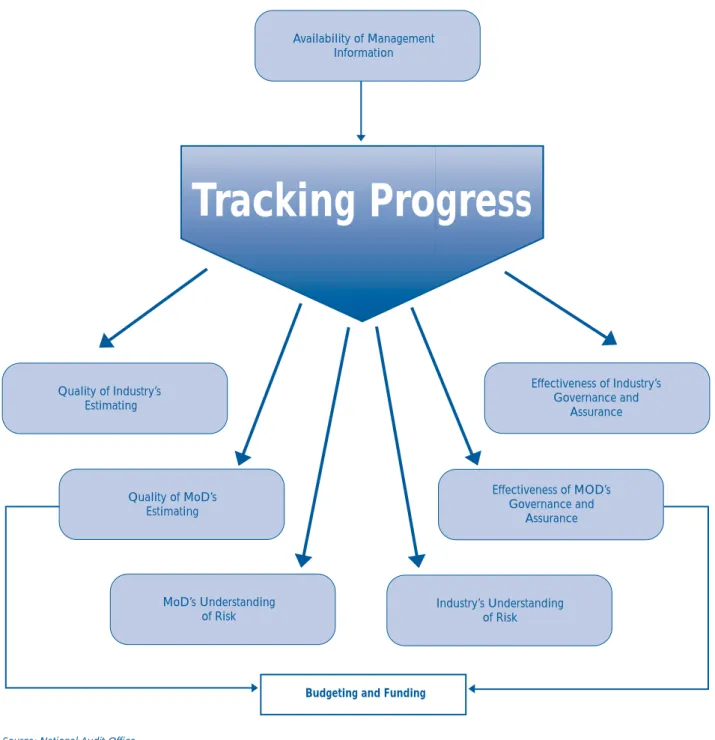
2.1 MoD and industry's ability to track the progress of major projects in a timely, relevant and accurate way and, to draw on this tracking for well-informed decision-making, is a common link across many of the key drivers of successful project delivery (see Figure 4). Tracking progress is dependent on having appropriate management information (the sixth most important driver of procurement performance) and, in turn, underpins critical decisions affecting the success of projects through the following drivers:
I governance and assurance;
(fourth most important driver of acquisition performance).
Tracking progress informs governance whereby the interests of major stakeholders are recognised (including their roles, responsibilities and authority levels), and stakeholders are engaged in the oversight of the project and its performance (including setting strategic direction and objectives, tracking progress and decision-making). Assurance is gained from tracking progress that the project is moving as intended towards its objectives and, if not, that rectification action can be taken through informed decision-making.5
I risk and cost estimating; and
(fifth most important driver of procurement performance)
Effective tracking of progress depends on MoD and industry's ability to robustly estimate the likely cost and time necessary to undertake remaining activities and the accompanying levels of residual risk associated with them. In turn, review of such estimates, and any assumptions they are based on, as part of tracking progress should give added confidence in their robustness.
I budgeting and funding.
(most important driver of procurement performance)
Through the above drivers, tracking progress ultimately feeds into budgeting and funding as the perceived amount of progress made and the amount of activity and residual risk remaining before objectives are expected to be met informs future funding decisions.
2
CONSULTATION ON TRACKING THE PROGRESS
OF MAJOR PROJECTS
5 PA Consulting: The key drivers of MoD's acquisition performance. Summary Report. 20 October 2003. p. 3-3.
Dri
ving successful deli
very of major defence projects: dr
aw
ing on wider pr
actice in tr
ac
king the progress of major projects
4
Source: National Audit Office
Availability of Management Information Quality of Industry’s Estimating Quality of MoD’s Estimating MoD’s Understanding of Risk Effectiveness of Industry’s Governance and Assurance Effectiveness of MOD’s Governance and Assurance Industry’s Understanding of Risk
Budgeting and Funding
Tracking Progress
12
Dri
ving successful deli
very of major defence projects: dr
aw
ing on wider pr
actice in tr
ac
king the progress of major projects
The aspects of tracking progress we would
like views on
2.2 Tracking progress is essentially about gathering, analysing and using information. Information that is relevant, accurate and timely, and goes to decision-makers with the authority to act upon it and who use it to take action. For the purposes of comparing MoD practice, we have captured these different aspects of tracking progress in a set of logically structured issues shown in Figure 5(with more detail on these issues available on our website at www.naodefencevfm.org). The aim of these issues is to determine how the MoD might improve the way it tracks progress, by improving the information it uses and how it uses the information. 2.3 To help us examine these issues, we are seeking views from a wide range of
practitioners across industrial sectors on good practice in tracking the progress of major projects in terms of:
I the methods used (i.e. what information is gathered, and how it is analysed and reviewed) to track the progress of major projects;
I the sources of tracking progress information (i.e. - who/where the information is sourced from - internally, externally or both, and how widely tracking progress information is shared with customers/clients - do customers/clients and suppliers have shared data environments - do they track progress in the same way, using the same information or differently, and does this help or hinder);
I reporting tracking progress information (i.e. - what and how frequently
information is reported, and who it goes to e.g. project directors, portfolio directors, board members, etc.); and
I using tracking progress information in decision-making (i.e - how it is used
by decision-makers at project and strategic levels to manage existing projects and plan for future projects.
2
Framework of issues for examining how the MoD might improve the way it tracks the progress of major projects 5
Can the MoD, with input from industry, improve how it
tracks the progress of acquisition programmes?
Can the MoD improve how it uses information
to track progress? Can the MoD improve
the information it uses to track progress?
Are there better performance measures and monitoring techniques the MoD could use?
Does information draw on input from industry? Is the information accurate and up to date? Does information go to decision-makers at appropriate points? Do decision-makers act on the information received? Is information shared with industry to agree action?
Dri
ving successful deli
very of major defence projects: dr
aw
ing on wider pr
actice in tr
ac
king the progress of major projects
2.4 Our interest is in drawing out best practice in tracking progress at both project and corporate levels. There are a range of different methods that can be used to track the progress of individual major projects. Some of the recognised methods, drawn from the Association of Project Management, are shown in
Figure 6. We are interested to learn practitioner's views on how useful and effective these and any other methods prove in practice. Which method, or combination of methods, works best and why, and are there ways of using the methods which are more likely to make them successful in tracking progress. In addition, how tracking progress information is aggregated and used at a strategic level to exercise governance and assurance over a portfolio of projects or an area of business.
How to give your views
2.5 We have designed a questionnaire as a vehicle for gathering views which is included for reference at Annex B to this document. The questionnaire can be completed and submitted offline or, it is also accessible for completion and submission online through our website at www.naodefencevfm.org. We hope to receive a wide range of views and encourage you to complete the questionnaire with any relevant information. A helpline will be available for any queries concerned with using the questionnaire up to last submission date of 7th May 2004. All replies will be held in the strictest confidence, according to any relevant provisions of the Data Protection Act 1998.
2.6 Alternatively we would be happy to receive views separately either by post, fax or e-mail. Please contact the study team at the address below who can e-mail, fax or post a hard copy version out to you (please mark all responses 'Tracking Progress').
Ffiona Kyte Room C510
National Audit Offiice
157-197 Buckingham Palace Road Victoria, LONDON SW1W 9SP Fax: 020-7798-7588
E-mail: [email protected]
Some recognised methods for tracking the progress of major projects
6
Source: Association for Project Management - Project Management Body of Knowledge, Fourth Edition, 2000.
Key Performance Indicators Project success criteria. Determined at the beginning of a project.
Value management Identifying key issues and setting targets in terms of success criteria; identifying teams and processes necessary for achievement; reviewing throughout the project.
Time scheduling/Phasing Ordering of the processes required to ensure timely completion of the project.
Budgeting/Cost management Process of estimating the proper cost expected to be incurred against a clear baseline.
Quality management Quality planning, control and assurance.
14
Dri
ving successful deli
very of major defence projects: dr
aw
ing on wider pr
actice in tr
ac
king the progress of major projects
3.1 This part of the document highlights other major insights emerging from the key drivers. In particular, it explores budgeting and funding of major projects, and staffing of major projects which may form the basis for separate consultation exercises in the future. It also explains why competition does not feature as one of the key drivers of successful delivery of typical major defence projects. Industry and, to a lesser extent MoD, had intuitively believed that competition would be a key driver.
Budgeting and funding major defence projects
3.2 The MoD's budgeting process has emerged as the key driver having the biggest impact on procurement performance. An understanding of how this complex process impacts on procurement performance can be gained from a discussion of the causal map that describes it (see Figure 7). The MoD's equipment budget is split into two main parts; one relating to procurement of the equipment and one relating to support of the equipment in service. The two parts are managed over different timescales by different budget holders. The causal map for the budgeting process shows that there are three spirals affecting the budget available for funding procurement. These relate to:
I financial management of existing commitments
The procurement budget can be subject to pressure from the support budget when the former is used to absorb potentially large and unforeseen demands placed on the support budget by operations. In order to respond to these pressures, the procurement budget needs to be flexible and its flexibility is directly proportional to the unallocated headroom that it possesses. Existing large, long duration projects mean that the majority of the procurement budget is committed for some years ahead and its flexibility to respond to unforeseen pressures is reduced. These pressures may, therefore, result in constraints on the funding of existing contracts, which can lead to escalation of costs, adding to the pressure on the procurement budget.
There is also potential pressure on the procurement budget from other sources. Seeking to ensure the best use of available funds, normal MoD practice is to budget and manage projects against cost and time at 50 per cent confidence figures, whilst approving projects against 90 per cent confidence figures.6 However, there is a potential risk of
overspend and delay should projects be managed and delivered against 90 per cent approved figures rather than the 50 per cent budgeted figures.
I Making new commitments
The pressures on the procurement budget can impact on new commitments as well as constraining spending on existing commitments, and can result in reduced funding for the early, risk identification and reduction (Assessment) phases of new projects. Consequently, unscoped and unquantified residual risk can be passed into prime contracts resulting in a lack of realism in some
3
OTHER MAJOR INSIGHTS EMERGING FROM THE KEY DRIVERS
6 50 per cent confidence figures are the MoD's forecast values for the most likely cost and delivery date of equipment and are the basis on which the MoD plans and apportions its procurement budget. 90 per cent confidence figures are the MoD's highest acceptable, not to be exceeded, values for the cost and delivery date of equipment and broadly represent the manifestation of all identified risks to a project.
Dri
ving successful deli
very of major defence projects: dr
aw
ing on wider pr
actice in tr
ac
king the progress of major projects
of the contracts awarded. Unrealistic contracts are more likely to run into cost, schedule and quality problems because the funding and time provided are not consistent with delivery of the contracted requirement at the contracted level of risk. Problem procurement projects result in unforeseen requirements for additional funds in the short and medium terms, adding to the pressures on the procurement budget.
I Management of risk
Effective ongoing management of a project and the interface with the prime contractor on the basis of a sound understanding of the remaining risk and the effectiveness of outstanding mitigation actions is fundamental to successful procurement performance. Where there is poor understanding and mitigation of risks, cost and time contingencies can quickly be eroded by cost escalation and delays, adding to the pressures on the procurement budget. Conversely, where there is good understanding and mitigation of risks, it may be possible to release some cost contingency, relieving pressure elsewhere on the procurement budget.
Causal Map for the MoD's budgeting process 7
Source: PA Consulting
Financial management of existing commitments
Pressure from support budget Available procurement budget Flexibility of procurement budget Prioritisation and apportionment Existing commitments Management of risk Making new commitments Pressure on procurement budget from portfolio of projects Escalation of project costs Management against 90% approvals Constraints on funding of existing prime contracts delivery
Funding for new concept and assessment phases Risk identification and mitigation Realism of prime contracts Problem projects Release of project risk contingency back
to the procurement budget Management of risk Manifestation of risks as costs
16
Dri
ving successful deli
very of major defence projects: dr
aw
ing on wider pr
actice in tr
ac
king the progress of major projects
Staffing major projects with suitably skilled and
experienced staff
3.3 Staffing major projects emerged as the second most important driver of procurement performance and the fifth most important driver of acquisition performance. This driver encompasses whether there are sufficient people, across both MoD and industry, with appropriate experience in the core competencies required for projects. For example, people with expertise and experience in the Concept of Operations for particular types of major equipment platforms and how the individual functions and systems of the platforms contribute to their operational capability.
3.4 There are slightly different dynamics involved for MoD and industry, although the effectiveness of human resource polices covering recruitment and retention, and adequacy of training of staff are dynamics common to both, as is learning from experience. The dynamics are shown in Figure 8.
3.5 For MoD, the introduction of new processes and technology, such as Whole Life Costing, adds to training requirements. Also, regular movement of staff affects levels of continuity in some roles, which impacts on skill and experience levels. The availability of suitably skilled and experienced staff in MoD impacts particularly on the early stages of projects when MoD is leading on decisions affecting the scope and direction of projects, which have resonance for downstream acquisition performance. For example, the availability of MoD staff with suitable skills and experience in risk management affects the quality of early risk reduction activity.
3.6 Process and technological change also adds to training requirements for industry. In addition, for industry, changing roles and taking on functions such as acting as Design Authority requires additional skills and experience to be brought in through recruitment, which can be affected by national shortages of skills in some cases. Within industry, consolidation has also impacted on the availability of skilled and experienced staff, and the mobility of staff can also affect this.
17
Dri
ving successful deli
very of major defence projects: dr
aw
ing on wider pr
actice in tr
ac
king the progress of major projects
Causal Map for staffing major pr
ojects with suitabl
y skilled and e xperienced staff 8 Source: P A C onsulting/National A u dit Office H L H MM H H M H HH M M L M M ML H M M L M H Changing role of industry Requirement for
additional skills and
experience National shortage of key skills Rate of process c hange - Industry Industry impro vement progr ammes MoD process c hanges Effecti veness of industry's recruitment process Effecti veness of industry's retention policies Adequac y of tr aining/coac hing
Reducing global defence market Consolidation of industrial base
Reduction in number of skilled and experienced
staff a vailable Effecti ve mobilisation of project staff Pressure of
procurement and support budgets
Lev
el of suitably skilled & experienced industry staff
Lev
el of suitable skilled & experienced staff
Lev
el of suitably skilled & experienced MoD staff
Effecti
veness of
industry's HR polic
y
and its implementation
Effecti veness of MoD's recruitment process Adequac y of tr aining/coac hing Effecti veness of MoD's HR polic y and its implementation Effecti veness of MoD's retention polic y Lev el of continuity in role Effecti veness of Learning from Experience Rate of process c hange - MoD Effecti veness of
Learning from Experience
Key
:
H/M/L refers to relati
ve
strength of relationships feeding into one point.
H - High M - Medium L - Lo
18
Dri
ving successful deli
very of major defence projects: dr
aw
ing on wider pr
actice in tr
ac
king the progress of major projects
Why competition is not amongst the key drivers
3.7 Figures 9 and 10describe the dynamics surrounding the impact of competition on the successful delivery of defence projects. Competition impacts through the realism of the prime contract awarded to industry, which is defined as the degree to which the funding and schedule contracted for, are consistent with delivery of the contracted requirement. The MoD and industry both contribute to the realism of the prime contract. The drivers associated with the MoD are shown in the outer unshaded block of Figure 9 and those associated with industry (the inner shaded block of Figure 9) are expanded in Figure 10. 3.8 The possible dynamics for industry (see Figure 10) are that the need for
corporate survival can drive a 'must win' attitude in the face of competition for a large contract. This can be added to by the need to create value for shareholders. Returns expected from internal improvement programmes can also drive a degree of optimism in pricing contracts. All of these drivers together contribute to the degree that industry is willing to accept an unrealistic prime contract. Key counterbalances to this are industry's ability to understand risk and put accurate cost and timescales estimates on activities, and the extent to which its governance and assurance processes pick up potential optimism or lack of reality in contracts.
3.9 The dynamics for MoD (see Figure 9) are associated with budgeting, and the governance, risk management and cost estimating that goes into preparing and reviewing the case for award of the contract. These drivers feed directly into the realism of the prime contract together with industry's willingness to accept an unrealistic prime contract. The connection of such a large number of competing drivers into one point results in a wide distribution of their effects. Essentially, from this model of the dynamics for typical major defence projects, the key message is that competition alone is not a key driver of successful delivery. Only if the other checks and balances are absent or their counterbalancing impact is reduced due to poor management of them does it emerge as a key driver.
Dri
ving successful deli
very of major defence projects: dr
aw
ing on wider pr
actice in tr
ac
king the progress of major projects
Causal Map showing how competition impacts on the successful delivery of defence projects through the realism of the prime contract awarded to industry
9
Source: PA Consulting/National Audit Office
Key:
H/M/L refers to relative strength of relationships feeding into one point. H - High M - Medium L - Low
H M H H M H H M Industry dynamics (see Figure 10) Industry willingness to accept an unrealistic prime contract
Realism of the prime contract MoD's Competition
Policy
Large long duration projects Budgeting Governance/ Assurance - MoD Estimating - MoD Risk - MoD Risk - Industry Estimating - Industry Degree of MoD's optimism H MoD dynamics H
20
Dri
ving successful deli
very of major defence projects: dr
aw
ing on wider pr
actice in tr
ac
king the progress of major projects
3
Causal Map showing drivers that contribute to the degree that industry is willing to accept an unrealistic prime contract in a competitive environment
10
Source: PA Consulting/National Audit Office
Consolidation of industrial base Industry's improvement programmes Reducing global defence market
Need for corporate survival
Degree of industry optimism
Estimating - Industry "Must win" attitude
by industry
Shareholder value
Risk - Industry Governance/Assurance - Industry
Industry willingness to accept an unrealistic prime contract MoD's competition
policy
Large long duration projects H H H L M H Industry dynamics H H Key:
H/M/L refers to relative strength of relationships feeding into one point. H - High M - Medium L - Low
1 Using this briefing and consultation document and the associated website (www.naodefencevfm.org), we are canvassing views on tracking the progress of major projects via the questionnaire at Annex B. We are seeking views from practitioners with experience in the management of major projects across all public and commercial sectors, defence and other. Our target audience encompasses individual companies and government departments, Trade Associations, Professional Associations and experts from academia.
2 In addition to this broad consultation, we are seeking detailed views and comparisons on tracking the progress of major projects through individual visits to a targeted sample of commercial organisations outside the MoD and overseas defence ministries. These are detailed below.
ANNEX
THE SECTORS AND ORGANISATIONS WE ARE SEEKING VIEWS FROM
21
Dri
ving successful deli
very of major defence projects: dr
aw
ing on wider pr
actice in tr
ac
king the progress of major projects
A
Target organisations for in-depth comparison
Overseas Defence Ministries Commercial Organisations
Selected sample: I France I Sweden I Israel I USA I Australia Selection criteria: Qualitative knowledge
I Similar nature of acquisition (e.g. use of competition, balance between domestic and overseas business)
I similar nature of capability requirements
I similar level of engagement in active operations
I perceived as at the leading edge of practice in any of the areas chosen for comparison
I previous contacts and accessibility
Informed by:
I level of defence expenditure
I total number of acquisition projects
I average cost and duration of projects
I number of complex, high technology projects
I data on project performance
Selected sample (to be completed from):
I Oil and Gas (exploration)
I Utilities I Distribution/Logistics I Nuclear I Information Technology I Construction I Telecoms I Transport I Pharmaceutical I Shipbuilding (tankers/cargo) Selection criteria: Qualitative knowledge
I similarity of business/operations (i.e. organisation concerned with project management)
I preceived as at the leading edge of practice in any of the areas chosen for comparison
I previous contacts and accessibility
Informed by:
I size of operations, for example:
I level of expenditure
I number of projects/service contracts
I average cost/duration of projects/service contracts
ANNEX
GIVING YOUR VIEWS - THE QUESTIONNAIRES
22
Dri
ving successful deli
very of major defence projects: dr
aw
ing on wider pr
actice in tr
ac
king the progress of major projects
B
Both of our consultation questionnaires are supplied here for reference. We encourage interested practitioners to visit the study website www.naodefencevfm.org in order to submit views and responses.
The questionnaire Terminology Guide can be found at Appendix B1.
Who should complete the questionnaires?
Questionnaire 1 - Tracking progress at project level
This is aimed at Project Directors primarily (i.e. those that have management authority over a single project or programme).
Questionnaire 2 - Tracking progress at a strategic level
This is aimed at all those who have a perspective across a number of projects or programmes. These may include Portfolio Directors, Technical Directors and Board Members.
We greatly appreciate any time spent giving us your views and anticipate each questionnaire taking approximately 30 minutes to complete. We would also welcome any feedback you may have on any aspect of the questionnaires. The deadline for responses is 7th May 2004.
Major Projects
A major project in the MoD is one valued at £400 million or more. These projects deliver equipment (or infrastructure) and are often characterised by complex technology, significant technical or other risk and long duration. The MoD is a client organisation, engaging outside companies to develop and produce equipment (or infrastructure).
Whilst we want to gain a robust comparison across projects in different sectors valued at £400 million or more, we recognise that a relatively small proportion of projects are valued at this level. We therefore welcome views from across the spectrum of projects to gain the widest possible insight into tracking project progress.
Helpline
If you require further assistance with any aspect of this questionnaire please do not hesitate to contact Ffiona Kyte (0207 798 7791, [email protected]) or Mike Scott (0207 798 7029, [email protected]).
FFO
O
RR
RREE
FFEE
RREE
N
N
CCEE
O
O
N
N
LLYY
Details of your organisation and project
This section will appear at the start of both questionnaires.
The following questions will enable the study team to effectively analyse and collate the data. All replies will be held in strict confidence.
1 What is your name?
2 What is the name of your organisation?
3 Please describe your role by checking the box that applies:
Comments Project Director
Organisation expert on project management Portfolio Director
Technical Director Senior Executive Board Member Other (please describe)
4 Please give your telephone and email address details to enable us to follow-up and/or clarify your questionnaire answers, if necessary.
Telephone: Email:
5 How long is a Project Director typically in post (on any one project) in your organisation? Please specify in years and months:
6 Is/Are your project(s) in the defence sector? If yes, please complete questions 6 - 11. If no, please complete questions 12 - 16.
7 Are you primarily a client organisation or a contractor organisation? Please check the box that applies: Client organisation (tracking projects being undertaken by others)
Contractor organisation (undertaking projects for clients)
8 What kind of defence project(s) are you engaged in? Please describe:
9 Was the project competed or single sourced ? Please select
10 Is your project supplying directly to the Ministry of Defence (MoD) or within a supply chain (if relevant)? Please select
Dri
ving successful deli
very of major defence projects: dr
aw
ing on wider pr
actice in tr
ac
FFO
O
RR
RREE
FFEE
RREE
N
N
CCEE
O
O
N
N
LLYY
11 What is the value (or typical value) of your project(s)? Please check one box: > £400 million
> £100 million > £20 million < £20 million
12 In which industrial sector is/are your project(s)?
13 Are you primarily a client organisation or a contractor organisation? Please check the box that applies: Client organisation (tracking projects being undertaken by others)
Contractor organisation (undertaking projects for clients) 14 What kind of project(s) are you engaged in? Please describe:
15 Is your project supplying directly to a client or within a supply chain (if relevant)? Please select 16 What is the value (or typical value) of your project(s)? Please check one box:
> £400 million > £100 million > £20 million < £20 million 24 Dri
ving successful deli
very of major defence projects: dr
aw
ing on wider pr
actice in tr
ac
king the progress of major projects
FFO
O
RR
RREE
FFEE
RREE
N
N
CCEE
O
O
N
N
LLYY
Methods of Tracking Progress
1 When do you use the following methods to track project progress (or have used them in the past)? A definition of each method can be found below. Please check the boxes that apply:
Design Manufacture Other
(please describe) Project scheduling tool
Contractual milestones Earned Value Management Risk Register
External cost incurred Forecasts to completion
Metrics relating to critical path activities Other (please describe)
Comments
Methods of Tracking Progress - Definitions
These are intended to be recognisable across different industrial sectors.
Source: Association for Project Management "Project Management Body of Knowledge" 2000, National Audit Office
Project scheduling tool Use of a software package to plan out project activities. This may involve creating work packages that correspond to those being undertaken by a contractor/client.
Contractual milestones Targets linked to payments schedule in the contract or are stipulated in the contract (for example, a certain level of achievement by a certain date at a certain cost) and could have an incentive or penalty attached.
Earned Value Management Process of representing physical progress achieved in terms of a cost based measure.
Risk Register Use of the project risk register alongside the schedule, cost and quality checks. Risk identification and mitigation as an ongoing process and linked explicitly to progress made on the project.
External cost incurred Reference to project balance sheet or ledgers - monitoring on the basis of money spent.
Forecasts to completion Measuring progress in terms of what remains to be done, rather than work already done, and forecasting how long this may take, at what cost and at what level of quality.
Metrics relating to critical The use of metrics to measure high risk activities, an example being metrics for software development.
path activities
Dri
ving successful deli
very of major defence projects: dr
aw
ing on wider pr
actice in tr
ac
king the progress of major projects
B
QUESTIONNAIRE 1 - TRACKING PROGRESS AT PROJECT LEVEL
to be completed by Project Directors
FFO
O
RR
RREE
FFEE
RREE
N
N
CCEE
O
O
N
N
LLYY
2 What are the advantages of using these methods? Please check all the boxes that apply on the basis of your experience: Advantages in terms of:
Practical/ Low/ Commonality High Low
easy to straightforward of use by a accuracy cost
use training client or
requirements contractor Project scheduling tool
Contractual milestones Earned Value Management Risk Register
External cost incurred Forecasts to completion
Metrics relating to critical path activities Other (please describe)
Comments
3 What are the disadvantages of using these methods? Please check all the boxes that apply on the basis of your experience: Disadvantages in terms of:
Impractical/ High Limited Low High
difficult training commonality accuracy cost to use requirements of use by a
client or contractor Project scheduling tool
Contractual milestones Earned Value Management Risk Register
External cost incurred Forecasts to completion
Metrics relating to critical path activities Other (please describe)
Comments
B
26
Dri
ving successful deli
very of major defence projects: dr
aw
ing on wider pr
actice in tr
ac
FFO
O
RR
RREE
FFEE
RREE
N
N
CCEE
O
O
N
N
LLYY
Driving successful deli
very of major defence projects: dr
aw
ing on wider pr
actice in tr
ac
king the progress of major projects
4 What methods do you use to track support projects, (which may typically be based on a logistics support contract that comes into force when manufacture is completed) if relevant?
Please check the boxes that apply:
Support phase Comments
Project scheduling tool Contractual milestones Earned Value Management Risk register
External cost incurred Forecasts to completion Logistics performance metrics Other (please describe)
5 Are project managers in your organisation empowered to choose tracking methods that suit their particular project and take appropriate decisions (without necessarily making reference to a more senior manager)?
Please select Comments
Yes No
6 Have you made any improvements to the method(s) of tracking your project's progress since January 2003?
Please select Comments
Yes No
If yes, please also check the boxes that apply:
Improvement Comments
Linked project management and reporting systems Started to operate lifecycle management
Started to analyse trends in time, cost or progress Adopted another method (please describe) Other (please describe)
FFO
O
RR
RREE
FFEE
RREE
N
N
CCEE
O
O
N
N
LLYY
B
28 Driving successful deli
very of major defence projects: dr
aw
ing on wider pr
actice in tr
ac
king the progress of major projects
Sources of tracking information
The purpose of the following questions is to understand how you gain access to information from outside your project team that may be relevant to tracking your project's progress.
7 Please describe how you gain access to information from your prime contractor by checking the boxes that apply. Comments
Weekly meetings Monthly review meetings Shared work breakdown structure Joint metrics
Joint risk register Co-location of staff Other (please describe)
8 Can data be shared easily between your project and its prime contractor? Please select
Yes No
If yes, is there a shared management information system?
Please select Comments
Yes No
9 Please describe how you verify prime contractor's data by checking the boxes that apply. Comments Data sample checking
Real-time electronic data system System checking
Dedicated staff Other (please describe)
10 How often do you have to report upwards on project progress? Please check the box that applies: Comments Weekly
Monthly Quarterly Every six months Other (please specify)
FFO
O
RR
RREE
FFEE
RREE
N
N
CCEE
O
O
N
N
LLYY
Driving successful deli
very of major defence projects: dr
aw
ing on wider pr
actice in tr
ac
king the progress of major projects
11 Do you have an independent review process for your project? Please check all the boxes that apply: Frequency
Monthly Quarterly Other Comments
(please specify) Peer Review
Governance Panel
Senior Management Review Other (please specify)
Reporting project progress
12 What standard data do you have to regularly report upwards in your own organisation? Please check the boxes that apply: Comments
Actual spend
Cost estimates/forecasts Schedule estimates/forecasts
Build progress/performance achievement against plan Trade offs
Staffing profile Project office costs Other (please describe)
13 In your experience, what are the features of an effective reporting system? Please check the boxes that apply: Comments
Clear purpose for reporting Clear data requirements
Common metrics across all projects Common information system
Requirements for reporting balanced with the utility of reports generated
FFO
O
RR
RREE
FFEE
RREE
N
N
CCEE
O
O
N
N
LLYY
14 In your experience, what are the obstacles to effective reporting of project progress? Please check the boxes that apply: Comments
Too many layers of management/levels of hierarchy Reliance on aggregated data across all projects Wrong types of project data required
Mismatch between data used on the project and data required for reporting
Poor timing of reporting No feedback mechanism
Lack of definition of data required Poor availability of data
Incompatible information systems Other (please describe)
15 How frequently do you have contact with your client/prime contractor to discuss tracking information and agree action? Please check the boxes that apply:
Comments Informal day-to-day contact
Weekly informal contact Weekly formal meeting Monthly informal contact Monthly formal meeting Other (please describe)
Taking action
16 What sorts of action do you agree with your client/prime contractor on the basis of tracking information? Please check the boxes that describe the actions you take:
Comments Re-allocate resources
Re-prioritise work Identify risks Mitigate risks
Identify training needs Recruit more staff Identify re-work Apply lessons learned Other (please describe)
B
30
Dri
ving successful deli
very of major defence projects: dr
aw
ing on wider pr
actice in tr
ac
FFO
O
RR
RREE
FFEE
RREE
N
N
CCEE
O
O
N
N
LLYY
Driving successful deli
very of major defence projects: dr
aw
ing on wider pr
actice in tr
ac
king the progress of major projects
If possible, please visit our website at www.naodefencevfm.org which gives further details of the key drivers of acquisition performance in the Ministry of Defence. We are interested to find out if these drivers apply in other industrial sectors.
17 According to the circumstances in your organisation, how would you rate the importance of tracking progress and the other key factors listed below to the success of major projects?
Scale: 1 = very important 2 = moderately important 3 = not noticeably important
Rating Comments
Tracking progress (Management information linked to governance and assurance) Early risk mitigation
Staffing
Budgeting process Lifecycle approach
16 Would you be interested in receiving feedback of the results of this questionnaire? Please select
Yes No
17 Would you be interested in attending a later seminar in 2004 to focus on these issues further? Please select
Yes No
Additional comments:
Thank You
Please return completed questionnaires by 7th April 2004. [email protected]
or in hard copy to:
Ffiona Kyte Fax: 0207 7987588
Defence Value for Money Team Tel: 0207 798 7791 National Audit Office
Room C510
157-197 Buckingham Palace Road Victoria
FFO
O
RR
RREE
FFEE
RREE
N
N
CCEE
O
O
N
N
LLYY
Types of data to track a number of projects
1 Why do you track the progress of your projects? Please check the boxes that apply:
Comments To highlight progress against corporate
targets/objectives
To gain assurance that the business is progressing satisfactorily
For future planning To allocate resources Other (please describe)
2 Please rate how useful the following types of data are to you in overseeing projects:
Scale: 1 = very useful 2 = moderately useful 3 = not noticeably useful
Rating Comments
Actual spend
Cost estimates/forecasts Schedule estimates/forecasts
Build progress/performance achievement against plan Trade offs
Staffing profile Project office costs Other (please describe)
3 Is a consistent set of metrics kept for all projects?
Please select Comments
Yes No
If yes, please outline what they measure
32
Dri
ving successful deli
very of major defence projects: dr
aw
ing on wider pr
actice in tr
ac
king the progress of major projects
QUESTIONNAIRE 2 - TRACKING PROGRESS AT A STRATEGIC LEVEL
to be completed by all those who have a perspective across a number of projects or
programmes; this may include Portfolio Directors, Technical Directors and Board Members
FFO
O
RR
RREE
FFEE
RREE
N
N
CCEE
O
O
N
N
LLYY
Driving successful deli
very of major defence projects: dr
aw
ing on wider pr
actice in tr
ac
king the progress of major projects
4 In your experience, what are the features of an effective reporting system? Please check the boxes that apply: Comments
Clear purpose for reporting Clear data requirements
Common metrics across all projects Common information system
Requirements for reporting balanced with the utility of reports generated
Other (please describe)
5 In your experience, what are the obstacles to effective reporting of project progress? Please check the boxes that apply: Comments
Too many layers of management/levels of hierarchy Reliance on aggregated data across all projects Wrong types of project data required
Mismatch between data used on the project and data required for reporting
Poor timing of reporting No feedback mechanism
Lack of definition of data required Poor availability of data
Incompatible information systems Other (please describe)
Reviewing project progress and taking action
6 How often do you routinely review project progress? Please check the box that applies: Comments Weekly
Monthly Quarterly Every six months Other (please specify)
FFO
O
RR
RREE
FFEE
RREE
N
N
CCEE
O
O
N
N
LLYY
7 Are there specific points during the project life-cycle when you review project progress and/or take decisions (for example on approval of funding)? If yes, please describe:
8 Is there an independent review process for your projects? Please check all the boxes that apply: Frequency
Monthly Quarterly Other Comments
(please specify) Peer Review
Governance Panel
Senior Management Review Other (please specify)
9 If you do have an independent review process for your projects (as in question 8 above), do you find it useful? Please select
Yes No
Please explain:
10 What sorts of action do you take on projects? Please check the boxes that apply: Comments Re-allocate resources
Re-prioritise work Identify risks Mitigate risks
Identify training needs Recruit more staff Identify re-work Apply lessons learned Other (please describe)
34
Dri
ving successful deli
very of major defence projects: dr
aw
ing on wider pr
actice in tr
ac
king the progress of major projects
FFO
O
RR
RREE
FFEE
RREE
N
N
CCEE
O
O
N
N
LLYY
Driving successful deli
very of major defence projects: dr
aw
ing on wider pr
actice in tr
ac
king the progress of major projects
11 Do you share tracking information with your opposite numbers in your contractor or client organisations to agree action:
Yes No Comments/Actions
On individual projects? Across the portfolio?
12 Are you reviewing the process by which you track the progress of a number of projects? If yes, please describe in the table below:
Method/Process Reason for review Likely improvement Comments under review e.g.
tracking metrics
If possible, please visit our website at www.naodefencevfm.org which gives further details of the key drivers of acquisition performance in the Ministry of Defence. We are interested to find out if these drivers apply in other industrial sectors. 13 According to the circumstances in your organisation, how would you rate the importance of tracking progress and the other
key factors listed below to the success of major projects?
Scale: 1 = very important 2 = moderately important 3 = not noticeably important
Rating Comments
Tracking progress (Management information linked to governance and assurance) Early risk mitigation
Staffing
Budgeting process Lifecycle approach
16 Would you be interested in receiving feedback of the results of this questionnaire? Please select
Yes No
FFO
O
RR
RREE
FFEE
RREE
N
N
CCEE
O
O
N
N
LLYY
17 Would you be interested in attending a later seminar in 2004 to focus on these issues further? Please select
Yes No
Additional comments:
Thank You
Please return completed questionnaires by 7th April 2004. [email protected]
or in hard copy to:
Ffiona Kyte Fax: 0207 7987588
DefenceValue for Money Team Tel: 0207 798 7791 National Audit Office
Room C510
157-197 Buckingham Palace Road Victoria
London SW1W 9SP
36
Dri
ving successful deli
very of major defence projects: dr
aw
ing on wider pr
actice in tr
ac
king the progress of major projects