ACPS Technology Plan
Table of Contents
1
Executive
Summary
...
3
2
Process
...
3
2.1
Summaryofconnectionstodivision’smissionandvision...3
2.2
Summaryofworkoftheplanningcommitteeanditsbenchmark...7
2.3
Summaryoftheevaluationprocessandplannedupdatedcycle...7
2.4
ConclusionsfromNeedsAssessment...8
2.5
Highlights ‐ SummaryofKeySuccessesduring2011‐2014...10
3
Actions
...
12
Appendix
1:
Timetable
and
Budget
for
goals,
objectives,
strategies,
and
measures49
Appendix
2:
Division
AUP
...
97
Appendix
3:
Summary
of
Internet
safety
program
...
102
Appendix
4
‐
Data
Driven
Decision
Making
(3DM)
Needs
Assessment
Summary
..
106
ExecutiveSummary...106
3DMInitiativeFramework...107
3DMInitiativeRoadmap...108
Appendix
5
‐
Online
Learning
...
109
Appendix
6
‐
Professional
Development
Program
Descriptions
...
115
Appendix
7
‐
Program
Plans
...
116
ElementaryProgramPlan...116
MiddleSchoolProgramPlan...117
1 Executive
Summary
2 Process
2.1 Summary of connections to division’s mission and vision
Student learning is transformed when the school community uses appropriate technology tools
and resources to meet instructional goals and learning needs of the 21st Century. Technology
that is seamless, reliable and easy to use is an integral part of a rich learning environment.
Technology cannot be considered in isolation. It is an integral part of ACPS curriculum and
practices.
The ACPS Technology Services department leads and manages the implementation of a
technology plan by aligning the Technology Goals to the Division Goals:
ACPS Strategic Goals
ACPS Technology
Goals
Learning Environment - Provide students and instructional staff the technology resources to
support a rich learning environment.
Professional Development Provide all staff effective professional development that supports student
learning.
Infrastructure Provide a reliable infrastructure that facilitates the operation of the school division and is transparent to the end user.
Provide access to high-quality data to support data-driven decision
making.
1. Ensure all students demonstrate significant academic growth, and dramatically improve achievement outcomes for students below grade level.
X X X X
2. Provide a rigorous, relevant, and internationally benchmarked education to enable all students to succeed as citizens in the global community.
X X X
3. Create an exceptional learning
environment. X X
4. Implement a focused, transparent governance model which incorporates effective communication and evidence-based decision making.
X X X
5. Provide clean, safe and conducive learning environments that utilize best practices for energy efficiency and environmental sustainability.
X X Technology Services
implements this mission by seeking to provide a reliable infrastructure, improve operational efficiency, and enhance the teaching and learning
Alexandria City Public Schools will provide a rich learning environment that integrates technology to prepare students for college, career and citizenship.
Alexandria City Public Schools will provide the environment, resources, and commitment to ensure that each and every student succeeds — academically, emotionally, physically, and socially. Technology Services Mission ACPS Technology Mission ACPS Mission
Characteristics of a rich learning environment include the following:
Collaboration to increase and improve student to student, student to teacher,
teacher to teacher and school to community communications
Engagement of students in the learning process
Equitable access to the appropriate tools for students and instructional staff
Relevant assignments that address global issues
Authentic use of real world data to solve real world problems
Utilization of a variety of instructional strategies and resources that meet the
needs for all students.
Technology Goal I: Learning Environment
Provide students and instructional staff the technology resources to support a rich
learning environment
Snapshot of Learning Environment: William is a sophomore student at the main campus that
has a learning disability which causes him to struggle with using a mouse and keyboard on a
traditional laptop. He is a generally good student with good grades, but they sometimes suffer
when assignments center around the use of his school-provided laptop. William has shown
promise with the new tablet program in the high school where he doesn't seem to struggle with
touching and manipulating objects directly on the screen like he normally would. His
participation and engagement in classroom activities and assignments have measurably
improved since switching to the new tablet program and using it in his classes.
Provide all staff effective professional development that supports student learning.
Snapshot of Professional Development: Ms. Jones, a seventh grade science teacher, has been
a middle school teacher in ACPS for four years. She came to ACPS from Ohio and therefore,
in her first year, had to take the TIE (Technology Integration Education) program, which is
required by the State of Virginia. Ms. Jones decided to take the blended version, doing some of
her work on-line and some in face-to- face classes.
The next year, her good friend, a high school science teacher, participated in Classroom 21.
That friend learned many interesting technology integration ideas in a collaborative
environment involving a number of high school teachers. Ms Jones really liked the ideas her
friend was sharing with her, so she applied for the middle school Teacher Leadership Project
(TLP). In that program she spent a year studying, experimenting, and collaborating on
technology integration ideas. Meeting face-to-face once a month and using Blackboard, she
learned many new and exciting ways to use technology in her daily classroom instruction.
The following year, Ms. Jones decided to challenge her technology instruction skills by
participating in the NETS*T (National Educational Technology Standards for Teachers)
certification program. Meeting once a month, and using Blackboard, the group, from grades K-
12, explores twenty rubrics dealing with educational technology. She is very excited about the
changes in her classroom instruction that have happened to her through her participation in
TIE, TLP, TLP-C and NETS*T.
Characteristics of effective professional development include the following:
A focus on what students learn
An analysis of the difference between current and desired student performance
Teacher involvement in identifying what they need to learn and developing the
learning experiences in which they will participate
A design that is school-based and built into the day-to-day work of teaching
Organization based on collaborative problem solving
Continuous and ongoing learning, involving follow-up and support
Opportunities for research, practice and reflection
A connection to a comprehensive change process focused on improving student
learning
Infrastructure addresses the following components:
Technical architecture includes computing and communication equipment
Management systems include applications for accounting, payroll, Human Resources, purchasing, student data, transportation, maintenance, special education, child nutrition, and student information.
End users refers to all students and ACPS employees
Security refers to hardware and software tools, policies, procedures and guidelines.
ACPS communication refers to all forms of electronic communications.
Provide a reliable infrastructure that facilitates the operation of the school division and is
transparent to the end user.
Snapshot for Infrastructure:
Ms. James, a first year kindergarten teacher, applies for a position in ACPS using an on-line
recruiting application. A Human Resources recruiter contacts her through email to arrange an
interview. Since Ms. James is not located in the Northern Virginia region, her interview is held
via teleconferencing software. After a successful interview with the Human Resources
department and several interested principals, Ms. James is offered and later accepts a position
with ACPS. After the Human Resources department completes applicant processing, Ms.
James’s information is submitted to the Technology Services department where all of her
accounts are created, access to the division’s instructional tools is granted, and her laptop is
prepared. Ms. James is notified via email of all of the necessary account information and
direction on the use of division tools. When Ms. James arrives at her assignment and meets her
students for the first time, she has reviewed her class information in the student information
system, created her lessons in blackboard, met with her teammates and communicated with the
parents of her students. Since the infrastructure and available systems are reliable and
seamless, Ms. James is able to focus on her classroom full of students and begin a new year
with them.
Technology Goal IV: Data
Characteristics of a data-driven organization:
A focus on facts rather than “gut feel”
Uses data to identify and monitor trends
A connection to a comprehensive change process focused on improving student
learning and organizational performance
Technical Architecture Management S ystems End Users External to ACPS
ACPS
Se curity Se curity Se curity Se curity External to ACPSMr. Patrick, a Chief Financial Officer, and Ms. Wang, Executive Director, are determining
budget priorities for the next fiscal year. They would like to increase investment in high-
performing reading programs and eliminate low performing ones. Due to an integrated process
and data environment, they were able to tie funding to a specific set of students that have been
in these programs over the last 5 years. They review the trend assessment data for the students
and are able to identify reading programs that have outperformed others. They decide to
reallocate all reading program investments to the top 2 performing reading programs.
2.2 Summary of work of the planning committee and its benchmark
During 2008-2009 the departments of Instructional and Information Technology led a major
revision of the ACPS Technology Plan. The ACPS Technology Plan 2008-2011 more clearly
communicated the division’s vision of the use of technology for learning, and its strategic plan
to ensure technology is an integral part of a rich learning environment that prepares students
for college, career and citizenship. The leadership of both departments worked with a
Community Technology Advisory Committee comprised of six citizens as well as teachers and
administrators representing central office and building administrators, curriculum specialists
and classroom teachers.
In 2010, Alexandria City Public Schools (ACPS) was the recipient of an “Enhancing Education
Through Technology (EETT)” federal grant. Using this grant, ACPS began implementing a
capacity building project to facilitate data-driven decision-making by teachers, principals, and
administrators to enhance technology connectivity to ensure that students and parents more
effectively access student academic progress, school data, and academic resources. During the
spring of 2010, ACPS organized a 3DM steering group and developed a comprehensive needs
assessment to determine “What needs to be in place to put meaningful data in the hands of
those who can affect student achievement” and roadmap that detailed how to reach 3DM goals.
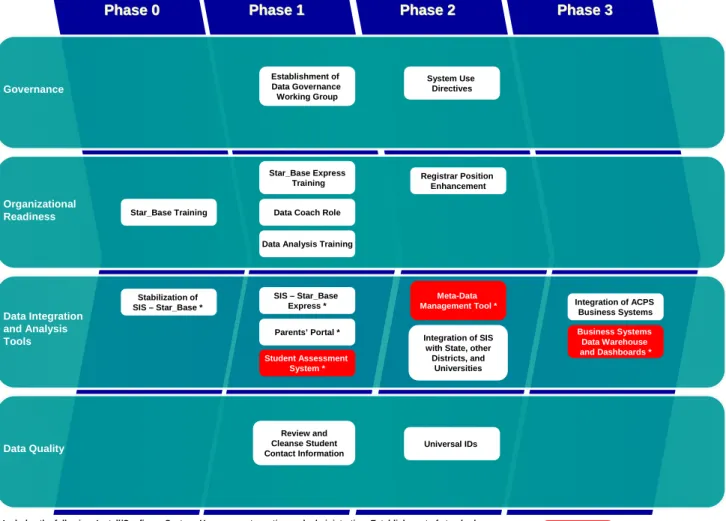
The 3DM roadmap first focused on creating solutions that impacted teachers most
significantly, with subsequent phases focused more on building 3DM capabilities for the
organization as a whole. The 3DM steering group and later the 3DMGG manages and
oversees the implementation of the roadmap.
Both of these strategic planning efforts were critical in the development of the overarching
technology plan.
2.3 Summary of the evaluation process and planned updated cycle
The strategic goals are designed to remain constant over the period of the plan. In contrast,
tactics, the executable details of the ACPS Technology Plan, are dynamic and need to be
continually assessed and revised when necessary.
An effective evaluation process provides the opportunity to fine tune the strategic plan and
make necessary corrections in response to changing circumstances. ACPS utilizes the
Continuous Improvement
Plan – Define the need for improvement and determine what the goal is for closing the gap.
Do – Define the approach to close the gap and engage staff and students in implementation.
Study – Gather data on the implementation and analyze.
Act – Determine how to improve the approach and implement changes in
the new plan.
Data-Driven Decision Making Governance Group (3DMGG) was
established to ensure that IT investment requests are well constructed and
align with ACPS’ strategic goals, to review initiatives, to identify
corrections that need revision, and to provide recommendations for
improvement. The 3DMGG meets every 2 months. A subset of the
3DMGG is the Technology Leadership Group. This group meets
regularly to monitor progress of the technology plan implementation and is also responsible for
identifying and assessing new technologies and their implications for supporting a rich learning
environment.
It is important for ACPS to gain feedback throughout the year to better support its
stakeholders. In addition to the 3DM needs assessment, ACPS launched a division-wide
strategic planning initiative to transform the organization to be more systems oriented and
process-centric by establishing cross-functional working groups throughout the district to
develop core processes and metrics. In January 2011, Technology Services initiated this
planning process by forming a Technology Services Process Implementation Working Group
and surveying ACPS with a comprehensive online questionnaire. The purpose of the online
questionnaire was to seek ACPS employee feedback about the quality of services Technology
Services provides and to provide valuable input to the working group regarding how to
prioritize the key processes for improvement. Results will help target areas of improvement to
be addressed throughout the year in addition to measuring current performance and planning
for the future
2.4 Conclusions from Needs Assessment
Before this process, technology was thought of in isolation and not an integral part of a rich
learning environment. As ACPS works towards these strategic goals, technology is being
thought of a powerful enabler that can meet instructional goals and learning needs of the 21st
Century. The needs assessment effort enabled ACPS to analyze and develop specific tactics
that will help reach the strategic goals.
Provide a variety of effective professional development options including workshops, webinars, podcasts, coaching and online instruction for instructional staff.
Maintain a program of instructional leadership that fosters effective use of technology in support of teaching and learning
Provide training for non-licensed personnel. Provide standardized tools and resources.
Implement promising practices that support a rich learning environment
Evaluate how technology is employed appropriately to support a rich learning environment.
Support community understanding of technology resources and practices and their impact on student learning.
Build and maintain a technical architecture that provides a strong and scalable foundation in support of the goals of the division.
Provide efficient and effective support for all instructional and administrative technology resources for students and staff.
Ensure management systems operate effectively.
Monitor policies, procedures and technologies to ensure that computing resources are secure and recoverable.
Maintain office productivity software and systems for communication and collaboration throughout the division.
Implement governance structure to manage and monitor IT investments
Enhance and implement systems and analysis tools Increase data accessibility and data quality
Technology Goal I: Learning Environment
Technology Goal II: Professional Development
Technology Goal III: Infrastructure
Technology Goal IV: Data
Aligns to Strategic Goal:
1) Ensure all students demonstrate significant academic growth, and dramatically improve achievement outcomes for students below grade level. 2) Provide a rigorous, relevant, and internationally benchmarked education to enable all students to succeed as citizens in the global community.
3) Create an exceptional learning environment.
5) Provide clean, safe and conducive learning environments that utilize best practices for energy efficiency and environmental sustainability.
Aligns to Strategic Goal:
1) Ensure all students demonstrate significant academic growth, and dramatically improve achievement outcomes for students below grade level. 4) Implement a focused, transparent governance model which incorporates effective communication and evidence-based decision making.
Aligns to Strategic Goal:
1) Ensure all students demonstrate significant academic growth, and dramatically improve achievement outcomes for students below grade level. 2) Provide a rigorous, relevant, and internationally benchmarked education to enable all students to succeed as citizens in the global community.
3) Create an exceptional learning environment.
4)Implement a focused, transparent governance model which incorporates effective communication and evidence-based decision making.
5) Provide clean, safe and conducive learning environments that utilize best practices for energy efficiency and environmental sustainability.
Aligns to Strategic Goal:
1) Ensure all students demonstrate significant academic growth, and dramatically improve achievement outcomes for students below grade level. 2) Provide a rigorous, relevant, and internationally benchmarked education to enable all students to succeed as citizens in the global community.
4)Implement a focused, transparent governance model which incorporates effective communication and evidence-based decision making.
2.5 Highlights - Summary of Key Successes during 2011-2014
Goal 1: Learning Environment
Elementary student to computer ratio decreased from a 4:1 ratio to a 3:1.
Explored the following “interactive tools” and developed implementation plans for the
following
o
iPads
o
eReaders
o
Amplify Tablets
Maintained a high school summer intern program
Provided an Online Learning Program, offering students opportunities to take elective,
core and remedial courses online. Over four hundred students enroll each year.
Goal 2: Professional Learning
Transitioned all K-12 teachers from STAR Express to PowerSchool
Trained all K-12 teachers in the use of the SchoolNet, an assessment management
system.
Eighty-five teachers completed the year long Teacher Leadership Project (TLP),
developing student centered technology applications over the past 3 years
Eighteen ACPS teachers succesfully completed the NETS-T training and have received
certification
Delivered tiered SMART Suite training to K-8 teachers via school and division wide
training sessions
Expanded professional development program by adding Teacher Leadership
Program – Collaborate (TLP-C). TLP-C was designed to build and continue a
community of practice collaborating, modeling and implementing relevant, engaging
and innovative technologies in the classroom. An online session was offered each
month, co-facilitated by ACPS teachers through Blackboard Collaborate, an online
collaboration platform.
Goal 3: Infrastructure
Increased virtualization of the ACPS data center
Increased speed of primary Internet connection
Implemented an application layer Firewall
Expanded backup capabilities and added off-site capabilities
Reorganized technicians to increase efficiency and improve productivity.
Increased flexible staff to meet demand during peak periods
Improved communication to end users' with high quality responses through an
automated process
hardware, upgrades, and software installations. This does not include issues resolved
through email, phone or in-person.
Supported over 130,000 online assessments through the academic year which includes
27,000 online SOL test administrations as well as universal screeners and progress
monitoring systems that support Response to Intervention (RtI). Support included
hardware preparation, training and technical support. With few exceptions, online
assessments were administered in wireless environments.
Goal 4: Data
Maintained the 3DM Governance Group (3DMGG) to submit, review, and prioritize
changes to ACPS organizational design, systems, and processes related to 3DM.
Supported the new elementary report card roll-out, by providing an on-time delivery
and successful design to match the specifications provided by Curriculum &
Instruction.
Continued Registrar Enhancement Project to improve organizational readiness,
professional development for Registrars and data entry processes
Established Registrar User Group to meet monthly to enhance capabilities and increase
communication
3 Actions
Virginia Department of Education Goal 1 - Provide a safe, flexible, and effective learning environment for all
students
VDOE
Objectives
ACPS Technology Goal
Action
Progress Measures
Objective 1.1 - Deliver appropriate and challenging curricula through face-to-face, blended, and virtual learning environments. TG1 T2.3 Increase participation in online learning opportunities to address diverse student and faculty needs.
1. Continue to increase operational capacity to enable every ACPS high school student to enroll in at least one online course beginning with the 2014-15 school year.
2. Identify and implement strategies to use online learning to serve at-risk students, enabling them to reach the goal of graduation.
3. Build the capacity to have ACPS teachers trained in online instruction thus reducing the need to use online teachers from outside providers.
4. Explore and create collaborative agreements with neighboring districts and programs to increase capacity and services of the online learning options provided.
5. Expand online learning options to middle school.
6. Explore the feasibility of creating a full-time online program option for ACPS students. 7. Create and implement a marketing plan to spread awareness about online learning options provided by ACPS-OLP to students, parents, ACPS staff, and the community at-large. 8. Continually assess the courses and services offered by ACPS-OLP to ensure alignment with student and district academic needs.
Enrollment, student, teacher, parent feedback
Objective 1.1 - Deliver appropriate and challenging curricula through face-to-face, blended, and virtual learning environments. SG1 T2.5 Establish Programs in which students facilitate the use of technology in the schools
1. Maintain senior experience program for HS seniors to intern with Technology Services 2. Maintain Technology Services Summer Internship program
3. Develop school-based student programs (e.g. Amplify Student Helpdesk)
Feedback Objective 1.2 - Provide the technical and human SG1 T1.1
Provide necessary hardware including laptops, workstations, presentation systems and interactive
1. Maintain an updated inventory of hardware that will be supported by Technology Services. 2. Maintain process to evaluate existing hardware standards and to review needs for
additional instructional technology hardware purchases.
3. Maintain a four year replenishment cycle that provides each middle school with mobile
Inventory document Documentation of evaluation process Inventory reference
infrastructure necessary to support real, blended, and virtual learning environments. tools. development
computer carts that support at least a 2:1 ratio of students to computers.
4. Maintain a four year replenishment cycle that provides each elementary school with at least a 3:1 ratio of students to computers.
5. Maintain a replenishment cycle that provides high school students with a 1:1 ratio.
6. Maintain a four year replenishment cycle for career and technical secondary program areas. 7. Maintain a four year replenishment cycle that provides a 1:1 device ratio for teachers. 8. Maintain a four year replenishment cycle that provides a 1:1 device ratio for administrators and non teaching staff.
9. Maintain a standard for an lcd projector, document camera, and smart products to be placed in all classrooms and other instructional settings where appropriate.
10. Explore applications and benefits of interactive tools in classrooms.
Presentation system plan Feedback/results from the following groups: -Teacher focus groups -NETS*T Participants -Teacher Leadership Project -Teacher Leadership Project Collaborate
-Teacher Dream Fund Applications Objective 1.2 - Provide the technical and human infrastructure necessary to support real, blended, and virtual learning environments. SG1 T2.1
Identify and align resources and tools with ACPS curriculum
1. Update existing resources vetted and supported by ACPS. 2. Align existing resources with new ACPS curriculum
3. Research additional tools and resources that address the characteristics of a rich learning environment. Feedback Objective 1.2 - Provide the technical and human infrastructure necessary to support real, blended, and virtual learning environments. SG1 T2.2
Identify and evaluate innovative and promising practices using exemplars collected during instruction and professional
1. Maintain a process (rubric, submission, review) to identify qualities of teacher/student work that demonstrates characteristics of rich learning environment.
2. Collect exemplary teacher/student work samples. 3. Provide access to collected samples through Blackboard.
Feedback Objective 1.2 - Provide the technical and human infrastructure necessary to SG1 T2.3
Increase participation in online learning opportunities to address diverse student and faculty needs.
1. Continue to increase operational capacity to enable every ACPS high school student to enroll in at least one online course beginning with the 2014-15 school year.
2. Identify and implement strategies to use online learning to serve at-risk students, enabling them to reach the goal of graduation.
3. Build the capacity to have ACPS teachers trained in online instruction thus reducing the need to use online teachers from outside providers.
Enrollment, student, teacher, parent feedback
support real, blended, and virtual learning environments.
4. Explore and create collaborative agreements with neighboring districts and programs to increase capacity and services of the online learning options provided.
5. Expand online learning options to middle school.
6. Explore the feasibility of creating a full-time online program option for ACPS students. 7. Create and implement a marketing plan to spread awareness about online learning options provided by ACPS-OLP to students, parents, ACPS staff, and the community at-large. 8. Continually assess the courses and services offered by ACPS-OLP to ensure alignment with student and district academic needs.
Objective 1.2 - Provide the technical and human infrastructure necessary to support real, blended, and virtual learning environments. SG1 T2.4
Expand division and school based programs of digital citizenship and Internet safety.
1. Incorporate Internet Safety lessons into the Character Counts program in the elementary schools.
2. Broadcast Public Service Announcements on Internet Safety on school programs and the ACPS community cable channel.
3. Partner with NetSmartz and Wired Safety to provide current resources. 4. Form an action research group to explore issues around Digital Citizenship. 5. Incorporate Internet Safety training into peer mediation program expectations. 6. Integrate Internet Safety into annual school plans and their instructional program. 7. Organize student clubs that support use of technology in schools.
Updated curriculum lessons Broadcast frequency Membership on advisory council/ committees Recommendations from research group Student-oriented training program School Plan Objective 1.2 - Provide the technical and human infrastructure necessary to support real, blended, and virtual learning environments. SG1 T2.5 Establish Programs in which students facilitate the use of technology in the schools
1. Maintain senior experience program for HS seniors to intern with Technology Services 2. Maintain Technology Services Summer Internship program
3. Develop school-based student programs (e.g. Amplify Student Helpdesk)
Feedback Objective 1.2 - Provide the technical and human infrastructure necessary to support real, blended, and virtual learning SG3 T1.1
Maintain and update ACPS physical infrastructure (computer rooms, electrical plant and environmental systems) to keep pace with increasing demands.
1. Maintain policies and procedures for the acceptable use of the ACPS technology facilities. 2. Audit physical infrastructure to determine current and projected needs
3. Maintain a replenishment cycle for upgrading network hardware at all schools, gradually increasing reliability and access
4. Continue to consolidate, centralize and virtualize servers to reduce cost and improve manageability of server based systems.
5. Create a network test lab for evaluation of new technology
Published acceptable use policy for technology facilities
Report from audit
Upgraded network hardware at schools
Virtualized servers; Improved manageability; reduced cost
environments. Network test lab installed Objective 1.2 - Provide the technical and human infrastructure necessary to support real, blended, and virtual learning environments. SG3 T1.2
Maintain Internet service that allows for appropriate speed and
redundancy to meet the
requirements for online learning, virtual classrooms, and high stakes testing.
1. Upgrade speed of primary Internet access service to 1Gbps. Operational link to the Internet Objective 1.2 - Provide the technical and human infrastructure necessary to support real, blended, and virtual learning environments. SG3 T1.3
Retro fit older wireless networks to increase speed and manageability
1. Maintain wireless connectivity throughout ACPS. Replace or upgrade as needed to maintain an operational level of connectivity for the students and staff
Wireless networking throughout schools Objective 1.2 - Provide the technical and human infrastructure necessary to support real, blended, and virtual learning environments. SG3 T1.4
Continue to provide off-site access to the ACPS network for students and staff.
1. Manage filters on student devices configured for off-site Internet access
2. Continue to expand availability of ACPS resources to off-site personnel via VPN and communication servers
Usage report
Installation on student laptops;
Increased number of staff with off-site access
Objective 1.2 - Provide the technical and
SG4 T1.1Maintain Data-Driven Decision Making Governance Group
1. Re-establish Project Charter indicating membership and roles and responsibilities 2. Organize and discuss enterprise-wide issues and initiatives
Coordinated and Signed Project Charter
human infrastructure necessary to support real, blended, and virtual learning environments. Objective 1.2 - Provide the technical and human infrastructure necessary to support real, blended, and virtual learning environments.
SG4 T 1.2 Develop Standard Project Request Process
1. Coordinate and implement standard IT project request and approval process Coordinated and approved Process Objective 1.2 - Provide the technical and human infrastructure necessary to support real, blended, and virtual learning environments.
SG4 T3.1 Customize, monitor and maintain Student Information System
1. Upgrade software with new builds
2. Refine and update user roles to allow access to data 3. Customize software to fit ACPS business model 4. Communicate and train on new features
Build schedule Survey Objective 1.3 - Provide high-quality professional development to help educators create, maintain, and work in a variety of learner-centered environments SG2 T1.1
Increase proficiency among ACPS staff in using essential
resources/systems (ie: student information system, email, online portal, network services).
1. Provide mandated orientation days for newly hired staff dedicated to hands-on training. 2. Revise practices for providing ongoing hands-on training for current employees. 3. Provide all directions and training materials on Blackboard.
Documentation, agenda and feedback of orientation days Identifiable plan of action Published directory of centrally located directions and training materials
Goal 1.3 - Provide high-quality professional development to help educators create, maintain, and work in a variety of learner-centered environments SG2 T1.2
Increase embedded professional development opportunities for teachers within the school day.
1. Create and implement school-wide professional development plan through the coordination of the TIS with building administrators. Integrate professional development opportunities with school-based professional development programs.
2. Document school-based professional development offerings including individual, group, coaching, modeling and just-in-time training.
3. Structure individualized technology integration classes that focuses on professional goals, reflections, authentic products and online alternatives to face-to-face instruction.
School wide professional development plan for all buildings
Documentation of staff development offerings, including data on increased teacher usage and student products
Documentation of
individual school offerings that are aligned with stated actions, participant feedback, and instructor feedback Goal 1.3 - Provide high-quality professional development to help educators create, maintain, and work in a variety of learner-centered environments SG2 T1.3
Maintain professional development opportunities for teachers that extend the learning environment.
1. Participation of teacher cohorts in ongoing study and research such as Action Research and Teacher Leadership projects.
2. Continue to evaluate and modify technology licensure program to not only include exposure to all ACPS resources and state requirements but also individualized professional goals, reflections, authentic products and online alternatives to face-to-face instruction. 3. Connect teacher and staff with online courses and webinars provided by outside organizations such as North Tier and PBS.
Documentation of staff development offerings, including data on increased teacher usage and student products Goal 1.3 - Provide high-quality professional development to help educators create, maintain, and work in a variety of learner-centered environments SG2 T1.4
Provide tiered learning
opportunities for teachers in the area of instructional technology.
1. Delineate multiple levels of application for instructional technology resources.
2. Establish common goals and delivery methods for facilitators of professional development.
Published matrix
Goal 1.3 - Provide high-quality professional development to help educators create, maintain, and work in a variety of learner-centered environments SG2 T2.1
Provide instructional leaders (administrators, directors, coaches, specialists) learning opportunities that identify effective practices.
1. Foster collaboration among instructional coaches and Technology Integration Specialists (TIS) through common training and planning sessions
2. Model use of instructional technology tools and resources in leadership meetings. 3. Participate in site Technology Services sponsored by the National School Board Association.
Documentation of
involvement with identified group
Document use of instructional technology tools and resources in leadership meetings Documentation of attendance and team reflection Documentation of attendance Documentation of walk-throughs Goal 1.3 - Provide high-quality professional development to help educators create, maintain, and work in a variety of learner-centered environments SG2 T3.1
Increase proficiency among ACPS non-licensed staff in using essential resources/systems (ie: student information system, email, online portal, network services).
1. Provide mandated orientation times for newly hired staff dedicated to hands-on training. 2. Revise practices for providing ongoing hands-on training for current employees. 3. Provide all directions and training materials on Blackboard.
Documentation, agenda and feedback of orientation days Identifiable plan of action Published directory of centrally located directions and training materials
Goal 1.3 - Provide high-quality professional development to help educators create, maintain, and work in a variety of learner-centered environments SG2 T3.2
Provide enhanced staff development for administrative, support and technical staff to ensure highest levels of competency.
1. Provide extensive training of Technology Services trainers in both training technique, and in content, to enhance support of all administrative systems.
2. Ensure that hardware technicians stay current on all equipment deployed in ACPS. 3. Provide extensive, multi-level training in all office productivity software supported by ACPS.
4. Ensure that all administrative system end users (new and current) are thoroughly trained in the use of their systems.
Training schedules, rosters, completion certificates
Goal 1.3 - Provide high-quality professional development to help educators create, maintain, and work in a variety of learner-centered environments SG2 T4.1
Use data to inform and guide professional development programs.
1. Use student assessment data (test scores, feedback and products) to determine needs for school wide and content specific professional development plans.
2. Use workshop evaluation data to determine needs for school wide and content specific professional development plans.
3. Use focus groups to provide feedback on professional development needs.
Annual revision of school wide and content specific professional development plans
purposeful and effective use of technology.
VDOE
Objectives
ACPS Technology Goal
Action
Progress Measures
Objective 2.1 - Support innovative professional development practices that promote strategic growth for all educators and collaboration with other educators, content experts, and students.
SG1 T2.2
Identify and evaluate innovative and promising practices using exemplars collected during instruction and professional
1. Maintain a process (rubric, submission, review) to identify qualities of teacher/student work that demonstrates characteristics of rich learning environment.
2. Collect exemplary teacher/student work samples. 3. Provide access to collected samples through Blackboard.
Feedback Objective 2.1 - Support innovative professional development practices that promote strategic growth for all educators and collaboration with other educators, content experts, and students.
SG1 T2.3
Increase participation in online learning opportunities to address diverse student and faculty needs.
1. Continue to increase operational capacity to enable every ACPS high school student to enroll in at least one online course beginning with the 2014-15 school year.
2. Identify and implement strategies to use online learning to serve at-risk students, enabling them to reach the goal of graduation.
3. Build the capacity to have ACPS teachers trained in online instruction thus reducing the need to use online teachers from outside providers.
4. Explore and create collaborative agreements with neighboring districts and programs to increase capacity and services of the online learning options provided.
5. Expand online learning options to middle school.
6. Explore the feasibility of creating a full-time online program option for ACPS students. 7. Create and implement a marketing plan to spread awareness about online learning options provided by ACPS-OLP to students, parents, ACPS staff, and the community at-large. 8. Continually assess the courses and services offered by ACPS-OLP to ensure alignment with student and district academic needs.
Enrollment, student, teacher, parent feedback
Objective 2.1 - Support innovative professional development practices that promote strategic growth for SG1 T2.5 Establish Programs in which students facilitate the use of technology in the schools
1. Maintain senior experience program for HS seniors to intern with Technology Services 2. Maintain Technology Services Summer Internship program
3. Develop school-based student programs (e.g. Amplify Student Helpdesk)
all educators and collaboration with other educators, content experts, and students. Objective 2.1 - Support innovative professional development practices that promote strategic growth for all educators and collaboration with other educators, content experts, and students.
SG2 T1.1
Increase proficiency among ACPS staff in using essential
resources/systems (ie: student information system, email, online portal, network services).
1. Provide mandated orientation days for newly hired staff dedicated to hands-on training. 2. Revise practices for providing ongoing hands-on training for current employees. 3. Provide all directions and training materials on Blackboard.
Documentation, agenda and feedback of orientation days Identifiable plan of action Published directory of centrally located directions and training materials
Objective 2.1 - Support innovative professional development practices that promote strategic growth for all educators and collaboration with other educators, content experts, and students.
SG2 T1.2
Increase embedded professional development opportunities for teachers within the school day.
1. Create and implement school-wide professional development plan through the coordination of the TIS with building administrators. Integrate professional development opportunities with school-based professional development programs.
2. Document school-based professional development offerings including individual, group, coaching, modeling and just-in-time training.
3. Structure individualized technology integration classes that focuses on professional goals, reflections, authentic products and online alternatives to face-to-face instruction.
School wide professional development plan for all buildings
Documentation of staff development offerings, including data on increased teacher usage and student products
Documentation of
individual school offerings that are aligned with stated actions, participant feedback, and instructor feedback Objective 2.1 - Support innovative professional development practices that promote strategic SG2 T1.3
Maintain professional development opportunities for teachers that extend the learning environment
1. Participation of teacher cohorts in ongoing study and research such as Action Research and Teacher Leadership projects.
2. Continue to evaluate and modify technology licensure program to not only include exposure to all ACPS resources and state requirements but also individualized professional goals, reflections, authentic products and online alternatives to face-to-face instruction. 3. Connect teacher and staff with online courses and webinars provided by outside
Documentation of staff development offerings, including data on increased teacher usage and student products
growth for all educators and collaboration with other educators, content experts, and students.
organizations such as North Tier and PBS.
Objective 2.1 - Support innovative professional development practices that promote strategic growth for all educators and collaboration with other educators, content experts, and students.
SG2 T1.4
Provide tiered learning
opportunities for teachers in the area of instructional technology.
1. Delineate multiple levels of application for instructional technology resources.
2. Establish common goals and delivery methods for facilitators of professional development.
Published matrix
Published facilitator’s guide
Objective 2.1 - Support innovative professional development practices that promote strategic growth for all educators and collaboration with other educators, content experts, and students.
SG2 T2.1
Provide instructional leaders (administrators, directors, coaches, specialists) learning opportunities that identify effective practices.
1. Foster collaboration among instructional coaches and Technology Integration Specialists (TIS) through common training and planning sessions
2. Model use of instructional technology tools and resources in leadership meetings. 3. Participate in site Technology Services sponsored by the National School Board Association.
Documentation of
involvement with identified group
Document use of instructional technology tools and resources in leadership meetings Documentation of attendance and team reflection Documentation of attendance Documentation of walk-throughs Objective 2.1 - Support innovative professional development practices that SG2 T3.1
Increase proficiency among ACPS non-licensed staff in using essential resources/systems (ie: student information system, email, online
1. Provide mandated orientation times for newly hired staff dedicated to hands-on training. 2. Revise practices for providing ongoing hands-on training for current employees. 3. Provide all directions and training materials on Blackboard.
Documentation, agenda and feedback of orientation days Identifiable plan of action Published directory of centrally located directions
promote strategic growth for all educators and collaboration with other educators, content experts, and students.
portal, network services). and training materials
Objective 2.1 - Support innovative professional development practices that promote strategic growth for all educators and collaboration with other educators, content experts, and students.
SG2 T3.2
Provide enhanced staff development for administrative, support and technical staff to ensure highest levels of competency.
1. Provide extensive training of Technology Services trainers in both training technique, and in content, to enhance support of all administrative systems.
Training schedules, rosters, completion certificates Objective 2.1 - Support innovative professional development practices that promote strategic growth for all educators and collaboration with other educators, content experts, and students.
SG2 T4.1
Use data to inform and guide professional development programs.
1. Use student assessment data (test scores, feedback and products) to determine needs for school wide and content specific professional development plans.
2. Use workshop evaluation data to determine needs for school wide and content specific professional development plans.
3. Use focus groups to provide feedback on professional development needs.
Annual revision of school wide and content specific professional development plans Objective 2.2 - Actualize the ability of technology to individualize learning and
SG1 T2.1 Identify and align resources and tools with ACPS curriculum
1. Update existing resources vetted and supported by ACPS. 2. Align existing resources with new ACPS curriculum
3. Research additional tools and resources that address the characteristics of a rich learning environment.
Curriculum and Instruction, ACAT
provide equitable opportunities for all learners. Objective 2.2 - Actualize the ability of technology to individualize learning and provide equitable opportunities for all learners.
T 3.2 Provide parents and families online access to student’s grade, attendance, and schedule information
1. Create account and provide access to K-5 parents Number of parents accessing the system Objective 2.3 -Facilitate the implementation of high-quality Internet safety programs in schools.
SG1 T2.4 Expand division and school based programs of digital citizenship and Internet safety.
1. Incorporate Internet Safety lessons into the Character Counts program in the elementary schools.
2. Broadcast Public Service Announcements on Internet Safety on school programs and the ACPS community cable channel.
3. Partner with NetSmartz and Wired Safety to provide current resources. 4. Form an action research group to explore issues around Digital Citizenship. 5. Incorporate Internet Safety training into peer mediation program expectations. 6. Integrate Internet Safety into annual school plans and their instructional program. 7. Organize student clubs that support use of technology in schools.
Updated curriculum lessons Broadcast frequency Membership on advisory council/ committees Recommendations from research group Student-oriented training program School Plan Objective 2.3 -Facilitate the implementation of high-quality Internet safety programs in schools.
SG3 T4.1 Use security monitoring tools to help ensure reliability and availability of ACPS resources.
1. Authenticate access to ACPS network
2. Renew licenses for Internet content filtering, email content filtering and virus protection and Firewall
3. Continue to use manual and automated content monitoring to evaluate effectiveness of security tool set
4. Continually review security as a part of normal operation
Document procedures and deploy current and future technologies for security.
Objective 2.3 -Facilitate the implementation of high-quality Internet safety programs in schools.
SG3 T4.2 Maintain Acceptable Use Policies (AUP) with staff and students that includes an Internet Safety Component aligned with the Virginia Department of Education’s
Guidelines and Resources for Internet Safety in Schools
1. Continue to review, revise and publish an AUP 2. Post AUPs on school grounds and web-based systems 3. Communicate AUP updates to staff every August
4. Provide new employees with a thorough description of the AUP agreement 5. Review AUPs with students as part of the Internet Safety program.
Revised AUP, School Board approval, Posted AUPs, Documentation of communication, New teacher processing requirements, Internet Safety Program Plan
gain knowledge, develop skills, and create and distribute artifacts that reflect their understandings.
VDOE
Objectives
ACPS Technology Goal
Action
Progress Measures
Objective 3.1 - Provide and support professional development that increases the capacity of teachers to design and facilitate meaningful learning experiences, thereby encouraging students to create, problem solve, communicate, collaborate, and use real-world skills by applying technology purposefully. SG1 T2.3
Increase participation in online learning opportunities to address diverse student and faculty needs.
1. Continue to increase operational capacity to enable every ACPS high school student to enroll in at least one online course beginning with the 2014-15 school year.
2. Identify and implement strategies to use online learning to serve at-risk students, enabling them to reach the goal of graduation.
3. Build the capacity to have ACPS teachers trained in online instruction thus reducing the need to use online teachers from outside providers.
4. Explore and create collaborative agreements with neighboring districts and programs to increase capacity and services of the online learning options provided.
5. Expand online learning options to middle school.
6. Explore the feasibility of creating a full-time online program option for ACPS students. 7. Create and implement a marketing plan to spread awareness about online learning options provided by ACPS-OLP to students, parents, ACPS staff, and the community at-large. 8. Continually assess the courses and services offered by ACPS-OLP to ensure alignment with student and district academic needs.
Enrollment, student, teacher, parent feedback
Objective 3.1 - Provide and support professional development that increases the capacity of teachers to design and facilitate meaningful learning SG1 T2.5 Establish Programs in which students facilitate the use of technology in the schools
1. Maintain senior experience program for HS seniors to intern with Technology Services 2. Maintain Technology Services Summer Internship program
3. Develop school-based student programs (e.g. Amplify Student Helpdesk)
experiences, thereby encouraging students to create, problem solve, communicate, collaborate, and use real-world skills by applying technology purposefully. Objective 3.2 -Ensure that students, teachers, and administrators are ICT literate.
SG1 T3.1
Monitor and assess student mastery of Virginia’s Computer Technology Standards of Learning (SOLs).
1. Identify student work samples (output) that demonstrate mastery of Computer Technology SOLs (CT/SOLs) by grade level.
2. Provide teachers tools (i.e. rubrics, checklists) to assess student mastery of CT/SOLs.
Work sample portfolios organized by grade level Mastery checklist and portfolios Objective 3.3 -Implement technology-based formative assessments that produce further growth in content knowledge and skills development. SG1 T1.2
Provide software including course management tools, curricular support, assessment systems and productivity
1. Continue annual reviews of student and teacher images.
2. Maintain annual process to update teacher computer with most recent image
Review and feedback documentation Documentation of annual image versions Objective 3.3 -Implement technology-based formative assessments that produce further growth in content knowledge and skills development. SG1 T1.3
Provide online subscriptions including research databases and collaborative systems.
1. Provide Blackboard as a content management and collaboration system.
2. Provide content area resources through online subscriptions to ensure division-wide accessibility.
3. Interface online subscriptions with Blackboard.
4. Establish committee to meet annually to review needs, usage and requests for software and online subscriptions.
Access provided to all staff and students
Accessible and renewed subscriptions
All subscriptions accessible through Blackboard Meeting agendas, schedules and reports
Objective 3.3 -Implement technology-based formative assessments that produce further growth in content knowledge and skills development. SG4 T 3.3 Develop Assessment Management System
1. Configure system to include ACPS curriculum 2. Provide training and outreach
3. Integrate SchoolNet into PowerSchool
Percentage of curriculum incorporated in the system Survey
knowledge, develop skills, extend capabilities, and create and disseminate artifacts that demonstrate their
understandings.
VDOE
Objectives
ACPS Technology Goal
Action
Progress Measures
Goal 4.1 Provide resources and support to ensure that every student has access to a personal
Computing device.
SG1 T1.1
Provide necessary hardware including laptops, workstations, presentation systems and interactive tools.
1. Maintain an updated inventory of hardware that will be supported by Technology Services. 2. Maintain process to evaluate existing hardware standards and to review needs for
additional instructional technology hardware purchases.
3. Maintain a four year replenishment cycle that provides each middle school with mobile computer carts that support at least a 2:1 ratio of students to computers.
4. Maintain a four year replenishment cycle that provides each elementary school with at least a 3:1 ratio of students to computers.
Inventory document Documentation of evaluation process Inventory reference Goal 4.1 Provide resources and support to ensure that every student has access to a personal
computing device.
SG1 T2.1
Identify and align resources and tools with ACPS curriculum
1. Update existing resources vetted and supported by ACPS. 2. Align existing resources with new ACPS curriculum
3. Research additional tools and resources that address the characteristics of a rich learning environment.
Feedback
Goal 4.1 Provide resources and support to ensure that every student has access to a personal
computing device.
SG3 T1.1
Maintain and update ACPS physical infrastructure (computer rooms, electrical plant and environmental systems) to keep pace with increasing demands.
1. Create policies and procedures for the acceptable use of the ACPS technology facilities. 2. Audit physical infrastructure to determine current and projected needs
3. Maintain a replenishment cycle for upgrading network hardware at all schools, gradually increasing reliability and access
4. Continue to consolidate, centralize and virtualize servers to reduce cost and improve manageability of server based systems.
5. Create a network test lab for evaluation of new technology
Published acceptable use policy for technology facilities
Report from audit
Upgraded network hardware at schools
Virtualized servers; Improved manageability; reduced cost
Network test lab installed Goal 4.1 Provide
resources and support to ensure that every student has access to a personal
computing device.
SG3 T1.2
Maintain Internet service that allows for appropriate speed and
redundancy to meet the
requirements for online learning, virtual classrooms, and high stakes testing.
1. Upgrade speed of primary Internet access service to 1Gbps. Operational link to the Internet
Goal 4.1 Provide resources and support to ensure that every student has access to a personal
computing device.
SG3 T1.3
Retro fit older wireless networks to increase speed and manageability
1. Maintain wireless connectivity throughout ACPS. Replace or upgrade as needed to maintain an operational level of connectivity for the students and staff
Wireless networking throughout schools
Goal 4.1 Provide resources and support to ensure that every student has access to a personal
computing device.
SG3 T1.4
Continue to provide off-site access to the ACPS network for students and staff.
1. Manage filters on student devices configured for off-site Internet access
2. Continue to expand availability of ACPS resources to off-site personnel via VPN and communication servers
Usage report
Installation on student laptops;
Increased number of staff with off-site access
Goal 4.1 Provide resources and support to ensure that every student has access to a personal
computing device
SG3 T2.1
Maintain an efficient and competent technical staff to support
increasingly high levels of use of available resources.
1. Continue to provide technical staff with formal and informal training
2. Continue to use our helpdesk management system, monitor and meet service levels and adjust training, procedures and staffing when appropriate.
3. Use a process approach to improve key technical support processes to increase productivity.
4. Continue to conduct annual performance review of helpdesk operations.
Reports from Service Desk management system and results of TS Customer Satisfaction Survey.
Goal 4.1 Provide resources and support to ensure that every student has access to a personal
computing device
SG3 T2.2
Use a multifaceted approach to technical support throughout the system.
1. Maintain a serviceable number of technicians
2. Use school-based teacher technology leadership groups to provide additional support structure and decrease loss of instructional time
3. Improve customer service and up-time by the use of remote diagnostic tools to increase 1st contact resolution.
Reports from Service Desk management system to make data driven decisions for staffing Goal 4.2 "Provide technical and pedagogical support to ensure that students, teachers, and administrators can effectively access and use technology
SG1 T1.2
Provide software including course management tools, curricular support, assessment systems and productivity
1. Continue annual reviews of student and teacher images.
2. Maintain annual process to update teacher computer with most recent image
Review and feedback documentation
Documentation of annual image versions
tools." Goal 4.2 "Provide technical and pedagogical support to ensure that students, teachers, and administrators can effectively access and use technology tools."
SG1 T1.3
Provide online subscriptions including research databases and collaborative systems.
1. Provide Blackboard as a content management and collaboration system.
2. Provide content area resources through online subscriptions to ensure division-wide accessibility.
3. Interface online subscriptions with Blackboard.
4. Re-establish committee to meet annually to review needs, usage and requests for software and online subscriptions.
Access provided to all staff and students
Accessible and renewed subscriptions Goal 4.2 "Provide technical and pedagogical support to ensure that students, teachers, and administrators can effectively access and use technology tools."
SG1 T2.3
Increase participation in online learning opportunities to address diverse student and faculty needs.
1. Continue to increase operational capacity to enable every ACPS high school student to enroll in at least one online course beginning with the 2014-15 school year.
2. Identify and implement strategies to use online learning to serve at-risk students, enabling them to reach the goal of graduation.
3. Build the capacity to have ACPS teachers trained in online instruction thus reducing the need to use online teachers from outside providers.
4. Explore and create collaborative agreements with neighboring districts and programs to increase capacity and services of the online learning options provided.
5. Expand online learning options to middle school.
6. Explore the feasibility of creating a full-time online program option for ACPS students. 7. Create and implement a marketing plan to spread awareness about online learning options provided by ACPS-OLP to students, parents, ACPS staff, and the community at-large. 8. Continually assess the courses and services offered by ACPS-OLP to ensure alignment with student and district academic needs.
Enrollment, student, teacher, parent feedback
Goal 4.2 "Provide technical and pedagogical support to ensure that students, teachers, and administrators can effectively access and use technology
SG1 T2.5 Establish Programs in which students facilitate the use of technology in the schools
1. Maintain senior experience program for HS seniors to intern with Technology Services 2. Maintain Technology Services Summer Internship program
3. Develop school-based student programs (e.g. Amplify Student Helpdesk)
tools." Goal 4.2 "Provide technical and pedagogical support to ensure that students, teachers, and administrators can effectively access and use technology tools."
SG1 T3.2
Monitor and assess the integratation of technology into instruction across all grade levels
1. Write a K-5 and 6-8 version of the high school Technology Integration Rubric.
2. Pilot the use of the Technology Integration Rubrics in a variety of classrooms and grade levels, with administrators.
3. Reflect, monitor and adjust Technology Integration Rubrics for expanded use.
Technology integration indicators Goal 4.2 "Provide technical and pedagogical support to ensure that students, teachers, and administrators can effectively access and use technology tools."
SG2 T1.1
Increase proficiency among ACPS staff in using essential
resources/systems (ie: student information system, email, online portal, network services).
1. Provide mandated orientation days for newly hired staff dedicated to hands-on training. 2. Revise practices for providing ongoing hands-on training for current employees. 3. Provide all directions and training materials on Blackboard.
Documentation, agenda and feedback of orientation days Identifiable plan of action Published directory of centrally located directions and training materials
Goal 4.2 "Provide technical and pedagogical support to ensure that students, teachers, and administrators can effectively access and use technology tools."
SG2 T1.2
Increase embedded professional development opportunities for teachers within the school day.
1. Create and implement school-wide professional development plan through the coordination of the TIS with building administrators. Integrate professional development opportunities with school-based professional development programs.
2. Document school-based professional development offerings including individual, group, coaching, modeling and just-in-time training.
3. Structure individualized technology integration classes that focuses on professional goals, reflections, authentic products and online alternatives to face-to-face instruction.
School wide professional development plan for all buildings
Documentation of staff development offerings, including data on increased teacher usage and student products
Documentation of
individual school offerings that are aligned with stated actions, participant feedback, and instructor